

 EN
EN 


The impact of high oil prices on the Canadian economy has always been complicated.
When oil prices rise, virtually every household in the country sees energy bills rise. But, Canada is also a major net energy exporter—it produces and exports more energy than it imports from other countries.
When the price of oil Canada sells abroad rises, the country receives more income for the same volume (in this case barrels per day) of production.
That helps explain an apparent paradox in the current outlook.
Higher oil prices can simultaneously improve the overall purchasing power of the Canadian economy while squeezing households through higher gasoline and other energy costs.
And, it also complicates the policy response from the Bank of Canada, which is unable to set different interest rate policies for different sectors or regions of the economy.
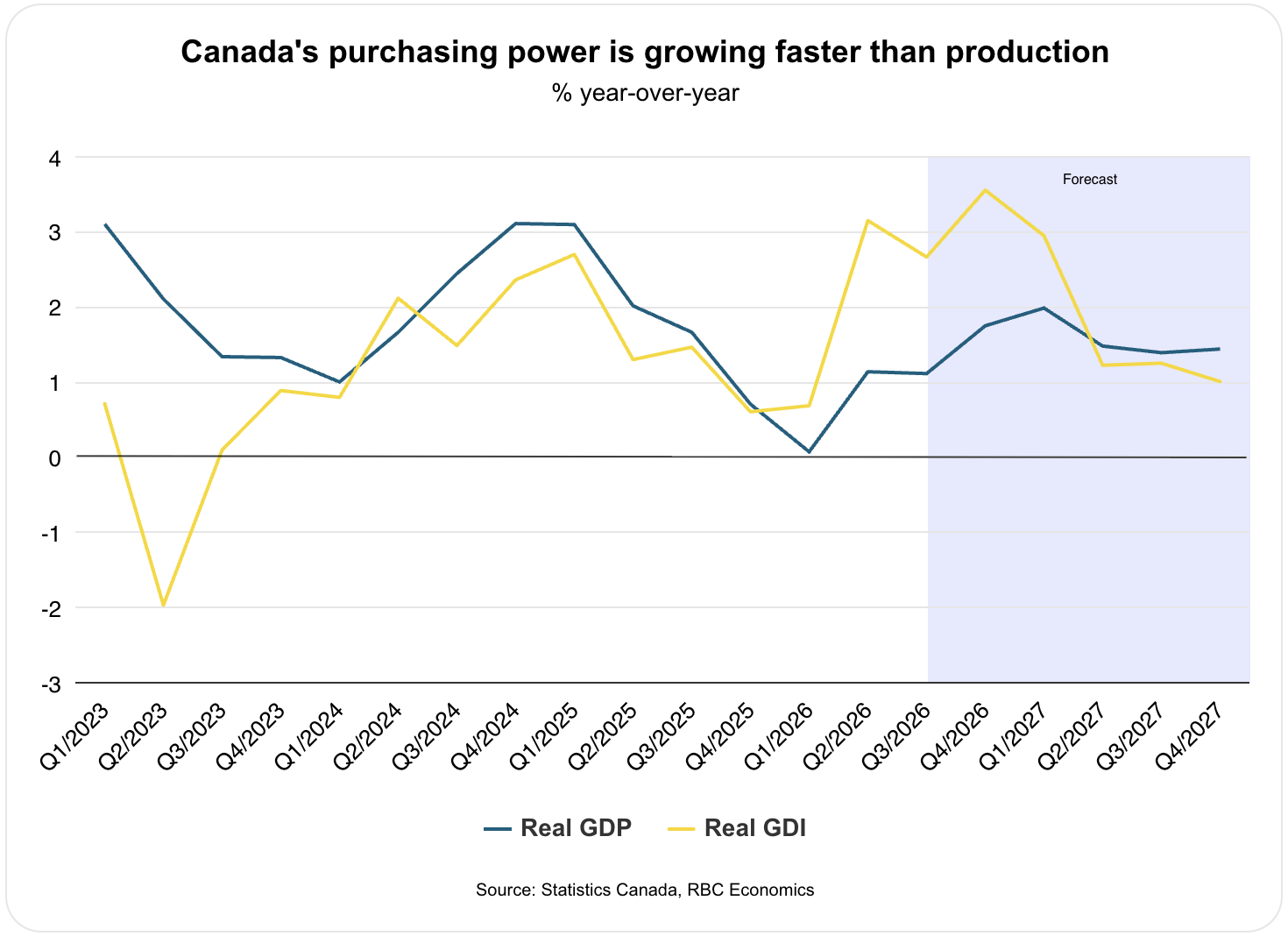
Canada’s purchasing power is growing faster than production
Often-quoted real gross domestic product measures the volume of goods and services produced in Canada, but production isn’t the end goal. The final purpose of production is ultimately to fund consumption.
For an economy like Canada’s that trades a lot with the world, the amount of consumption/investment by consumers, governments, and businesses that can be purchased from the sale of production is significantly impacted by the price of exports relative to the cost of imports (i.e. the terms of trade).
When export prices rise faster than import prices, the income generated from the sale of a given amount of Canadian production can purchase more goods and services abroad. That added purchasing power is captured in growth in real gross domestic income (real GDI).
Put simply, real GDP answers how much Canada produced. Real GDI gets closer to answering how much that production can actually buy.
That distinction has become increasingly important (and visible) in the current data as conflict in the Middle East sent oil prices soaring, raising costs for Canadian households, but also increasing the value of a key export.
Real GDP growth in Canada bounced back strongly in Q2 after softening over the winter, rising 1.1% above a year ago. But, growth in the purchasing power of that GDP (real GDI) grew almost three times as quickly, climbing 3.1% year-over-year.
The income windfall is not distributed evenly
However, since oil revenues are heavily concentrated in oil producing regions, higher real GDI does not mean every Canadian household receives a boost.
As of Q2, a 46%1 surge in oil prices coincided with roughly a $12 billion per quarter year-over-year boost from Canada’s terms of trade, increasing the purchasing power of exports.
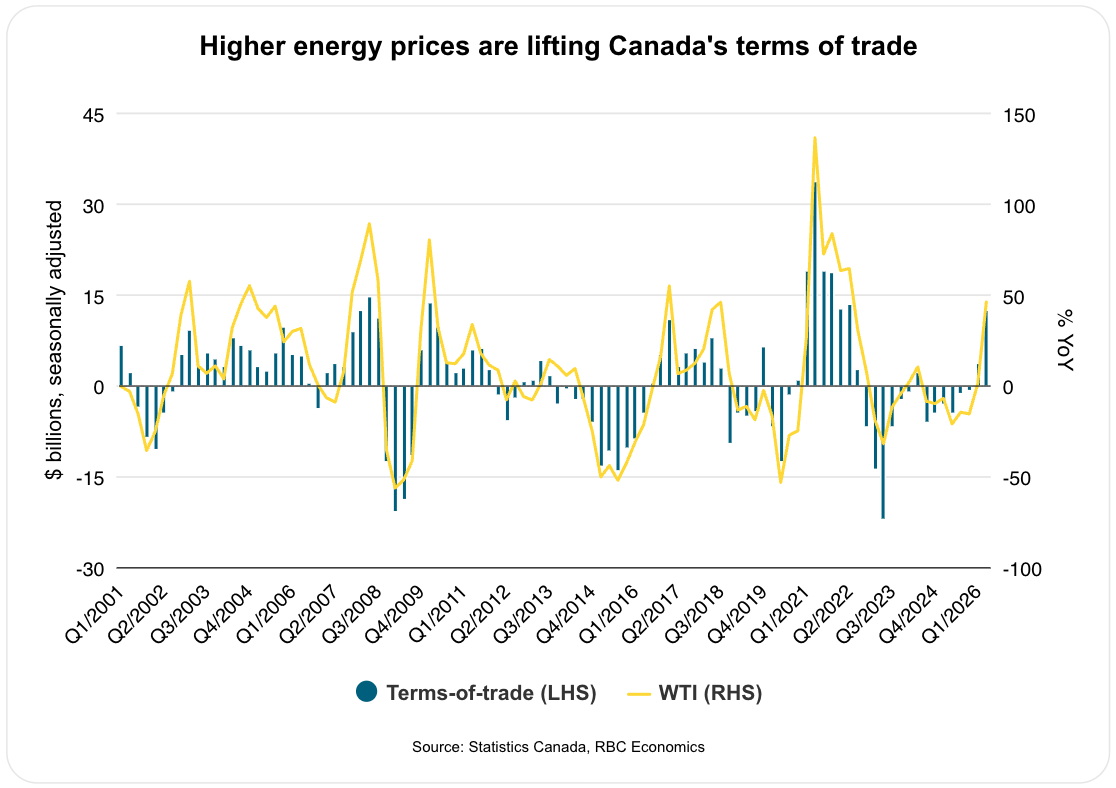
The first-round recipients of higher energy export prices are primarily higher profits for oil producers (and their shareholders).
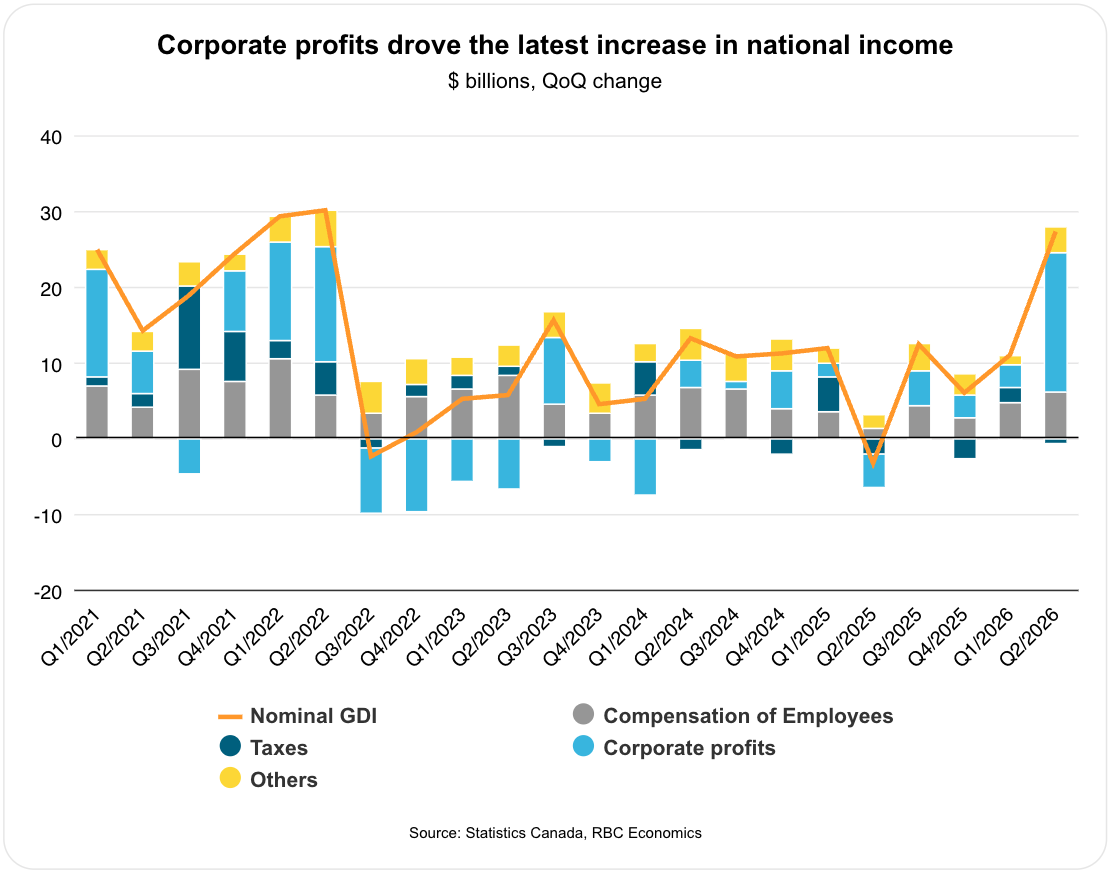
Corporate profits accounted for the bulk of the increase in national income in Q2, rising by roughly $18 billion from the previous quarter. Industry level data reinforces that story with oil and gas extraction accounting for nearly 30% of the increase in net income across non-financial industries.
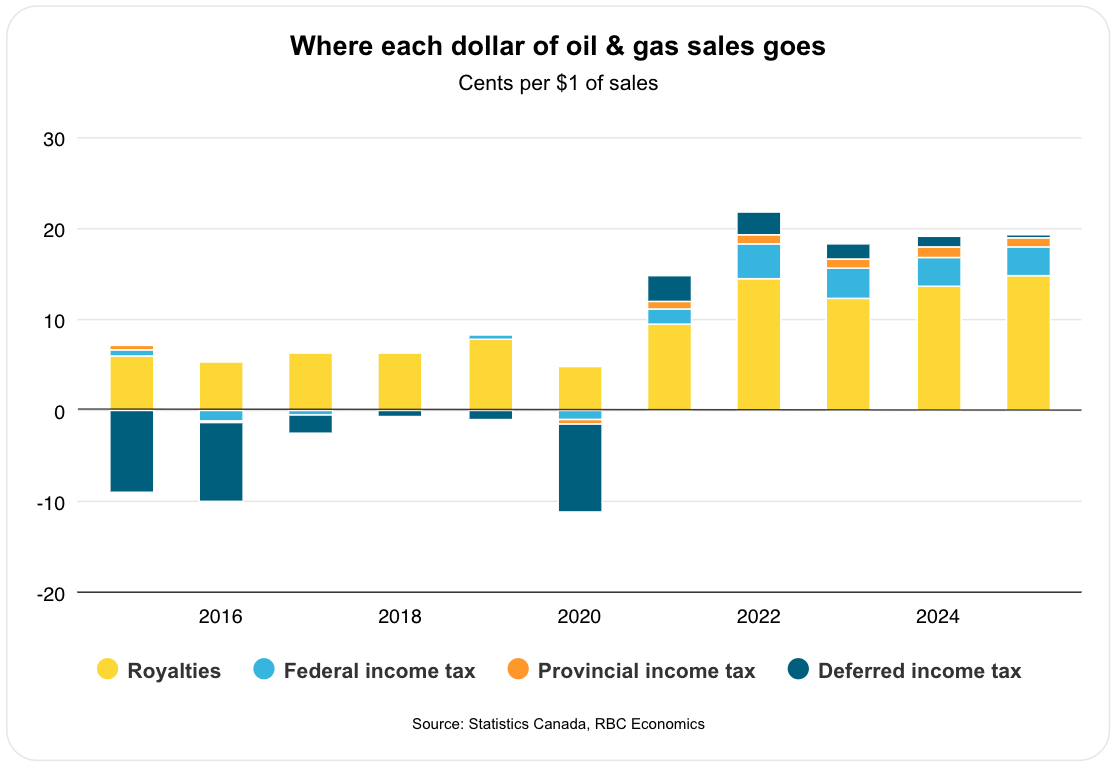
Oil revenues then flow more broadly across the economy as taxes/royalties are paid to governments and redistributed either through increased spending or lower taxes (or reducing fiscal debt burdens). But, those revenue increases are heavily concentrated in the provincial government.
Overall, out of every dollar of oil and gas revenue, roughly 15 cents were paid out to provincial governments in natural resource royalties. Then, 1 cent (as of 2025) was paid to provincial governments via corporate income taxes, and another 3 cents went to federal corporate income taxes.
That means a lot of the first/second round distribution of income from higher oil prices is concentrated in oil exporting regions.
For most Canadian households, particularly in net oil importing provinces, higher oil prices just make purchases more expensive. Households spent an estimated $2.6 billion more on motor fuel in Q2 2026 than a year ago (about $150 per household) to buy 3% less fuel.
What does this mean for interest rates?
That distinction also matters for monetary policy. High oil prices impact different parts of the country very differently, but the BoC only controls one interest rate.
The central bank’s core mandate is to hit a 2% inflation target over time, while government spending/tax policy is better suited to address different regional economic conditions.
Overall, the net impact of higher oil prices on the Canadian economy is likely neutral to slightly positive from a growth perspective with large but narrowly concentrated revenue increases offset by broadly base increased costs for most households.
And the longer energy prices remain high, the greater the risk of spillover into broader inflation pressures as global supply chain pressures build.
Our base case forecast remains that the BoC will hold rates through the end of 2026 before beginning gradual hikes in early 2027 as strengthening domestic demand closes the economy’s spare capacity, and not simply because oil prices are elevated.
Risks would tilt toward earlier tightening if higher energy prices began feeding more broadly into inflation at the same time that domestic growth continues to improve.
About the authors:
Nathan Janzen is an Assistant Chief Economist, leading the macroeconomic analysis group. His focus is on analysis and forecasting macroeconomic developments in Canada and the United States.
Abbey Xu is an economist at RBC. She is a member of the macroeconomic analysis group, focusing on macroeconomic forecasting models and providing timely analysis and updates on economic trends.
- Not all Canadian oil prices have increased by the same amount. Heavy Canadian crude (WCS) prices have risen by less, but were still up almost 40% from a year ago in Q2 and synthetic Canadian light oil prices were up 50%. ↩︎
This article is intended as general information only and is not to be relied upon as constituting legal, financial or other professional advice. The reader is solely liable for any use of the information contained in this document and Royal Bank of Canada (“RBC”) nor any of its affiliates nor any of their respective directors, officers, employees or agents shall be held responsible for any direct or indirect damages arising from the use of this document by the reader. A professional advisor should be consulted regarding your specific situation. Information presented is believed to be factual and up-to-date but we do not guarantee its accuracy and it should not be regarded as a complete analysis of the subjects discussed. All expressions of opinion reflect the judgment of the authors as of the date of publication and are subject to change. No endorsement of any third parties or their advice, opinions, information, products or services is expressly given or implied by Royal Bank of Canada or any of its affiliates.
This document may contain forward-looking statements within the meaning of certain securities laws, which are subject to RBC’s caution regarding forward-looking statements. ESG (including climate) metrics, data and other information contained on this website are or may be based on assumptions, estimates and judgements. For cautionary statements relating to the information on this website, refer to the “Caution regarding forward-looking statements” and the “Important notice regarding this document” sections in our latest climate report or sustainability report, available at: https://www.rbc.com/community-social-impact/reporting-performance/index.html. Except as required by law, none of RBC nor any of its affiliates undertake to update any information in this document.

