

 EN
EN 


For week of Sept. 28
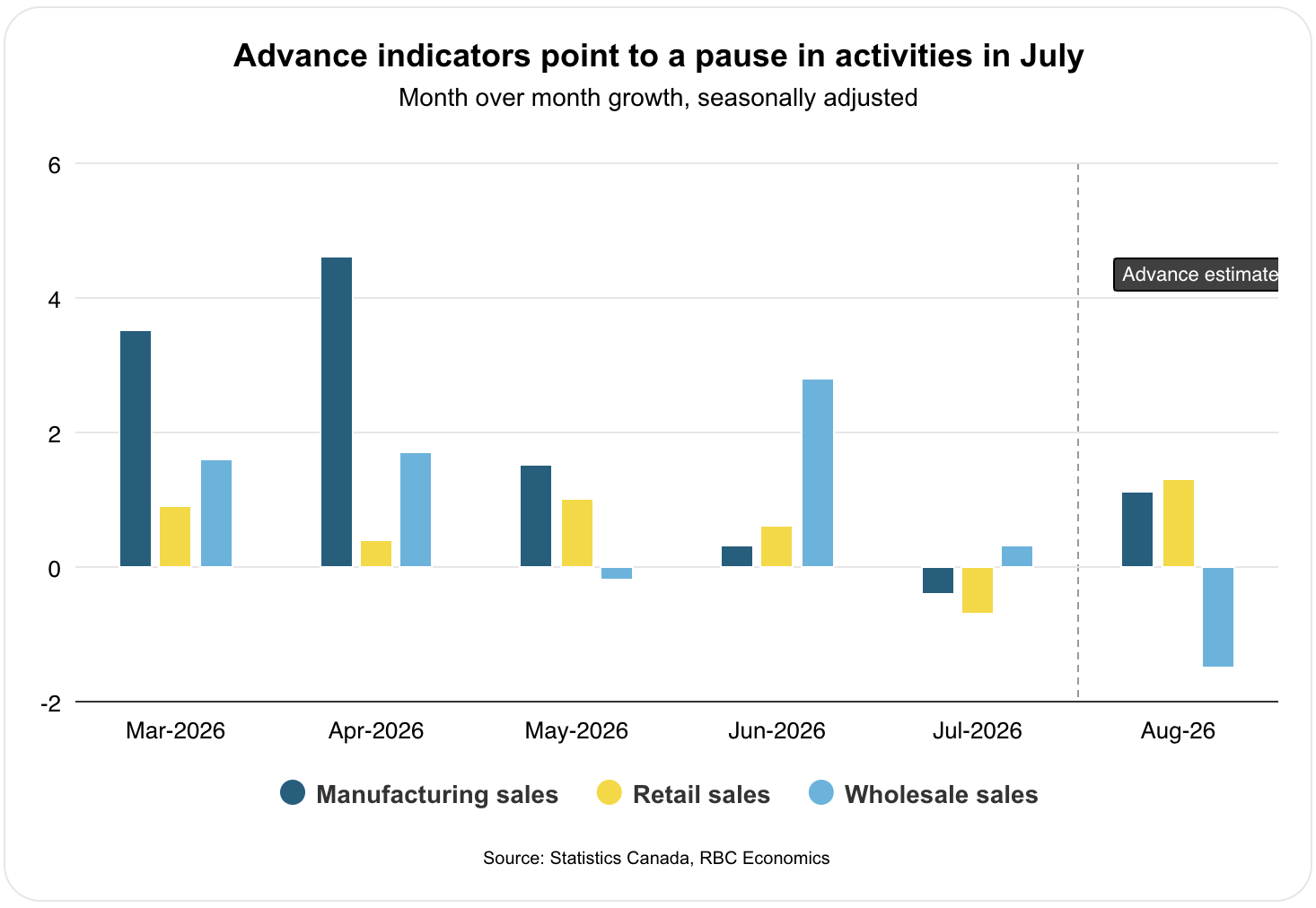
Early industry data suggests the Canadian economy stalled in July, following stronger monthly gains in real gross domestic product from April to June that averaged 0.4%.
July’s manufacturing, wholesale and retail sales data all point to declines in shipments, although manufacturing GDP was likely near flat as weakness was concentrated in petroleum and auto. These sectors are overweighted in sales data relative to their contribution to domestic production.
Oil and gas output likely held steady as rising non-conventional extraction in Alberta offset lower drilling. Housing rebounded in July, supporting another increase in real estate and rental services GDP, though momentum likely waned in August as rising trade tensions dampened buyer confidence.
A preliminary take of August’s GDP should reveal how the economy fared, as trade talks with the United States collapsed, and the U.S. imposed 50% tariffs on 5% of imports from Canada on Aug. 22.
The economy is still on track for more recovery in Q3
Flat real GDP in July poses downside risk to our Q3 tracking estimate of 1.8% annualized growth. Still, other data are flagging resilience. Hours worked continued to rise strongly in August (up 0.6%), job openings held relatively firm through mid-September, and our tracking of RBC card transactions and advance August retail sales data (up 1.3%) also suggest consumer resilience late in Q3.
Similar to the Bank of Canada, we expect new tariffs imposed in August will have significant, but narrow effects on the small share of Canadian exports targeted. They may have also driven a rush in pre-tariff shipments to the U.S. before Aug. 22 that will have added to growth volatility in Q3.
BoC watching growth data closely ahead of October interest rate decision
Strong GDP growth in Q2 is unlikely to be repeated to the same extent in the second half of the year, as trade tensions brew. The Bank of Canada flagged new U.S. tariffs could halve GDP growth to under 1% (annualized) in Q4.
Additional government funding support to companies and workers affected by trade disruptions should provide an offset, and help contain the broader economic damage. They are more effective at addressing targeted supply shocks over a blunt tool like interest rates.
While the central bank watches for growth risks, they have also become increasingly focused on the potential need to stay ahead of any spreading in (so far well contained) broader inflation pressures from elevated global oil prices and historically wide refinery margins.
Our base case forecast for now remains that the central bank will hold interest rates in the near term before hiking gradually beginning in early 2027. Incoming data will matter for the October decision, with communications from the BoC continuing to suggest it will be a close call.
-
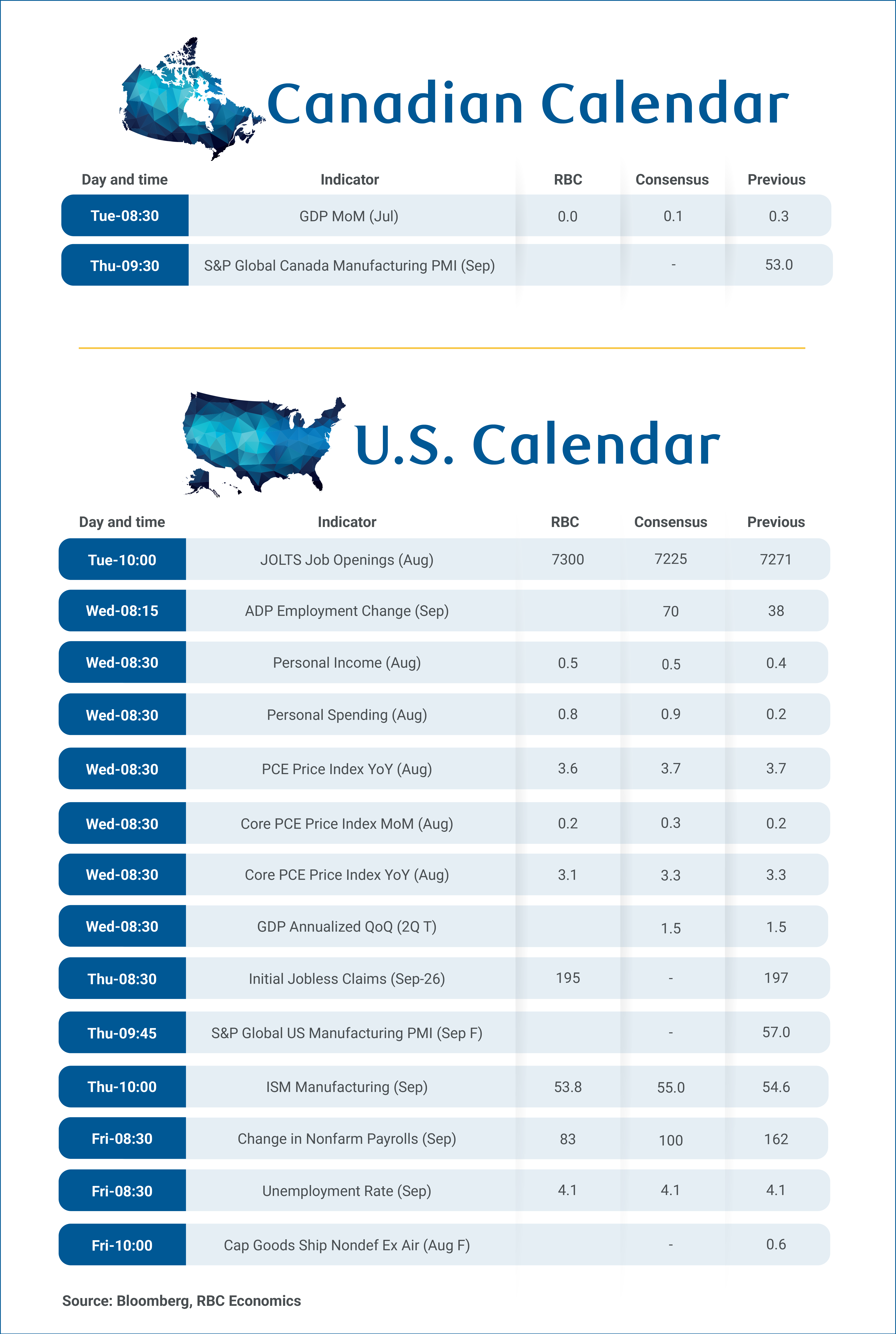
U.S. labour markets are expected to have remained tight in September, with the unemployment rate holding at historically low levels after edging down to 4.1% (the lowest since June 2025) in July and August. Employment growth is unlikely to repeat the magnitude of the surprisingly firm 162k increase in August (boosted in part by challenges seasonally adjusting local government education hiring over the summer.) But layoffs remain low and high rates of worker retirement as the population ages and immigration curbs are also weighing on labour supply.
About the authors:
Nathan Janzen is an Assistant Chief Economist, leading the macroeconomic analysis group. His focus is on analysis and forecasting macroeconomic developments in Canada and the United States.
Claire Fan is a Senior Economist at RBC. She focuses on macroeconomic analysis and is responsible for projecting key indicators including GDP, employment and inflation for Canada and the US.
Explore the latest from RBC Economics:
Revised numbers point to positive population growth in Canada
More clues on the state of Canada’s economy in Q3 on deck
Canada’s economy gains ground despite trade and energy headwinds
Share these insights with your network:
This article is intended as general information only and is not to be relied upon as constituting legal, financial or other professional advice. The reader is solely liable for any use of the information contained in this document and Royal Bank of Canada (“RBC”) nor any of its affiliates nor any of their respective directors, officers, employees or agents shall be held responsible for any direct or indirect damages arising from the use of this document by the reader. A professional advisor should be consulted regarding your specific situation. Information presented is believed to be factual and up-to-date but we do not guarantee its accuracy and it should not be regarded as a complete analysis of the subjects discussed. All expressions of opinion reflect the judgment of the authors as of the date of publication and are subject to change. No endorsement of any third parties or their advice, opinions, information, products or services is expressly given or implied by Royal Bank of Canada or any of its affiliates.
This document may contain forward-looking statements within the meaning of certain securities laws, which are subject to RBC’s caution regarding forward-looking statements. ESG (including climate) metrics, data and other information contained on this website are or may be based on assumptions, estimates and judgements. For cautionary statements relating to the information on this website, refer to the “Caution regarding forward-looking statements” and the “Important notice regarding this document” sections in our latest climate report or sustainability report, available at: https://www.rbc.com/community-social-impact/reporting-performance/index.html. Except as required by law, none of RBC nor any of its affiliates undertake to update any information in this document.

