

 EN
EN 


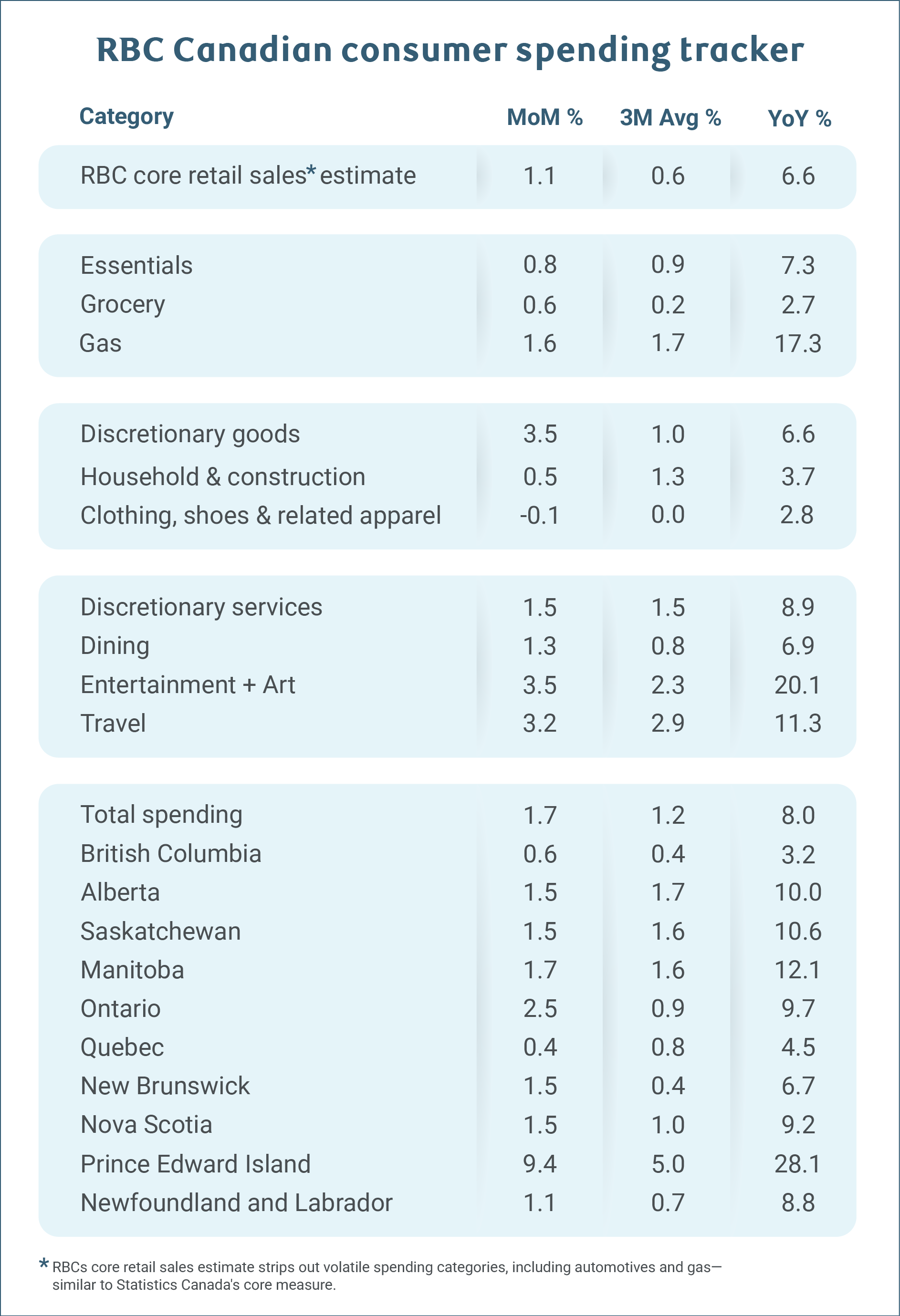
August spending snapshot: RBC Canadian cardholder spending remained on a positive trajectory with growth broadening across major spending categories. Our estimate of core retail sales rose 0.6% on a three-month average, building on July’s 0.5% gain.
Discretionary services continued to lead spending growth, supported by solid gains in travel, entertainment and arts. Discretionary goods spending also improved, while essentials spending remained firm, although gasoline continued to account for an outsized share of the increase.
The latest card transactions data suggests household demand remained resilient heading into Q3. Spending patterns stayed uneven across categories, but continued gains across goods and services are consistent with a gradual recovery in domestic demand.
Elevated trade uncertainty continues to pose downside risks in specific sectors/regions impacted by U.S. tariffs, but most exports continue to cross the border duty free, limiting the impact on broader aggregate growth and spending trends.
The details:
-
Discretionary services remained the strongest major spending category, rising 1.5% on a three-month average. Travel spending led at 2.9%, while entertainment and arts spending rose 2.3%. Dining spending was also positive, increasing 0.8%.
-
Essentials spending remained firm, rising 0.9% on a three-month average. Gasoline spending continued to account for a significant share of the increase, rising 1.7% despite a tick lower in gasoline prices in the month, while grocery spending grew at a more modest 0.2% pace.
-
Discretionary goods spending improved, rising 1% on a three-month average. Household and construction-related spending remained relatively strong at 1.3%, consistent with the gradual improvement in housing activity from soft levels. Clothing, shoes and related apparel spending, however, was essentially flat.
-
Regional spending growth remained uneven. Prince Edward Island recorded the strongest increase, while Alberta, Saskatchewan and Manitoba also posted relatively strong gains. Growth was more moderate in Ontario, Quebec and British Columbia.
About the authors:
Abbey Xu is an economist at RBC. She is a member of the macroeconomic analysis group, focusing on macroeconomic forecasting models and providing timely analysis and updates on economic trends.
Rachel Battaglia is an economist at RBC, providing forecasts for the Canadian provincial economies and analyzing key trends in housing and consumer spending.
Read more from RBC Economics:
Canadian cardholder spending holds up but momentum eases
Q2 Canadian consumer signals: Spending on fuel overshadowed purchases by sports fans
June spending holds steady as Canadians balance essentials and experiences
By Carrie Freestone
RBC’s consumer spending tracking report uses RBC Data & Analytics’ proprietary database of anonymized card transactions by Canadian clients. The data are an accounting of merchant transactions that are divided into various spending categories covering tens of millions of weekly card transactions worth billions of dollars each week. Transactions, both in person and online, are classified into 11 broad spending groups: Dining, Education, Finances, Groceries, Health, Household, Shopping, Transport, Travel, Utilities, and Other. Within each group, the data are further classified: for example, shopping covers merchants classified as clothing stores, hobby shops, electronics stores, and jewelers, among others. We exclude purely financial transactions such as cash advances and insurance from spending.
We examined changes in the value of all transactions in these areas using a 7 day rolling sample starting January 1st of each year that is indexed to pre-covid levels which are calculated as the average spending for the month of February 2020. To examine the impact of seasonal factors, we also show each’s year spending profile which depicts monthly trends in spending. Online spending volumes are estimated based on the presence of an RBC card at the time of the authorization.
Protecting your privacy and safeguarding your personal information is a cornerstone of our organizational ethics and values and will always be one of our highest priorities. The underlying data for this analysis was aggregated based on transaction date, region and merchant category, and cannot be used to identify any individual client or merchant. For additional information please visit www.rbc.com/privacy.
This article is intended as general information only and is not to be relied upon as constituting legal, financial or other professional advice. The reader is solely liable for any use of the information contained in this document and Royal Bank of Canada (“RBC”) nor any of its affiliates nor any of their respective directors, officers, employees or agents shall be held responsible for any direct or indirect damages arising from the use of this document by the reader. A professional advisor should be consulted regarding your specific situation. Information presented is believed to be factual and up-to-date but we do not guarantee its accuracy and it should not be regarded as a complete analysis of the subjects discussed. All expressions of opinion reflect the judgment of the authors as of the date of publication and are subject to change. No endorsement of any third parties or their advice, opinions, information, products or services is expressly given or implied by Royal Bank of Canada or any of its affiliates.
This document may contain forward-looking statements within the meaning of certain securities laws, which are subject to RBC’s caution regarding forward-looking statements. ESG (including climate) metrics, data and other information contained on this website are or may be based on assumptions, estimates and judgements. For cautionary statements relating to the information on this website, refer to the “Caution regarding forward-looking statements” and the “Important notice regarding this document” sections in our latest climate report or sustainability report, available at: https://www.rbc.com/community-social-impact/reporting-performance/index.html. Except as required by law, none of RBC nor any of its affiliates undertake to update any information in this document.

