

 EN
EN 


The Federal Reserve has hiked interest rates by 25 bps for the first time since July 2023, stating, “My commitment in June was to reaffirm…that we will deliver price stability…Today’s action starts to show we are serious about this.” The culmination of this meeting’s communication – the FOMC statement, the Summary of Economic Projections and Fed Chair Warsh’s press conference suggest the Fed is considering additional hikes. The SEP showed sixteen committee members expect another rate increase in 2026, reinforcing the hawkish lean. Also, within the SEP, the PCE inflation and GDP growth projections were revised higher while the unemployment rate was marked lower, painting a picture skewed towards inflationary risk.
There are three key questions for the Fed, markets, and economists are:
-
Will this hiking cycle be an effective treatment for inflation that is being driven by supply shocks?
-
Could the increase in interest rates lead to a drag on growth?
-
What trends does the Fed need to see for them to go on pause again?
Chair Warsh, unsurprisingly, provided no forward guidance, but he did outline three key developments that occurred over the past seven weeks to initiate the hike:
-
A wide range of data, including labor market data, signaled that the economy has strengthened.
-
Inflation trends through the summer “weren’t passing the test.”
-
The geopolitical situation has changed for the worse.
Our expectation is for two additional hikes in 2026, fully reversing the 2025 “insurance” cuts. Chair Warsh emphasized that he would be “hard-pressed to consider conditions restrictive” and that current conditions allowed the Fed to remove “a dose of accommodation.”
We acknowledge that three rate hikes are unlikely to meaningfully move the dial on what is primarily supply-driven inflation. However, it may cause some unpleasant side effects on lower-and-middle-income consumers who have already been weakened by high energy prices, reduced savings and a rising debt burden.
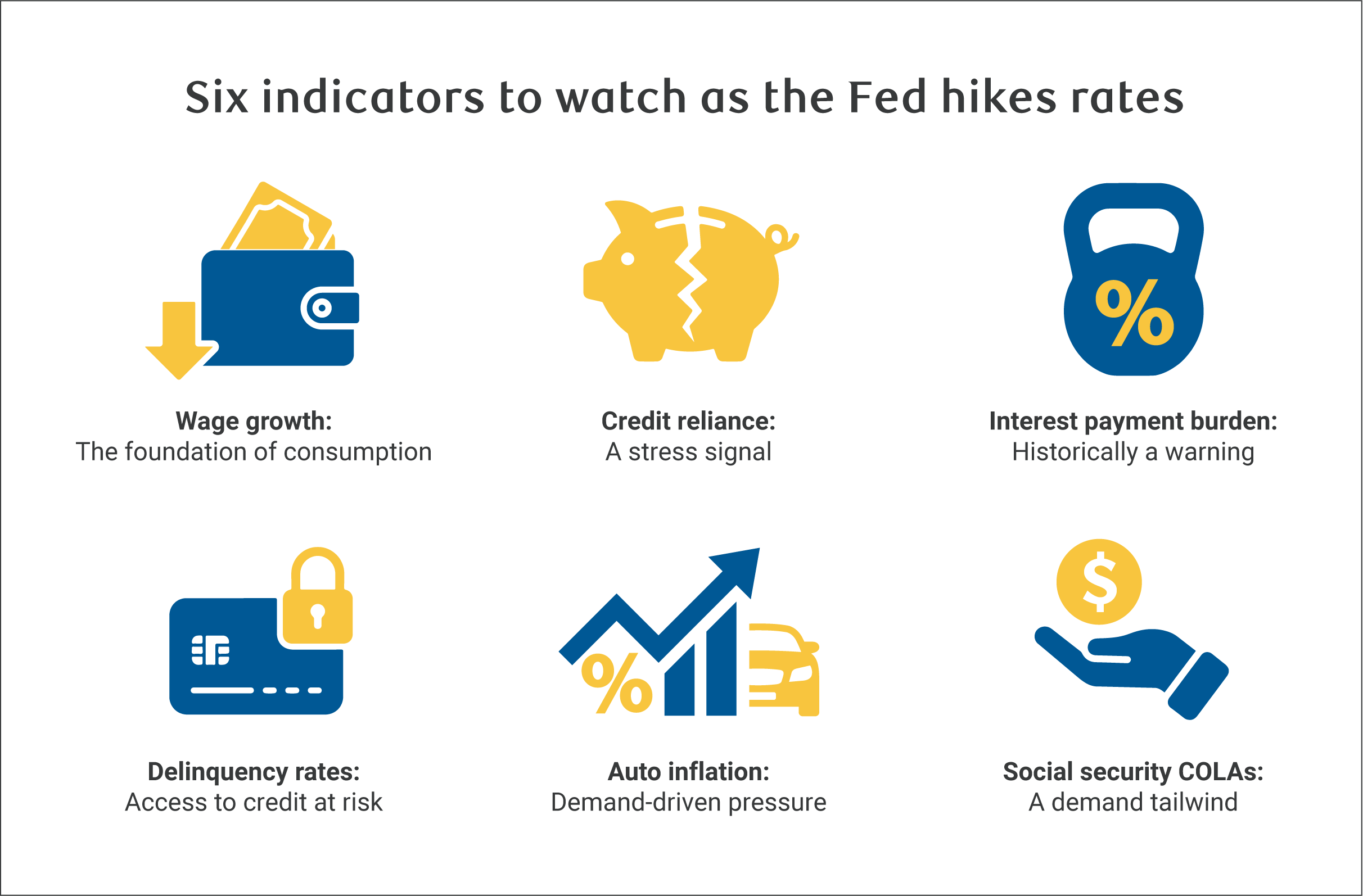
How far the Fed will want and need to go will depend on a range of data and events, including fluctuating oil prices and oscillating tariff policies. A particularly uncertain macro backdrop necessitates keeping a close watch on some key indicators. Here are six indicators we will be monitoring in the months ahead:
1) Wage growth vs. inflation: The foundation of consumption
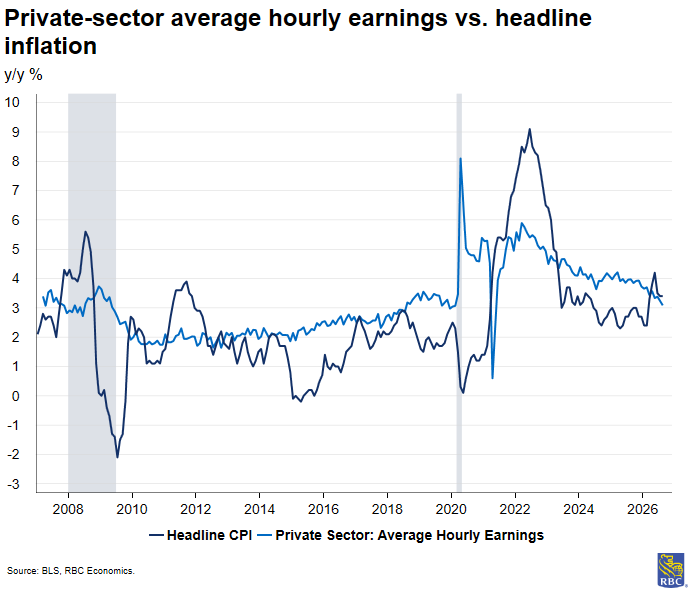
Private-sector wage growth has failed to keep pace with inflation since April, creating negative real wage growth that threatens consumer spending. Wages account for 50% of personal income, so this gap matters. While disposable personal income has grown 4.2% year over year, this masks a troubling distribution: high earners benefit from rising interest income as the Fed hikes rates, while lower- and middle-income households face real wage declines. If inflation continues outpacing wage growth, this raises the question of whether higher personal interest income at the top can offset demand destruction from real wage declines at the bottom.
2) Credit reliance: A stress signal
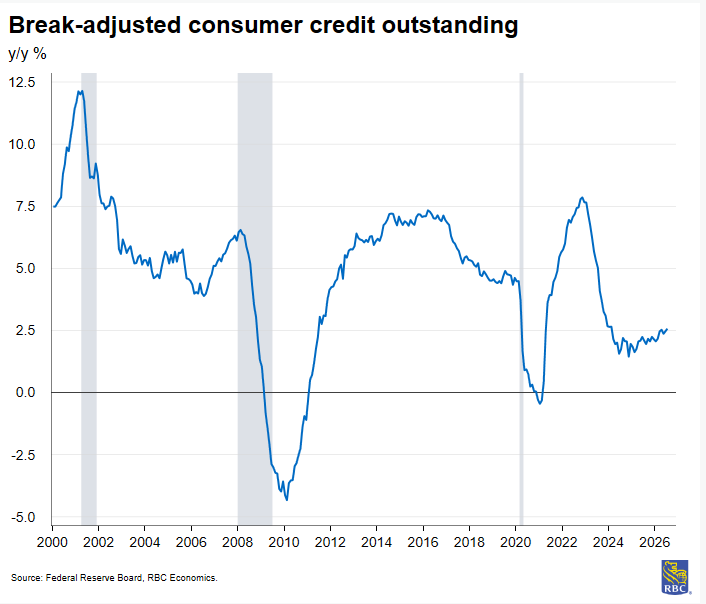
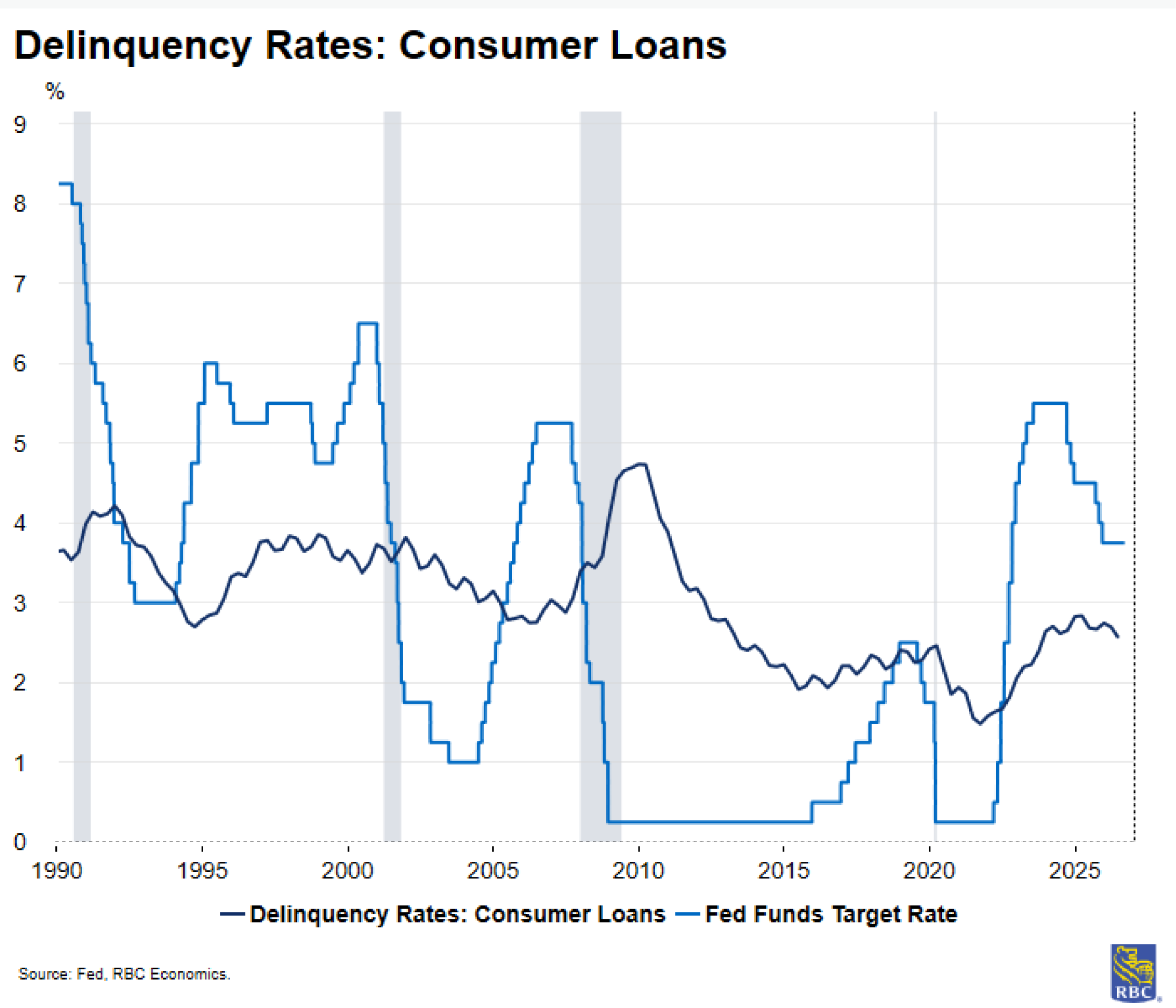
Households are saving less and borrowing more to sustain spending. Revolving credit utilization—credit cards and home equity lines—has risen 4% year over year, while non-revolving loans (auto, student, personal) have also climbed. This shift signals growing consumer stress even before Fed hikes. Historically, negative real wage growth triggers increased consumer loan activity. Delinquency rates have already normalized; if consumers become more dependent on credit during a Fed hiking cycle, we should expect delinquencies to rise alongside the interest rate burden.
3) Interest payment burden: Historically a slowdown/recession warning
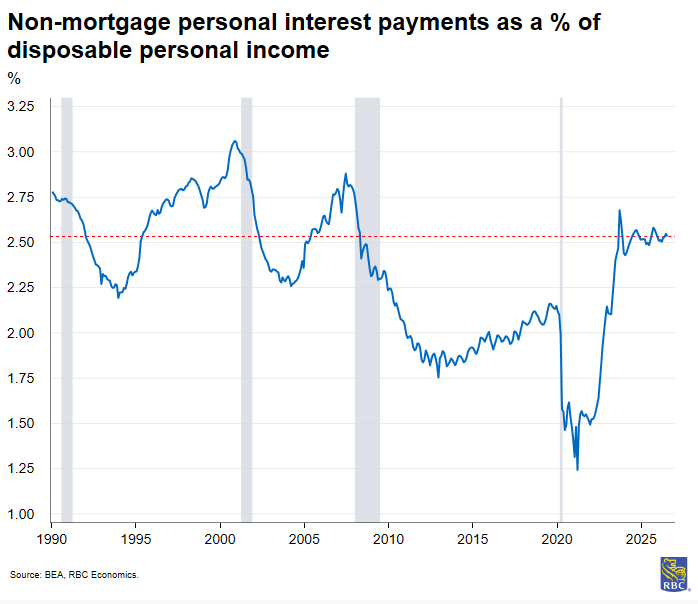
Non-mortgage personal interest payments now consume 2.5% of disposable income—alarmingly close to the 2.8% threshold that preceded the three pre-COVID recessions. What’s more concerning: this burden has remained flat despite 125 basis points of Fed cuts in 2024–2025, suggesting consumers are already heavily leveraged. If the Fed hikes rates, the burden will flow quickly through credit cards, auto loans, and other consumer lending, pushing closer to recessionary levels. Consumers will face a stark choice: cut spending or deplete already-low savings.
4) Delinquency rates: Access to credit a risk
Commercial bank loan delinquencies sit at 2.6%, with credit cards at 2.9% and auto loans trending higher. More concerning is the recent spike in delinquencies 120+ days late or in derogatory status — repossessions, charge-offs, and foreclosures. Residential loan delinquencies, by contrast, remain modest at 1.9%, a reflection of the K-shaped economy where lower- and middle-income consumers are relying more heavily on credit and struggling to make payments. Once consumers enter derogatory status, they lose credit access entirely, which could weigh significantly on consumption.
5) Auto inflation: Demand-driven pressure
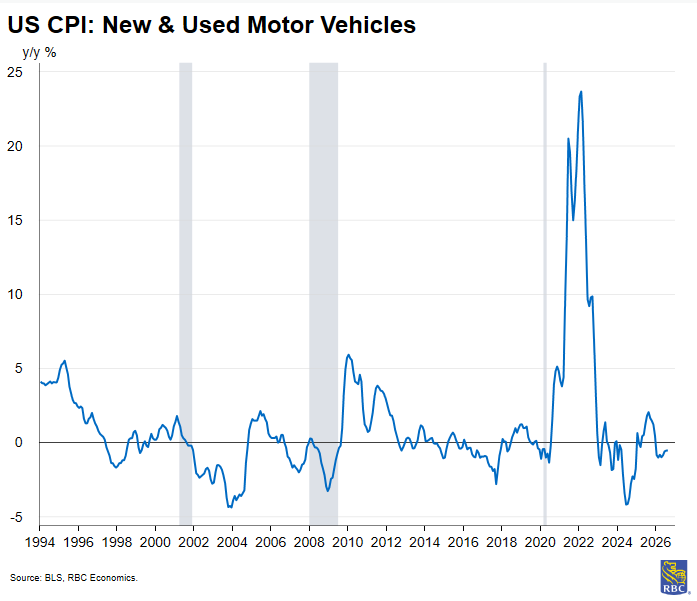
The auto sector remains one of the few inflation categories sensitive to consumer demand. Price pressures persist, and tariffs will add upward force. The critical question: will higher rates cool auto demand enough to ease price pressures, or will tariff-driven costs keep them elevated regardless? This matters because auto inflation doesn’t stay isolated. During COVID-19, maintenance, repair, and insurance costs lagged auto price spikes by roughly a year. A similar pattern could broaden the inflation impulse.
6) Social security COLAs: A demand tailwind
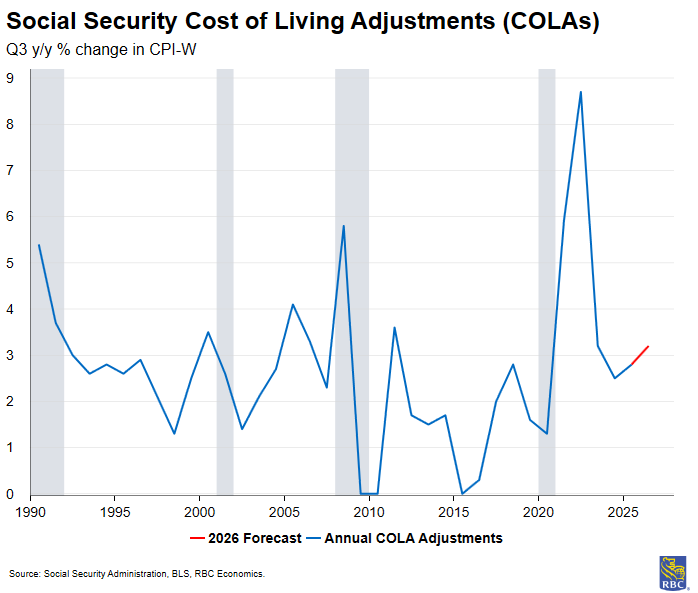
The 2027 Social Security cost-of-living adjustment (COLA)—calculated from Q3 2026 CPI-W data—is expected to reach 3.5%, benefiting 70 million retirees. Transfer income now represents just under 20% of total personal income. If inflation cools in 2027 while elevated transfer payments persist, COLAs themselves could become a source of demand-driven inflation pressure, creating an unusual dynamic where benefits meant to support retirees fuel broader price increases.
Honorable mention: Housing remains in a deep freeze
Housing will likely represent a drag on growth as affordability remains a key hurdle. As mortgage rates rise, this disincentivizes would-be buyers from entering into the market and discourages existing homeowners from moving. Since housing affordability has drastically deteriorated, we see little prospect for growth stemming from residential investment. And, if anything, rate hikes will make the situation worse.
About the authors:
Frances Donald is the Chief Economist at RBC and oversees a team of leading professionals, who deliver economic analyses and insights to inform RBC clients around the globe. Frances is a key expert on economic issues and is highly sought after by clients, government leaders, policy makers, and media in the U.S. and Canada.
Mike Reid is Head of US Economics at RBC. He is responsible for generating RBC’s US economic outlook, providing commentary on macro indicators, and producing written analysis around the economic backdrop.
Carrie Freestone is a Senior US Economist at RBC. She is responsible for generating RBC’s US economic forecasts across GDP, employment, and inflation, and providing macro commentary through publications, presentations, and the media.
Imri Haggin is an US Economist at RBC, where he focuses on thematic research. His prior work has centered on consumer credit dynamics and treasury modeling, with an emphasis on leveraging data to understand behavior.
This article is intended as general information only and is not to be relied upon as constituting legal, financial or other professional advice. The reader is solely liable for any use of the information contained in this document and Royal Bank of Canada (“RBC”) nor any of its affiliates nor any of their respective directors, officers, employees or agents shall be held responsible for any direct or indirect damages arising from the use of this document by the reader. A professional advisor should be consulted regarding your specific situation. Information presented is believed to be factual and up-to-date but we do not guarantee its accuracy and it should not be regarded as a complete analysis of the subjects discussed. All expressions of opinion reflect the judgment of the authors as of the date of publication and are subject to change. No endorsement of any third parties or their advice, opinions, information, products or services is expressly given or implied by Royal Bank of Canada or any of its affiliates.
This document may contain forward-looking statements within the meaning of certain securities laws, which are subject to RBC’s caution regarding forward-looking statements. ESG (including climate) metrics, data and other information contained on this website are or may be based on assumptions, estimates and judgements. For cautionary statements relating to the information on this website, refer to the “Caution regarding forward-looking statements” and the “Important notice regarding this document” sections in our latest climate report or sustainability report, available at: https://www.rbc.com/community-social-impact/reporting-performance/index.html. Except as required by law, none of RBC nor any of its affiliates undertake to update any information in this document.

