

 EN
EN 


Bottom Line:
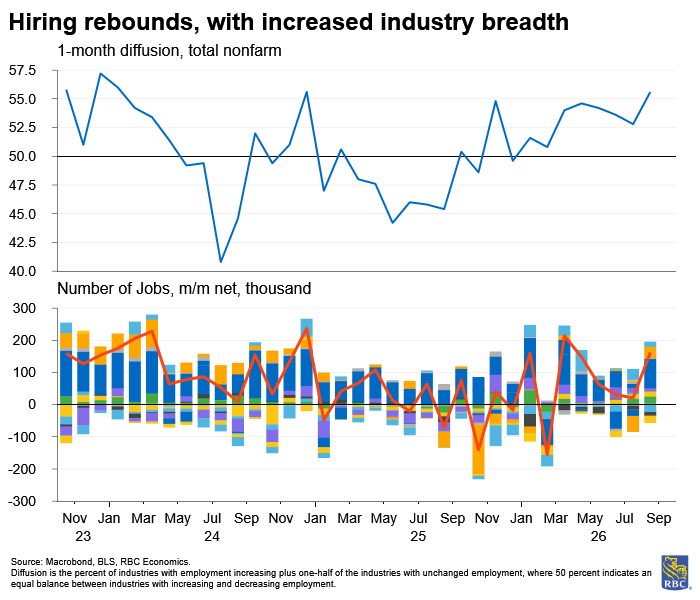
The US labor market is solid. We have been consistent in our view that the labor market is tight and even when faced with cyclical weakness, structural forces would keep the unemployment rate from rising meaningfully. The August employment report shows resilience and growth continue despite the headwinds (tariffs, energy, etc.) – and importantly cyclical strength is broadening out beyond a narrow set of industries (i.e., health care and leisure & hospitality). The underlying details are encouraging and show no signs of demand slowing:
-
the aggregate hours index is accelerating on a y/y basis,
-
broader measures of labor slack sit near all-time lows (i.e. U6 unemployment),
-
layoffs are exceptionally low,
-
and the share of workers who are part-time for economic reasons (i.e. those who want to work more but cannot) sits at 2.7%, near the all-time low of 2.3% seen in 2000.
This is a labor market that shares more similarities with the late 90s economy than the post-GFC period and it’s going to take more than a summer slowdown to throw it off course.
Encouragingly, the revision to July (+21K from a previous decline of -23K) suggests the concern over weakness was overstated. And that’s significant given the “typical” seasonal weakness we have witnessed in the summers of the past few years. But more revisions are a reminder of volatility and frequent revisions that should encourage monitoring trends over individual prints.
It’s worth noting that the preliminary benchmark revisions, while negative, were rather modest on a monthly basis, meaning we have greater confidence in the strength of this data compared to prior years. And this tightness is reflected in the unemployment rate holding steady – at 4.1% the unemployment rate is lower than 80% of all monthly readings going back to 1948. We maintain our view that the labor market will stay tight through year-end and will change little in 2027. What this means for the Fed is that their focus should remain on the inflation backdrop.
The August report was exceptionally strong
The August employment report posted a massive upside (+162K), including upward revisions to July (+21K from a previous decline of -23K), and a steady unemployment rate at 4.1%. The labor force participation ticked up to 61.6% from 61.4%.
The upside to nonfarm payrolls was primarily driven by a few sectors. Leisure and hospitality (+62K) retraced a sizeable share of jobs shed over the past two months, local government hiring ramped up in the education sector ahead of back-to-school (+33K), and health care & social assistance contributed meaningfully (+28K), as expected. Excluding these sectors, payroll gains were more modest but still sizeable. The two sectors that shed jobs were financial services and information.
The household survey data is the more interesting part of this report. This month’s jump in participation was driven by non-prime age workers. Older adults (aged 55+) accounted for half of the increase in the labor force, and the other half were youth under the age of 25. The number of unemployed job seekers ticked up, but at a slower pace than the growth in the size of the labor force – enough to keep the unemployment rate anchored. And looking at flows into employment, there were significantly more workers who found a job from out of the labor force than those who were previously unemployed, which suggests a short (less than one-month) job search timeline. Also interesting was the fact that there were twice as many quits as layoffs in August. But this could likely be explained by students leaving summer employment and returning to school.
About the authors:
Mike Reid is Head of US Economics at RBC. He is responsible for generating RBC’s U.S. economic outlook, providing commentary on macro indicators, and producing written analysis around the economic backdrop.
Carrie Freestone is a Senior US Economist at RBC. She is responsible for generating RBC’s US economic forecasts across GDP, employment, and inflation, and providing macro commentary through publications, presentations, and the media.
Imri Haggin is an US Economist at RBC, where he focuses on thematic research. His prior work has centered on consumer credit dynamics and treasury modeling, with an emphasis on leveraging data to understand behavior.
This article is intended as general information only and is not to be relied upon as constituting legal, financial or other professional advice. The reader is solely liable for any use of the information contained in this document and Royal Bank of Canada (“RBC”) nor any of its affiliates nor any of their respective directors, officers, employees or agents shall be held responsible for any direct or indirect damages arising from the use of this document by the reader. A professional advisor should be consulted regarding your specific situation. Information presented is believed to be factual and up-to-date but we do not guarantee its accuracy and it should not be regarded as a complete analysis of the subjects discussed. All expressions of opinion reflect the judgment of the authors as of the date of publication and are subject to change. No endorsement of any third parties or their advice, opinions, information, products or services is expressly given or implied by Royal Bank of Canada or any of its affiliates.
This document may contain forward-looking statements within the meaning of certain securities laws, which are subject to RBC’s caution regarding forward-looking statements. ESG (including climate) metrics, data and other information contained on this website are or may be based on assumptions, estimates and judgements. For cautionary statements relating to the information on this website, refer to the “Caution regarding forward-looking statements” and the “Important notice regarding this document” sections in our latest climate report or sustainability report, available at: https://www.rbc.com/community-social-impact/reporting-performance/index.html. Except as required by law, none of RBC nor any of its affiliates undertake to update any information in this document.

