

 EN
EN 

Key Findings
-
There are more self-employed young Canadians than ever, but 40% fewer are building businesses that hire than 20 years ago. Two decades ago, 1-in-35 working young Canadians (aged 20-39) owned a business with employees. Today, it’s 1-in-57.
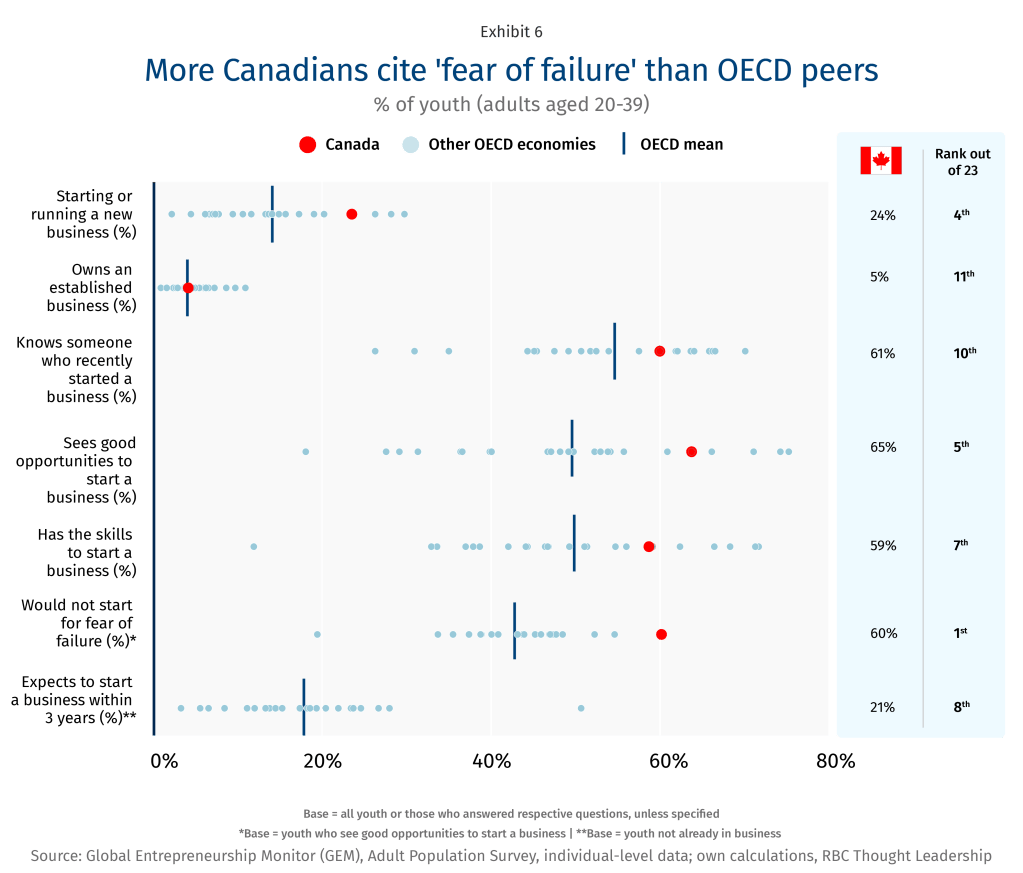
Young Canadians have enormous entrepreneurial ambition. Two-thirds of young Canadians report seeing good opportunities to start a business, while three-in-five say they have the skills to start a business—both above the OECD average. Canada ranks fourth of 23 OECD economies on early-stage entrepreneurial activity among young Canadians (24%).1 But Canada ranks eleventh on established youth business ownership (5%).2
-
Fear is a key constraint. Nearly 60% of young Canadians would not pursue entrepreneurship for fear of failure—the highest among 22 OECD peers.3
-
One-person shops account for 80% of self-employment in Canada. The types of entrepreneurs who hire have lost ground (‘builders’) or collapsed (‘strivers’). Aside from solopreneurship, the only other category to meaningfully increase is the public sector.
-
The window for transitioning from solo self-employment to employer status is narrow. More than 90% of incorporated businesses that hire do so in the first five years; but hiring rates peak in year one and drop every year thereafter.4
-
Founders describe a scale-up gap. Canada’s support ecosystem dries up at exactly the point where young firms are stalling. Supports for firms could focus on making their first hire through scale-up capital, operator-led mentorship, and lowering the personal cost of failure.
Scan the headlines and it’s easy to assume that youth entrepreneurship is undergoing something of a renaissance. LinkedIn reported a near 70% jump in those adding ‘founder’ to their profiles last year.5 Almost 40% of soon-to-be U.S. college grads surveyed say they’re leaning towards entrepreneurship over a traditional job. Closer to home, almost one-in-four young Canadians are in the process of establishing a business (13%) or in the early years of business ownership (11%). That’s nearly double the OECD average. In fact, Canada ranks fourth among OECD countries in early-stage entrepreneurial activity.
In absolute terms, Canada has more young entrepreneurs than ever. Last year, more than 800,000 Canadians between the ages of 20 and 39 counted themselves as self-employed, a two-decade high. But digging a little deeper, our research reveals that entrepreneurship among young Canadians, in relative terms, is hovering near a 20-year low. More alarming still is that the share of self-employed young people who employ others is down 40%: 1-in-57 youth presently own an enterprise that employs others, down from 1-in-35 two decades ago. One-person shops account for 80% of all self-employment in Canada—a trend with wider economic consequences.6
Youth entrepreneurship—especially the building-companies-that-scale variety—is core to a healthy, dynamic economy and to broad-based prosperity. We‘re talking about the next Shopify, the next Cohere. It’s the young who tend to create the next big thing—the products and services of the future. Look no further than the 10 largest publicly-traded firms in the U.S.—mega-cap tech companies like Apple, Microsoft, Meta, and SpaceX. On average, the age of the founder at incorporation was under 30.
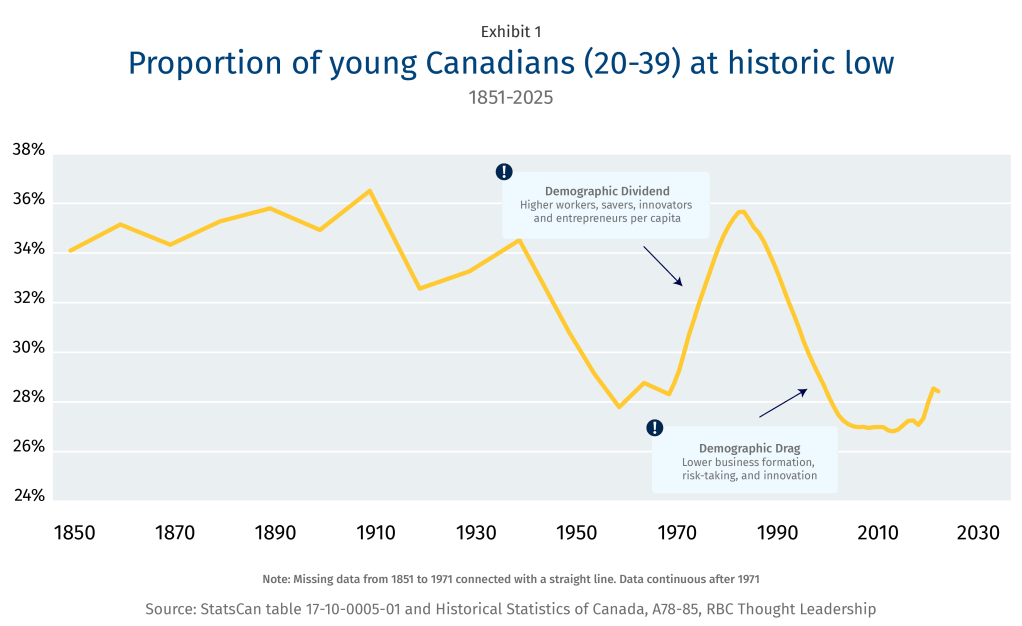
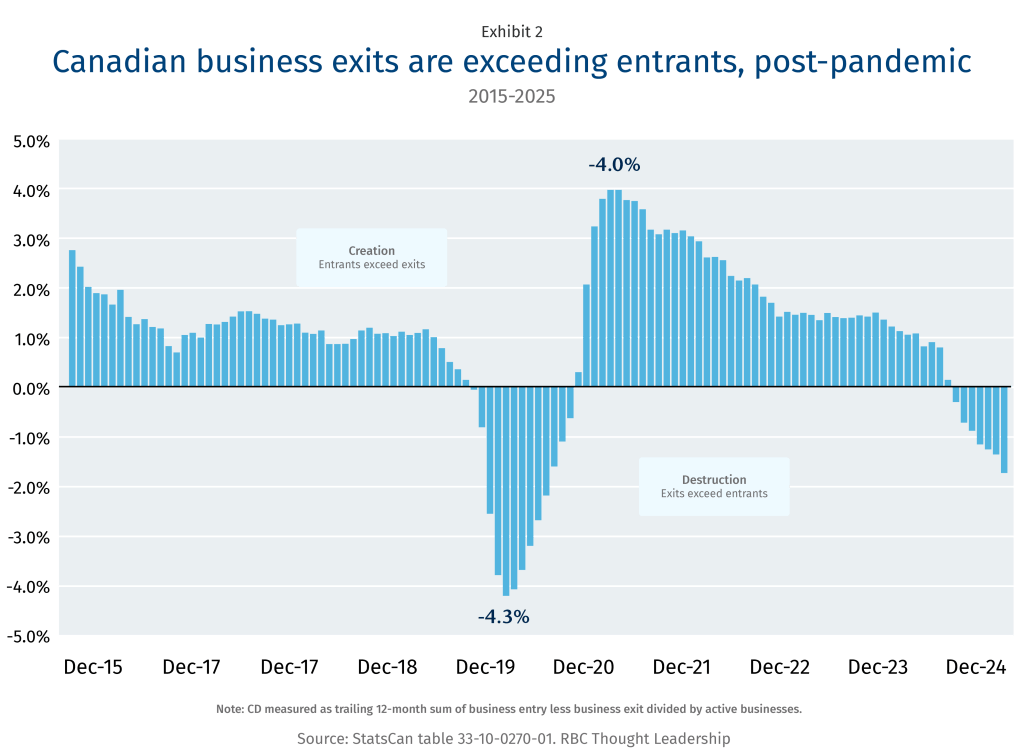
Two forces threaten to make things worse. For one, there are fewer young people in Canada as a proportion of the total population, due in part to falling birth rates (Exhibit 1). A further headwind comes with trends in business formation. The pandemic era saw excessive business destruction, unsurprisingly, followed by a surge in creation, post-lockdown (Exhibit 2). But over the past five years the rate of net new business creation has been falling. U.S. tariffs, a more restrictive approach to immigration, and a challenging policy environment could all be factors. The affordability crunch may be another reason that young people aren’t taking the leap.
RBC Thought Leadership spoke to young founders across the country, representing a range of industries in different stages of growth. Many noted various obstacles when it came to scaling their businesses. While supports are available at launch—from grants to programs like Futurpreneur, Business Development Bank of Canada, Next Canada, and the League of Innovators—access to capital is a persistent hurdle, with Canada’s risk-averse investment culture identified as one factor that has pushed entrepreneurs to seek funding in the U.S., and elsewhere. Mentorship is also cited as a major gap, leaving founders navigating hiring, financing, and expansion on their own.
Given the importance of youth entrepreneurship, civil society and political leaders face a cascading set of trade-offs and strategic tensions. Navigating these is critical to reversing the decline in youth entrepreneurship.
But it’s important to first understand the landscape.
Four Archetypes of Entrepreneurship
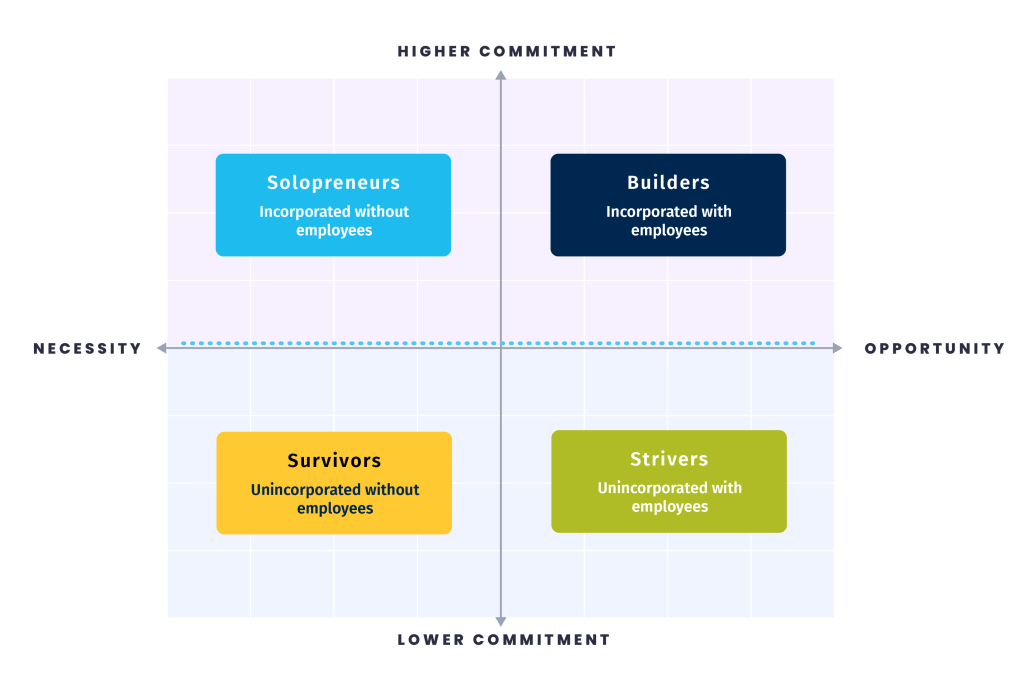
Since Statistics Canada does not break out youth entrepreneurship from the broader population of entrepreneurs, we spliced together more than 1.2 billion cells of StatsCan data to create a new multi-decade history of youth entrepreneurship in Canada. We map young entrepreneurs, between the ages of 20 and 39, into one of four categories, segmented by motivation for founding (opportunity versus necessity) and the level of commitment (lower versus higher), recognizing that the motivations and level of commitment do not cleanly fit this four-way taxonomy, not least because they blend into each other. The four archetypes include (Exhibit 3):
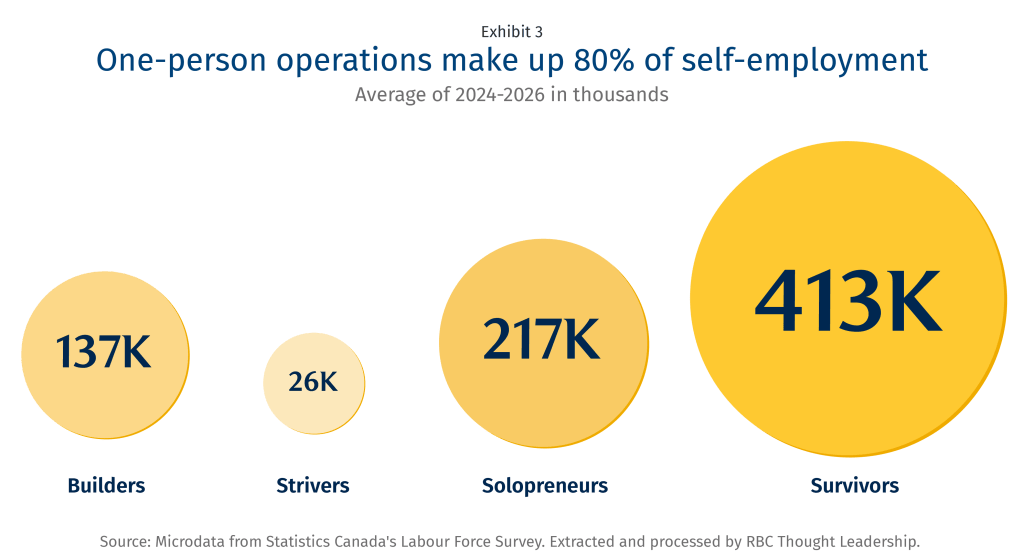
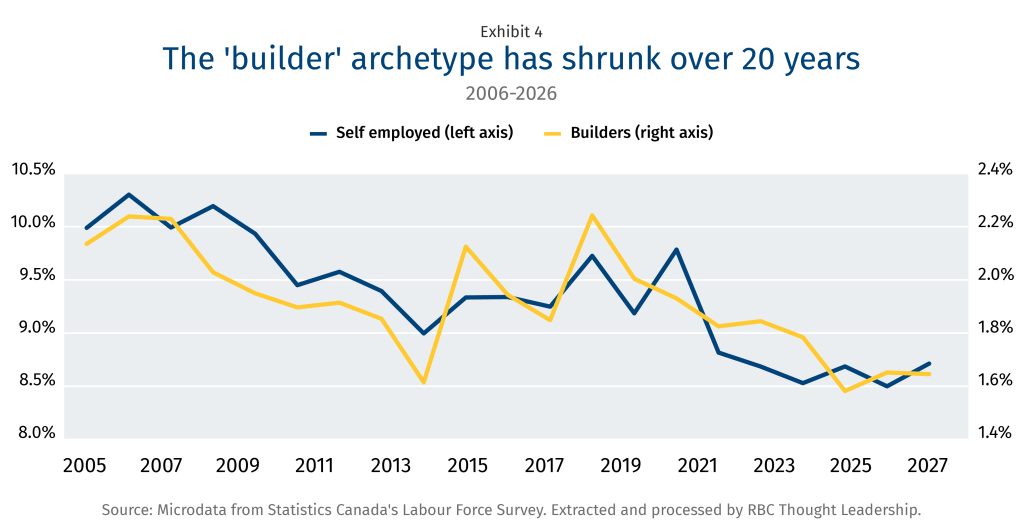
The self-employed among young Canadians skews massively toward solo forms of self-employment, with four-in-five operating a business without employees. This may limit the potential to meaningfully scale and become the type of lucrative enterprise that creates broad-based wealth through the production of goods and services, and indirectly through the payment of wages, salaries, and taxes. It’s unclear if AI will change this calculus. It’s possible that young founders can leverage this technology to scale an enterprise with few (if any) employees, given that AI is proficient at an expanding range of tasks. In the interim, it’s concerning that the share of young people who fit the builder archetype is shrinking: 20 years ago, 1-in-45 young people owned a business with employees. More recently, it stands at 1-in-63 (Exhibit 4).7
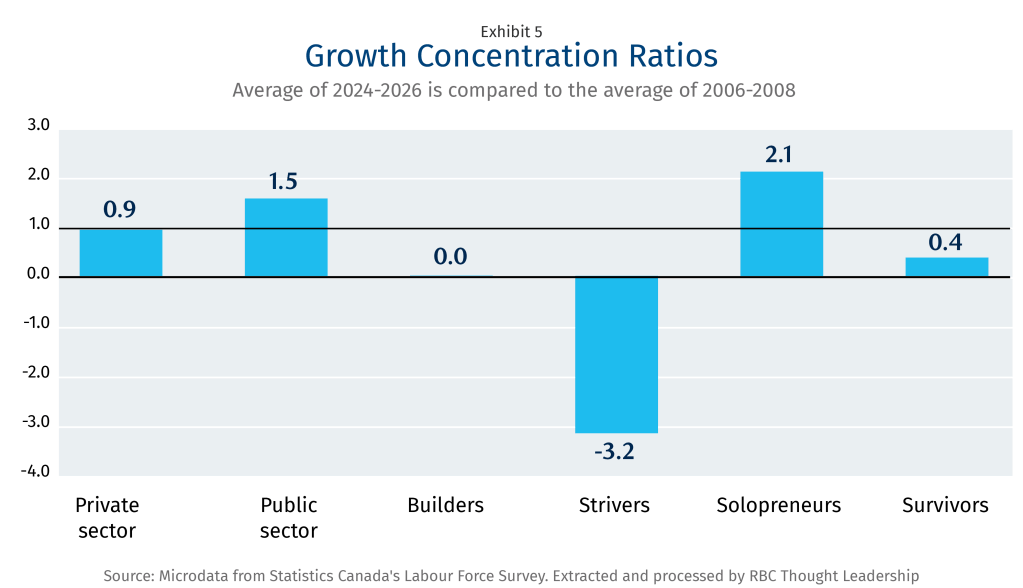
To be clear, not all entrepreneurship has stagnated among young Canadians; it has bifurcated. The types of entrepreneurship that scale enterprises by hiring employees have lost ground (builders) or collapsed (strivers). And all have been dislodged by the surge in solopreneurship. The only other category to meaningfully increase is the public sector (Exhibit 5). The reasons for this are not clear, but the public sector tends to offer higher levels of job and retirement security. Amidst an affordability crunch, growing public sector employment could be interpreted as a flight to safety.
The rise of solopreneurship is more challenging, partly because of the mixed motivations at play. Surveys show that young people are pulled into entrepreneurship because they value flexibility, purpose, and social impact, or because they believe entrepreneurship is simply more lucrative.8 But young people also report being pushed into entrepreneurship because many entry-level jobs are vanishing, which eliminates the traditional pathway to middle class security and prosperity.9
Despite the mixed motivations, what seems clear is that there is an elevated desire among the young to at least explore entrepreneurship. Nearly two-thirds (65%) see good opportunities to start a business in Canada and feel they possess the skills to launch a new enterprise (59%), both of which are well above the OECD average. But as a recent survey by Ownr revealed, while 23% of those surveyed have a side hustle, only 19% of them were thinking of handing in their two weeks’ notice and taking the leap into full-time entrepreneurship.10
So what’s holding would-be entrepreneurs back?
The high cost of living—especially housing—for one thing. When food and shelter costs are rising it makes self-financing a new venture riskier—or in some cases a non-starter. A Be Giant poll of young entrepreneurs in Canada found this to be the top reason why Canada is losing entrepreneurial talent to other markets.11
Fear of failure is another factor (Exhibit 6). According to Global Entrepreneurship Monitor (GEM) data, 60% of Canadians surveyed said they would not start a business because the probability of failing is too great. Canada is an outlier on the fear metric, ranking first out of 22 peers and well above the OECD average. This meshes with what we heard from founders who said culture—including a fear of failure—may be limiting the pipeline. Matthew Hibbert, CEO of Winnipeg-based MAKA Power, said that failure is often viewed negatively in Canada compared to other countries like the U.S., for instance, where “it’s more celebrated: they had the guts to try to start a company, and that should be celebrated. There has to be a shift towards celebrating the people who tried and failed.”
In speaking with young founders across the country, here are some of the other things that they faced—and in many cases overcame.
Access to capital remains a barrier. Entrepreneurs repeatedly cited difficulties in securing funding at various stages of launch. While the early-stage ecosystem offers many supports and programs, young founders often face a credibility challenge, particularly when the business is still just an idea. Canada’s scale-up risk capital eco-system is comparatively thin, which drives many founders to the U.S. Several entrepreneurs were advised to seek capital stateside, where it can be easier to access and on more favourable terms. “If we want more Canadian companies ready for growth capital, we also have to create more opportunities for promising ideas to reach the growth stage,” said Chloe Swain, 20, CEO of FutureTwin, a Vancouver-based tech startup.
Supports dry up at scaling. Capital is a particular challenge when it comes to helping businesses reach the next level. In the initial days of launching, Maguire Shoes cofounder Romy Belzile-Maguire said the company was able to use early-stage funding and pre-sales to drive growth. As the Montreal-based company grew, financing became more of a challenge. “You can get help at the beginning, and you can get help when you’re a big company and more profitable. When you’re in between, you’re kind of on your own,” she said. “You’re too big to be small, but too small to be big.”
Mentorship and network density is lacking. Every founder we spoke with emphasized a desire for more mentorship opportunities throughout the lifecycle of entrepreneurship. “Canada doesn’t only need more entrepreneurs,” said Francesca Chan, founder of Artket Goods in Toronto. “We need stronger connections between the entrepreneurs, suppliers and businesses that are already here.” Founders noted the importance of mentorship in managing the stress and difficulties associated with starting a business, as well as guidance to avoid costly mistakes. Some also expressed a desire to have entrepreneurship opportunities encouraged and tied to postsecondary programming, which is lacking. Early exposure and connections to entrepreneurs could also help spark innovation: most of the entrepreneurs we spoke to came from entrepreneurial families.
Labour and skills matching are an obstacle to hiring. As companies scale, they need to be able to hire the right talent. Some in high-tech industries said they are facing a skills gap in a rapidly changing and evolving industry. Georgiy Sekretaryuk, CEO of Vancouver-based AI startup Overdrive, said the struggle to find the right talent has pushed him to be creative when it comes to hiring, hosting hackathons and approaching those who have performed well, and offering remote work to expand their potential talent pool. Those relying on trade workers are also grappling with shortages. One founder said that recent changes to immigration policies has made it more difficult to keep some researchers in Canada.
Risk-aversion, both among entrepreneurs and their funders. From investors who may be reluctant to take a chance on an unproven idea, to young people that may be wary of the financial uncertainty that can come with launching a business, many said broad risk-aversion remains an obstacle.
Key Considerations
1. Measure what matters: first hires, three-year survival, and growth
Research from ISED shows that the window for transitioning from incorporated solo self-employment to employer status is narrow: hiring odds fall from 10-16% in year one to just 1% in year five.12 Financial and mentorship support could be concentrated in the early years of incorporation to help new founders not only secure their first customer, but graduate to their first hire. Funders and not-for-profits could report first hires, three-year survival rates, and revenue growth, not applications or startups launched, as the key success metrics, noting that early and scale-up supports are ultimately complementary, not alternatives.
2. Simplify federal programs and judge them on whether firm’s scale
Recent research shows the federal government currently has 166 separate programs that support firms to innovate and grow.13 A young founder must find the right program, learn its rules, and complete its paperwork, and then repeat the exercise for the next application. The associated administrative burn (time spent on paperwork and compliance) detracts from scaling their business. Our research suggests support is strongest at launch and thins out at scale-up. Programs could be reviewed against the measures in the consideration above. Programs that cannot show results should be merged or retired, with the savings redirected to the stage where founders say existing supports dry up.
3. Close the scale-up gap with anchor customers and operator-led mentorship
Canada’s capital ecosystem dries up at exactly the point where its market structure winnows: mid-size, scaling firms. Larger firms and government could commit procurement to young-founder suppliers and pay in an expedited window to ease liquidity constraints (e.g., 15–30 days). Business associations and corporate executives could commit to multi-year pairings with founders who have already scaled and build offerings that combine operational and financial expertise, tailored to the industry and stage of maturity.14
4. Match young talent with young firms
Founders said hiring skilled people is difficult, while youth unemployment runs well above national rates. A first hire of a young graduate helps both sides: the founder gets capacity, and the graduate gets an entry-level job. Large firms, colleges, and industry associations could fund co-op and apprenticeship placements at early-stage firms.
5. Lower the personal cost of failure
Canada ranks first of 22 OECD peers on fear of failure, at 60%. Founders cite the lack of six-figure reserves and a high cost of living as obstacles from launching new enterprises, and possibly, scaling them. Employers could offer entrepreneurial leave with a right to return, treat founder experience as a hiring credential, and consider extending benefits. Education and non-profit leaders could put founding on the curriculum and publicly recognise founders who recovered from failure.






Download the Report
Contributors:
RBC Thought Leadership
Jordan Brennan, Managing Director
Alicja Siekierska, Editor
Farhad Panahov, Economist
John Intini, Senior Director, Editorial
Yadullah Hussain, Managing Editor
Caprice Biasoni, Design Lead
Lavanya Kaleeswaran, Director, Digital & Production
Acknowledgments:
Karen Greve Young, Futurpreneur Canada
Laurent Carbonneau, Canadian Council of Innovators
Yan Zhang, Statistics Canada
Huju Liu, Statistics Canada
Global Entrepreneurship Monitor, 2026. Adult Population Survey (individual-level data). RBC Thought Leadership calculations.
Global Entrepreneurship Monitor, 2026. Adult Population Survey (individual-level data). RBC Thought Leadership calculations.
Global Entrepreneurship Monitor, 2026. Adult Population Survey (individual-level data). RBC Thought Leadership calculations.
Lyming, Huang. 2024. From start-up to employer: a duration analysis of the time until Canadian start-ups hire their first employee. Ottawa: Innovation, Science, and Economic Development Canada.
Perna, Mark. 2026. ‘The New Entrepreneurship: What Gen Z Is Getting Right’, Forbes, July 16.
Entrepreneurship is a well-researched topic in Canada. A sample of recently published research that informed our background thinking includes: (i) Deans, Jennifer, and Chad Risley. 2015. The Virtuous Cycle: Why Large Firms Should Nurture Young Entrepreneurs. Business Council of National Issues; (ii) Liu, Huju, and Yan Zhang. 2025. Update on the Entry into and Exit from Self-Employment and Business Ownership in Canada. Ottawa: Statistics Canada; (iii) Business Development Bank of Canada. 2026. The Entrepreneurial Spark of Canada’s Self-Employed. Ottawa: BDC; (iv) Business Development Bank of Canada. 2003. Entrepreneurship in Motion: Skills to Succeed in a Changing World. Ottawa: BDC; (v) Canadian Federation of Independent Business. 2026. Work in Progress: Bridging the Gap between Small Businesses and Canada’s Youth; (vi) Economic Developers Council of Ontario. 2024. Fostering Entrepreneurial Talent in Millennial and Gen Z Ontarians: Bright Ideas Competition Report; (vii) Global Entrepreneurship Monitor. 2025. Global Report 2025/2026: From Uncertainty to Opportunity; (viii) Innovation, Science and Economic Development Canada. 2026. SME Profile: Ownership Demographics Statistics.
The ease of access and low cost of powerful technologies like AI may enable entrepreneurs to scale their operations without hiring traditional employees through reliance on digital platforms, automation, outsourcing, contractors, or virtual assistants. It’s unclear is, in this context, employer status will continue to be the best indicator of business growth potential or entrepreneurial success.
Croll, Dylan. 2023. ‘Gen Z may be the most entrepreneurial of all generations‘, Yahoo Finance reporting of a poll from ZenBusiness, July 17.
Perna (2026). ‘The New Entrepreneurship’, Forbes.
Ownr. 2026. Canadian Side Hustle Report.
Herrold, Charlotte. 2026. ’What it takes to build a business in Canada right now: exclusive poll’, Be Giant-commissionedIpsos poll, April 23.
Lyming (2024), From upstart to employer.
Lammam, Charles. 2026. ‘Canada’s innovation ecosystem doesn’t need a 167th government program’, The Hub, October 5.
OECD European Commission. 2023. The Missing Entrepreneurs 2023: Policies for Inclusive Entrepreneurship and Self-Employment. Paris: OECD Publishing.
This article is intended as general information only and is not to be relied upon as constituting legal, financial or other professional advice. The reader is solely liable for any use of the information contained in this document and Royal Bank of Canada (“RBC”) nor any of its affiliates nor any of their respective directors, officers, employees or agents shall be held responsible for any direct or indirect damages arising from the use of this document by the reader. A professional advisor should be consulted regarding your specific situation. Information presented is believed to be factual and up-to-date but we do not guarantee its accuracy and it should not be regarded as a complete analysis of the subjects discussed. All expressions of opinion reflect the judgment of the authors as of the date of publication and are subject to change. No endorsement of any third parties or their advice, opinions, information, products or services is expressly given or implied by Royal Bank of Canada or any of its affiliates. This document may contain forward-looking statements within the meaning of certain securities laws, which are subject to RBC’s caution regarding forward-looking statements. ESG (including climate) metrics, data and other information contained on this website are or may be based on assumptions, estimates and judgements. For cautionary statements relating to the information on this website, refer to the “Caution regarding forward-looking statements” and the “Important notice regarding this document” sections in our latest climate report or sustainability report, available at: https://www.rbc.com/our-impact/sustainability-reporting/index.html. Except as required by law, none of RBC nor any of its affiliates undertake to update any information in this document.