

 EN
EN 

➔ A new way to unlock nature as an asset class in Canada
➔ A waste heat-to-power tech gains traction
➔ Tom Cruise stars in “misunderstood” climate disaster movie
Signals
A proposed U.S. energy project permitting bill could prove to be transformative. A bipartisan bill to speed up energy projects faces a vote after November’s midterms. If approved, it would exempt federal loans, certain grants, geothermal testing, Federal Energy Regulatory Commission (FERC) transmission permits and gas pipelines in existing rights-of-way from the National Environmental Policy Act review. Solar and storage groups back it as a rare chance to clear interconnection queues, even though the bill is agnostic on the energy sources. But environmental justice groups, including Indigenous and frontline-community organizations, call it deregulatory and say it overstates the clean energy benefits.
A waste heat-to-power (WHP) company got a $138 million boost. Calgary-based Kanin Energy raised the equity with S2G Investments and the Canada Growth Fund each committing about $69 million to develop, build and operate waste to heat power and other power projects across Canada and the U.S. The company says it captures waste heat that’s a byproduct of industrial operations, including oil and gas production, cement plants and steels mills, and creates power without additional emissions. Kanin says up to 58% of energy used in industrial processes is lost as waste heat, and that it remains an untapped source of electricity for heavy industries.
Tom Cruise’s climate-disaster movie sinks at the box office. Swapping the Mission: Impossible franchise’s high-stakes stunts for a shovel—literally—Cruise portrays a caricature-esque Texan oil tycoon. His character’s hunt for crude in Greenland triggers a methane leak that threatens the stability of the ice sheet, risking a catastrophic flood in Europe. While a mid-plot twist proves intriguing, the movie’s U.S. opening weekend of US$8 million falls far short of its projected US$40 million box office. Critics are divided: one climate-focused review “hated” it, while another argued it was misunderstood.
The makings of a climate-tech hub
Canada is poised to spend north of $200 billion on new oil and gas projects, according to our new report, A New Energy. While that has implications for emissions, governments could push for more energy efficient cleantech. The build-out already has a climate-tech component in the shape of the massive Pathways’ Carbon Capture project. could spawn new industries that go beyond CCS to direct air capture, methane reduction and monitoring. Alberta was once the heartland for oil prospectors. Now, its Industrial Heartland could become a happy hunting ground for enterprising cleantech prospectors.
Alberta’s engineering and geoscience regulator reports about 71,000 registrants, which is a start. The province is already home to several promising cleantech companies that can lay the ground for the Silicon Valley of the North. Energy-related R&D is already up from $2.1 billion in 2014, to $3.1 billion in 2024, according to Statistics Canada.
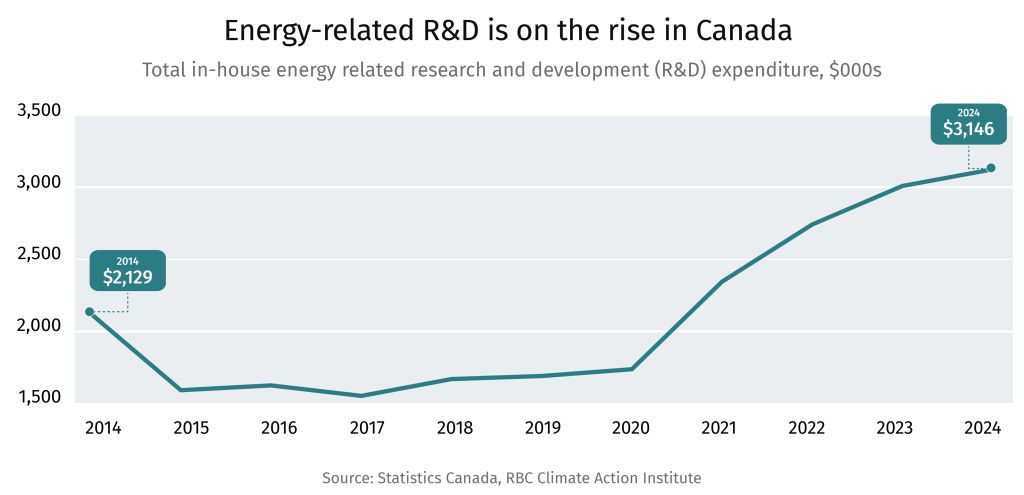
It’s time to accelerate R&D: Overall, Canada is a laggard in R&D with 1.6% of GDP compared to 2.9% for OECD peers in 2024. New builds could focus on energy efficiency, monitoring and methane reduction. AI and quantum computing development from data centres nationwide can feed into and off this momentum.
Develop a credible price signal. Credits trade near $30 a tonne, below what most capture costs. Alberta must legislate by year-end a credit floor that reaches $60 a tonne in 2030, a long way away from implied Pathways’ costs of likely well over $300 a tonne before public support. There’s a need for price predictability so that investors can factor in their investment decisions, says Energy Lead Shaz Merwat.
Methane needs a monitoring gut check. Alberta reported a 52% cut from 2014 levels by 2023, but aircraft measurements in 2021 put oil and gas methane emissions about 1.5 times the official figure. The March agreement-in-principle with Ottawa builds in the check: federal rules would stand down if Alberta reaches a 75% cut by 2035, independently assessed. Buyers are moving the same way, with Japan’s JERA and Korea’s KOGAS, two of the world’s largest LNG buyers, leading a coalition to make methane emissions in LNG supply chains more visible.
The great carbon swap
Canada is hoping to turn its natural resources and carbon-management potential into a new asset class. It’s developing a framework that would let Canadian companies take part in international carbon markets and trade what are known as Internationally Transferred Mitigation Outcomes, or ITMOs, under Article 6 of the Paris Agreement.
How it works. Under this system, foreign buyers and investors could finance a Canadian emissions reduction project, with the resulting emissions reductions counted towards the national emissions of the investor’s home country, not Canada’s (hence, the internationally transferred mitigation outcomes). Switzerland and Kenya struck such a deal last year, and Japan and the island state of Palau followed suit.
Canada is a surprising laggard in carbon credits. If Canada develops the framework, it could lead to a new way to fund Canadian projects that reduce or remove emissions, including those for nature or on farmland, says Wilson Fink, our Agriculture Lead. It would also help Canada catch up with other nations in the voluntary carbon markets. Of the more than 250 agriculture-related offset projects across a dozen countries, only three are in Canada, according to Verra, the largest international registry of voluntary carbon credits projects.
“The slow adoption demonstrates Canada’s struggle in coordinating interest, investment, and innovation into the environmental markets space so practitioners can get credit for their sustainable practices,” said Wilson.The new initiative comes as Canada enters a new resource-building wave. The new federal framework may bring some much-needed investment and attention in Canada’s nascent carbon management markets, especially as it embarks on a new resource-building spree.
For more on the challenge—and potential policy solutions—see our report Giving Farmers Credit: Integrating agriculture in Canada’s industrial carbon pricing system.
Conversations
Canada’s clean-energy groups want a triple double-double: Twice the power, twice the electrification, and twice the efficiency by 2050. As Rachel Doran, Executive Director, Clean Energy Canada put it: “A low-priced clean power is a serious competitive advantage that will bring more investment dollars into Canada. And… it will power the EVs and heat pumps that bring real, lasting energy savings to Canadian families.”
Young Torontonians’ eyes glaze over when institutions use words like “net zero.” Phrases such as “limiting greenhouse gas emissions” and “corporate responsibility,” also don’t resonate, according to a survey. To engage with youth, corporations must frame the discussion through a justice-based lens, focused on affordability, access, and equity, the authors of the survey recommend.
Replacing imports with mature clean technologies could displace up to nearly one-third of oil and gas use globally. But it can be slow and expensive, and it’s about to hit a hard ceiling, McKinsey Institute wrote in its latest report. As a result, a combination of new sources of supply, infrastructure to rewire trade, and inventories plays an important role.
Curated by Yadullah Hussain, Managing Editor, RBC Climate Action Institute.
Climate Crunch would not be possible without John Stackhouse, Jordan Brennan, John Intini, Farhad Panahov, Lisa Ashton, Shaz Merwat, Vivan Sorab, Caprice Biasoni, Lavanya Kaleeswaran, Joelle Schonberg and Alicja Siekierska.
Have a comment, commendation, or umm, criticism? Write to me here (yadullahhussain@rbc.com)
Climate Crunch Newsletter
This article is intended as general information only and is not to be relied upon as constituting legal, financial or other professional advice. The reader is solely liable for any use of the information contained in this document and Royal Bank of Canada (“RBC”) nor any of its affiliates nor any of their respective directors, officers, employees or agents shall be held responsible for any direct or indirect damages arising from the use of this document by the reader. A professional advisor should be consulted regarding your specific situation. Information presented is believed to be factual and up-to-date but we do not guarantee its accuracy and it should not be regarded as a complete analysis of the subjects discussed. All expressions of opinion reflect the judgment of the authors as of the date of publication and are subject to change. No endorsement of any third parties or their advice, opinions, information, products or services is expressly given or implied by Royal Bank of Canada or any of its affiliates. This document may contain forward-looking statements within the meaning of certain securities laws, which are subject to RBC’s caution regarding forward-looking statements. ESG (including climate) metrics, data and other information contained on this website are or may be based on assumptions, estimates and judgements. For cautionary statements relating to the information on this website, refer to the “Caution regarding forward-looking statements” and the “Important notice regarding this document” sections in our latest climate report or sustainability report, available at: https://www.rbc.com/our-impact/sustainability-reporting/index.html. Except as required by law, none of RBC nor any of its affiliates undertake to update any information in this document.