

 EN
EN 

Starting April 5th, the U.S. is imposing 10% baseline tariffs, with most countries facing a tariff rate that appears to be based on a calculation of trade deficits as a share of exports from that country. Crucially, it exempts Canada and Mexico as it’s not applied to USMCA-compliant products.
Here are six impacts we’re watching out for:
1. Canada lives to fight another day, but not without some pain.
Existing tariffs remain, including those based on IEEPA/fentanyl , steel and aluminum and auto and auto-parts that went into effect just past midnight today. Duty-free trade still applies to products that are USMCA compliant—perhaps a signal that the President still takes the agreement he signed seriously.
-
Most, if not all, Canadian auto manufacturers have 50% S. content, which means an effective tariff rate of 12.5%. Combined with a 70-cent Canadian dollar, it puts Canadian auto and parts makers in relatively good stead, especially in comparison to Asian and European automakers facing up to 25% in tariffs.
-
The story on energy is similarly that of relief—RBC Capital Markets highlighted how most, if not all, oilsands producers are USMCA compliant, and not be subject to the 10% tariff on energy. A 10% tariff on other resource products and potash, although significant, is not enough to affect producers’ bottom lines.
-
While we may see specific provinces and sectors negotiating for exemptions, most will likely not want to rock the boat until the federal election is over on April 28, and an economic and security partnership can be negotiated. But Canada isn’t out of the woods yet—lumber is still in the U.S. administration’s crosshairs, and President Donald Trump alluded to a longstanding irritant of his in Canadian dairy.
2. It’ll be hard to raise revenues (only) from tariffs.
To fund tax cuts, President Trump and Secretary Howard Lutnick’s stated goals are to raise US$1 trillion in revenues from tariffs and achieve another US$1 trillion with an aggressive program of cost-cutting through the Department of Government Efficiency. But the math doesn’t add up.
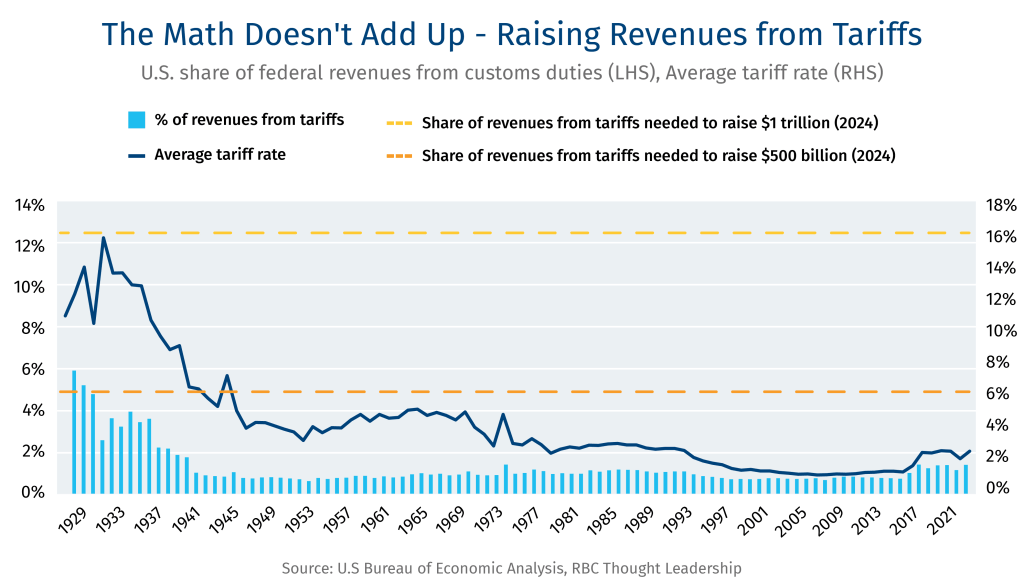
The government would have to generate 12.4% of total revenues from tariffs to raise US$1 trillion—something the U.S. government has not achieved in the past century, even during the height of the Smoot-Hawley tariffs in the 1930s. Even the more modest goal of US$500 billion seems hard to achieve given the U.S. federal government hasn’t raised 6.2% of its revenues from tariffs since 1929—when the Great Depression started.
3. Will China deviate from its targeted retaliatory approach?
China now faces an effective tariff rate of 54%, on top of tariffs on steel and aluminum and those levied under the IEEPA. The Chinese government has historically responded with targeted retaliatory tariffs, particularly on agriculture and geared toward swing states or those voting Republican. However, these are the highest effective tariff rates ever levied on China. It will be interesting to see if Beijing sticks to a strategy of targeted action, or one that will be more sweeping. Regardless, a trade war between the world’s two biggest economies will cause significant economic ripples and rejig supply chains.
-
Of note, China recently entered exploratory talks on a regional free trade and investment agreement with Japan and South Korea, two countries that are not traditional Chinese allies. This is an important signal that countries in Asia and beyond are creating bulwarks and buffers against a United States that they increasingly see as threatening and unpredictable. These developments may isolate Canada even further.
4. The price of the climb down may be steep.
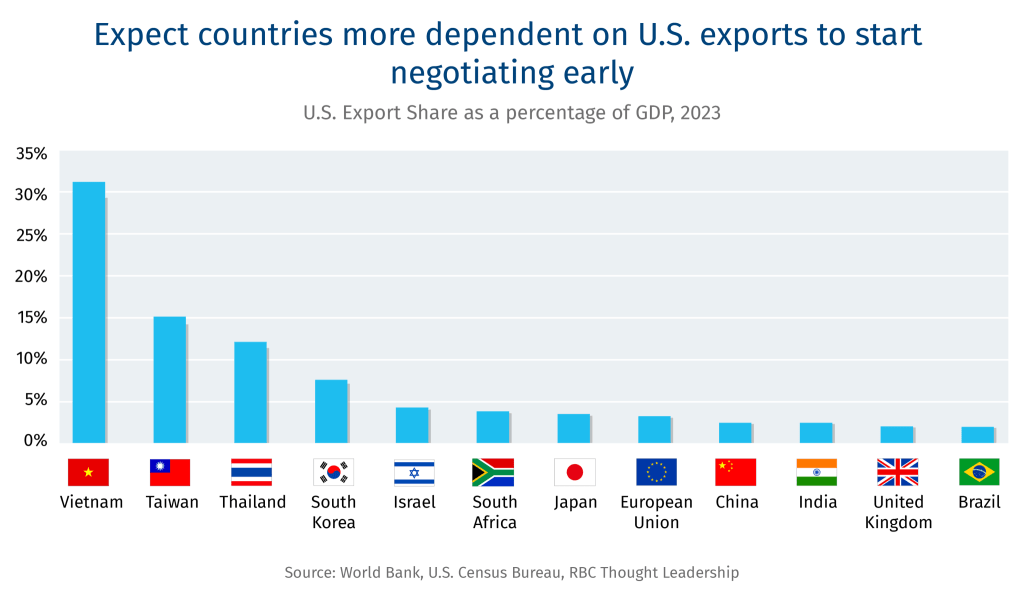
Trump explicitly signaled to countries that he was willing to negotiate concessions in exchange for reduced trade actions. The cost of these concessions will be worth watching, with the countries first in line to negotiate exemptions (especially the ones most exposed to U.S. trade actions) likely getting a raw deal. Expect the coming few days, before the tariffs officially come into force, to be a lobbying frenzy in D.C. as countries most exposed to U.S. trade action try and negotiate lower rates.
-
Allied Retaliation: Trump explicitly warned countries that teaming up against the United States to retaliate would yield higher tariffs. Canada may not wish to gang up against the United States as the degree of integration between our economies does not favour Canada. But expect the Canadian government to partner with allies on strategic sectors, such as critical minerals or semiconductors, to press against U.S. trade action and to share a more unified message on the costs of a full-blown tariff war on sectors with strategic or national security importance.
5. Congressional rancor over the trade deficit emergency.
On the other side of Pennsylvania Ave., the Senate voted to pass a joint resolution to strike down the emergency Trump used to levy tariffs on Canada, with four Republicans joining the Democrats. The joint resolution is unlikely to pass the House, where caucus discipline is more strongly enforced, but it is still a repudiation of Trump’s trade policies against the country’s closest ally. The President used the same authorities, stemming from the International Economic Emergency Powers Act, deeming trade deficits as a national emergency. Expect to see another fight in Congress as the legislature seeks to regain control over trade and tariff policy, and as Democrats use the joint resolution as a cudgel to split the Republicans and a referendum on Trump.
6. Global macroeconomic and supply chain shocks.
The bigger channel of impact of these tariffs—and the biggest unknown—will come from governments and businesses completely reshaping the trading links that have been built over the past century. Some companies may choose to reshore production to the United States, while many others may avoid the U.S. completely. Regardless of how the tariffs are implemented, the macroeconomic effects of uncertainty are significant and dire, as our Economics team has noted, pushing up the U.S. effective tariff rate over 20%.
Trump appears to want to achieve multiple goals through his policy instrument of choice, including reshoring investment and trade flows, strengthening the greenback, raising revenues and using tariffs as economic leverage to achieve other policy outcomes. It is unclear whether he will be able to achieve all these goals. What is clear is that this is only the beginning of a rocky ride for the global economy, and for Canada.
Varun Srivatsan is Director, Policy and Strategic Engagement, RBC Thought Leadership
This article is intended as general information only and is not to be relied upon as constituting legal, financial or other professional advice. The reader is solely liable for any use of the information contained in this document and Royal Bank of Canada (“RBC”) nor any of its affiliates nor any of their respective directors, officers, employees or agents shall be held responsible for any direct or indirect damages arising from the use of this document by the reader. A professional advisor should be consulted regarding your specific situation. Information presented is believed to be factual and up-to-date but we do not guarantee its accuracy and it should not be regarded as a complete analysis of the subjects discussed. All expressions of opinion reflect the judgment of the authors as of the date of publication and are subject to change. No endorsement of any third parties or their advice, opinions, information, products or services is expressly given or implied by Royal Bank of Canada or any of its affiliates. This document may contain forward-looking statements within the meaning of certain securities laws, which are subject to RBC’s caution regarding forward-looking statements. ESG (including climate) metrics, data and other information contained on this website are or may be based on assumptions, estimates and judgements. For cautionary statements relating to the information on this website, refer to the “Caution regarding forward-looking statements” and the “Important notice regarding this document” sections in our latest climate report or sustainability report, available at: https://www.rbc.com/our-impact/sustainability-reporting/index.html. Except as required by law, none of RBC nor any of its affiliates undertake to update any information in this document.