

 EN



For the week of November 30th
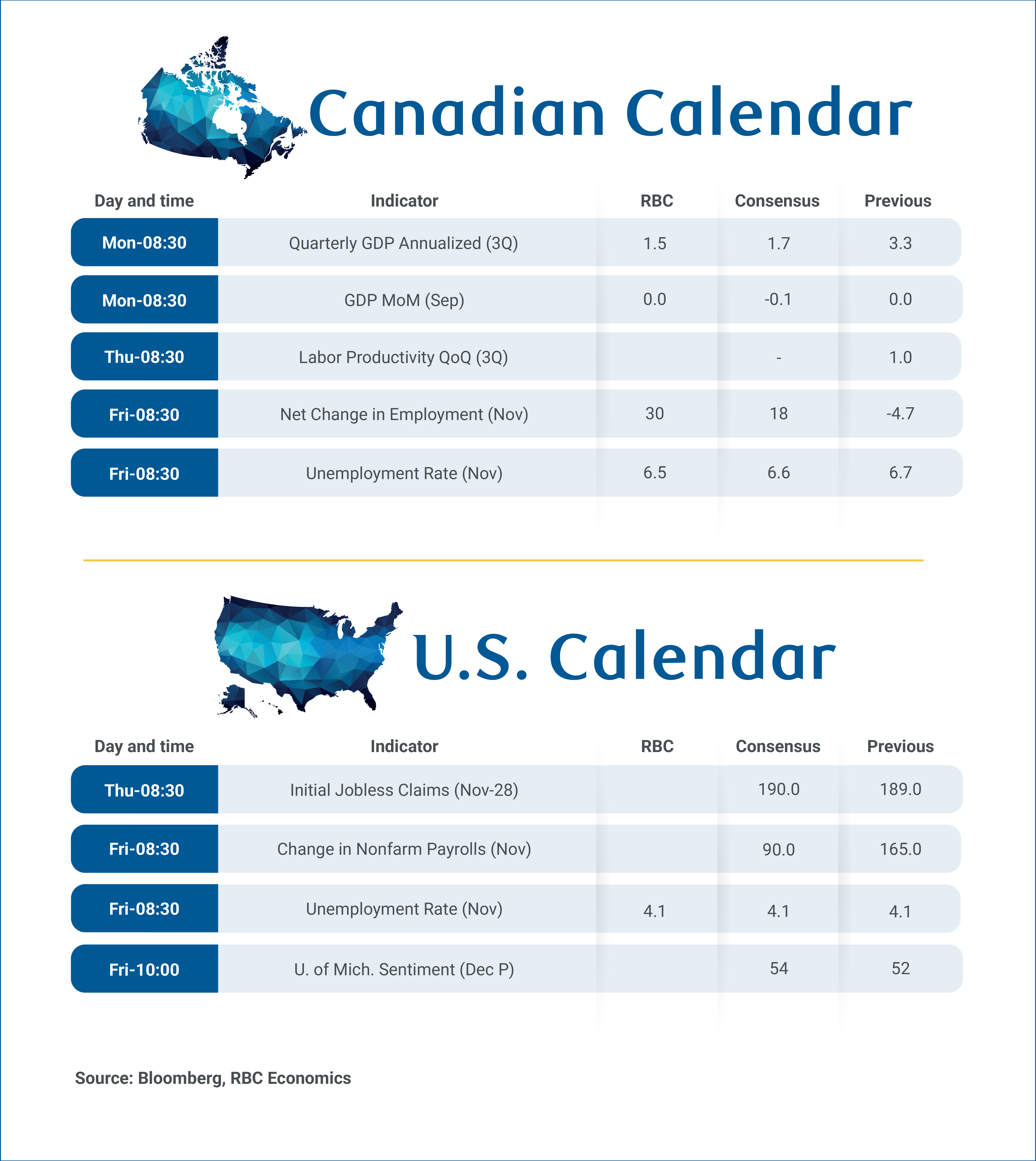
Canada’s Q3 gross domestic product data on Monday and November Labour Force Survey data on Friday are final key inputs that could sway the Bank of Canada’s December 9 interest rate decision.
We expect GDP growth to slow to 1.5% annualized and employment to rebound, with the unemployment rate falling to 6.5% in November. A solid jobs print would support our call for a 25 bp rate hike in December, while a soft print could weaken the case.
Headline GDP grew slower in Q3 with stronger details
We expect real GDP to have increased 1.5% (annualized) in Q3, a notable slowdown from 3.3% in Q2 and below the BoC’s 2% estimate in October. The quarter likely ended quietly – GDP is expected to have remained largely unchanged in September, still slightly better than Statistics Canada’s advance estimate for a 0.1% decline but marking a third straight month of no growth.
The underlying quarterly expenditure details should look better. We expect strength in household and government spending from Q2 to have persisted in Q3. Both residential and non-residential business investment growth, however, likely tapered off after stronger Q2 results.
Residential investment growth slowed in Q3 as home resales and new construction activities moderated. Non-residential investment is expected to have picked up slightly, driven by stronger structures investment – non-residential building construction in July recorded the strongest monthly increase since January 2022, in part reflecting the construction of a new institutional building in Ontario.
Outside of structures, non-residential equipment spending likely held flat in Q3, as rising spending on electronic equipment (particularly processing units used in data centres) was offset by lower aircraft purchases. Net trade is expected to have added to growth in Q3 as imports fell more than exports, although not enough to fully offset the drag from a larger inventory drawdown.
Strong hiring demand expected to lead Canada’s labour market recover after a weak streak
Monthly economic indicators in Canada are notoriously volatile but early available readings for October point to a mixed start to Q4. Advanced manufacturing sales rose strongly in October but both retail and wholesale sales (ex-petroleum) declined, the latter reflecting weakness in the auto sector related to recent production shutdowns in the U.S.
Labour market in October recorded a third consecutive employment loss but we expect a rebound in November. While recent deterioration has been persistent, it has been concentrated among younger job seekers. Layoffs have mostly remained limited, and the unemployment rate among prime-age (25-54 year old) workers has held steady since summer.
More encouragingly, leading indicators for hiring demand have continued to rise into Q4. Job openings on Indeed.com surged over October and November to levels unseen since early 2024, and job vacancies from the separately reported SEPH employment data were on a similar, though more muted, recovery trend.
In November, we expect the labour market added 30,000 jobs to partially reverse the cumulative loss of 115,000 between July and October, and see the unemployment rate falling to 6.5%. Looking ahead, we expect strong hiring activity will start translating into more job growth in coming quarters, lowering the unemployment rate to below 6% by mid-year 2027.
-
U.S. labour market likely remained tight in November, with another larger payrolls increase keeping the unemployment rate unchanged at 4.1%. These readings are in line with jobless claims near decade lows, and support our base case forecast that the unemployment rate will end the year near current levels.
About the authors:
Claire Fan is a Senior Economist at RBC. She focuses on macroeconomic analysis and is responsible for projecting key indicators including GDP, employment and inflation for Canada and the US.
Abbey Xu is an economist at RBC. She is a member of the macroeconomic analysis group, focusing on macroeconomic forecasting models and providing timely analysis and updates on economic trends.
Explore the latest from RBC Economics:
November US Executive Briefing: Resilience up in the economy but so are costs
Q3 Canadian consumer signals: Spending still edging higher despite headwinds
Canadian inflation unchanged in October as underlying pressures remain contained
Share these insights with your network:
This article is intended as general information only and is not to be relied upon as constituting legal, financial or other professional advice. The reader is solely liable for any use of the information contained in this document and Royal Bank of Canada (“RBC”) nor any of its affiliates nor any of their respective directors, officers, employees or agents shall be held responsible for any direct or indirect damages arising from the use of this document by the reader. A professional advisor should be consulted regarding your specific situation. Information presented is believed to be factual and up-to-date but we do not guarantee its accuracy and it should not be regarded as a complete analysis of the subjects discussed. All expressions of opinion reflect the judgment of the authors as of the date of publication and are subject to change. No endorsement of any third parties or their advice, opinions, information, products or services is expressly given or implied by Royal Bank of Canada or any of its affiliates.
This document may contain forward-looking statements within the meaning of certain securities laws, which are subject to RBC’s caution regarding forward-looking statements. ESG (including climate) metrics, data and other information contained on this website are or may be based on assumptions, estimates and judgements. For cautionary statements relating to the information on this website, refer to the “Caution regarding forward-looking statements” and the “Important notice regarding this document” sections in our latest climate report or sustainability report, available at: https://www.rbc.com/community-social-impact/reporting-performance/index.html. Except as required by law, none of RBC nor any of its affiliates undertake to update any information in this document.

