

 EN
EN 


May spending snapshot: The pace of RBC Canadian cardholder spending outside of purchases at the pumps and autos moderated in May from the previous month, but remained positive.
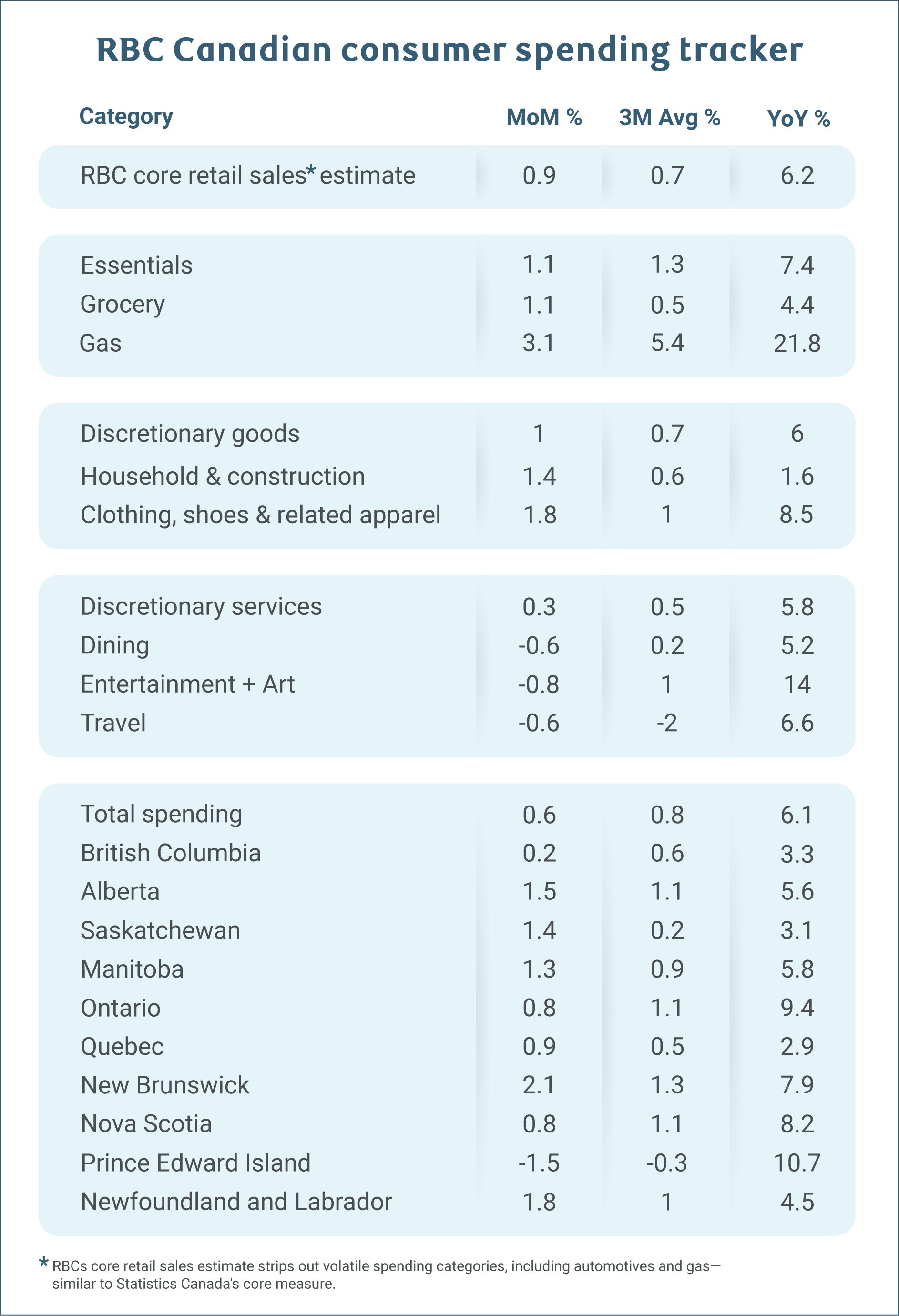
Our estimate of RBC’s core retail sales (excluding purchases of gasoline and autos) eased to 0.7% from 1.2% in April on a three-month average.
Higher gasoline prices continued to absorb a larger share of household budgets. However, limited pullback in spending by consumers on other goods and services implies households continue, for now, to dip into savings (or increase borrowing) to keep spending.
Essentials’ spending growth excluding gasoline moderated to 0.1%, but discretionary goods spending (ex-gasoline) continued to strengthen, suggesting consumers remain selective.
The details:
-
Essentials’ spending increased 1.1% in May and remained up 1.3% on a three-month average, but largely reflected price increases in spending on gasoline. Growth excluding gasoline purchases was essentially flat, suggesting elevated fuel costs may constraining household budgets for other everyday necessities.
-
Still, discretionary goods spending rose 1%, while the three-month average increased 0.7%, extending a steady improvement from near-flat readings earlier this year.
-
Clothing, shoes and related apparel remained a notable source of strength with spending rising 1.8%, and maintaining a 1% three-month average gain.
-
A 0.6% three-month average increase in household and construction-related purchases aligns with some evidence of stabilization in housing activity. It supports our view that while activity remains largely flat, some green shoots are beginning to appear in housing markets.
-
Discretionary services spending rose 0.3%, and held at a 0.5% three-month average. Dining and entertainment spending softened in May, but both remained on a positive trend.
-
Travel spending continued to lag other spending categories with the three-month average remaining negative at – 2%, suggesting households remain selective with larger discretionary purchases.
About the authors:
Abbey Xu is an economist at RBC. She is a member of the macroeconomic analysis group, focusing on macroeconomic forecasting models and providing timely analysis and updates on economic trends.
Rachel Battaglia is an economist at RBC, providing forecasts for the Canadian provincial economies and analyzing key trends in housing and consumer spending.
By Carrie Freestone
RBC’s consumer spending tracking report uses RBC Data & Analytics’ proprietary database of anonymized card transactions by Canadian clients. The data are an accounting of merchant transactions that are divided into various spending categories covering tens of millions of weekly card transactions worth billions of dollars each week. Transactions, both in person and online, are classified into 11 broad spending groups: Dining, Education, Finances, Groceries, Health, Household, Shopping, Transport, Travel, Utilities, and Other. Within each group, the data are further classified: for example, shopping covers merchants classified as clothing stores, hobby shops, electronics stores, and jewelers, among others. We exclude purely financial transactions such as cash advances and insurance from spending.
We examined changes in the value of all transactions in these areas using a 7 day rolling sample starting January 1st of each year that is indexed to pre-covid levels which are calculated as the average spending for the month of February 2020. To examine the impact of seasonal factors, we also show each’s year spending profile which depicts monthly trends in spending. Online spending volumes are estimated based on the presence of an RBC card at the time of the authorization.
Protecting your privacy and safeguarding your personal information is a cornerstone of our organizational ethics and values and will always be one of our highest priorities. The underlying data for this analysis was aggregated based on transaction date, region and merchant category, and cannot be used to identify any individual client or merchant. For additional information please visit www.rbc.com/privacy.
This article is intended as general information only and is not to be relied upon as constituting legal, financial or other professional advice. The reader is solely liable for any use of the information contained in this document and Royal Bank of Canada (“RBC”) nor any of its affiliates nor any of their respective directors, officers, employees or agents shall be held responsible for any direct or indirect damages arising from the use of this document by the reader. A professional advisor should be consulted regarding your specific situation. Information presented is believed to be factual and up-to-date but we do not guarantee its accuracy and it should not be regarded as a complete analysis of the subjects discussed. All expressions of opinion reflect the judgment of the authors as of the date of publication and are subject to change. No endorsement of any third parties or their advice, opinions, information, products or services is expressly given or implied by Royal Bank of Canada or any of its affiliates.
This document may contain forward-looking statements within the meaning of certain securities laws, which are subject to RBC’s caution regarding forward-looking statements. ESG (including climate) metrics, data and other information contained on this website are or may be based on assumptions, estimates and judgements. For cautionary statements relating to the information on this website, refer to the “Caution regarding forward-looking statements” and the “Important notice regarding this document” sections in our latest climate report or sustainability report, available at: https://www.rbc.com/community-social-impact/reporting-performance/index.html. Except as required by law, none of RBC nor any of its affiliates undertake to update any information in this document.

