

 EN



The Bottom Line:
Canadian inflation ticked slightly higher to 3.1% year-over-year in September, after holding at 3% for the prior two months. This was below the consensus estimate of 3.2% and a tick higher than our own pre-release expectation of 3%.
As expected, energy inflation accelerated as gasoline and furnace oil prices rose from August, while food inflation continued to moderate.
But there continued to be limited evidence that elevated energy costs were spreading significantly across consumer prices. The breadth of recent inflation pressures did widen somewhat in the September data. Pass-through remained most visible in oil-sensitive transportation categories, including airfares, while price growth in local transit remained comparatively subdued.
Food price growth slowed further, with prices at grocery stores rising at their slowest pace since May 2024 (1.7% year-over-year). CPI excluding food and energy held at 2.1% year-over-year, while the Bank of Canada’s preferred CPI-trim and CPI-median measures averaged 1.9% on a year-over-year basis.
The Bank of Canada is still facing an uncomfortable balance. The economy is gradually improving but remains soft, with employment declining in both August and September and the unemployment rate holding around 6.5%. At the same time, policymakers remain alert to the risk that persistently elevated oil prices lift inflation expectations or generate broader second-round price pressures.
Governor Macklem acknowledged as much on Saturday, noting from the IMF meetings in Bangkok that “the risk that inflation broadens and becomes more persistent has gone up” and that the Bank has found it increasingly difficult to continue looking through the direct impact of higher energy prices.
Producer-price pressures have broadened, but those cost increases would need to persist and pass through several layers of production before reaching consumers more broadly.
Our own base-case forecast assumes that the Bank will hold the overnight rate unchanged through the remainder of 2026 before gradually raising rates in 2027. Softer labour-market data and higher fixed borrowing costs give policymakers room to remain patient. However, recent communication from the Bank of Canada and Governor Macklem are denoting more urgency than the data to date might suggest and add to the risk the Bank chooses to move preemptively.
The details:
-
Headline CPI rose 0.4% m/m on a seasonally adjusted basis in September, leaving the annual inflation rate at 3.1% after holding at 3% during the last two months.
-
Energy prices were 19% higher than a year ago, compared with annual growth of 15.4% in August. Gasoline prices rose 27.8%, contributing 1.1 percentage points to headline inflation.
-
Food inflation eased to 2.2% year-over-year from 2.8% in August, continuing its downward trend. Grocery price growth came in at 1.7%, down from 2.8% in the prior month, while restaurant price growth was little changed at 3.1%.
-
CPI excluding food and energy inflation was unchanged at 2.1% year-over-year, pointing to relatively contained price growth outside the most volatile categories.
-
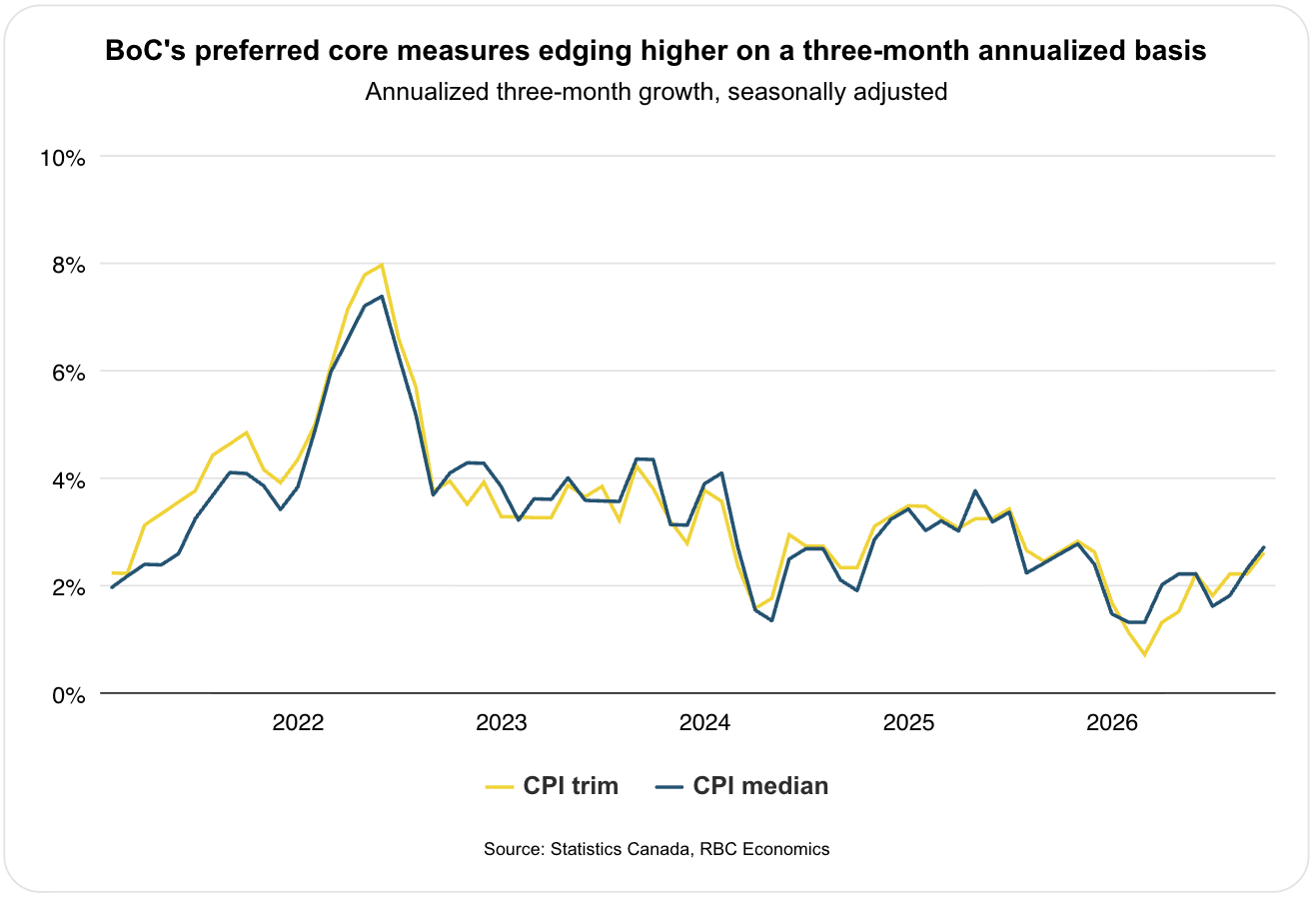
The Bank of Canada’s closely watched CPI-trim was 1.8% y/y and 0.2% m/m, while CPI-median was 1.9% y/y and 0.2% m/m. On a three-month annualized basis, the average of CPI-trim and CPI-median was 2.6%, compared with 2.3% in August.
-
The trim services excluding shelter measure — sometimes referred to as “supercore” — was 2.5% year-over-year, compared with 2.6% previously.
-
Our diffusion index (measuring the breadth of inflation pressures) showed that the share of CPI components rising faster than 3% jumped to 47.8%, compared with 25.9% in August and 48.5% a year ago. The share rising faster than 5% was 19.6%, compared with 18.5% previously and 32.3% from a year ago.
-
Tuition fees, which are priced annually in September, increased 2.4%, up from 1.7% in 2025. That increase coincides with the 7.6% year-over-year decline in non-permanent residents (with study permits only and with work & study permits). The drop in international students has reduced a key revenue stream for post-secondary institutions, prompting many to adjust tuition fees upward to offset the shortfall.
-
Prices for airfares surged 19.4%, as one of the categories most exposed to higher energy prices, up from 15% in August. But prices for local transportation continued their downward trajectory.
-
Shelter inflation was 1.8% year-over-year, compared with 1.5% in August. Outside of the fuel oil and other fuels category, price increases were driven by faster growth in homeowners’ home and mortgage insurance, as well as maintenance and repairs.
About the author:
Abbey Xu is an economist at RBC. She is a member of the macroeconomic analysis group, focusing on macroeconomic forecasting models and providing timely analysis and updates on economic trends.
This article is intended as general information only and is not to be relied upon as constituting legal, financial or other professional advice. The reader is solely liable for any use of the information contained in this document and Royal Bank of Canada (“RBC”) nor any of its affiliates nor any of their respective directors, officers, employees or agents shall be held responsible for any direct or indirect damages arising from the use of this document by the reader. A professional advisor should be consulted regarding your specific situation. Information presented is believed to be factual and up-to-date but we do not guarantee its accuracy and it should not be regarded as a complete analysis of the subjects discussed. All expressions of opinion reflect the judgment of the authors as of the date of publication and are subject to change. No endorsement of any third parties or their advice, opinions, information, products or services is expressly given or implied by Royal Bank of Canada or any of its affiliates.
This document may contain forward-looking statements within the meaning of certain securities laws, which are subject to RBC’s caution regarding forward-looking statements. ESG (including climate) metrics, data and other information contained on this website are or may be based on assumptions, estimates and judgements. For cautionary statements relating to the information on this website, refer to the “Caution regarding forward-looking statements” and the “Important notice regarding this document” sections in our latest climate report or sustainability report, available at: https://www.rbc.com/community-social-impact/reporting-performance/index.html. Except as required by law, none of RBC nor any of its affiliates undertake to update any information in this document.

