

 EN



-
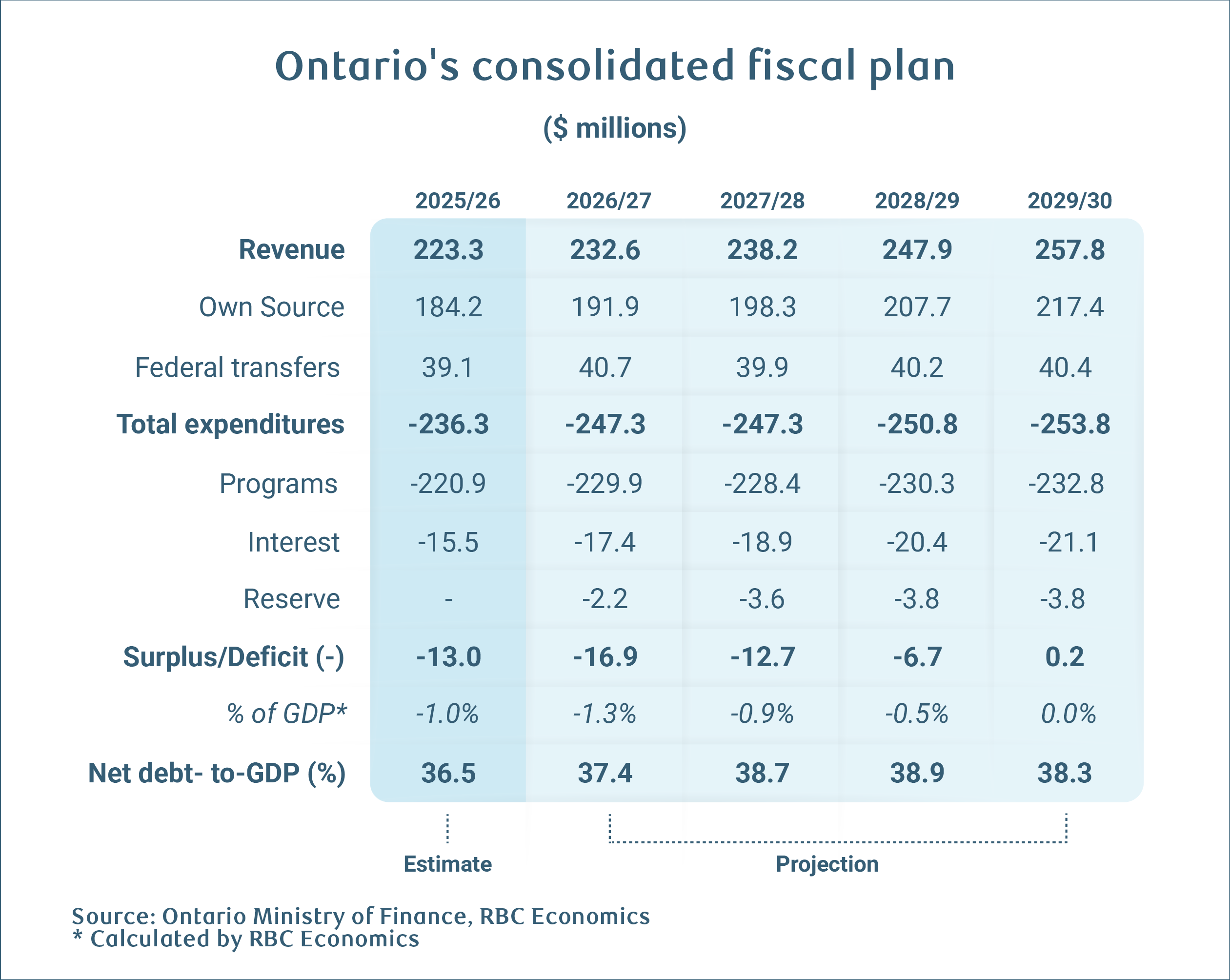
Update 2026 marks up the current-year deficit, 2026-27, by $3 billion versus the spring budget, to $16.9 billion (1.3% of GDP, up from 1.1%).
-
But the larger deficit revisions come in 2027-28 and 2028-29, marked up by $6.6 billion and $7.3 billion, respectively, and 2028-29 no longer showing a surplus. Balance has been delayed for one year, in a repeat of budget 2026 – it is now expected to be achieved in 2029-30; before budget 2026 it was 2027-28.
-
A lower revenue profile versus budget 2026 reflects more general economic weakness rather than the approximate $8 billion cost of the new corporate expensing mega deduction, which has not yet been incorporated in the update.
-
Elevated contingencies, reserves, and lower economic planning assumptions exist to address the uncertain economic climate and may provide some upside to current deficit forecasts.
-
However, elevated buffers are partly attributed to the upcoming cost of the mega deduction and unexpected expenses. The update outlines a very optimistic spending profile post 2026-27, falling in real per capita terms – an intentional move to support prudent fiscal management.
-
Unfortunately, Ontario’s greater relative discipline over the last decade in containing growth in the public service versus Ottawa and other provinces, mean finding government savings may be harder.
-
Despite a higher deficit path, the net debt-to-GDP ratio follows substantially the same profile as in budget 2026 in the early years – benefiting from upward revisions to nominal GDP- before ending higher than budget. In terms of trajectory, the debt burden is expected to trend up for 5 consecutive years before barely stabilizing, but remains below the 40% fiscal anchor.
-
Whereas the province has operated with buffers against 2 of its 3 fiscal anchors in recent cycles, update 2026 sees the net interest-to-revenue measure increase to 7.5% in the outer years, right at the government’s <7.5% target.
Revenues marked down versus budget profile
Revenue grows at an annual average rate of almost 4% per year over the 4 years from 2026-27 to 2029-30, in line with average nominal GDP growth.
However, the dollar profile is lower overall versus budget 2026, especially in 2027-28 and 2028-29, that the budget attributes to lower-than-expected tax revenues.
This is not due to Ontario incorporating Ottawa’s new corporate expensing mega deduction.
As a province whose corporate tax system is harmonized with the federal government, Ontario is one of many who will face budget gaps as they automatically adopt the federal measure. The update says the measure will provide $8 billion in tax savings over 5 years.
The measure will be incorporated following passage of federal legislation and will pressure revenue, although rising contingencies are partly attributed to this.
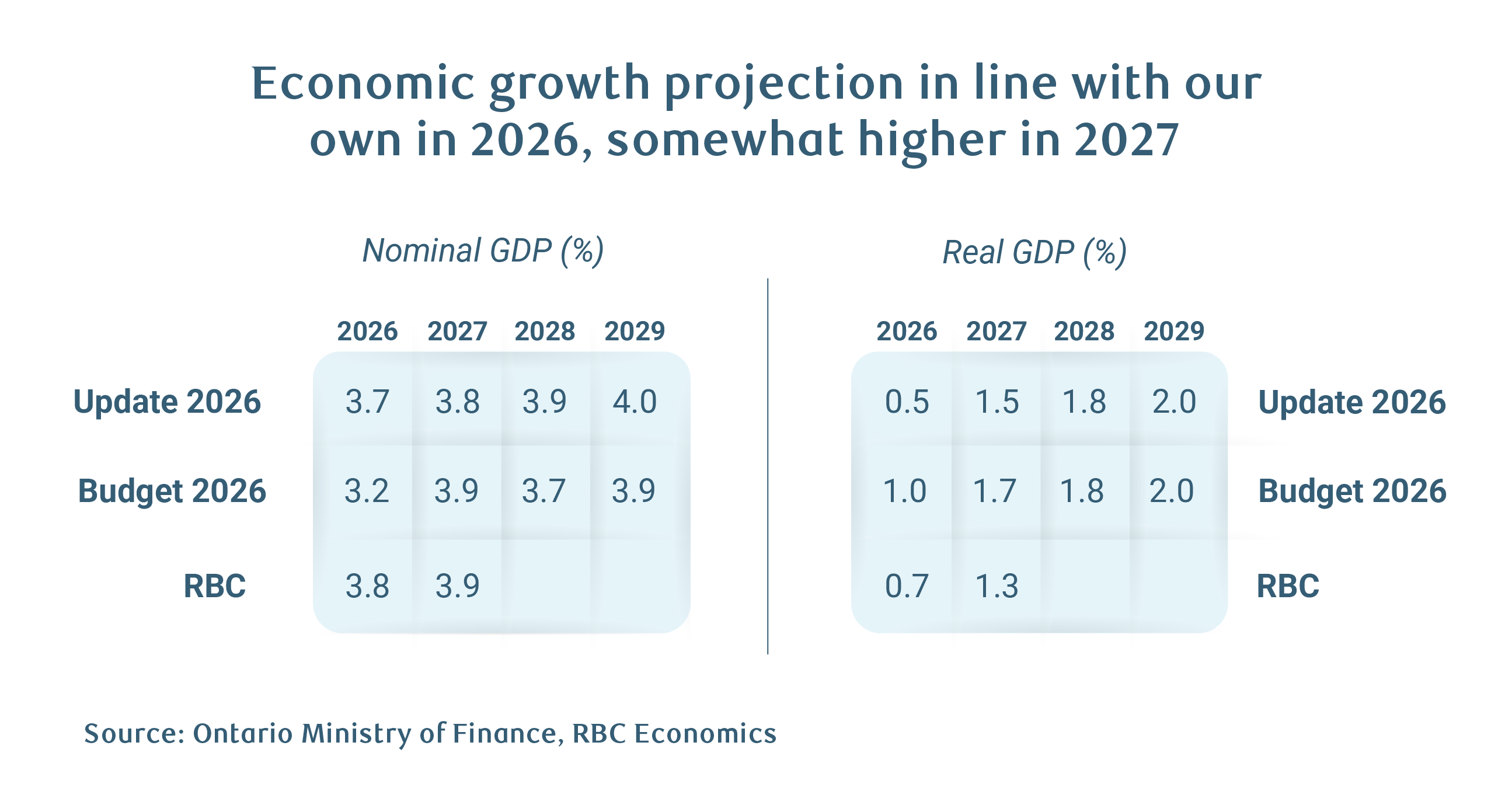
Overall, the economic growth assumptions in budget 2026 are in line with our own, although the update notes it uses planning assumptions slightly below the private sector average, building in another buffer to headline numbers.
Fiscal cost of mega deduction to outpace direct growth payoff
We believe that the new corporate mega deduction will lead to a permanent lift in growth over time – this would benefit provincial finances. By convention, fiscal outlooks do not include the dynamic revenue impacts of new measures. However, on its own, the growth lift of the measure should be modest – we estimate about +0.2% to GDP nationally over the next decade, back weighted. Further, as the measure applies to existing, as well as new investment, we expect its fiscal cost to outpace its direct growth payoff.
Spending growth forecast is low again, by design
Annual expense levels are close to the 2026 budget throughout the projection period, although 2026-27 was marked higher. This is something we predicted in our budget 2026 analysis: the budget assumed low annual spending growth of 2.4% for 2026-27, which is revised higher in the update to a more realistic 4.7%. The revision was mostly attributed to topping up the contingency fund, for potential program or compensation pressures.
For the outer years, projected overall spending growth remains very low – 0% in 2027-28, 1.4% in 2028-29 and 1.2% – and program spending growth is even weaker (it falls in 2027-28), given higher assumed growth in public debt charges.
This forecast is equivalent to real per capita spending declines when accounting for projected inflation and population growth.
The government says it is intentionally keeping expenditure growth restrained relative to revenue growth to maintain fiscal responsibility, with elevated contingencies in place to address unexpected challenges. However, the update’s contingencies are doing triple duty – against tariffs, the mega deduction, and spending pressures – even if elevated.
Unfortunately, Ontario’s greater relative discipline over the last decade in containing growth in the public service versus Ottawa and other provinces, mean there is likely less low-hanging savings to be harvested from government operations. Still, the document highlights how the government is trying to find efficiencies.
Update 2026 has no major new measures that were not announced prior.
Debt ratio ends higher by end of projection period but still within fiscal anchor
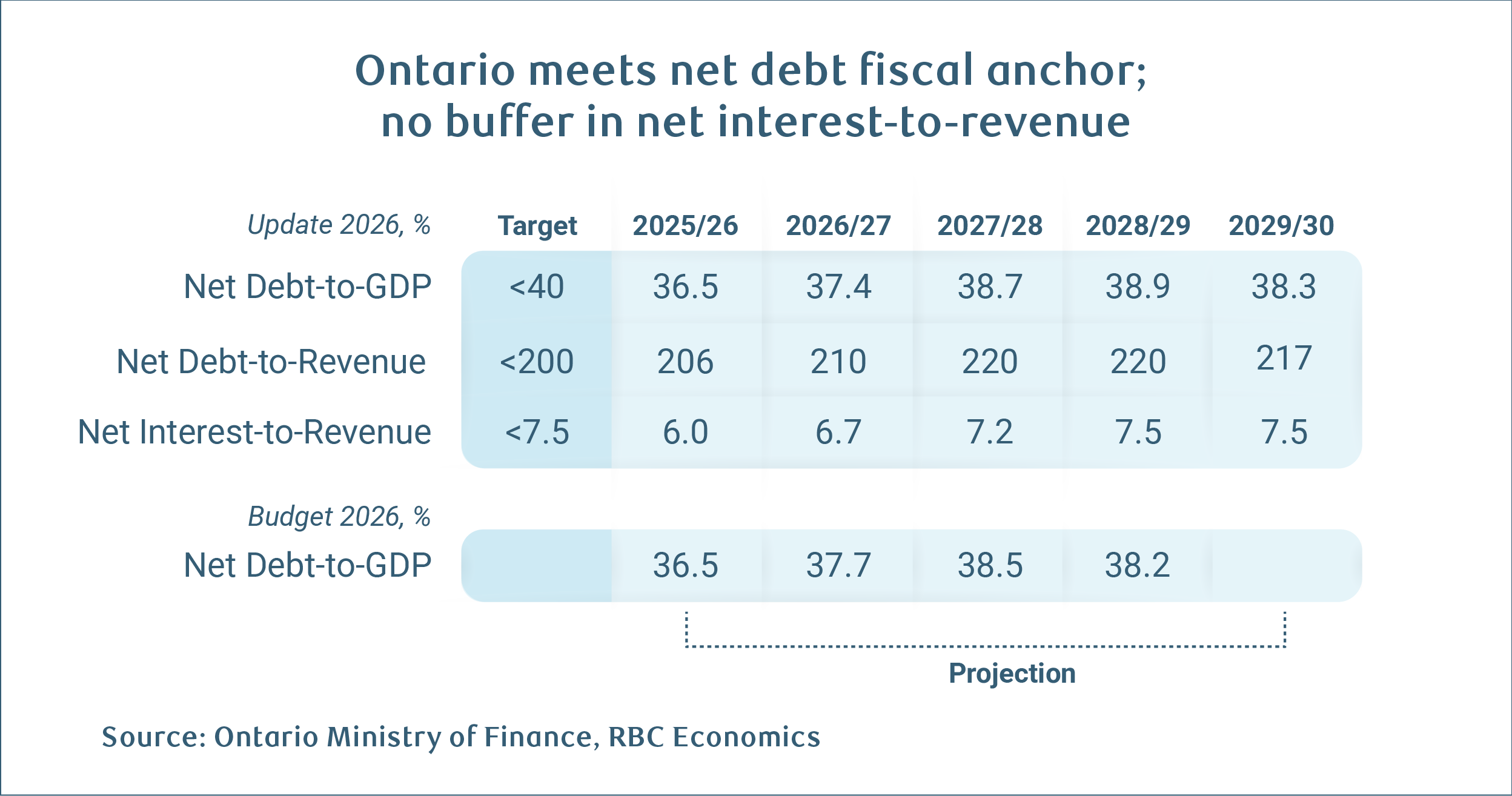
Despite a higher deficit path, the net debt-to-GDP ratio follows substantially the same profile as in budget 2026 in the early years, benefiting from upward revisions to nominal GDP. By the end of the projection period, however, the debt burden ratio is higher than budget, with only a very small projected decline in the added year, 2029-30. This ratio is now expected to trend upwards for 5 consecutive years (versus 4 prior) before stabilizing.
The debt ratio remains below the government’s 40 per cent fiscal anchor throughout the projection period, while the net debt-to-revenue measure continues to be above the government’s anchor – as it has been in recent cycles.
However, update 2026 sees borderline slippage on the third anchor centred on net interest-to-revenue. Whereas, budget 2026 had the province continuing to meet 2 out of 3 of its fiscal anchors throughout the forecast period with some buffer, update 2026 has the outer years’ net interest-to-revenue measure at 7.5 per cent, right against the government’s <7.5% anchor.
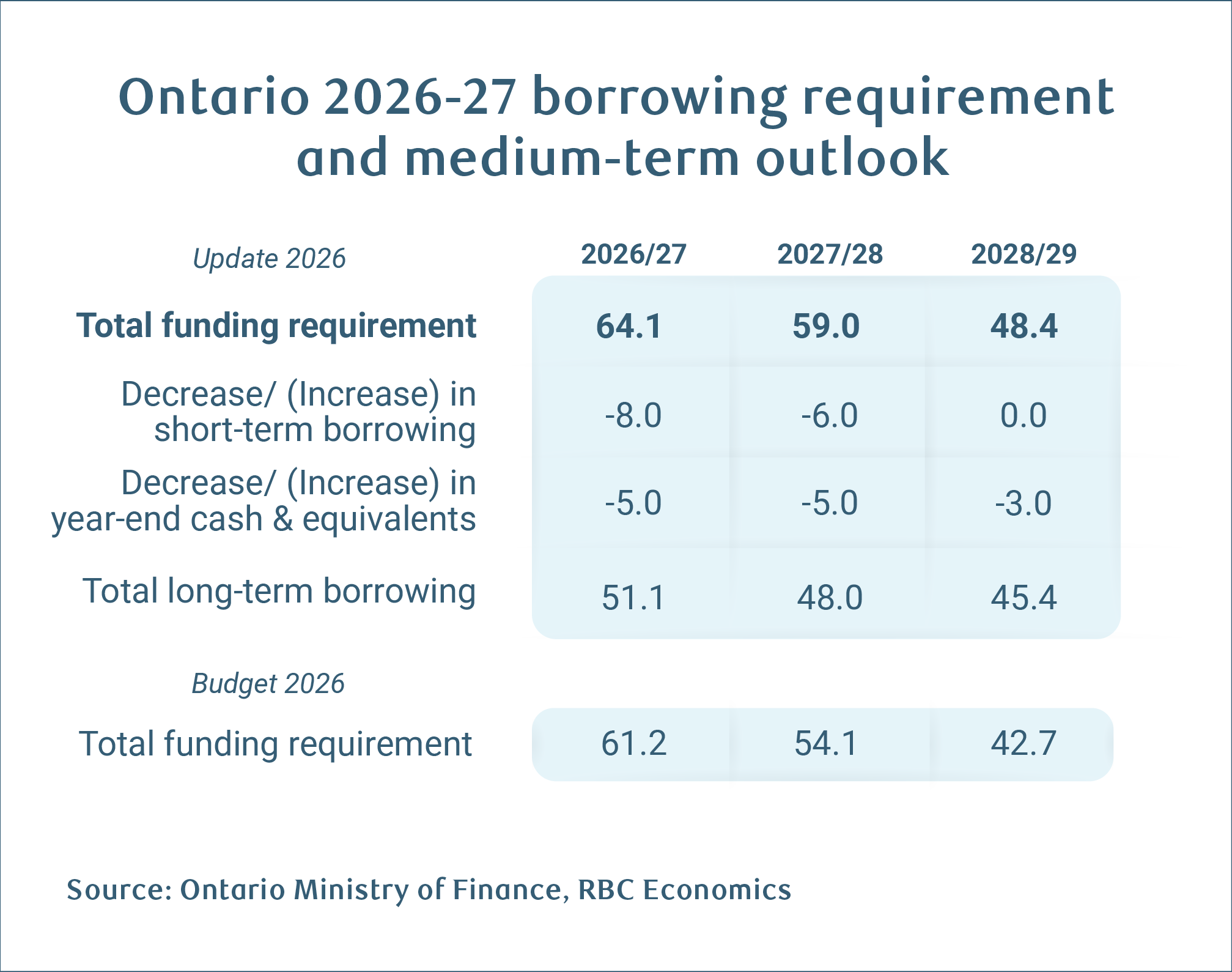
Update 2026 shows no change to the capital plan’s near-term spending or 10-year envelope. Meanwhile, funding requirements have been revised upwards consistent with higher deficit spending.
About the author:
Cynthia Leach is Assistant Chief Economist at RBC covering the team’s medium-term economic analysis, including primary research areas of federal and provincial fiscal analysis, structural government policy, and demographics.
This article is intended as general information only and is not to be relied upon as constituting legal, financial or other professional advice. The reader is solely liable for any use of the information contained in this document and Royal Bank of Canada (“RBC”) nor any of its affiliates nor any of their respective directors, officers, employees or agents shall be held responsible for any direct or indirect damages arising from the use of this document by the reader. A professional advisor should be consulted regarding your specific situation. Information presented is believed to be factual and up-to-date but we do not guarantee its accuracy and it should not be regarded as a complete analysis of the subjects discussed. All expressions of opinion reflect the judgment of the authors as of the date of publication and are subject to change. No endorsement of any third parties or their advice, opinions, information, products or services is expressly given or implied by Royal Bank of Canada or any of its affiliates.
This document may contain forward-looking statements within the meaning of certain securities laws, which are subject to RBC’s caution regarding forward-looking statements. ESG (including climate) metrics, data and other information contained on this website are or may be based on assumptions, estimates and judgements. For cautionary statements relating to the information on this website, refer to the “Caution regarding forward-looking statements” and the “Important notice regarding this document” sections in our latest climate report or sustainability report, available at: https://www.rbc.com/community-social-impact/reporting-performance/index.html. Except as required by law, none of RBC nor any of its affiliates undertake to update any information in this document.

