

 EN



The Q3 Business Outlook Survey highlights the increasingly contentious growth-inflation trade-off confronting the Bank of Canada ahead of its upcoming policy decision.
Conditions among firms generally improved through early August, but evidence collected after the breakdown of Canada-U.S. trade talks on August 21 pointed to renewed weakness in sentiment, exports and investment alongside rising inflation expectations.
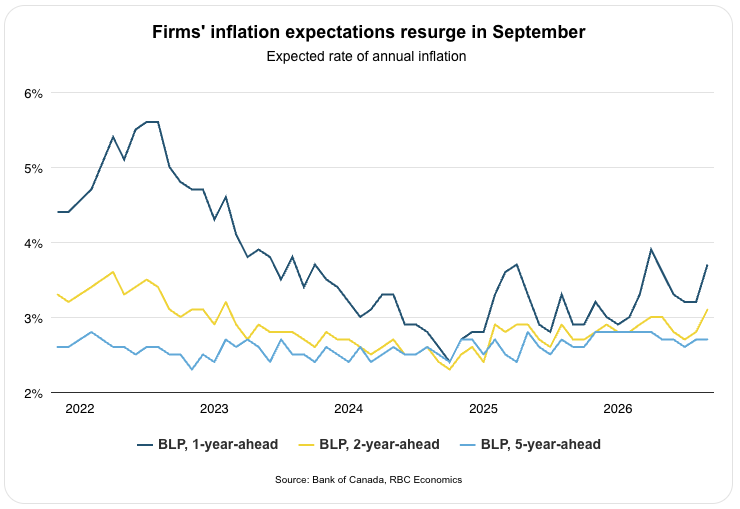
Firms’ one- to two-year-ahead inflation expectations declined between May and August as oil prices and trade uncertainty moderated, but resurged in September to near spring highs as those trends reversed.
Concerningly, half of firms surveyed—more than last quarter—plan to pass on cost increases to customers. Although stabilizing demand and firms’ desire to recover compressed margins are also driving pass-through.
Odds for an October BoC rate hike rose significantly over the weekend following Governor Macklem’s hawkish comments. But this morning’s September CPI data showed core inflation measures averaging 1.9%, while the separate consumer survey suggested weaker spending intentions ahead.
We continue to see fragile economic recovery as the biggest counterweight to heitened inflation risks, and expect caution from the BoC, especially when rising bond yields are already tightening financial conditions and raising borrowing costs for businesses and households.
Risks to our base case forecast of no rate hikes until 2027 are tilted toward earlier moves – including potentially as early as next week’s Decision.
Business sentiment worsened after trade talks collapsed
Business sentiment and sales outlooks improved through August 21 after deteriorating in Q2, reflected reduced external headwinds, somewhat stronger consumer demand for budget offerings and tourism, and continued public infrastructure and defence spending support. The share of firms planning for a recession over the next 12 months fell to 6% from 17%—the lowest since 2023.
However, three-quarters of responses were collected before the trade breakdown. Firms surveyed after August 21 reported markedly weaker sentiment, lower export expectations and higher inflation expectations. Businesses have been adapting to tariffs through supply chain modifications, efficiency improvements, export market diversification and in some cases, scaling back capacity.
Investment plans are robust but hiring demand remains soft
Investment intentions eased slightly in Q3 but remain robust. Outlooks are strong in natural resources sectors, supported by strong demand and elevated commodity prices. Across sectors, firms planned to invest more in digital technologies and AI-embedded automation. Investment intentions retreated once again according to evidence collected after August 21.
Employment intentions remain soft and below historical averages. Most firms plan unchanged headcounts, citing sufficient capacity. There was a larger share of firms noting challenges with hiring, with shortages mostly concentrated in skilled trades and specialized technical positions in rural areas and some linking it to immigration policy changes. Still, reports of binding labour shortages were roughly unchanged and remain below historical levels in Q3.
Half of firms plan to pass through cost increases in Q3
Sufficient labour capacity is consistent with wage growth expectations remaining near historical averages, unchanged since mid-2024. Roughly half of firms—more than last quarter—plan to pass on some or all of their cost increases to customers, reflecting not just supply pressures but also improved demand conditions and efforts to recover margins compressed by earlier cost increases.
Firms’ near-term inflation expectations remained below elevated April levels through July and August but rose sharply in September, to 3.7% one-year-ahead and 3.1% two-years-ahead. Five-year expectations remained roughly unchanged. Concerningly, almost one-quarter of firms said it was “too hard to say” when inflation will return to 2%, reflecting greater uncertainty.
Consumer near-term inflation expectations were little changed at elevated levels. New development in Q3 was that longer-term (five-year-ahead) expectations rose significantly to match elevated shorter-term expectations, driven primarily by the ongoing war in the Middle East.
Consumer spending plans weakened despite better financial health
Consumer spending intentions edged lower despite improved financial health perceptions driven by higher asset values and greater labour market confidence. High prices and economic uncertainty remain top barriers to spending. Nearly half of consumers believe the most serious effects of trade tensions are still ahead and plan to defer major purchases. Spending plans were also weaker among households expecting higher inflation from the Middle East conflict.
Labour market perceptions improved modestly but remain below average in Q3, in part reflecting strength among natural resource sectors. Workers in trade-exposed sectors reported better conditions before tensions re-escalated in late August, though job-loss concerns remain elevated.
AI adoption accelerating among firms and workers
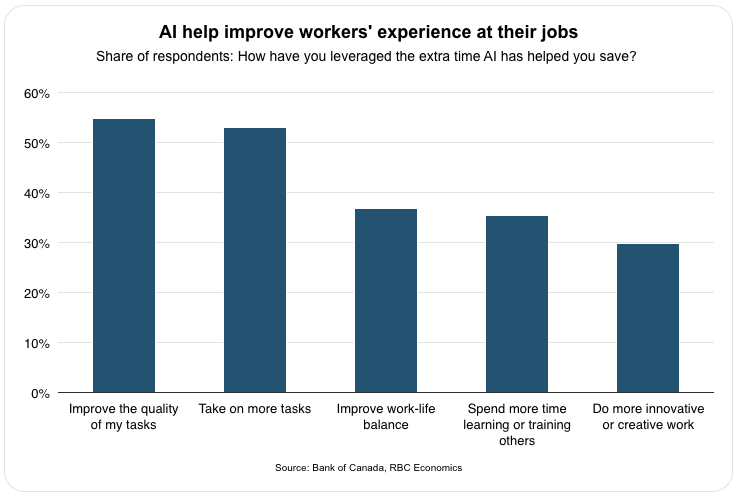
Finally, firms across sectors are increasingly investing in AI-embedded automation to improve efficiency and offset higher costs, enabling them to meet demand increases without expanding headcounts. Workers in sectors with higher AI task-replacement risk, however, continue to report weaker labour market perceptions and lower confidence in finding alternative employment.
About 40% of workers now use AI at work—mostly generative AI tools—typically three to four days weekly for less than an hour daily. Despite modest active usage, productivity gains are significant: workers estimate they would need about five additional hours weekly to complete the same work without AI. Just under one-fifth of non-users expect to begin using AI over the next 12 months.
About the author:
Claire Fan is a senior economist at RBC. She focuses on macroeconomic analysis and is responsible for projecting key indicators including GDP, employment and inflation for Canada and the US.
This article is intended as general information only and is not to be relied upon as constituting legal, financial or other professional advice. The reader is solely liable for any use of the information contained in this document and Royal Bank of Canada (“RBC”) nor any of its affiliates nor any of their respective directors, officers, employees or agents shall be held responsible for any direct or indirect damages arising from the use of this document by the reader. A professional advisor should be consulted regarding your specific situation. Information presented is believed to be factual and up-to-date but we do not guarantee its accuracy and it should not be regarded as a complete analysis of the subjects discussed. All expressions of opinion reflect the judgment of the authors as of the date of publication and are subject to change. No endorsement of any third parties or their advice, opinions, information, products or services is expressly given or implied by Royal Bank of Canada or any of its affiliates.
This document may contain forward-looking statements within the meaning of certain securities laws, which are subject to RBC’s caution regarding forward-looking statements. ESG (including climate) metrics, data and other information contained on this website are or may be based on assumptions, estimates and judgements. For cautionary statements relating to the information on this website, refer to the “Caution regarding forward-looking statements” and the “Important notice regarding this document” sections in our latest climate report or sustainability report, available at: https://www.rbc.com/community-social-impact/reporting-performance/index.html. Except as required by law, none of RBC nor any of its affiliates undertake to update any information in this document.

