Central to Growth: How Indigenous equity can be a source of strength for Canada
Author: Varun Srivatsan
All eyes were on the election this week—but something else remarkable was taking place, too. Many of the country’s top Indigenous leaders came to Toronto, and Bay Street, to see how we can better mobilize capital for Indigenous-partnered projects. These conversations are central to the questions we’re grappling with as a country–including reimagining our relationship with our closest ally and building up our economic strength.
The two outcomes—of the election and economic reconciliation—are closely related. Indeed, our economy and trade won’t grow and diversify if we don’t ensure a lot more Indigenous ownership. That was the focus of the annual First Nations Major Projects Coalition Conference, in Toronto, which drew nearly 2,000 people to explore the future of Indigenous capital—and how it is a source of strength for Canada in an increasingly competitive world.
Here’s some of what we took away, and questions we need to keep asking:
From critical minerals to hydro and natural gas, Canada’s ability to build resource projects at speed and scale will come down to 3Cs: capital, capacity and consent. Can we develop those together?
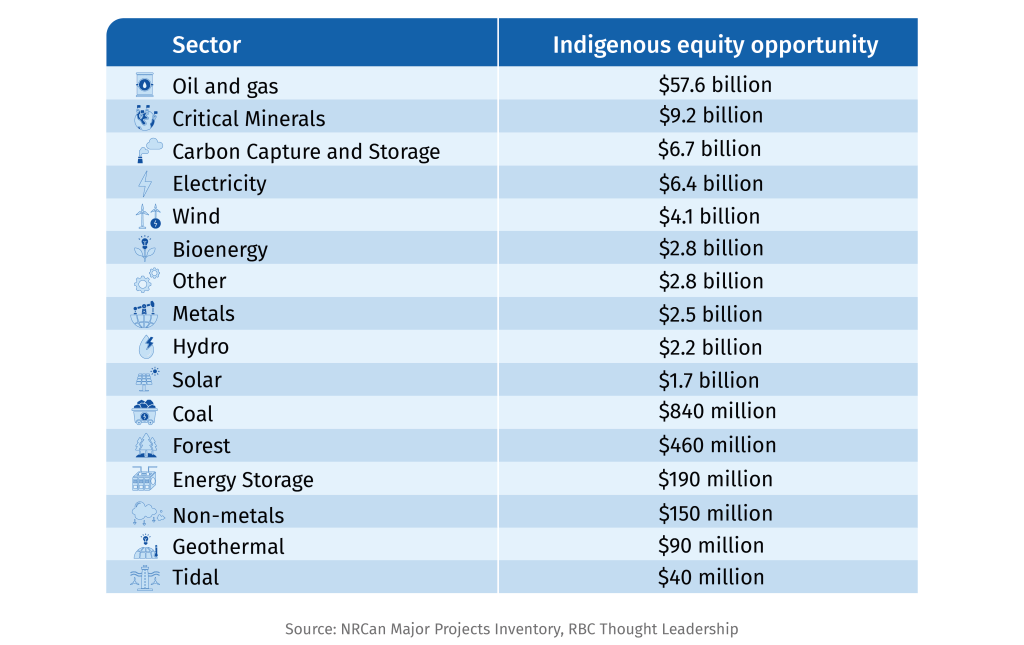
Our research shows that there is an Indigenous equity opportunity of close to $100 billion over the next decade. How can governments mobilize concessional tools to attract more private capital?
Government loan guarantees are in fashion, with the Carney government committing to double its program to $10 billion and Ontario using the conference to announce a tripling of its program to $3 billion. How can those programs be better coordinated and implemented at a faster click?
Equity may not be the most appropriate tool for some communities. Can we also promote new debt instruments, royalty models and procurement agreements for communities to invest in?
Indigenous capital is being built up quickly–from project participation to trust settlements. What structures can help us pool this capital–and reinvest returns back into Indigenous Nations?
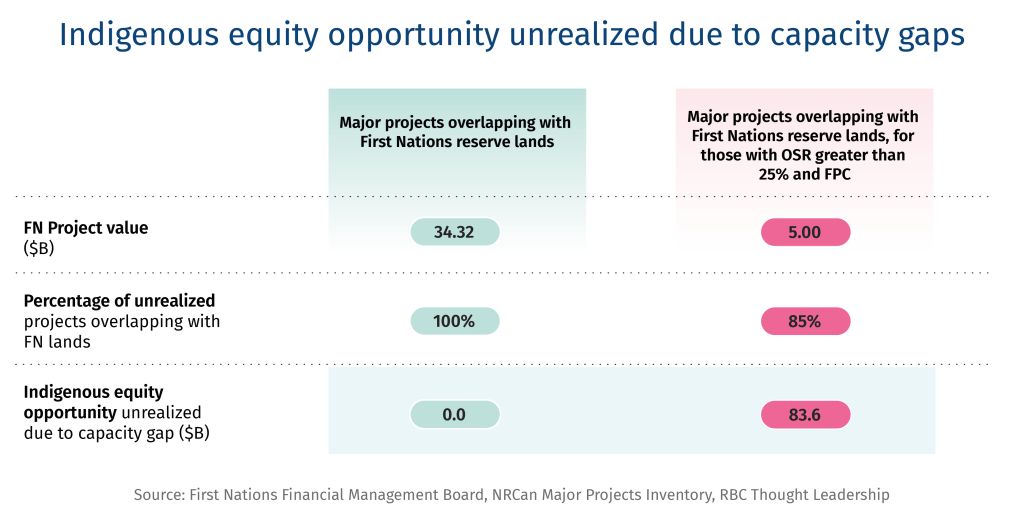
Most communities need a lot more capacity—from finance to engineering and legal—to make these deals and projects work. In fact, our research suggests close to 85% of these projects may be unrealized without plugging the capacity gap. How can we invest more in scholarships, training, work placements and exchanges—for companies as well as communities?
Capital and capacity are useless without consent, which is more than a one-off vote, or signature. Can we develop accepted, non-binding approaches to consent that allow both parties to develop and deepen their trust and confidence?
Voice is a critical part of consent. How do we know if each partner feels they have a respected voice?
Time is of the essence. Can companies and communities create clearer approaches to timelines, and time expectations, for projects?
Uncertainty is the enemy of investment. Can co-developed models for Indigenous consent become one of Canada’s advantages with global investors?
Indigenous priorities are not diversity issues—they undergird the Constitution of our country and how our country is constituted. How can we more boldly state that Indigenous partnerships are a foundational part of operating in Canada?
Small businesses and projects tend to be excluded from these major project conversations, and yet are crucial for the success of our economy. How should we better raise capital for small business collectives and projects?
John Stackhouse, Senior Vice-President, Office of the CEO, RBC
Varun Srivatsan, Director, Policy and Strategic Engagement
Canada could be on the verge of a historic investment boom. The trade war with the U.S., an increasingly divided global economy, concerns over Arctic security and an AI revolution that comes with enormous energy requirements—all point to the need for more economic and security infrastructure. But those diverse ambitions, from northern ports to West Coast LNG to critical mineral plants, have a common requirement: Indigenous partnerships.
Canada’s future growth and prosperity depends heavily on getting Indigenous economic reconciliation right. If not, the country’s ability to diversify our resource exports, enjoy independence and resiliency in strategic sectors, and improve productivity, which has lagged that of other countries for years, are all at risk. And that’s not the only thing at stake. As RBC Thought Leadership’s research indicates, 73% of the 504 major resource and energy projects planned or currently underway in Canada run through, or are within a 20-kilometre radius of, Indigenous territories—namely, treaty, title unceded and consultation lands. The value of the Indigenous equity opportunity of those projects alone is $98 billion over the next 10 years.
Canada can’t afford to miss out on the opportunity. Fortunately, examples of Indigenous economic reconciliation in action span the country, including:
In Kitimat, B.C., the Haisla Nation and Pembina Pipeline are working on the Cedar LNG project, a four-year partnership that will result in a $4-billion facility. Once operational, this majority Indigenous-owned facility is expected to generate $85 million in GDP annually.
In several Manitoba and Nunavut communities, the Kivalliq Hydro-Fiber Link seeks to provide clean energy through a proposed 1,200-kilometre energy and telecommunications corridor connecting Nunavut with Manitoba’s grid.
In the small southwestern Ontario town of Jarvis, the Oneida Battery Storage Project will be one of North America’s largest battery-storage facilities when it comes online. Partly owned by Six Nations of the Grand River Development Corporation, Oneida will provide much-needed capacity to Ontario’s strained electricity grid.
While these projects illustrate progress, more can be done. Centuries of treaties, Nation-to-Nation and business agreements, and case law have underscored the centrality of Indigenous peoples in Canadian decision-making, particularly in building up infrastructure and resource projects. The Constitution Act of 1982, particularly Section 35, recognized and affirmed Aboriginal and treaty rights in the Canadian legal and political fabric. Supreme Court cases, including Calder, Delgamuukw and Tsilhqot’in, further affirmed Aboriginal rights and title—the inherent right to use and jurisdiction over an Indigenous Nation’s traditional territory.
One of the key principles enshrined through the Constitution and case law is maintaining the Honour of the Crown—a legal concept characterizing the fiduciary duty imposed on the Government of Canada toward Indigenous peoples. One of the duties that this principle imparts on the Crown is the duty to consult and accommodate. When the Crown engages in an activity that could have a negative effect on an Aboriginal right or title, it must consult with the relevant Indigenous groups and accommodate these infringements. This duty has been affirmed through case law and is characterized in the Nation-to-Nation relationship between Indigenous peoples and the Government of Canada.
The United Nations Declaration on the Rights of Indigenous Peoples (UNDRIP) advanced the concept of free, prior and informed consent (FPIC). This is a pro-active means for governments (and businesses) to seek and achieve consent on developments occurring on Indigenous territories. UNDRIP is now law federally, as well as in British Columbia and the Northwest Territories.
Together, the duty to consult and FPIC provide the framework and requirements for the way governments and businesses engage with Indigenous Nations on projects happening on their lands or implicating their interests.
What’s needed now is bold, innovative thinking. And it starts by finding ways of unlocking three critical elements:
CAPITAL: Indigenous ownership in major projects requires a mix of private and concessional financing tools, including loans, loan guarantees and grants. Without access to capital, a historic challenge for Indigenous Nations, many equity opportunities, and indeed, entire projects, may not get started.
CAPACITY: Rights-based negotiations, along with commercial and legal discussions around major project development, are complex and requires investing in capacity for everyone at the table—Indigenous Nations, governments and business—to ensure project success.
CONSENT: The constitutional duty to consult and accommodate, UNDRIP, case law, and decades of legal and political developments have cemented how important free, prior and informed consent is to project development. The downpayment needed to seek and achieve FPIC is long-term, trust-based relationships across all parties, which requires going beyond transactional project discussions.
Advancing all three elements—capital, capacity and consent—in parallel is necessary to bringing Indigenous Nations along as true partners in economic development. Through a collective call for action, led by Indigenous Nations and closely supported by businesses and governments, there is an opportunity to generate shared prosperity—and get Canada building at speed and scale.
Capital
Access to affordable capital is a persistent challenge for members of Indigenous communities, caused in part by institutional barriers set up by Canadian governments. Risk premium for Indigenous borrowers is impacted by rating agencies, and by extension, financial institutions’ risk and liability considerations. This is partly due to First Nations communities being unable to collateralize reserve land under Section 89 of the Indian Act; Metis communities being unable to leverage a land base and access federal funding; and Inuit communities finding it challenging to secure project funding in remote, rural areas. As we outlined in previous reports, loan guarantees and other financing tools can help address access to capital and risk issues.
Historically, the speed of implementation and scaling of these tools has been slow, while capital needs are only growing. This ranges from an infrastructure capital gap of up to $270 billion1, a $30-billion gap in critical minerals2, and a $60-billion gap related to climate-aligned investments in carbon capture, electricity and renewables3. The support of both private and public lenders is needed to meet demand.
The Canada Infrastructure Bank (CIB) stepped up recently, committing $1 billion to its Indigenous Equity Initiative. CIB’s equity grants, ranging from $5 million to $100 million, have a 15-year repayment target. And in early 2024, the money started to flow. That’s when CIB issued its first Indigenous equity loan, committing up to $18 million to Wskijinu’k Mtmo’taqnuow Agency Ltd. (WMA), a limited partnership owned by 13 Mi’kmaw communities. The financing allowed WMA to take an equity stake in the Nova Scotia Energy Project, Canada’s largest planned battery storage initiative.
Another important source has been the First Nations Finance Authority (FNFA), which has enabled First Nations economic development through a pooled borrowing facility. By issuing debentures on behalf of First Nations (certified by the First Nations Financial Management Board for a clean balance sheet and good financial management practices), the FNFA has borrowed $3 billion for its members toward critical, revenue-generating projects—creating an economic output of $6.3 billion.
These aren’t the only examples of progress when it comes to unlocking capital. Last year, three loan-guarantee programs were announced. One at the Federal level (recently increased from $5 to $10 billion) and two at the provincial level—B.C. ($1 billion) and Manitoba ($500 million).
The various access-to-capital tools currently available amount to about $20 billion. And based on the amount of private investment these concessional financing tools have crowded-in, there is potential to mobilize close to $48 billion in Indigenous equity investments. This leaves a concessional financing gap of $20.7 billion and a private financing gap of $28.7 billion4.
While gaps remain, there’s more capital flowing than ever. And it’s leading to action. Between 2022 and 2024, 111 Indigenous communities announced that they had acquired an equity stake in an infrastructure project, according to a report by the Toronto-based law firm Fasken Martineau DuMoulin LLP last April. More than a quarter (26%) of those were in Alberta, home to the $3-billion Alberta Indigenous Opportunities Corporation Loan Guarantee Program. Wind generation projects resulted in a spike in Nova Scotia (23%). And B.C. rounded out the top 3 with 18%. And that was before the launch of the province’s loan guarantee program noted above5.
From a private financing standpoint, approaches to risk management need to accommodate unique Indigenous concerns, with banks recognizing that if project economics are sound, Indigenous borrowers should have an opportunity to be treated on equal footing to other market borrowers.
For existing and announced access-to-capital tools, prioritize speed to implementation, a risk-accommodative approach, and broader sectoral scope, spanning not just resource and energy projects, but infrastructure, transportation, agriculture, fisheries—essentially, any sector with a nexus between Indigenous interests and a national economic imperative.
Capacity
The added complexity of major project development requires capacity building on all sides. This includes education and training required for businesses and governments to better understand Indigenous histories, economies, cultures and priorities. For Indigenous Nations, this can include everything from financial, legal and engineering capacity required for commercial negotiations, to the environmental, historical and legal support needed to participate in regulatory and rights-based discussions. It is important to recognize that Indigenous capacity has always existed, whether through trade networks, economic systems, governance models and traditional knowledge that Indigenous Nations have built up over centuries.
Two (imperfect) measures of fiscal and economic capacity are the ability of Nations to be able to raise own-source revenues (revenues not generated through governmental transfers) and maintain financial and governance controls. We assume two proxies for these measures—own-source revenues greater than 25% of total revenues in a First Nation, and a First Nation receiving the Financial Performance Certification. The FPC is a voluntary, independent assessment by the First Nations Financial Management Board certifying good financial health and ability to borrow from the First Nations Finance Authority.
Our research indicates that capacity gaps put 85% of projects that pass through First Nations territory at risk. That’s an estimated $83.6 billion in project value.
Project Rocket, a partnership between 23 First Nations and Metis communities and Enbridge, resulted in capacity building that benefits all parties. The partnership involved the creation of Athabasca Indigenous Investments, the special-purpose vehicle behind the Indigenous Nations taking on an 12% equity stake—valued at $1.1 billion—in seven pipelines. In addition to the potential economic benefits, the dealmaking process provided technical, legal and commercial capacity for Indigenous Nations, as well as the proponents and financial intermediaries. Agreements that include multiple Nations, like this one, allow better resourced and experienced Nations to share their expertise, ultimately making it more replicable and scalable.
Indigenous-corporate partnerships, including secondments, knowledge sharing, and leader-to-leader forums can help hone capacity.
By bridging corporate and Indigenous Canada, organizations such as the First Nations Major Projects Coalition and the Canadian Council for Indigenous Business enable relationship and capacity building, and uplift Indigenous businesses and governments. Organizations like FNMPC and CCIB are positive models to emulate and scale across the country, to provide mentorship, skills-development, environmental and economic tools, procurement strategies and project-level negotiation support for and with Indigenous Nations.
Capacity building with lending or M&A teams for proponents and financial institutions must be prioritized. This can help ensure lending team members are educated on Indigenous history, economic-development priorities, and the lens through which teams must engage with Indigenous Nations.
An important consideration for businesses is whether to build capacity internally—through targeted hiring and training—or to enhance capacity through acquiring existing organizations with the right mix of commercial knowledge and Indigenous community-level expertise.
Governments should consider dedicating 2-5% of grants, loans and guarantee funds toward capacity, to empower Indigenous Nations with the right information and ability to negotiate agreements with better-resourced private-sector counterparts. Between 2% and 5% is a guideline based on past transactions.
Consent
The nature of consent varies from community to community, and project to project. Getting to a shared understanding of consent is challenging and intersects with constitutional (Section 35 and the duty to consult) and international legal obligations (UNDRIP). However, there are some necessary, but not sufficient, conditions for achieving and maintaining consent, which include engaging early and often, economic partnerships, and inclusion of Indigenous Nations in the regulatory process.
A big part of getting projects built is the permitting and regulatory process. Part of the process is seeking informed Indigenous engagement, and, where required, consent. The Government of Canada has a duty to consult and accommodate Indigenous groups when its actions may impact potential or established Aboriginal or treaty rights—a duty that has been affirmed by the courts and the constitution. As such, expediting permitting timelines, although an important objective to speed up project development, cannot be done in a vacuum without the Crown discharging its duty to consult. Proponents have an important responsibility and role to play in building deep trust-based relationships with Indigenous Nations, and through that process, seek and achieve consent.
The Cedar LNG project illustrates how federal, provincial and Indigenous Nations can expedite the permitting process. The federal government, through a process called substitution, eliminated the duplication of two assessments for a single project. And the B.C. government worked in close partnership with the Haisla Nation to identify and mitigate environmental, social, health and economic impacts—a process that was accelerated in no small part because Haisla Nation is a co-owner in the project—resulting in a shorter and less contentious permitting process (notwithstanding ongoing concerns of the project by other Nations).
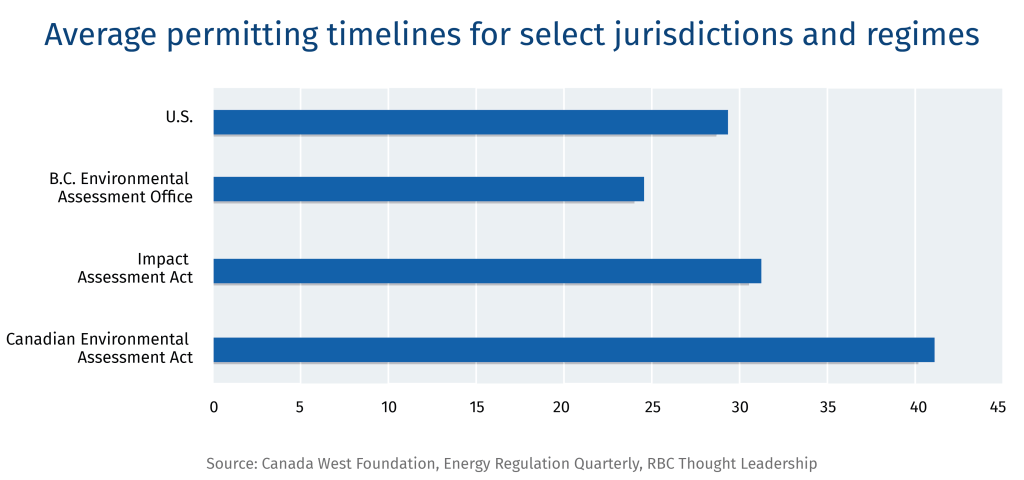
While equity ownership by the Haisla Nation on Cedar LNG likely moved things along more quickly, average assessment timelines in B.C. are, generally, some of the shortest in the country. This is partly due to proponents engaging early and often with Indigenous Nations, and provincial regulators increasingly empowering Indigenous Nations to lead assessments. The B.C. Environmental Assessment (EA) process, can integrate Indigenous-led assessments through substitution, delegation or other mechanisms. It yields a process that is 5 to 15 months shorter than the average timelines of two long-standing federal regimes and the U.S. permitting process. Federally permitted projects, particularly those that cross provincial boundaries, are complex, requiring longer permitting times. Still, the B.C. experience suggests a permitting process that incorporates Indigenous views, processes and knowledge can facilitate trust and social license.
The Eskay Creek Consent-Based Decision-Making Agreement, and the Squamish Nation Environmental Assessment Agreement both provide blueprints for how consent can be operationalized through the environmental assessment and permitting process.
The agreement, pertaining to the reopening of the Eskay Creek gold and silver mine in northern B.C., was set up under section 7 of the Declaration Act (B.C.’s legislation aligning its laws to UNDRIP). As part of the deal, the modified EA process seeks consensus through a collaboration team between the Tahltan Nation and B.C., a Tahltan risk assessment, free, prior and informed consent on the final decision, and independent dispute resolution. The agreement provides a unique model for joint decision-making, a shared environmental assessment and sustaining social license.
The Squamish Nation EA process involving the Woodfibre LNG plant and export terminal in B.C., was the first-of-its-kind legally binding, Indigenous-led EA process in Canada. A framework agreement enabled the Squamish Nation to set up a process outside the provincial and federal EA regimes. What enabled success was a parallel process of environmental and socio-economic information collection and analysis, with the final decision-making resting with the Squamish Nation Chief and Council, enabling accountability at both the technical and political levels. Buy-in for the Indigenous-led EA from federal and provincial governments, and the proponent, was crucial. And all three parties could be confident that the review addressed Squamish Nation’s concerns and interests—important for consistency of social license and support.
These approaches are not without challenges—as other Nations may seek to assert jurisdiction over those that are leading the EA process, or substantially support project development. Furthermore, this does not obviate the opposition of other interest groups, such as environmental or social groups. Nonetheless, they provide useful models of operationalizing consent through a collaborative assessment process.
Some key principles for businesses and governments when seeking and maintaining consent:
Indigenous-led assessments is one way. So is including Indigenous legal orders, traditional knowledge, values and priorities into the regulatory and assessment process through a co-assessment of projects, or the meaningful delegation of certain aspects of a project to Indigenous governments.
Relationships take investment—both time and money. Governments and businesses cannot engage on project-related issues without meaningfully building relationships to maintain consent, trust and social license for project development.
Information sharing and transparent discussions between proponents, government and Indigenous Nations is imperative.
This is challenging as it depends on both legal definitions on which First Nations the government has to discharge the duty to consult and accommodate, as well as relationship-based measures that can provide an indication of which Nations to consult. Building strong and lasting relationships with Nations, regardless of having to discharge the duty of consult, is a best practice.
Moving forward: Considerations for Canada
The geopolitical tensions with our closest ally have exposed the fault lines of Canada’s economic strategy. Trade diversification, massively building up our resource and infrastructure base, resolving internal trade once and for all, and moving up the product value chain have all become economic imperatives. Advancing Indigenous economic reconciliation is a keystone to meeting these goals. Other considerations that will drive the conversation in Canada in the months ahead will include:
What’s on the fast-track list: Both major political parties in Canada have promised to speed up development, permitting and financing of certain trade, infrastructure and resource projects in the national interest. Virtually all of the projects that will be fast-tracked will impact Indigenous interests and run through Indigenous territories. Fulsome Indigenous engagement and partnerships will determine the federal government’s ability to move at speed and scale.
The renewal of the continental security agreement: The incoming federal government will likely enter discussions with the U.S. administration on renewing the economic and security framework between the two countries. The investments needed will include surveillance, domain awareness and trade infrastructure to strengthen the North. Beyond trade and security, the social infrastructure, including housing, education and healthcare facilities, need to be built up. These discussions need to happen in close collaboration with territorial governments, Inuit birthright corporations and communities in the Inuit Nunangat.
The impact of the geopolitical contest between the United States and China: As we have explored previously, critical minerals have emerged as a key element in the new great game between the two superpowers. Canada’s ability to step in as a pinch-hitter on critical minerals mining and processing will depend on our ability to tap into mineral-rich regions such as the Ring of Fire in Ontario and the Golden Triangle in B.C. The Tahltan Nation, whose traditional territories cover 70% of the Golden Triangle, have been supportive of mineral exploration. But Indigenous claims and partnerships are yet to be resolved in the Ring of Fire—a question that will challenge other mining regions in Canada.
Generational changes in the global trading system: Changes in international trade and investment flows have countries seeking sources of economic resilience. That includes diversifying markets, but also reshoring parts of their value chain. Canada is no less immune. While these changes take effect, it is useful to remind ourselves that Indigenous Nations, as our youngest and fastest-growing population, are a source of strength and comparative advantage.
Our ability to move fast depends on our ability to move collectively. As the late Murray Sinclair, chairman of the Truth and Reconciliation Commission, said at the release of the Commission’s final report: “We have described for you a mountain, we have shown you the path to the top. We call upon you to do the climbing.”
4. Financing gap calculations are based on the capital cost of projects implicated under treaty, title and title-like, and unceded lands, multiplied by average debt-equity ratios by sector, and industry-specific assumptions on the ratio of capital that would be Indigenous-owned. The aggregate figures across sectors are multiplied by the ratio of concessional to private capital through existing loan guarantee programs, to arrive at the concessional and private capital gap. It is important to note that of the $17 billion in concessional financing tools, about $11.5 billion has not yet been implemented.
Starting April 5th, the U.S. is imposing 10% baseline tariffs, with most countries facing a tariff rate that appears to be based on a calculation of trade deficits as a share of exports from that country. Crucially, it exempts Canada and Mexico as it’s not applied to USMCA-compliant products.
Here are six impacts we’re watching out for:
1. Canada lives to fight another day, but not without some pain.
Existing tariffs remain, including those based on IEEPA/fentanyl , steel and aluminum and auto and auto-parts that went into effect just past midnight today. Duty-free trade still applies to products that are USMCA compliant—perhaps a signal that the President still takes the agreement he signed seriously.
Most, if not all, Canadian auto manufacturers have 50% S. content, which means an effective tariff rate of 12.5%. Combined with a 70-cent Canadian dollar, it puts Canadian auto and parts makers in relatively good stead, especially in comparison to Asian and European automakers facing up to 25% in tariffs.
The story on energy is similarly that of relief—RBC Capital Markets highlighted how most, if not all, oilsands producers are USMCA compliant, and not be subject to the 10% tariff on energy. A 10% tariff on other resource products and potash, although significant, is not enough to affect producers’ bottom lines.
While we may see specific provinces and sectors negotiating for exemptions, most will likely not want to rock the boat until the federal election is over on April 28, and an economic and security partnership can be negotiated. But Canada isn’t out of the woods yet—lumber is still in the U.S. administration’s crosshairs, and President Donald Trump alluded to a longstanding irritant of his in Canadian dairy.
2. It’ll be hard to raise revenues (only) from tariffs.
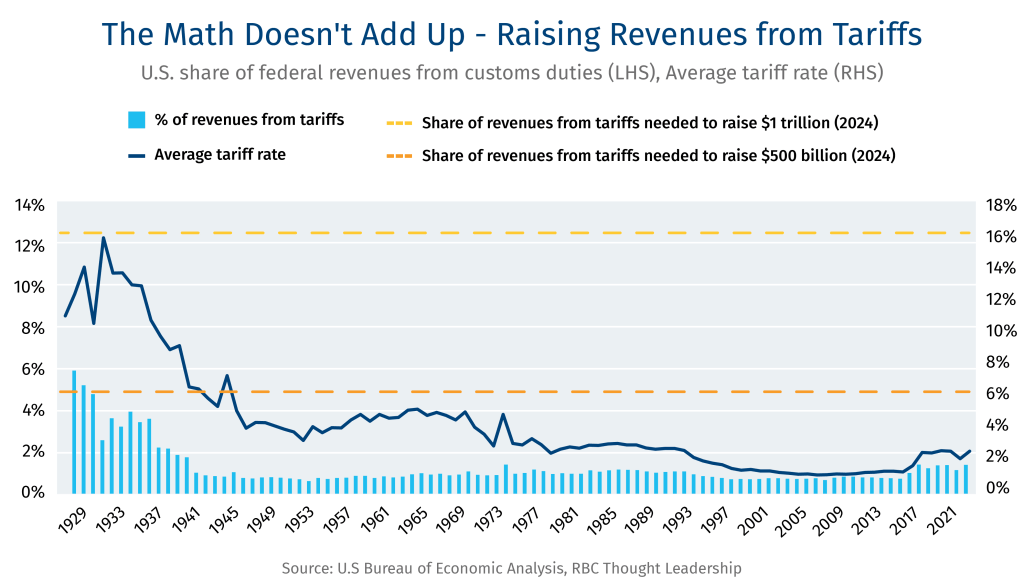
To fund tax cuts, President Trump and Secretary Howard Lutnick’s stated goals are to raise US$1 trillion in revenues from tariffs and achieve another US$1 trillion with an aggressive program of cost-cutting through the Department of Government Efficiency. But the math doesn’t add up.
The government would have to generate 12.4% of total revenues from tariffs to raise US$1 trillion—something the U.S. government has not achieved in the past century, even during the height of the Smoot-Hawley tariffs in the 1930s. Even the more modest goal of US$500 billion seems hard to achieve given the U.S. federal government hasn’t raised 6.2% of its revenues from tariffs since 1929—when the Great Depression started.
3. Will China deviate from its targeted retaliatory approach?
China now faces an effective tariff rate of 54%, on top of tariffs on steel and aluminum and those levied under the IEEPA. The Chinese government has historically responded with targeted retaliatory tariffs, particularly on agriculture and geared toward swing states or those voting Republican. However, these are the highest effective tariff rates ever levied on China. It will be interesting to see if Beijing sticks to a strategy of targeted action, or one that will be more sweeping. Regardless, a trade war between the world’s two biggest economies will cause significant economic ripples and rejig supply chains.
Of note, China recently entered exploratory talks on a regional free trade and investment agreement with Japan and South Korea, two countries that are not traditional Chinese allies. This is an important signal that countries in Asia and beyond are creating bulwarks and buffers against a United States that they increasingly see as threatening and unpredictable. These developments may isolate Canada even further.
4. The price of the climb down may be steep.
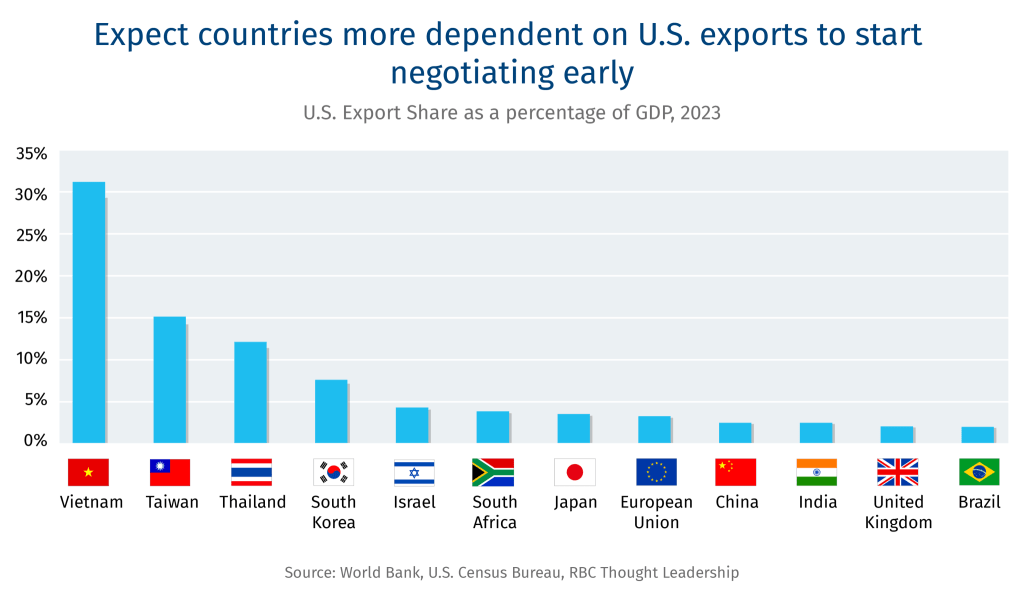
Trump explicitly signaled to countries that he was willing to negotiate concessions in exchange for reduced trade actions. The cost of these concessions will be worth watching, with the countries first in line to negotiate exemptions (especially the ones most exposed to U.S. trade actions) likely getting a raw deal. Expect the coming few days, before the tariffs officially come into force, to be a lobbying frenzy in D.C. as countries most exposed to U.S. trade action try and negotiate lower rates.
Allied Retaliation: Trump explicitly warned countries that teaming up against the United States to retaliate would yield higher tariffs. Canada may not wish to gang up against the United States as the degree of integration between our economies does not favour Canada. But expect the Canadian government to partner with allies on strategic sectors, such as critical minerals or semiconductors, to press against U.S. trade action and to share a more unified message on the costs of a full-blown tariff war on sectors with strategic or national security importance.
5. Congressional rancor over the trade deficit emergency.
On the other side of Pennsylvania Ave., the Senate voted to pass a joint resolution to strike down the emergency Trump used to levy tariffs on Canada, with four Republicans joining the Democrats. The joint resolution is unlikely to pass the House, where caucus discipline is more strongly enforced, but it is still a repudiation of Trump’s trade policies against the country’s closest ally. The President used the same authorities, stemming from the International Economic Emergency Powers Act, deeming trade deficits as a national emergency. Expect to see another fight in Congress as the legislature seeks to regain control over trade and tariff policy, and as Democrats use the joint resolution as a cudgel to split the Republicans and a referendum on Trump.
6. Global macroeconomic and supply chain shocks.
The bigger channel of impact of these tariffs—and the biggest unknown—will come from governments and businesses completely reshaping the trading links that have been built over the past century. Some companies may choose to reshore production to the United States, while many others may avoid the U.S. completely. Regardless of how the tariffs are implemented, the macroeconomic effects of uncertainty are significant and dire, as our Economics team has noted, pushing up the U.S. effective tariff rate over 20%.
Trump appears to want to achieve multiple goals through his policy instrument of choice, including reshoring investment and trade flows, strengthening the greenback, raising revenues and using tariffs as economic leverage to achieve other policy outcomes. It is unclear whether he will be able to achieve all these goals. What is clear is that this is only the beginning of a rocky ride for the global economy, and for Canada.
Varun Srivatsan is Director, Policy and Strategic Engagement, RBC Thought Leadership
Excluding energy, Canada has a trade deficit with the United States. That’s the top message Ottawa sent to Washington in a filing in response to U.S. Trade Representative’s (USTR) request for comments as it assesses the “unfair” practices of its trading partners.
U.S. President Donald Trump has decried the trade surplus Canada enjoys against the U.S., calling it “essentially a subsidy”. Ottawa’s eight-page filing, however, noted that the surplus is primarily due to American refiners’ preference for affordable, reliable Canadian fuels that Americans count on to power the U.S. economy.
Excluding energy, the U.S. has enjoyed a merchandise trade surplus with Canada since 2007, which stood at $34.3 billion in 2024. Meanwhile, U.S.’s services surplus with Canada stood at $34.9 billion.
The filing sets the stage for a Canadian response and also tries to get ahead of several sticky points that will likely come up in any future negotiations on the Canada-U.S.-Mexico Agreement (CUSMA).
Here are some of the key themes and numbers—and grievances—that emerged from Canada’s filing:
We are your biggest customer: Canada buys more U.S. goods than China, Japan, and Germany combined. Canada was the top export destination for 32 U.S. states in 2024, and buys many high-valued finished manufactured products such as equipment, vehicles, agricultural products and a wide variety of consumer goods. Some eight million U.S. jobs are tied to trade with Canada.
Canada shares American concerns over unfair trade practices: Ottawa imposed 100% tariffs on Chinese EVs and 25% on Chinese steel and aluminum products, in addition to other tariffs on Chinese critical minerals, renewable equipment etc.—all these align Canada to several U.S. actions to limit Chinese goods. Ottawa is also monitoring steel import supply chains, and amended its Investment Canada Act last year to address national—and continental—security risks.
Crucially, “Canada is considering additional measures to address risks to Canadian and North American economic security and supply chains,” to crack down on critical mineral being sourced from “jurisdiction of concern.” Equally critical, Canada emphasized that it’s neither a transshipment risk nor a backdoor to the U.S. market for trade practices that could harm the continent’s collective economic security.
There should be no beef over dairy trade: U.S. dairy exports to Canada has soared to $1.14 billion from $728 million when CUSMA came into force. The U.S. enjoys a dairy trade surplus with Canada, which has grown 45% since 2020. Trump had said Canada’s 200% tariffs on U.S. dairy products is a “trade irritant,” but omitted that the tariffs only apply if the agreed tariff-rate quotas on U.S. dairy imports under CUSMA are reached or exceeded. U.S. negotiators were interested in retail access to dairy during the original CUSMA negotiations, which may pop up again during the renegotiations process. But the quota system is what’s seen as a trade irritant, which may require some accommodation from Canada.
Canadian digital services tax do not discriminate: The tax does not solely target U.S. firms, but applies equally to Canadian entities. Last fall, Canada engaged in a substantive and constructive dialogue with USTR counterparts as part of the USMCA dispute settlement consultation process. The DST, however, has been a persistent irritant that corporations and the U.S. government have raised, and this letter is unlikely to wish that away.
Setting the record straight on VAT: A bone of contention that President Trump raised was Canada’s GST—a consumption tax, equating it to a tariff. The Canadian brief sets the record straight—that it’s not a tariff and does not unduly harm, U.S. firms.
Let’s launch a trilateral Financial Regulatory Forum: The first Trump administration had proposed the creation of a Canada-Mexico-U.S. Financial Regulatory Forum to boost dialogue on financial sector developments and regulations. The forum never got off the ground, but Canada said it welcomes the opportunity to establish the initiative.
We need each other in steel and aluminum: Canada bought 37% of U.S. steel exports , or $5.5 billion, and has historically been a top export destination for U.S. steel for the past fifty years. Meanwhile, U.S. manufacturers rely on Canadian steel are vertically integrated with companies north of the border to maintain their competitiveness.
The U.S. industry is also highly reliant on scrap aluminum – and particularly on primary scrap aluminum of which Canada is the primary source.
Canada has taken steps to protect both industries from unfair trade practices by imposing tariffs on Chinese imports and strengthening its trade remedies regime to address unfair trade and circumvention.
The overall message was Ottawa remains committed to promoting fair trade and countering unfair and non-reciprocal trade practices by other countries to facilitate North American competitiveness and security.
“However, Canada’s ability to take action to combat unfair trade practices from other countries is constrained when faced with unjust and unwarranted trade measures from the United States,” The briefing noted.
Ottawa said it aims to leverage its G7 presidency this year and stress on the issue of unfair trade practices with like-minded countries. Closer to home in Charlevoix, G7 Foreign Ministers came out with a statement calling out China’s “non-market policies and practices that are leading to harmful overcapacity and market distortions”, but watered down language on the human rights situation relative to prior G7 statements.
The G7 will be an important forum this year on issues of trade, economic security and energy, with Prime Minister Mark Carney inviting President Zelenskyy, with whom President Trump is signing a ceasefire deal with that could lead to Ukraine signing away some of its critical minerals. It’s a useful reminder that Canada is one of many countries that is at the receiving end of the U.S.’s economic statecraft measures.
With contributions from Shaz Merwat and Varun Srivatsan.
This article is intended as general information only and is not to be relied upon as constituting legal, financial or other professional advice. A professional advisor should be consulted regarding your specific situation. Information presented is believed to be factual and up-to-date but we do not guarantee its accuracy and it should not be regarded as a complete analysis of the subjects discussed. All expressions of opinion reflect the judgment of the authors as of the date of publication and are subject to change. No endorsement of any third parties or their advice, opinions, information, products or services is expressly given or implied by Royal Bank of Canada or any of its affiliates.
U.S. tariffs looming over Canada’s economy demand an urgent, forceful and strategic response. The next 30 days are critical: Canada must demonstrate to Washington that America’s path to energy and economic security depends on Canada. Especially, Canadian resources.
A focus on key commodities can underpin a broader Canadian industrial resurgence that boosts Canadian GDP, revitalizes technical innovation, attracts foreign and domestic investment in several key areas, enhances productivity and accelerate Indigenous investments in resources. That would make us indispensable to U.S. interests, and a key pillar of its economic and energy strategy.
Focusing on specific commodities can also drive a renaissance in Canada’s manufacturing and ancillary services, and can ensure robust Canadian sustainability policies, such as methane capture and conservation, advance emission reductions across the value chain. In other words, a resource-focused economic strategy need not be a strip-and-ship strategy.
There’s a broader imperative, too: geographic diversification. U.S. tariffs of 25% on all steel and aluminum imports from Canada and other countries highlight the urgency of finding new markets. Resource expansion would further derisk large-scale commodity projects and boost Canadian agriculture, materials and energy exports to Asia and Europe. Over time, this could widen the door to greater trade with many of the world’s largest and fastest-growing countries. Strategically owning parts of the value chain raises our global profile, boosts our leverage in trade negotiations with the U.S. and other partners, and makes us more resilient to shifting geopolitics.
Washington already recognizes Canada’s resource strength. The decision to impose less-punitive 10% tariffs on Canadian energy compared to 25% on other goods was a tacit U.S. acknowledgement of the strategic importance of resources to American interests. We need to seize on that geo-strategic edge and elevate commodities, and their end products, in future trade negotiations with Washington.
Here are three strategic sets of resources Canadian negotiators can focus on to deepen one of the world’s most valuable economic partnerships:
1. Abundant Canadian oil, gas and power can underpin America’s energy ambitions
Canada’s exports of oil, gas, and electricity strengthen U.S. energy reserves, reduce consumer costs, and support American objectives to expand international energy exports to global allies. Deep north-south integration of North American energy infrastructure means efforts to diversify away from Canada would be costly and time-consuming.
Although a net exporter of oil and natural gas, the U.S. is looking to help Europe and allied Asian countries reduce their reliance on less-friendly energy sources, while meeting its growing domestic demand. American reserves are plentiful but energy-intensive data centres to power artificial intelligence, and other technologies, are straining capacity. Stable Canadian energy production can add to U.S. supply through integrated pipelines and grids. That would give the U.S. a cushion to export oil and natural gas to global allies without raising prices at the pump for domestic consumers-a key Trump priority.
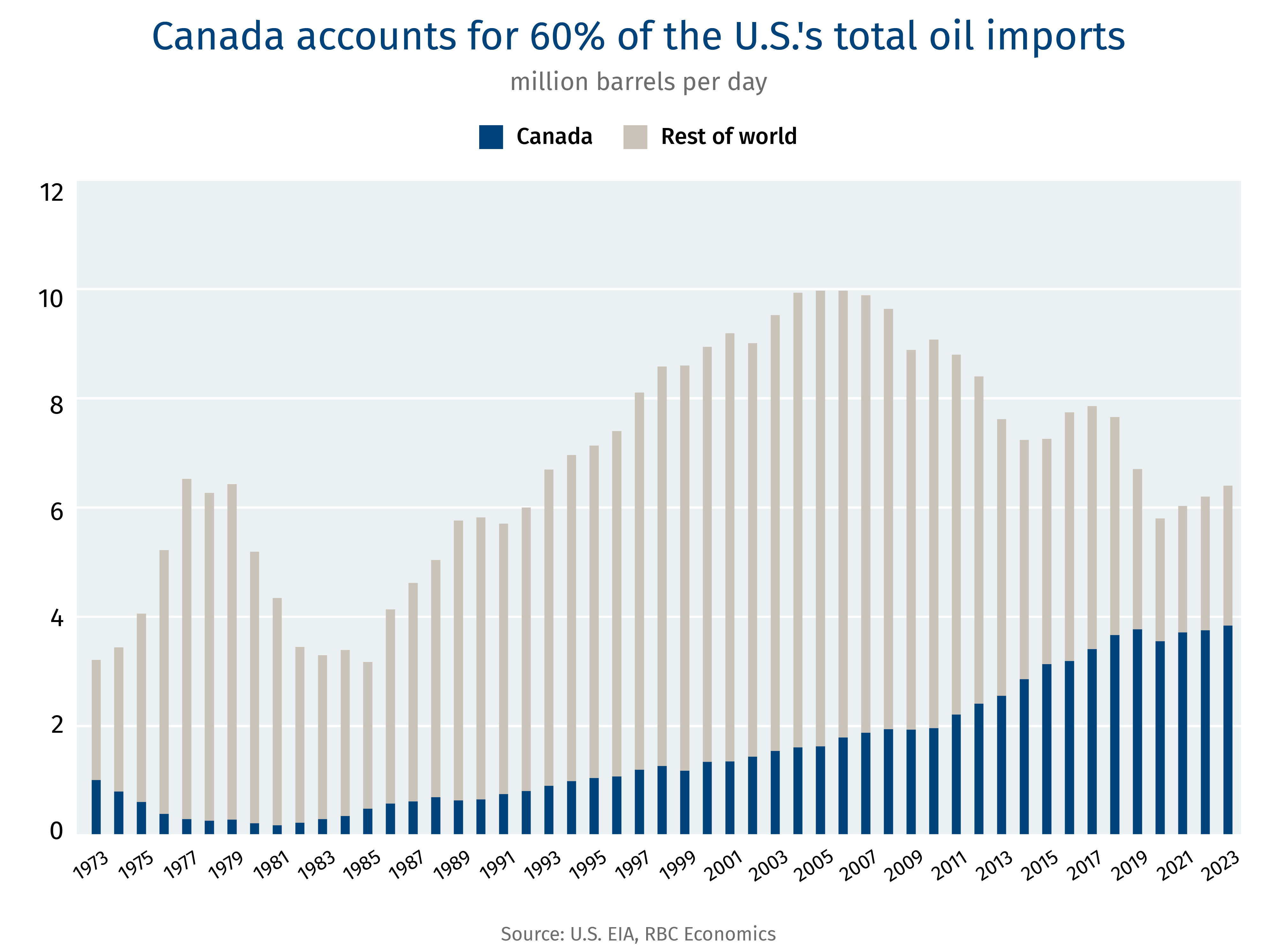
Oil: 60% of U.S. imports1
Canada’s advantage: Canadian oil can backstop U.S. efforts to become the de facto global swing oil supplier.
Canada’s share of U.S. crude oil imports has grown significantly over the past few decades, and now represent 24% of total U.S. oil consumption2. Cross-border pipelines deliver heavy crude directly to U.S. refineries that are specifically designed to process it. For these refineries, particularly those in the Midwest, moving away from Canadian heavy crude would leave them with high retooling costs or dependent on alternative sources such as Venezuela or the Middle East, exposing them to geopolitical risks. Recently, the Trans Mountain pipeline expansion has nearly tripled Canada’s oil shipping capacity to tidewater markets, carving out a role for Canada’s oil in supporting global allies, such as South Korea and Japan.
Electricity: 90% of U.S. imports3
Canada’s advantage: Low-cost and clean Canadian electricity can power several U.S. efforts including artificial intelligence, advanced manufacturing and advanced technology products.
Although the U.S. generates most of its own electricity, Canadian supplies keep the lights on and costs low across several U.S. states. New projects, such as Hydro-Quebec’s Hertel-New York powerline, aim to further increase electricity exports by providing 20% of New York City’s electricity needs, saving its residents an estimated $17 billion in electricity costs over the next three decades4.
With more than 30 cross-border transmission lines linking Canadian provinces with American states, Canada is essential for ensuring cross-border grid security and a potential source for incremental generation. For example, the rapid growth of AI technology–a U.S. strategic priority–is expected to drive a sharp increase in electricity consumption from U.S. data centres, which is estimated to account for up to 12% of U.S. total consumption by 2028, compared to 4.4% in 20235.
Natural Gas: 99% of U.S. imports
Canada’s advantage: Canadian natural gas can help America ensure ample domestic supplies and room for exports to allies in Europe and Asia.
Higher U.S. natural gas demand is expected to outpace supply growth in the next two years, according to the U.S. Energy Information Association. In addition, demand from data centres and reshoring of manufacturing could further strain natural gas power generation. Canadian natural gas is well positioned to meet supply gaps, and already accounts for 9% of total U.S. natural gas consumption with the capacity to expand further.
Canada is also poised to become a significant supplier of liquefied natural gas (LNG), and is uniquely positioned to export energy to strategic Asian allies. With six West Coast LNG projects proposed and under construction, including LNG Canada Phase I which is set to come online this year, Canada is estimated to have a total export capacity of 6.26 billion cubic feet per day (bcfd). This proposed capacity would put Canada among the top five global LNG exporters at current levels. In addition, West Coast terminals are strategically located just 10 shipping days from Asia, compared to 20 days for U.S. Gulf Coast exporters via the Panama Canal.
2. Canadian agriculture would strengthen American food security
Canada is a major part of the North American breadbasket, providing a stable and reliable supply of agricultural commodities that supplement the United States’ strengths in the sector. As a key provider of essential inputs like potash and seed oils, Canada supports U.S. food and biofuel production. With the U.S. facing potential labour shortages due to a crackdown on illegal immigration, Canada can help supplement this gap in the short term, while adding to continental food security in the long term.
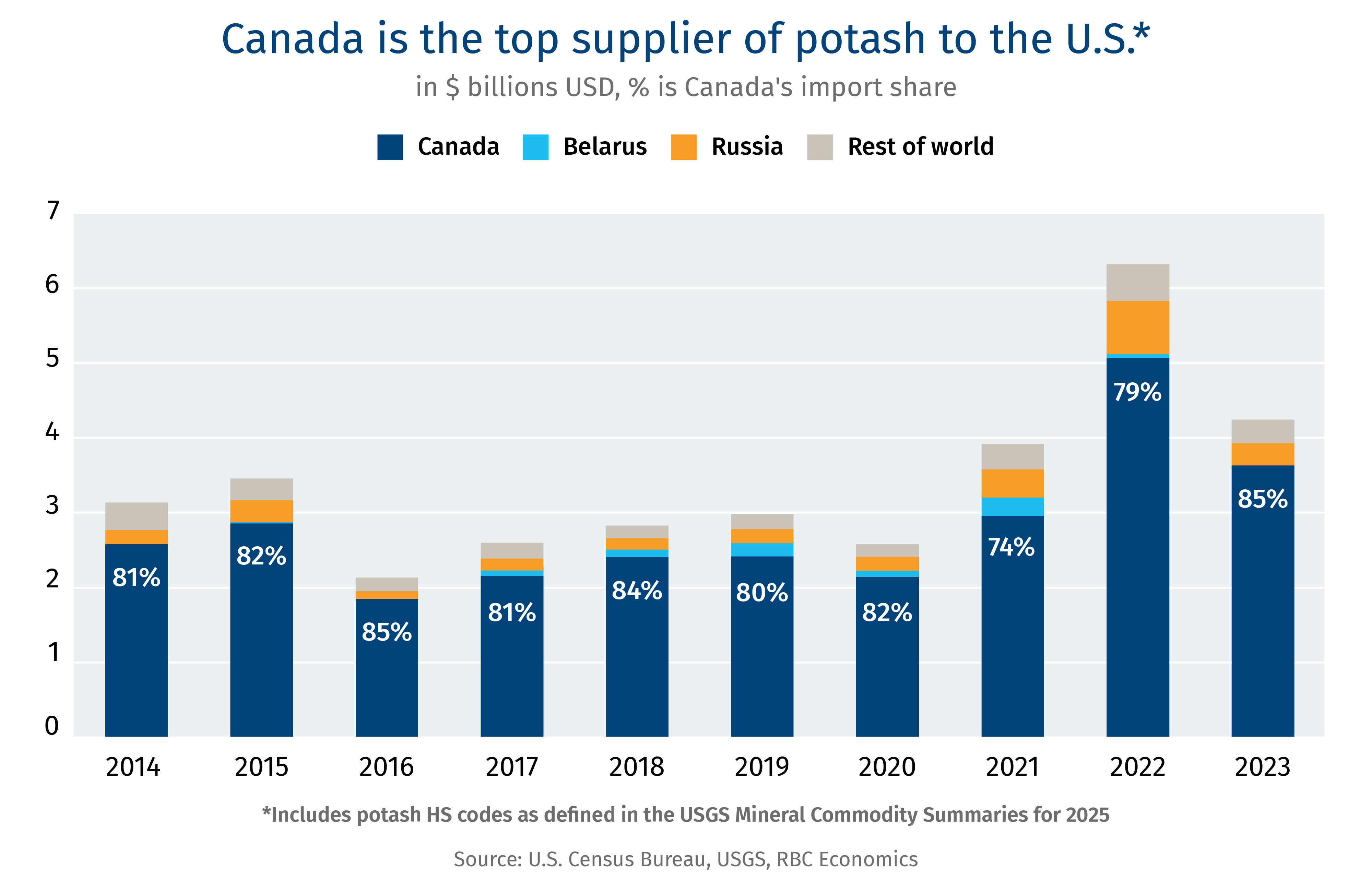
Potash: 85% of U.S. imports
Canada’s advantage: Canadian potash, a critical fertilizer component, can boost American crop yields amid extreme weather patterns, reinforcing continental food security and supply chain stability.
With growing food demand, there’s significant potential to strengthen this partnership. The Jansen potash mine, slated to begin operations in 2026, is projected to boost Canadian potash production by 4.2 million tonnes per year (mtpa), with potential expansion up to 8.5 mtpa by 2029—boosting Canadian capacity by more than a third. The new project would raise Canada’s global market share to nearly 40% by 2026. The increased production will not only bolster American food security but also help displace potash exports from non-aligned nations such as Russia and Belarus.
Canola oil: 98% of U.S. imports6
Canada’s advantage: Canola, a product developed in Canada, can play a key role in U.S. food security and meeting biofuel demand.
Canada provides a stable and diverse supply of agricultural products to the U.S., second only to Mexico. The U.S. is heavily reliant on Canadian canola oil, which account for 98% of its total imports, and is a key input in U.S. food production and renewable fuels.
Canada is also the top U.S. import source for cereal products, underpinning the deeply integrated cross-border supply chain in these sectors.
Meat: 34% of U.S. imports
Canada’s advantage:Canadian meat, including bovines and swine, are an important part of the meat feedstock into the U.S.
Animal proteins will continue to play a significant role in American diets, with per capita consumption in the U.S. projected to increase from 68.7 kilograms in 2023 to 74.6 kilograms by 20288. Canadian meat producers are essential in meeting this rising demand, as the U.S. already imports 33% of its beef and 66% of its pork from Canada7. The strong integration between Canadian and American meat markets is driven by high safety standards, a similar market structure, and alignment on product quality. As a result, Canadian meat not only supports U.S. domestic consumption but also contributes to American meat exports to global markets.
3. Canadian critical minerals and uranium can power advanced technologies in North America
The U.S. has reserves of many of the critical minerals needed in semiconductors and other sensitive technologies. Its uranium reserves are also able to help build out a new wave of nuclear power projects. It’s aiming to mine and enrich as much as possible within its borders to displace supplies from China and Russia but faces constraints, especially in adding enrichment capability. Canada has capacity in key complementary areas, like uranium conversion, that can help the U.S. build out an efficient North American value chain.
Critical minerals: 19% of U.S. imports, in total minerals and metals9
Canada’s advantage: With the right investments and innovation, Canada can advance production of several critical minerals.
The new U.S. administration is looking to accelerate several critical mineral projects and considering opportunities to advance activity within the Quadrilateral Security Dialogue, comprising the U.S., India, Japan, and Australia. Although outside this alliance, Canada is a player in the critical minerals space. It is a top 10 global producer and already a major supplier to the U.S. for aluminum, iron, steel, copper, nickel and more.
Canada has been working toward U.S. efforts to reduce reliance on China, from establishing a Canada-U.S. Joint Act Plan on Critical Minerals to $3.8 billion in public investments to ramping up exports to the U.S. of gallium and germanium, both impacted by Chinese export controls. Canada’s existing extraction and processing infrastructure could further fill U.S. gaps in key areas, such as aluminum, nickel and zinc.
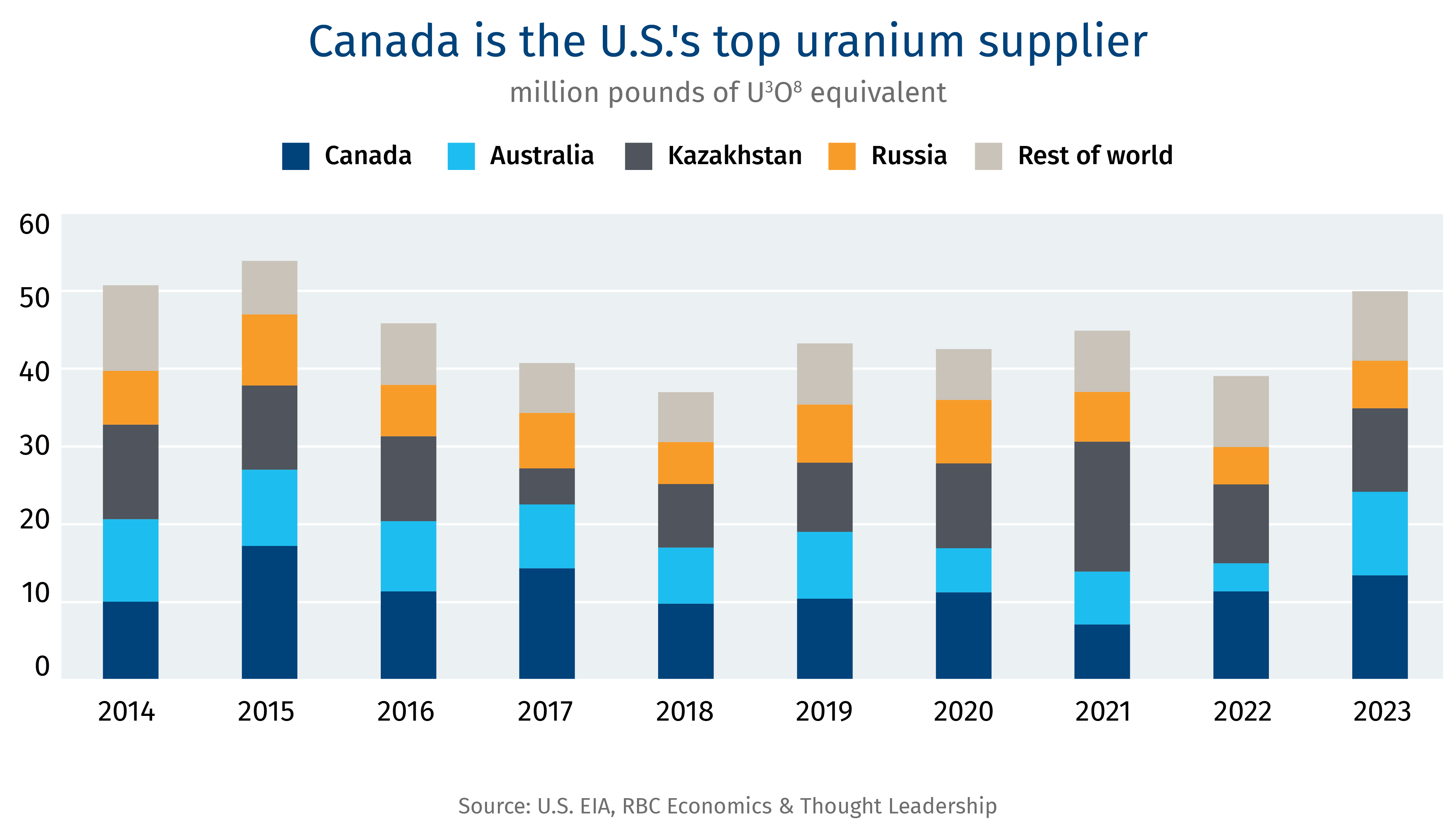
Uranium and nuclear expertise: 27% of U.S. imports, in uranium
Canada’s advantage: America’s path to nuclear renaissance goes through Canada—the world’s second largest producer of uranium after Kazakhstan.
The energy source is increasingly important to meet growing electricity demand to power AI data centres and other energy-intensive strategic advanced technologies. As the largest uranium supplier to the U.S., Canada can be an important part of the continental nuclear fuel cycle with world-leading technology and talent, small modular reactors (SMRs), and an 89,000-strong nuclear workforce honed through work on CANDU projects.
What Canada can deliver in advancing U.S. interests
In the short-term, there’s an urgent need for Canada to realign our economic interests with the U.S. For its part, the U.S. can go it alone, but it’s going to be a harder, costlier and longer route to self-sufficiency. A shifting economic and geopolitical environment behooves both to collaborate in the three core areas of mutual benefit.
This strategy heavily depends on the U.S. getting on board. We have a short window to convince Washington about the need to collaborate in the resource and energy space, which has been weaponized by several non-allied actors.
Canada also needs to get its own house in order.
A resource-focused economic and trade strategy would require billions of dollars in new infrastructure, including rail lines, seaports and processing facilities. However, domestic and foreign capital will only come to the table If there’s a stable regulatory environment and reliable pricing in what can be highly volatile markets.
These are not new challenges for Canada. Regulatory and policy uncertainty have hobbled economic development for decades. So, too, has lack of reliable demand from our major trading partners, including the U.S.
Resource production and processing calls for longer-term thinking, which will require the federal and provincial governments to work together to create entities, and strengthen existing ones, to attract and retain capital, and protect against extreme price volatility. We will also need to ensure our education systems are geared towards attracting the right talent and skills to ensure the economy is poised for long-term growth. And while positioning Canadian resources anew in the U.S. market, we will need to improve our trading relationships with many other countries and regions.
All this will require a different mindset among Canadians, to ensure our natural resources are not seen as a trading card with the U.S., but rather a strategic platform for growth, and prosperity, for decades to come.
It can be Canada’s greatest resource play.
Contributors:
Salim Zanzana, Economist, RBC Economics
Varun Srivatsan, Director of Policy, RBC Thought Leadership


 EN
EN