Artificial intelligence is the transformational tech of our time — and is one of the most disruptive forces in history.

This was the year AI got wings — especially generative AI — and it’s soaring to new heights. It’s powerful, versatile, and yet only partly understood.

To better understand Canada’s preparedness, the RBC Economics and Thought Leadership team recently launched a new research paper: Gen AI: Is Canada ready?

A few key takeaways:

  1. Despite boasting renowned AI research institutes, Canada is a laggard in Gen AI implementation and adoption;
  2. Gen AI has the potential to get Canada’s economy growing again through accelerated innovation and productivity;
  3. Professional services, financial services and manufacturing are both most at risk and have highest reward for adoption;
  4. Gen AI in the public sector represents an opportunity for Canadians to get more bang for their tax dollars.

Canada should invest more in education and training to build an AI-capable workforce; foster an environment safe for exploration and experimentation; build the infrastructure to enable robust and reliable data; and create rational regulatory environments through technologically neutral and risk-based approaches to legislation.

Is Canada prepared for artificial intelligence?

On the season finale of Disruptors, we visit the AI Super Session at the University of Toronto’s Creative Destruction Lab to talk with leading minds on the frontlines of Canada’s AI journey. We also sit down with Cari Covent, Head of AI at Canadian Tire to hear about how the iconic Canadian company is using AI — from robots to shopping assistants — to enhance the customer experience, improve employee productivity and eliminate mundane tasks.

AI and other emerging technologies can close the productivity gap and help Canada compete in an increasingly digital and data-driven world. The big question is whether businesses and public sector organizations will seize the moment — or risk getting left behind.

Speaker 1 [00:00:01] My name is Allen Lau, operating partner at Two Small Fish Ventures. I’m excited about AI because it completely transforms many behaviors. From consumer to enterprise to perhaps industrial, many sectors might not have changed in a century. And now is the time to transform that. I don’t have any huge concern, but if I have to pick one, it’s the pace of the development it’s so fast, this is perhaps the fastest change we have ever seen in human history. In terms of Canada’s preparedness, we have probably the best AI talents in the world. However, as a country, we suck at commercialization and this is something we have to fix.

[00:00:44] My name is Ken Nickerson. I’m a researcher, self-funded, a company called Ibinary. I started about 24 years ago, done roughly 36 companies, a lot in the AI or advanced deep tech space. So in terms of excitement of AI, what’s been interesting is the amount of surprise that the transformer and GPT world has generated. The average person on the street now has an interest in something called artificial intelligence. So is Canada prepared for AI? I would say there’s not a country on the planet that’s prepared for AI. The impact of labour is significant. We know from other countries that when you disenfranchize say 50% of a young male population, you may have secondary effects in political and social systems. The bigger concern, I would say, beyond that is just the trust factor. How can we trust something that has some level of ability to execute, but does not have accountability or authority or responsibility?

Speaker 2 [00:01:45] My name is James Slifierz. I am the CEO and co-founder of Skywatch, one of the world’s leading distributors of satellite data. We work with about 95% of all satellite operators. What I’m most excited about in terms of artificial intelligence is using AI for autonomous space systems. Fundamentally, if humans are going to explore beyond low-Earth orbit, we’re going to need to use machines. We’re going to need to give those machines the ability to make decisions, think, learn and adopt for themselves. I don’t think anybody’s prepared for AI. My broad advice is not to wait for us to be ready. I think we can only learn by doing, and we can’t allow our fear of bad things happening slow us from moving forward.

Speaker 3 [00:02:23] My name is Kiko Wemmer and I’m a general manager at Dandelion Health. I think what I’m most excited about for AI in the health care sector is the opportunity to personalize medicine so that you can optimally decide what is the correct intervention point and what the ideal intervention would be. The second big opportunity is around seeing data differently than the way humans see data, or making linkages between data types that humans can’t make today. With better data sources coming online, I hope that people work to ensure that the data used to train health care algorithms are high fidelity, longitudinal, multi-modal, and representative of the patients who will be beneficiaries of the algorithms that are created.

Speaker 4 [00:03:10] Hi, it’s John here. Those are some of the voices we heard at a recent AI super session held at the University of Toronto’s Creative Destruction Lab. If you haven’t noticed, AI is the hot topic in tech this year, and there was no let up at the CDL event. I think there were more than 500 people who came from around the world to Toronto to explore how AI, and especially generative AI, is transforming everything from health care to education to space exploration. And the message was clear, if you’re not trying to take advantage of gen AI, it’ll be taking advantage of you pretty soon. This is disruptors, an RBC podcast. I’m Sean Stackhouse. We’ve been exploring the theme of AI on Disruptors all year and want to wrap up the season with this special episode focused on AI and what it means for Canada. I’ll be joined shortly by perhaps the most iconic Canadian company, Canadian Tire, to hear what it’s doing. From running its warehouses more efficiently to deploying AI enabled robots to help you the next time you’re looking for tires or a weed whacker. It’s a great story and the sort of innovation that we need to see in every sector in our economy. Unfortunately, we’re not collectively seizing the opportunity. Our economics and thought leadership team here at RBC just put out a new research paper called Gen AI: is Canada Ready? And the answer is a pretty clear no. The bigger question, though, may not be whether we’re ready. It’s what do we need to do and where and how fast. As the paper notes, Gen AI is to steal the movie title everything everywhere, all at once. To come to grips with all that, here are some of the most important points to consider. First, despite boasting renowned capabilities in AI, Canada is a laggard in gen AI implementation and adoption. Second, gen AI has the potential to get Canada’s economy growing again, but only through accelerated innovation and productivity. The challenge is whether businesses and public sector organizations will seize the moment fast enough. Third, we need to play to our strengths in professional services and financial services, as well as health care and education, where the opportunities may be greatest. And lastly, we need to think about the public sector and government itself and how to deploy AI tools to ensure Canadians are getting more bang for their tax buck.

Speaker 1 [00:05:43] I’m Avi Goldfarb. I hold the Rotman Chair in Artificial Intelligence and Healthcare here at Rotman School, of the University of Toronto. The thing that excites me most about AI is that it has potential to transform the way we live in the way we work for the better. What concerns me most is that we won’t have enough of it. Canada is prepared for AI in some ways. We have an amazing research community that is genuinely top of the world. The thing that worries me for Canada is whether we’re going to be able to take that advantage and turn it into something that ends up impacting the economy overall. And I think there’s a real worry with AI, just like with past technologies, that we won’t be the ones to commercialize our own innovations.

Speaker 4 [00:06:27] So what do we do about it? Well, we’ve made a few suggestions. Canada can invest more in education and training to build an AI capable workforce. We can also foster an environment that’s safe for exploration and experimentation. Reliable data will be key. So building an infrastructure of data is critical and governments will be critical too. We need them to take a technologically neutral and risk based approach to legislation. In other words, rational regulatory environments that won’t stifle innovation. You can read more in our report at RBC.com/thoughtleadership or through my social media channels. So check us out on LinkedIn and X. This new AI era is full of risks, but also opportunities. So let’s hear from someone who’s taking on the challenge. Cari Covent runs AI at Canadian Tire. And she seems to be everywhere, tackling everything all at once. Canadian Tire is an iconic retailer and has been in operation for more than 100 years, with approximately 1700 locations across the nation. The brand is so pervasive that most of us live within a 15 minute drive of a Canadian Tire store. Of course, Canadian Tire is about more than just tires. In fact, it’s been about digital technology for years, and Canadian Tire has been on an AI journey for many of those years. So let’s hear more. Cari, welcome to disruptors.

Speaker 3 [00:07:52] Thank you for having me. I’m very excited to be here.

Speaker 4 [00:07:55] When people think of Gene, I suspect Canadian Tire is not the first company that comes to mind. So help us understand what journey Canadian Tire is on with AI.

Speaker 3 [00:08:05] Our journey with AI has been happening for many years, starting with automation, moving into more optimization, operations research, machine learning, and then most recently within generative AI. And our vision really is to use AI as an enabler to transform the way we work. We recognize that we’re at a very pivotal time where the technology is really revolutionizing all facets of how we live and also how we work. And at Canadian Tire, we’re embracing it wholeheartedly.

Speaker 4 [00:08:41] Take us into some of the applications that you’re developing. Let’s start with CeeTee ,your shopping assistant. How does that work for those of us who haven’t used it?

Speaker 3 [00:08:49] CeeTee is our virtual shopping assistant, powered by generative AI that is part of our Canadian Tire mobile app for iOS users. We recognize that purchasing tires is not always an easy decision for many people. A lot of people really don’t understand the details of tires. It’s a technical buying decision. It’s also an expensive purchase. And so far, we’re seeing that it’s understanding the intent of what our customers are asking for. It’s guiding them through their shopping journey from really browsing and asking questions, to ultimately providing a recommendation and giving them an opportunity to purchase the tires. It’s also nudging them so when they are sort of pausing, perhaps thinking about something, it has the ability to be able to predict the next words or the intent of what the customer is asking for, and then it’s able to generate content, and it’s able to generate recommendations that help the customer ultimately make a decision.

Speaker 4 [00:10:00] Let me ask about how consumers are adjusting to this, and it’s probably still early days, but how is consumer behavior and your interaction with consumers evolving as AI plays a greater role in the customer journey?

Speaker 3 [00:10:14] So early days on CeeTee in particular, we are seeing signals that the consumers really like it. They’re enjoying the interaction. We’re able to do analytics on patterns of the conversation as well as the types of questions that they’re asking. And so that’s valuable to us, but it’s also really valuable to our consumers. The other thing that we’re seeing that we’re really excited about is because we’re able to digitize and capture this data in a way that we have never been able to before, we’re now able to use that to inform other decisions on personalization, for example, or recommendations. And also eventually it will feed back into informing our merchandizing and what products we buy and how we go to market with those products. So we’re really excited about that.

Speaker 4 [00:11:13] What about employees? I’m wondering how Gen AI has affected their experience and even changed how people are carrying out their day to day work?

Speaker 3 [00:11:22] Well, it’s been interesting. One of the things that we did in early 2023 is we recognized that ChatGPT as a very consumable chat bot, is going to change the way that people work and also going to be used. And so what we did out of the gate was we created our own version of that chat CTC. And with over the last 6 to 8 months provided tons of opportunities to thousands of our employees. And they’re using it daily. So they’re using it to generate content, for example, for marketing campaigns. They’re using it for code generation, like how do I write this function in Python or in Excel? They’re using it to upload and talk. So summarizing and reducing text to create concise and informative descriptions of the upload. So for example, we might drop in a series of financial reports and then it could focus on financial performance analytics and KPIs. But it also can provide insights and strategies to improve financial performance. I’d say the most effectively what we’re doing is we’re scaling AI literacy training, helping people to understand what it is and what it isn’t, and how it actually is there to help the humans. So if we think about humans in the centre of it all our employees and our customers in particular. And we’re also using the AI literacy training to teach people how to do prompt engineering, because we recognize that the days of needing certain degrees to do some of this are no longer required. And we see the value of AI, generative AI in particular, being scaled into the hands of our business and really empowering them to start to change how they work.

Speaker 4 [00:13:19] You’ve talked Cari about how AI helps consumers and how AI helps employees. It also has a role in terms of the store. What if you can give us a bit of a sense of the role AI is playing in the way stores are run?

Speaker 3 [00:13:34] Yeah, I can give you a specific example, John, that we’re pretty proud of. So about a year and a half ago, we launched a product that we built called Tetris, and it uses operation research to solve for what historically is a very large retail problem, not just a Canadian Tire problem. And that is what products to place on what shelf at what time. The objective was to make what was traditionally kind of a national level planogram, and think of a planogram as the game Tetris, where all the products to fit together perfectly in a very constrained space. We wanted to make it store specific based on specific sizes of shelves in that store. How many weeks of inventory that store might have. The supplier agreements on the placement of those products, as well as the local customer demand. We started rolling it out in 2023, and we’re continuing to work with our dealer community, getting feedback on how to make it better. So it’s continuing to evolve, but we’ve rolled it out to about half of the network, and we’re seeing a savings in hours related to setting up the shelves, as well as creating the planograms as well as an increase in sales. So we’re seeing great signals that this is actually working.

Speaker 4 [00:15:00] You’re also doing some really interesting work with robots and robotics within stores. You’ve partnered with sanctuary AI, which we’ve profiled on previous episodes of Disruptors. Can you tell us a bit more about what you’re doing with robots and where you see that initiative going.

Speaker 3 [00:15:16] Sure. I think the first point on that is that the labour shortage for us is an issue. We can’t get people quickly enough to work in our stores and work in our distribution centres. And so in late 2019, we were introduced to Sanctuary, and we understood what a general purpose robot could do for both our store labour as well as our distribution centres. And we decided that it was an amazing opportunity for us to to work alongside Sanctuary in the research and development by providing them with use cases specific to certain manual store tasks, as well as distribution centre tasks. We agreed to test them out in our stores, and in the future we’ll be testing them out in our distribution centres. So we provided a live lab for this type of work. Not only did they replicate our store in their own lab, but we provided this live lab and it was incredible to see our employees getting excited to work alongside a robot and interacting with it, and also understanding the value that the robots could do, which would ultimately free them up to be able to focus on customers. It also gave us a chance to do some really interesting qualitative testing with a small customer base, so that we could get feedback on their interaction with the robot, how they felt about it, and how these robots could actually inform their decisions to continue to shop at our stores.

Speaker 4 [00:16:57] What are these robots doing in the stores?

Speaker 3 [00:16:59] In the stores, they’ve been trained to do tasks like picking products and then packing them to service e-commerce orders would be one example. Another example would be when the store closes, the robots can be roaming through the aisles. They can be placing products on the shelves. It can hang clothes up. It can take products that were returned, it can scan them so that we know that they’re back in the system. They can clean washrooms. So these robots are general purpose, and the value that they have is they’re not just there to do picking and packing. For example, they can rotate from one task to the next, freeing up the people to do much more meaningful work, create meaningful experiences for our customers. But overnight, the robot can continue to do work that the people wouldn’t be doing.

Speaker 4 [00:17:56] This is all very well and good now for things like cleaning washrooms. Probably something most employees don’t want to do, but do they wonder if this is going to continue to evolve and take on some of those higher functions? And how does that change the future of work?

Speaker 3 [00:18:11] I think everyone wonders that. So the anecdotes that we heard from our employees, for example, is there are tasks that they don’t want to do. And if a robot can do that, they will have a much more satisfied experience at work. In terms of the robots being able to replace the humans, I personally don’t see a day where the robots are going to take on the relationships that we put so much focus on with our customers and take over that, so there’s always going to be places for humans. And what we’re seeing in the early days is there are new roles that will be created as a result of that. So, for example, in our distribution centres, we will need people to manage the robots. That’s a job that just doesn’t exist today. So that critical thinking and judgment continues to be a main part of where we’re continuing to focus on the people labour side of our business.

Speaker 4 [00:19:18] All of this, whether it’s for the consumer or the employee or the way you run your stores, rests on trust. And I imagine Canadian Tire is one of the most trusted companies in Canada. It should be more than 100 years old. How do you ensure that the trust you’ve built up over that century or more, continues but is even enhanced through these transformations, where in different situations, trusts can be in play?

Speaker 3 [00:19:44] Yeah. Our brand is our most important asset that we have, so we take trust very seriously. We take our customer data and privacy very seriously. And so as this artificial intelligence continues to evolve, we have built and integrated a strong, responsible AI framework. The other area that we’re focused on is this idea of AI literacy, similar to cybersecurity. We know that many of the risks start with a lack of employee awareness. And so as part of the AI literacy training, not only are we demystifying AI, but we’re also teaching them about responsible AI and ensuring that they recognize that it’s everyone’s responsibility and accountability. Because there is still a lack of AI regulation here in Canada. We’re using the guidelines that are proposed as part of the Artificial Intelligence Data Act, the code of conduct, and we’re cross-referencing with that to ensure that as these guidelines actually get cemented in policy and regulation, that we’re ahead of it. And then finally, we work really closely with our audit teams, with our privacy and our risk office. And they are in this every step of the way. We don’t do anything without them.

Speaker 4 [00:21:10] Those are great messages for pretty much any organization, but to invest in your employees and secure their buy in has to be a critical component of any roll out. Cari, how do you achieve that in an organization as large and complex as yours?

Speaker 3 [00:21:24] Yeah. What I’m finding is that communication is constant and critical to the success of getting the buy in. So whether it’s bringing hundreds and thousands of people together to do lunch and learns, or whether it’s a conference where we have employees that come talk about artificial intelligence and the opportunity ahead, doing board of directors education, educating our senior leadership. It really comes down to humanizing artificial intelligence and really broadcasting the story and getting people as excited about it as we are. And the only way to do that is to make sure that the people understand it and are at the centre of it.

Speaker 4 [00:22:21] Cari, this has been such a great conversation, fascinating on so many levels, and it’s wonderful to be seeing one of Canada’s most iconic companies, Canadian Tire, continue to transform the retail experience. And I wonder if I can ask you as a last question, where do you see AI going over the next few years and particularly how it will continue to transform your business?

Speaker 3 [00:22:44] Well, there’s a few different areas. We’re going to continue to collect and use our data, and we’re going to partner with other data providers. And then we’re going to use that to advance our AI capabilities to drive relevant and meaningful customer experiences. But those experiences will change in the future. And although machines end up doing some of the work on the background, it will feel even more personal and relevant than it’s ever felt. We see the digital and the physical world become one as a result of AI, and really, this will facilitate the opportunity for people to connect with Canadian Tire in a way that they want to. And this becomes the foundation for personalization and how people want to shop. I believe that AI will be embedded into everything we do, and we are really excited to be on the highway of AI and really using it to accelerate how we evolve our business.

Speaker 4 [00:23:56] What a great message to end on that AI is going to be critical to every organization in terms of accelerating the way that we build strategies and build our businesses. Cari, thank you for being on Disruptors. This was the year that artificial intelligence got wings and the tech is truly taking off. You can hear more about it over the summer as we play some of our favourite episodes from the past season. And join us again in the fall for a new season in which AI will again be at the centre of Disruptors. Before we sign off with the summer, I’d like to thank you, our listeners, for joining us on our journey this year. We hit more than 1.5 million downloads, with thousands of new listeners each month, and we won Best Tech Podcast of the year. So whether you’re listening to this with your first cup of coffee or during your commute, while you drive, or even in the air on your Air Canada flight, thanks for joining us this season on Disruptors. And if you like what you’re hearing, please rate, subscribe and share our show. We’ll be back in the fall to speak with more Disruptors who are leading the way and helping us prepare for a brave new world. But until then, have a great summer. I’m John Stackhouse, and this is Disruptors, an RBC podcast.

Speaker 3 [00:25:16] Disruptors and RBC podcast is created by the RBC Thought Leadership Group and does not constitute a recommendation for any organization, product or service. For more disruptors content, visit our RBC.com/disruptors and leave us a five star rating if you like our show.

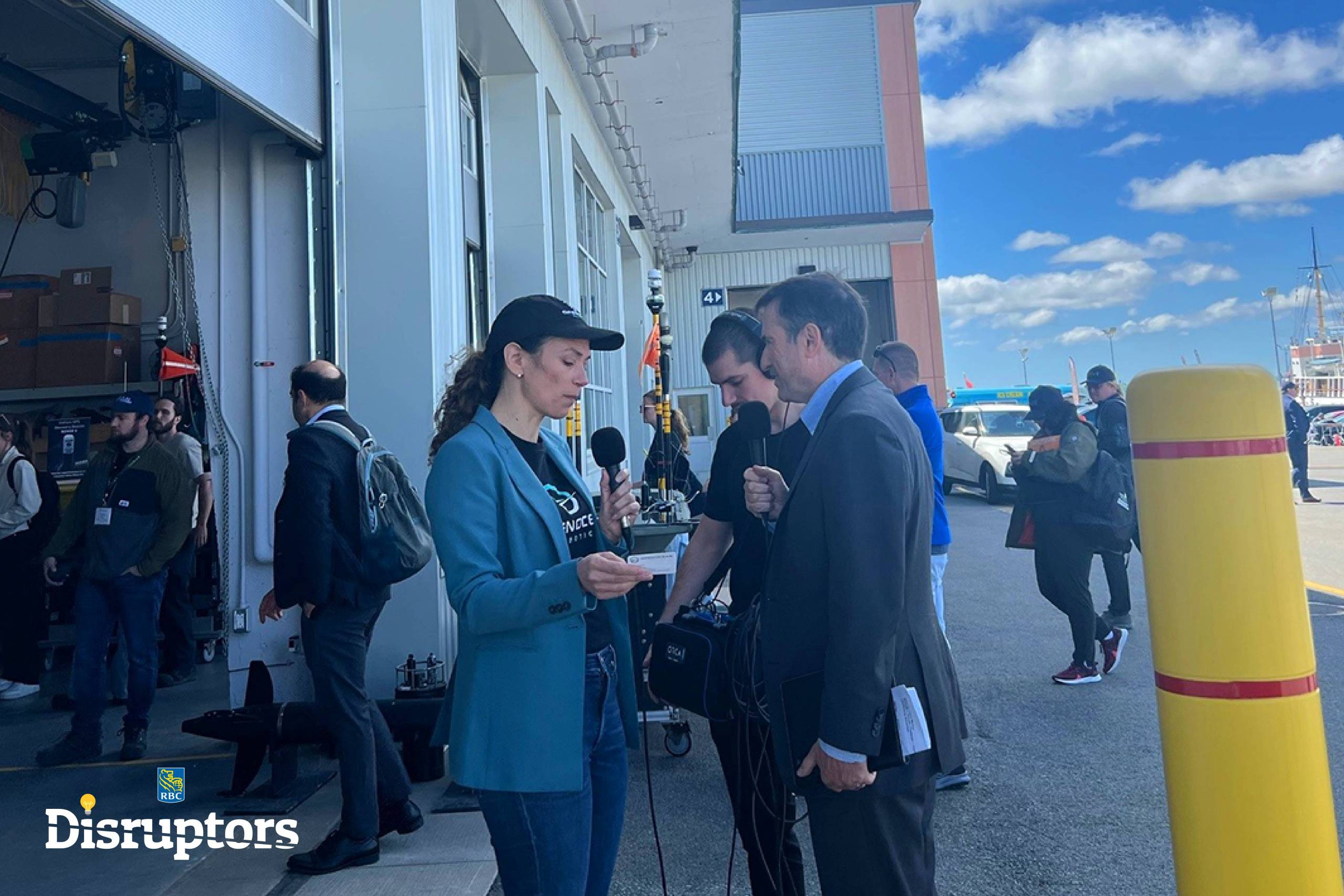
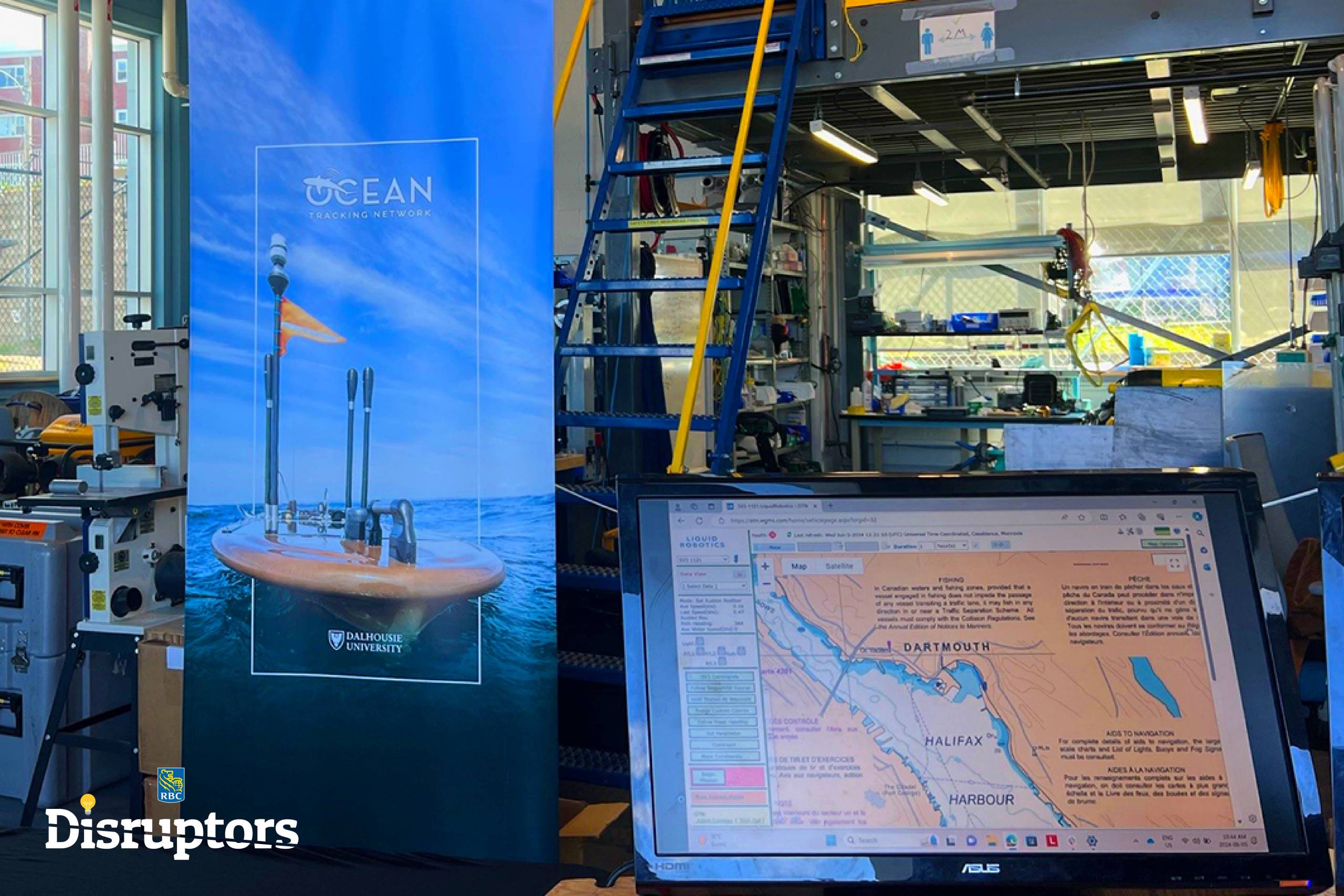
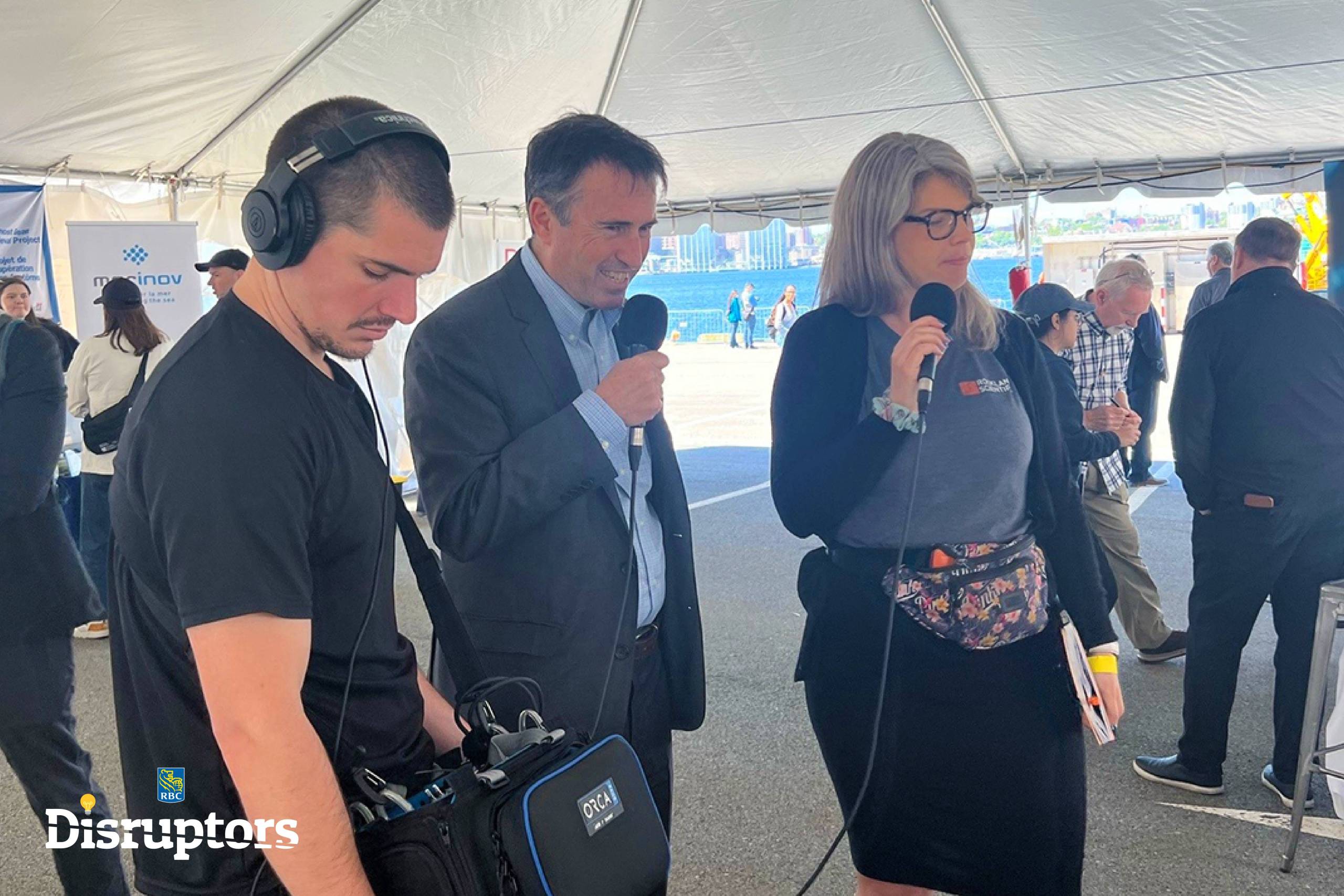
The ocean and climate are inextricably linked — and these waters are the planet’s greatest carbon sink. But with so much pollution in the atmosphere over the centuries, it’s going to take more than nature to restore the balance. AI and emerging technology are critical in reducing emissions and helping us better understand the ocean’s impact on climate. Canada is an ocean nation, with marine waters spanning our North, West and East Coasts — so, it likely comes as no surprise that we’re a leader when it comes to ocean advocacy and preservation. The concept of World Oceans Day was first proposed by the Government of Canada at the UN Earth Summit in Rio de Janeiro in 1992. Not only do the oceans connect people worldwide, they play a key role in the fight against climate change. And while two-thirds of the world’s surface is covered by oceans, many ecosystems are still largely unknown — particularly those in the deep ocean. As a nation, we’re also a leader in ocean research — and punch above our weight in ocean innovation. Atlantic Canada was recently named in the top ten oceantech ecosystems in the world — with the highest concentration of ocean scientists. Canadian companies are building world class sensors, autonomous platforms, and some of the most impressive marine carbon dioxide removal technologies — to measure ocean emissions and mitigate climate risk. But can innovative tech turn the tide in the climate crisis? On this episode, John Stackhouse visits Nova Scotia — to check out the Cove Demo Day, Canada’s largest showcase of marine technology. He is joined by Anya Waite, CEO & Scientific Director and Eric Siegel, Chief Innovation Officer at the Ocean Frontier Institute, led by Dalhousie University to discuss the opportunities for our nation — and the planet. The waters hold vast potential in the fight against climate change — and they may be nature’s great disruptor.
Speaker 1 [00:00:01] I’m Candace Smith from Rockland Scientific. We’re, a Victoria-based company that makes these instruments to measure turbulent mixing in the ocean. This is a cylindrical tube. It’s about a meter long. At one end, we have something to make it steady when it’s falling in the water. And at the other end, we have a bunch of sensors. Speaker 2 [00:00:19] I’m Adam Comeau. I manage the glider operations at Dalhousie University. So we’ve got a Slocum glider here. This is an underwater robotic submarine that’s battery powered, that can stay in the ocean for months at a time, collecting data for researchers. Speaker 1 [00:00:34] I’m Julie Angus, CEO of Open Ocean Robotics. So this is our uncrewed surface vehicle data explorer. It’s about as big as a kayak. It’s covered in solar panels, and it has a roll bar on the back that allows it to self. Right. So this means it can go out in big storms and collect data. Speaker 3 [00:00:52] My name is Nicole Ivan up on Bernie Koski and I am currently a field support specialist with Rockland Scientific. So this is called a wave glider. So this is a, surface platform that can collect data for months in the ocean and can carry a range of sensors. The data gets streamed via satellites back to shore. And then scientists and users can look at the data and have information in real time. Speaker 2 [00:01:17] Those were clips from The Cove Demo Day in Dartmouth, Nova Scotia. It’s Canada’s largest showcase of marine tech, with more than 50 companies demonstrating their latest innovations and technologies. It also happened, if you didn’t know this to be World Ocean Day and the concept of World Ocean Day, it’s been around for a while. It was first proposed by the Government of Canada at the U.N. Earth Summit in Rio de Janeiro in 1992. Not only do the oceans connect people worldwide, as well as people across Canada on all our coasts especially. They play a key role in the fight against climate change, and it’s going to take all hands on deck to fulfill the potential that oceans have. We’re going to talk about some of the technologies on this episode, and some of the ambitions that lay right before us in Canada. This is Disruptors, an RBC podcast. I’m John Stackhouse. Today, I’m live at the Ocean Frontier Institute, led by Dalhousie University in Halifax, and I’m joined by Anya Waite, the CEO and scientific director at the Ocean Frontier Institute, or OFI, as you’ll hear it called. Anya is a renowned researcher who currently sits on the board of Canada’s Ocean Supercluster and was the first woman to co-chair the Global Ocean Observing System Steering Committee. We’re also joined by Eric Siegel, OFI’s Chief Innovation Officer. Eric serves on the UN Ocean Decade Technology and Innovation Working Group. He also sits on the board of directors at Sustainable Oceans Applied Research, and is the executive in residence at the Creative Destruction Lab Ocean Stream. Anya and Eric, welcome to Disruptors. Speaker 3 [00:03:03] Thank you John. Speaker 4 [00:03:04] Thank you. Speaker 2 [00:03:05] Let me start first with your ocean journey and how you got so engaged in oceans. Anya, I’m going to start with you because I was curious to learn you have a musical background. So how do you go from music to oceans? Speaker 4 [00:03:16] I think it’s a rhythm. I think it’s the color blue. There’s lots of link between how music moves and how it works in the brain, and the rhythms and structures of ocean movement and patterns. So in a way, it’s not such a different system. Speaker 2 [00:03:31] Do you have a favorite piece of music that makes you think of the ocean? Speaker 4 [00:03:35] I’m a fan of Bach. My kids kind of laugh at me because of course, that’s not at all what they listen to. But the rhythms and structures of Bach, to me are like the rhythms and structures of tides and waves. Speaker 2 [00:03:46] That’s beautifully said. Eric, what drew you to the ocean? Speaker 3 [00:03:49] The oceans have always been close to my heart. As a young adult, I crossed the Pacific Ocean on a small boat from Seattle to New Zealand, and then, with my family and three young kids, crossed the Atlantic Ocean from Scotland to North America. So I’ve always have been very close to the oceans. And then I just have always enjoyed the interface between ocean science, technology and innovation and how we can couple those things together to make interesting measurements and hopefully solve some important problems. Speaker 2 [00:04:13] And that point about oceans and technology, we’re going to get deep into this, but it’s probably something that doesn’t jump to mind when people think of oceans as being a tech center. How did you connect those two pieces? Oceans and technology? Speaker 3 [00:04:26] Well, as an ocean scientist, we know that we have to study the ocean to understand it. And the best way to study it, other than looking at it, is to actually measure it. And measuring the ocean is very challenging, and it requires a lot of technology and a lot of innovation. And those things have happened over the generations. But things are happening very rapidly now. Speaker 2 [00:04:43] And of course, we could talk about all sorts of things when it comes to the seven seas, but this conversation is going to focus on climate and the vast potential that oceans have in terms of addressing the climate crisis. Anya, give us a high-level view of how we should be seeing the oceans in the context of climate. Speaker 4 [00:05:01] I think it’s important to realize that, in fact, the oceans control our climate. And that’s something that’s been missed not just by policymakers and governments, but even some cases by scientists. So the ocean absorbs most of the heat that we produce. So 90% of that and also holds most of the carbon on Earth. And that means that the ocean is probably the world’s most natural carbon sink. And it’s a place we need to look for solutions and control of the whole climate system. So just as an example, as the ocean warms, it starts to change rainfall patterns on land that impacts forest fires. It impacts how we deal with hurricanes. For example, hurricanes become more intense. They move deeper into continents because they have more moisture. So the ocean controls a lot of land based weather patterns. And without having enough information from the ocean, we can’t actually predict key things like rainfall. And that’s something that’s of critical concern. So when we’re looking at the climate and we think of the ocean sometimes as a bit of a victim, you know, poor ocean that’s becoming acidic, we’re losing species and so on. But the ocean actually is the powerhouse that is saving us from climate change. Speaker 2 [00:06:14] It’s intriguing to think how carbon goes from, say, the tailpipe of my car up into the atmosphere and then somehow ends up in the ocean. How does that happen? Speaker 4 [00:06:24] So interesting. So if we follow that molecule out of the tailpipe of your car and it goes up into the atmosphere, what happens is that the ocean actually has a slightly lower concentration of carbon than the atmosphere. And so as that carbon accumulates in the atmosphere, it starts to literally pump down into the ocean. So the surface ocean has a higher concentration of carbon dioxide than the rest of the ocean. And then the surface ocean moves up towards the poles, and then it cools and sinks, and it carries that carbon rich water deep into the belly of the ocean, if you will. And so it turns out that the carbon that you have emitted ends up stored at 2000m depth along the Mid-Atlantic Ridge somewhere. Speaker 2 [00:07:03] And some people may hear that and say, great, there’s the solution to climate. Let’s just let the oceans be that powerhouse for us. But oceans can’t do this on their own. Why is that? Speaker 4 [00:07:14] That’s right. So the oceans have done. Most of the work in controlling the climate to date, and that means that we have relied on them without knowing that we’re relying on them. And that’s always a really risky scenario. When you are leaning on a chair you don’t even know is there and someone takes it away. So what we really need to do is understand exactly how this operates. Because if we don’t understand the ocean and it changes, then we’re not prepared for the impact that’s going to have on the global climate and as nations, as citizens, as people who work with industry and government, we need to understand how do we create policies that can allow society to respond to climate change? And if we don’t know what that trajectory is going to look like, we can’t respond to it effectively. So not understanding the ocean means that we’re critically insecure about our climate future, and we can’t afford that anymore. We need to be able to predict what’s going to happen, so we can respond intelligently to it and inform the public of what they need to do to respond. Speaker 2 [00:08:13] So if we understand the oceans better, we’ll understand these surprises, which shouldn’t be surprises when they hit us like forest fires, as you mentioned, because we’ll see the weather patterns changing as they come off the oceans. Speaker 4 [00:08:26] That’s exactly right. We need to get the climate models right. And to do that, we need to get the ocean right. And that means a lot more observation and understanding than we have to date. Speaker 2 [00:08:35] We are an oceeanary planet, which a lot of us forget because we are landlubbers most of us. But Eric, to understand the great beyond of the oceans, we are going to need a lot more of those technologies, those sensory devices that we heard about in our opening at Cove on Demo Day. Tell us a bit about the role of technology in better understanding the oceans. Speaker 3 [00:08:58] Yeah, measuring the oceans is very difficult. At the surface, there are wind and waves and ships that can hit things. At the bottom of the ocean, it’s very deep and there’s a tremendous amount of pressure that can crush things. Then once you start trying to do that, to measure things like climate, climate change and how the oceans are absorbing carbon and other dissolved gases, it gets even more difficult. If you think about going outside in the winter. You might look at your thermometer and say, is it four degrees? Is it ten degrees? Is it zero degrees? And those changes in temperature will make a big difference on how you get dressed, what you wear and how much you heat up your car. But the changes in the ocean are tiny. They’re just small fractions of degrees. And if you get that wrong, if the actual measurement is incorrect, you’ll have a different concept about the way that climate is going. So making consistent and accurate measurements that are stable for decades is a very difficult challenge. Speaker 2 [00:09:47] And the ocean is just so vast as to be beyond certainly my imagination. How do we measure something so vast? Speaker 3 [00:09:54] Yeah. So traditionally people would go out on boats and put buckets in the water and sample that way. Over the last couple decades, there have been fairly sophisticated ocean buoys, which are floating objects on the ocean that are anchored to the seafloor, not just along the coast, but in the middle of the ocean, across the Atlantic Ocean, across the Pacific Ocean and other places. And those measure the wind and the water temperature and the water salinity and other things within the ocean column from the surface to the bottom. But those are expensive. They’re expensive to build, they’re expensive to maintain and expensive to deploy, and they only measure in one place. And as we’ve seen more recently, there’s been some innovation in autonomous surface platforms. That means boats that run on the surface, that don’t need people, vessels underwater like submarines, and things that can sit on the seafloor without people. And those types of measurements are allowing us to reduce the cost of making good quality measurements and expand the volume of those measurements all over the oceans. Speaker 2 [00:10:52] All of this, of course, generates lots of data. What are we going to do with all that data coming out of the ocean? Speaker 4 [00:11:00] That’s a really great question. And I think oceanographers have been scratching their heads over this for a while. It used to be that you could, as Eric said, put your bucket over the side and make a little measurement of temperature. And then you’d write that down in your notebook. You’d have a notebook full of numbers. And that’s what’s called a data set. Now, with all the sensors that Eric has described, what’s happening is that the data are starting to come really fast. So they’re called data flows. So this instrument is sending a constant stream of data that then has to be caught somewhere, like on a laptop computer stored somewhere in a, in a big storage system. And then as those flows get faster and faster and with more and more sensing systems and observation points, it really becomes a mapping of data flows and data streams, as opposed to my little data set in my notebook. And that requires a whole new set of statistics, a whole new type of mathematics. You’re dealing with billions of numbers rather than six. That’s a really, really different problem. And so mathematics has come in and there’s a whole lot of really interesting new statistical ways of handling this where you use computer models, you use crazy new formulae from new types of statistics that can make sense of that. And you need really smart people who can put their heads to that and create knowledge from it. And so I think our knowledge creation has really changed when we’ve gone from our little data set to our data flows to our data Niagara Falls. AI and other technologies are so critically important to help us make sense of all that. So it’s it’s like a whole new journey for scientists. It’s new learnings for all of us, but kind of an exciting time as well. Speaker 2 [00:12:40] I like that idea of the river flowing from data to knowledge. Of course, from there it has to take us to action. And one of the pieces of action that’s really exciting in this conversation is the idea of marine carbon dioxide removal, or MCDR. Give us a sense of the potential for carbon removal. And then we’ll talk a bit about how that actually can be carried out. Speaker 4 [00:13:02] So the international scientific organizations that give us information that we need about climate change have identified that we can’t just stop emitting. We’ve emitted so much of carbon dioxide into the atmosphere that we actually need to pull it out of the atmosphere. If we’re going to get to a reasonable climate future, pulling it out of the atmosphere is hard. It takes technologies and it takes a concerted effort. It’s also pretty true that no one has really done it successfully at big scale yet. The ocean executes carbon uptake in several ways. It takes up the carbon in that way of sinking cold water in the deep sea. It takes up carbon just through dissolving at the surface, and it also takes up carbon through organisms growing. They form their carbon bodies through photosynthesis and and so on. Then all of those can be perturbed to make them happen more. You can increase photosynthesis in the ocean. You can increase the absorption of carbon dioxide, and you can increase that sinking capacity. Now those are not easy things to do. They’re costly. And they also cost carbon, right. Because they cost energy to drive them. So the trick is how to do that and actually have a net positive impact. So 80% of the total climate carbon is sitting there in the ocean. It is the place to do this work. So it has the biggest capacity to do it, but also one of the hardest technological challenges. Speaker 3 [00:14:19] I would also add that the ocean is already naturally doing this. It’s already sequestering the excess carbon from the atmosphere. And if the globe stopped emitting today, the ocean would solve climate change. It would absorb all of the net carbon dioxide in the atmosphere into the ocean. Has the capacity to do that. The problem is it would take hundreds of thousands of years. Naturally, it would do it. But we don’t have hundreds of thousands of years. So this concept of marine carbon dioxide removal, the different pathways that Anya just spoke about, we’re trying to accelerate those natural processes because we don’t have hundreds of thousands of years to wait. Speaker 2 [00:14:51] Give us a bit more of a sense of what those processes can look like. We’ve talked on previous episodes about eelgrass and seaweed as one way of capturing carbon in the ocean. It’s an important effort, but limited in terms of its scale compared to the vast oceans, as well as all that carbon in the atmosphere that we have to remove. What other opportunities are there? Speaker 3 [00:15:14] Yeah. So the the blue carbon that you spoke about, the eel grasses and kelp and mangroves, those are very important to maintain healthy ecosystems. That’s where baby fish are born. That protects us against storm surge and coastal erosion. And there’s a lot of legacy carbon stored in the root system. So that’s very important to maintain and not disturb. But the real opportunity for large scale, high volume net carbon removal from the atmosphere into the ocean comes in the form of what we call deep blue carbon. And that’s in the chemistry of the ocean and in the biology of the ocean. Speaker 4 [00:15:47] So the chemistry of the ocean basically can be perturbed. So that it can absorb more carbonates into the ocean system, and the biology can be encouraged to grow, usually by some kind of artificial upwelling or bringing nutrients to the surface or seeding with iron. And I was involved in one of those early experiments. Speaker 2 [00:16:05] What do you mean by seeding with iron? Speaker 4 [00:16:07] So the further you get away from the land, the less iron is in the ocean, because iron comes from land borne dust. And so if you’re way out in the open ocean, the ecosystem is actually anemic. So we did an experiment back in 1999 where we put our iron sulfate in a big patch of ocean and created a big plankton bloom, which then carried its carbon down to the deep sea and doubled the flux of carbon that was naturally already occurring. And that’s also a perturbation that has been controversial because people are concerned about what are you doing to the ecosystems. Could you cause anoxia, low oxygen zones. And those are really important questions that have to be answered. But this is one way that the carbon system has been perturbed, an increase of carbon sequestration into the deep sea. Speaker 3 [00:16:54] I would just add that coincidentally the same year you did that in the Southern Ocean. I did a similar project in the Gulf of Mexico in 1999. You did that as a newly minted post-doc for amazing, scientific research. I did that I was still an, a graduate student. I did it simply because they offered to pay me and give me food for three days. Speaker 2 [00:17:11] In the Gulf of Mexico, which is depending on the time of year, not a bad place to be, but give us a bit more insight into the kind of research you were doing there. Speaker 3 [00:17:19] Yeah, we were doing the same kind of work, which is trying to figure out how do we fertilize the ocean to grow more plankton and sequester the carbon dioxide. We found a very small patch of the Gulf of Mexico that I believe was outside of the U.S. waters and outside of Mexico waters, and somehow — I was not involved in the permitting of it — it happened, but we did leave in the middle of the night before reporters could get out there. Speaker 2 [00:17:44] Give us a sense of the scale of the challenge, but also opportunity here. I’ve heard you talk of gigatons, so this is again beyond most of our imaginations, but help us understand the scale. Speaker 4 [00:17:57] I struggle myself to be honest, to understand the scale. It’s just so big. A gigaton is a billion tonnes and we need to be pulling out ten gigatons per year. Now we are nowhere near that in any of the technologies, land based or ocean based. So I scratched my head about how to even describe it, because most of the work we do feels like it’s being done in a teacup or a, you know, a thimble in comparison to the great ocean. But what it means really is that if all the potential in the ocean was harnessed, we could probably do about between 10% and 25, maybe 30% of the work that needs to be done of pulling that carbon dioxide out of the atmosphere. That means doing tankers full of iron or, massive interventions in the open ocean. And I am not sure we understand the real impacts of those yet. So there’s huge amount of work to do to say, what are we willing to do as a society? What do we have to do to save ourselves from climate change, but also what is ethical? My view is we just need a massive push to understand the impacts. We also need kind of a forum, a place where we can have these conversations about what kinds of decisions are we going to make. And as a community, how do we make the right decisions for humankind. Speaker 2 [00:19:14] And a home for that kind of transparency, and certainly knowledge building and conversation is in part what you’re trying to build here at the Ocean Frontier Institute. Give us a deeper sense of what you’re trying to create in the OFI. And then also in the North Atlantic Carbon Observatory. Speaker 4 [00:19:30] The Ocean Frontier Institute brings together researchers to tackle big problems, and we want to do that in an open and a transparent way. And we want to support government and industry to get their answers right. So we want to be useful. And one of the ways that we’re hoping that we can deliver to society is by the creation of a North Atlantic Carbon observatory, which starts in the North Atlantic. To understand how is the carbon cycle working right now and how is it changing? How is it likely to change in future? It’s a critical point in the whole ocean circulation system, where we have the formation of this deep water, where the carbon rich water sinks into the ocean interior. And it’s also a basin that’s surrounded with nations that basically get along and are all good ocean observers. So we’re working to discuss how that could look. Just as an example, there’s telescopes that work globally. There’s dozens of these and nations support them. They work together. They all invest their infrastructure in one place. They share the data, and then they make these beautiful information products which are shared among the partners. And that’s the kind of governance model, if you will, that we’re thinking about. How do we bring ocean observation in the North Atlantic together so that can actually really deliver for nations, for industry and for the public, the kind of understanding of the ocean that’s going to make us really be able to reach our climate targets. Speaker 2 [00:20:50] What role can and should Canada play in this, not just as a North Atlantic nation, but also as an oceans nation with three oceans that make up our coastline? Speaker 4 [00:21:00] Canada has a huge opportunity here. We’ve always been leaders in ocean research, and now, more than ever, that leadership is necessary. I think it’s important that a small, highly qualified nation step up to global leadership. We are also a powerful nation in terms of our education, in terms of what we do in the ocean. And now, with the new ocean tech industry springing up in Canada, we have every opportunity to lead here. So I think it’s a real opportunity for Canada to take global leadership. Speaker 2 [00:21:32] I want to bring this back to technology and innovation as well. I mentioned in the introduction. The connectivity here at Dalhousie and in Halifax to the Ocean Supercluster. But how does the work of the Supercluster of the Creative Destruction Lab, Eric and other groups take on this massive challenge? Speaker 3 [00:21:50] Yeah, Canada’s really always been punching above its weight in terms of its delivery of ocean innovation and technology into the world. It was recently at least Atlantic Canada was recently named in the top ten ocean tech ecosystems in the world. And considering we only have a little bit more than a million people here, to be in the top ten in the world is really saying something. And we naturally have a cluster here. We have more than 450 PhDs in ocean science in this, area, which is the highest concentration in the world of ocean scientists. And then we have this fantastic ocean ecosystem. We have several top universities here. We have the government organization Bedford, instead of oceanography, we have the Cove Center for Ocean Ventures and Entrepreneurship. We have the Creative Destruction Lab, which is a global ocean tech accelerator that happens to be housed at Dalhousie University, and then programs like Ocean Supercluster and other government support. And so what we’re finding here is that there are companies that are building some of the world class sensors to measure the ocean, some of the world class, the autonomous platforms we used to measure the ocean, and some of the most impressive marine carbon dioxide removal technologies. They’re all based in Canada. Speaker 2 [00:22:58] Let me turn to a possible commercial opportunity here and ask if we’re going to get any time soon to a market approach to this where investors, companies, governments can pay for some of these as offsets or through other financial exchanges and therefore create a monetary incentive, but also the capital that may be needed to take on these rather massive undertakings. Speaker 3 [00:23:25] Yeah. So as Anya mentioned, some reports say that we’ll need to get to around ten gigatons of carbon removal by 2050, and that the ocean pathways will probably represent several gigatons and a future forecast value of about $100 per ton each gigaton is $100 billion. So if the ocean pathways can create two or 3 or 4 gigatons removal, that’s three, four, $500 billion of opportunity. But that’s going to happen slowly. It’s not happening today. Right now there’s maybe millions of dollars of removal, but not billions. And the other interesting thing is similar to the gold rush, where it wasn’t the miners of the gold that made all the money. It’s the suppliers for the miners of the gold, those that sold the picks and shovels, things like that. And that will also have opportunities to make money. So it’s not just the CDR pathway providers, but those providing the sensors, the models, the verification in the markets. Those are all pathways to create a large economy here. Speaker 4 [00:24:24] I think the other thing to remember is that we cannot create this economy without observing system that’s good enough to give us that baseline, because any carbon credit in the ocean needs to be a measurement of carbon absorption against a baseline of an ocean that’s already absorbing carbon. So if we don’t do that correctly, then we get into the problem of fraudulent credits. So ocean observation becomes kind of this critical piece without which the whole industry could be hobbled. Speaker 3 [00:24:52] And that’s where we see this North Atlantic Carbon Observatory fitting in. It would be a climate relevant scale. That means over large areas of the North Atlantic, over very long time frames, that can do two things. It can help understand the changing ocean to help improve climate forecasts for countries and industries to better inform their climate strategies, but also, as we get to these multi gigaton scale removals, provide the observations to provide the credibility and to provide the responsible opportunity to remove carbon safely from the atmosphere into the ocean. Speaker 2 [00:25:25] The great challenge of MRV of measurement, reporting and verification. What kind of overlap is there between MRV approaches on land, whether it’s for forests or soil and that which is emerging with oceans? Speaker 4 [00:25:39] The problem with the ocean is that they move, and so you will bring carbon into the ocean at one point. But the actual sink of that carbon is at another point in the ocean, and that point in the ocean might be hundreds of kilometers away, and it might be 1000 or 2000 or 3000m in depth. So you have to track the carbon when it’s being absorbed by the ocean, which you don’t have to do in a direct air capture facility. You know exactly where that is. It’s in the thing. You don’t have to run around with an oceanographic model to find it, but oceans move. And that’s the big challenge. Speaker 2 [00:26:12] This idea of not being able to track the carbon is fascinating. Is there any way of tracking it? It’s not like a plant or animal that you can tag, or even part of the food supply chain that we can trace. Any chance of doing that in the ocean. Speaker 4 [00:26:26] So we put an inert tracer there that can be easily tracked. And then that water mass you simply. Go and measure the concentration of that inert tracer. And you know exactly how far it’s come from the beginning. You know how far it’s been diluted. So there’s ways to track water masses, and then you have to actually track the carbon. Now, carbon is hard to measure. And there is right now no single sensor that can measure carbon. And certainly even there is no group of sensors that can measure carbon accurately enough. That means that we need accurate measurements. We need many, many of them. And then we need models. Speaker 3 [00:27:02] And it’s this interplay of observations with the models, it’s going to be very interesting as we move forward in the next several years and decades, because there will never be enough ocean observations all over the world, as Anya said, at the required sensitivity to make those measurements credibly. But we know how carbon is absorbed and that can be numerically modeled quite well. And so it’s this joining up of the measurements, the ocean measurements, where they’re needed and when they’re needed with the models to help create that MRV opportunity. Speaker 2 [00:27:34] Anya I’m thinking back to the cautions you raised about doing this right. We’re also up against time, and we do have to act. What’s the risk if we don’t act fast enough or in a big enough scale? Speaker 4 [00:27:47] I think what we have to remember is the first thing to do is decarbonize, so that we can do fast. Let’s work on decarbonizing quickly and then developing these other technologies at a time scale that’s going to be ethical. But I do think that we are at huge risk that if we go too fast and we don’t bring the public along with us, that the whole thing will get shut down, because already you can see that the proponents of certain technologies are so excited about those technologies that they forget that the public needs to understand and support what they’re doing. So that work of talking to people in communities, getting the message out about how important this is, and just informing people about what their options are, I think is really important. Speaker 2 [00:28:32] This has been a fascinating conversation. I’ve learned so much. And yet have so many questions. You’re both academics, but you’re also entrepreneurs. You’re building something here. If all goes according to plan, where will this be in five years? Speaker 4 [00:28:46] In five years, I hope we have a coalition of nations working together on ocean observation at a scale that has not been seen before, and that would really be transformative for all of us. Speaker 2 [00:28:56] Eric. Anya, thank you for being on Disruptors. I love that picture of oceans as a sink and indeed that sink our oceans control climate change. They have, through the ages, done the bulk of the work of removing carbon from the atmosphere and storing it in the deep sea. But we’ve put so much carbon in the atmosphere over the centuries that it’s going to take more than nature to restore us to a balance. As Anya said quite passionately, we have to focus first and foremost on emissions reduction. We can’t just keep doing as we’re doing, but we can be investing in the future, in that science and technology that we will need in the decades ahead. And we can do that right here in Canada. Small nation, but a very big nation in terms of our coastline and in terms of our understanding of the oceans and also our relationship with so many other ocean nations around the world. So maybe the next time you get to stand on any of our beautiful coastlines and stare out at those magnificent oceans, maybe pause for a moment and reflect on the vast potential that those waters hold, not only for the planet, but for all of us in our fight against climate change. They could be nature’s great Disruptor. I’m John Stackhouse, and this is Disruptors, an RBC podcast. Talk to you soon. Speaker 1 [00:30:25] Disruptors, and RBC podcast is created by the RBC Thought Leadership Group and does not constitute a recommendation for any organization, product or service. For more disruptors content, visit RBC.com/Disruptors and leave us a five-star rating if you like our show.
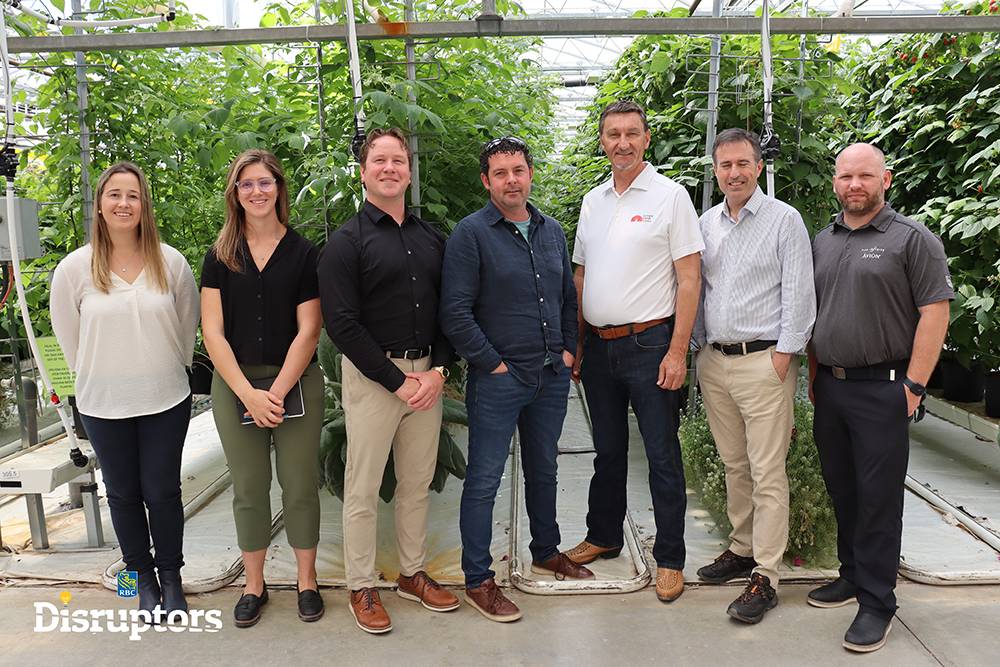
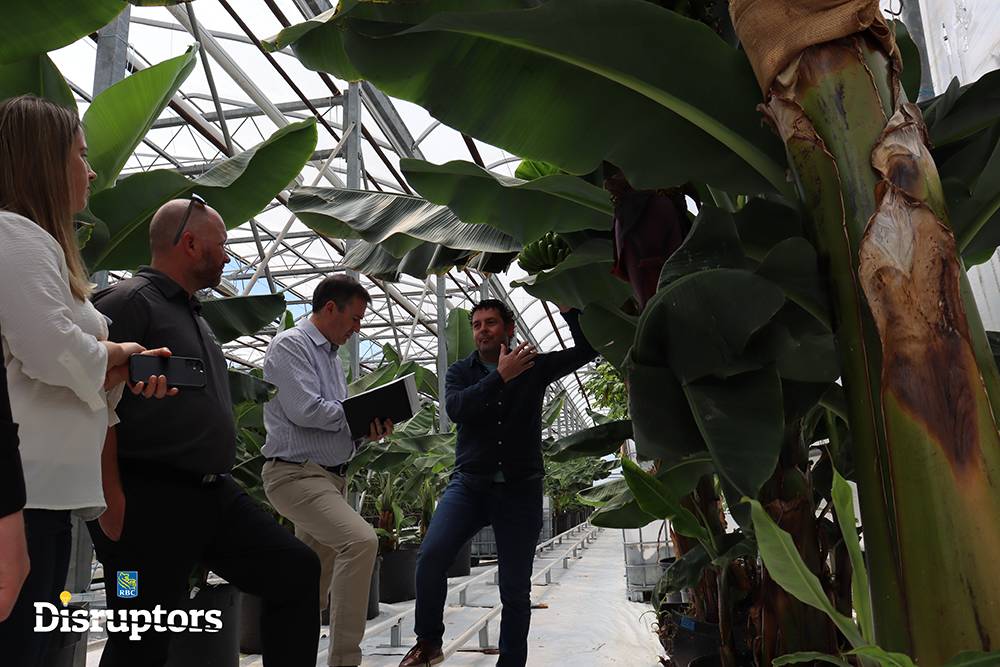
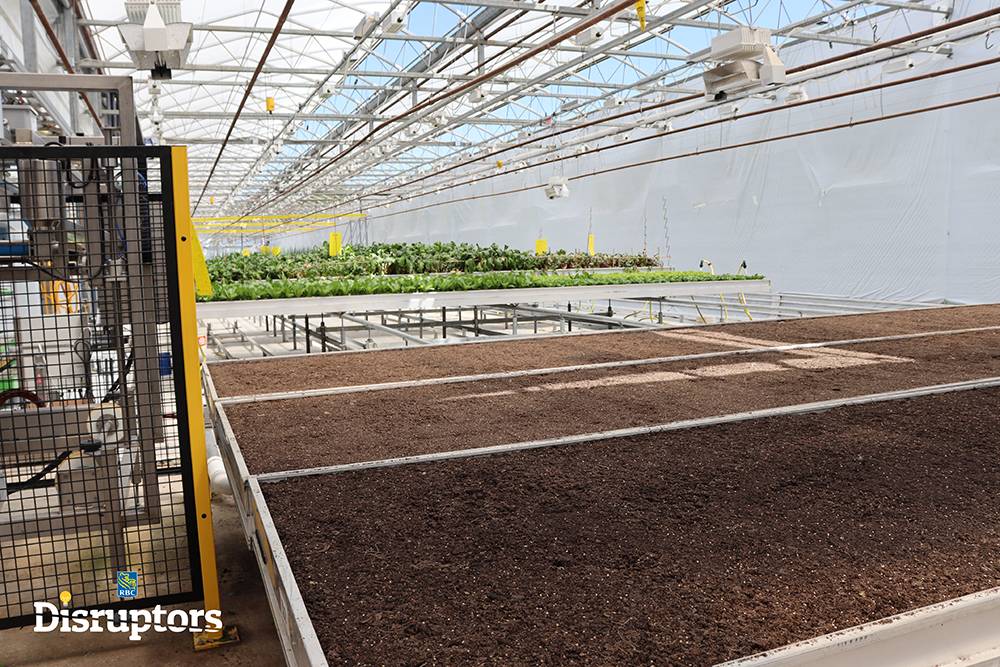
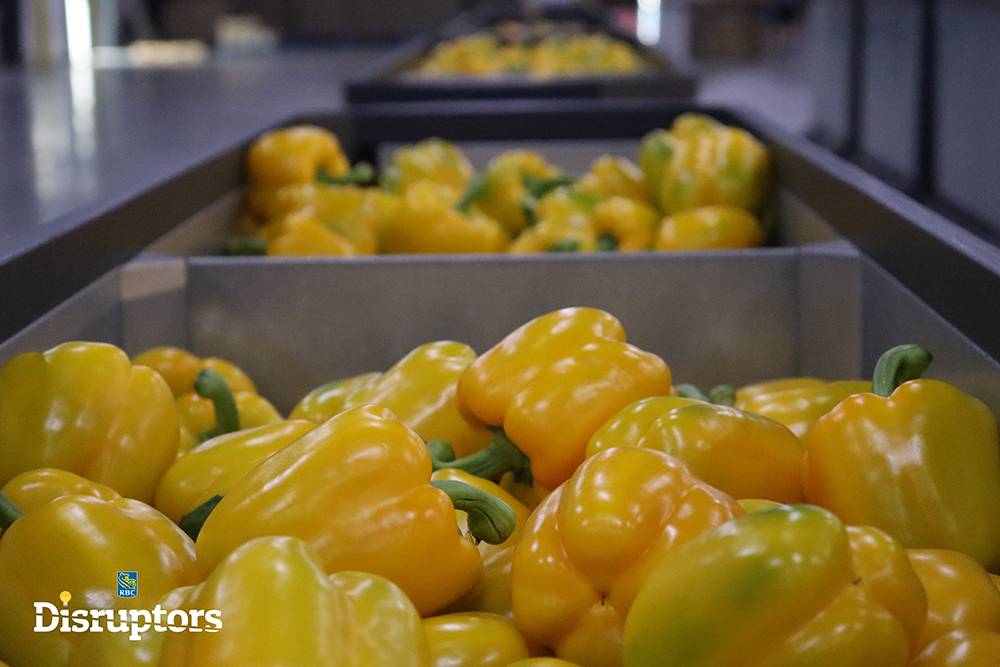
AI, automation, drones, and genetic science are impacting the way we grow — from cucumbers, spinach, peppers, and even tropical fruit. These innovations are all happening here on Canadian soil. With a growing population, an affordability crisis and increasing food insecurity, greenhouses have emerged as a key player in the agri-food sector. There’s a need — and huge opportunity on the table — for better quality food that is grown sustainably. Canada’s greenhouse sector is a hotbed for growth — increasing sales for the 11th consecutive year — and up 9.2% to $2.5 billion in 2023, doubling in size from a decade ago. A new report from the RBC Climate Action Institute launching next week, provides a lay of the land and highlights ways to transform indoor food production and its export opportunities. How can Canada emerge as a leader in a low-carbon global food system? To learn more, John Stackhouse visits the greenhouse capital of Canada, Leamington, Ontario and is joined by Peter Quiring, CEO at Nature Fresh Farms, Matt Korpan, Executive Director at the SEF Center for Horticultural Innovation and Lisa Ashton, Agriculture Lead at the RBC Climate Action Institute. Canada’s greenhouse sector is a success story in growth and productivity — and can play a critical role in the Next Green Revolution — but it’s time to consider steps to support and expand sustainably. By addressing infrastructure challenges, land-use efficiency and energy demand, the country can create ideal growing conditions for the sector to bloom further.
Speaker 1 [00:00:01] So we’re growing some guava here. We also have a whole lot of banana plants. I think we have the biggest banana farm in Canada. Down here, we actually see banana plants flowering and bananas growing. So we have a couple of big bunches of bananas right here that are just probably in about the middle of their growth stage. We have figs. And then here we have some papaya as well. Long before ten years from now, we’ll hopefully be in a new facility. And we may have one entire section dedicated to all kinds of cool and interesting exotic crops. We’re also actually growing some vanilla in another part of the greenhouse, and we’re working on coffee beans as well. Speaker 2[00:00:43] That was the voice of Peter Quiring, who in some ways is the king of greenhouses in southwestern Ontario. Pete is the founder and CEO of Nature Fresh Farms, and is on a mission to transform the way we grow food in Canada. We’re in his experimental greenhouses outside Leamington, Ontario, where he has drones, robots, data centers, and a team of scientists innovating with ways to grow pretty much everything from cucumbers and spinach to guavas and vanilla and papaya. Maybe one day, even coffee. So pour yourself a cup and get ready for an eye opening conversation. This is disruptors and RBC podcast. I’m John Stackhouse. Peter Quiring is known as the Accidental Farmer. He started a machining business in 1993, now known as South Essex Fabricating, and in 1999 he built a greenhouse that he couldn’t seem to sell, so he decided to grow in it. And that’s when Nature Fresh Farms was born. More on that in a bit. With us, we also have Matt Korpan. He’s the executive director of R&D at the SEF Centre for Horticulture Innovation. It’s a dynamic institution striving to empower growers, improve crop productivity, and contribute to the long term sustainability and food security of the sector in Canada and beyond. And from the RBC Climate Action Institute, we’re joined by Lisa Ashton, our AG policy lead. Welcome all of you to Disruptors. Speaker 3[00:02:20] Thank you for having me. Speaker 2[00:02:21] Thank you. [00:02:21] Pete, let’s start with the origin story. I mentioned you as the accidental farmer. How did this all begin? Speaker 1 [00:02:29] I built greenhouses in the early 90s and saw better technology in other parts of the world, mainly Holland and Europe. And I couldn’t seem to get people to buy the technology in North America. So I convinced a few banker friends of mine to lend me some of the money to build the first greenhouse, which I thought I would sell as a turnkey growing solution. And it didn’t sell. So I already had an agronomist and a management team, and so we continued to just grow the crop. And a few years later we decided to double that. And then we continued to expand as time went on. We’ve actually sold some of the greenhouses now, but we still have over 250 acres that we grow in here and in the States. We also have a marketing arm which markets to all of the major retailers in North America. Speaker 2[00:03:20] And as we’ve just seen through your greenhouse, and I’m looking at a table of some of your very colorful produce here, you’re doing much more than building greenhouses. What’s driving you to innovate in the way that we grow food? Speaker 1 [00:03:33] Well, I see that with a growing population in the world, we need to get more innovative on how we grow food, and we need to grow better quality food. Also, people don’t want pesticides. We all are concerned about what that’s doing to us. So we want better quality food, we want more nutritious food, and we want food to be available and affordable for everybody. As we all know, currently food is becoming increasingly unaffordable for many people, even in Canada, nevermind other parts of the world. So one of our big goals here is to see how can we grow food more affordably. Speaker 2[00:04:09] That’s a great ambition. Let’s start with the Leamington story. We’re surrounded by greenhouses. People may not appreciate that this is not only the greenhouse capital of Canada, it’s truly one of the key greenhouse centres in North America, if not the world. What’s so appealing about Leamington? Speaker 1 [00:04:25] We are here. No, that’s not it. One of the really big things is that we’re surrounded by the Great Lakes, so we have a bit of a microclimate. We have more sunshine here than even 20, 30 miles away. Once the industry started to grow, a lot of the suppliers started to show up here, including South Essex and others. We have fertilizer at a phone call away. We have biological companies that provide us with good bugs to fight the bad bugs so we can avoid pesticides. We have lighting companies, mechanical companies. Just everything is right here. Speaker 2[00:05:00] And a lot of really interesting technology that we’ll get into. From robotics to drones to some really interesting science in your labs here. I wonder if for a moment, Lisa, I can turn to you to zoom out and give us a sense of how big the opportunity here is. What’s the potential? Speaker 3[00:05:18] Greenhouse production of fruit and vegetables has a significant opportunity ahead of them. And diversifying production, innovating in automation and sustainability, and expanding production to meet the growing domestic and international demand. And they are actually building from a really solid foundation with year over year growth for the past decade, with farmgate values at over 2.5 billion. Speaker 2[00:05:41] And it’s going to take a lot of innovation, built on some impressive records of innovation here. Matt, I wonder if you can give us a sense of the scale of innovation in the sector. Most people, when they think about greenhouses, probably don’t think about a tech centre. And yet we’ve just walked through one of the most impressive tech centers I’ve seen in any part of the Canadian economy. Speaker 4 [00:06:04] Well, it’s interesting we say this a lot. We’ve got tools now that we didn’t have before. Five years ago, ten years ago, things like lighting controls were existent, but not really being utilized. And now with LED technology, we can now change the spectrum of light. So that’s one example we talk about a lot. So innovation and growing strategies our knowledge of plants and crops has come a long way. And it’s the reason we call it controlled environment, agriculture, because we have control of all the conditions required to produce the kind of crops that everybody needs from the grocery store. So whether it’s lighting, humidity, climate to water, irrigation and then the genetics behind the breeding that develops these kind of things. It’s come a long ways. As well as the drones, the vision technology, AI is becoming a big part of what we do. We’ve got a talented guy on our team who write scripts and programs that can see something that humans maybe can’t see in our crops or in our growing strategies. So there’s so much potential there. Speaker 1 [00:07:03] Give us a sense of what those drones and AI systems are doing. Speaker 4 [00:07:08] Sure. A few examples that we’re currently using at the moment. One being in some of our lettuce crops. We’ve got cameras that go over the crop and we’ll count the number of plants for germination rates. Those are things that are either timely or take a lot of time and are very difficult to deal with with human labor, but it takes seconds to do it now with the drone technology. So at night, we’ve got cameras in the greenhouse that scan the crops, and they can see moths or weevils or bugs flying around that we don’t typically see during the day. And the drone then will get instructions from the camera to go out and kill the bug, and then come back and wait for the next bug to fly by. And it’s really fascinating what we can do now, which we didn’t have that capability before. Speaker 1 [00:07:50] I hope you can license that so I can use it in my backyard. That sounds like a terrific opportunity. Speaker 4 [00:07:55] We’ll work on it. Speaker 1 [00:08:00] Pete, tell us some of the operating challenges. These are fascinating experiments and scaling it to a commercial level. Even for something as basic as the strawberry, is an interesting challenge. As an entrepreneur, as a business builder, what are the key challenges in your mind to scaling these innovations that Matt was describing? Speaker 3[00:08:20] We don’t actually start with an economic model when we’re doing research and development. We start with what are the challenges? Just the basic growing challenges. Climate, lighting, watering pests. If it looks like it might be economically viable, we don’t start with the economics. Next we start with let’s just do it. We try to overcome as many challenges as we can to be as productive and economical as we can. And usually the economics are as simple as this. What’s the retail price of the product currently, and can we grow it on a large scale? Because economies of scale are probably the one big thing that’s made this industry so very competitive over the last couple of years. And so we need to grow at a 30, 50, 100 acre scale. And then the economies all of a sudden fall into line. And you can afford the automation and the robotics and all of that. Another thing to really consider is there’s a really big difference between AI, robotics and automation. Those are not the same thing. AI is very advanced, and I think it’s going to get way more advanced. Robotics is not nearly as far as we think. We can’t even make a vacuum cleaner that works properly. So picking tomatoes robotically or any other crop is a really big challenge. Automation, on the other hand, I think we’re really good at automation these days, so we take all of those things into consideration, including working with seed companies, fertilizer companies, the bio companies that provide the good bugs to fight the bad bugs, automation companies, mechanical companies. We have a lot of our own ideas, obviously, and because we have a fabricating shop, we can make a lot of the things that we can dream up. We like to say that there’s no idea. Too crazy. We’ll try almost anything. In fact, we have tried some really crazy things. Speaker 1 [00:10:15] You’re trying coffee in Leamington Ontario. Speaker 3[00:10:18] Yeah. I mean, we’re growing papaya. We’re growing bananas. We have the biggest banana farm in Canada. I think. We’re open to be challenged on that. Speaker 1 [00:10:27] You’ve got an impressive business model going here from the fabrication, where you’re making greenhouses for others to those core produce and then the experimental side. So that’s not a bad way to run a business. But you mentioned a really important word there, important for innovation, which is scale. And it’s Canada’s inherent challenge. We’re a small market, yet we’re next door to the world’s most affluent market. How are you thinking about scaling your business and the sector more broadly in terms of the what people would call the total addressable market? Speaker 3[00:11:01] Well, Nature Fresh grows on both sides of the border, and we market on both sides of the border. Although at least 75% of what we grow here in Leamington gets sold to the US. We also build greenhouses in the U.S., so we’re on both sides of the border there as well. The U.S. market is extremely important to us. We would love to serve other markets, whether it’s Europe or China or any other place. But geographically, that’s a really big challenge. We have some rules around organic growing that don’t make a lot of sense. We’re trying to effect change in that area. The US is much more competitive, growing organically than we’ve been Canada’s. Speaker 1 [00:11:38] Why is that? Speaker 3[00:11:40] We need a certain amount of meters of soil per square meter where the US doesn’t. The thinking is that the plants get their nutrients from the soil, when in fact, without introducing fertilizer, you couldn’t grow a crop anyway. It’s the nutrients that provide the nutrients, not the volume of soil. Actually, the bigger volume of soil makes it more challenging to grow. So we would like to be at parity with the US and organic growing, for example. Speaker 1 [00:12:08] Talking about quantity, I wonder if I can also ask you, Matt, about quality, because people need think only of industrial farming and that reduce prices, but also compromise quality, over the last many decades. The food that you’re producing here is high quality. The tastes are unique. How do you do that? Speaker 2[00:12:27] Well, Control Dragons is about having that control in a greenhouse environment. We can always produce conditions for the plant that are better than outside. Wind stress, rain or extreme sunlight. It all affects the crops that are grown in the outdoor environment. So we can grow high quality. And we know this. We believe that consumers expect high quality from us. So that’s kind of the focus for us when we’re growing. And in those strategies we use every plant, every crop here needs a different approach to growing. And our job is to figure out what that is and then we can take that knowledge and transfer it to the growers in our community and keep quality top of mind. Really, that’s what sets our industry apart from some of the other produce that’s out there is the quality is better. Speaker 1 [00:13:09] There’s also the question about climate impact. And Lisa, I wonder if you can give us a brief sense from your research of what the outlook is on that front. One of the challenges that we’ve tried to lay down for the country is how do we grow more food with fewer emissions? We think that can be Canada’s moonshot, but what are you seeing? Speaker 3[00:13:28] Canada’s green host sector is an untold success story of productivity and growth, and to build upon that growth in the future, the industry has key energy, water and waste infrastructure challenges that need to be overcome. Energy use, for example, is a key contributor to greenhouses carbon footprint. Their expenses and productive regions like Leamington are seeing increasing demands for the energy that is available, and we are seeing that innovative solutions are underway, but they need to be scaled to bring down emissions, bills and demand. Speaker 1 [00:14:05] I wonder if you can tell us a bit about what you’re doing on the energy front. Maybe start with a bit of, one on one. For people who may not appreciate how much energy is required to produce the food that we get to enjoy. Speaker 2[00:14:18] So I’ll start with gas from even 10 or 15 years ago. Our energy consumption is down by 25 to 30%. That’s due to better technology in manufacturing greenhouses, better energy screens, more efficient boiler systems, and hot water heating systems. When you burn natural gas clean, the byproduct is pure food grade CO2. Plants need CO2, like humans need oxygen. And so we’re dosing that natural gas into the greenhouse for the plants. And we have these large vertical thermal storage tanks where we store the heat energy. Tonight probably about three in the morning we want to dehumidify that crop. And the boilers don’t turn on. The pumps reverse and we take heat energy out of the tank and we put it into the greenhouse. On electricity, we would like to see cogeneration be a part of Ontario’s energy supply system. It is the best use of a fossil fuel that you can possibly imagine. Because we can use all of the heat. Any excess heat we would have, we would sell to our neighbours. And they would avoid turning their boilers on. And we can still use the CO2, and we can still use most of the heat in the summertime as well, if not all of the heat. And so that fossil fuel is being used and consumed completely to either provide electricity to the grid in the wintertime. Provide electricity to the greenhouse and the CO2, the electricity and the heat, all self-contained. Speaker 4 [00:15:56] So still producing food. Speaker 2[00:15:57] Still producing food. Exactly right. Competitively. I think the really big challenge is that if you simply believe we need to stop using fossil fuels, then you can’t get your head around this idea. But if you have a little bit of an open mind, then growing food is important. Saving the climate is important, but not at the expense of all of eating. We need both. Speaker 1 [00:16:23] But you can do both. Speaker 1 [00:16:24] I think some open minded cooperation, collaboration between industry, government, the powers that be, whoever that is, is very appropriate here. Speaker 1 [00:16:34] You mentioned at the outset how much sunshine there is. And people may wonder, well, why not harvest that sunshine as well through solar panels and other renewables? There’s lots of wind farms in this part of Ontario as well. Much opportunity there? Speaker 2[00:16:48] We live in a northern climate that has short days in the wintertime, and so during the at least six months of the winter, it’s hit and miss, mostly missed. In the summertime, not bad. We can definitely use solar panels. We’re also looking at panels that can harvest the sun during the summer and still grow crops. So there’s some opportunity there. I think solar panels are getting better and better. So far, the economic model isn’t fantastic. Speaker 1 [00:17:19] I love how you’re trying so many different things, from solar panels to food varieties to drones, and some of those things will work. Presumably some don’t work. Give us a bit more of a sense of your kind of innovation, thinking how you go about these these challenges, but also the questions that must be popping up in your mind every day. Speaker 2[00:17:38] I guess I just have a very innovative mind. My family grew up relatively poor. We had to be innovative and creative basically all of our lives. I just enjoy building things. I enjoy new ideas. Again, the crazier the idea, the better I like it because anybody can do the normal. So what gets me up in the morning is what can we do today that’s really cool and will actually help humanity overall. Speaker 1 [00:18:08] What a great ambition to start the day with. I imagine a lot of that comes to you as the head of R&D. What’s he like to work for with that, with that ambition? Speaker 4 [00:18:17] It’s great. You know, some days we don’t know, what new project we’re going to come up with. We’ve structured and built this really incredible team here at the Innovation Center. We really collaborate together in projects. So Pete might show up one day, and. And suddenly we’ve got a whole new idea, and we’re doing something crazy in the greenhouse. And other times, it might be even one of our team members that will come, and we kind of add to each other’s ideas and build on it. So this is the best place that I’ve been able to have the fortune of working. There are very few people in the world that get this opportunity, and also they’ve impacted and changed on the lives of anybody who eats food. Speaker 1 [00:18:54] As we were walking through the greenhouses today, I was thinking, this really could be the Silicon Valley of food production. This area, you’ve got a great mix of competitors here. Maybe some more collaboration would be helpful. There’s universities and colleges. There’s good market access. Matt, when you think about innovation, what do you think this region needs to be the Silicon Valley of food production? Speaker 4 [00:19:17] For starters, I think there’s a very good base here, right? We’ve got the industry, we’ve got the suppliers, we’ve got the market, like you just mentioned, access to some 200 million people within a day’s drive of our location. But we do have some hiccups. There are some challenges we have with legislation that we need to fix and collaboration within the industry itself. And that really is where we see ourselves creating what you call the Silicon Valley of food production, is being a hub for the whole industry to come together. We sit around the table, we toss ideas around. We we solve our challenges as an industry together. Because really, what is our competition? Yes, there’s competition within our own industry. But on the grocery store shelves, we’re competing with chips and candy, and we’re competing with other things. And as a greenhouse industry, there is much more potential than what we see right now, and we just are happy to be part of that. Speaker 2[00:20:08] You bring a really good point, man. This is all health. If you want to solve the health care crisis, solve the eating crisis. Eat this stuff. And you’re almost certainly going to be a whole lot healthier. Speaker 4 [00:20:21] Well, and sadly, the packet of sugar in your candy bar is cheaper than this. And that’s where we really need to work on bringing the cost of food down. The retailers need to do their part. The government needs to do its part. Let’s work on doing this and doing it well and not trying to hold things back. Speaker 1 [00:20:38] You mentioned legislative challenges. What are you thinking about? Speaker 4 [00:20:41] Well, I think there’s always issues with taxing. There’s federal, provincial and municipal issues, and I’m not involved in the policy side. But we’ve got a great association. Greenhouse Vegetable Growers of Ontario that lead the charge on some of that stuff. And whether it’s bit unfortunate, but also new bylaws that are being put into practice that are hindering the expansion of this industry, which is really essential to Ontario and into a North American market. Speaker 2[00:21:07] And I’d like to add something to that. We need a change of thinking on all three levels of government. So we need more infrastructure. We need water expansion. We need roads. We need natural gas, we need electricity. All of those things need to be expanded. And the industry is here because those things were available. We maxed them out. So now we have two choices. We can let it go to the US, or we can provide the infrastructure here and do it ourselves. And we love the U.S. and don’t get us wrong, we love the Americans. We love the American market, but we live here. Speaker 1 [00:21:45] It’s interesting to compare this also to the housing debate, where I think we’ve come to grips with the fact that we’ve got a supply crisis and lots is being thrown at it. And when we talk about food prices or food affordability, people don’t talk about the supply side. And how do we support the supply side to get not only more food, more accessible food, but better quality? We do all these things for cars and houses, but maybe not as much for food. Pete, what does Canada need to do to keep you focused here? Speaker 2[00:22:15] Well, one thing is for sure reduce the tax burden. Reduce the regulations. If we could focus on growing far more things, more affordably so that a piece of fruit isn’t more expensive than a candy bar, then perhaps we, like we already said, we may solve some of the health care crisis. We need to work together to grow more things for less money on a smaller footprint with less energy. Speaker 1 [00:22:48] So we move towards close of this conversation. I wonder if you can each give us a sense of how big the opportunity is here. So Pete, for Nature Fresh Farms. If you look out 5, 10 years, how big can this be? Speaker 2[00:23:02] Every acre of greenhouse has the potential to produce up to $1 million of food per acre per year. Every time we build a couple of hundred acres. It’s a couple of hundred million dollars per year added to the economy, but also added to food security. We build the equivalent of an automotive plant every year in the greenhouse industry. Speaker 1 [00:23:24] Equivalent by what measure? Speaker 2[00:23:25] An automotive plant is usually somewhere around $1 billion to build. The greenhouse is somewhere around $2 million per acre. We’re building 2 to 300 acres a year. So that means that we’re basically building an automotive plant almost every year. Another thing that is really important to know, the yield in greenhouses is 10 to 30 times what it would be in the field. So it would take 10 to 30 times as much area open field as it does in a greenhouse. Speaker 1 [00:23:58] So we can use less land, presumably with, better yields, better intensification. Speaker 2[00:24:04] We can reforest the rest of it, or we can grow other things outside. Speaker 1 [00:24:08] And it’s also about a diversity. It’s interesting to think that this region used to thrive on one crop, which was tomatoes. And now you are growing papayas here, which is still mind boggling. And bananas, as you said, and vanilla and maybe one day coffee. But I’m looking at a very colorful tray of sweet peppers as well. So, Matt, when you think about that diversification challenge, what does Canada need to come to grips with? What does the sector need to kind of lean into to ensure that we are able to do what people 50, certainly 100 years ago, could not have imagined growing here? Speaker 4 [00:24:45] That’s a big question. We have a vision for how we can or this industry can move some of these things forward. And in the coming years, we’ll release the plans for how that’s going to play out. Speaker 2[00:24:56] We’ve actually even considered getting the public involved know, so selling some kind of membership or sponsorship, and we would send out regular updates on what we’re doing, what we’re achieving or not achieving the different ideas. Speaker 4 [00:25:10] This is a vision Pete had for, I’d say decades now, probably. And it’s now starting to happen. It’s taking life and it’s becoming a thing. So grateful again that our team can be a part of that and start it. But we can’t do it alone. We really do need the industry, the academics, the government, the retailers involved in doing this work alongside of us. Speaker 1 [00:25:31] This is a great story, and what you’ve created here in a short number of years is truly impressive and sort of, use the pun, but let’s hope it keeps growing. And that Canada gets behind what you’re building here. Thank you for being on disruptors. So Lisa, that was an incredible conversation. I can’t believe that we’re looking at papaya and guava growing here in southwestern Ontario. What jumped out at you from what Pete and Matt shared? Speaker 3[00:26:03] The largest banana farm was definitely a surprise for me, but what I found most interesting was to see workers and automation working together to provide our food to us in a more efficient, productive way. The automated spinach harvester that we saw do a large panel of spinach growing in a matter of seconds. I thought that was so fascinating. Speaker 1 [00:26:26] And people can see video of this on our website at RBC.com/Climate-Action-Institute, or just Google RBC Climate Action Institute. It’s amazing to see these trays move along a conveyor belt day by day, from complete darkness so that the seed germinates to light. And then within a week or two, bags of spinach are suddenly, leaving the property. What do you think we need to do as a country to get more people engaged in agriculture, including at the very techie edge of agriculture? Speaker 3[00:26:59] Yeah, I think when people think about agriculture, they don’t necessarily see it as this data driven, high tech industry, but it really is becoming that, it’s a really exciting space to work. So I think it starts in universities or even sooner than that, exposing young people to those types of opportunities in agriculture. We do have a huge labour shortage. So there are ample number of amount of opportunities available. It’s just a matter of connecting young people and new Canadians and people maybe looking for a career change and welcoming them to the opportunities that exist in agriculture. Speaker 1 [00:27:34] Well, lots more to explore there. And Lisa, thanks for being on disruptors. [00:27:40] That was my conversation from Nature Fresh Farms in Leamington, Ontario, the greenhouse capital of Canada. With a growing population, an affordability crisis and increasing food insecurity. Canada can emerge as a leader in a low carbon global food system. It will take a lot of technology and we saw it today at play. AI, automation, robots and drones are all impacting the way we grow, from cucumbers to spinach, peppers, tropical fruit and who knows, maybe one day even coffee. All happening here on Canadian soil. But we’ll have to be collaborative and scale innovation like the ones you heard about on this episode. You can learn much more about all of this in a new report from the RBC Climate Action Institute. It explores how greenhouses are a Canadian productivity success story, and how much more room there is to grow, quite literally. Watch for it at RBC.com/climate-action-institute, or follow us on LinkedIn at the RBC Climate Action Institute. I’m John Stackhouse and this is disruptors, an RBC podcast. Talk to you soon. Speaker 1 [00:28:51] Disruptors, and RBC podcast is created by the RBC Thought Leadership Group and does not constitute a recommendation for any organization, product or service. For more disruptors content, visit RBC.com/Disruptors and leave us a five star rating if you like our show.
It’s no secret that the last few years have been rough for tech – but the sector also has a unique ability to look beyond the clouds and see opportunity through innovation. And while there are challenges ahead, there is a renewed optimism that we may be entering a recovery stage – where a period of fiscal discipline and strategic focus can set companies up nicely for long-term success. That was the spirit from the RBC Capital Markets Technology Private Company Conference in LA, an annual gathering of tech founders and investors exploring ideas, risks and opportunities in tech land. Key takeaways from the conference on the outlook for tech:
  1. Private for longer: Despite the run up in some tech stocks, the mood continues to be that private tech companies will avoid the stock market a while longer.
  2. The next tech boom: May come from low code and no code. A lot of startups are showing what drop and drag can do to replace old fashioned code writing and get ready for even more transformation in software with voice to code and image to code.
  3. Data navigation: It’s all about the plumbing of digital networks in the hyperconnected age of AI. Many organizations are now realizing they can’t be wired to a single cloud. Regulators won’t let them anyway, so there’s a big opportunity for tech firms that are helping us all navigate multiple clouds and see where our data is going.
  4. Cyber defense: Cyber threats are growing exponentially in an AI-powered world, and few of us can keep up with the cyber criminals and their AI weapons. But generative AI is also on our side, helping companies, governments, and everyone else stay safe. It’s big business and it’s growing.
  5. AI’s next frontier: It’s all about strategy, because strategy is about solutions, not problems. To be blunt, too much gen AI has been looking for problems to solve rather than accelerating strategies and liberating solutions for all of us.
On this episode of Disruptors, John Stackhouse is live from LA and is joined by Sachin Dev Dugal, Chief Wizard at Builder AI — named one of the world’s top three Most innovative Companies in AI, alongside Open AI and DeepMind. Builder uses low code and customizable software to provide flexible, bespoke apps at the speed and cost of an off-shelf product — aiming to make building software as easy as ordering a pizza. Silicon Valley and other tech centres are hopeful and as markets look toward rate cuts going into 2025, a new confidence can be felt. But until then, many executives and investors could remain focused on managing cash and costs, proving out business models, especially in AI, and maintaining secure relationships with patient investors. And for those who remain strategically focused, operationally lean and results oriented, the outlook is pretty sunny. To read ‘The Roaring ‘20s are back, thanks to seven stocks, two letters and one central bank’ by John Stackhouse, click here.
Speaker 1 [00:00:01] Hi. It’s John here. I’m in Los Angeles, where it’s 72 and sunny. Like, it is pretty much every day here in spring. I’m coming to you from the RBC Capital Markets Technology Private Company conference. It’s an annual gathering of tech founders and investors exploring ideas, risks and opportunities in tech land. Now, if you’ve been following Disruptors, you know that the last couple of years haven’t been exactly 72 and sunny, at least for tech. Year on year, the tech heavy Nasdaq index is flat, while the S&P 500 is up 25%. But one of the things I love about tech is its ability to look beyond the clouds, to see opportunity. And that was definitely the spirit of this conference. We covered a lot of themes, but here are five ideas I came away with. Number one private for longer. We heard it again and again. Despite the run up in some tech stocks, the mood continues to be that private tech companies will avoid the stock market a while longer. It’s too volatile, too onerous for compliance, too demanding of profits. And given the abundance of private capital, not as necessary as it once was. But that doesn’t mean there isn’t a lot of potential. One fund manager told us that this year feels a lot like the early 2000s, when there was a seven-year bull run just ahead, and some of that next tech boom may come from Low-code No Code, which was my second takeaway. A lot of startups are showing what drop and drag can do to replace old fashioned code writing, and get ready for even more transformation in software with voice to code and image to code. And that will take more data navigation, which was my third takeaway. Data navigation is all about the plumbing of digital networks. In the hyperconnected age of AI. Many organizations are now realizing they can’t be wired to a single cloud. Regulators won’t let them anyway, so there’s a big opportunity for tech firms that are helping us all navigate multiple clouds and see where our data is going. And with that comes a wave of new risks, which was my fourth takeaway. Cyber defense is the new frontier for tech investing, which is both old news and the new thing. Cyber threats are growing exponentially in an AI powered world, and few of us can keep up with the cyber criminals and their AI weapons. But guess what? Generative AI is also on our side, helping companies, governments, and everyone else stay safe. It’s big business and it’s growing. My fifth and final big takeaway is that the next frontier for AI is strategy, because strategy is about solutions, not problems. To be blunt, too much gen AI has been looking for problems to solve rather than accelerating strategies and liberating solutions for all of us. You can read more of my takeaways on tech by searching RBC and Thought Leadership, or on my LinkedIn page. One of the champions of that last idea of AI for growth is Sachin Dev Duggal, who is our featured guest for this episode. Sachin is the CEO and founder of builder AI. It’s an AI powered platform that uses low code and customizable software to provide flexible, bespoke apps at the speed and cost of an off shelf product. In 2023, builder was named one of the world’s top three Most innovative Companies in AI, alongside wait for it, Open AI and DeepMind. So let’s jump right into that conversation. It’s a good one. This is disruptors, an RBC podcast. I’m John Stackhouse. Welcome to the RBC Capital Markets private technology conference in Los Angeles. I’m John Stackhouse and I’m joined by Sachin Dev Duggal, who is the founder and CEO of builder AI. And carries another title, chief wizard. And we’ll, we’ll get to that in a moment. Sachin is a serial entrepreneur. He started his career at the age of 14, building PCs and moved quickly into other aspects of technology by 17. He was already starting to build one of the world’s first automatic currency arbitrage trading systems for Deutsche Bank. Sachin then launched builder AI in 2016, and had a simple aim to simplify the lives of everyday users and make building software as easy as ordering a pizza. Sachin, welcome to disruptors. Speaker 2 [00:04:40] Thank you so much for having me here. Speaker 1 [00:04:41] Let’s start with your story, Sachin. How did you get hooked on technology? Speaker 2 [00:04:46] You know, it was a really funny story. So growing up, I actually had no interest in technology or computers. I wanted to play tennis, and I managed to blow up my mom’s computer and she said, fix it, or else. And so then I had to start reading this book, understanding how to program DOS. And it was really quite addictive. And so I managed to rewrite the DOS menu so that it could now start working. And then it came full circle. Next year it was my birthday. And I said, oh, I want a PC. And she said, you know what happened the last time you touched one? And I said, no, no, but I want to build it. And she said, this is just such a bad idea. In the end, I actually ended up building it and I thought, it’s not so bad and sort of got into building computers. My first customer was my design teacher, and actually for him, I just fixed his laptop and I still got paid. So that was great and full circle. You know, Michael launched Dell, building PCs was no longer as profitable. And so I started to write code and learn how to write software programs. And I guess the rest is history. Speaker 1 [00:05:40] So mothers are great teachers, so is failure. And you had a couple of early failures, which I think allowed you to help doing what you’re doing now, but give us a quick sense of what you learned. Speaker 2 [00:05:51] There’s a natural velocity at which things are meant to run. If you broach that law of physics, things break. So that was a huge learning lesson for me, because I was this really restless teenager where everything should have been done yesterday, could not understand why anything took more than a day, and had no real sort of perception. Some things is like wine that just need time to ferment. I think the second is high the right sort of the people around you. When you’re 21, 22, you kind of don’t know what the right or the wrong person is, and you’re just very trusting that everyone’s the right person. And I still go into discussions when I meet people for the first time with 100% trust, but I’m a little bit more cautious of what to look for. And I think, and this was probably the hardest one, was celebrate the failure and the things that didn’t work. You know, for many years I would just say, hey, you know, that happened. And it was some broken glass and we had an exit and we moved on. And and it was because I was on to my next part of my life. I was quite young when that happened, and I didn’t know how to deal with explaining. Well, you know, I screwed up or this happened or this was the broken glass, because to some extent, I was just like my mind had already gone forward, and I felt that people would look at me differently if I say, oh, what if she didn’t work? And I had this issue and I didn’t know how to explain it? I guess I feel so much more comfortable now because with builder, we built a tremendous business, and I don’t want to ever have the narrative that, oh, you know, there weren’t problems and there weren’t issues because I don’t think it’s fair to the entrepreneur that was in my shoes 20 years back to give them the confidence. Speaker 1 [00:07:18] Tell us about Builder AI and what you’re trying to build. Speaker 2 [00:07:20] For me it’s always the root of the problem that is really interesting, right? And in this case, I was in San Francisco. I was trying to build a photo sharing app, but a really robust backend kept trying to find front end developers, getting rogered and trying to get it done and then realize it’s so difficult. So that was sort of the seed. Started to see more and more people trying to build software businesses or trying to become software entrepreneurs and going through very similar struggles. And then I think it just struck me as saying, well, if we take a long enough view, there’s going to be no more traditional business. Everything is going to be software powered or software native. And if that’s the case, then 95% of the people that are running businesses, running departments, running ideas, running large corporations, they’re ill equipped because they’re not technical, they’re not product managers. And yet they need to be able to use software and build software to unlock their potential. And that’s really what got us started. The Genesis actually was really simple. They said, well, the world’s going to build software. Most of the world doesn’t know how. When you look at what they’re building, they’re quite similar. But what do we mean by quite similar? The ingredients or the features that make up most software applications? They’re the same. 80% of the features that make up most applications are the same time. Just look at the phones and applications you have, right? I’m sure you’ve seen a login view or profile view, a map view, a payment, a chart. They’re all the same features. Like I still don’t understand why there are a thousand people in the world today trying to build a login feature. It’s the same login as the last thousand yesterday. And so we said, well, that’s a lot like Lego. And you know, I have two kids. They play with Lego a lot, and you can use the same Lego blocks to build different things. Why can’t we use A.I. to put those Lego blocks together and organize them? And really, the dream for us is how fast do we get to, we call it 77 apps an hour, which is a million applications a year, which is only 1% of all the new businesses being started every year. And that way, I think we’ve made a small step towards allowing entrepreneurs of all sizes, companies of all sizes and professionals from across domains to be able to unlock the potential. Speaker 1 [00:09:23] We’ll come back to the business model, but tell us first about Chief Wizard. Speaker 2 [00:09:26] So this goes back to my learnings. I was very keen when I was younger. I’m CEO, sort of the brash version of your younger self, and I realized that I actually had none of the experience. The second was the title carries with it like a huge amount of weight. Not so much a weight for me, but a weight for when I speak to folks. It’s too serious. And so you don’t necessarily always find things out. But I say the third thing is, if I really think about what my job is, it’s to help magic happen. And so whether that is magic between teams, magic in product, helping customers unlock potential, which is also quite magical, hence wizard. Plus it gives me something to grow into. Eventually I will become a good CEO and I will carry that title. Speaker 1 [00:10:08] So helping your customers understand or find the wizardry in the economic and business opportunity here is a big challenge for AI. How are you approaching that? Speaker 2 [00:10:17] Maybe the preamble to this question is where exactly are we in the hype cycle? If you remember a Real Player back in the day, it was a promise of video streaming. You’d hit play, you’d wait 10 minutes or 20 minutes, and then you’d get a 32nd clip. How many of you use Netflix or Hulu or Apple TV today? So where’s Real Player? How many of you have a dial up modem today other than sitting in the cupboard or in a museum? Right. You don’t. Right. And and so that’s my point when we’re at this really early evolution of the technology. So that is quite interesting because you have a really early technology that has this massive ability to cause disruption. Then the question is then why is everyone becoming so hyper? It’s been here for about a decade. What changed? So what changed was design, the thing that no one actually talked about. Suddenly you had the most complex software system and it looked like WhatsApp. So the design change suddenly meant everyone reacted like people on the tube were talking about large language models. The world is talking about it. Every boardroom, every CEO saying, where is our AI strategy in many cases? Where is our generative AI strategy? And yet they haven’t found all the use cases. So you have many pilots that aren’t going into production. And this boils down to, to me, the last part, right. Which is what is AI. Because it’s surely not just generative. If artificial intelligence is in some respects trying to emulate human intelligence. We have fundamentally three ways of thinking. I’m sure many of you swam as kids. If you have that visual in your mind, that video that you’re playing, you’re not generating the video, by the way, that’s a real video. You’re retrieving it. That’s a knowledge graph. If I said to you, please help me complete my sentence, what do you think I’m going to say? Right? You might have said, do this. Probably a million other words you could have used, but you inferred say or do. And so that’s inference neural networks. And then if we say, hey, we’re going to write this poem about us on stage, known entities. Now we’re generative. And but the thing is, we had all these other systems that had to come together for us to be able to do that. And I think that’s what is now dawning on CEOs and companies as I meet them is they’re realizing, well, actually, I got to be very specific with the problem I’m trying to solve. You know, today’s AI is really good for removing human variance. It’s really good for removing tasks. It is not removing jobs. It’s allowing people to move more upstream. And my favorite analogy it’s the cape you put on humans to make them super human. Speaker 1 [00:12:46] I get to talk to a lot of CEOs, including about AI, and I find the most successful ones see it as a growth opportunity. This is not about an efficiency play. They’re looking to add productivity, but essentially value per worker per hour worked. That comes down to skills and enhancing skills. You’ve talked about helping people go from good to great. Maybe that’s the superhero cape that you’re putting on them. Give us a sense of how that actually plays out in a real company and in the real economy. Speaker 2 [00:13:14] Broadly speaking, what are company’s most interested in? How do I build a better customer experience in what I’m selling? How do I build a richer customer experience when I’m servicing, and how do I make sure I’ve optimized my cost base so that I’m getting the right leverage to be able to scale? And so this is where AI becomes really powerful. So, you know, imagine a call center. We often think in call centre calls, every conversation is unique but it’s not. I remember my own experience in the sort of rough data points, we ask too many questions last year about customers, but only 1200 were unique. The rest of it was the same question asked in different ways. So that tells you actually the conversations the brand has with its customers aren’t that unique. So you can actually be quite controlled around it. And if you had an AI that could allow an agent to be successful straight from the beginning without having to wait three months for training, that’s really quite powerful. Well, what about the customer experience? This is an example I actually had with the customer last week. They said, I have all these people calling our call center. They’re clueless individuals that are trying to buy an engagement ring. We waste all our time answering the same question. What if we could actually have a conversation with them synthetically through an AI and we talk to them and say, hey, what kind of things does she like? Is she a sporty person? Does she like to go down Beverly Hills wearing Chanel? Like, what is her raison d’etre? And on the back of that, you can then start to say, well, actually, these are the kind of stones you might like. This is the kind of designs you might like. You could even generate by saying, it’s a bit of this and a bit of that and something like this. And so now suddenly you have a really rich, fluid experience to buy something that otherwise was entirely manual, and you had to keep going backwards and forwards. And it was really complex to buy. Speaker 1 [00:14:51] And what’s the role of builder AI in that conversation? Speaker 2 [00:14:55] So we’re helping customers build really that soup to nuts. So whether it’s using Natasha as the conversational platform, whether it’s how we’re allowing you to bring your core insights and your data up, realizing that actually 90% of communication is repetitive, of the 7% that’s actually unique. So figuring out what that seven is and then building the software stack, right. So it can be a conversational experience. It could be a call centre experience. It could be a web or a mobile app experience. Our job is really simple. We’re here to help people build software and do it in a way where it’s really voice to software or text to software, and you don’t need to worry about anything in the middle, as long as you can answer questions and you can describe what’s in your mind. You can build it. Speaker 1 [00:15:44] Tell us a bit more about what that means voice to software or text to software. Speaker 2 [00:15:48] Yeah. So today what we’re seeing in the industry is a lot of tools for developers. Cognition Vercel GitHub Copilot. They’re all about allowing developers to code, complete, or write code more efficiently or faster. And so you’re seeing like 30, 40, 50% performance gains at the developer level. But writing code is not building software. It goes so much before that there’s the design. There’s even further. What are the features needed to solve the problems? What are the journeys needed to solve the problems? Now what can everyone do universally, globally? They can talk, they can chat, and they can explain what’s in their mind and the problem they’re trying to solve. And so the question is how can we use that common user interface? Show you options. Ask you questions. Drive you through a path, and then ultimately start to build a software application with abstracting away all of that complexity. Speaker 1 [00:16:39] Are you actually putting the Lego blocks together, or just giving the Lego set to the customer, and maybe giving them a user guide or one of those maps that they can play with? Speaker 2 [00:16:47] Great question. So no, we’re actually putting the Lego together. We’re customizing the Lego for them. We’re deploying the Lego. So we’re putting it in the showcase. And then we’re saying the lights are on. Now you can invite people home to see the Ferrari you just built. And that’s actually really important because for a customer that’s not technical, which makes up 95% of the audience, they don’t want to be given tools and canvases. No one wants to be given a white page and saying, what do you want to do. When you buy things that you don’t understand, you always buy with options. So I want a bit of this and a bit of that, and I really like this. It’s the pizza analogy. You never go in saying, I would like a pizza and say, this is how much dopugh I want you to put. You say, I want this pizza or this space with these toppings. And that’s generally how we work. Speaker 1 [00:17:30] But don’t customers want a bit of customization or a lot of customization? Speaker 2 [00:17:33] Absolutely. So what we found is at the volumes that we now operate, 80% of the software is out of the box. 20% is customized, sometimes 30%. And that 20 to 30%, we have now built the technology to generate half of it. And then we have an expert network, which is humans in the loop that are doing the last mile. And I don’t think that’s ever going to change. And there’s a very specific reason for that, because there are new things that are being built and you need that human creativity around it. But here’s the flip side of it is today, for every developer being available, there’s eight developers being demanded, nine developers meanwhile. So we just have a shortage of supply anyway. Speaker 1 [00:18:17] You’ve talked about this being a new age of Da Vinci. Explain a bit more your thinking there and where the creator economy is going to take us, but also builder. Speaker 2 [00:18:26] So look, you know, I give you this analogy of imagine, imagine you have a skill, right? And let’s say your skill is you’re a good salesperson on the shop floor. We now know through what we can do with AI, we can empower other people to be really good salespeople because we can see your attribute. We can see how you did it. We can see what you said. We can see how you closed and we can empower everyone else. Now that’s great for the company. It’s not so good for the salesperson because they went from being the best performing salesperson. But now everyone is really good performing. The evolution of skills is actually learning new skills. And that opens up another point, which is from an educational framework perspective, Stem doesn’t work anymore. Kids shouldn’t be learning how to code. What really is important is kids are doing music and architecture and and the arts. And that polymath is why I talk about the da Vinci era, which is for us to now coexist with this technology, to really be the superhumans. We need to open our minds to disciplines that probably never percolated together before. Speaker 1 [00:19:32] At a more practical level, a lot of companies are doing POCs proofs of concept. Do you see that shifting significantly in the next couple of years? Speaker 2 [00:19:39] So I think it goes to my point. You know, you did the video streaming POC when Real Player was here, but it wasn’t until we could stream 4K or we could stream ten ADP that actually it worked. Right. And so the POCs are actually a double entendre in some respects. On one hand they’re testing the technology, but actually what they’re doing is they’re testing the problem. And so what you’re finding is that, well, it’s not really a problem I need to solve, because what I’m still seeing a lot of is a solution seeking a problem. And the POCs are the conversion of the solution, seeking a problem. What we will see over the next 12 months, 24 months is the problem starts to seek a solution because people now understand what the art of the possible is. And that kind of makes sense, right? Because until this wave came along, we never had a concept of what the art of the possible was. Speaker 1 [00:20:24] So shifting more to solution identification and description, what are the best companies you deal with, getting about AI that maybe others are not? Speaker 2 [00:20:33] From a customer perspective, where we have seen this be lightning is when the use case is really well specified. And so we have a customer that says we need our sales teams to be able to answer any question on the back of this data set, and that data set included PDFs. That data set included conversations that had been recorded. And so that was solid, right? Because it was very well defined. We’ve had customers that said, our NPS in the call center is 15, which is not so bad for a call centre, but still terrible. We needed to be 40. And so we said, okay, well, what are the problem? Well, here are the problems we’re seeing, you know, a good agent and a bad agent, we don’t know until six months in. And so now you can use AI, you can use the full gamut from knowledge graphs to machine learning to neural networks to generative to be able to help them solve that problem. So the more defined the problem is where there’s a real business case behind it. And then the third one I was like, is there are folks exploring, but they’re going in with a really open mind on what the future of a user interface might look like. And that makes much more sense when it’s a brand to a B2C audience or a B2B to C audience. And so you’re seeing a lot of people reimagine. What does a shopping app look like? Sephora did this, for example, with makeup, but like, how does it look for trying clothes on? And can we make that whole thing feel like a concierge, almost like a personal shopper experience for people? Speaker 1 [00:21:55] We’ve got just a couple of minutes left. I wonder if we can turn to builder and some of your challenges, but also dreams and ambitions in taking it forward. What are the biggest challenges you’re up against? Speaker 2 [00:22:07] We’ve had the good fortune and the challenge of growing very quickly, so we started the company in 2016. We came out of beta in 2020 during COVID, disastrous time to come out of beta, and we were all nervous. I was very bullish and the board kept saying, Sachin, this is not the time to be optimistic, the world is falling apart. And and we grew from 17 million revenue to almost 180 million revenue in three years. And along the way we put on a lot of weight. And it was akin to having lots of cheeseburgers and ice cream for three years. We’ve now realized we need to go to the gym. It’s a bit painful to go to the gym after having eaten pizza, ice cream, burgers for three years. And so a part of this is trying to figure out what is the right size of this org. Where do we put on weight, what was necessary, what was an issue, where have we not invested enough? The second, I think, and this is why I use the wizard versus CEO, is companies go through story arcs. We’ve completed story arc one. We completed that when we crossed 100 million revenue. We’re now on story arc two. The things that got us to story arc one will not be the things that get us to story arc two. So the biggest challenge is trying to figure that out and unpack that. And, you know, it’s scary because the genie’s out of the bottle, right? And so to a certain extent, you’re trying to learn this precipice. And then this goes back to sort of I think the other part of the question, which is, what’s the plan? If you ask any of the leadership team at builder, we have only one mission in life, which is how fast do we get to a million applications a year? That’s about 90,000 applications a month, 77 applications an hour. The only thing we’re interested in now is what do we need to do to get to 77? Speaker 1 [00:23:38] Where are you now? Speaker 2 [00:23:39] Probably around 3 or 4. So it’s an exponential step change. And that is the excitement right. Because you have to unpack it backwards. And one of the things I learned, and this goes back to challenge and the direction of travel. We did this exercise a year ago and said, what do we need to do to get to 77 apps am hour? And everybody projected today’s problem seven years forward. I said, guys, if we’re solving the same problem that we’re solving this year, in seven years, that’s the clinical definition of insanity, because we’ve woken up every single morning saying we’re going to solve the same problem. So I said, now I want you to think about this differently. I want you to go seven years into the future and write a story. This is what I see around me. This is what my team is doing. And I’m going to move back every half life since then, which are the two story arcs. And suddenly people changed what they thought the problems were. They were now being creative around what the problem could be. Speaker 1 [00:24:26] If we’re here a year from now where will Builder be? Speaker 2 [00:24:30] We will still be delivering dreams around the world. Speaker 1 [00:24:33] And on that journey from 3 to 77. Speaker 2 [00:24:35] Oh, gosh. So we need to grow at 0.26% a day. So I haven’t done the math of that, but hopefully we’ll be close to six. Speaker 1 [00:24:43] And as a Chief Wizards last question, what sort of wizardry do you need to apply over the next year to achieve that? Speaker 2 [00:24:49] You know, I think that that’s probably a lot more personal for me because I love detail and I love understanding detail because it helps me explain the narrative, but it’s become really big. My biggest struggle and the challenge I need to overcome is how can I still be involved in the detail at the right time? Speaker 1 [00:25:05] It’s a great conversation. Really inspiring. Thank you. Saching, thanks for being on disruptor. Speaker 2 [00:25:09] Thank you. Thank you so much. Speaker 1 [00:25:13] I really like Sachin’s take on the future. That is both fabulous for tech, but also not for the faint of heart. Three descriptions will be key to the year ahead. Strategically focused, operationally lean and results oriented. And for those with that approach, the outlook is pretty sunny. This is Disruptors an RBC podcast. I’m John Stackhouse. Talk to you soon. Speaker 3 [00:25:41] Disruptors, an RBC podcast is created by the RBC Thought Leadership Group and does not constitute a recommendation for any organization, product or service. For more disruptors content, visit RBC.com/Disruptors and leave us a five-star rating if you like our show.
Interlocuteur 1 [00:00:01] Bonjour. Mon nom est John. Je me trouve ici à Los Angeles, où il fait 72 °F et où le ciel est ensoleillé. En vérité, on dirait pratiquement que telles sont les conditions qui prévalent quotidiennement ici au printemps. Je suis ici pour participer à la Conférence des Sociétés fermées, Technologie, RBC Marchés des Capitaux. Il s’agit d’une rencontre annuelle de fondateurs et d’investisseurs dans le domaine de la technologie qui se réunissent pour examiner attentivement les idées, les risques et les possibilités qu’offre le domaine de la technologie. Si vous suivez le balado Les innovateurs, on ne peut dire que les dernières années ont été marquées par des conditions ensoleillées et de 72 °F. C’est à tout le moins le cas du domaine de la technologie. Sur les derniers 12 mois, l’indice Nasdaq qui est fortement axé sur le secteur de la technologie n’a pas progressé, tandis que le S&P 500 est en hausse de 25 %. Cependant, l’un des aspects que j’adore au sujet de la technologie est sa capacité de faire porter son regard au-delà de ce qui est susceptible d’obscurcir l’avenir, un peu comme ce serait le cas des nuages dans le ciel, pour y découvrir des possibilités éventuelles. Et tel est indiscutablement l’esprit qui a marqué cette conférence. Si nous y avons traité d’une multiplicité de thèmes, voici cinq conclusions dont j’en ai tiré. La première est : les sociétés vont demeurer fermées encore un certain temps. Ces propos ont été répétés à de très nombreuses reprises. Malgré l’embellie de certains titres technologiques, persiste le sentiment que les sociétés fermées dans le domaine de la technologie éviteront quelque temps encore de se tourner vers le marché boursier. Ce marché est trop volatile, en plus d’être contraignant sur le plan de la conformité et d’être trop solidement axé sur les bénéfices. Et au vu de l’abondance de capitaux privés, ce recours aux marchés boursiers ne s’avère pas aussi nécessaire qu’il le fut jadis. Cela ne signifie pas pour autant que le potentiel n’est pas formidable. En effet, un gestionnaire de fonds nous a dit que cette année lui rappelait beaucoup le début des années 2000, alors que pointait à l’horizon une période de hausse qui a duré sept ans. Il se pourrait fort bien qu’une partie de ce prochain boum technologique soit imputable au développement de logiciels sans code ou faisant appel à une programmation schématisée, ce qui constitue la deuxième conclusion que j’ai tirée de la conférence. Une multitude d’entreprises en démarrage démontrent ce que l’approche de type glisser-déplacer peut permettre de faire pour remplacer l’approche traditionnelle en matière de programmation. Et il faut s’attendre à des transformations encore plus marquées dans le domaine du logiciel, avec la venue des modalités de la programmation à partir de la voix ou d’une image. Et pour ce faire devront se multiplier les opérations de navigation des données, ce qui constitue ma troisième conclusion. La navigation des données s’entend de ce que l’on pourrait qualifier de la « plomberie » des réseaux numériques. À cette ère hyperconnectée de l’intelligence artificielle (IA), de nombreuses organisations réalisent désormais qu’elles ne peuvent être liées qu’à une seule solution infonuagique. Comme les organismes responsables de la réglementation ne les laisseront pas agir de la sorte, s’offre une formidable occasion aux entreprises technologiques qui nous aident à gérer les nuages multiples afin de suivre la trace de nos données. Et cette réalité est assortie d’une vague de nouveaux risques, ce qui nous mène à ma quatrième conclusion. La cyberdéfense constitue la nouvelle frontière en matière d’investissement en technologie, ce qui est tout à la fois une nouveauté et ne l’est pas. En effet, les cybermenaces connaissent une croissance exponentielle dans un monde axé sur l’IA et rares sont ceux d’entre nous qui sont en mesure de maintenir le rythme imposé par les cybercriminels et leurs armes faisant appel à l’IA. Mais vous savez quoi ? Nous pouvons également compter sur l’IA générative, laquelle aide les entreprises, les gouvernements et, ma foi, tout le monde à demeurer en sécurité. Il s’agit là d’un domaine extrêmement important qui ne cesse de croître. Ma cinquième et dernière grande conclusion tient au fait que la prochaine frontière en ce qui concerne l’IA tient à la stratégie, puisque la stratégie s’intéresse aux solutions et non aux problèmes. Pour être bien franc, l’IA générative s’est dans une trop large mesure préoccupée de trouver des problèmes à résoudre plutôt que d’accélérer l’élaboration de stratégies et de solutions libératrices pour nous tous. Vous pourrez en apprendre plus sur les conclusions que je tire sur le sujet de la technologie en faisant une recherche avec les mots clés « RBC » et « Leadership avisé », ou en consultant ma page LinkedIn. L’un des plus ardents défenseurs de cette dernière idée mettant en cause l’IA comme vecteur de croissance est Sachin Dev Duggal, qui est notre invité vedette dans le cadre de cet épisode. Sachin est chef de la direction et fondateur de la société Builder.ai. Il s’agit d’une plateforme alimentée par l’IA qui a recours à des logiciels personnalisables et à l’approche à programmation schématisée pour élaborer des applications souples et taillées sur mesure aussi rapidement que le serait un produit commercial et ce, à un coût comparable. En 2023, la société Builder.ai fut nommée parmi les trois entreprises les plus innovantes dans le domaine de l’IA du monde, avec… roulement de tambour… Open AI et DeepMind. Amorçons donc sans plus attendre cette conversation, puisqu’elle saura, j’en suis sûr, capter votre attention. Vous écoutez Les innovateurs, un balado de RBC. Mon nom est John Stackhouse. Permettez-moi de vous souhaiter la bienvenue à la Conférence des Sociétés fermées, Technologie, RBC Marchés des Capitaux à Los Angeles. Mon nom est John Stackhouse et j’ai le plaisir de me retrouver en compagnie de Sachin Dev Duggal, qui est fondateur et chef de la direction de la société Builder.ai. Il porte également un autre titre, soit celui de sorcier informatique principal. Nous reviendrons sur cela dans quelques instants. Sachin est un créateur d’entreprises en série. Il a entamé sa carrière à l’âge de 14 ans, alors qu’il s’affairait à assembler des PC. Il s’est ensuite rapidement intéressé à d’autres aspects de la technologie. Avant l’âge de 17 ans, il avait déjà entrepris d’élaborer l’un des premiers systèmes automatiques d’opérations d’arbitrage sur devises pour la Deutsche Bank. Sachin a ensuite lancé la société Builder.ai en 2016. Il avait un objectif simple, soit simplifier la vie des utilisateurs de tous les jours et faire en sorte que l’on puisse aussi facilement créer des logiciels que commander de la pizza… Sachin, permettez-moi de vous souhaiter la bienvenue au balado Les innovateurs. Interlocuteur 2 [00:04:40] Merci beaucoup de m’avoir invité. Interlocuteur 1 [00:04:41] Commençons par votre histoire, Sachin. D’où vient votre intérêt pour la technologie ? Interlocuteur 2 [00:04:46] En fait, c’est très amusant. Lorsque j’étais enfant, en vérité, je ne m’intéressais nullement à la technologie ou aux ordinateurs. Mon désir était de jouer au tennis. Et il se trouve que j’ai brisé l’ordinateur de ma mère et qu’elle m’avait alors ordonné de le réparer, à défaut de quoi… J’ai donc dû commencer à lire un livre pour parvenir à comprendre comment programmer en DOS. Et je dois dire que je me suis vraiment passionné pour cela. Je suis donc parvenu à remanier le menu DOS de telle sorte que le système puisse recommencer à fonctionner. Et le reste s’en est suivi. Lors de mon anniversaire suivant, je dis à ma mère que je souhaitais obtenir un PC. Et elle me répondit alors, en me demandant si je me rappelais de ce qui était arrivé lorsque j’avais touché un tel appareil pour la dernière fois. Et je lui avais alors répondu non, mais que je souhaitais plutôt en construire un. Elle me répondit qu’il s’agissait là vraiment d’une très mauvaise idée. En définitive, je suis parvenu à construire cet ordinateur et je me suis dit que ce n’était pas si difficile, de telle sorte que je me suis mis à assembler des ordinateurs. Mon premier client fut mon professeur de design et, en fait, dans son cas, je me suis contenté d’arranger son ordinateur portable, ce pour quoi il m’a tout de même payé. Voilà qui fut donc une expérience fort enrichissante. Vous savez, Michael avait entretemps entrepris de lancer la société Dell et l’assemblage d’ordinateurs personnels était de moins en moins rentable. J’ai donc commencé à écrire des programmes et à apprendre à écrire des logiciels. Et je suppose que tout le reste s’en est suivi. Interlocuteur 1 [00:05:40] Ainsi donc, si nos mères peuvent être d’excellentes enseignantes, l’échec est également un formidable vecteur d’apprentissage. Vous avez connu quelques échecs au tout début de votre carrière. Et il me semble par ailleurs que ces échecs vous ont aidé à accomplir le travail que vous faites aujourd’hui. Auriez-vous l’obligeance de nous en dire un peu plus de ce que vous avez appris de tout cela. Interlocuteur 2 [00:05:51] La première leçon est que les choses doivent se dérouler à une vitesse qui s’impose pratiquement d’elle-même. Lorsqu’on ne respecte pas cette loi de la physique, les choses ne fonctionnent pas. Voilà qui fut pour moi une formidable leçon dans le cadre de mon cheminement d’apprentissage puisque j’étais en vérité un adolescent extrêmement impatient pour qui tout devait déjà avoir été réalisé la veille, qui ne parvenait pas à comprendre pourquoi il fallait toujours du temps pour accomplir quoi que ce soit, et qui avait vraiment un problème sur le plan de la perception des choses. En effet, comme c’est le cas du vin, il faut du temps pour certaines choses, comme le vin a besoin de temps pour fermenter. La deuxième leçon tient à l’importance de s’entourer des bonnes personnes. Lorsqu’on a 21 ou 22 ans, on n’est pas vraiment en mesure de distinguer les bonnes des mauvaises personnes, et on a naturellement tendance à croire que chaque personne est intrinsèquement bonne. Il m’arrive toujours d’avoir des discussions sans me méfier du tout lorsque je rencontre des gens pour la première fois. Cependant, je me montre un peu plus prudent quant à ce à quoi je dois porter attention. Par ailleurs, et ceci constitue probablement la leçon la plus difficile à apprendre, est qu’il importe de célébrer les échecs et ce qui n’a pas produit les résultats escomptés. Vous savez, pendant de nombreuses années, je me contentais de faire un état de la situation. Quelque chose n’avait pas fonctionné, nous disposions d’une solution de rechange et nous poursuivions notre chemin. Et cela s’explique du fait que j’avais déjà entrepris la partie suivante de ma vie. Lorsque ces situations sont survenues, j’étais assez jeune et je ne savais pas très bien comment expliquer les choses. En vérité, comment dirais-je, je me suis trompé ou cette situation s’est produite, ou cette situation a échoué car, dans une certaine mesure, c’est un peu comme si, dans mon esprit, j’avais déjà tourné la page et que j’avais l’impression qu’on me regarderait différemment si je me demandais ce qu’il serait advenu si la situation n’avait pas fonctionné. J’avais été confronté à un problème, et je ne savais pas comment l’expliquer. Je suppose que je me sens aujourd’hui beaucoup plus à l’aise parce que nous avons créé une formidable entreprise avec Builder.ai, et je ne souhaite absolument pas qu’on puisse laisser entendre que, comment dirais-je, nous n’avons pas dû surmonter des problèmes et n’avons pas eu de difficulté, parce que je ne pense pas qu’en agissant de la sorte je me montrerais juste envers l’entrepreneur qui se retrouve dans la même situation que celle qui était la mienne il y a 20 ans, pour lui permettre d’acquérir une certaine confiance. Interlocuteur 1 [00:07:18] Pourriez-vous nous en dire un peu plus sur Builder.ai et sur ce que vous tentez de créer ? Interlocuteur 2 [00:07:20] Pour moi, c’est toujours l’essence même du problème qui est particulièrement intéressante, si vous voyez ce que je veux dire. Et dans ce cas-ci, je me trouvais à San Francisco. Je tentais de concevoir une application de partage de photos. Avec une dorsale extrêmement robuste ; je m’efforçais de trouver des développeurs de modules frontaux, je me butais à des difficultés, je tentais malgré tout d’y parvenir pour ensuite prendre conscience de la difficulté de cette entreprise. Telle est en quelque sorte l’origine de ma démarche. J’ai alors commencé à découvrir qu’un nombre sans cesse croissant de gens s’efforçaient de créer des entreprises dans le domaine du logiciel ou tentaient de devenir des entrepreneurs dans ce domaine et se butaient à des difficultés tout à fait similaires. Et un jour, je pense que j’ai pris conscience du fait que, si nous faisons porter notre regard sur une période suffisamment longue, il n’y aurait un jour plus d’entreprises traditionnelles. Tout sera fondé sur des logiciels ou sera développé à l’aide de logiciels. Et si tel est le cas, 95 % des gens qui exploitent des entreprises, des services, qui mettent de l’avant des idées, qui gèrent de grandes sociétés, se retrouvent en situation fâcheuse puisqu’ils n’ont pas de base technique et qu’ils ne sont pas des gestionnaires de produits. Malgré tout, ils doivent être en mesure de se servir de logiciels et d’élaborer des logiciels pour développer leur plein potentiel. Et c’est véritablement cela qui nous a lancés. En vérité, la genèse fut relativement élémentaire. Nous nous sommes dit que partout à travers le monde des logiciels allaient être conçus et que la majorité des gens ne savaient pas comment s’y prendre. Lorsqu’on jette un coup d’œil à ce qui est créé, on constate que les produits sont plutôt similaires. Mais que veut-on dire par « plutôt similaire » ? Nous faisons référence aux composantes ou aux caractéristiques que l’on retrouve dans la plupart des applications logicielles. Elles sont identiques. Quatre-vingts pour cent des fonctions de la plupart des applications sont identiques. Qu’il suffise de jeter un coup d’œil aux téléphones et aux applications dont nous disposons. Vous voyez ce que je veux dire ? Je suis sûr que vous avez déjà vu un écran d’ouverture de session ou de profil, un écran de carte, un système de paiement ou un tableau. En fait, toutes ces fonctionnalités sont similaires. Ainsi, par exemple, je ne comprends toujours pas pourquoi des milliers de gens à travers le monde s’efforcent aujourd’hui de créer une fonction d’ouverture de session. Cette fonction demeure identique aux mille dernières fonctions de ce genre. Nous nous sommes donc dit que tout cela rappelait l’exemple des Lego. Comme vous le savez, j’ai deux enfants. Ils jouent beaucoup avec les Lego et chacun sait qu’il est possible de se servir des mêmes blocs de Lego pour créer des choses différentes. Nous nous sommes donc demandé pourquoi nous n’aurions pas recours à l’IA pour assembler ces blocs de Lego et les organiser. Et en vérité, pour nous, le rêve tient à la rapidité à laquelle nous pouvons parvenir à… ce qui constitue pour nous un seuil de 77 applications par heure, soit un million d’applications par année, ce qui ne représente que 1 % de l’ensemble des nouvelles entreprises créées tous les ans. Et de cette façon, je pense que nous avons accompli un petit pas en avant pour permettre aux entrepreneurs, quelle qu’en soit la taille, de même qu’aux entreprises de toutes tailles et aux professionnels de tous les domaines, d’être en mesure de développer leur plein potentiel. Interlocuteur 1 [00:09:23] Nous allons revenir au modèle d’affaires, mais dites-nous-en tout d’abord un peu plus sur votre titre de sorcier informatique principal. Interlocuteur 2 [00:09:26] En fait, il faut remonter à mes premières années. Quand j’étais jeune, j’étais très passionné. Je suis devenu chef de la direction et en quelque sorte une version encore plus effrontée de ce que j’étais plus jeune. Et je me suis rendu compte qu’en fait je n’avais aucune expérience. Le deuxième facteur tient au fait que le titre a un poids énorme. Il ne s’agit pas ici vraiment d’un poids pour moi, mais d’un poids lorsque je m’adresse à d’autres personnes. Le titre est trop sérieux. Il fait en sorte qu’il n’est pas toujours en mesure de découvrir certaines choses. Mais je dirais que le troisième aspect, si je réfléchis vraiment à ce en quoi consiste mon travail, c’est de contribuer à faire en sorte qu’une certaine magie puisse opérer. Qu’il s’agisse d’une magie mettant en cause diverses équipes, un produit, qu’il s’agisse d’aider des clients à découvrir leur plein potentiel, ce qui peut en soit également présenter un certain caractère magique, tout cela explique cette référence à la magie et ce terme de magicien informatique ou de sorcier informatique. Sans compter le fait que cela me donne un objectif à atteindre. Je deviendrai un jour un bon chef de la direction et je porterai alors pleinement ce titre. Interlocuteur 1 [00:10:08] Ainsi donc, le fait d’aider vos clients à comprendre ou à trouver les mystères que recèlent certaines possibilités économiques et commerciales constitue en l’espèce un défi important dans le domaine de l’IA. Comment vous y prenez-vous à cet égard ? Interlocuteur 2 [00:10:17] Peut-être le préambule à cette question consiste-t-il à se demander vraiment où nous en sommes dans le cycle du battage médiatique. Si vous vous rappelez de Real Player, ce logiciel permettait jadis de prendre en charge la lecture en continu de vidéos. Il vous suffisait d’appuyer sur le bouton « Play », d’attendre 10 minutes ou 20 minutes, pour finalement obtenir un extrait de 30 secondes. Combien d’entre vous êtes aujourd’hui clients de Netflix, de Hulu ou d’Apple TV ? Et qu’est devenu Real Player ? Combien d’entre vous disposez-vous aujourd’hui d’un modem commuté, hormis ceux qui ont été rangés dans une armoire ou se retrouvent dans un musée ? Bien. En fait, vous n’en avez pas. Et cela nous ramène au point que j’aimerais souligner lorsque nous nous trouvons à une étape si précoce de la technologie. Mais cette situation est plutôt intéressante puisqu’on se retrouve en face d’une technologie qui en est encore à ses premiers balbutiements et qui présente un incroyable potentiel de perturbation. La question consiste donc à se demander pourquoi tout le monde s’énerve-t-il tant. Nous connaissons cette technologie depuis environ une décennie. Qu’est-ce qui a changé ? Ce qui a changé tient à la conception ou au design, aux aspects dont en vérité personne ne parlait. Aujourd’hui, nous disposons des systèmes logiciels les plus complexes et ils ressemblent à WhatsApp. De sorte que les modifications sur le plan de la conception ont soudainement fait en sorte que chacun a réagi ; dans le métro, on entend aujourd’hui parler de grands modèles de langage. Ce sujet est sur toutes les lèvres à travers le monde. Dans chaque salle de conférences, chaque chef de la direction se demande dans bien des cas où se trouve leur stratégie en matière d’IA. Où se trouve notre stratégie en matière d’IA générative. Et malgré tout, ils n’ont pas encore découvert tous les cas d’utilisation. De nombreux projets pilotes ne passent pas encore à l’étape de la production. Et pour moi, en vérité, cette situation s’explique du fait du dernier volet. Qui porte sur ce qu’est véritablement l’IA. Car, à n’en pas douter, l’IA n’est pas simplement générative. Si l’IA s’emploie à certains égards à véritablement reproduire l’intelligence humaine, s’offrent fondamentalement à nous trois façons de voir les choses. Je suis certain que plusieurs d’entre vous nagiez lorsque vous étiez enfant. Si vous pouvez vous représenter cette image dans votre esprit, cette vidéo qui défile dans votre esprit, il faut savoir, incidemment, que ce n’est pas vous qui générez cette vidéo, mais qu’il s’agit plutôt d’une vidéo réelle. En vérité, vous l’extrayez de votre mémoire. Il s’agit ici d’un graphe de connaissances. Si je vous demandais de m’aider à compléter ma phrase en vous demandant ce que vous pensez que je suis sur le point de… Vous voyez ce que je veux dire ? Peut-être auriez-vous dit : « faire ». Vous aurez fort probablement pu faire intervenir un million d’autres combinaisons de termes, mais par déduction vous avez retenu les verbes « dire » ou « faire ». Voilà qui évoque les réseaux neuronaux d’inférence. Et par la suite, si nous nous disons que nous allons écrire ce poème portant sur nous, à titre d’entité connue. Alors, nous adoptons une démarche générative. Mais en fait, pour que nous puissions intervenir en ce sens, tous ces autres systèmes ont dû se mettre en place. Et il me semble que tel est ce que découvrent les chefs de la direction et les entreprises. Lorsque je les rencontre, je constate qu’ils prennent conscience du fait qu’ils doivent en vérité être très spécifiques à l’égard du problème qu’ils tentent de résoudre. Vous savez, l’IA qui est aujourd’hui à notre portée offre d’excellents résultats sur le plan de l’élimination des aspects relatifs à la variance humaine. Elle est très bonne sur le plan de l’élimination des tâches. Elle n’entraîne pas d’élimination d’emplois. Elle permet à chacun de progresser sur le plan hiérarchique. Et l’analogie que je préfère renvoie à la cape qu’arborent les humains pour leur conférer des capacités superhumaines. Interlocuteur 1 [00:12:46] J’ai l’occasion de parler à de nombreux chefs de la direction, y compris au sujet de l’IA. Et je constate que les chefs de la direction qui connaissent le plus de succès estiment qu’elle représente une occasion de croissance. L’enjeu ne tient pas à l’efficacité. Ils souhaitent rehausser la productivité et, surtout, la valeur par employé par heure travaillée. Ce qui revient aux notions d’aptitude et d’amélioration des aptitudes. Vous venez d’évoquer le fait d’aider chacun à progresser, en l’aidant à devenir excellent alors qu’il est actuellement bon. Peut-être cela tient-il de la cape de superhéros que vous mettez sur leurs épaules. Pourriez-vous nous en dire un peu plus sur les aspects pratiques de tout cela dans une entreprise réelle et dans un contexte économique bien tangible ? Interlocuteur 2 [00:13:14] De manière générale, qu’est-ce qui intéresse le plus les entreprises ? Comment puis-je proposer une meilleure expérience client à l’égard de ce que je vends ? Comment puis-je mettre de l’avant une expérience client enrichie lorsque j’offre un service et comment puis-je m’assurer d’avoir optimisé ma base de coût de telle sorte que je puisse bénéficier du levier approprié pour être en mesure de me développer ? Et c’est à cet égard que l’IA devient extrêmement puissante. Prenons, si vous le voulez bien, le cas d’un centre d’appels. Nous pensons fréquemment que, dans un contexte de centre d’appels, toutes les conversations sont uniques. Tel n’est cependant pas le cas. Il me vient à l’esprit ma propre expérience en ce qui concerne les points de données relativement bruts : nous avons posé un trop grand nombre de questions au sujet des clients l’an dernier, mais seulement 1 200 d’entre elles étaient uniques. Les autres étaient identiques, bien qu’elles aient été posées différemment. Voilà qui vous en dit beaucoup sur le fait que les conversations qu’a la marque avec ses clients ne sont pas si uniques que cela. En vérité, vous pouvez intervenir de manière relativement contrôlée. Et si vous disposiez d’un outil d’IA qui pourrait permettre à un agent de connaître d’entrée de jeu du succès sans qu’il ait à suivre une formation de trois mois, cela serait tout à fait intéressant. Et qu’en est-il de l’expérience client ? Voici un exemple auquel j’ai vraiment été confronté avec un client la semaine dernière. Ce client m’a expliqué que son centre d’appels était surchargé. Ces appels provenaient de personnes mal informées qui souhaitaient faire l’achat d’une bague de fiançailles. Et les employés de mon client perdaient leur temps à répondre aux mêmes questions. Qu’en serait-il si nous pouvions véritablement avoir avec ces clients une conversation virtuelle grâce à un outil d’IA et leur demandions, par exemple, ce qu’aime l’élue de leur cœur ? Est-elle du type sportif ? Est-elle du genre à aimer se promener à Beverly Hills en portant des vêtements griffés Chanel ? Quelle est en vérité sa raison d’être ? Ensuite, fort de cette information, vous pourriez entreprendre de formuler des suggestions quant au type de bijoux qu’elle pourrait aimer. Voici le type de style qui pourrait lui plaire. Vous pourriez également générer une réponse en faisant référence à divers éléments pour produire un résultat éventuel. De sorte que vous connaîtriez alors une expérience harmonieuse, intéressante en vue de faire l’achat de quelque chose, alors que cette opération aurait autrement été entièrement manuelle et aurait nécessité de votre part que vous multipliiez les échanges plus ou moins révélateurs. Et le processus d’achat était en vérité très complexe. Interlocuteur 1 [00:14:51] Et quel est le rôle de Builder.ai dans ce contexte ? Interlocuteur 2 [00:14:55] Nous aidons nos clients à mettre en place cette solution intégrée. Ainsi donc, que nous ayons recours à Natasha à titre de plateforme conversationnelle, que l’objectif soit de vous permettre d’intégrer vos informations de base et vos données, en tenant pour acquis que 90 % des échanges présentent dans les faits un caractère répétitif et que seulement 7 % de ces échanges présentent pour leur part un caractère tout à fait unique. La démarche consiste donc à cerner plus précisément ce en quoi consiste ces 7 % puis à créer les systèmes logiciels. L’expérience pourrait être du type conversationnel. Elle pourrait concerner un centre d’appels. Elle pourrait concerner une application mobile ou sur le Web. En vérité, notre travail est très simple. Notre mission consiste à aider les gens à créer des logiciels et à envisager cette tâche d’une manière qui prévoie des passerelles entre la voix et le logiciel, voire entre le texte et le logiciel, de telle sorte que vous n’ayez à vous soucier d’aucun aspect intermédiaire, pour autant que vous puissiez répondre à des questions et décrire ce que vous avez en tête. Vous pouvez alors créer ce logiciel. Interlocuteur 1 [00:15:44] Pourriez-vous nous en dire un peu plus sur ce que signifie cette référence à la passerelle entre la voix et le logiciel ou le texte et le logiciel ? Interlocuteur 2 [00:15:48] Absolument. Aujourd’hui, nous retrouvons dans l’industrie beaucoup d’outils destinés aux développeurs. Cognition, Vercel, GitHub Copilot. Tous ces outils ont pour objectif de permettre aux développeurs de programmer, d’élaborer ou d’écrire des programmes plus efficacement et plus rapidement. De sorte que l’on observe des progrès sur le plan du rendement de l’ordre de 30 %, 40 % ou 50 % au niveau des développeurs. Cependant, écrire un programme n’est pas synonyme de développer un logiciel. Interviennent en effet de nombreuses autres composantes, comme sur le plan de la conception. Et d’autres aspects. Par exemple, il faut se demander quelles sont les fonctions qui sont nécessaires pour résoudre les problèmes. Quels sont les parcours qui doivent être suivis pour résoudre ces problèmes ? Quelles sont les tâches que chacun est en mesure de faire de manière globale ou universelle ? Chacun peut parler, clavarder et même expliquer ce que l’on a à l’esprit, de même que le problème que nous tentons de résoudre. La question consiste donc à déterminer quel usage nous pouvons faire de cette interface utilisateur commune. Elle a pour objectif de présenter des options. De poser des questions. De vous guider le long d’un parcours pour entreprendre, à terme, de concevoir une application logicielle en supprimant de cette tâche tous ces aspects fondamentalement complexes. Interlocuteur 1 [00:16:39] Votre objectif consiste-t-il vraiment à assembler les blocs Lego ou tout simplement à remettre ces blocs au client en lui fournissant peut-être également un guide d’utilisateur ou l’une de ces cartes qui pourraient s’avérer utiles pour lui ? Interlocuteur 2 [00:16:47] Voilà une excellente question. La réponse est non. En fait, nous assemblons les pièces de Lego. Nous personnalisons le Lego pour le client. Et nous en assurons le déploiement. Nous le présentons. Nous sommes ensuite en mesure de lui dire que son produit est utilisable. En vérité, vous pouvez inviter des gens chez vous pour voir la Ferrari que vous venez de construire. Et, en fait, c’est très important puisque, pour les clients qui n’ont pas d’assise technique, et ce groupe représente 95 % de l’auditoire, comme je le disais, ces clients ne souhaitent pas se voir confier des outils et présenter des toiles blanches. Personne n’aime se faire remettre une page blanche et être invité à répondre à la question qui consiste à déterminer ce qu’il faut faire. Lorsque vous achetez quelque chose que vous ne comprenez pas, cette chose comporte toujours un certain nombre d’options. Je sais en effet que je veux un peu de ceci et un peu de cela et que j’aime vraiment beaucoup cette autre chose. Voilà qui évoque l’analogie de la pizza. Jamais vous adressez-vous à un commerçant pour lui dire que vous voulez une pizza en lui précisant la quantité de pâte que vous souhaitez qu’il prévoie. Votre démarche consiste plutôt à dire que vous voulez un type de pizza en particulier ou en précisant peut-être certaines garnitures, et c’est généralement de cette façon que nous nous y prenons. Interlocuteur 1 [00:17:30] Mais n’est-il pas vrai que les clients souhaitent un peu, voire beaucoup, de personnalisation ? Interlocuteur 2 [00:17:33] Absolument. Ce que nous avons constaté est que, dans le contexte des volumes qui prévalent actuellement, 80 % des logiciels sont utilisés tels quels, tels que commercialisés ; 20 % d’entre eux sont personnalisés, cette proportion pouvant parfois atteindre les 30 %. Et pour cette proportion de 20 % à 30 %, il faut savoir que nous avons désormais élaboré la technologie qui permet d’en générer la moitié. Intervient ensuite un réseau d’experts qui se compose d’êtres humains qui se chargent en quelque sorte du dernier kilomètre. Et je ne pense pas que cette réalité changera un jour. Cela s’explique par une raison tout à fait spécifique puisque, comme il est ici question de création, la créativité proprement humaine a son rôle à jouer. Cependant, en contrepartie de cette réalité, il faut savoir que, pour chaque développeur disponible aujourd’hui, il y a de la demande pour huit ou neuf développeurs. De telle sorte que nous sommes malgré tout confrontés à une pénurie sur le plan de l’offre. Interlocuteur 1 [00:18:17] Vous avez évoqué le fait que nous connaissions une nouvelle ère de Vinci. Pourriez-vous nous en dire un peu plus sur votre réflexion à cet égard, sur les perspectives que nous réserve l’économie des créateurs, mais également sur Builder.ai ? Interlocuteur 2 [00:18:26] Permettez-moi de vous offrir cette analogie, dans le cadre de laquelle vous imagineriez que vous possédez une compétence ou une aptitude particulière, n’est-ce pas ? Et supposons que votre aptitude particulière tient au fait que vous êtes un bon vendeur sur le terrain. Nous savons désormais ce que nous pouvons faire avec l’IA et que nous pouvons aider d’autres personnes à devenir de bons vendeurs puisque nous pouvons observer vos qualités. Nous pouvons voir comment vous vous y êtes pris. Nous pouvons observer ce que vous avez dit. Nous pouvons observer comment vous avez conclu l’affaire et nous pouvons également investir tout le monde de ces mêmes qualités. Voilà qui constitue un formidable atout pour l’entreprise. Cependant, ce n’est pas aussi intéressant pour le vendeur car, alors qu’il était jadis le meilleur vendeur, tout le monde sera désormais aussi bon que lui. L’évolution des aptitudes tient en fait à l’acquisition de nouvelles aptitudes. Et cela ouvre de toutes nouvelles perspectives qui mettent en cause le cadre éducatif. Les disciplines que sont les sciences, les technologies, l’ingénierie et les mathématiques ne suffisent plus désormais. Les enfants ne devraient pas apprendre à programmer. Ce qui importe vraiment pour les enfants est qu’ils puissent apprendre la musique, l’architecture et les arts. Et c’est cette polymathie qui explique pourquoi je parle de l’ère de Vinci, qui nous invite à coexister avec cette technologie de manière à devenir de super-êtres humains. Nous devons élargir notre esprit à des disciplines qui ne se sont probablement jamais croisées auparavant. Interlocuteur 1 [00:19:32] Sur un plan plus pratique, de nombreuses entreprises procèdent à des validations de principe. Considérez-vous que cette réalité doive changer de manière marquée au cours des prochaines années ? Interlocuteur 2 [00:19:39] En fait, je pense que cela nous ramène à ce que je disais plus tôt. Vous savez, vous avez réalisé la validation de principe mettant en cause la diffusion en la lecture en continu lorsque nous disposions de Real Player. Mais ce n’est qu’au moment où nous avons pu diffuser en continu des images de qualité 4 k ou en qualité 1080p que les résultats ont vraiment été concluants. Très bien. De sorte que les validations de principe sont à certains égards à vocation double. D’une part, l’objectif est de mettre à l’épreuve la technologie. Cependant, ce que ces validations de principe permettent de faire consiste à mettre à l’épreuve le problème. De sorte que ce que nous constatons est qu’il ne s’agit pas en vérité d’un problème que je dois résoudre puisque je constate que, dans une large mesure, je suis plutôt confronté à une solution à la recherche d’un problème. Et les validations de principe incarnent la conversion de la solution, qui est à la recherche d’un problème. Au cours des 12 ou 24 prochains mois, c’est le problème qui entreprendra de se mettre à la recherche d’une solution puisque chacun comprend désormais ce que recèle l’art du possible. Et cela est compréhensible, n’est-ce pas ? Puisque tant que cette vague n’avait pas pris forme, nous n’avions jamais pu disposer auparavant d’un concept de ce qu’était cet art du possible. Interlocuteur 1 [00:20:24] De sorte que nous passerons maintenant plus à l’identification et à la description des solutions. Qu’est-ce que les meilleures entreprises avec lesquelles vous traitez comprennent au sujet de l’IA que ne comprennent peut-être pas d’autres entreprises ? Interlocuteur 2 [00:20:33] Du point de vue du client, nous avons observé que le contact se fait en quelque sorte lorsque le cas d’utilisation est très bien défini. Nous avons donc un client qui nous indique qu’il souhaite que son équipe de vente soit en mesure de répondre à toute question sur la foi d’un ensemble de données, et que cet ensemble de données comprend des fichiers en format PDF. Parmi cet ensemble de données figuraient des conversations qui avaient été enregistrées. De sorte que nous disposions là d’une information de qualité, n’est-ce pas ? Car elle était extrêmement bien définie. Certains de nos clients nous ont indiqué que l’indice de recommandation client de leur centre d’appels était de 15, ce qui n’est pas si mauvais dans le cas d’un centre d’appels, mais qui laisse néanmoins à désirer. Nous devions nous situer au niveau 40. Nous nous sommes donc demandé ce qu’était le problème. Et voici les problèmes que nous observons. Vous savez, un agent compétent et un agent moins compétent… nous n’avons pu le déterminer qu’après six mois de travail. De sorte que vous pouvez aujourd’hui faire appel à l’IA, vous pouvez tirer parti de l’ensemble des graphiques de connaissance, de l’apprentissage automatique, des réseaux neuronaux ou de l’IA générative pour être en mesure de contribuer à résoudre ce problème. De sorte que les problèmes les mieux définis sont ceux auxquels correspond une véritable analyse de rentabilisation. Et le troisième aspect renvoie au fait que certains font des expériences, mais ils abordent les questions en faisant preuve d’ouverture d’esprit quant à ce à quoi pourrait ressembler l’avenir d’une interface graphique. Et cela semble aller beaucoup plus de soi lorsqu’il s’agit d’un auditoire de marque ou dans un contexte de commerce interentreprises, voire de commerce électronique de détail. Nous observons donc que nombreuses sont les personnes qui sont appelées à réimaginer tout cela. À quoi ressemble une application de magasinage ? À titre d’exemple, Sephora a agi de la sorte dans le domaine du maquillage, mais, pour dire vrai, à quoi ressemble-t-elle, s’agissait d’essayer des vêtements ? Et sommes-nous en mesure de faire en sorte que cette application puisse répondre à tout, en offrant pratiquement une expérience d’acheteur personnel pour les clients ? Interlocuteur 1 [00:21:55] Il ne nous reste que quelques minutes. Je me demande si nous pouvons nous tourner vers Builder.ai et certains des défis auxquels vous êtes confronté, mais également certains des défis et des ambitions que vous caressez. Quelles sont les principales difficultés auxquelles vous vous butez ? Interlocuteur 2 [00:22:07] Nous avons eu la chance de croître très rapidement et avons été confrontés aux difficultés inhérentes à cette réalité. Nous avons créé l’entreprise en 2016. Nous avons produit notre version bêta en 2020, durant la pandémie de COVID. En vérité, nous n’aurions pu choisir pire période pour terminer notre version bêta, et nous étions tous très nerveux. Je faisais preuve de beaucoup d’optimisme et les membres du conseil ne cessaient de me répéter que le moment était mal choisi pour faire preuve d’optimisme puisque le monde autour de nous s’effondrait. Par la suite, nous avons progressé, notre chiffre d’affaires passant de 17 à 180 millions de dollars en trois ans. Et au fil de ce parcours, nous nous sommes, disons, quelque peu enveloppés. C’est un peu comme si, pendant trois ans, nous nous étions nourris de cheeseburgers et de crème glacée. Et nous avons compris depuis lors qu’un petit passage au gymnase s’imposait. Pour dire vrai, il est un peu difficile de se remettre à fréquenter le gymnase après s’être délecté de pizza, de crème glacée et de burgers pendant trois ans. De sorte qu’une partie de l’enjeu consistait à tenter de déterminer quelle serait la taille optimale de cette organisation. À quoi nous devions accorder de l’importance, ce qui était nécessaire, ce qui posait problème, et à l’égard de quels aspects nous n’avions pas suffisamment investi. En deuxième partie, me semble-t-il, et c’est bien pour cette raison que j’utilise le terme de sorcier informatique plutôt que de chef de la direction, c’est que les entreprises connaissent divers arcs narratifs ou périodes dans le cadre de leur développement. Nous avons terminé notre premier arc. Nous avons franchi cette étape lorsque nous avons atteint les 100 millions de dollars de chiffre d’affaires. Nous avons entrepris le deuxième arc. Et ce qui nous a permis de franchir la première étape n’est pas ce qui nous permettra de franchir la deuxième. De sorte que la principale difficulté consiste à tenter de nous y retrouver et à voir clair dans tout cela. Et pour dire vrai, c’est un peu apeurant parce que, dans une certaine mesure, le génie est déjà sorti de la bouteille, si vous voyez ce que je veux dire ? Et, dans une certaine mesure, nous tentons de naviguer aux abords de ce précipice. Et nous en revenons à ce qui me semble être l’autre partie de la question, qui est de déterminer ce en quoi consiste le plan. Si vous posez la question à n’importe quel membre de l’équipe de direction de Builder.ai, ils vous répondront que nous n’avons qu’une seule mission, qui consiste à déterminer combien rapidement nous pourrons parvenir à produire un million d’applications par année. Soit environ 90 000 applications par mois et 77 applications par heure. Actuellement, la seule chose qui nous intéresse consiste à déterminer ce dont nous avons besoin pour atteindre ce seuil de 77. Interlocuteur 1 [00:23:38] Où en êtes-vous actuellement ? Interlocuteur 2 [00:23:39] Probablement vers 3 ou 4. Cela représente donc un changement exponentiel. Et voilà qui est extrêmement stimulant, car nous devons procéder à rebours. Et l’une des choses que j’ai apprises remonte à la nécessité de remettre en cause la façon d’envisager les situations. Nous avons réalisé cet exercice il y a environ un an, et nous nous sommes alors demandé ce dont nous avions besoin pour atteindre le seuil des 77 applications par heure. Et tout le monde a été en mesure de prévoir le problème auquel nous sommes confrontés aujourd’hui, mais dans sept ans. J’avais alors dit à chacun que, si nous résolvions le même problème que celui que nous résolvons cette année, nous vérifierons la définition clinique de ce qu’est la folie dans sept ans, puisque nous nous serons réveillés tous les matins en nous disant que nous allons régler le même problème. J’avais alors suggéré à chacun d’envisager cette situation différemment. En les invitant à se projeter sept ans dans l’avenir et à établir une trame narrative. En établissant ce que chacun était en mesure d’observer. Ce que son équipe réalisait avant de remonter dans le temps depuis lors, ce qui correspond à environ deux stades de développement. Et, tout d’un coup, chacun a entrepris de modifier ce qui semblait constituer à ses yeux un problème. Chacun se montrait désormais créatif quant à ce que le problème pourrait être. Interlocuteur 1 [00:24:26] Si nous devions nous retrouver dans un an, dans quelle situation se retrouvera Builder.ai ? Interlocuteur 2 [00:24:30] Nous nous préoccuperons toujours de réaliser des rêves à travers le monde. Interlocuteur 1 [00:24:33] Et en ce qui concerne ce parcours vous menant de 3 à 77 applications par heure ? Interlocuteur 2 [00:24:35] Eh bien, nous devons croître à un rythme quotidien de 0,26 %. Je n’ai pas vraiment refait ce calcul, mais, avec un peu de chance, nous devrions nous retrouver à un niveau proche de six. Interlocuteur 1 [00:24:43] Et à titre de dernière question destinée au sorcier informatique principal, quel type de magie devriez-vous faire intervenir au cours de la prochaine année pour atteindre cet objectif ? Interlocuteur 2 [00:24:49] Vous savez, je pense que la question est pour moi beaucoup plus personnelle car j’ai le souci du détail, j’aime comprendre les détails puisque cela m’explique à brosser la trame narrative. Mais l’entreprise est désormais grande. Ma principale difficulté et le défi que je dois relever consistent à déterminer comment je peux tout de même me préoccuper en même temps du détail. Interlocuteur 1 [00:25:05] Voilà une conversation très intéressante qui s’est avérée formidablement inspirante. Permettez-moi de vous remercier, Sachin, d’avoir participé au balado Les innovateurs. Interlocuteur 2 [00:25:09] Merci. Merci beaucoup. Interlocuteur 1 [00:25:13] J’aime beaucoup la façon dont Sachin entrevoit l’avenir. Ses perspectives sont à la fois fabuleuses pour le domaine de la technologie, mais ne sont pas également sans soulever quelques inquiétudes. Trois descriptions seront clés au cours de la prochaine année. Une approche axée sur le plan stratégique, un mode de fonctionnement allégé et une approche axée sur les résultats. Et ceux d’entre vous qui sauront épouser une telle approche devraient connaître des résultats plutôt intéressants. Vous écoutez Les innovateurs, un balado de RBC. Mon nom est John Stackhouse. Au plaisir de vous retrouver. Interlocuteur 3 [00:25:41] Le balado Les innovateurs est produit par le groupe Leadership avisé RBC et ne vise pas à recommander une organisation, un produit ou un service. Pour écouter d’autres balados de la série « Les innovateurs », consultez le site RBC.com/Lesinnovateurs. Si vous avez aimé notre balado, n’hésitez pas à nous octroyer une note de cinq étoiles.
Nuclear innovation is making a resurgence as an attractive power source for a net-zero future — from large legacy reactors to small modular reactors (SMRs). If you’ve seen Oppenheimer, you saw the fundamentals of nuclear, quite literally. And while the science and technology from Christopher Nolan’s blockbuster have not changed profoundly over the decades, new SMR technology promises something very different. SMRs use compact and moveable nuclear technology and if commercialized successfully, could bring new, non-emitting sources of electricity to big cities and remote communities, while providing flexibility to key Canadian industries that currently use fossil fuels. The RBC Climate Action Institute recently released a report Think Small: How Canada can make small modular nuclear reactors a priority that lays out the potential for this new age of nuclear. Our research projects Canada will need to build 85 SMRs at a cost of $102 billion to $226 billion to reach our net-zero emissions target by 2050. There’s also a huge export opportunity on the table — to lead the world like we did with Canada Deuterium Uranium (CANDU) in the 50s and 60s. Provinces like Ontario, New Brunswick, Saskatchewan, and Alberta are exploring this nuclear technology to decarbonize industry and power their grids. So, how do SMRs contribute to Canada’s energy security and what are the economic benefits to becoming a global leader? To learn more, we toured the home of the first-ever grid-scale SMR site in Canada at Darlington Nuclear Generating Station. On this episode, John Stackhouse sits down with three nuclear leaders working to make SMRs a reality in Canada; Nicolle Butcher, COO at Ontario Power Generation; Bill Labbe, CEO at ARC Clean Technology Canada; and Heather Chalmers, CEO at GE Vernova. One thing is clear: nuclear power can be a key part of a lower-emissions future — and an increasingly promising option is to commercialize SMRs. To read the RBC Climate Action Institute Report on SMRs, click here.
Speaker 1 [00:00:02] Hi. Is John here today? I’m at the site of SMRS. At least in Canada. I’m overlooking the Darlington nuclear facility. It’s one of the world’s largest. And a huge construction site where four SMRS as they’re known, are being built. In fact, I’m looking at a sign that says future home of Canada’s first grid scale SMR. And I’m joined here by Chuck Lamers from OPG. Explain a bit, Chuck, what we’re looking at. Speaker 2 [00:00:32] Okay, so the area that we have to the south of us and to the east is the area for the new small modular reactors. Four of them will be constructed here. Speaker 1 [00:00:43] And for those who need a refresher, what is an SMR? Speaker 2 [00:00:47] It is a reactor that can be constructed in a location and then transported and set up to run. They can be put in place quicker and more economically than a large nuclear facility, such as what Darlington is with four large reactors, each one of them at around 900MW. The small modular reactors that will be built here, each one will only be about 300MW. Speaker 1 [00:01:13] We’ve got a gorgeous day here looking out over Lake Ontario. Why does it matter that this is being built right next to the lake? Speaker 2 [00:01:21] Nuclear reactors generate heat and the heat is used to make steam. And the steam turns to turbine. The steam needs to be condensed back into water to be brought back into the boilers. So the lake water is used for condensation of that steam, and it’s also used for cooling of the reactor for some of the operational purposes. Speaker 1 [00:01:43] So on one side of us, we have this enormous and very impressive nuclear facility that’s helping power Toronto, among other needs here in southern Ontario. And then the future to the left with small modular reactors that will exist here but can be replicated all over the country in remote places as well. Speaker 2 [00:02:01] Yeah. The possibility and the potential for a small modular reactor anywhere in Canada is originating with the first ones being built here. Speaker 1 [00:02:08] And it’s not just other provinces that are looking. A lot of the world’s looking here to Darlington and the team here at all the construction. It’s a real hive of activity going on around us, as you can pull this off over the rest of the 2020s, we’re going to see a lot more SMRs across Canada, but also around the world. That introduction was recorded at the Darlington nuclear site just east of Toronto. It’s one of Canada’s largest nuclear power plants, indeed one of the largest in the world. And as we’re seeing in so many places, nuclear innovation is making a resurgence from large legacy reactors to small and modular reactors known as SMRs. We’ll be learning a lot about SMRs in this episode. And one of their key selling points is that they’re cheaper and easier to scale than traditional nuclear energy technologies. SMRs use compact and movable technology wherever it’s needed. So think of remote mining sites or distant communities that need power and are just too far away to transmit it, or even big cities that need extra power in a hurry and don’t want to rely on other flexible but polluting sources like coal or even natural gas. The RBC Climate Action Institute has a new report out on SMRs and what the opportunity is for Canada. We may see dozens of these in the Canadian market in the decades to come, and we’ll need to mobilize well over $100 billion of capital to make that happen. There’s also increasing an impressive global demand for the knowledge and technologies that we’re seeing develop in Darlington, as well as other places in Canada. If SMRs are indeed part of our energy future, how will they contribute to our energy security? What are the economic benefits to becoming a global leader in this new space? And how critical will small modular reactors be to powering a net zero future? This is disruptors, an RBC podcast. I’m John Stackhouse. Our first guest is Nicolle Butcher, chief operating officer at Ontario Power Generation. Nicolle is responsible for all of OPG’s generating fleet, which includes ten nuclear units, 66 hydro stations, two thermal stations, and a solar facility. She’s been named one of Canada’s Top 100 Most Powerful Women and Woman of the Year by Wire, which stands for Women in Renewable Energy. If you’re not familiar with OPG, it’s one of Canada’s largest enterprises. It’s owned by the government of Ontario and is responsible for approximately half the electricity generation in the province. It’s the successor to Ontario Hydro, which listeners of a certain age will remember as a flagship company in Ontario. And its legacy includes a massive hydro dam at Niagara Falls and the Bruce Nuclear Power Plant, which is the largest nuclear plant in the world by net capacity. Nicolle, welcome to disruptors. Speaker 3 [00:05:11] Thanks, John. I’m excited to be here. Speaker 1 [00:05:13] Let’s start with a bit of OPG’s story and then we’ll look to the future. OPG has an incredible history, including back in the Ontario Hydro days. Why is it now looking at SMRs? And what’s the ambition? Speaker 3 [00:05:26] Well, I think the ambitions are quite clear from our climate change perspective. We’re looking to really drive the economy to net zero by 2050. And we fundamentally believe you can’t do that without nuclear. So this SMR project is really a natural evolution of where we are in our Darlington refurbishment project and what we thought was next after that, as far as being able to build new nuclear generation. Speaker 1 [00:05:54] Let’s talk a bit about the refurbishment and the connectivity with SMRs. As I said in the intro, I had the opportunity to visit Darlington and get inside the rather awesome traditional facility and then also see the groundbreaking for where the SMRs will be. So a bit of the past, present and future, if you will. Give us a sense, Nicolle, from OPG’s perspective, of why those are side by side, not just literally, but in terms of the company’s evolution. Speaker 3 [00:06:22] Yeah. So to answer that question, I probably have to go back a bit in history. In the 2000s, we were actually looking at building a large nuclear site beside the Darlington site. And so we completed the environmental assessment process and had a license to prepare the site with the nuclear safety regulator. And at the time, demand wasn’t there to build a new nuclear plant. So we stopped. Now we’ve come back with electrification and really the drive for climate change. We’re seeing that demand increasing. So there is a need for new nuclear now. And so that’s how we’ve gotten to the point where we’re planning to build not just one, but four SMRs on that site. Speaker 1 [00:07:07] I wonder if you can explain to all of us laypeople what the key differences are between SMRs and the reactors that most of us have known for the last few decades? Speaker 3 [00:07:17] Sure. And there’s lots of different kinds of SMRs. So the one that we’re building is really very similar technology to the technology that has existed for decades. But the SMR is smaller, it’s modular. So the components would be built in factories and then shipped to the site. So the work on the site is substantially less than a traditional nuclear construction. And that is really part of the reason why we like the SMRs. It makes it faster to build them, because you’re building big components offsite and just shipping them on site. It also helps with cost certainty. So an SMR is a small enough check size, for lack of a better word, that you can finance it. Ultimately, that’s our goal with SMRs is to get to that point where you can build them as easily as you could build a gas plant. Speaker 1 [00:08:11] I love that word certainty because it is such a key word in so many climate conversations, but something I don’t think as a society we’ve come to grips with fully in terms of ensuring that there is that certainty in all these new technologies. Tell us a bit more about what you’ve learned and taken from the refurbishment, because it’s an extraordinary project in and of itself. I got to see the mock up, reactor, which was really fascinating. And, that cost tens of millions of dollars, but has saved, much, much more, because processes and practices were tested and improved in that demonstration facility. Give us a sense of how that kind of thinking and management approach applies also to the SMR effort. Speaker 3 [00:08:57] It is absolutely why we’re confident with taking on the first of a kind SMR, and it comes from that detailed project management. So one thing we have seen is there’s four units at our Darlington facility where each unit has gotten better and better. Because we’ve learned from the last one. We’ve improved the tooling that we use. We’ve improved how we do it. And that’s critical. That’s why it was important for us to build not just one SMR, but four. By the time we get to the fourth reactor, that’s the reactor that will set the baseline cost and schedule for any SMR being built after that. Speaker 1 [00:09:42] What’s your longer term vision of what this can lead to after that fourth SMR? Speaker 3 [00:09:48] I think from a Canadian perspective, it’s important that we look at building a fleet that will help the entire country. If we have a fleet of reactors that we have a maintenance crew that knows how to maintain them and can travel across the country and maintain these reactors in the most efficient way. If we have design engineers who are shared across the fleet and are tackling the same problems. And so for that to be successful, one of the key things that we are doing on the project is ensuring that we’re building a standard plant, and we’re working with Tennessee Valley Authority in the U.S. and Synthos Green Energy in Poland on that standard design so that we will all align, put our input in now to that design. And then we’ve all agreed we will build that same unit in all the countries, and that will really allow us to be efficient with engineering issues in the future. Speaker 1 [00:10:47] Listening to you talk there, Nicolle, it’s like listening to a management case study. I’m curious, from a management and leadership perspective, what you’ve taken from this SMR journey. Speaker 3 [00:10:58] From a leadership perspective, I would say we certainly feel that everyone globally is watching us. We’ve probably had over a dozen different countries come and see us. So if there’s one thing we’ve learned, it’s to not get ahead of where you are today and to focus on what we first need to accomplish. And that is executing this first SMR on time and on budget. So, you know, one of our key lessons has been don’t get distracted, which is very difficult because there’s lots of people interested. Speaker 1 [00:11:33] I want to turn to a couple of other issues that I’m sure you’re thinking through. One is community engagement. And then secondly, indigenous engagement. Let’s talk first about community concerns. There’s a ton of support in the Darlington area for nuclear. People who live closest to the site are quite confident in it. As you think of expanding, building that fleet, of taking nuclear technology, even in small modular forms, to different parts of the country. How are you thinking about engaging communities and helping us all understand nuclear a bit better? Speaker 3 [00:12:05] Yeah, I think we’re already starting to see shifting public attitudes towards nuclear. I think in particular in Canada, we seem to have a good understanding that nuclear has to be part of the solution. We’ve put a lot of time and effort into being a good neighbour, making sure people understand what we’re doing, how we do it, the role we play in the energy system, and really the critical role that we play in keeping the lights on as a baseload generator. Speaker 1 [00:12:38] Let’s shift also to indigenous communities. And indigenous conversations are about much more than community engagement. There are equity considerations and also partnership opportunities. Tell us a bit about what OPG is doing and where you’re hoping to go in terms of indigenous engagement with your nuclear build out. Speaker 3 [00:12:57] It’s important to recognize that it is very different. The indigenous are rights holders, not stakeholders, and we need to acknowledge that and make sure we’re treating them that way. And our approach has really been approaching it as a partnership from the very first step. We’ve been working with the Williams Treaty, First Nations. It’s interesting. They have lots to learn about nuclear, but I would say we have even more to learn from them and really about the land in the environment and how we think about the impact that we have on it. It’s been amazing how that truly is a partnership and in understanding their point of view. And I think that’s the only way we’re going to have a true partnership. You can talk about equity, you can talk about community support agreement. But fundamentally we have to understand their perspective and make sure we’re listening to that and engaging in that. We certainly would like to see, at the end of the day, them to be not just a partner in the community, but an equity partner. That’ll be their choice as we work through the project. Speaker 1 [00:14:08] Where do you think the applications will be most exciting for Canada? Speaker 3 [00:14:12] We see it in three categories. There’s the grid scale SMR, which is the one we are building at DNP, which is really meant to supply grid load. There’s industrial SMRs, which are a bit of a different technology, but they enable high temperature steam, which is a big advantage in an industrial application where you can use not only electricity but the steam in process. That’s the second type. And then the third type is a micro reactor, which is really meant to supply off grid communities, off grid mines where you need something that you can ship in and essentially ship out. Speaker 1 [00:14:55] So a lot of options there and a lot of opportunities from all that you’ve laid out, certainly for Canada. Nicolle, if I can ask a final question, as we all think ahead through the 2020s and into the 2030s and see nuclear playing a greater role in our energy systems. What do you think is most important for us to come to grips with? Speaker 3 [00:15:17] I think from a climate change perspective, being able to build nuclear as your key baseload supply is going to be critical. You need your solar and wind, your renewables, you need your baseload hydro, you need your gas for peaking at this point until another technology comes around. But most importantly, you need the baseload nuclear. And so what’s most important is to, prove that it can be built on time and on budget, and then secondly, gain the support of communities to be able to host nuclear plants, because those two things are really critical for our path to net zero by 2050. Speaker 1 [00:16:01] Those are great ambitions and definitely within our reach. Nicolle, thanks for being on Disruptors. Our next guest is Bill Labbe. He’s the CEO at Arc Clean Technology in New Brunswick. Arc is developing the Arc 100. It’s an advanced small modular reactor. And their technology has been selected by New Brunswick Power for one of the few planned SMR projects to be used at their Point Lepreau site. Its modular design provides electricity and industrial heat that promises to be cost competitive with fossil fuels and, of course, carbon free. Bill, welcome to Disruptors. Let’s start with the Arc story. Bill, tell us a bit about the company and about your technology. Speaker 2 [00:16:47] Certainly Arc was established in 2006. Our headquarters are in Washington, DC, and we came to Canada in 2017 to develop this generation for small modular reactor. The Arc 100 is a sodium fast reactor. It is technology that was developed by the Department of Energy, and it’s a pool type reactor with an intermediate loop. That just means it transfers heat from the pool to a balance of plant, where that heat is used to make electricity. Speaker 1 [00:17:23] So this technology has been developed over the decades, largely in the US. Why New Brunswick? Speaker 2 [00:17:29] Yes. You know, I’m really excited about what Canada has done. And that was from an initiative through, the ministry Natural Resources Canada. They thought, okay, where where do we go from here with our future energy source? And they really came together around a SMR roadmap, and it really moved this industry forward. And so Canada really got the pole position as I think about it. And Ontario Power Generation, New Brunswick Power got engaged in that roadmap and put together the action plan. Speaker 1 [00:18:07] There’s a lot of excitement, as you know, around SMRs and nuclear more broadly. There are also concerns, especially at the community level. We’re curious what some of the questions you’re being asked in New Brunswick and how you’re addressing them at the community level. Speaker 2 [00:18:24] There’s a lot of interest around what is the technology. What are the environmental impacts? And then what is the plan for waste? And I do believe that their interest is genuine around, you know, how do we protect the planet. And they’ve learned about ways that ARC can really support that. And then we have a conversation about the waste, how the waste is stored and how that is currently done today, and that we would continue around that process. So stakeholder engagement, community involvement will continue there. We believe that we are working our way through, alleviating those concerns. Speaker 1 [00:19:04] Tell us a bit more, Bill, about the indigenous component. They’re very big and ambitious indigenous communities all over New Brunswick. What engagement are you trying to develop? Speaker 2 [00:19:15] Yeah, it’s a learning opportunity for me to participate with the First Nations. There are 15 communities in the province, and so we have tried to spend time with all of those communities to make sure their interests are well understood. We’ve had an equity investment by the North Shore community as a way to participate in the projects here in New Brunswick and beyond. So very encouraged to see their leadership in this way. And we find that their support is very helpful to our progress, and we believe it’s the collaboration that has just started. We are at the starting line, not the finish line, and this engagement will be just part of our business going forward. Speaker 1 [00:20:06] Bill, as we move towards closed for this part of the conversation, I wonder if you can pull back and give us a wider aperture view of the economic promise of SMRs for Canada as a whole, you bring an international perspective. What should we as Canadians be thinking through? Speaker 2 [00:20:25] It’s a really exciting time for new nuclear, for SMRs in general and for the advanced reactors. When you look at what is the potential opportunity, we describe it in two ways. You can use these advances SMRs to make electricity, or you can also use them for industrial applications. There’s a significant opportunity to deploy many here that’s in the range of 18 to 20, just in the province of New Brunswick and then across to the rest of Canada. What our challenge will be is to optimize the regulatory process so that we can find the sites and get into the early permitting, and then allow us to get into eventual construction. Well, for what needs to be done between now and 2050. Decarbonize the heavy industry. These advances SMRs can play a role in that space in a very significant way. And I’m really excited about what ARC can do here Canada. Speaker 1 [00:21:29] Bill, this has been a great conversation. I love your reference to being at the starting line, at the finish line with respect to indigenous engagement, but, one could use the same reference for SMRs generally. And an important part of leaving the starting line is to get out of the blocks really fast. And it’s exciting to see so many people moving out of the blocks fast in Canada. Thanks for being on Disruptors. Our last guest is Heather Chalmers. She’s the Canadian head of GE Vernova. It’s a multinational company focused on driving electrification and decarbonization. Heather is also responsible for global growth markets. GE, as you may know, has deep roots dating back to Canada’s first nuclear plant in 1962 and continues to be a driving force in the country’s nuclear energy industry. They’re also taking the next step in the nuclear energy evolution by implementing SMR designs to help Canada achieve a net-zero carbon electrical grid. Heather, welcome to Disruptors. Speaker 3 [00:22:32] Thanks for having me, John. It’s great to be here. Speaker 1 [00:22:34] As I mentioned, Heather GE has got deep roots in Canada, but in some ways you’re sprouting new branches, if I can put it that way with SMRs. Why the focus on this in Canada? Speaker 3 [00:22:45] First of all, in terms of the market in itself, Canada already has an electricity grid that’s over 80% carbon free. And in terms of solving for that, we’ll say last mile of decarbonization, it’s going to require new technologies in order to do that. So that would be my first remark. The second one is we have a history in nuclear. We’re a tier one nuclear country, and we’re really good at it. Speaker 1 [00:23:15] Lots of other countries are in the same race, and GE is active in a lot of other countries. Who else is catching your eye in terms of the SMR race. Speaker 3 [00:23:26] Other countries that are interested in small modular reactors? The US, Poland has stated their intention to decarbonize a lot of their industrial operations through small modular reactors. Another country that’s very active is the UK, and we are involved in a country wide competition to be one of the first technologies that they launch in their small modular reactor program. Speaker 1 [00:23:54] What do Canadians need to think through and even come to grips with in terms of the SMR opportunity, but also challenges that we should be mindful of. Speaker 3 [00:24:05] From an opportunity perspective? I am incredibly bullish on what this could mean for Canada. Without question, any time you are first of a kind mover in a technology, there’s always additional challenges that are presented because you are, in a sense, learning as you go. But we have this opportunity to continue to be a leading edge, tier one nuclear country. At one point, we had an independent report done that estimated that the first small modular reactor deployed with Ontario Power Generation was going to generate approximately $2.3 billion of gross domestic product. And then every subsequent reactor after that in Canada would generate over $1 billion. And that’s just for deployment in Canada. But as we start to scale this, that economic value creation starts to extend well beyond the borders of Canada. I am incredibly excited about the opportunity for Canada to be a global leader here. Speaker 1 [00:25:10] We’re still in the early days of this, but what have you learned so far? Speaker 3 [00:25:14] I would start with the fact that it takes a team approach, the opportunity to deploy this at speed and in a cost effective manner means involvement from many different parties, but all solving for the same outcome. The team involvement is inclusive of federal government, the provincial government. Municipal governments are indigenous partners, the project partners, and in this case it’s Ontario Power Generation. Obviously GE, Hitachi. We’ve got Akon, we’ve got Atkins, Realis, and I’ve been wonderfully impressed with what we’ve seen thus far in the deployment of this Western world’s first small modular reactor. Speaker 1 [00:26:04] SMRs, as you mentioned earlier, are also part of a system. Energy systems tend to be complex, and in Canada’s case, we have the benefit of having multiple sources of energy that can fit into our grids. How do we need to think about SMEs as part of that broader energy system? Speaker 3 [00:26:21] It is a system, and there’s no one technology that can provide both the sustainability aspect along with the affordability and reliability piece. Renewables are wonderful, whether that’s solar or wind. But when the wind isn’t blowing and the sun isn’t shining, you’re not generating the energy that’s required. And that’s where having power generation that is flexible becomes incredibly important. And it’s all these puzzle pieces coming together. And in Canada’s case, and in a lot of other countries place, they are looking to nuclear power generation as part of that puzzle piece to provide that flexibility, that baseload, that reliability piece to the grid. Speaker 1 [00:27:13] Heather, as we wrap up, I wonder if I can take your imagination ahead into the 2030s and ask you what Canada’s energy systems look like then, and what role does nuclear play? Speaker 3 [00:27:27] I would start with the hope that Canada’s well on its way to meeting its stated energy transition goals in terms of emission reductions. Number one. Secondly, I would share that nuclear plays a significant part of us being able to do that and that we have seen the deployment of small modular reactors, not just with Ontario power generation, but in other provinces as well. And thirdly, we’ve done it in such a way that it has secured and solidified Canada’s place as a small modular reactor global leader that has manifested itself in supply chain and expertise that is subsequently supporting the energy transition goals of other countries, but doing in a way that brings in economic growth for Canada and for Canadians. Speaker 1 [00:28:26] That’s a great ambition, Heather, and thank you for being on Disruptors. We began this episode at a construction site where Canada’s first small modular nuclear reactors will be built through the back half of this decade, and those reactors will provide a template and a bit of a playbook on how we can scale this new technology to power Canada’s energy needs and also help other parts of the world shift to lower emissions and ultimately, emissions free energy sources. Today, you heard from three nuclear leaders working to make SMRs a reality in Canada, and you can find out much more in our new report on SMRs from the RBC Climate Action Institute. You can download a copy at our RBC.com/Climate-Action-Institute or follow our work on the RBC Climate Action Institute page on LinkedIn or other social media channels. I’m John Stackhouse and this is Disruptors, an RBC podcast. Talk to you soon. Speaker 3 [00:29:30] Disruptors and RBC podcast is created by the RBC Thought Leadership Group and does not constitute a recommendation for any organization, product or service. For more Disruptors content, visit RBC.com/Disruptors and leave us a five star rating if you like our show.
Interlocuteur 1 [00:00:02] Bonjour. Mon nom est John. Aujourd’hui, je me trouve au site réservé aux petits réacteurs modulaires (PRM), à tout le moins au Canada. Je vois d’ici la centrale nucléaire de Darlington. C’est l’une des plus grandes du monde. Et c’est aussi un énorme chantier de construction où sont en voie d’être construits quatre PRM. En fait, je regarde un panneau où l’on retrouve l’équivalent de l’inscription suivante : « Futur site du premier PRM apte à contribuer au réseau du Canada ». Et se joint à moi ici Chuck Lamers, de la société Ontario Power Generation (OPG). Chuck, auriez-vous l’obligeance de nous en dire un peu plus sur ce que nous voyons d’ici ? Interlocuteur 2 [00:00:32] Bien sûr. La région qui se déploie au sud et à l’est de l’endroit où nous sommes est celle où seront construits les quatre nouveaux petits réacteurs modulaires. Quatre d’entre eux seront construits ici. Interlocuteur 1 [00:00:43] Et pour ceux d’entre nous dont il convient de rafraîchir la mémoire, qu’est-ce qu’un PRM ? Interlocuteur 2 [00:00:47] Il s’agit d’un réacteur qui peut être construit à un endroit avant d’être transporté ailleurs et y être installé pour passer à l’étape de la mise en exploitation. Ces réacteurs peuvent être implantés plus rapidement et de manière plus économique que c’est le cas d’une grande centrale nucléaire, comme la centrale de Darlington qui comporte quatre grands réacteurs dont chacun offre une puissance d’environ 900 MW. Les petits réacteurs modulaires qui seront construits ici offriront une puissance d’environ 300 MW. Interlocuteur 1 [00:01:13] Nous profitons d’une magnifique journée ici, alors que nous surplombons le lac Ontario. Pourquoi importe-t-il que cette centrale soit construite tout juste à côté du lac ? Interlocuteur 2 [00:01:21] Les réacteurs nucléaires produisent de la chaleur et cette chaleur sert à produire de la vapeur. À son tour, cette vapeur sert à faire fonctionner une turbine. La vapeur doit ensuite être condensée sous forme d’eau pour repasser dans les chaudières. L’eau du lac sert donc à l’opération de condensation de cette vapeur, en plus d’être utilisée pour le refroidissement du réacteur pour certaines fins opérationnelles. Interlocuteur 1 [00:01:43] Donc, d’un côté de l’endroit où nous sommes se trouve cette énorme et impressionnante centrale nucléaire qui contribue à alimenter Toronto en électricité, en plus de combler d’autres besoins ici, dans le sud de l’Ontario. Et à la gauche de l’endroit où nous sommes se présente ce que l’avenir nous réserve puisqu’y seront aménagés de petits réacteurs modulaires qui pourront également être implantés un peu partout à travers le pays, dans des endroits éloignés. Interlocuteur 2 [00:02:01] Oui, c’est le cas. Ce sont bien ces premiers petits réacteurs modulaires construits ici qui ouvrent la voie à l’implantation éventuelle de tels PRM un peu partout à travers le Canada. Interlocuteur 1 [00:02:08] Et ce ne sont pas simplement les autres provinces qui s’intéressent à ce qui se passe ici. En effet, plusieurs intervenants du monde entier se montrent intéressés à ce qui se passe à Darlington, à l’équipe qui s’affaire ici, ainsi qu’aux activités de construction. Je dois dire que nous sommes en plein milieu d’une véritable ruche d’activités et que, si vous êtes en mesure de parvenir à réaliser ce projet d’ici la fin de la décennie, nous constaterons qu’un nombre beaucoup plus considérable de PRM seront construits non seulement au Canada, mais aussi à travers le monde. Cette introduction a été enregistrée sur le site de la centrale nucléaire de Darlington, tout juste à l’est de Toronto. C’est indiscutablement l’une des plus grosses centrales nucléaires du Canada, voire du monde entier. Et comme nous pouvons l’observer en de si nombreux endroits, l’innovation dans le domaine du nucléaire connaît une forme de résurgence, tant du point de vue des grands réacteurs traditionnels existants que du point de vue des petits réacteurs modulaires. Dans le présent épisode, nous allons en apprendre énormément sur les PRM. L’un de leurs principaux atouts commerciaux tient au fait qu’ils sont moins onéreux et plus faciles à développer que ne le sont les technologies traditionnelles propres au nucléaire. Les PRM ont recours à une approche technologique compacte et mobile et ils peuvent être implantés là où ils sont nécessaires. Qu’il suffise donc de penser, par exemple, à des sites miniers éloignés ou à des communautés isolées qui ont besoin d’électricité et qui se trouvent tout simplement trop loin pour que l’on puisse les approvisionner en électricité. On pourrait aussi penser à de grandes villes qui ont rapidement besoin d’un peu plus d’électricité et qui ne souhaitent pas avoir à se tourner vers d’autres sources souples, mais néanmoins polluantes, comme c’est le cas du charbon et du gaz naturel. L’Institut d’action climatique RBC a produit un nouveau rapport sur le thème des PRM et des possibilités qu’offre cette technologie au Canada. Il se pourrait fort bien que nous retrouvions des dizaines de ces PRM sur le marché canadien au cours des prochaines décennies, et nous devrons mobiliser bien plus de 100 milliards de dollars de capitaux pour faire de ce scénario une réalité. Nous observons également une demande mondiale croissante et impressionnante à l’égard des connaissances et des technologies que nous voyons se développer ici à Darlington, ainsi qu’ailleurs au Canada. Si les PRM devaient en effet s’inscrire dans le cadre de notre avenir énergétique, en quoi contribueront-ils à notre sécurité énergétique ? Quels sont les avantages économiques liés au fait de devenir un leader mondial dans ce nouveau domaine ? Et en quoi les petits réacteurs nucléaires joueront-ils un rôle essentiel pour nous permettre d’opérer notre transition menant à un avenir carboneutre ? Vous écoutez Les innovateurs, un balado de RBC. Mon nom est John Stackhouse. Notre première invitée est Nicolle Butcher, directrice des opérations, Ontario Power Generation (OPG). Nicolle est responsable de l’ensemble du parc de production d’OPG, qui comprend dix unités nucléaires, 66 centrales électriques, deux centrales thermiques et une centrale solaire. Elle a été nommée l’une des 10 femmes les plus influentes du Canada, en plus d’être nommée femme de l’année par l’organisme Women in Renewable Energy (Wire). Si vous ne connaissez pas la société OPG, c’est l’une des plus grandes entreprises du Canada. Cette entreprise appartient au gouvernement de l’Ontario et c’est à elle qu’incombe la responsabilité de près de la moitié de la production électrique de la province. Cette entreprise a pris la relève d’Ontario Hydro, organisme dont les personnes d’un certain âge qui nous écoutent se souviendront comme étant une entreprise ontarienne phare. Et parmi l’héritage laissé par cette entreprise figure un immense barrage hydroélectrique à Niagara Falls ainsi que la centrale nucléaire de Bruce, qui est la plus grande centrale nucléaire au monde en termes de capacité nette. Nicolle, permettez-moi de vous souhaiter la bienvenue à Les innovateurs. Interlocutrice 3 [00:05:11] Merci, John. Je suis ravie d’être ici. Interlocuteur 1 [00:05:13] Commençons, si vous le voulez bien, par présenter brièvement OPG, après quoi nous tournerons notre regard vers l’avenir. Le passé d’OPG est absolument incroyable, y compris lorsqu’on remonte à l’époque d’Ontario Hydro. Pourquoi l’entreprise s’intéresse-t-elle aujourd’hui aux PRM ? Et quelle est l’ambition ? Interlocutrice 3 [00:05:26] Eh bien, je pense que l’ambition est relativement claire, si l’on tient compte du contexte du changement climatique. Nous cherchons vraiment à rendre l’économie carboneutre d’ici 2050. Et, fondamentalement, nous croyons qu’il est impossible d’atteindre un tel objectif sans le recours au nucléaire. De sorte que ce projet de PRM constitue en vérité une évolution tout à fait naturelle de notre situation dans le cadre du projet de remise à neuf de la centrale de Darlington et de ce que nous estimions être l’étape suivante, s’agissant de notre capacité à nous doter de nouveaux mécanismes de production d’énergie nucléaire. Interlocuteur 1 [00:05:54] Parlons un peu, si vous le voulez bien, de ce projet de remise à neuf ainsi que du lien qu’il entretient avec les PRM. Comme je l’ai dit lors de l’introduction, j’ai eu l’occasion de me rendre à Darlington et de visiter cette centrale traditionnelle extrêmement impressionnante, en plus d’assister à l’inauguration de l’emplacement qui accueillera les PRM. J’ai donc été exposé en quelque sorte tant au passé qu’au présent et qu’à l’avenir. Auriez-vous l’obligeance, Nicolle, de nous expliquer pourquoi, du point de vue d’OPG, ces réacteurs se retrouvent côte à côte, non seulement physiquement, mais également dans le contexte de l’évolution de l’entreprise ? Interlocutrice 3 [00:06:22] Absolument. Pour répondre à votre question, je dois probablement remonter quelque peu dans le temps. Dans les années 2000, nous envisagions de construire une grande centrale nucléaire à côté du site de Darlington. Nous avons donc engagé et parachevé le processus d’évaluation environnementale et nous avons obtenu les permis nécessaires pour aménager le site auprès de l’organisme responsable de la réglementation de la sûreté nucléaire. Et à l’époque, il se trouve que la demande ne justifiait tout simplement pas la construction d’une nouvelle centrale nucléaire. Nous avons donc mis ce projet de côté. Le temps a passé et la situation a évolué en ce qui concerne les besoins en matière d’électricité et l’impératif que représente la lutte contre le changement climatique. Nous observons aujourd’hui cette demande augmenter. Le temps est donc désormais venu de nous doter d’une nouvelle installation nucléaire. Et c’est ainsi que nous sommes parvenus au point où nous entrevoyons non seulement de construire une centrale nucléaire, mais quatre PRM à cet endroit. Interlocuteur 1 [00:07:07] Je me demande si vous pourriez expliquer à nous tous qui vous écoutons, et qui sommes des profanes, quelles sont les principales différences entre les PRM et les réacteurs que la plupart d’entre nous ont connus au cours des dernières décennies ? Interlocutrice 3 [00:07:17] Bien sûr. Il faut savoir qu’il existe une foule de types différents de PRM. Le PRM que nous construisons ici fait appel à une technologie très similaire à celle qui existe depuis des décennies. Cependant, le PRM est plus petit, en plus d’être modulaire. De sorte que ses composantes constitutives seront construites en usine avant d’être expédiées sur le chantier. Le travail qui devra s’y accomplir sera donc nettement moindre que celui qui serait associé à la construction d’une centrale nucléaire traditionnelle. Et il s’agit là à vrai dire de l’une des raisons qui justifient l’intérêt que nous portons aux PRM. Du point de vue conceptuel, ces PRM sont plus rapides à construire car les principales composantes sont façonnées ailleurs, et qu’il suffit ensuite de les transporter au lieu où elles doivent être assemblées. Leur approche conceptuelle offre également une certaine mesure de certitude sur le plan des coûts. Enfin, pour ainsi dire, les coûts des PRM sont suffisamment abordables pour que l’on puisse en assumer le financement. À terme, notre objectif en ce qui concerne les PRM est de parvenir à une étape où nous pourrons les construire aussi facilement que nous pouvons construire une centrale alimentée au gaz. Interlocuteur 1 [00:08:11] J’aime beaucoup ce terme « certitude » puisqu’il s’agit indiscutablement d’un terme clé dans une multitude de conversations qui portent sur le climat. Cependant, en tant que société, je ne pense pas que nous en avons parfaitement assimilé les tenants et aboutissants, s’agissant de veiller à ce que toutes ces nouvelles technologies offrent une mesure de certitude. Pourriez-vous nous en dire un peu plus sur ce que vous avez appris et tiré du projet de remise à neuf puisqu’il s’agit en soi d’une entreprise tout à fait extraordinaire. J’ai eu la chance de voir la maquette du réacteur qui est absolument fascinante. Et si elle a coûté des dizaines de millions de dollars, je crois savoir qu’elle a permis d’économiser bien plus encore puisqu’elle aura servi à mettre à l’épreuve les processus et les pratiques, lesquels ont pu être améliorés dans cette installation de démonstration. Pourriez-vous nous donner une idée de la manière dont ce type de réflexion et d’approche en matière de gestion s’applique également à l’effort engagé à l’endroit des PRM ? Interlocutrice 3 [00:08:57] C’est indiscutablement la raison pour laquelle nous faisons preuve d’une telle confiance à l’égard de ce PRM qui constitue une première. Et la réponse tient véritablement à cette approche détaillée en matière de gestion de projets. L’une des choses que nous avons constatées est la suivante : notre centrale de Darlington comporte quatre unités. Et avec chacune d’entre elles, nous n’avons cessé d’apporter des améliorations. Car nous avons tiré des enseignements de la précédente. Nous avons amélioré les outils auxquels nous faisons appel. Nous avons amélioré la façon dont nous nous y prenons. Et cela est essentiel. Voilà pourquoi il importait tant pour nous de construire non seulement un PRM, mais quatre PRM. En effet, c’est bien le quatrième réacteur qui, en soi, permettra de fixer le coût de base et l’échéancier de tout PRM qui sera construit par la suite. Interlocuteur 1 [00:09:42] Quelle est votre vision à plus long terme de ce que à quoi tout cela pourrait mener, après ce quatrième PRM ? Interlocutrice 3 [00:09:48] Du point de vue canadien, je pense qu’il importe que nous nous efforcions de nous doter d’un parc qui aidera l’ensemble du pays. Nous pourrions disposer d’un parc de réacteurs pour lesquels a été constituée une équipe responsable de l’entretien qui sait comment assurer cette opération et qui est apte à se déplacer à travers le pays pour assurer l’entretien de ces réacteurs, de la manière la plus efficace possible… Nous pourrions compter sur des ingénieurs de conception qui interviennent à l’égard de l’ensemble du parc et qui se penchent sur les mêmes problèmes… De sorte que, pour qu’une telle approche soit couronnée de succès, l’un des éléments clés du projet consiste à veiller à ce que nous construisions une centrale standard. Et il se trouve que nous collaborons avec la Tennessee Valley Authority aux États-Unis et avec la société Synthos Green Energy en Pologne sur cette conception standard. L’objectif est que nous puissions tous nous entendre sur elle et contribuer dès aujourd’hui à cette approche conceptuelle. Par la suite, nous nous sommes tous entendus sur le fait que nous construirions cette même unité dans tous les pays, ce qui nous permettra de bien faire preuve d’efficacité à l’égard des problèmes techniques susceptibles de survenir à l’avenir. Interlocuteur 1 [00:10:47] En vous écoutant, Nicolle, j’ai l’impression que vous parlez d’une étude de cas de gestion. Je suis curieux, du point de vue de la gestion et du leadership, de savoir ce que vous avez retenu de ce projet concernant les PRM. Interlocutrice 3 [00:10:58] Du point de vue du leadership, je dirais que nous avons certainement le sentiment que tout le monde nous observe. Plus d’une dizaine de pays différents sont probablement venus nous rendre visite. Ainsi, si nous avons appris quelque chose, c’est qu’il importe de ne pas aller trop vite par rapport à notre situation actuelle et de mettre l’accent sur ce que nous devons tout d’abord accomplir. Et cette tâche consiste à réaliser ce premier PRM à temps et conformément à ce que prévoit le budget. L’un des premiers enseignements que nous avons tirés consiste en vérité à ne pas se laisser distraire, ce qui est très difficile du fait de la multiplicité des gens qui se montrent intéressés. Interlocuteur 1 [00:11:33] J’aimerais me tourner maintenant vers un certain nombre d’autres enjeux dont je ne doute pas qu’ils attirent également votre attention. L’un de ces enjeux est celui de l’engagement communautaire. L’autre concerne l’engagement autochtone. Parlons tout d’abord, si vous le voulez bien, des préoccupations communautaires. Dans la région de Darlington, nous observons un énorme soutien en faveur du nucléaire. Les personnes qui habitent le plus près du site se montrent plutôt confiantes envers cette technologie. Alors que vous envisagez d’agrandir ce parc et d’étendre la portée de la technologie nucléaire, même sous de petites formes modulaires dans différentes régions du pays, comment envisagez-vous de mobiliser les communautés et de nous aider tous à comprendre un peu mieux ce en quoi consiste le nucléaire ? Interlocutrice 3 [00:12:05] Absolument. Je pense que nous commençons déjà à observer un changement d’attitude de la population à l’égard du nucléaire. Je pense qu’au Canada, en particulier, nous semblons avoir bien compris que le nucléaire doit faire partie de la solution. Nous avons engagé énormément de temps et d’effort pour devenir un bon voisin, en nous assurant que chacun sache ce que nous faisons, comment nous nous y prenons, le rôle que nous jouons par rapport au système énergétique et, en vérité, notre rôle essentiel, s’agissant de veiller à ce que soient mises en place les ressources électriques nécessaires à titre d’organisme chargé d’assurer l’alimentation électrique de base. Interlocuteur 1 [00:12:38] Passons maintenant également aux communautés autochtones. Les conversations avec les autochtones ne se limitent certainement pas à l’aspect de l’engagement communautaire. En effet, doivent intervenir des considérations sur le plan de la participation, de même que des possibilités de partenariat. Pourriez-vous nous en dire un peu plus sur ce que fait OPG et sur ce que l’entreprise espère pouvoir réaliser sur le plan de l’engagement communautaire dans le cadre du développement de vos actifs nucléaires ? Interlocutrice 3 [00:12:57] Il est important de reconnaître que la situation est tout à fait différente. Les autochtones sont des détenteurs de droits et non des parties prenantes. Nous devons prendre acte de ce fait et nous assurer de les traiter de cette façon. Et notre approche a toujours consisté, d’entrée de jeu, à envisager cette situation comme s’il s’agissait d’un partenariat. Nous travaillons avec les Premières Nations signataires des traités Williams. C’est intéressant… Si les Autochtones ont indiscutablement beaucoup à apprendre sur le nucléaire, je dirais que nous avons encore plus à apprendre d’eux, sur le territoire, l’environnement, et la façon dont nous envisageons l’impact que nous avons sur lui. Je dois dire qu’il est tout à fait extraordinaire de constater la mesure dans laquelle il s’agit là véritablement d’un partenariat et sur le plan de ce que nous avons pu accomplir pour bien comprendre leur point de vue. Je pense qu’il s’agit là en fait de la seule façon dont nous allons parvenir à conclure un vrai partenariat. En effet, s’il est possible de s’attarder aux aspects relatifs à la participation et à une entente de soutien communautaire, fondamentalement, nous devons comprendre leur point de vue et nous assurer que nous y sommes sensibles et que nous nous engageons à cet égard. En définitive, nous aimerions indiscutablement qu’ils ne soient pas simplement un partenaire dans la communauté, mais également un partenaire sur le plan de la participation. Ce choix leur incombera au fil de l’évolution du projet. Interlocuteur 1 [00:14:08] À quel égard pensez-vous que les applications s’avéreront les plus intéressantes pour le Canada ? Interlocutrice 3 [00:14:12] En fait, nous voyons les choses selon trois catégories. D’une part, il y a les PRM à l’échelle du réseau électrique, comme celui que nous construisons à la centrale nucléaire de Darlington, et dont l’objectif consiste vraiment à alimenter le réseau. Il y a ensuite les PRM industriels, qui font appel à une technologie un peu différente, mais qui permettent de produire de la vapeur à température élevée, ce qui constitue un avantage significatif dans les applications industrielles dont les procédés font intervenir non seulement l’électricité, mais aussi la vapeur. Voilà pour le deuxième type. Enfin, le troisième type est celui des microréacteurs, dont l’objet consiste véritablement à alimenter les communautés et les mines non reliées au réseau, dans les cas où il importe de disposer d’une solution qui puisse, en termes simples, être construite ailleurs, installée et, au besoin, démontée. Interlocuteur 1 [00:14:55] À vous entendre, les options sont donc multiples, tout comme les possibilités sont nombreuses, et certainement pour le Canada. Nicolle, si je pouvais vous poser une dernière question, alors que nous réfléchissons tous aux années 2020 et 2030, et que nous percevons que le nucléaire sera appelé à jouer un rôle plus important dans nos systèmes énergétiques, quel est l’aspect dont vous estimez qu’il est pour nous le plus important à parvenir à maîtriser ? Interlocutrice 3 [00:15:17] Du point de vue du changement climatique, il sera essentiel d’être en mesure de faire en sorte que le nucléaire puisse contribuer à notre source principale d’approvisionnement de base. Bien évidemment, doivent intervenir les avenues que représentent l’énergie solaire et l’énergie éolienne, les énergies renouvelables, l’hydroélectricité de base et, en l’état actuel des choses, l’énergie produite à partir du gaz, pour les périodes de pointe, jusqu’à ce qu’une autre technologie s’offre en guise d’alternative. Cependant, fait plus important encore, il importe de pouvoir compter sur un apport nucléaire de base. De sorte que ce qui me semble le plus important consiste à démontrer que ces solutions peuvent être mises en place dans les délais et selon les budgets prévus. Il importe de surcroît d’obtenir le soutien des communautés pour être en mesure d’implanter des centrales nucléaires. Et ces deux aspects sont vraiment essentiels pour le parcours qui nous mènera à la carboneutralité d’ici 2050. Interlocuteur 1 [00:16:01] Il s’agit là d’ambitions élevées qui sont certainement à notre portée. Nicolle, permettez-moi de vous remercier d’avoir participé au balado Les innovateurs. Notre prochain invité est Bill Labbe. Bill est chef de la direction de la société ARC Clean Technology Inc., au Nouveau-Brunswick. La société ARC a entrepris de développer le petit réacteur modulaire de pointe ARC-100. Et sa technologie a été retenue par la Société d’Énergie du Nouveau-Brunswick pour l’un des projets de PRM prévus devant être implanté au site de Point Lepreau. Sa conception modulaire permet de générer de l’électricité et de la chaleur industrielle qui promettent d’être concurrentielles par rapport aux combustibles fossiles, en plus, bien évidemment, d’être sans émissions. Bill, permettez-moi de vous souhaiter la bienvenue au balado Les innovateurs. Commençons, si vous le voulez bien, par présenter la société ARC. Bill, auriez-vous l’obligeance de nous en dire un peu plus sur l’entreprise et votre technologie ? Interlocuteur 4 [00:16:47] Certainement. La société ARC a été créée en 2006. Notre siège social se trouve à Washington, DC, et nous sommes venus nous installer au Canada en 2017 afin de développer cette génération de petits réacteurs modulaires. Le réacteur ARC-100 est un réacteur rapide refroidi au sodium. Il s’agit d’une technologie qui a été développée par le ministère de l’Énergie. Il s’agit en fait d’un réacteur à cœur ouvert ou « piscine » qui comporte une boucle intermédiaire. Cela signifie tout simplement qu’il transfère de la chaleur de la piscine vers une autre installation, où cette chaleur sert à produire de l’électricité. Interlocuteur 1 [00:17:23] Ainsi donc, cette technologie a été développée au fil des décennies, principalement aux États-Unis. Pourquoi êtes-vous venus au Nouveau-Brunswick ? Interlocuteur 4 [00:17:29] Oui. Vous savez, je suis très enthousiasmé par ce que le Canada a accompli. Et tout cela résulte d’une initiative engagée par Ressources naturelles Canada. Les représentants de ce ministère se sont demandé ce qu’il allait advenir de leur source énergétique d’avenir. Et ils se sont entendus sur une feuille de route concernant les PRM qui a vraiment permis à cette industrie de se développer. En fait, le Canada a assuré le rôle de chef de file. Et Ontario Power Generation de même que la Société d’Énergie du Nouveau-Brunswick se sont investies à l’égard de cette feuille de route et ont élaboré le plan d’action. Interlocuteur 1 [00:18:07] Comme vous le savez, les PRM et le nucléaire, de manière plus générale, suscitent énormément d’enthousiasme. Se manifestent également un certain nombre d’inquiétudes, notamment au niveau communautaire. Nous sommes curieux d’en apprendre plus sur certaines des questions qui vous sont posées au Nouveau-Brunswick, ainsi que sur la façon dont vous y répondez au niveau communautaire. Interlocuteur 4 [00:18:24] Nous observons énormément d’intérêt en ce qui concerne la technologie. Quels sont les impacts environnementaux ? Et aussi, qu’envisage-t-on en ce qui concerne les déchets ? De sorte que je crois que l’intérêt de la population en ce qui concerne la façon dont nous protégeons la planète est, comment dirais-je, authentique. Et la population s’est familiarisée avec les façons dont ARC peut vraiment appuyer cela. Nous avons aussi des conversations sur le thème des déchets, sur la façon dont les déchets sont stockés et sur la façon dont les choses sont actuellement prises en charge, en établissant que nous maintiendrions ce processus. De sorte qu’à cet égard les aspects relatifs à la mobilisation des parties prenantes et à la participation de la communauté se poursuivront. Nous sommes d’avis que nous accomplissons des progrès, pour apaiser ces préoccupations. Interlocuteur 1 [00:19:04] Pourriez-vous nous en dire un peu plus, Bill, sur le volet autochtone ? Partout au Nouveau-Brunswick, il y a de très importantes et très ambitieuses communautés autochtones. Quel type d’engagement vous efforcez-vous de développer ? Interlocuteur 4 [00:19:15] Oui, il s’agit clairement d’une occasion d’apprentissage pour moi de participer avec les Premières Nations. Il y a 15 communautés dans la province de sorte que nous nous sommes efforcés de passer du temps avec chacune de ces communautés pour nous assurer de bien comprendre leurs intérêts. De la part de la communauté du district de la Rive nord, nous avons reçu une manifestation d’intérêt comme moyen de participer aux projets réalisés ici, au Nouveau-Brunswick, et ailleurs. Nous sommes donc très encouragés de voir leur leadership de cette façon. Nous trouvons que leur soutien est très utile pour les progrès que nous réalisons. Nous sommes d’avis que cette collaboration vient à peine de commencer. Nous en sommes à la ligne de départ et non à la ligne d’arrivée et cet engagement s’inscrira tout simplement dans le cadre de nos activités futures. Interlocuteur 1 [00:20:06] Bill, alors que nous approchons de la fin de cette partie de notre conversation, je me demandais si vous pourriez prendre un peu de recul et nous donner un point de vue peut-être plus général des promesses économiques que recèlent les PRM pour le Canada dans son ensemble, car vous pouvez nous faire profiter d’un point de vue international. À quoi devrions-nous réfléchir en tant que Canadiens ? Interlocuteur 4 [00:20:25] La nouvelle technologie nucléaire vit une période tout à fait passionnante : pour les PRM de manière générale ainsi que pour les réacteurs avancés. Lorsque vous examinez ce que sont les possibilités potentielles, nous pouvons décrire la situation de deux façons. Vous pouvez tirer parti de ces PRM évolués pour fabriquer de l’électricité tout comme vous pouvez vous en servir pour des applications industrielles. S’offre à nous une intéressante occasion d’en déployer plusieurs ici, soit de l’ordre de 18 à 20, et je ne parle ici que de la province du Nouveau-Brunswick avant d’envisager le reste du Canada. Notre défi consistera à optimiser le processus réglementaire de telle sorte que nous puissions trouver les sites et engager le processus de délivrance des permis avant de passer éventuellement à l’étape de la construction. En ce qui concerne ce qui doit être fait d’ici 2050… Nous devons décarboner l’industrie lourde. À cet égard, ces PRM modernes peuvent jouer un rôle important. Et je suis tout à fait enthousiaste de ce que la société ARC peut accomplir ici au Canada. Interlocuteur 1 [00:21:29] Bill, nous venons d’avoir des échanges extrêmement éclairants. J’aime beaucoup votre allusion au fait que nous nous trouvons à la ligne de départ, à la ligne d’arrivée en ce qui concerne l’engagement autochtone, mais j’estime que, de manière générale, nous pourrions utiliser la même référence en ce qui concerne les PRM. Et un aspect propre au fait de se retrouver à la ligne de départ consiste à pouvoir sortir des blocs très rapidement. Et je dois dire qu’il y a lieu de se réjouir de voir qu’autant de gens quittent les blocs si rapidement au Canada. Permettez-moi de vous remercier d’avoir participé au balado Les innovateurs. Notre dernière invitée est Heather Chalmers. Heather est la cheffe de la direction canadienne de GE Vernova. Il s’agit d’une entreprise multinationale qui s’intéresse à l’électrification et à la décarbonation. Heather est également responsable des marchés de croissance mondiaux. Comme vous le savez peut-être, GE a des racines établies de longue date qui remontent à la première centrale nucléaire construite au Canada en 1962. Cette entreprise demeure une force motrice du secteur canadien de l’énergie nucléaire. GE a également entrepris d’engager l’étape suivante du processus d’évolution de l’énergie nucléaire en mettant en œuvre des concepts de PRM qui visent à aider le Canada à se doter d’un réseau électrique carboneutre. Heather, permettez-moi de vous souhaiter la bienvenue au balado Les innovateurs. Interlocutrice 5 [00:22:32] Merci de m’avoir invitée, John. Je suis ravie d’être ici. Interlocuteur 1 [00:22:34] Comme je l’ai indiqué, Heather, GE possède de solides racines au Canada. Cependant, d’une certaine manière, vous ouvrez de nouvelles avenues, si je peux m’exprimer ainsi, en ce qui concerne les PRM. Comment expliquez-vous l’intérêt porté à ces derniers au Canada ? Interlocutrice 5 [00:22:45] Tout d’abord, en ce qui concerne le marché en tant que tel, le Canada dispose déjà d’un réseau électrique carboneutre à hauteur de plus de 80 %. Et pour intervenir sur le plan, disons, du dernier kilomètre de la décarbonation, nous devrons faire appel à de nouvelles technologies. Telle serait donc ma première remarque. La deuxième serait que nous possédons des antécédents dans le domaine du nucléaire. Notre pays se situe parmi les premiers sur le plan du nucléaire et nous excellons vraiment dans ce domaine. Interlocuteur 1 [00:23:15] De nombreux autres pays participent à la même course, et la société GE est active dans plusieurs autres pays. Qui d’autre attire votre attention en ce qui concerne la course aux PRM ? Interlocutrice 5 [00:23:26] Vous voulez dire les autres pays qui s’intéressent aux petits réacteurs modulaires ? Eh bien, les États-Unis et la Pologne ont déclaré leur intention de décarboner une partie importante de leurs opérations industrielles grâce aux petits réacteurs modulaires. Un autre pays très actif est le Royaume-Uni. Et il se trouve que nous participons à un concours national au terme duquel nous pourrions constituer l’une des premières technologies qui sera mise de l’avant dans le cadre de leur programme de petits réacteurs modulaires. Interlocuteur 1 [00:23:54] À quoi les Canadiens doivent-ils bien réfléchir et que doivent-ils parvenir à gérer comme il se doit en ce qui concerne les avenues qu’offrent les PRM, sans compter les défis dont il y aurait lieu d’être conscient ? Interlocutrice 5 [00:24:05] Du point de vue des avenues, je suis incroyablement optimiste quant à ce que cela pourrait signifier pour le Canada. Il va sans dire que chaque fois que l’on figure parmi les premiers à l’égard d’une technologie en particulier, se posent des défis additionnels puisque, d’une certaine manière, vous apprenez au fur et à mesure. Mais s’offre à nous cette occasion de continuer d’être un pays nucléaire de premier plan, à la pointe de ce qui se fait dans ce domaine. Nous avons déjà fait réaliser un rapport indépendant qui estimait que le premier petit réacteur modulaire déployé auprès de l’Ontario Power Generation parviendrait à générer environ 2,3 milliards de dollars en termes de produit intérieur brut. Et que, par la suite, chaque réacteur subséquent implanté au Canada permettrait de générer plus de 1 milliard de dollars. Et il n’est ici question que du déploiement au Canada. Cependant, alors que ce phénomène prendra de l’ampleur, cette création de valeur économique entreprendra de s’étendre bien au-delà des frontières de notre pays. Je suis formidablement enthousiasmée par la possibilité qui s’offre au Canada d’être un leader mondial en la matière. Interlocuteur 1 [00:25:10] Même si nous n’en sommes qu’au tout début de cette aventure, qu’avez-vous appris jusqu’à présent ? Interlocutrice 5 [00:25:14] Je commencerais par ceci : il faut prévoir une approche d’équipe. En effet, la possibilité de déployer de tels systèmes rapidement et de manière rentable nécessite la participation de nombreuses parties différentes s’employant toutes à atteindre le même résultat. Cette approche collective englobe les gouvernements fédéral et provinciaux et municipaux, les partenaires autochtones, les partenaires du projet et, dans ce cas-ci, il s’agit d’Ontario Power Generation. Manifestement, il est aussi question de GE et d’Hitachi. Interviennent également les sociétés Aecon, AtkinsRéalis, et je dois dire que ce que j’ai pu observer jusqu’à présent en marge du déploiement de ce premier petit réacteur modulaire du monde occidental m’a vivement impressionnée. Interlocuteur 1 [00:26:04] Comme vous l’avez indiqué plus tôt, les PRM font également partie d’un système. Les systèmes énergétiques ont tendance à être complexes et, dans le cas du Canada, nous avons l’avantage de pouvoir compter sur de multiples sources d’énergie qui peuvent venir s’intégrer à nos réseaux. Comment devons-nous envisager les PRM dans le cadre de ce système énergétique plus vaste ? Interlocutrice 5 [00:26:21] Il s’agit d’un système et aucune technologie en particulier n’est en mesure d’assurer tant l’aspect de la durabilité que celui de l’abordabilité ou de la fiabilité. Les énergies renouvelables présentent indiscutablement de nombreux attraits, qu’il s’agisse de l’énergie solaire ou de l’énergie éolienne. Cependant, lorsque le vent ne souffle pas et que le soleil ne brille pas, nous ne parvenons pas à générer l’énergie nécessaire. Et c’est à cet égard que le fait de pouvoir compter sur un système de production d’électricité souple devient incroyablement important. Et c’est ainsi que viennent s’imbriquer toutes ces pièces du casse-tête. Et dans le cas du Canada, de même que dans plusieurs autres pays, la démarche consiste à envisager la production d’énergie nucléaire comme constituant une pièce de ce casse-tête en vue d’offrir cette souplesse, d’assurer cette charge de base, de même que cet aspect de la fiabilité du réseau. Interlocuteur 1 [00:27:13] Heather, alors que nous sommes sur le point de conclure, je me demandais si vous pouviez nous amener jusque dans les années 2030 et vous demander à quoi ressembleront alors les systèmes énergétiques du pays, et quel rôle y sera appelé à jouer le nucléaire ? Interlocutrice 5 [00:27:27] I Je commencerais par souligner l’espoir que je caresse de voir le Canada être bien engagé sur le parcours qui lui permettra d’atteindre ses objectifs déclarés en matière de transition énergétique, en termes de réduction des émissions. Tel est le premier aspect. En deuxième lieu, je dirais que le nucléaire joue un rôle important pour nous permettre d’atteindre cet objectif. Nous avons observé le déploiement de petits réacteurs modulaires, non seulement auprès d’Ontario Power Generation, mais également dans d’autres provinces. Enfin, en troisième lieu, je souhaiterais que nous ayons accompli cela d’une manière qui nous aura permis de renforcer et de solidifier le rôle que le Canada pourrait être appelé à jouer à titre de leader mondial dans le domaine des petits réacteurs modulaires, rôle qui s’incarne dans la chaîne d’approvisionnement et dans l’expertise qui appuiera ultérieurement les objectifs en matière de transition énergétique d’autres pays, mais en faisant cela de telle sorte que le Canada comme les Canadiens puissent profiter d’une croissance économique. Interlocuteur 1 [00:28:26] Voilà une ambition élevée, Heather. Permettez-moi de vous remercier d’avoir participé au balado Les innovateurs. Nous avons débuté cet épisode alors que nous nous trouvions sur le chantier de construction où seront implantés les premiers petits réacteurs modulaires du Canada au cours de la deuxième moitié de cette décennie. Ces réacteurs jetteront les bases et permettront de déterminer la manière dont nous pourrons faire évoluer cette technologie de telle sorte qu’elle puisse combler les besoins énergétiques du Canada, en plus d’aider d’autres parties du monde à réduire leurs émissions et, à terme, accéder à la carboneutralité. Aujourd’hui, vous avez entendu les propos de trois leaders dans le domaine du nucléaire qui s’emploient à faire des PRM une réalité au Canada. Vous pourrez en apprendre plus en prenant connaissance de notre nouveau rapport portant sur les PRM produit par l’Institut d’action climatique RBC. Vous pouvez en télécharger une copie sous le lien Institut d’action climatique, tout comme vous pouvez suivre notre travail en consultant la page de l’Institut d’action climatique RBC sur LinkedIn ou sur d’autres médias sociaux. Mon nom est John Stackhouse et vous écoutez Les innovateurs, un balado de RBC. Au plaisir de vous retrouver bientôt. Interlocutrice 6 [00:29:30] Le balado Les innovateurs est produit par le groupe Leadership avisé RBC et ne vise pas à recommander une organisation, un produit ou un service. Pour écouter d’autres balados de la série « Les innovateurs », consultez le site RBC.com/Lesinnovateurs. Si vous avez aimé notre balado, n’hésitez pas à nous octroyer une note de cinq étoiles.
New technology has rarely led to less jobs — though it has impacted various types of work that have disappeared over time. When tech eliminates old ways of doing things — like operating an elevator — it creates new opportunities. The Canadian government recently announced more than $2 billion for an enhanced AI strategy — to boost productivity and build artificial intelligence capacity. But what does AI adoption mean for our jobs? AI has the potential to usher in a new era of proficiency to create value for society, but how Canada supports workers is critical. To mitigate workforce disruption from AI’s rise, we must invest in skills and education to help ensure a smooth transition to an AI-enabled future. However, this tech shift has been met with mixed emotions, whether pessimistic or optimistic. Elon Musk referred to AI as “the most disruptive force in history” and predicted there will come a point when no job is needed. In a world with decades of rising inequality, AI could enable more people with better tools to do high value work. And in a country that has a productivity challenge, we have an opportunity to reimagine what expertise looks like — because technology doesn’t decide how it will be used, humans determine how it’s applied. So, how do we prepare ourselves and the workforce for what’s to come? John Stackhouse is joined by David Autor, economist, public policy scholar and professor at the Massachusetts Institute of Technology (MIT). He wrote the book The Work of the Future Building Better Jobs in an Age of Intelligent Machines and has released groundbreaking research on automation’s impact on jobs, the nuances of skill-bias technological change, and the pivotal role of education and policy in shaping the workforce of tomorrow.
Speaker 1 [00:00:01] Hi, it’s John here. You have to be in the middle of some kind of epic digital detox to not know that this is the year of AI, especially AI adoption. Not a week goes by without one of the platforms unveiling a new AI tool that’s transforming how we live, think, share, and even play in the digital universe. The Canadian government stepped into the fray in its recent budget, announcing $2.4 billion of new funding to support Canadian computing power and help Canadians take advantage of this new age. The goal is clear to spark innovation and boost productivity, and all that money actually may not be enough. I got to spend a weekend in early March, just outside of Silicon Valley, with some of North America’s leading AI thinkers and doers, corporate leaders, investors, techies and regulators who are trying to figure out where all this is going, and also think ahead to a possible convergence of humans and machines that will change, well, pretty much everything. It’s a bit out there, maybe even sci fi ish, but there are plenty of questions about the world of today and what AI is doing to our lives and our jobs. One of the most interesting voices at the retreat is my guest today, David Autor, a renowned labour force economist at MIT who spent his career studying the impact of technology on jobs and the economy. We all may have different views and even emotions on the consequences of AI, ranging from fear to excitement. So spoiler alert, David thinks we’ll be fine if we prepare. So how do we prepare ourselves and the workforce for what’s to come? What does AI mean for white collar work in the middle class? And how do we ensure AI is constructive and not destructive? We’ll have a very human conversation on those questions and much more. This is Disruptors, an RBC podcast. I’m John Stackhouse. If you haven’t heard of David Autor, you should. He’s a brilliant economist, public policy scholar and professor at the Massachusetts Institute of Technology in Cambridge, just outside of Boston. He wrote the book The Work of the Future Building Better Jobs in an Age of Intelligent Machines. He’s released groundbreaking research on Automation’s impact on jobs, the nuances of skill-bias technological change, and the pivotal role of education and policy in shaping the workforce of tomorrow. David, welcome to disruptors. Speaker 2 [00:02:40] Thanks so much for inviting me on the show. Speaker 1 [00:02:42] We’re talking about AI, and it’s hard not to start with some words from Elon. So I’m going to quote an interview he had with the British Prime minister not so long ago. And he referred to artificial intelligence as the most disruptive force in history. Even went on to say that there will come a point when no job is needed. True or false? Speaker 2 [00:03:04] False. We’re going to have lots of jobs. We shouldn’t actually be worried about the quantity of jobs. We should be worried about the quality of jobs, what type of expertise they use, how well they pay, whether they provide economic security. And that’s not simply a function of AI itself, but the way we use it. This is a technology. It’s not a living entity. It doesn’t get to decide how it’s used. And we have a lot of agency about whether we use it mostly to replace workers and automate things, or whether we use it to enhance the value of human expertise and create capabilities that we don’t already have. Speaker 1 [00:03:38] David, you’re a great student of history, and I’ve been following you for years. In fact, you’ve helped open my eyes to the fact that over a couple of centuries, in fact, technology has never led to less jobs. It’s usually led to more jobs and often better jobs. I work at a bank which our sector invented, the automated teller machine that was supposed to eliminate thousands and thousands of jobs, which of course it did in one respect. But the sector employs more people and arguably with better jobs, better paying jobs, more productive jobs than ever before. Speaker 2 [00:04:09] That’s not to say that it’s all a win, right? These things are quite disruptive. And the industrial revolution, the Luddites who rose up against the power frames, they weren’t wrong. Technology wiped out the value of their skills, wiped out their livelihoods. And the last 40 years of computerization have also been actually very hard on middle class jobs that displaced a lot of workers from office, clerical, production and administrative support. And I think I will also disrupt. So it’s not that there’s nothing to be worried about. I think people are focused on the wrong thing. If we look around all rich countries right now, they’re short of workers. Not short of jobs. That’s not the question. The question is, what type of work will we be doing? Speaker 1 [00:04:50] So to the people whose jobs may be disrupted, even eliminated, is that just the price of technological progress, or are there better ways at transitioning and transforming work? Speaker 2 [00:05:03] There are better ways. And different countries do this much better or worse. For example, during the China trade shock of the 2000, the U.S. lost more than a million manufacturing jobs to China, and people were really damaged by that and communities took a very long time to recover. But in other countries, similar declines in manufacturing don’t have as catastrophic consequences, including in Canada, by the way. And in Denmark, which spends about 3% of GDP on worker training and activation, which is an order of magnitude more than the U.S. spends, there’s very little scarring. So some disruption is almost inevitable. But how we support workers to make those transitions, what new opportunities open? And also the speed at which that change occurs, those things are influenced very strongly by policy and by investment. Speaker 1 [00:05:54] The Canadian government has just put down more than $2 billion for an enhanced AI strategy, a significant amount of money, especially in tighter fiscal times. A lot of that is going to the tech side of things to compute and supporting research. What do we need to be mindful of to ensure that $2 billion isn’t eliminating jobs, but actually enhancing? Speaker 2 [00:06:18] I think it’s a question of how that money is directed. If I were in charge of this stuff, and obviously I’m not in charge in either the U.S. or in Canada, I would want to take some moonshots for that. The health care sector is an area that could benefit enormously from AI, not just in the quality of care, but also the type of work. And there’s always an unlimited demand for health care. There’s long waiting lines. It’s expensive. And we could improve the opportunities for workers in this sector, meet consumer demand and there would be no adverse job consequences. And of course, that’s public sector money. So all the more reason to use it well. It helps have a vision of what you’re trying to accomplish. And I do think the Silicon Valley vision and you and I both know this directly, having been at conferences together recently where we saw this firsthand is really about eliminating labor. They keep saying we’re going to eliminate scarcity. Of course they don’t mean all scarcity, right? So all the AI in the world is not going to create more beachfront property in Monterey, California. It’s just going to reduce labour scarcity. But reducing labor scarcity really shouldn’t be our goal. Labour scarcity is actually an achievement. In fact, in most rich countries, labour is paid somewhere between 55 and 65% of all national income. So we should be trying to use labor better, not trying to undermine it. That’s not the type of scarcity we need to get rid of. Because if you said we got rid of all labour scarcity, saying we’d be getting rid of all jobs, I don’t think that’s feasible. But I also don’t think it’s desirable. It’s not the goal we should be shooting for. I think many people think it’s very natural that the way you use the technology is to automate stuff, right? You have a new technology. What can we do that we’re doing by hand that we can now do with a machine? But automation is actually a very small part of what we do with new technology, and not where most of the benefits come from. If we were to go back to ancient Greece and automate everything they did 3000 years ago, that wouldn’t give us modern Ottawa. That would give us ancient Greece without horses, right? Most of the most valuable uses of technology are because it instantiates new capabilities. It simply was infeasible. Without those tools, our lives are utterly transformed by technology, but not so much because of automation, but because of all the capabilities that we produce with it. And AI has certainly lots of that potential that can change the way we research. It can change the set of skills or tasks that people can do. It’s a really great decision support tool. And so that’s what we ought to be using it for. Rather than just thinking of what can we eliminate. Speaker 1 [00:08:50] I think I’m quoting you here, David, when you said the microscope didn’t eliminate any jobs, like, think of all that it led to. Speaker 2 [00:08:57] Yeah. Even more specifically, the scanning electron microscope didn’t eliminate the job of looking at subatomic particles. We just couldn’t see them before we had the scanning electron microscope. And yeah, it’s true for flight. Flight didn’t eliminate the way we used to flap our arms and go from place to place. We just didn’t fly before we had planes. Speaker 1 [00:09:17] There are many AI proponents who say generative AI particularly is different. It will allow machines to replace human activities, including whole job categories. Do you see it differently than previous transformative technologies? Speaker 2 [00:09:34] Well, first of all, generative AI is different from other technologies, and in fact, all technologies are different from one another. Generative AI certainly can do things that previous technologies couldn’t do. Computerization prior to was extremely good at carrying out formal rules and procedures in a way that used to require a lot of education. It was very good for people who are decision makers and professionals who have. Having access to information and analysis is extremely beneficial. It was obviously not particularly helpful to people whose primary job was, you know, typing and filing and copying or doing repetitive assembly line procedures. So generative AI will certainly complement and substitute for a different set of activities. What it’s really good for is weaving together information, rules and kind of judgment experience to support decision making, right? Whether it’s reading x rays, doing some types of writing, or even a skilled repair, having a kind of a copilot in many things you do could be quite valuable. So it certainly will eliminate some work. I don’t mean to suggest otherwise. There’s no question that certain types of decision-making tasks of managerial tasks, judgmental tasks, will be automated, right? So it’s reasonable. Amazon no longer uses people to do inventory projection. That used to be kind of a task where you combined information plus judgment and sort of intuition to make those decisions. The machines are really good at that. That’s true. On the other hand, I’d like to think, and I think this is true, that we can use these same tools to enable people to do some of that hard work. So if you think about what is expert work, expert work is using judgment to face high stakes, one off problems. So your figuring out how to treat this cancer patient, or you’re architecting a piece of software, or you are rewiring a house, or you’re landing a plane under challenging conditions, right? All these things, you have some formal knowledge. Obviously you need that. Then you have lots of experience and you have to apply. You have to translate from that formal knowledge and your experience to this one case to make the right decision. And there’s very high upside and very low downside or a high cost to making the wrong decision. If you a skilled trades person, that’s what you’re paid a lot for. If you’re paid a lot as a roofer, for example, it’s not because you’re good at pounding nails, right? It’s because you know how to put on a roof that doesn’t leak. AI is very good at supporting expert work. It doesn’t necessarily always make the right decisions, but it can help guide decisions. So, for example, a medical setting, it could say. This set of symptoms would be consistent with the following. Had you consider these diagnoses and could also say, hey, don’t prescribe those two drugs together, they have a negative interaction. That doesn’t mean you don’t want a nurse practitioner or a doctor doing that work, but having them guide it in this way could enable more people to do that work. Speaker 1 [00:12:21] Some would suggest that that supports the idea that this will create mass expertise. And if there is mass expertise, maybe there’s no expertise. We’re all experts at everything, right? Is this the end of expertise? Speaker 2 [00:12:34] No, I don’t think so. But it is a different era of expertise. So let’s define what we mean by expertise. So expertise is the specific know-how or competence to do something valuable that needs to be done. So you need two things for it to really count in the labor market. One is it’s got to be useful for something else that’s valuable. Right. So it’s got to be data science not card tricks. Two, it needs to be scarce. As you just said in a second ago, if everyone’s expert, no one’s expert. Consider the job of air traffic controller and crossing guard. These are basically the same job. The goal is to prevent things from colliding with one another. But in the United States, air traffic controllers are paid more than four times what crossing guards are paid. And it’s not mysterious why, but it’s not about social value. If we had to pay crossing guards like air traffic controllers to prevent our kids from being run over on the way to school, we certainly would do that, right? So what they’re doing is valuable, but it requires no licensure or training in almost any U.S. state. Whereas becoming air traffic controller takes years of training. You have to go to an air traffic control college and then spend hundreds or thousands of hours apprenticing. Right? So that’s expertise. In some areas, I will directly eliminate the need for that expertise. Right. So I imagine actually I will do air traffic controller, most of it in ten years time. But in many other cases that’s not true. It’s going to supplement judgment. It’s not going to make it unnecessary, many of us. Right. And let’s just stipulate most people are not good at writing and never have been. Writing is hard, but most people are asked to write things. If this can enable more people to communicate more effectively, it doesn’t eliminate the need for them to communicate, but enables them to do that work more efficiently. So I think there are certain forms of expertise that will be stranded. They were valuable and now they’re not because they’re no longer scarce. Used to be to be a London taxi driver, you literally had to spend years memorizing stuff. Now it’s all done by Waze and you’re just a driver and lots of people can drive. But again, it partly depends on the vision that we pursue. This technology does not decide how it will be used, and we have lots of agency in this. Speaker 1 [00:14:36] How do we as a society help ensure that that is the direction of travel for this new technology? So you’ve mentioned a couple of times the opportunity in health care and all the public good that would come from that. But others have noted that for all the powers of social media and all the good that it could have done in the world, what it’s really meant is a lot more amateur photographs being taken, sorted and shared. Speaker 2 [00:15:01] That’s the good scenario. Speaker 2 [00:15:04] Yes, and a lot of misinformation. Speaker 1 [00:15:05] Yeah. So and that’s just the market at work I agree. Speaker 2 [00:15:09] And I don’t think the market gets us all the way where we want to go. And I don’t think the incentives are correctly aligned. And that’s why when you ask me about Canada’s dramatic investment in this, I say I want to direct it. Right? So partly comes from government. It doesn’t mean the government has to do all the technology. It just needs to say we’re going to put out grants or contracts to develop certain things or to incentivize. It comes from universities, it comes from NGOs. You know, labour is very involved in negotiations of how technology will be used, and that affects what technologies are actually developed. It also depends on the private sector. But I also think it’s really affected by the vision of who’s doing the technology development. Your vision of what you’re trying to accomplish does affect what you do, because you may not accomplish what you set out to accomplish, but you generally won’t accomplish what you don’t set out to accomplish. I believe at the conference, you and I are both out. We saw Sebastian Thrun. He’s the originator of the Google car and self-driving vehicles, and he was sort of berating some of the people in the room saying, you know, you’re talking about get a robot to wash dishes, get a Royces. You’re thinking so small. Like, why do you want to do exactly what you do already? Think big, right? Don’t think about just putting a robot to do what a person does. Let’s just make a new capability. So I thought that was actually an inspiring point. Speaker 1 [00:16:25] I want to ask you about the middle class, because you’ve written a lot and a lot of profound insights on what this means for the middle class. You mentioned the China shock and what that did to a lot of blue collar communities in the US, manufacturing communities. What risk is there that AI does something similarly to the middle class and particularly to white collar jobs? Speaker 2 [00:16:49] Yeah. So the degree to which AI competes with workers is actually much more in the professions. And I actually don’t think that’s so terrible. Professionals are the highest paid people in our society, other than a few entrepreneurs, and a lot of the work they do is decision making work, and they’ve become very valuable. Understandably, computing has actually made them much more valuable because they can make better decisions. And the people who supported them, many of them in automated, but they become more and more expensive as a result. Part of the rise of inequality is the rise of the pay of college educated and post college educated workers. Now, I don’t resent anyone’s high pay. That’s great. However, their high pay is everyone else’s cost, right? It’s the cost of legal services, the cost of medical services. It’s the cost of education. And those things have had very slow productivity growth. A lot of our rising prosperity after the Second World War had to do with getting much more efficient at producing stuff. Televisions, home appliances, cars and those things are much, much cheaper than they used to be, right? You can buy televisions by the yard very cheaply. However, the cost of medical services, of legal services, of education, and we spend an enormous share of our budgets on education and health. Those have risen. They haven’t fallen because they involve a lot of expensive decision makers whose productivity isn’t rising. So if technology can one make those people more efficient, but two enable a larger set of people to do that work, it may indeed bid down the wages, a bit of very highly paid workers like myself. However, if it lowers the cost of those services and enables more people to do that viable work, that would be a very positive thing. Speaker 1 [00:18:28] So it sounds like you’ll have a bidding up as well as a bidding down. If a lot of frontline workers, salespeople and the like become experts or have access to all the expertise that we were talking about earlier, they bring more value to their jobs. Speaker 2 [00:18:41] That’s what I would like to see. I would like to see more valuable work done by people without college degrees. That’s the majority of working adults in our countries, and they have actually had a rough 40 years because they’ve been so pushed out of the middle and increasingly a large fraction of them do in person services, food service, cleaning, security, entertainment, recreation. Those crossing guards we were talking about earlier, that’s all valuable work, but it’s poorly paid because it’s not expert work, because it’s just abundant set of people who can do it. It doesn’t require much credentialing or training. So what would be great in a way we can know we’re succeeding is if we see more people without four year college degrees doing high value work, enabling more people to do valuable work with better tools would be a very valuable development, in a world that is seeing more than four decades of rising inequality. Speaker 1 [00:19:35] And then all those elites that feed off that producer. Yeah, the the lawyers, the accountants not to pick on them, but those start to they don’t maybe not disappear, but start to diminish in terms of the economic rent that they gain from that front line producer. Speaker 2 [00:19:50] Exactly. Maybe a little bit less economic rent. You know, it’s not they can become less valuable. They just might have a few more competitors. Speaker 1 [00:19:56] This sounds almost egalitarian. Speaker 2 [00:19:57] That would be the good scenario. Speaker 1 [00:19:59] Technology generally doesn’t do that right. It skews it doesn’t converge. Speaker 2 [00:20:03] Well, you know, it really varies over time, the industrial era, right from kind of 1890 through 1970, really built the world’s middle class. Certainly the middle class in the West, right, allowed people with primarily with high school educations to do a lot of very valuable work in factories and offices. Right. Speaker 1 [00:20:21] They Left the farm to go to the city and tripled what their forbearers probably made on the farm. Speaker 2 [00:20:27] Absolutely. And life in the factory and in the office, it’s a lot less physically demanding, a lot safer than working on a farm, a lot more economically secure. So that worked very well. In fact, that was a very good era in many ways. Not everything about it was good, but in terms of the growth of the middle class, the last four decades have not been I think computerization has really contributed to that, although some countries have handled it better than others, and Canada has had less growth of inequality and more social supports than the United States. And so now we’re another era I don’t want to forecast, say, this is what will happen. I’m really talking about what we could do, what the opportunity is. I think this technology has really different properties from conventional computing. Right. If I told you the world’s frontier technology, it’s just so amazing. But it’s not reliable with facts and it can’t do math. You would say that doesn’t sound like any frontier technology I’m familiar with. And the answer is yes, right? Because I is really quite different and used well, it can enable more and better decision making, which is really the valuable work that we do. And. Decision making. I don’t mean just sitting around making decisions, I mean in some vein where it matters. Speaker 1 [00:21:39] When you look ahead, what might the middle class look like in an AI-enabled economy? Speaker 2 [00:21:44] Well, if we do it well, we’ll have more people who are not from the most elite educational environments and so on. But they’ll do expert work and they’ll use better tools to do it. The world that we don’t want to live in is a world, not a world without work, but a world where everyone’s a crossing guard again, crossing guard, valuable work. But if we’re doing work that’s non-expert, and anyone who is of sound mind and body can do reasonably well, it won’t pay well. Labour’s share of national income will fall. Now, that doesn’t mean the money gets burned. It just goes to owners of capital, owners of machines. And I don’t think that’s as good a scenario. I think a world in which a lot of income comes from labour, which is the world in which we currently live, is a very good world, because in a democracy, you want people to be participants. Part of the way participation happens is people have an ownership stake in society. A lot of that comes from the ability to generate resources. They have incomes. Strong labor markets and democratic governments go well together. And without a solid middle class, it’s actually hard for democracy to work well. If all the money is in the hands of a few people who are then giving it away in the form of UBI, we’re really at their mercy. Speaker 1 [00:22:57] What are the skills that you think people will need to hold on to and enhance to thrive in this sort of transformation? Speaker 2 [00:23:05] So let me give two answers at a foundational level, the world is very different from when I went to high school in that period. Facts were scarce, information was scarce, and ownership of information was very key. Now, young people live in a world that’s a wash in information. Their information is unreliable. It’s very uncertain. It’s not facts, it’s conjecture, it’s conspiracy. And so a very foundational skill is to be able to work in a information rich but uncertain environment and draw valid conclusions, make the right inferences, use analytical, statistical, and scientific thinking to work in that very complex environment. But then I think at a more specific level, in almost every area of work, to be really good at, you need to develop judgment. Judgment comes from experience and from immersion, right? Most jobs that are professional jobs are jobs for which you apprentice. We just don’t call it apprenticeship. So if you’re a medical resident, if you’re an assistant professor, if you’re a junior lawyer, you’re an apprentice. And then of course, we have lots of apprenticing in the trades and so on. And so people develop that judgment when they work with AI, they’re still going to need that judgment. You want to think of AI as a quite fallible assistant. It’s always sounds confident. It’s not always right. And I don’t think that’s going to fundamentally go away. I do not think AI is going to become infallible. I do not think the hallucination problem goes away. And so it’s going to take judgment to use this tool. For example, we know my colleagues Nikhil Agarwal and Tobias Salz, among others, did a really amazing study of the use of AI by radiologists. This is reading scans as a kind of task for which I is really well-suited, because there aren’t really bright line rules. You just get the kind of the overall image and you try to focus on things and say, what do I think is likely here? So the AI is about as good as 65% of radiologists just working from scans. But it turns out that when the doctors and the radiologists work together, the doctors do worse. And the reason they do worse is because they haven’t been trained in using this tool. The tool has uncertainty, just like doctors do, and it reports uncertainty. So it will say, I’m 55% confident that this is an edema or that this is pneumonia or I’m not. So it turns out when the AI is uncertain, usually the doctors are uncertain. And when the AI is very confident, usually doctors are very confident. And what tends to happen is when the AI and the doctor are uncertain, the doctor will defer to the AI. And when the doctor and the AI are both confident, the doctor will override the AI if they differ, and neither of those appears to be the right decision. In fact, when it’s not very certain, it’s probably not very reliable. Your judgment is probably better. When it’s very confident, you should at least ask yourself why this AI that has seen millions of scans has a different opinion than you do, and at least take that into account. So that doesn’t mean that this tool can’t be helpful to radiologists, but it means it takes a training about how to use it, and b it takes judgment. So we’re going to be seeing these machines as fallible, just like any colleague you would work with. You need to know when to rely on their judgment and when to rely on your own. And so I think our interactions with the AI, we’re going to have to be very good at staying alert, remain in the loop and listening, but not uncritically. Speaker 1 [00:26:20] David, I wonder if I can ask two quick questions in closing. One is to take you back ten years and the other to throw you forward ten years. If you go back ten years and see where we are today, what surprises you? What didn’t you get right about the world of work in the mid 2020s? Speaker 2 [00:26:36] So two things. One is I thought the inequality would keep rising as it has been, but in fact it’s plateaued in the United States, it’s come down significantly since the pandemic. I was surprised I didn’t predict that. The others, I didn’t think that I would get as good as it has as fast as it has. I was aware of AI because I’ve been writing about technology labour markets for a long time, and I spent a lot of time with my colleagues at MIT who do AI work. And they were very divided a decade ago about where things were going. Some people were like, wow, these predictive models are really improving so fast. And others say, oh yeah, now it gets it right on average, gets it wrong in every relevant case. This is a dead end. Diminishing returns, not going anywhere. It turns out the first group was right. It was really evolving very rapidly. So that was quite surprising. And I think it’s quite destabilizing. We have less certainty about the future now than we did ten years ago, not more. Speaker 1 [00:27:26] Take us ahead ten years. We’re in the mid 2030s. How is work? How is labour different? Speaker 2 [00:27:33] So if we do this well, more people will find the scope of their job responsibilities expanded, not contracted. People who work in insurance. They will work with a broader variety of products. People who are doing writing, they will use better tools. People in medicine. There will be more people doing more diagnostic and support work, not simply just processing. And then if that all works out, we’ll also have higher productivity and higher productivity fixes many ills. It could enable somewhat shorter workweeks in rich countries. We have large populations who are over the age of 65, who’ve earned a retirement, and a smaller number of workers supporting them. So if we have higher productivity, it’ll be easier for us to meet that care responsibility. Now, I want to say there are a lot of things that I will do and not all of them in labour markets. So when I worry about I don’t primarily worry about elimination of jobs. Although I do worry about that. I worry much more about disinformation, weapons development, control of critical systems. But I’m a labour economist, and I think fundamentally the health of society depends on a well-functioning labour market. And I think there’s opportunity to do well in this era. Speaker 1 [00:28:45] We’ll leave those other topics for a future episode of Disruptors. But David, this has been a great conversation. Thank you for being on Disruptors. Speaker 2 [00:28:52] It’s a pleasure talking with you, John. Thanks for inviting me. Speaker 1 [00:28:57] Throughout history, technology has rarely led to less jobs, although it’s certainly impacted a lot of jobs that have disappeared over time. That’s because when technology eliminates old ways of doing things, operating an elevator, for instance, it creates new opportunities. But to get it right, we need to invest in our people to enhance the value of expertise and enable valuable work. And whether you’re optimistic or pessimistic about AI, remember technology doesn’t decide how it will be used. That’s on all of us. Those listening know that AI and the promise of productivity has been a recurring theme this season. And for a country with a productivity challenge, to put it mildly, we need to figure out these challenges and turn them to Canadian opportunities. And fast. Before I let you go, one other tech note. You probably listened to our show today on your mobile device, but Disruptors is now also available as in-flight entertainment on Air Canada so you can listen in the sky as well as on the ground. I’m John Stackhouse and this is Disruptors, an RBC podcast. Talk to you soon. Speaker 3 [00:30:11] Disruptors and RBC podcast is created by the RBC Thought Leadership Group and does not constitute a recommendation for any organization, product or service. For more disruptors content, visit our RBC.com/disruptors and leave us a five-star rating if you like our show.
Intervenant 1 [00:00:01] Bonjour, ici John. À moins que vous soyez passablement coupé du monde parce que vous êtes en train de faire une sorte de cure de désintoxication numérique, vous seriez censé savoir que l’année en cours est celle de l’IA, et plus particulièrement de l’adoption de l’IA. Il ne se passe pas une semaine sans que l’une des plateformes dévoile un nouvel outil d’IA appelé à transformer notre façon de vivre, de penser, de partager, et même de jouer dans l’univers numérique. Le gouvernement du Canada s’est joint au bal dans le cadre de son budget récent en annonçant de nouveaux investissements totalisant 2,4 milliards de dollars afin de soutenir la puissance de traitement du pays et d’aider les Canadiens à tirer profit de cette nouvelle ère. L’objectif visé est clair : stimuler l’innovation et la productivité, et en fait, il se pourrait que tout cet argent ne suffise pas. Au début de mars, j’ai passé une fin de semaine dans un endroit très près de la Silicon Valley en compagnie de certains des penseurs et des acteurs les plus influents du secteur nord-américain de l’IA : des chefs d’entreprise, des investisseurs, des spécialistes de la technologie et des responsables de la réglementation qui tentent de comprendre où tout cela mène, ainsi que d’entrevoir une convergence possible entre les humains et des machines qui sont appelées à changer, pourrait-on dire, pratiquement tout. Tout cela peut sembler un peu farfelu, ou même relever de la science-fiction, mais cela touche une foule de questions relatives au monde d’aujourd’hui et à la façon dont l’IA influe sur notre vie et nos emplois. L’une des voix les plus intéressantes que j’ai entendues lors de cette retraite est celle de mon invité d’aujourd’hui, l’économiste réputé David Autor, spécialiste de l’économie du travail au MIT, qui a consacré sa carrière à l’étude de l’incidence de la technologie sur l’emploi et l’économie. Les opinions, voire les émotions, suscitées par les conséquences possibles de l’IA sont variées, allant de la crainte à l’enthousiasme. Qu’en pense David ? Selon lui, tout ira bien à condition que nous nous préparions. Comment pouvons-nous nous préparer et préparer la population active ? Quel effet l’IA aura-t-elle sur le travail des cols blancs et la classe moyenne ? Et comment pouvons-nous nous assurer que les effets de l’IA seront positifs plutôt que destructeurs ? Ce ne sont là que quelques-unes des questions que nous comptons aborder, d’un point de vue très humain, dans notre conversation. Bienvenue au balado « Les innovateurs », de RBC. Mon nom est John Stackhouse. Si vous n’avez pas entendu parler de David Autor, vous devriez remédier à cette lacune. C’est un économiste brillant qui est chercheur et professeur en politique publique au Massachusetts Institute of Technology, à Cambridge, dans la banlieue immédiate de Boston. Il a écrit le livre The Work of the Future : Building Better Jobs in an Age of Intelligent Machines. Il a publié des recherches révolutionnaires ayant trait à l’impact de l’automatisation sur l’emploi, aux nuances du changement technologique influencé par les compétences, ainsi qu’au rôle vital de l’éducation et des politiques dans la création de la main-d’œuvre de demain. Bienvenue aux Innovateurs, David. Intervenant 2 [00:02:40] Merci beaucoup de m’accueillir à votre émission. Intervenant 1 [00:02:42] Comme nous allons discuter d’IA, il est difficile de ne pas commencer par parler un peu de ce qu’a dit Elon. Je vais donc mentionner certaines choses qu’il a dites lors d’une entrevue avec le premier ministre britannique il n’y a pas très longtemps. Il a parlé de l’intelligence artificielle comme de la force perturbatrice la plus importante de l’histoire. Il a même dit qu’un moment viendrait où aucun emploi ne serait nécessaire. Est-ce vrai ou faux ? Intervenant 2 [00:03:04] C’est faux. Nous aurons beaucoup d’emplois. En fait, nous ne devrions pas nous inquiéter au sujet de la quantité d’emplois. Notre inquiétude devrait porter sur la qualité des emplois, sur le type d’expertise que les emplois utiliseront, sur la qualité de la rémunération, et sur la possibilité d’avoir un emploi offrant une sécurité économique. Et tout cela ne dépend pas simplement de l’IA elle-même, mais plutôt de la façon dont nous l’utilisons. C’est une technologie. Pas une entité vivante. Elle n’a pas le pouvoir de décider de la façon dont elle sera utilisée. Et nous avons beaucoup de pouvoir en ce qui a trait à la décision d’utiliser l’IA principalement pour remplacer des travailleurs et automatiser des choses, ou plutôt pour rehausser la valeur de l’expertise humaine et créer des capacités que nous n’avons pas encore. Intervenant 1 [00:03:38] David, vous êtes un extraordinaire étudiant de l’histoire, et je vous suis depuis des années. En fait, vous m’avez aidé à ouvrir les yeux sur le fait que, depuis deux siècles, la technologie n’a jamais entraîné une diminution du nombre d’emplois. Elle a habituellement mené à une augmentation du nombre d’emplois, et souvent à de meilleurs emplois. Je travaille pour une banque, et notre secteur a inventé le guichet automatique, une innovation qui, croyait-on, était censée éliminer des milliers d’emplois. Et effectivement, d’un certain point de vue, cela s’est concrétisé. Mais le secteur emploie aujourd’hui plus de gens, et cela, pourrait-on dire, dans de meilleures conditions et pour faire un travail mieux rémunéré et plus productif que jamais auparavant. Intervenant 2 [00:04:09] Cela ne veut pas dire qu’il y a eu des gains sur tous les plans, n’est-ce pas ? De telles évolutions ont un effet perturbateur important. Durant la révolution industrielle, les « luddites » qui se sont révoltés contre l’utilisation de métiers à tisser mécaniques n’avaient pas tort, car la technologie détruisait la valeur de leur expertise, leur enlevait leur moyen de subsistance. De façon similaire, le processus d’informatisation des 40 dernières années a frappé très durement des emplois des classes moyennes, déplaçant un grand nombre de travailleurs qui occupaient jusque-là des emplois de bureau, de production ou de soutien administratif. Je crois que l’IA aura elle aussi un effet perturbateur. Il serait faux de croire qu’il n’y a pas lieu de s’inquiéter. Mais je pense que les inquiétudes des gens sont orientées vers la mauvaise cible. À l’heure actuelle, si nous regardons autour de nous, nous voyons dans tous les pays riches qu’il y a un manque de travailleurs – pas un manque d’emplois. Le problème, ce n’est pas l’emploi, mais plutôt de savoir quel type de travail nous ferons. Intervenant 1 [00:04:50] Qu’en est-il des gens dont l’emploi pourrait être perturbé ou même éliminé ? Est-ce qu’il s’agit simplement du prix à payer pour le progrès technologique ? Ou existe-t-il de meilleures façons d’effectuer la transition et de transformer le travail ? Intervenant 2 [00:05:03] Il existe de meilleures façons. Et certains pays s’en tirent beaucoup mieux que d’autres dans ce genre de contexte. Par exemple, durant la période marquée par le choc commercial chinois dans les années 2000, les États-Unis ont perdu plus d’un million d’emplois manufacturiers au profit de la Chine. Les gens ont énormément souffert de cette situation et les collectivités ont mis beaucoup de temps à s’en remettre. Toutefois, dans d’autres pays, un déclin similaire du secteur manufacturier n’a pas des conséquences aussi catastrophiques. Le Canada est l’un de ces pays, soit dit en passant. On peut aussi mentionner le cas du Danemark, où les investissements dans la formation des travailleurs et l’activation des compétences se chiffrent à environ 3 % du PIB – soit dix fois plus qu’aux États-Unis –, et où l’on n’observe que très peu de conséquences négatives durables. En somme, il est presque inévitable qu’il y ait certaines perturbations. Mais de quelle façon soutenons-nous les travailleurs qui vivent ces transitions ? Quelles sont les nouvelles possibilités qui s’ouvrent ? Et à quelle vitesse le changement se produit-il ? Tout cela dépend largement des politiques publiques et des investissements. Intervenant 1 [00:05:54] Le gouvernement du Canada vient d’affecter plus de 2 milliards de dollars à une stratégie d’IA améliorée. C’est une somme substantielle, particulièrement en période de restrictions budgétaires. Une bonne partie de cet argent sera affecté à la technologie, aux capacités de traitement et au soutien de la recherche. À quoi devons-nous être attentifs si nous voulons nous assurer que ces 2 milliards de dollars contribueront non pas à supprimer des emplois, mais bien à améliorer les choses ? Intervenant 2 [00:06:18] Tout dépend selon moi de la façon dont les fonds seront utilisés. Si j’étais responsable des décisions – ce qui n’est pas le cas, bien sûr, ni aux États-Unis ni au Canada –, je voudrais me tourner vers certains défis d’envergure. Le secteur de la santé est un secteur où l’IA pourrait avoir des effets bénéfiques énormes, non seulement en ce qui a trait à la qualité des soins, mais aussi au type de travail qui se fait. Et il y a toujours une demande illimitée de soins de santé. Les listes d’attente sont longues. Les soins coûtent cher. Nous pourrions améliorer les perspectives offertes aux travailleurs de ce secteur tout en répondant aux exigences des consommateurs, et il n’y aurait aucune conséquence négative sur l’emploi. Et bien sûr, il s’agit d’argent du secteur public. C’est une raison supplémentaire pour l’utiliser judicieusement. Il est bon d’avoir une vision de ce que l’on cherche à accomplir. Et selon moi, la vision de la Silicon Valley – comme vous et moi l’avons constaté directement au cours des colloques auxquels nous avons participé ensemble récemment – est une vision essentiellement centrée sur la suppression de main-d’œuvre. Les tenants de cette vision disent constamment qu’ils vont éliminer la rareté. Bien sûr, ils ne veulent pas dire éliminer la rareté à tous les points de vue. Même avec toute l’IA du monde, on ne créera pas plus de propriétés au bord de la mer à Monterey, en Californie. On réduira simplement la rareté de la main-d’œuvre. Cependant, réduire la rareté de la main-d’œuvre ne serait pas censé être notre objectif. La rareté de la main-d’œuvre est en fait une réalisation. Dans la plupart des pays riches, la rémunération de la main-d’œuvre représente environ de 55 % à 65 % de l’ensemble du revenu national. Et donc, nous devrions nous efforcer de mieux utiliser la main-d’œuvre, et non chercher à l’affaiblir. Ce n’est pas un type de rareté que nous devrions chercher à éliminer. Parce que dire qu’il faut éliminer toute rareté de main d’œuvre, cela voudrait dire qu’il faut éliminer tous les emplois. Je ne pense pas que ce soit faisable. Et je ne pense pas non plus que ce soit souhaitable. Ce n’est pas l’objectif que nous devrions chercher à atteindre. Je crois que beaucoup de gens pensent – c’est une attitude très naturelle – que l’utilisation de la technologie vise à automatiser des choses. Quand une nouvelle technologie apparaît, on se demande : quelles sont les choses que nous faisions manuellement jusqu’ici et qui pourront maintenant être confiées à une machine ? Mais en fait, l’automatisation n’est qu’une très petite part de ce que nous faisons avec une nouvelle technologie. Et ce n’est pas là que se situent la plupart des avantages. Si nous pouvions retourner à l’époque de la Grèce ancienne et automatiser tout ce que les gens faisaient il y a 3 000 ans, cela ne nous donnerait pas l’équivalent de la ville d’Ottawa d’aujourd’hui. Cela nous donnerait la Grèce ancienne sans chevaux. La plupart des utilisations de la technologie qui procurent de la valeur tiennent aux nouvelles capacités qui sont créées – et qui permettent de faire des choses qui n’étaient tout simplement pas possibles sans ces outils. Notre vie est transformée en profondeur par la technologie. Toutefois, cette transformation tient moins à l’automatisation qu’à toutes les capacités que nous créons grâce à la technologie. L’IA présente clairement une large part de ce potentiel. Elle peut transformer notre façon de faire des recherches. Elle peut transformer l’éventail des aptitudes à posséder ou des tâches pouvant être accomplies. C’est un formidable outil de soutien à la décision. Voilà la façon dont nous devrions l’utiliser, plutôt que de simplement penser à ce que nous pourrions éliminer. Intervenant 1 [00:08:50] Je crois que je vais citer ici ce que vous avez dit, David, lorsque vous avez mentionné que le microscope n’avait éliminé aucun emploi, et qu’il faut plutôt songer à tout ce qu’il a rendu possible. Intervenant 2 [00:08:57] Oui. Et on peut même dire que le microscope électronique à balayage n’a pas éliminé la tâche consistant à observer les particules subatomiques, puisque nous ne pouvions tout simplement pas voir ces particules avant d’avoir des microscopes électroniques à balayage. C’est aussi vrai pour la capacité de voler. L’invention de l’aéronef n’a pas éliminé notre façon de voler en agitant les bras pour nous déplacer d’un endroit à l’autre. Nous ne volions tout simplement pas avant l’aéronef. Intervenant 1 [00:09:17] Beaucoup de ceux qui plaident en faveur de l’IA disent que l’intelligence artificielle générative, en particulier, est différente. Celle-ci permettra à des machines de remplacer diverses activités humaines, y compris des catégories d’emploi entières. Voyez-vous cette technologie différemment des technologies transformatrices qui l’ont précédée ? Intervenant 2 [00:09:34] D’abord, l’IA générative est différente des autres technologies ; en fait, chaque technologie est différente de toutes les autres. Il est clair que l’IA générative peut faire des choses que les technologies précédentes ne pouvaient pas faire. Avant l’IA, l’informatisation était extrêmement efficace pour appliquer des règles et des procédures rigoureuses d’une façon qui, auparavant, aurait exigé un niveau de formation poussé. C’était excellent pour les décideurs et les professionnels, pour qui il est extrêmement utile d’avoir accès à de l’information et à des analyses. Et de toute évidence, ce n’était pas particulièrement utile pour les gens dont le travail consistait principalement à taper, classer ou copier des documents, ou à effectuer un travail répétitif sur une chaîne de montage. Par conséquent, l’IA générative aura sûrement pour fonction de compléter ou de remplacer différents ensembles d’activités. Elle excelle particulièrement pour ce qui est de créer un lien entre des renseignements, des règles, et aussi, en quelque sorte, le jugement et l’expérience afin de soutenir la prise de décision. Qu’il s’agisse de lire des radiographies, de rédiger certains types de documents, ou même d’effectuer une réparation spécialisée, le fait d’avoir accès à une sorte de copilote peut être très utile dans de nombreuses tâches. En somme, cette technologie éliminera sûrement certaines tâches. Je ne conteste pas cela. Il est clair que certains types de tâches de prise de décision, de tâches de gestion et de tâches faisant appel au jugement seront automatisées. Par exemple, Amazon ne confie plus à des employés la tâche de faire les projections d’inventaire. Traditionnellement, c’était un type de tâche pour lequel on se servait à la fois de renseignements, de son jugement et, pourrait-on dire, de son intuition pour prendre des décisions. Les machines excellent dans ce genre de tâche. C’est vrai. En revanche, j’aime penser – et je crois avoir raison de le faire – que nous pouvons utiliser les mêmes outils pour permettre à des gens de faire une partie de ce travail difficile. Si on réfléchit un instant à la définition du travail d’expert, on réalise qu’il s’agit de travail faisant appel au jugement pour s’attaquer à des problèmes uniques liés à des enjeux élevés. Par exemple, cela peut signifier réfléchir à la façon de procéder pour traiter un patient atteint de cancer. Ou concevoir un logiciel. Ou refaire l’installation électrique d’une maison. Ou faire atterrir un avion dans des conditions difficiles. Pour toutes ces tâches, vous devez évidemment posséder certaines connaissances formelles. Vous devez aussi avoir une solide expérience. Et vous devez appliquer ces connaissances formelles et cette expérience dans ce cas précis afin de prendre la bonne décision. Et il y a d’importants avantages à prendre une bonne décision, et d’importants désavantages à prendre une mauvaise décision, autrement dit un coût élevé. Si vous êtes un ouvrier professionnel compétent, c’est cette capacité qui justifie vos honoraires élevés. Par exemple, si vous êtes très bien payé en tant que couvreur, ce n’est pas parce que vous êtes habile pour planter des clous. C’est parce que vous savez comment installer une toiture qui ne fuira pas. L’IA est très efficace pour soutenir le travail d’expert. Elle ne prend pas nécessairement toujours les bonnes décisions, mais elle peut contribuer à guider les décisions. Par exemple, dans un contexte médical, elle pourrait dire : « Cet ensemble de symptômes peut être associé aux problèmes de santé suivants. Avez-vous envisagé la possibilité de ces diagnostics ? » L’IA pourrait aussi dire : « Attention. Évitez de prescrire ces deux médicaments ensemble ; leur interaction produit un effet négatif. » Cela ne signifie pas que vous ne devez pas confier ce travail à une infirmière praticienne ou à un médecin. Cela signifie cependant que d’autres personnes seraient elles aussi en mesure de faire ce travail si elles étaient guidées de la sorte. Intervenant 1 [00:12:21] Certains diront que cette approche va dans le sens de l’idée de créer une expertise « de masse », et que s’il y a une expertise de masse, peut-être qu’il n’y a pas d’expertise : nous sommes tous experts en tout. Est-ce la fin de l’expertise ? Intervenant 2 [00:12:34] Non, je ne pense pas. Mais c’est une ère différente pour ce qui concerne l’expertise. Définissons ce que nous entendons par expertise. L’expertise, c’est le savoir-faire ou les compétences spécifiques qui permettent d’accomplir une tâche importante qui doit être accomplie. Pour qu’une caractéristique compte véritablement comme expertise dans le marché du travail, deux conditions doivent être réunies. En premier lieu, il faut que cette caractéristique soit utile pour faire une autre chose qui a de la valeur. Donc, cela peut être des connaissances en science des données, mais pas un talent pour les tours de cartes. En second lieu, il doit y avoir une rareté. Comme vous l’avez dit il y a un instant, si nous sommes tous des experts, personne n’est un expert. Pensons aux emplois de contrôleur aérien et de brigadier scolaire. Essentiellement, le travail est le même dans les deux cas. Le but est de prévenir des collisions. Toutefois, aux États-Unis, les contrôleurs aériens touchent un salaire plus de quatre fois supérieur à celui des brigadiers scolaires. La raison de cet écart n’a rien de mystérieux, mais elle ne concerne pas la valeur sociale du travail. Si nous devions verser aux brigadiers scolaires le même salaire qu’aux contrôleurs aériens pour empêcher que nos enfants se fassent frapper sur le chemin de l’école, nous le ferions sûrement. Ils font un travail qui a une valeur élevée. Toutefois, on peut travailler comme brigadier scolaire dans pratiquement n’importe quel État américain sans devoir obtenir un permis d’exercice ou suivre une formation. Par comparaison, il faut des années de formation pour devenir contrôleur aérien. Il faut étudier dans un collège où l’on forme les futurs contrôleurs aériens, puis travailler comme apprenti pendant des centaines ou des milliers d’heures. Voilà ce qu’est l’expertise. Dans certains domaines, l’IA éliminera directement la nécessité de l’expertise. J’imagine que dans dix ans, l’IA effectuera le travail des contrôleurs aériens, ou la majeure partie de celui-ci. Mais dans beaucoup d’autres domaines, ce ne sera pas le cas. L’IA viendra compléter le rôle du jugement, mais n’aura pas pour effet de le rendre inutile. Parmi nous, beaucoup de gens écrivent. Et précisons simplement que la plupart des gens ne sont pas doués pour l’écriture et ne l’ont jamais été. Écrire est difficile. Mais la plupart des gens se font demander d’écrire des choses. Si cette technologie peut faire en sorte que plus de gens puissent communiquer plus efficacement, elle n’élimine pas le besoin qu’ont ces gens de communiquer, mais elle leur permet d’effectuer ce travail plus efficacement. En somme, je crois que certaines formes d’expertise perdront leur pertinence. Il s’agit d’expertise qui avait une valeur jusqu’ici, et qui perd maintenant cette valeur parce que la rareté de cette expertise a disparu. À une époque, pour être chauffeur de taxi à Londres, il fallait littéralement passer des années à mémoriser des choses. Maintenant, tout ce travail est fait par Waze, et le chauffeur peut se contenter de conduire, de sorte qu’une foule de gens peuvent faire ce travail. Cela dit, l’évolution des choses dépend en partie de la vision qu’on se donne. Cette technologie ne décide pas de la façon dont elle sera utilisée, et nous avons beaucoup de pouvoir à cet égard. Intervenant 1 [00:14:36] Comment, en tant que société, pouvons-nous faire en sorte que l’orientation qui sera prise relativement à cette nouvelle technologie soit celle que nous désirons ? Vous avez mentionné à quelques reprises les possibilités qui s’offrent dans les soins de santé, en faisant référence aux vastes retombées positives qui en résulteraient pour la société. Toutefois, d’autres observateurs ont noté que malgré toute la puissance des médias sociaux et tout le bien qu’ils auraient pu faire dans le monde, ce qui en a résulté, en fait, est une forte augmentation du nombre de photographies d’amateur qui ont été prises, classées en catégories et partagées. Intervenant 2 [00:15:01] (rires) C’est le scénario positif. Intervenant 2 [00:15:04] Et beaucoup d’information fausse. Intervenant 1 [00:15:05] Oui, et c’est seulement le marché à l’œuvre. Intervenant 2 [00:15:09] Je suis d’accord. Et je ne pense pas que le marché puisse nous emmener véritablement jusqu’où nous voulons aller. Et je ne pense pas que les incitatifs soient correctement alignés. C’est la raison pour laquelle, lorsque vous m’interrogez au sujet de l’investissement majeur du Canada dans cette technologie, je dis que je souhaite qu’on oriente cette évolution. C’est en partie le rôle du gouvernement. Cela ne signifie pas que le gouvernement doit créer toute la technologie. Il doit simplement indiquer qu’il compte offrir des subventions ou des contrats en vue du développement de certaines choses ou en guise d’incitatifs. C’est aussi le rôle des universités, ainsi que des ONG. Vous savez, le monde du travail participe de près aux négociations qui concernent les façons dont la technologie sera utilisée, et cela a une incidence réelle sur les types de technologies qui sont développés. C’est également le rôle du secteur privé. Mais je pense aussi que l’évolution est fortement influencée par la vision des acteurs du développement technologique. La vision de ce qu’on essaie d’accomplir a un effet réel sur notre action. Définir un objectif ne signifie pas nécessairement qu’on l’atteindra ; toutefois, en général, les objectifs que l’on ne définit pas ne sont jamais atteints. Je crois que vous vous rappellerez que lors du colloque auquel nous avons participé tous deux, nous avons vu Sebastian Thrun, qui est à l’origine des véhicules sans conducteur et de la voiture Google. Il a en quelque sorte adressé des reproches à certaines personnes présentes dans la salle qui parlaient d’utiliser des robots, par exemple, pour laver la vaisselle. Pourquoi se limiter à une vision aussi étroite ? Pourquoi rester centré sur des tâches précises telles qu’on les fait déjà ? Il faut voir plus grand, n’est-ce pas ? Il ne s’agit pas simplement de mettre un robot à la place d’un humain pour certaines tâches. Il faut créer de nouvelles possibilités. J’ai trouvé cette approche inspirante. Intervenant 1 [00:16:25] J’aimerais vous interroger au sujet de la classe moyenne, car vous avez beaucoup écrit et dégagé de profondes conclusions au sujet de ce que signifie cette évolution pour la classe moyenne. Vous avez mentionné le choc chinois et l’impact qu’il a eu dans de nombreuses collectivités ouvrières des États-Unis, dans les collectivités manufacturières. Quel est le risque que l’IA touche de façon similaire la classe moyenne, et en particulier les emplois de col blanc ? Intervenant 2 [00:16:49] Les professionnels sont de loin les travailleurs les plus touchés par la concurrence de l’IA. Et en fait, selon moi, ce n’est pas une situation particulièrement terrible. Les professionnels sont les gens les mieux payés dans notre société, si l’on fait abstraction de quelques entrepreneurs. Une bonne partie de leur travail consiste à prendre des décisions et leur travail est considéré comme ayant une valeur très élevée, ce qui est compréhensible. L’informatisation a considérablement accru la valeur de ce qu’ils font, car ils peuvent maintenant prendre de meilleures décisions – sans oublier que dans bien des cas, les emplois des gens qui les soutenaient ont été automatisés, ce qui a eu comme conséquence que la valeur du travail des professionnels est devenue de plus en plus élevée. L’accroissement des inégalités est en partie le reflet de la hausse de la rémunération associée au fait d’avoir étudié dans un collège ou une université. Cela dit, je ne reproche à personne d’être bien payé. C’est une excellente chose. Cependant, la rémunération élevée de ces gens est un coût pour tous les autres, n’est-ce pas ? Ce coût est celui des services juridiques, celui des services médicaux. C’est le coût de l’éducation. Et la croissance de la productivité dans ces secteurs a été très lente. L’augmentation de notre prospérité à la suite de la Seconde Guerre mondiale tient dans une large mesure au fait que nous sommes devenus beaucoup plus efficaces en matière de production de biens : téléviseurs, appareils ménagers, voitures. Et ces biens coûtent beaucoup moins cher de nos jours. On peut maintenant acheter un téléviseur à un prix très bas. Cependant, le coût des services médicaux, des services juridiques et de l’éducation a augmenté – et une part énorme de nos budgets est affectée à l’éducation et à la santé. Ces coûts n’ont pas diminué parce qu’ils concernent un grand nombre de décideurs qui coûtent cher et dont la productivité n’augmente pas. Par conséquent, si la technologie peut, d’une part, rendre ces gens plus efficaces, mais aussi, d’autre part, permettre à un plus large éventail de personnes de faire ce travail, cela pourrait effectivement faire en sorte de diminuer un peu la rémunération des gens qui, comme moi, sont très bien payés. Cependant, si cela abaisse le coût de ces services et permet à plus de gens d’effectuer un tel travail ayant une grande valeur, ce sera un résultat très positif. Intervenant 1 [00:18:28] Cela semble indiquer qu’il y aura à la fois une augmentation de valeur sur certains plans, et une diminution sur d’autres. Si un grand nombre de travailleurs de première ligne, de vendeurs, etc., deviennent des experts ou ont accès à toute l’expertise dont nous avons parlé plus tôt, ils pourront insuffler plus de valeur dans leur travail. Intervenant 2 [00:18:41] C’est ce que j’aimerais voir. J’aimerais voir plus de travail ayant une valeur élevée être effectué par des gens qui ne sont pas des diplômés universitaires, ce qui, dans nos pays, est le cas de la majorité des adultes qui travaillent. Ces gens ont été confrontés à d’importantes difficultés ces 40 dernières années, car leur position dans la classe moyenne a été soumise à de sérieuses pressions. Et de plus en plus, bon nombre d’entre eux travaillent dans les services en personne, les services d’alimentation, le nettoyage, la sécurité, le divertissement, les loisirs. Ou ce sont les brigadiers scolaires dont nous avons parlé plus tôt. Tous ces gens font un travail qui a une grande valeur. Mais leur rémunération est faible parce qu’il ne s’agit pas d’un travail d’expert, parce qu’une foule de gens peuvent le faire et parce que ce travail n’exige pas beaucoup de qualification professionnelle ou de formation. Ce qui serait extraordinaire – car cela nous permettrait de savoir que nous réussissons – serait de voir plus de gens faire un travail ayant une valeur élevée même s’ils n’ont pas de baccalauréat. S’il devient possible pour plus de gens de faire un travail ayant une valeur élevée, en se servant de meilleurs outils, il s’agira d’une évolution extrêmement positive dans un monde qui a connu plus de quatre décennies de croissance des inégalités. Intervenant 1 [00:19:35] Ainsi, toutes ces élites dont la prospérité est tributaire de l’activité de production – comme les avocats et les comptables, et ce n’est pas une critique à leur égard –, ces élites ne disparaîtraient peut-être pas, mais on commencerait à voir diminuer la rente économique que leur procurent les travailleurs de production de première ligne. Intervenant 2 [00:19:50] Exactement. Cette rente économique diminuerait peut-être légèrement. Ça ne veut pas dire que ces élites auraient moins de valeur. Elles auraient tout simplement un peu plus de concurrents. Intervenant 1 [00:19:56] Cela semble presque égalitaire. Intervenant 2 [00:19:57] Ce serait le scénario positif (rires). Intervenant 1 [00:19:59] La technologie n’a pas ce genre d’effet en général, n’est-ce pas ? Elle fait surgir des divergences plutôt que des convergences. Intervenant 2 [00:20:03] En fait, cela varie avec le temps. L’époque industrielle, à partir d’environ 1890 jusqu’à 1970, a véritablement suscité l’apparition de la classe moyenne dans le monde. Ça a clairement été le cas pour la classe moyenne en Occident. Cela a permis à des gens ayant pour la plupart une éducation de niveau secondaire d’effectuer de nombreux types de tâches ayant une grande valeur dans des usines et des bureaux. Intervenant 1 [00:20:21] Ils sont partis de la ferme et se sont installés en ville, où ils ont sans doute gagné trois fois plus d’argent que les générations qui les avaient précédés sur la ferme. Intervenant 2 [00:20:27] Exactement. Et travailler à l’usine ou dans un bureau, c’est beaucoup moins exigeant physiquement, et beaucoup plus sécuritaire, que travailler sur une ferme. Et ça offre beaucoup plus de sécurité économique. Et donc, cela a très bien fonctionné. En fait, cela a donné lieu à une époque très fructueuse sur divers plans. Pas à tous les points de vue, mais certainement en ce qui a trait à la croissance de la classe moyenne. Les quatre dernières décennies n’ont pas été de ce type, et je crois que l’informatisation a contribué à cela. Toutefois, certains pays ont géré la situation mieux que d’autres, et le Canada n’a pas vu croître les inégalités autant que les États-Unis, et a également mieux maintenu les soutiens sociaux. Et donc, maintenant, nous sommes entrés dans une autre époque. Je ne veux pas faire de prédictions du genre : voici ce qui va arriver. Je parle essentiellement de ce que nous pourrions faire, de la possibilité qui s’offre à nous. Et je pense que cette technologie a des caractéristiques qui sont vraiment très différentes de celles de l’informatique conventionnelle. Si je vous disais : la technologie qui est à la fine pointe dans le monde est absolument extraordinaire, mais elle n’est pas fiable pour ce qui concerne les faits et elle n’est pas efficace en mathématiques. Vous répondriez : ça ne ressemble à aucune des technologies de pointe que je connais. Et vous auriez raison, car l’IA est vraiment une technologie très différente. Si on l’utilise bien, elle peut nous permettre de prendre des décisions à la fois meilleures et plus nombreuses. Or, de toutes nos tâches, la prise de décision est nettement celle qui a le plus de valeur. Et quand je parle de prise de décision, je ne parle pas de décisions sans conséquences, mais bien de décisions sur des questions importantes. Intervenant 1 [00:21:39] Si vous regardez vers l’avenir, à quoi la classe moyenne que vous entrevoyez pourrait-elle ressembler dans une économie fondée sur l’IA ? Intervenant 2 [00:21:44] Si nous faisons bien les choses, il y aura plus de gens qui n’auront pas étudié dans les environnements les plus élitistes, mais qui feront un travail d’expert et utiliseront pour cela de meilleurs outils. Le monde dans lequel nous ne voulons pas vivre est non pas un monde sans travail, mais un monde où il n’y a que des brigadiers scolaires. Je le répète, le travail d’un brigadier scolaire a une grande valeur. Mais si nous faisons un travail de non-expert – un travail que toute personne saine de corps et d’esprit peut faire relativement bien –, il ne sera pas bien rémunéré. La part du travail dans le revenu national chutera. Cela ne veut pas dire que l’argent serait brûlé. Il irait simplement aux propriétaires de capitaux, aux propriétaires de machines. Et je ne pense pas qu’un tel scénario soit aussi attrayant. Selon moi, un monde dans lequel une part importante du revenu provient du travail – ce qui est le cas dans le monde où nous vivons à l’heure actuelle – est un monde très intéressant. Dans une démocratie, on veut que les gens participent, et l’un des aspects de la participation est le fait de jouer un rôle actif dans la société. Et une bonne partie de cela tient à la capacité de générer des ressources. Les gens ont des revenus. Des marchés du travail robustes et des gouvernements démocratiques vont bien ensemble. Et sans une classe moyenne robuste, la démocratie a de la difficulté à bien fonctionner. Si tout l’argent est dans les mains de quelques personnes, qui le distribuent ensuite sous la forme d’un revenu universel de base, nous sommes essentiellement à la merci de ces personnes. Intervenant 1 [00:22:57] Selon vous, quelles sont les aptitudes que les gens devront posséder et développer davantage pour prospérer dans une telle transformation ? Intervenant 2 [00:23:05] Permettez-moi de vous donner deux réponses. Fondamentalement, le monde d’aujourd’hui est très différent de ce qu’il était à l’époque où j’ai fait mon cours secondaire. Les faits étaient rares, l’information était rare. Et il était très important de posséder de l’information. Maintenant, les jeunes vivent dans un monde qui est inondé d’information. Mais l’information n’est pas fiable. Elle est très incertaine : on ne parle pas de faits, mais de conjectures, de conspiration. Par conséquent, une aptitude très fondamentale à posséder est la capacité de travailler dans un environnement d’information abondante, mais incertaine, la capacité de tirer des conclusions valides, de raisonner par déduction et d’appliquer une approche analytique, statistique et scientifique dans le travail que l’on effectue dans cet environnement très complexe. Cela dit, je crois qu’à un niveau plus spécifique, dans pratiquement n’importe quel secteur du travail, il faut développer son jugement si l’on veut espérer exceller. Le jugement découle de l’expérience et de l’immersion. La plupart des emplois de professionnel sont des emplois dans lesquels il faut commencer par être apprenti – même si l’on n’emploie tout simplement pas le terme apprentissage pour désigner cette période. Par conséquent, si vous êtes médecin résident, ou professeur adjoint, ou avocat junior, vous êtes un apprenti. Et bien sûr, il y a aussi des périodes d’apprentissage dans de nombreux métiers et domaines. En somme, les gens développent le jugement nécessaire. Lorsqu’ils travailleront avec l’IA, ils continueront d’avoir besoin de ce jugement. Il faut voir l’IA comme un adjoint qui peut facilement se tromper. Cet adjoint semble toujours sûr de lui. Mais il n’a pas toujours raison. Et je ne pense pas que cette caractéristique va disparaître fondamentalement. Je ne pense pas que l’IA va devenir infaillible. Je ne pense pas que le problème d’hallucination va disparaître. En somme, il va falloir exercer du jugement pour utiliser cet outil. Je vous donne un exemple. Mes collègues Nikhil Agarwal et Tobias Salz, entre autres, ont réalisé une étude vraiment extraordinaire portant sur l’utilisation de l’IA par les radiologistes. Cela porte sur l’analyse de radiographies. C’est un type de tâche pour laquelle l’utilisation de l’IA est très pertinente, car il n’y a pas vraiment de règles coulées dans le béton. On est simplement, en quelque sorte, devant un tableau d’ensemble, et l’on essaie de se centrer sur certaines choses et de se demander : qu’est-ce qui me semble probable ici ? Dans ce contexte, l’IA est à peu près aussi efficace que 65 % des radiologistes pour faire une analyse s’appuyant uniquement sur les radiographies. Or, on a constaté que lorsque les médecins et les radiologistes travaillent ensemble, les médecins obtiennent de moins bons résultats. Leurs résultats inférieurs sont dus au fait qu’ils n’ont pas reçu de formation portant sur l’utilisation de cet outil. L’outil a des incertitudes, tout comme les médecins en ont, et il signale ses incertitudes. Il indiquera par exemple : j’ai un degré de certitude de 55 % qu’il s’agit d’un œdème. Ou qu’il s’agit d’une pneumonie. Et ainsi de suite. On constate que lorsque l’IA est incertaine, les médecins le sont habituellement eux aussi – et que lorsque l’IA a un fort degré de certitude, c’est habituellement vrai aussi pour les médecins. Mais ce qui a tendance à se produire, c’est que lorsque l’IA et le médecin sont incertains, le médecin s’en remet à l’opinion de l’IA ; par contre, lorsque le médecin et l’IA ont tous deux un fort degré de certitude, le médecin ne tient pas compte de l’opinion de l’IA si elle diffère de la sienne. Or, il s’avère que ni l’une ni l’autre de ces décisions ne semble être la bonne. En fait, lorsque l’IA n’est pas très certaine, son opinion n’est sans doute pas très fiable. Votre jugement est probablement plus fiable. Lorsque l’IA a un fort degré de certitude, vous devriez à tout le moins vous demander pourquoi un outil d’IA qui a vu des millions de radiographies a une opinion différente de la vôtre. Et vous devriez au moins tenir compte de ce fait. Donc, ça ne veut pas dire que cet outil ne peut pas être utile aux radiologistes. Toutefois, cela signifie, d’une part, qu’il faut avoir reçu une formation portant sur son utilisation, et, d’autre part, qu’il faut exercer son jugement. Nous allons nous habituer à considérer que ces machines peuvent se tromper, tout comme n’importe quelle personne avec laquelle nous travaillons peut se tromper. Nous devons savoir quand il est pertinent de nous fier à leur jugement, et quand il est pertinent de nous fier au nôtre. Par conséquent, je crois que dans nos interactions avec l’IA, nous devrons nous assurer de demeurer vigilants, de demeurer informés, et nous devrons savoir écouter, mais sans perdre notre esprit critique. Intervenant 1 [00:26:20] David, j’aimerais encore vous soumettre deux questions afin de recueillir brièvement vos commentaires en terminant. La première vise à vous ramener dix ans en arrière ; la deuxième, à vous projeter dix ans dans l’avenir. Si vous vous reportez dix ans en arrière et regardez où nous en sommes aujourd’hui, qu’est-ce qui vous surprend ? Qu’est-ce que vous n’aviez pas entrevu au sujet du monde du travail du milieu des années 2020 ? Intervenant 2 [00:26:36] Deux choses. L’une est que je pensais que les inégalités continueraient de s’accroître comme elles l’avaient fait jusque-là, mais en fait, elles ont marqué un plateau. Aux États-Unis, elles ont sensiblement diminué depuis la pandémie. Cela m’a surpris. Je ne l’avais pas prévu. L’autre chose est que je ne pensais pas que l’IA deviendrait si rapidement aussi performante. Je connaissais l’IA, car j’écris sur la technologie et les marchés du travail depuis longtemps, et je passe beaucoup de temps avec mes collègues du MIT qui travaillent dans le domaine de l’IA. Et ceux-ci étaient très divisés il y a dix ans au sujet de l’évolution future des choses. Certains étaient renversés de voir avec quelle rapidité les modèles prédictifs s’amélioraient. Par contre, d’autres disaient : non, le modèle a raison en moyenne, mais il se trompe dans chaque cas pertinent. C’est une avenue sans issue. Des rendements qui diminuent. Ça ne va nulle part. Or, il s’avère que le premier groupe avait raison. La technologie évoluait vraiment très rapidement. Donc, ça a été assez surprenant. Et je crois que c’est assez déstabilisant. Nous avons maintenant moins de certitudes au sujet de l’avenir que nous en avions il y a dix ans. Nous n’en avons pas plus. Intervenant 1 [00:27:26] Transportez-nous dix ans dans l’avenir. Nous sommes au milieu des années 2030. Qu’est-ce qui a changé en ce qui a trait au travail et à la main-d’œuvre ? Intervenant 2 [00:27:33] Eh bien, si nous faisons bien les choses, un plus grand nombre de gens verront les responsabilités liées à leur travail prendre de l’expansion, plutôt que se resserrer. Par exemple, les gens du secteur de l’assurance, qui travailleront avec une gamme de produits plus diversifiée. Les gens qui écrivent, car ils auront de meilleurs outils. Les gens du secteur de la médecine, où plus de gens effectueront du travail de diagnostic et de soutien, plutôt que de simples tâches de traitement liées aux dossiers. En outre, si tout se passe bien, nous assisterons aussi à une augmentation de la productivité. Et une meilleure productivité permet de régler de nombreux problèmes. Cela pourrait permettre de réduire quelque peu la semaine de travail. Dans les pays riches, nous avons d’importantes populations de gens de plus de 65 ans qui ont mérité de prendre leur retraite, et un plus petit nombre de travailleurs qui les soutiennent. Et donc, si nous avons une meilleure productivité, il sera plus facile d’assumer la responsabilité qui nous incombe de prendre soin de ces personnes. Je tiens à préciser que l’IA fera une foule de choses, et pas seulement dans le marché du travail. Par conséquent, lorsque j’ai des préoccupations relativement à l’IA, ce qui me préoccupe principalement, ce n’est pas l’élimination d’emplois, même si cette question me préoccupe. Je m’inquiète beaucoup plus des risques liés à la désinformation, au développement d’armes et au contrôle de systèmes critiques. Je suis un économiste spécialisé dans l’économie du travail, et je crois que, fondamentalement, la santé de la société passe par le bon fonctionnement du marché du travail. Et je crois qu’il est possible de bien faire les choses à cet égard. Intervenant 1 [00:28:45] Nous garderons ces autres sujets en mémoire pour un épisode futur des Innovateurs. David, ça a été une conversation extraordinaire. Merci d’avoir participé aux Innovateurs. Intervenant 2 [00:28:52] C’est un plaisir de discuter avec vous, John. Merci de m’avoir invité. Intervenant 1 [00:28:57] Au cours de l’histoire, la technologie a rarement entraîné une réduction du nombre d’emplois, même si elle a clairement eu un impact sur une foule d’emplois qui ont disparu au fil du temps. Cela tient au fait que lorsque la technologie rend inutiles certaines façons de faire les choses, par exemple la tâche de faire fonctionner un ascenseur, on voit surgir de nouvelles possibilités. Mais pour que les choses se passent bien, nous devons investir dans les gens afin d’accroître la valeur de l’expertise et de faire en sorte que le travail effectué ait une valeur élevée. Que vous soyez optimiste ou pessimiste relativement à l’IA, rappelez-vous : la technologie ne décide pas de l’usage que nous en ferons. C’est à nous tous qu’il revient d’en décider. Nos auditeurs savent que l’IA et la promesse de la productivité ont constitué un thème récurrent au cours de cette saison. Et dans un pays qui est confronté à un défi de productivité, pour dire les choses sans crainte d’exagérer, nous devons comprendre de tels défis et les transformer en possibilités pour le Canada. Et rapidement. Avant de vous quitter, j’aimerais mentionner un autre point lié à la technologie. Vous avez probablement écouté notre émission d’aujourd’hui sur votre appareil mobile. Cependant, le balado « Les innovateurs » est maintenant aussi disponible dans le cadre des divertissements en vol offerts aux passagers d’Air Canada. Vous pouvez donc nous écouter où que vous soyez : au sol ou dans les airs. Je m’appelle John Stackhouse, et vous venez d’écouter le balado de RBC « Les innovateurs ». À bientôt. Intervenant 3 [00:30:11] Le balado « Les innovateurs » est produit par le groupe Leadership avisé RBC et ne vise pas à recommander une organisation, un produit ou un service. Pour écouter d’autres balados de la série « Les innovateurs », consultez le site RBC.com/Lesinnovateurs. Si vous avez aimé notre balado, n’hésitez pas à nous octroyer une note de cinq étoiles.
Canadians are struggling to find affordable housing — policy responses, structural shifts, inflation, and consumer behaviour created the perfect storm, propelling housing prices and rent to extraordinary levels. The crisis is spreading to middle-income individuals and impacting the broader socio-economic landscape — extending beyond urban centres and undermining the Canadian dream of home ownership. To add fuel to the fire, the Canadian population is growing at record pace. RBC’s latest report The Great Rebuild suggests more than half of nearly 2 million new households by 2030 will not be able to buy a home — that’s equivalent to almost all the households in Atlantic Canada. To restore housing affordability, the Canada Mortgage and Housing Corporation (CHMC) suggests Canada needs 5.8 million new homes by 2030. Bold action is needed to close the supply-demand gap and halt our worsening trajectory. We’ll need greater collaboration between key stakeholders; policy makers; urban planners; developers; construction companies; financial institutions and more. We also need to think about the type of housing required and how to incorporate innovative designs, building techniques and technology to boost productivity. Prefab homes have been around for years, but advancements in building innovation have made them more appealing — promising faster, more cost-effective alternatives to traditional construction methods. These homes are constructed in a controlled environment ranging from single-family homes to multi-story buildings, and then transported and assembled on-site. Trinh Theresa Do is joined by three prefab experts Craig Mitchell, Principle at BlackBox Offsite Solutions, Michele Tung, CEO at homeD Modular, and Mark Stephenson, CEO at Qube Building Systems — using technology to rethink construction and get homes built faster, better and at scale. And while the industry still needs more public and private sector support, the federal government’s recent announcement of a “Home Building Technology Innovation Fund” is intended to help scale prefabricated and modular homes and a step in the right direction. This is Canada’s opportunity to leverage building innovation to build better for a growing population. To read our most recent report: The Great Rebuild: Seven ways to fix Canada’s housing shortage
Speaker 1 [00:00:02] Hey, it’s Theresa. I’m here filling in for John today. Let’s jump right in. Across the nation, Canadians are struggling to find housing they can afford. Government policies, structural shifts, inflation, consumer behavior, created the perfect storm, propelling housing demand, prices and rent to extraordinary levels. Canada’s middle class is now feeling the squeeze, let alone lower income Canadians. And it’s not just city folks who can’t afford a home. The crisis is going beyond urban borders and undermining the dream of home ownership everywhere. And to add fuel to the fire, the Canadian population is growing at record pace. RBC’s latest report, The Great Rebuild, suggests more than half of nearly 2 million new households in the next six years will not be able to buy home. That’s equal to almost all the households in Atlantic Canada. We need bold action to close the gap between supply and demand, and we need it before things get worse. Solutions are going to require more and better collaboration between key stakeholders, policy makers, urban planners, developers, construction companies, financial institutions and more. We also need to think about the type of housing required. Which leads us to today’s discussion on prefabricated modular construction. Prefab homes have been around for years. But advancements in technology, innovation and design have made them more appealing. They also offer a promising solution to help address home prices and rent relief. So how can we quickly increase housing stock while considering the building sector’s impact on climate? At a time when construction capacity is limited, what does prefab mean for labour and material costs? And what can we do to prioritize building innovation to help solve one of our most pressing challenges? This is disruptors and RBC podcast. I’m Trinh Theresa Do. When you hear the term modular, which is a form of prefab, you may think Lego. Or perhaps furniture, that you’re able to move and assemble in different ways to suit your living space. Prefab and modular homes are constructed in a controlled environment, ranging from simple wall panels all the way to single family homes and multi-story buildings. The buildings are then transported and assembled on site, promising faster and more cost effective alternatives to traditional construction methods. Our first guest is Craig Mitchell, principal at Black Box Offsite Solutions and partner at 720 modular. Craig’s worked in Modular construction for more than two decades and is now consultant, leading building owners, architects and contractors through the process to effectively execute modular construction projects. Craig, welcome to disruptors. Speaker 2 [00:02:45] Hey, nice to meet you today. Speaker 1 [00:02:46] So you have a long history of working in modular construction, what’s changed since your early days of working in this space? Speaker 2 [00:02:53] Yeah, it’s actually been quite a change during the course of my career. You know, when I first got into this industry, the need for modular construction really resonated in the industrial sector here in Canada. So think of industrial type trailers or working in the oil sands. And I would say that was primarily the use of modular construction in this country for really up until the last decade or so. I think what we’ve seen in the last little bit is the use of modular construction in a way that the rest of the world is using it, and that’s permanent modular facilities. People are seeing it as an alternative form of construction that solves some of the issues that we have currently going on in the construction industry, challenges with labor and skilled labor force. People are looking for alternates now to solve some of the headaches that have really arisen in the traditional construction sector. Speaker 1 [00:03:44] Yeah, I think there’s a really strong case now to scale prefab and modular and especially in light of the housing affordability crisis. But there are so many, I think, challenges still that must be addressed in order to scale and unlock this opportunity. So can you share with us just some of those biggest challenges that you’re seeing now? Speaker 2 [00:04:01] Yeah, I would say the the challenges that we’re seeing right now is that the construction industry has been around for 100 plus years. The process is well ingrained, and I think those in the industry have trouble adopting this new form of construction. And so that needs to change. And I would say that it’s how to use it and how to enable this scale. And this growth, I think is one of the challenges. And so that’s the development sector. The public sector is a big advocate of modular construction in this country, and we’ve seen it with a lot of provincial governments and municipal governments adopting modular construction. The federal government is coming out with industrialized housing strategy. So there’s this wave of interesting growth in it. However, the public sector has older processes in terms of how they procure products. And because modular construction is different, the procurement practices in the public sector don’t lend themselves to the growth of modular construction or off site construction in this country. And so we really need to change public sector procurement practices toward more collaborative contracting methods and no longer design, bid, build that doesn’t work with modular construction. Speaker 1 [00:05:19] And for our listeners, what is design build, build? Speaker 2 [00:05:22] Yeah, it’s where, owner, for example, gets together with an architect and they design a building and they bring in the consultants. And at the end of the design process, what they do is they formulate a budget for the project. They send it out to bid to contractors. And guess what happens? A lot of times in this environment the project is over budget, and then you have to restart the wheel again in the design process and re tweak the design to come in under that budget. Modular construction requires an integrated approach. You must have the owner at the table, the design consultants must be at the table. But now you also need a contractor at the table. You need the modular manufacturer at the table. You need the person who’s handling logistics and all the erection of the building at the table. You may even want the local municipality and the authority having jurisdiction at the table during the design process, and all of that during that pre-construction phase, before you actually even get in the ground is where a project is won or lost. Speaker 1 [00:06:30] So it sounds like there are a lot of entrenched processes and methods that have been around for ages that need to be changed. So what have you seen work in terms of shaking things up, or what could work in terms of shaking things up and making those changes happen? Speaker 2 [00:06:45] Yeah, I would say even in the public sector right now, in municipalities, I know that the development and construction industry has long cried out that we need to reduce red tape when it comes to permitting and building permits, and I would echo that. I think there needs to be even a separate stream for permitting for offsite construction methodologies, because in order for modular construction to thrive and take hold, we have to understand what the permitting timelines are. Otherwise, all the advantages of modular construction will go by the wayside if we don’t have visibility about how long permitting takes. The other part of it to is for government to start enabling prefabrication, we really need good data and good examples and good case studies of successful projects, and we really haven’t seen that. You know, one of the things that I really think it would be important is for any publicly funded project, that there must be a lessons learned, there must be data directed capture during the course of the project. That’s the only way industry is going to get certainty around this method of construction. Speaker 1 [00:07:57] Yeah, that’s what I hear too, in speaking with some of our clients and stakeholders across the building sector, is there’s a lack of knowledge sharing, and they would love to learn more about what the best practices are. You work across the country. You’ve worked in many different jurisdictions. Can you share with us which ones are furthest along? When it comes to prefab and what do they do differently that makes it successful there? Speaker 2 [00:08:19] Yeah. So I’m in Vancouver, and a lot of my experience and history in modular construction has been largely on the West Coast and the provincial housing authority here in BC. BC housing has been a really great adopter of modular construction over the last ten plus years, probably even longer than that. But I would say, you know, the jurisdictions that have done well in Canada have been the ones that have accelerated timelines when it comes to permitting. They have an entity that promotes the use of modular construction within public housing, and they also have policies that promote the use of modular construction in their language when they go and procure modular construction. I recently was working on a project for even just a homeless shelter, and we were utilizing some existing modular structures that we were transporting from northern Alberta to set up in this very smaller, communities in Ontario. And perfect example was we were able to get a building permit turned around in four days. And we’ll be open in less than 35 days with this one particular facility. And so it made me realize that where there’s the political will in this country to enable that to happen. That’s what we need on a larger scale, that we need people realizing that we are actually in a housing crisis, and that we need to get people in the political arena to start approving these projects faster. So I think it can be done. It’s political will at the end of the day. Speaker 1 [00:10:07] One thing that is top of mind for us as we think through the housing crisis, is also not forgetting that we have a climate crisis. From your perspective, how does Prefab Modular contribute to the reduction of emissions when it comes to building homes? Speaker 2 [00:10:22] Yeah, that’s a really important point, and I feel really strongly about delivering sustainable solutions. From a carbon emissions standpoint, it’s well documented that if we can move things into a factory or industrialized housing environment, we reduce the carbon emissions because everything is centralized in one location, gets built in one location, and then delivering a finished product that is of higher quality to a jobsite, whether that’s in pieces or in volumetric components. There’s fewer carbon emissions as a result. And so we really need to start thinking about industrialized housing as a solution in terms of how we build sustainable housing in this country. Speaker 1 [00:11:07] How do you see prefab growing in Canada over the next ten years? Speaker 2 [00:11:11] So, you know, Canada, we’ve got this huge landmass with population centres that are very regional in nature. And I think we need to look at that and say, this is really how we need to grow our sector, because the East Coast will have different demands than Ontario than the West Coast. And. We really need to start looking at pattern plans that are more regional in nature and developing those individual areas within this country. So I think there’s that opportunity. I also mentioned too, I think we really need to start doing a better job of acquiring data on successful projects and using those lessons learned to develop this sector and getting it further along that the private sector will eventually start adopting modular construction. That’s what’s happened in other countries around the world. I suspect that that’s what’s going to happen here, but we need good examples first from the public sector. Speaker 1 [00:12:04] So regionalism, data and then having the public sector mitigate the risks so that private sector could take this on. I think those are really excellent calls to action. Thank you so much for your insights and thank you for joining us on Disruptors. Speaker 2 [00:12:17] Yeah, it’s my pleasure. Thanks again Theresa. Speaker 1 [00:12:22] Our next guest is Michele Tung, a CEO at HomeD, a green modular building company that focuses on below market and affordable housing, including emergency shelters. Michelle also sits on the board of directors at the First Nations Housing and Infrastructure Council in Vancouver, and volunteers on the Government Affairs Committee at the Modular Building Institute. Michelle, welcome to Disruptors. Speaker 3 [00:12:42] It’s very nice to be here. Thank you very much, Theresa. Speaker 1 [00:12:44] So we’re talking today about prefab as a solution to the housing affordability crisis. Can you tell us how and why does prefab modular solve for affordability and homelessness. Speaker 3 [00:12:56] So prefab and modular together is a very effective way of getting homes out quickly to people who need them. Because if we look at how we manufacture, we can bring in efficiencies, we can optimize savings and costs, we can reach economies of scale. When we’re working in factory, for example, we’re working in ideal conditions. So we actually have the opportunity to reduce worker accidents, increase worker safety. And because we have a centralized way of manufacturing, we can optimize transportation as well as procurement of resources and supplies. And we’re also decreasing waste. Speaker 1 [00:13:34] Why did you choose to start a modular housing company? Speaker 3 [00:13:37] Well, I started homeD with two other people. One is a architect who is a dear friend of mine. He has over 20 years of experience building skyscrapers around the world, and what he was seeing was that there is a shift from building in the traditional way to building modular. So he created this box by design, and we’ve taken that here in Vancouver and offered a different solution to traditional stick frame or steel manufacturing. So that was one of the major reasons why we started home. And the other one was we started the company at the height of Covid, and it was for me, it was really a time of self-reflection as a mother, you know, thinking about future generations. And so I really wanted to do something that would have social purpose, social impact, seeing that there was this increasing disparity with the haves and have nots, people with homes and people that could not afford to live in homes. Speaker 1 [00:14:31] Yeah. An incredible thing about modular construction is, the scale and the speed at which you’re able to build, especially now with the housing crisis and so many people who are unhoused across the country. How much does it cost to build a modular home, one of your box pod designs perhaps compared to a traditional build? Speaker 3 [00:14:51] That’s a very interesting because we often get that question like, is modular, cheaper way of building than traditional construction? And the answer is, if we look at the cost of construction versus a lifecycle cost analysis. Right. Modular construction should be cheaper. But one thing that is always consistent with modular is that when you build a modular project, it will always be faster. You’ll be saving about 20 to 50% time in construction. When you centralize manufacturing, you can optimize certain elements like the procurement of, materials. And then you can also have increased quality of the product. So when we’re looking at the cost over the lifetime, you are saving money on a modular product. Speaker 1 [00:15:37] And how long would it take to build a modular home compared to a traditional home? Speaker 3 [00:15:44]So, for example, if we were to take a project of 30 units, a typical project would be about 26 months. If we were to do it by traditional stick frame, if we were to do it with modular would take nine months. So you’re saving? Well, yeah, an incredible amount of time. Speaker 1 [00:15:59] Yeah. That’s incredible time savings and cost savings. If you think about just things like insurance cost to maintain a construction site by shortening the time frame, you are saving so much. HomeD offers standardized modules that can be reused, relocated, and remodeled. What types of housing is modular best suited for? Speaker 3 [00:16:23] Modular is best suited for structures that are repeatable. Unit sizes that can be put onto a truck as an example. So when we look at the types of uses of which modular is best for, it is best for affordable housing such as public housing, retirement communities. It’s good for student housing and it’s great for hotels or even hostels. Speaker 1 [00:16:44] Can you tell us about some of these communities that you work with? Speaker 3 [00:16:47] So HomeD has been working with Lumenative Housing Society in Vancouver. They have over 30 years of experience. They understand the market. And so when they saw what we were doing, offering a different solution, an alternative solution to, you know, traditional stick frame or steel, we worked with them in understanding where the gaps were in the market and what we could provide. So the box pod that we have created with Luma has been very much a collaborative effort to create something that is very, you know, useful here in Canada, not only in the urban markets, but also in rural and remote communities. Speaker 1 [00:17:22] That’s awesome. And that’s a good segue to my next question, Michelle, which is on the climate side and the sustainability side. You know, it’s so tempting these days to focus on the urgency of building more homes, building more affordable homes above all other crises, including climate. But we know that it’s so crucial to build homes that are not only future proofed against climate disasters, but also don’t contribute to greater emissions. So I’m hoping you can perhaps expand more on how prefab is or can be more climate friendly than conventional methods. Speaker 3 [00:17:52] Right now, if we look at how modular is built in Canada, it’s basically taking stick frame into a factory, right? So we haven’t optimized the opportunity to really get to where we should be with climate inefficiencies, with modular. But once we get to that state where we’re using higher quality materials, penalized assembly as an example, then we can get to homes that are airtight, energy efficient, and then that’s when we’re going to really see the full optimization of how modular can really impact climate action. Speaker 1 [00:18:27] If you look out at the landscape of construction today and housing today, just based on your experience, what do you see are the greatest opportunities for homebuilders, prefab or otherwise, to reduce emissions? Speaker 3 [00:18:41] There’s a lot of things that we can do to reduce emissions. Looking at our design, even the placement of where we put our homes, retrofitting with climate change, it’s getting hotter. So there are ways of not really using air conditioning, but we could even use just passive cooling techniques such as habitat screens, roller shutter systems that, you know, reflect the UV rays. There’s different ways of building to certain standards and certifications like lead and green. And then there’s ways of, optimizing the types of mechanical equipment that we have at home, our Hvac systems, our lighting, our appliances, and also just having better envelope performance, looking at the installations, making sure that the homes are airtight, that the windows are of higher quality. Speaker 1 [00:19:24] What do you think it would take to unlock more modular construction in Canada? Speaker 3 [00:19:29] Requires a lot of, education. People are still learning about modular. I know that there is push by government to have, like a playbook for municipalities to play by, to increase modular, but I think we need much more than that. I think that there needs to be more incentive programs, for example. I can’t see us fulfilling our goals to 5.8 million homes by 2030, if we do not have modular. So we need to incentivize developers to think modular. You need to put people who understand manufacturing into the factories to understand elements like Just-in-time, TQM, lean manufacturing and all these elements. So there needs to be this collaboration and this open mindedness, to embrace that. And even for CMHC funds, if we look at how the financing is done, it’s set up for traditional construction. What we need is understanding that when you building in modular, a lot of the capital financing is required upfront. Speaker 1 [00:20:27] Well, those are really good calls to action. Thank you so much for being on Disruptors, Michelle. Speaker 3 [00:20:31] Thank you very much, Theresa. Speaker 1 [00:20:36] Our final guest, Mark Stephenson, is the Founder and President of Cube Building Systems, a building science and technology company. Cube creates modular, mid to high rise buildings using techniques and processes inspired by automotive and aircraft engineering. Mark, welcome to disruptors. Speaker 4 [00:20:52] Hello. Thanks for having me. Speaker 1 [00:20:53] So I’m hoping to get into the context for this conversation. Prefab. Modular. It’s been around for decades, but only really now is it starting to be seen as a viable fix to the housing crisis. Why now Mark? Speaker 4 [00:21:06]Well, I think necessity presently we’re seeing extreme amounts of demand for housing solutions. The demand is so great it’s not possible to address with conventional means. And we need to look sort of beyond conventional construction to prefab and modularization and other modern forms of construction. We don’t believe prefab is is the fix, so to speak, but simply, a contribution towards solving the problem. It has developed a lot, particularly in the last decade previously, with sort of a one size fits all solution that was typically applied in limited capacity or to lesser forms of construction. And I think because of that, it had a little bit of a stigma. But now I feel there’s a recognition that it actually has a much more broad reaching application that can be used in in remarkable ways. You know, we’ve been at this a long time. So to see the industry sort of coming to us is exciting. Speaker 1 [00:22:06] Can you give us example of what the different stages are that cube uses to construct a building versus like a traditional construction method? Speaker 4 [00:22:15] I think that’s actually an important distinction to make, is that we don’t look at as phases or stages, but we look at it as one stage in one process. And I think that’s fundamentally the mind shift that drives how we think. You know, one of the challenges with the construction sector is that independent actors operate in very siloed environments, and it typically pits one party against the other. It’s all about shifting risk down the value chain, and it’s very challenging. We take much more of a broad approach where, having developed an integrated building system, which in and of itself is a productized approach, we’re able to orient the value chain and all of the actors within it in more of a circular format oriented around the product itself and around continuous improvement of the product, of its transportation, of its installation, of its commissioning, and ultimately it building operations. It’s a completely different approach where we start sort of with the end user, the occupant in mind. What type of building are we looking to deliver? And we design the building literally with the building system, and that encompasses everything from, massing of the building unit mixes, features, accessories, components. It’s it’s a very it’s a holistic, full spectrum approach. Speaker 1 [00:23:39] So. Okay, so what does that mean? You know, traditionally, you might bring in architects, engineers, multiple teams, and then after each stage, you hand off the the design over to the blueprint, over to and so on and so forth. But here are you describing that cube does all of that in-house. It’s vertically integrated. Speaker 4 [00:23:59] It is in a sense. But it does require work with partners. It’s not in isolation. So for example, when we design energy systems and Hvac systems and building facade and insulation systems, all of that design and engineering is already done and embedded in our product, and it’s a configurable system. And so in working with partners, engineers and architects on on specific project applications, we’re able to make adjustments to configure to reconfigure certain elements of the system to fulfill the project needs. But the bulk of the engineering, so to speak, from the ground up, is embedded within the product itself. So we don’t displace other actors in sort of the construction value chain, but we shift the order of events and where certain elements of project design project execution take place. Speaker 1 [00:24:58] Could you walk me through the process that you goes through to construct a building, starting from the vision and design all the way through to the construction of the actual building? Speaker 4 [00:25:09] Sure, absolutely. I mean, I can speak about the first step in sort of looking at what is a specific use case for the projects or what type of building are we going to to create? Who’s going to live in that building? Who are the end occupants? We start to look at optimization of density, the economics behind it. To me, whether it’s market based rental or affordable market rental, we develop the massing. We work out the unit mix, and we essentially understand it that early in the project, what it’s going to take to manufacture the components of the project, what it’s going to take to transport the project, what it’s going to take to install the project and ultimately commission it and turn it into an operating building. Speaker 1 [00:25:53] What challenges were you looking to solve with this building system? Speaker 4 [00:25:57] Well, when we started the company, we did a study and we saw an opportunity for, a product tie solution in the construction sector. And that’s really the sort of founding premise that drove us to to develop the system. You know, we immediately adopted a viewpoint that we’re really more about building science and technology than than we are about sort of construction and prefabrication. Those are just elements of the product that we sought to produce. And we recognized that we wanted to develop the system or manufacture the system. You know, much more analogous to the methods that you see in automotive manufacturing or aircraft manufacturing. And so we borrow elements from conventional construction and conventional materials. But we also looked outside the industry to other material types, other methods of installation. We didn’t want it to be a built product. We didn’t want it to be a constructed product. We wanted to be truly a manufactured product. It’s assembled. It’s installed. We preferred those types of words because it really gives you the vision of the direction that we’re going. Speaker 1 [00:27:10] Construction, as as I’m sure you’re aware, is a as an industry notoriously stuck in the status quo. How we build today is largely the same as how we’ve been building for generations. And and many builders I’ve spoken with aren’t even at the stage of prefab, let alone thinking about industrialized construction. And a whole integrated system like cube is working on. What would it take for builders to be able to replicate such systems or even get there? Speaker 4 [00:27:32] Well, I think it’s if you look at the market opportunity right now, there’s an immense supply gap in the housing market, for example. The conventional industry cannot fulfill demand, and I think that’s where the innovation needs to come. We realized early on that we were going to be faced with the requirement to have to demonstrate, to develop this system, to test the system, to build projects using the system. Because of that, typical resistance or the status quo doesn’t want to try it out. They want to wait for the risk to be mitigated, for it to be more broadly acceptable. And so I think the act of demonstrating those solutions, exhibiting that thought leadership and showing the product in action is what will ultimately drive market acceptance. And hopefully others will join the bandwagon and help do the heavy lifting. Speaker 1 [00:28:21] Yeah, that is a great call to action. And Mark, thank you so much for being on Disruptors. Speaker 4 [00:28:25] Thank you. Appreciate it. Speaker 1 [00:28:29] Today you heard from three prefab experts and disruptors. They are using technology to rethink construction and get homes built faster, better and at scale. But prefab still needs more government and private sector support. As you heard, the industry will need demonstrable solutions and clear successes to win over the hearts and minds of Canadians. Our latest housing report, The Great Rebuild, dives into this and six other recommendations to take on the supply and affordability challenge. To check it out, visit RBC.com/thegreatrebuild. [00:29:00] This is Canada’s opportunity to build better for a growing population. Can we make it happen? I’m Trinh Theresa Do and this is Disruptors, an RBC podcast. Until next time. Speaker 5 [00:29:19] Disruptors and RBC podcast is created by the RBC Thought Leadership Group and does not constitute a recommendation for any organization, product or service. For more Disruptors content, visit our rbc.com/disruptors and leave us a five star rating if you like our show.
Intervenante 1 [00:00:02] – Bonjour, ici Theresa. Je remplace John aujourd’hui. Les Canadiens ont du mal à trouver des logements abordables. Sous l’action conjuguée des politiques gouvernementales, des mutations structurelles, de l’inflation et des habitudes de consommation, la demande, le prix des maisons et les loyers ont atteint des sommets. La classe moyenne est sous pression – que dire des Canadiens moins nantis ! Et ce ne sont pas seulement les citadins qui peinent à se loger : la crise s’étend partout, brisant les espoirs d’accession à la propriété. Par-dessus le marché, la population canadienne croît à un rythme inédit. Le dernier rapport de RBC (« La grande reconstruction ») indique que plus de la moitié des nouveaux ménages (on en attend près de deux millions au cours des six prochaines années) ne pourront s’acheter une maison. C’est près du total actuel des ménages des provinces de l’Atlantique. Pour combler l’écart entre l’offre et la demande, il va falloir agir avec décision et vite, avant que la situation ne s’aggrave. Les solutions passent par une meilleure collaboration entre les parties prenantes, les décideurs politiques, les urbanistes, les promoteurs, les entreprises du bâtiment, les institutions financières, etc. Il nous faut aussi réfléchir au type de logements requis. D’où le sujet de discussion du jour : les constructions modulaires préfabriquées. Les maisons préfabriquées ne datent pas d’hier, mais les progrès réalisés en matière de technologie, d’innovation et de conception rendent la formule plus intéressante. Sur le plan des coûts d’achat ou de location, c’est aussi une solution prometteuse. Comment augmenter l’offre rapidement tout en tenant compte de l’impact du bâtiment sur le climat ? La capacité est limitée ; en matière de main-d’œuvre ou de matériaux, quel impact le recours aux maisons préfabriquées aura-t-il sur les coûts ? Que pouvons-nous faire pour prioriser l’innovation et, ainsi, contribuer à résoudre l’un des problèmes les plus criants de l’heure ? Ici Trinh Theresa Do. Vous écoutez le balado « Les innovateurs RBC ». Le terme « modulaire » fait penser aux blocs Lego, ou encore à ces meubles qu’on peut déplacer et assembler de différentes façons, suivant l’espace dont on dispose. Les éléments préfabriqués et modulaires se prêtent à une production en milieu contrôlé – des simples cloisons aux maisons familiales tout entières, voire aux immeubles à étages multiples. Les éléments sont ensuite transportés et assemblés sur place, ce qui est plus rapide et plus économique que selon les méthodes classiques. Notre premier invité est Craig Mitchell, responsable chez Black Box Offsite Solutions et partenaire de 720 Modular. Craig travaille dans le domaine depuis plus de vingt ans. Aujourd’hui consultant, il assiste les maîtres d’ouvrage, les architectes et les entrepreneurs tout au long des projets de construction modulaire. Bienvenue aux Innovateurs, Craig. Intervenant 2 [00:02:45] – Tout le plaisir est pour moi. Intervenant 1 [00:02:46] – Cela fait longtemps que vous vous occupez de construction modulaire. Qu’est-ce qui a changé depuis vos débuts dans ce domaine ? Intervenant 2 [00:02:53] – J’ai vu effectivement beaucoup d’évolution au cours de ma carrière. Les premiers temps, au Canada, la construction modulaire intéressait surtout le secteur industriel. Pensez aux roulottes de chantier sur remorque ou aux bâtiments utilisés dans l’industrie des sables bitumineux. Je dirais que c’était surtout dans ce domaine qu’on utilisait des constructions modulaires au Canada, il y a dix ans encore à peu près. Depuis pas si longtemps, le Canada emboîte le pas au reste du monde, où les installations modulaires se prêtent à un usage permanent. On réalise que ce type de construction contribue à régler certains des problèmes auxquels fait face le secteur du bâtiment, par exemple en matière de main-d’œuvre et de personnel qualifié. Les gens explorent de nouvelles avenues permettant de résoudre une partie du casse-tête qu’entraînent les méthodes traditionnelles. Intervenant 1 [00:03:44] – De fait, la construction préfabriquée ou modulaire à grande échelle présente aujourd’hui bien des avantages, surtout en contexte de crise du logement. Je crois cependant que sa pleine mise en œuvre se heurte encore à bien des obstacles. Pouvez-vous nous expliquer en quoi ils consistent surtout ? Intervenant 2 [00:04:01] – Le premier frein, selon moi, est lié au fait que notre secteur du bâtiment n’a guère changé depuis plus d’un siècle. Les façons de faire sont bien enracinées et je crois que les acteurs ont du mal à adopter ces nouvelles formes de construction. Un changement s’impose. Quel usage faire de ces bâtiments, comment en permettre la construction à grande échelle ? Le passage à la vitesse supérieure, voilà l’un des principaux défis à relever. Il concerne d’abord les promoteurs immobiliers. Le secteur public canadien pousse fortement en faveur de la construction modulaire ; de nombreuses administrations provinciales ou municipales adoptent la formule, et le gouvernement fédéral est en train d’accoucher d’une stratégie de construction industrialisée. On constate donc un engouement. Cependant, les processus d’achat du secteur public datent quelque peu. La construction modulaire est un domaine particulier dont les pratiques de l’administration, qui restent à adapter, ne facilitent pas l’essor – ni celui, plus généralement, des constructions préfabriquées. Il faut donc orienter les méthodes d’approvisionnement du secteur public dans le sens de la collaboration ; l’approche « conception », « appel d’offres » et « construction » ne fonctionne pas, ici. Intervenant 1 [00:05:19] – En quoi consiste cette approche, plus précisément ? Intervenant 2 [00:05:22] – C’est celle que suit par exemple un maître d’ouvrage quand il fait appel à un architecte. On conçoit l’immeuble puis on fait venir les consultants. On dresse ensuite un budget qu’on soumet aux entrepreneurs, aux fins de l’appel d’offres. Ce qui arrive bien souvent, quand on procède ainsi, c’est un dépassement du budget. Il faut alors se remettre à la planche à dessin et modifier les plans pour que le projet respecte le budget. La construction modulaire exige une approche intégrée. Le maître d’ouvrage et les consultants doivent travailler ensemble, mais il faut aussi s’adjoindre un entrepreneur. Le constructeur des éléments préfabriqués doit faire partie de l’équipe. Il vous faut aussi la personne qui s’occupera de la logistique et de l’assemblage du bâtiment. La phase de conception peut même nécessiter d’avoir à ses côtés, dès le départ, les représentants de la municipalité ou de l’autorité compétente. Il faut collaborer avant de construire, avant d’ouvrir le chantier. C’est là que se joue la réussite ou l’échec du projet. Intervenant 1 [00:06:30] – Si je comprends bien, il va falloir changer un tas de processus et de méthodes solidement ancrés. Dans les faits, comment redistribue-t-on les cartes ? Qu’est-ce qu’il faudrait faire pour bousculer le statu quo et provoquer les réformes nécessaires? Intervenant 2 [00:06:45] – Dans le secteur public, dans les municipalités, les promoteurs et les constructeurs en appellent depuis longtemps à la réduction de la bureaucratie liée à l’octroi des permis, et je me fais volontiers l’écho de leurs doléances. Je pense même que les permis concernant les constructions hors chantier devraient faire l’objet de procédures différentes ; l’essor de la construction modulaire exige plus de clarté en matière de délais d’octroi de permis. Si l’on ne sait jamais combien de temps il faut attendre avant d’obtenir les permis, ce type de construction ne présentera plus aucun avantage. Par ailleurs, pour que les gouvernements donnent le feu vert à la préfabrication, il faut des données solides, des exemples de projets réussis et des études de cas probantes. Tout cela a manqué jusqu’ici. Une chose qui me semble essentielle pour tout projet financé par les deniers publics, c’est de tirer les leçons et de recueillir des données tout au long de l’entreprise. C’est la seule façon d’acquérir progressivement des certitudes sur ce type de construction. Intervenant 1 [00:07:57] – Ceux de nos clients et partenaires du bâtiment avec lesquels j’ai parlé trouvent en effet qu’on ne met pas suffisamment en commun les connaissances, et ils voudraient savoir quelles sont les bonnes pratiques à suivre. Vous travaillez aux quatre coins du pays, sous différents régimes administratifs. En matière de préfabrication, quelles sont les régions les plus en avance ? Qu’est-ce qui fait qu’on y obtient de bons résultats ? Intervenant 2 [00:08:19] – J’ai œuvré principalement sur la côte occidentale de la Colombie-Britannique. Je travaille à Vancouver, où se trouve le ministère provincial du logement. Depuis au moins dix ans, ce ministère a beaucoup poussé en faveur des constructions modulaires, mais je le répète, les administrations qui, au Canada, marquent des points dans ce domaine sont celles qui accélèrent la délivrance des permis. En Colombie-Britannique, un organisme public fait la promotion des logements modulaires et les politiques de passation de contrat sont clairement définies en ce sens. J’ai participé récemment à un projet concernant un simple refuge pour personnes itinérantes ; nous avons utilisé les mêmes structures modulaires que nous transportions autrefois du nord de l’Alberta pour les monter dans de minuscules localités ontariennes. Il s’agit d’un un cas modèle : nous avons obtenu le permis de construire en quatre jours et le refuge pourra être ouvert moins de 35 jours après le début des travaux. C’est la preuve que la volonté politique requise existe dans notre pays. Nous en avons besoin à une plus grande échelle. Les gens doivent saisir l’ampleur de la crise du logement et les acteurs politiques doivent commencer à approuver plus vite ce genre de projet. C’est possible, selon moi. C’est une question politique, au bout du compte. Intervenant 1 [00:10:07] – Quand on analyse la crise du logement, il est impossible de faire l’impasse sur la crise climatique. Selon vous, comment la préfabrication de maisons modulaires contribue-t-elle à réduire les émissions de GES ? Intervenant 2 [00:10:22] – C’est une question essentielle. Les solutions écologiques me tiennent particulièrement à cœur. Le fait est connu : en favorisant la construction en usine ou industrialisée, nous réduisons l’empreinte carbone, par simple centralisation. Mieux : non seulement la fabrication se fait au même endroit, mais on livre aux chantiers des produits finis de meilleure qualité, qu’il s’agisse d’éléments individuels ou de volumes habitables déjà assemblés, d’où réduction supplémentaire des émissions. Les Canadiens doivent commencer à considérer l’industrialisation de la construction comme une solution au problème du logement écologique. Intervenant 1 [00:11:07] – Selon vous, comment va évoluer le secteur canadien de la préfabrication au cours des dix prochaines années ? Intervenant 2 [00:11:11] – Le Canada est un immense pays dont les agglomérations ont des caractères régionaux très marqués. Il faut en être conscient. Le développement du secteur en est tributaire : les besoins de la côte Est diffèrent de ceux de l’Ontario et de la côte Ouest. Il nous faut absolument envisager des plans régionaux, aménager chaque territoire en fonction de ses spécificités. Les possibilités sont là. J’ajoute, comme je l’ai dit tout à l’heure, que nous devons à tout prix recueillir de l’information sur les projets qui aboutissent, afin d’en tirer les leçons et de poursuivre l’expérience jusqu’à ce que le secteur privé adopte lui aussi la construction modulaire. C’est ce qu’ont fait les autres pays. Je crois que cela s’en vient chez nous, mais il faut que le secteur public montre la voie. Intervenant 1 [00:12:04] – Ce serait donc affaire d’approche régionale, de collecte de données et de prise en charge des risques par le secteur public, auquel le privé pourrait ensuite emboîter le pas. D’excellentes pistes à suivre ! Merci beaucoup d’avoir été des nôtres et de nous avoir éclairés. Intervenant 2 [00:12:17] – Ce fut un plaisir. Merci, Theresa. Intervenant 1 [00:12:22] – Notre prochaine invitée est Michele Tung, PDG de HomeD, une entreprise spécialisée dans la construction modulaire écologique et l’offre de logements abordables (refuges et autres). Michelle fait également partie du conseil d’administration du First Nations Housing and Infrastructure Council de Vancouver et travaille à titre de bénévole au sein du comité des affaires gouvernementales du Modular Building Institute. Bienvenue aux Innovateurs, Michelle. Intervenant 3 [00:12:42] – Je suis ravie d’être ici. Merci beaucoup, Theresa. Intervenant 1 [00:12:44] – Nous essayons de voir aujourd’hui en quoi la préfabrication peut contribuer à atténuer la crise du logement. Comment et pourquoi les modules fabriqués en usine peuvent-ils résoudre les problèmes d’abordabilité et d’itinérance ? Intervenant 3 [00:12:56] – Combinées, la préfabrication et la modularité permettent de répondre à la demande rapidement et avec beaucoup d’efficacité. En changeant de méthodes de fabrication, on peut faire des gains d’efficacité, réduire les coûts et réaliser des économies d’échelle. En usine, le travail se fait dans des conditions idéales. Le risque d’accidents est moindre, la sécurité accrue. De plus, qui dit centralisation dit optimisation du transport comme de l’approvisionnement en ressources et en fournitures, sans parler de la diminution des déchets. Intervenant 1 [00:13:34] – Pourquoi avez-vous décidé de fonder une entreprise dans le secteur de la construction modulaire ? Intervenant 3 [00:13:37] – J’ai lancé HomeD avec deux associés. L’un est architecte – un excellent ami, qui possède plus de 20 ans d’expérience en construction de gratte-ciel sous tous les cieux. Il a constaté que les méthodes traditionnelles font progressivement place à la construction modulaire. Il a donc créé son propre style de module, que nous avons utilisé à Vancouver et qui constitue une autre solution que les ossatures de bois ou la construction métallique classiques. C’est l’une des raisons pour lesquelles nous avons créé HomeD. Il y en a une autre : nous étions au paroxysme de la pandémie et, pour la maman que j’étais déjà, le moment était venu de réfléchir, de penser aux prochaines générations. Je voulais faire quelque chose qui ait une portée sociale, un impact social, compte tenu de cet écart croissant entre les possédants et les démunis, entre les propriétaires et ceux qui ne trouvent pas de logement abordable. Intervenant 1 [00:14:31] – Oui, un très grand intérêt de la construction modulaire, c’est qu’elle permet de bâtir à grande échelle et très vite. Immense avantage, à l’heure où tant de gens peinent à se loger, d’un bout à l’autre du pays. Par rapport à un logement classique, combien en coûte-t-il d’assembler une maison modulaire, de type conteneur par exemple, comme les vôtres ? Intervenant 3 [00:14:51] – Excellente question, qu’on nous pose souvent : la construction modulaire est-elle meilleure marché que la construction traditionnelle ? Si l’on considère simplement le coût de construction, un bâtiment modulaire est forcément moins cher. Considérons maintenant les coûts associés à l’ensemble du cycle de vie. Les travaux s’exécutent toujours plus vite – ils nécessitent environ vingt à cinquante pour cent moins de temps. Par ailleurs, quand on centralise les opérations de fabrication, on peut optimiser certains postes, par exemple l’achat des matériaux. De plus, la qualité du produit fini est meilleure. Bref, ramenée à la durée de vie utile du logement, l’approche modulaire permet d’économiser de l’argent. Intervenant 1 [00:15:37] – Combien de temps prend la construction d’une maison modulaire, par rapport à une maison classique ? Intervenant 3 [00:15:44] – Un projet de 30 unités prend en moyenne 26 mois si l’on procède par ossatures de bois. Le recours à des éléments modulaires ramène les délais à neuf mois. On gagne donc énormément de temps. Intervenant 1 [00:15:59] – Ce sont d’appréciables économies, en temps comme en coûts. Il n’y a qu’à songer aux frais d’assurance liés à la tenue du chantier : si les travaux se terminent plus tôt, vous économisez énormément. HomeD propose des modules standardisés qui peuvent être réutilisés, déplacés et reconfigurés. Pour quels types de logements la construction modulaire convient-elle le mieux ? Intervenant 3 [00:16:23] – Avant tout, pour des assemblages répétitifs. Pour vous donner un exemple, les unités tiennent sur un camion. Elles répondent donc très bien à la demande en logements abordables (habitations sociales, villages de retraités, etc.). C’est également l’idéal pour les résidences universitaires, les hôtels, les refuges ou les auberges de jeunesse. Intervenant 1 [00:16:44] – Avec quels organismes travaillez-vous ? Intervenant 3 [00:16:47] – HomeD a déjà collaboré avec la Lu’ma Native Housing Society de Vancouver, un organisme fort de plus de 30 années d’expérience et bien au fait des besoins du marché. Ses membres ont vu que nous proposions une solution originale, différente des ossatures de bois et des constructions métalliques traditionnelles. Nous avons examiné avec eux les besoins à combler et comment remédier aux problèmes. Les modules que nous avons créés avec Lu’ma résultent d’un effort de collaboration visant à offrir un produit qui trouve toute son utilité au Canada, pas seulement en ville, mais aussi dans les zones rurales et les contrées éloignées. Intervenant 1 [00:17:22] – Fantastique. Cela nous amène à ma prochaine question, qui est en rapport avec les enjeux climatiques et écologiques. Il est très tentant aujourd’hui de considérer les besoins en logements aussi nombreux et abordables que possible comme plus importants que, par exemple, la crise climatique. Or nous savons qu’il faut construire des maisons qui résisteront aux catastrophes climatiques et qui n’augmenteront pas notre empreinte carbone. J’aimerais que vous nous expliquiez en quoi les logements préfabriqués sont ou peuvent être plus écologiques que les logements classiques. Intervenant 3 [00:17:52] – Actuellement, la construction d’une maison modulaire, au Canada, n’est guère autre chose que le montage en usine d’une ossature de bois traditionnelle. Nous n’avons donc pas encore tiré tout le parti de la formule. Du point de vue climatique, l’efficacité est loin d’être maximale. Mais dès que nous en serons à utiliser des matériaux de meilleure qualité, notamment pour tout ce qui nuit à l’efficacité énergétique, nous aurons des logements bien isolés et nous constaterons alors tout l’intérêt de la construction modulaire en matière climatique. Intervenant 1 [00:18:27] – D’après votre expérience, compte tenu de l’état actuel du secteur du bâtiment et du parc de logements actuel, de quels moyens disposent les constructeurs, toutes techniques confondues, pour réduire leurs émissions ? Intervenant 3 [00:18:41] – Ce ne sont pas les moyens qui manquent. Revoir la conception, choisir de meilleurs emplacements, rénover en fonction du climat… Celui-ci se réchauffe, mais les systèmes de climatisation ne s’imposent pas dans tous les cas ; il existe des solutions « passives » (écrans, volets roulants et autres dispositifs réfléchissant le rayonnement UV). On peut encore se conformer aux normes et certifications ad hoc (LEED and Green, par exemple). Et puis il est possible aussi d’optimiser nos équipements domestiques (systèmes de chauffage, de ventilation et de climatisation, appareils d’éclairage ou électroménagers). Améliorer l’enveloppe des bâtiments, vérifier l’étanchéité, opter pour des fenêtres de meilleure qualité… Intervenant 1 [00:19:24] – Que faudrait-il, selon vous, pour généraliser la construction modulaire au Canada? Intervenant 3 [00:19:29] – Beaucoup d’éducation ! Dans ce domaine, il reste beaucoup à apprendre. Certes, le gouvernement doit pousser à la roue et les municipalités doivent suivre un plan de match, mais il faut faire bien davantage, je crois. Proposer plus de programmes incitatifs, par exemple. Je ne nous vois pas atteindre notre objectif (5,8 millions de logements supplémentaires d’ici 2030) si nous ne recourons pas à la construction modulaire. Il faut donc rendre la formule attrayante pour les promoteurs. Il faut que, dans les usines, les méthodologies JAT (juste-à-temps), TQM (gestion de la qualité totale), PVA (production à valeur ajoutée ou lean), etc. deviennent familières. La collaboration et l’ouverture d’esprit sont donc de mise. En matière de financement, la SCHL doit revoir son approche qui, actuellement, n’est adaptée qu’aux modes de construction traditionnels. Il faut bien comprendre que, en construction modulaire, une bonne partie du financement des immobilisations est requise en amont des projets. Intervenant 1 [00:20:27] – Ce sont là de vibrants appels à l’action. Merci d’avoir participé aux Innovateurs, Michelle. Intervenant 3 [00:20:31] – Merci à vous, Theresa. Intervenant 1 [00:20:36] – Notre dernier invité est Mark Stephenson, fondateur et président de Cube Building Systems, une entreprise spécialisée dans les sciences du bâtiment et les technologies connexes. Grâce aux techniques et processus que lui inspirent l’industrie automobile et le secteur aéronautique, Cube conçoit des immeubles modulaires de taille moyenne ou élevée. Bienvenue aux Innovateurs, Mark. Intervenant 4 [00:20:52] – Bonjour. Merci de m’avoir invité. Intervenant 1 [00:20:53] – Rappelons le sujet du jour : les logements préfabriqués et la construction modulaire. On en parle depuis des dizaines d’années, mais ce n’est que maintenant qu’on y voit un remède à la crise du logement. Pourquoi maintenant, Mark ? Intervenant 4 [00:21:06] – Parce que nous y sommes acculés ! La demande en logements est si forte qu’on ne peut y répondre uniquement par des moyens classiques. Nous devons faire autrement, nous tourner vers la préfabrication, la modularisation et autres approches modernes. Nous ne pensons pas que la préfabrication est la panacée ; c’est un élément de solution. Ce secteur s’est beaucoup développé, notamment ces dix dernières années ; on a proposé des modules universels, généralement installés dans le cadre de projets modestes ou peu prestigieux, ce qui, je crois, a quelque peu discrédité la formule. À présent, toutefois, on reconnaît qu’elle est de portée beaucoup plus étendue et peut donner lieu à de remarquables réalisations. Cet engouement a de quoi nous réjouir, nous qui œuvrons depuis longtemps dans ce domaine. Intervenant 1 [00:22:06] – Pouvez-vous nous donner une idée des étapes que suit votre entreprise pour construire un bâtiment, par rapport aux méthodes classiques ? Intervenant 4 [00:22:15] – Une remarque importante s’impose : nous ne parlons pas de phases ou d’étapes. Tout le projet ne constitue qu’une seule et même opération. C’est là que réside au fond toute notre façon de penser. L’un des freins auxquels se heurte l’industrie du bâtiment est que les acteurs y travaillent chacun de son côté, ce qui les amène souvent en opposition. Le risque se propage le long de la chaîne de valeur et cela complique beaucoup les choses. Notre approche est beaucoup plus ouverte : parce que nous avons conçu un mode de construction intégré – suivant en cela une approche qui, elle-même, est « orientée produit » –, nous pouvons placer le produit, son amélioration continue, son transport, son installation, sa mise en service et son exploitation au cœur de l’ensemble circulaire que constituent dès lors sa chaîne de valeur et les acteurs qui y participent. C’est une approche totalement différente, parce que tout est conçu en fonction de l’utilisateur final – l’occupant –, la question étant : quel type d’immeuble devons-nous offrir ? La conception repose sur notre système de construction, qui prend tout en compte – répartition des unités de l’immeuble, mixité des usages, fonctions, accessoires, composantes… C’est une approche particulièrement holistique – intégrale. Intervenant 1 [00:23:39] – Qu’entendez-vous par là ? Traditionnellement, on convoque des architectes, des ingénieurs, des équipes diverses qui, après chaque étape, se passent le flambeau. Vous nous dites ici que Cube Building Systems s’occupe de tout cela elle-même. Il s’agit d’une intégration verticale. Intervenant 4 [00:23:59] – Oui, d’une certaine façon. Mais il faut quand même travailler avec des partenaires, et non pas de manière isolée. Ainsi, les systèmes de fourniture d’énergie ou CVC, la façade du bâtiment, les dispositifs d’isolation thermique, tout cela est déjà conçu dans notre produit – de manière configurable, bien entendu : quand les spécificités du projet exigent de recueillir l’avis des partenaires, ingénieurs ou architectes externes, nous apportons à notre système de construction les quelques modifications que réclame le cahier des charges. Le plus gros de l’ingénierie, toutefois, est déjà contenue dans notre produit. Nous ne nous substituons donc pas aux autres acteurs de la chaîne de valeur ; nous changeons l’ordre des événements en fonction de tel ou tel élément de conception ou d’exécution du projet. Intervenant 1 [00:24:58] – Pouvez-vous nous décrire le processus que vous suivez, depuis la vision initiale jusqu’à la construction proprement dite, en passant par la conception de l’immeuble ? Intervenant 4 [00:25:09] – Tout à fait. Je dirais que la première étape consiste à déterminer précisément le cas d’utilisation en jeu. Quel type d’immeuble allons-nous bâtir ? Qui y résidera ? Qui en seront les occupants ? Nous étudions d’abord les possibilités d’optimisation de la densité et les facteurs économiques connexes. Nous procédons à la distribution des masses, peu importe que ce soit dans une perspective de location au taux du marché ou de location économique (abordable). Nous nous penchons sur la diversité des unités dès le début du projet, en réfléchissant à ce que vont nécessiter la fabrication des modules et composantes, leur transport, leur installation et leur mise en service, autrement dit le passage à un immeuble fonctionnel. Intervenant 1 [00:25:53] – Quelles difficultés cherchez-vous à résoudre avec votre système ? Intervenant 4 [00:25:57] – Quand nous avons lancé notre entreprise, nous avons mené une étude qui laissait entrevoir un créneau – une solution complémentaire dans le secteur de la construction. C’est en fait cette prémisse qui nous a amenés à développer notre système. Nous avons d’emblée décidé que nous étions davantage versés dans les sciences et technologies du bâtiment que dans la construction et la préfabrication. Ces deux aspects ne sont que des sous-éléments du système que nous cherchions à produire. Nous avons voulu développer un système à part entière, de manière très semblable à ce qui se fait dans l’industrie automobile ou dans le secteur aéronautique. Nous empruntons à la construction traditionnelle et aux matériaux traditionnels, mais nous cherchons aussi ailleurs – d’autres matériaux, d’autres méthodes d’installation. Nous ne voulions pas proposer quelque chose de « bâti », de « construit ». Nous visions un produit préfabriqué, assemblé, installé. Nous préférons utiliser ce vocabulaire, qui exprime mieux notre vision. Intervenant 1 [00:27:10] – Vous le savez, le secteur du bâtiment est bien connu pour entretenir le statu quo. La manière de bâtir actuelle n’est guère différente de celle qui a été employée pendant des générations. Bien des constructeurs avec lesquels je me suis entretenue n’en sont même pas encore à la préfabrication, alors n’allez pas leur parler de construction industrialisée ou de système totalement intégré comme celui de Cube. Qu’est-ce qu’il faudrait pour que les constructeurs adoptent une telle approche ? Intervenant 4 [00:27:32] – Regardez les perspectives actuelles du marché : l’offre de logements est extrêmement réduite. Les constructeurs classiques ne peuvent répondre à la demande. C’est pour cela que l’innovation doit entrer en scène. Nous avons réalisé d’entrée de jeu qu’il nous faudrait faire nos preuves : développer un système, l’essayer, l’appliquer dans le cadre de projets réels. La résistance habituelle, la préférence pour le statu quo font qu’on ne veut pas essayer – on préfère attendre que le risque ait été atténué ou soit devenu acceptable par le plus grand nombre. Pour emporter l’adhésion du marché, il faut faire la démonstration de la solution proposée, faire preuve de leadership avisé et présenter le produit en action. Alors, peut-être d’autres s’accrocheront-ils au véhicule de tête et contribueront-ils à vaincre l’inertie. Intervenant 1 [00:28:21] – Eh bien l’invitation est lancée ! Merci infiniment d’avoir participé aux Innovateurs, Mark. Intervenant 4 [00:28:25] – Merci de m’avoir invité. Intervenant 1 [00:28:29] – Nous avons entendu aujourd’hui trois experts en préfabrication – des innovateurs. Misant sur la technologie, ils repensent l’univers de la construction. Objectif : permettre que des habitations soient bâties plus vite, mieux et en grand nombre. La préfabrication exige encore le soutien de l’État et du secteur privé. Pour convaincre les Canadiens, l’industrie a besoin de solutions probantes et de réussites manifestes. C’est l’objet de notre dernier rapport sur le logement (« La grande reconstruction ») qui, sur la question de l’offre et de l’abordabilité, fait six autres recommandations. Pour en prendre connaissance, consultez la page rbc.com/lagrandereconstruction. [00:29:00] Le Canada est à même de mieux construire afin de répondre aux besoins d’une population en pleine croissance. Comment y parvenir ? Je m’appelle Trinh Theresa Do et vous venez d’écouter le balado de RBC « Les innovateurs ». À la prochaine fois ! Intervenant 5 [00:29:19] – Le balado « Les innovateurs » est produit par le groupe Leadership avisé RBC et ne vise pas à recommander une organisation, un produit ou un service. Pour écouter d’autres balados de la série « Les innovateurs », consultez le site RBC.com/Lesinnovateurs. Si vous avez aimé notre balado, n’hésitez pas à nous octroyer une note de cinq étoiles.
Innovative technology continues to disrupt the service sector — where expertise is augmented by cutting-edge tools — in attempt to remove complexity and reimagine delivery. But in highly regulated industries like legal, innovation has often been met with reluctance and resistance — though LegalTech advancements are changing that narrative. Cloud computing has transformed the legal profession and now AI stands to push that transformation even further, paving the way for a more inclusive and efficient legal system. But what does that transformation mean for lawyers and their clients? Legal services are often complex and can become expensive, but cloud-based platforms facilitate remote collaboration that enable virtual law firms to simplify those processes. And AI-powered tools that automate routine tasks and enhance decision-making capabilities, have the potential to make legal services more accessible and effective. The true potential of this technology is only starting to be realized, but what’s clear is the changes will have profound impacts on productivity. So, can lawyers be the next profession to put AI into practice? And what will the law firm of the future look like? On this episode, we’re joined by Jack Newton, CEO and Founder of Clio, a LegalTech unicorn — and one of Canada’s most successful tech companies — to discuss how tech disruption is transforming the legal landscape and what that means for access to justice. To learn more about: Clio, click here.
Speaker 1 [00:00:01] Hi, it’s John here. I was recently in Silicon Valley with some of the leading minds in AI from across the United States and Canada. Investors, engineers and executives from some of the world’s biggest tech companies. Among the many conversations which I’ll share in future episodes. We chatted about how close we are to seeing generative AI perform human tasks without command, and what we need to do as a society to prepare for that. Is this AI revolution going to spark mass unemployment or lead to social anarchy? Or will it lead to a world of surplus where humans will at last have the chance to fulfill the ambitions of humanity? Yes. When people hear AI, we often anonymize it with the robots are coming. Yeah, we’ve all seen James Cameron’s Terminator. But one of the things I took away from that trip is that in reality, the hardware side of AI is proving to be a lot harder than the software. And as a result, white collar work is likely to be more disrupted by AI in the coming years than blue collar work. AI, at least for now, is all about brainpower and less about brawn power. That means some of the most exciting opportunities for AI remain in the services sector. And one of the most valuable parts of that service sector is law. Over the past decade or so, cloud technology has transformed the legal profession. But it’s really just beginning. And now artificial intelligence combined with that cloud computing stands to transform the legal profession yet again. So, what does that transformation mean for lawyers and their clients? Can Canadian innovators lead the charge? And can lawyers be the next profession to put AI into practice? This is Disruptors, an RBC podcast. I’m John Stackhouse. Today I’m joined by Jack Newton, a technologist who studied machine learning and is now building one of Canada’s most successful tech companies. Jack is the CEO and founder of Clio, a legal tech centaur. We’ll hear more about that term later. Based here in Canada with global scale. He’s also the author of a bestselling book, The Client Centered Law Firm, and the host of his own podcast, Daily Matters. Jack, welcome to disruptors. Speaker 2 [00:02:23] Thanks for having me, John. Speaker 1 [00:02:24] Jack, let’s start with the origin story for Clio. What was the spark? Speaker 2 [00:02:29] So the spark was way back in 2007, and I saw the cloud was going to be this massively disruptive transformational wave in many ways. It was very reminiscent of what we’re seeing with AI today, where it feels like this is going to change everything. And to me, in 2007, this was fairly early in the cloud journey, but I saw companies like Salesforce starting to explode. I saw 37 signals and what they were doing with Base Camp, and I felt like there’s a massive opportunity here, and this is going to revolutionize technology in every industry. And reached out to my childhood best friend, Rian Gauvreau, and kind of shared this thesis with him. Like, the clouds are going to be big. What do you think a good application domain might be? Ryan at the time was working as the IT manager for Gowling’s Vancouver office, and for anyone that is unfamiliar with Gowling, it’s one of Canada’s largest law firms. At the time, they had about a thousand lawyers on staff, and Ryan’s comment was, this is right in my backyard. But I see lawyers really struggle with technology and don’t use it very effectively. And a lot of the software that they’re using is frankly, garbage. And I feel like this is maybe the space we should innovate in. So that was the spark for the idea behind Clio. And the question was, where do we want to apply this new technology? And discovered that legal was, you know, many ways, one of the last major industries to almost just ignore the internet revolution. Yeah, a lot of lawyers at the time were practicing like it was still 1980. And these lawyers that are doing such important work were not leveraging technology in a way that helped them be productive and impactful. Speaker 1 [00:04:18] I’m glad you said at the time, putting it in the past tense, that lawyers and technology were a bit distant from each other. There may be some listening who say, that’s still the case. Let’s come back in a moment to where the legal profession is at in terms of its relationship with technology. But give us a quick sense. Jack of Clio today. So, oh seven. You see the cloud? Hey, you’re a kid from Edmonton, so you saw where the puck was going. Here we are in 2024. Where’s the puck? Where is Clio? Speaker 2 [00:04:46] So we saw this opportunity 2007. Me and Ryan went away and spent the better part of a year building the product and had a beta to launch at ABA Tech Show, which is the American Bar Association technology event in Chicago in March of 2008. And feel like we got the timing exactly right, because there was maybe half the people that approached us saying we were insane, basically aiding and abetting professional malpractice by suggesting lawyers store their data in the cloud. And we had another half of the audience suggest or tell us they’ve been waiting for somebody to create this product for them, and they were so happy to finally have a beautiful, easy to use, powerful cloud-based product that they could run their practice in. And that was just to them in an epiphany. Speaker 1 [00:05:37] It’s a problem, Jack, in those days, because legal documents obviously are among the most secure documents. None of us want our legal secrets floating around in the public domain. Speaker 2 [00:05:48] Exactly. Speaker 1 [00:05:48] And the cloud was a new thing. More vulnerable maybe back then than it is now. Speaker 2 [00:05:53] But that’s exactly right. The cloud in those days was so new that many people had reservations about storing data in the cloud. Lawyers have, you know, very high bar for their level of professional obligation to their clients and ultimately to be fiduciaries to their clients data and make decisions that helps preserve the confidentiality of that data. So, our perspective at the time, John, was a pretty radical one, which was. We believe your data is safer in the cloud and safer with Clio than it is in your own on-premises system. And this was especially the case for the initial audience for Clio, which was solo and small firm practitioners. Unlike Gowling, which has an entire floor of it people, they did not have any level of IT support. And what Ryan and I were really surprised by, by the way, was that the solo Small Firms segment is actually the majority of the legal market. 80% of lawyers practice in firms of ten lawyers or less, and that a full half of all lawyers practice as solos. Speaker 1 [00:07:05] So help us understand how cloud computing. And then we’ll get into AI. But how cloud computing helps lawyers do things. Yes, more efficiently. Probably. Most people can figure that out. But how does it start to change the practice of law? Speaker 2 [00:07:20] So number one, it makes real technological power available to all of those solos and small firms that I described earlier. They were this kind of ignored segment of the market. Even if they wanted to buy one of these on-premise products, they often couldn’t make the economics and the onboarding process work in the sense that these products were often $1,000, $2,000 to license just for one user. You had to buy a server, and you needed an IT person to support that server and maintain it and patch it. You needed to make a real investment to get up and running in this software. And then it was so complex, you needed a whole other set of investment to get trained on it and get running. And what the cloud changed about all of that was it was basically as easy as signing up for a magazine subscription online. It was a predictable, accessible cost, and you could deploy it in an evening. The more important technological transformation that the cloud has driven, though, it’s really helped lawyers reframe how they interact with their clients. And it’s also really dramatically changed how they interact and collaborate with each other. And what we saw over the course of COVID19 was the most dramatic transformation we’ve ever seen in the history of legal, in terms of both what clients expect and want from their lawyers and what lawyers expect when they’re working with each other and their professional staff. And the cloud helps enable this whole new world of effortless collaboration. It eliminates the need for that expensive triple A office space. And now we can see lawyers working from lower cost locations, working from their own home and delivering just as high quality, if not higher quality experiences to their clients that are similarly benefited by being able to access those legal services from their home or while they’re on their commute, or whatever the case might be. Speaker 1 [00:09:18] Well, let’s come back to that point about it’s not just remote work. Speaker 2 [00:09:22] Yes. Speaker 1 [00:09:23] It is about the distribution work, which we got a taste of in the pandemic. And it’s still playing out this idea that work can be done by anyone from anywhere. It was Bill gates who said the pandemic would have been far worse in terms of its economic impact, were it not for cloud computing. But it also takes us with all technology. It takes a mind shift. It’s one thing to have the tools, totally different to use them. And you suggested off the top that lawyers and technology have not always been the best of friends. That’s changing significantly. But give us a sense, Jack in 2024. Scale of 1 to 10, where’s the law profession in terms of tech adoption? Speaker 2 [00:10:04] I would say six today. Speaker 1 [00:10:06] Not a great score. Probably most lawyers wouldn’t want to live with that. What are they missing? Speaker 2 [00:10:10] No. And what I see, John, is a huge sea change happening in the profession as we speak. If you ask me that question in February of 2020, I probably would have said three. But also I think lawyers are sometimes unfairly blamed, call it for this lack of technology adoption when I think, you know, again, me and Ryan surveyed the landscape of what legal technology looked like in 2007 and said there is an ocean of opportunity to do better here. Like, these tools are not great. So we looked at that software, thought, we don’t blame lawyers for not wanting to use the software. It sucks. And so I think the tools have gotten a lot better over the course of the last 16 years. The need to embrace these tools has really gone from something that you only saw leading edge, technologically advanced law firms doing in 2018, 2019 to today, where it’s becoming more and more table stakes to embrace technology at a law firm. And law firms are starting to understand that the stakes are rapidly becoming existential. Speaker 1 [00:11:24] Give us a sense, jack, of how AI is starting to transform law. I like to think of cloud computing crudely as the back office, and AI is moving more into the front office. It’s sitting there invisibly next to your lawyer, or next to your bank, or next to your doctor or whatever it’s doing. It’s not off in the back. Speaker 2 [00:11:42] Yeah. We think about the divide in legal technology and even the day-to-day work of a lawyer as really orbiting around, on one side, the business of law, and on the other side the practice of law. The business of law. This is doing your billing, doing your invoicing, managing your leads, converting them to clients. And the practice of law is really about how you deliver your legal work product. This is writing a brief. This is doing legal research. This is summarizing a document for a client. And if you think about what the current generation of AI is strong at, it’s best at analyzing text and it’s best at generating text, when you have a large corpus of training data to train those algorithms on. And what is legal full of? It’s full of huge databases with large numbers of precedents of similar documents, and it’s obviously all text, so the use cases for AI on the practice of law side are almost limitless in basically every aspect of what a lawyer’s day to day job looks like can be augmented with AI. And on the business of law side, there’s similarly a gigantic opportunity to start look at all the data that exists in the practice of law, and start to generate some really profound and useful insights around, for example, what are my most profitable customer acquisition channels? Speaker 1 [00:13:08] Jack, is this going to eliminate lawyers? Speaker 2 [00:13:10] There is definitely some gnashing of teeth in the legal profession about AI eliminating the profession or having a profoundly negative impact on the profession. And I think that concern is misplaced. And if we look at the history of technological innovation, even rewinding the clock all the way to the first industrial revolution, what we see on a repeated basis, whether it’s the mechanical loom or whether it’s the assembly line building the model T, we see this lump of labour fallacy that there’s essentially a fixed amount of labor out there, and that AI will eat away at that fixed lump of labor. And what we saw in a more recent example that I think is very instructive to look at was the advent of the spreadsheet in the late 1970s and the impact that had on accountants. Did that destroy the accounting industry? It didn’t. What it did is it helped create a much more accessible tool that leveled the playing field for accountants and ultimately let accountants move up the value chain in terms of the value they were delivering to clients. So, what we see with this lump of labor fallacy, what will happen is AI will actually help lawyers become more efficient. It will help drive down the marginal cost of delivering legal services. It will help make legal services, in turn accessible to more people and in turn, lawyers and other legal professionals that are adjacent to those lawyers, because AI helped improve their marginal productivity. This will help make them more profitable while they’ve dramatically expanded the size of the legal economy. Speaker 1 [00:14:51] That last point, though, is critical because it’s the difference between the fixed mindset and the growth mindset. Speaker 2 [00:14:56] That is exactly correct. Speaker 1 [00:14:57] The fixed mindset sees this as an efficiency play. I’m going to use this to cut my costs. That’s fine. The growth mindset sees it as a revenue play. Speaker 2 [00:15:06] That’s right. Speaker 1 [00:15:06] I was amazed at Davos this year. Those were clearly the growth mindset. Saw this as a generational opportunity to grow their businesses. Yeah might cut costs but this was really exciting for them. On the revenue side of things. How are you seeing that growth mindset take root in the legal profession? Speaker 2 [00:15:24] It’s a real paradigm and mindset shift for lawyers because all through law school, they basically have the risk-taking nature of their personality surgically removed. They become what I call issue spotters, and they’re trained to walk into any scenario and spot potential issues. And then when they’re looking even at their own business and how they might improve it, all they can do is the same issue spotting. And I saw that in 2008 when we launched Clio. Well, what about what if you go bankrupt? What if you get hacked? What if the cloud is less secure than on premise? What if, what if, what if, what if? And that issue spotting just becomes almost debilitating at a certain point. And that, coupled with every aspect of the legal profession when it comes to arguing a case being oriented around precedent also creates a huge amount of gravity around the status quo, and doing anything new when there’s no precedent for it becomes enormously difficult. Speaker 1 [00:16:36] You’ve articulated very well how lawyers can win in the age of AI, or prosper in the age of AI. I want to understand how Clio is going to win in the age of generative AI, but let’s start with where Clio is today, which is really impressive. I think you’ve got more than a thousand employees now, so congratulations on building that. As I said, off the top, you’re a unicorn so valued at more than $1 billion. But you’re also a centaur, which is a term applied to tech companies with more than $100 million of annual recurring revenue. Also really, really impressive. I think you’re doing that proudly here from Canada. Maybe just quickly give us a sense of looking back. Over the last decade, the smartest thing you did to, get you to where you are today. Speaker 2 [00:17:24] Yeah. You know, it’s, series of decisions over the last decade plus that got us to where we are today. So we picked the market well, and we had our timing right. One thing you do successfully as a founder is sometimes fight off the pressures that are being applied to you along the way as well. And we were founded in 2008, ironically enough, when Ryan and I were living in different cities. So, we’re doing the work from home, distributed work thing way before it was cool. I was working at Edmonton, Ryan was working in Vancouver, we started a hiring team all over Alberta and BC, and when we started some of the early VC conversations in 2008, 2009, some of the first requests we got from those VCs were, hey, we like the company, but will, you move it to the valley, and Ryan and I really fended off those requests and felt like we can build a great company in Canada. And I’m really happy we made that decision, because I think we’ve helped prove, along with other great Canadian companies like Shopify and others, that we can grow incredible companies in Canada. And I feel very lucky that we narrowly avoided signing what would have been, with the benefit of hindsight. Catastrophically bad term sheets with potential investors either, you know, very low valuations or control provisions or other kind of structure that would have just led to an early death of the company or an early acquisition. On the note of what we’ve done. Right. Just from a people perspective, I think we’ve built a really great company culture that is focused on our customers, focused on supporting each other, thriving as a team and building a really collaborative, conducive environment for people doing the best work of their careers. We describe our culture as being human and high performing, where we see a real duality of both expecting high performance from our employees, but supporting them in getting there in a very human way. So I could go on about, you know, some of the bad decisions we made and good decisions we’ve made. But those are some of the near-death experiences we’ve had, coupled with a culture that is just focused on delivering long term value to our customers, that has helped us navigate 16 years now of very high growth. Speaker 1 [00:20:06] Does the Clio story stop with law? Speaker 2 [00:20:09] It’s a great question, and it’s kind of a perennial question we ask ourselves as we’re considering the strategic options available for Clio in the future. We see a very clear path to building $1 billion ARR company within legal. But beyond that, we see a huge opportunity to expand to other professional services over time, like accountants, engineers, consultants and so on. That, in fact, just as an aside was in mine and Ryan’s original business plan, we thought we could knock out legal in 2 to 3 years max and then move on to additional verticals. And what we discovered is legal is gigantic. It’s a huge market. There’s over $1 trillion of legal spend worldwide every year. So, what we’re trying to balance our ambition with is not wanting to get distracted by going into other verticals and continuing to focus on what we feel is an almost endless amount of opportunity, and still very much a greenfield opportunity in terms of even onboarding new customers in legal. Just to give you a sense of the opportunity, two thirds of lawyers in the US and Canada don’t use a practice management system like Clio. And I see, you know, for the next few years, we’ll be laser focused on legal. And as we move to, you know, billion dollars of AR and beyond, I think that’s where we may need to open up the aperture and think about what’s beyond legal for Clio. But I see a world where maybe that never happens. Speaker 1 [00:21:53] Well, you’re also going to have your hands full with AI, which is not only a fantastic opportunity, it’s a big capital requirement. Speaker 2 [00:22:00] Well, that that’s exactly it. And I think AI completely change that calculus as well, where, you know, we see an opportunity to double or triple our average revenue per account over time with the kind of value that AI will unlock. You know, you asked a question earlier that I don’t think I actually answered in terms of why Clio is well positioned to execute on the AI opportunity. And really the answer to that question is, as the system of record for a law firm, we’re what a lawyer uses day in and day out, where the first application they open in the morning and we’re the last application, they close at night. Speaker 1 [00:22:44] How are you thinking through the competitive landscape in AI? The cloud giants are all over this, and they’ve got capital that most players can’t even dream of, as well as the technology clout. Where is Clio going to be in that landscape when you’ve got the Microsoft’s, Amazons, Googles of the world dominating the space? And they’re also attracting the capital now and the trillions of dollars. How do you differentiate yourself and compete in that exciting but somewhat daunting landscape? Speaker 2 [00:23:18] I think it’ll be a flavour of what we see, even with call it the cloud era, and then the on premise era of software where the horizontal players like Microsoft will have a very hard to disrupt right to win for those horizontal applications. But what we’ve seen over the last decade plus is that there is an enormous amount of demand and appetite for vertically tailored applications and solutions that really deeply understand a customer’s needs and workflows and use cases. And AI is only going to exacerbate that situation and create an even bigger opportunity for vertical players like Clio. If your business plan is, I’m going to write a word processor that competes with Microsoft Word and competes with its generative AI capabilities. You’re going to be in for a tough slog. If your business plan is, I want to deeply understand how personal injury lawyers create demand letters, and how I could leverage data around all the claims that have happened across the United States in the last two decades, and use that to generate a more accurate demand letter that is closer to the maximum of what the insurance company is willing to pay. Microsoft is never going to touch that as a use case, but you’ve just unlocked an enormous amount of value for a personal injury lawyer when they’re trying to write a demand letter. So, I think that’s where the opportunity for entrepreneurs exist, is how do I take this generalized solution and target it to a specific vertical and create a high amount of value and high amount of impact within that vertical? Speaker 1 [00:25:07] Jack, this has been a remarkable conversation. Thank you for your time. I wonder in our remaining minutes, if I can ask you to answer a few questions about the future. Fairly rapid. Speaker 2 [00:25:16] Absolutely. Happy to. Speaker 1 [00:25:17] Let’s start with the law firm of 2034. What does it look like? Speaker 2 [00:25:22] The law firm of 2034 is absolutely cloud based. It is virtual. There’s no physical office. Everyone in that law firm is leveraging AI for probably what accounts for 90% of their day to day today, and they are in turn, able to handle an order of magnitude more clients than they did previously, and they’re able to deliver a higher level of service to each one of those clients. Thanks to the efficiency that both the cloud and I have enabled. Speaker 1 [00:25:58] In 2034, will I be able to use ChatGPT? Eight, nine, ten whatever generation it is, as my lawyer? Speaker 2 [00:26:04] You will use, I believe, likely some augmented version of ChatGPT that is supported by a lawyer that is easy to interact with, but that you can validate the output of with the lawyer that’s delivering that legal advice. At the end of the day, ChatGPT is an algorithm, and if you’re looking for a legal opinion, even in 2034, only a lawyer will be able to deliver that opinion to you. I think we’re we’ll see internet-based chat bots and similar tools leveraged is for consumers to better understand if they have a legal issue, and if so, which lawyer is going to be able to help them with that legal issue? And a lawyer that is technologically savvy, being tied into the back end of that ChatGPT API and be able to take that lead and probably jump on a video call without missing a beat after they’ve discovered they’ve got a legal issue. Speaker 1 [00:27:04] So for all the lawyers who are still thriving in 2034, what will they have done over the next decade to be in that good place? Speaker 2 [00:27:14] They’ll one have adopted the growth mindset you and I talked about. They’ll start thinking about how they can work backwards from people that have problems and how they can basically intercept a customer, a client, that has that problem, and they will leverage the cloud, they will leverage AI, they will leverage everything at their disposal. And I believe they will get more specialized in the type of problems they solve and solve those problems at scale. Speaker 1 [00:27:48] Last question. Were in 2034, Clio’s ten times bigger as you predict. You’re still a Canadian company. What has Canada done to help you grow and reach that scale and keep you Canadian? Speaker 2 [00:28:02] So I think Canada has an unprecedented opportunity to be the home of choice for people that are driving this digital transformation. We have every right to be the world leader in AI innovation, and we need more great companies growing in Canada. We need more incentives for companies to found and stay in Canada. We need to make it easier to attract talent into Canada. We need to find what Canada’s unique value proposition is, and make it the best place in the world for knowledge workers in AI to work. If we succeed at that, we’ve got an incredible opportunity to be the best place in the world to build an innovative company. And no other country has that kind of opportunity ahead of them. Speaker 1 [00:28:56] Jack, great way to end the conversation. Two words for you. Keep going. Speaker 2 [00:29:00] Thank you. Speaker 1 [00:29:00] It’s really impressive what you’re building. Thanks for being on Disruptors. Speaker 2 [00:29:04] Thanks for having me, John. Speaker 1 [00:29:08] Clio is just one of Canada’s many AI success stories, and over the coming months, we’ll hear from other Canadian innovators who are exploring the new frontiers of generative AI and hear from them, as well as a host of Canadian businesses, on what it means for the Canadian economy, for the future of work, for business opportunities, and for society at large. It’s an essential conversation for all Canadians to lean into, so please join us. [00:29:35] I’m John Stackhouse and This is disruptors, an RBC podcast. Talk to you soon. Speaker 3 [00:29:43] Disruptors, an RBC podcast is created by the RBC Thought Leadership Group and does not constitute a recommendation for any organization, product or service. For more Disruptors content, visit our RBC.com/disruptors and leave us a five star rating if you like our show.
The complexities of the climate transition require funding and access to capital that includes broader support nationwide — because without investment, there will be no transition. This shift will also require innovation, but it’s a bumpy year for innovators, with higher interest rates and consumer resistance. And while climate intentions are admirable, consumers are going to act with their economic benefit in mind. Research from the RBC Climate Action Institute’s report Double or Trouble shows that around two-thirds of Canadians want to do more to tackle climate change, though roughly half don’t favour actions that erode their standard of living. Canadians also feel they need more awareness of their options when it comes to sustainability — and we must find ways to simplify sustainable solutions that lead to acceleration and scale to unlock value for society. But we’re running out of time, and a lot of it will come down to technology and whether it can transform our economy fast enough. So, what should we make of Apple’s decision to pull back from the EV sector? Why aren’t we seeing bigger industrial projects in Canada? And what will elections mean in Canada, the U.S. and Europe for clean-tech subsidies? As a country, we need to address uncertainty and find ways to encourage adoption — ultimately supporting pathways to net zero. We’re joined by the ARC Energy Research Institute’s Peter Tertzakian (Founder) and Jackie Forrest (Executive Director) to double our impact on our first-ever joint episode — discussing key considerations for Canada’s energy transition. What’s clear is that this is a critical time in the climate journey — maybe even a make-or-break year — and the fact that technology has a key role to play is increasingly evident. To learn more about: The ARC Energy Research Institute, click here. The ARC Energy Ideas podcast, click here.
Speaker 1 [00:00:01] Hi, it’s John here. Today we’re trying something completely different. I’m co-hosting and co-producing this episode with another pod, the ARC Energy Ideas podcast with my energy friends, Peter Tertzakian and Jackie Forrest. If you don’t know Peter and Jackie’s Show, it’s really worth listening to. They know a ton about energy. They get into great debates and host some of the countries and the world’s top energy thinkers. They recently invited me to join them to talk about our big new climate report, Double or Trouble. And I thought, hey, why don’t we double our impact and have them on our show too? So today you’ll hear some of my conversation with the ARC Energy Gang, and if you tune in to their pod, you’ll capture some of the same conversation and some elements we won’t get to in this episode. I wanted to get their take on clean tech and where we’re headed this year. Whether it’s hydrogen or EVs or heat pumps. It’s a much bumpier year for innovators, what with higher interest rates and consumer resistance. What should we make of Apple’s decision to pull back from the EV sector? Why aren’t we seeing bigger industrial projects in Canada? And what will elections mean in the U.S. and Canada and Europe to clean tech subsidies? Peter and Jackie have different views on those questions and a lot of other things, as do I. But we agreed this will be a critical year, maybe even a make-or-break year in the climate journey. And a lot of it will come down to technology and whether it can transform our economy fast enough. This is Disruptors, an RBC podcast. I’m John Stackhouse. [00:01:45] I’m speaking today with Peter Tertzakian and Jackie Forrest of the Arc Energy Research Institute in Calgary. Peter and Jackie, welcome to disruptors. Speaker 2 [00:01:54] Thanks for that, John. Speaker 3 [00:01:55] Yeah, thanks. Speaker 1 [00:01:56] I know we’re going to talk about our report, Double or Trouble, but I want to start first with your views of where we’re heading in 2024 in cleantech. Certainly it’s a lot harder in this higher rate environment. We’ve seen a big decline in clean tech stocks and a lot of concerns about the viability of some big, ambitious projects. Maybe broadly, Jackie, I can start with you. Are you feeling bullish or bearish right now about clean tech? Speaker 2 [00:02:21] I think on certain sectors I’m feeling quite bullish, right. If you look globally, something like 90% of all the spending is really in a couple of categories. Wind, solar to these scale type investments. And EVs are really taking off this year. EVs actually total spending in EVs was higher than wind and solar renewable energy. So that’s an area where yeah, people are disappointed this year because maybe it grew less than they expected. But but they all grew substantially still this year. And of course, when you’re starting at a small base, it’s easy to have big growth rates as you get bigger and bigger. I think it makes sense that the growth rate slows at bit. So I’m still really excited. I mean, those are technologies that are ready. They’re economic, they’re scaling up, and I think you’re going to do quite well in them. And hey, the stock markets have fallen quite a bit from 2021. But I think a lot of that was they were too frothy. I think we’re getting into a point where maybe these businesses are valued a little closer to what they should be. Things like hydrogen, carbon capture, storage, even biofuels actually shrunk last year. So there are certainly segments that are much, much smaller. And just to give you a sense of something like 1.8 trillion spent on clean energy last year, how much do you think hydrogen was globally? Speaker 1 [00:03:30] I don’t think I want to guess. Speaker 2 [00:03:31] It was 10 billion. So I mean, these are just really small areas and it’s going to take a while to scale up and get experience. I’m excited by them, but I think there’s probably a little bit of hype in them too. Speaker 3 [00:03:41] I think selectively bullish and selectively bearish is how I would come at it. Like if you look at wind and solar, they garner about almost half of global spending. And wind and solar farms make money. And then if you look at EVs, LED light bulbs, heat pumps those are at the consuming end. Like right at the end of the supply chain of the jewels wind and solar, right up front, it’s the midsection of the energy complex that is very difficult to finance right now. And that’s why hydrogen, I think, is garnering less, CCS all these industrial processes, because their cost curves are not coming down as compellingly as the front end of the energy supply chain and the back end of the supply chain. And by the way, retrofitting infrastructure is very, very expensive. And so the investor basically says, okay, that’s a risk. So I’m going to put my money somewhere else. So I call this a barbell transition. The front and the back end are doing well. It’s the middle that’s really problematic. Speaker 2 [00:04:47] You know, the stuff in the middle. I would just comment. The costs are high now. The hope is that they come down just like wind, solar and batteries did. But it took ten years for that to happen for those technologies. So it may not happen overnight. Speaker 1 [00:05:00] You talked about the risks of the barbell which include supply chain disruptions. Yeah. Do you think the market’s going to sort that out. Because there would be a greater incentive on one level to flow capital into that middle tier as the demand at the two ends of the barbell row. Is the market going to take care of that? Speaker 3 [00:05:16] I’m not sure it is because capital markets migrate to where they can best make money. And so right now the money is going to other segments of the economy, which is very exciting, bullish with near-term returns. And also I believe the market is smart. Investors are sophisticated. They say something like hydrogen. That’s a 2030 story, right by the time the technology gets there. So okay, you know, I’ll wait till 2030. Well that becomes kind of a self referring lack of finance for the midsection. Speaker 2 [00:05:46] Right. And another issue with the midsection is it’s like things like transmission and infrastructure for our electrical systems. There’s a lot of processes, regulatory processes. It is not really a free market. So I wonder if it can respond as fast as it needs to as demand starts pulling harder and harder. I mean, we’re we’re all talking about that, but I think that’s another constraint. Speaker 1 [00:06:13] We should talk a little bit about EVs, because even for people who don’t own an EV, they’d probably have an opinion. It’s really interesting what’s going on out there. There is China’s excess production. We’ve seen Apple pull out and seeing interesting supply chain disruptions. What’s your feeling in the early months of 2024 as to where the EV journey is at? Speaker 2 [00:06:35] There’s been a lot of noise if you actually look at the growth rate. Last year, it was pretty strong. I think it was about 18% and it wasn’t all BYD. So I think yes, there are certain manufacturers that are struggling, but I think overall the segment still growing at a very high rate. And I think we’ll see a lot of growth this year as well. We had the early adopters who are willing to put up with everything. You know, they’re willing to, take twice as long to get somewhere because they love the technology. Right. And I think we’re getting into the phase now where we have to make a product that works for people that aren’t willing to put up with everything, like Peter there. Speaker 3 [00:07:09] Yeah. So with that in mind, I think what we’re seeing and what you’re going to see more of is a shift to plug in hybrids. I think for the next few years, plug in hybrids are going to start to really be dominating the EV conversation. But as battery technologies continue to get better with higher energy densities, faster charging times, etc., then pure EVs will come back. But I would say for the next few years, you’re going to see plug in hybrids is becoming the the focus of automakers and consumers. Speaker 2 [00:07:44] Okay. So maybe the outlook is that we’re going to see growth. I certainly don’t think we’re going to get up to Canada’s goals of what is it by 2030, something like 60% of new vehicles are going to be EV. I don’t think that’s going to happen. Speaker 3 [00:07:56] Depends how you define EV. If it’s a hybrid EV, I think even 60% is just pretty lofty. Speaker 2 [00:08:03] Yeah, but it will grow. But maybe not as fast as some of those adoption rates. We have some growing pains, but I still believe over the long haul EVs are the way to go. Speaker 1 [00:08:12] But that touches on the time horizon of all of this. Because even if you have 50% of new vehicles coming on to the road in 2030, they’re all going to be on the road in 2050 or certainly 2045. And if those are, hybrid, we’re therefore going to need, some form of oil. So it does challenge the mind in terms of thinking how we’re going to transition in the 2040s. Way, way off. But the seeds for that transition are planted every time a new vehicle goes on the road. Speaker 2 [00:08:45] Yeah. But I would just say, to your point, if 50% of the new vehicles are electric or hybrid, 50% aren’t and will still be around in 2045. So we’ve done a lot of detailed modeling of the vehicle fleet globally, and I just see no way for oil demand to come down as some of these projections are just practically there’s just a lot of combustion engine machines out there, and it takes a long time to substitute them out. So I do think we’re going to have a lot more oil and gas being used in 2050 than some of those net-zero projections. Speaker 3 [00:09:14] Yeah. Speaker 2 [00:09:15] The biggest issue with electric cars is the batteries, the range, how fast they charge. I think that’s all going to improve a lot. It’s going to continue to improve and look better in five years, way better in ten years. And it’s going to make it get rid of those hybrids Peter. It’s going to be all electric. Speaker 3 [00:09:29] So no, I think the biggest issue is perceptions of all of what you just described. And right now if you look at headlines and articles, the perception is that electric is challenging. That’s problematic because once people get something under their head, it takes a long time to get it out of their heads. Speaker 1 [00:09:52] And I think one of the sadder parts of Apple pulling out is that it is such an extraordinary consumer products company and consumer experience company, and wow, would have been great to see what it could do to the vehicle experience and have that sort of competition. We need more of that in the market then gets people excited about these things. Speaker 3 [00:10:12] I agree, but actually there is another important lesson in Apple pulling out, which is kind of obvious, is that electric vehicles are becoming a very low margin, cutthroat business, and the rest of Apple’s empire is high margin. So I can imagine the decisions around the boardroom table like, okay, how much money does this thing make? Oh, not that much. And the Chinese are moving in and going to undercut the market. Okay. Well, I think that sort of seals that. Speaker 1 [00:10:46] Whether you’re bullish or bearish on clean tech right now, it’s going to take a lot more capital to get us on a path to net zero. And that’s the focus of our report. How do we get to $60 billion a year that’s going to be needed to finance the transition. And we’ll create, if we get it right, enormous opportunities. Peter and Jackie, let me hand the mic back to you. And we can get deeper into some of the issues. Speaker 2 [00:11:09] Well, John, that’s a good intro actually to some of the themes of for the rest of the discussion. RBC recently released Climate Action 2024, an annual report on Canada’s net zero journey. It does say that we’re not spending enough on clean energy, and I think a lot of people probably realize that according to your first key finding, we are spending about 22 billion annually on supply side spending. But we should be spending closer to 60 billion a year in order to achieve goals like our 2030 and 2050 goals. So what is supply side spending? And give us a bit of a context for what’s being spent, where areas we’re spending and where we’re falling short to get to the 60 billion. We, as in Canada. Speaker 1 [00:11:48] I think it’s important to stress that we are making progress as a country. Capital flows have gone from 15 billion to 22.5 billion, by our calculations, in three years. That’s a 50% increase. Most of that comes from government. And government investment, in our view, is going to be limited in the years ahead. So if we’re going to get to 60 billion, which is a more than a doubling, most of that’s going to have to come from private markets. So how do we develop the tools to mobilize the billions and trillions which are out there looking for these investment opportunities, if there’s good returns, but we can’t assume they’re just going to flow into Canada or flow into the sectors where the capital’s needed on its own. We’re going to have to help manage that. Speaker 3 [00:12:34] Yeah. So I mean, what you’re trying to do is highlight where we’re at and also highlight that the money isn’t flowing enough to achieve decarbonization goals. What I want to ask you, then, is to what extent is the money not flowing because of the lack of profitability in some of these projects versus, say, the taxonomy, because we don’t have a labeling system and we’re paralyzed because we don’t know what’s green and what isn’t green. Speaker 1 [00:13:00] Yeah, I’m a free-market person and have been all my life. You cannot engineer an economy. I’ve lived and worked in countries that have tried to do that. And the results are to be polite, suboptimal. You do need guardrails. You need tools like a taxonomy, but ultimately you need a thriving market. Free market, private market, attracting, generating, regenerating capital. And we’re not seeing that certainly at scale. That’s our opportunity in the back half of the decade as a country is to shift, not suddenly but shift from this public sector led transition, which is important in in all sorts of economic transitions. It’s almost always going to be led by public capital in the early days, de-risking situations for that private capital. But a lot of those risks have been, I don’t say eliminated, but reduced to a level that’s acceptable for private investors. Speaker 3 [00:13:58] So let me challenge you on that a little bit, because look at the whole notion of even needing a taxonomy to inform investors how to invest, determine what’s green and what isn’t. And the notion of risk and investors understanding profitability or not. There’s this assumption, especially by the climate community, that investors don’t get it. And it’s almost a little bit patronizing to the investment community to say, you don’t get it. We’ve de-risked it. You need a labeling system. But I would argue, actually, knowing a lot of investors are pretty smart people. Speaker 1 [00:14:37] You need a labeling system. I think everyone agrees on whether you’re selling groceries or selling financial products. A consistent, transparent labeling system is a good thing to have in any free market. It allows, buyers and sellers to work by the same definitions. But that on its own ain’t going to get you anywhere. What’s going to drive that capital and excite that capital is the opportunity for those kinds of returns, and the kind of innovation out there that I think is important to understand. The, you know, capital providers and business people are not out only for profit. Most entrepreneurs I know are trying to create something. They’re trying to build something. And they have to do it profitably. But it’s not just to make a buck. Speaker 3 [00:15:23] Fair enough. To what extent is the issue, given the choice between artificial intelligence financing and the Nvidia effect, I’ll call it, versus investing in a fuel cell, option B. Well, you know, I’m going to hitch my horse to the AI wagon and other things that are just going through the roof. So therefore it’s very nice to hear about the labeling and everything else, but I’ve got a better option over there. Speaker 1 [00:15:50] I’m so glad you raised that, Peter, because I think that may be one of the biggest challenges to the energy transition, and we should not underestimate what’s going on in global capital markets. I was lucky enough to spend a couple of days recently in California with a group of technology leaders, and it was awesome, but really eye opening to see what’s going on in that space and the ambition there to raise trillions of dollars. There’s a finite amount of capital in the world, and right now, those involved in the energy transition or in climate more broadly, I think need to be very thoughtful about how the competitive landscape has shifted and right under our eyes, right. Like this is real time. And then I’d add to that there’s another force out there which also may be underestimated, which is not to get too geeky here, but is around banking regulation in the United States and what’s known as the Basel end game, which is, if it goes through, going to require banks to set aside more capital to protect the banking system. So it’s an understandable concern. But what it may lead to is less bank capital being available for things like renewables. Speaker 2 [00:17:11] So what can we do to in light of how scarce capital is, attract more? I mean, I see some big barriers in Canada. I think competition with U.S., their policies around clean energy investing are better in many areas and therefore our projects can’t compete. I think institutional capital is an issue, too. I mean, my experience has been while many want to invest in green, organizationally, they’re not really kind of set up to have pools of capital as big as you would think in some of these areas. So what do you see in terms of the barriers, right, in Canada to get that scarce capital and get it invested in the ground here? Speaker 1 [00:17:44] You’ve touched on a couple of them. Certainly, our ability to make things more complicated than they should be is a profound challenge to the transition. We come up with rules upon rules and almost tilt to a European mindset versus an American mindset. And in a lot of us, we’re competing more with the United States then with Europe. So how do we simplify? That includes things like a different approach to regulations, which I know federal government is thinking through in terms of how to have one process, instead of asking people to go through the provincial process and then a federal process. So simple example how to not duplicate processes in what companies are trying to set up, how not to intentionally or unintentionally restrict the amount of reward potential in any particular project which you don’t see in the United States. Last point is, as a country, we need a few clear wins, especially in the private sector, in the energy transition space. So ensuring that those model projects, if you will, are able to move at speed and get to a scale and show the world, but frankly also show the country that we can do this, and then we’ll do it again and again, and we just need to create that cadence of success. Speaker 3 [00:19:07] Yeah. So I mean, policy density and complexity is something that we’ve talked about on this podcast. And I certainly believe it’s a huge detriment to making decisions around a boardroom table. But speaking of boardroom tables, your report found that 96% of CEOs surveyed are confident they can hit their 2030 targets. In some ways, there’s sort of a disconnect here. Like the survey says, there’s a confidence amongst these high level decision makers, yet the money’s not flowing. There’s all sorts of other uncertainties that are talked about. Can you break down these 96% of CEOs and the seeming disconnect that I’m sensing in the report? Speaker 1 [00:19:48] Certainly the CEOs I got to talk to are still confident they can hit their goals. There’s a concern that it may not be 2030 precisely, but they feel they’re within range of hitting it in a reasonable period of time. So there’s a number of variables at play. And it’s still a ways off six years. But we’re getting closer. And I think we’re getting very close to an important moment in time where collectively as a society, we’re going to have to say, can we get to 2030? And what are going to be the costs that we’re willing to absorb as a society to do that, or are we going to make adjustments? That’s going to be one of the great Democratic debates, I think, over the next couple of years. Speaker 3 [00:20:40] Now let’s talk about that desire to spend more or not. Your polling concluded that two thirds of Canadians want to do more to tackle climate change. But as I interpret the conclusions, few want to pay for it. In fact, the report says, quote, our research shows most Canadians are not willing to change their lifestyles for high impact climate action. Can you expand on that? Speaker 1 [00:21:01] In one way, we shouldn’t be surprised. I think that any retailer who’s been around will tell you that when you ask consumers, they’re usually not willing to pay for an additional cost. And especially in this inflationary environment, people aren’t willing to pay more for whether it’s an externality or just seen as an additional benefit to the raw value of that product. What we are seeing is that people do want climate friendly products and services, and that’s the opportunity for companies to think about whatever it is they’re making or providing. If it’s a service, to do that efficiently in a way that doesn’t drive up the price and then share the information with the market as to what the benefits are. Really good example underway is with heat pumps, which are accelerating really nicely as costs come down. But as consumers realize the extended value of a heat pump to their overall energy costs in their homes in different parts of the country, in New Brunswick, as an example. Sales are accelerating at a really impressive rate because the products are competitive, but there’s a broader economic benefit to say people are going to do things, consumers are going to do things that is in their economic benefit, and we shouldn’t be surprised by that. We should actually look for ways to ensure that there is an economic benefit in everything we do in the transition for consumers, and that’s what’s going to lead to that acceleration to scale. Speaker 2 [00:22:31] Right? While making incremental improvements to show your product is better environmentally to me implies kind of a slower transition, though, right? Because you have to do it in a way that doesn’t increase your costs so much. Your report mentioned the potential for political change could reduce climate ambition and change greenhouse gas policy. So that’s for sure. In everyone’s minds right now, with the conservatives pulling strongly in Canada and Trump looking like a real candidate here in the United States to be the president in the next election. Do you think that’s already slowing investment on both sides of the border, in your view? The like wait and see what the new regime looks like. Speaker 1 [00:23:10] And don’t leave Europe out of that calculation as well. European Commission elections this year. That could change some of the political dynamic there as well. It’s certainly causing a number of businesses to think about where the world or where their market may be 24 months from now, but I’m intrigued by the number who are staying the course because it’s what’s in their shareholders interests. There isn’t any apparent let up across the board. There may be in certain pockets, certainly in those sectors where there is that economic opportunity and where there is that economic opportunity, and this can be in energy systems, it can also be in agriculture and housing. I don’t think you’re going to see a different government change things radically if it’s good for the economy, if it’s good for the regions of the country, particularly where they may draw support. I wouldn’t be surprised if a conservative government came out with an ambitious climate strategy that’s different from the Liberal strategy, but has the same goals and aligns with a number of conservative governments at the provincial level that are all taking different courses, maybe have different ambitions or timelines, but are working towards the same goal, just have a different approach as to how to get to that goal. Speaker 3 [00:24:27] I’ve always liken to say no investment equals no transition because we have to pay for it. I think your report, you’re basically saying not enough investment equals not enough transition. And so that leads to the conclusion. And I want to come back to these 2030 goals, that the ability to achieve a 40% reduction in emissions within five years seems now to be not that realistic. You’ve attended a number of UN climate meetings and attended all sorts of discussions. So do you think it’s realistic for us or for the rest of the world, for that matter, to achieve these things? And if not, I mean, shouldn’t we be thinking about some kind of plan B because there is a paralysis out there in terms of liberating capital to get things done? Speaker 1 [00:25:18] Let me come at that from maybe a different perspective, Peter, but I want to speak to your first point about no investment, no transition, which is absolutely right. And one of my concerns for Canada is that we’re not attracting and generating enough business investment across the economy. It’s down over the course of a decade. That’s a fundamental challenge to the country that we are not attracting and generating enough true private sector, productive capital. And if we’re not doing it for the whole economy, how are we going to do it for the climate transition? So that’s point 1. Point 2 on what you call the kind of paralysis, I wouldn’t call a paralysis. I think at Dubai, we saw a real excitement around climate from a broad range of countries that are doubling down, tripling down on renewables. The Saudis and the Emiratis are determined to dominate green hydrogen, to dominate solar, to dominate carbon capture not just for their own region, but they see this as an export opportunity for the world. We should too. You know, we can go toe to toe with them. Maybe not at the same scale, but we’re really good at all those things. So that kind of excitement and private sector capital led transition, I think, is you call it a plan B? I mean, we’re getting into semantics here. Maybe it’s plan A plus or, asterisk. But I think the next plan, if you will, has to be around some of what we saw. Dubai, which is this animated capital conversation around energy transition opportunities around the world. But they’re here in Canada. So if we have a plan A, B or C, whatever it is, I hope it’s animated by that capital opportunity. Speaker 3 [00:27:09] Well, I don’t want to sound too cynical here, but the Middle Eastern countries don’t have a taxonomy, to my knowledge, and they don’t have layers and convoluted policy. Speaker 2 [00:27:22] Well, there’s a lot national companies too. Speaker 3 [00:27:24] And they’re not nationalized. Yeah. Speaker 1 [00:27:27] They don’t have democratic capitalism. Speaker 3 [00:27:29] So, it’s not a fair comparison because we’re a democracy and there’s pros and cons. I’d like to speak largely pro, but it’s hard to compete against the authoritarian directives of capital from state owned companies. So I don’t know if that’s a fair comparison. Speaker 1 [00:27:46] The US is the we’re talking about the I earlier I mean, the U.S. is competing in in AI and attracting and generating that kind of capital. Speaker 3 [00:27:53] The policies in the U.S. are much simpler, although some would argue at the state level they’re not that they are very convoluted with regulation and all sorts of things that are inhibiting transition and things like electrical power and so on and so forth. Speaker 1 [00:28:07] But thank you for saying that word simpler. Speaker 3 [00:28:09] Yeah, no I agree. Speaker 1 [00:28:11] Lets keep it simple. Keep it simple. Speaker 2 [00:28:13] Yeah. No I think that’s a great take away. You’ve really hit on a lot of the issues and I will finish on that point for all those policymakers listening. Keep it simple. It will help drive more capital investment in Canada. So thank you for joining the podcast. Speaker 1 [00:28:28] Peter and Jackie, thank you so much for having me on your show and for you being on my show in this kind of novel approach to podcasting. Speaker 2 [00:28:36] Yeah, thanks. Speaker 3 [00:28:36] Our pleasure. Speaker 1 [00:28:37] Among my takeaways is that as much as we want to keep this simple, it is complicated, but we don’t have a lot of time. And if we don’t come to grips with this faster, yeah, there’s a risk that people are going to give up on it to. To your point, Peter, maybe the search for a plan B or whatever it is. You’ve also reminded me of the power of many of our sectors, including the oil and gas sector, which continue to power, pardon the expression, a lot of the Canadian economy, but a lot of Canadian innovation as well. And I’ve always enjoyed listening to your podcast. I hear from many of the great innovators, not just in Alberta but across Canada. When it comes to energy, we’re going to need that kind of ingenuity and hope the listeners get excited by the opportunities that are out there. Challenges, yes, but with those come some really cool opportunities that are going to help Canada thrive in the decades ahead. This is disruptors, an RBC podcast. I’m John Stackhouse. Talk to you soon. Speaker 2 [00:29:38] Disruptors and RBC podcast is created by the RBC Thought Leadership Group and does not constitute a recommendation for any organization, product or service. For more disruptors content, visit our Bbc.com disruptors and leave us a five star rating if you like our show.
Orateur 1 [00:00:01] Bonjour, mon nom est John. Aujourd’hui, nous allons essayer quelque chose de complètement différent. Je vais coanimer et coproduire cet épisode avec un autre balado, soit le balado ARC Energy Ideas, en compagnie de mes amis du secteur énergétique, soit Peter Tertzakian et Jackie Forrest. Si vous ne connaissez pas le balado de Peter et Jackie, je vous incite vivement à l’écouter. Ils savent une foule de choses sur le thème de l’énergie. Ils ont des débats intéressants et accueillent certains des principaux penseurs du pays et de la planète entière en matière d’énergie. Ils m’ont récemment invité à me joindre à eux pour parler de notre nouveau rapport climatique intitulé « L’urgence de mettre les bouchées doubles ». Et je me suis demandé pourquoi nous ne pourrions pas multiplier notre impact par deux en faisant en sorte qu’ils participent également à notre propre balado. Ainsi donc, aujourd’hui, vous allez entendre une partie de l’entretien que j’ai eu avec mes amis du balado ARC Energy Ideas. Si vous êtes en mesure d’écouter leur balado, vous retrouverez une partie des mêmes propos et certains sujets que nous n’abordons pas dans le présent épisode. Je souhaitais connaître leur point de vue sur les technologies propres, en plus de déterminer dans quelle direction, selon eux, nous nous dirigions cette année. Savoir si l’avenir était à l’hydrogène, aux véhicules électriques (VE) ou aux thermopompes. Pour les innovateurs, l’année a été beaucoup plus mouvementée, compte tenu des taux d’intérêt plus élevés et de la résistance des consommateurs. Quelle conclusion devrions-nous tirer de la décision d’Apple de se retirer du secteur des VE ? Pourquoi n’y a-t-il pas de projets industriels de plus grande envergure au Canada ? Et quelles seront les répercussions des élections aux États-Unis, au Canada et en Europe sur le plan des subventions aux technologies propres ? Peter et Jackie ont des points de vue différents sur ces questions ainsi que sur une foule d’autres sujets, comme c’est également mon cas. Cependant, nous nous sommes entendus sur le fait que cette année allait être une année critique et peut-être même une année décisive sur la voie du parcours climatique. Et en vérité, l’avenir dépendra dans une large mesure de la technologie et du fait que celle-ci est ou non en mesure de transformer notre économie suffisamment rapidement. Vous écoutez Les innovateurs, un balado de RBC. Mon nom est John Stackhouse. [00:01:45] Je m’entretiens aujourd’hui avec Peter Tertzakian et Jackie Forrest, de l’institut Arc Energy Research Institute, à Calgary. Peter et Jackie, permettez-moi de vous souhaiter la bienvenue au balado Les innovateurs. Oratrice 2 [00:01:54] Merci, John. Orateur 3 [00:01:55] Absolument, merci. Orateur 1 [00:01:56] Je sais que nous allons parler de notre rapport intitulé « L’urgence de mettre les bouchées doubles », mais je souhaitais commencer en recueillant tout d’abord votre point de vue sur le sort que nous réserve 2024 dans le domaine des technologies propres. Manifestement, la situation est beaucoup plus difficile dans cette conjoncture de taux plus élevés qui est la nôtre. Nous avons observé une forte baisse des valeurs dans le secteur des technologies propres ainsi que de nombreuses préoccupations à l’égard de la viabilité de certains grands projets ambitieux. De manière générale, peut-être, Jackie, pourrais-je commencer avec vous. Êtes-vous actuellement optimiste ou pessimiste à l’égard des technologies propres ? Oratrice 2 [00:02:21] Je pense qu’à l’égard de certains secteurs, je me sens assez optimiste à vrai dire. Si l’on examine la situation à l’échelle mondiale, quelques catégories s’accaparent en vérité quelque chose comme 90 % de toutes les dépenses. L’éolien et le solaire suscitent des investissements massifs. Et les VE ont vraiment pris leur envol cette année. En vérité, les dépenses totales consacrées aux VE ont été plus élevées que celles qui sont allées à l’énergie renouvelable éolienne et solaire. Voilà donc un domaine où, indiscutablement, certaines personnes ont été déçues cette année du fait que la croissance a été peut-être un peu moins forte que ce qui avait été prévu. Cependant, tous ces secteurs ont connu une forte progression cette année. Et, évidemment, comme c’est toujours le cas, lorsqu’on démarre d’une base relativement restreinte, on obtient facilement des taux de croissance impressionnants. Quand le secteur entreprend de se développer, je pense qu’il est raisonnable de s’attendre à ce que les taux de croissance ralentissent un peu. Je suis donc toujours très enthousiaste. En fait, je pense aux technologies qui sont prêtes, qui ont fait leurs preuves sur le plan de la rentabilité, qui se développent et j’estime que les résultats seront plutôt intéressants dans ce domaine. Et n’oublions pas que les marchés boursiers ont pas mal chuté par rapport à 2021. Mais il me semble qu’une partie importante de ce phénomène tient au fait qu’ils étaient trop effervescents. Je pense qu’ils se rapprochent d’un point ou peut-être ces entreprises seront valorisées à un niveau se rapprochant un peu plus de ce qu’il devrait être. Des secteurs comme l’hydrogène, la capture et le stockage du carbone, et même les biocarburants, se sont en vérité contractés l’année dernière. Il y a donc indiscutablement un certain nombre de segments qui sont beaucoup plus restreints. Et simplement pour vous donner une idée, si l’on pense aux quelque 1 800 milliards de dollars qui ont été engagés dans le secteur des énergies propres l’an dernier, quelle part de cette somme pensez-vous qui a été investie dans le domaine de l’hydrogène à travers le monde ? Orateur 1 [00:03:30] Je pense que je ferais sans doute mieux de ne pas deviner… Oratrice 2 [00:03:31] Le montant a été de 10 milliards de dollars. Ainsi donc, il s’agit indiscutablement de très petites sommes et il faudra un certain temps pour que ce secteur se développe et parvienne à maturité. Si ces secteurs m’enthousiasment, je pense qu’ils font peut-être également l’objet d’un peu de battage médiatique. Orateur 3 [00:03:41] Pour ma part, je suis tantôt optimiste et tantôt pessimiste. En fait, si l’on s’attarde, par exemple, au secteur de l’énergie éolienne et solaire, ces deux volets s’accaparent près de la moitié des dépenses mondiales. Et il faut dire que les parcs éoliens et solaires sont rentables. Ensuite, si l’on pense aux VE, aux ampoules à DEL, aux thermopompes, il faut convenir que ces produits relèvent de la sphère de la consommation. En fait, c’est à l’extrémité de la chaîne d’approvisionnement que se trouvent les joyaux, des secteurs comme l’énergie éolienne et solaire sont au tout début de celle-ci. C’est d’emblée la partie médiane du complexe énergétique qui, actuellement, présente des difficultés sur le plan du financement. Et telle est la raison pour laquelle, me semble-t-il, l’hydrogène suscite moins d’enthousiasme, la capture et le stockage du carbone, tous ces processus industriels parce que leurs courbes de coût ne baissent pas de manière aussi marquée que la partie amont de la chaîne d’approvisionnement énergétique et que la partie aval de la chaîne d’approvisionnement. Et, soit dit en passant, la modernisation des infrastructures est en soi une proposition extrêmement onéreuse. De sorte qu’en fait, les investisseurs se disent qu’en effet il y a un risque. Et ils décident donc de placer leur argent ailleurs. Pour ma part, j’estime qu’il s’agit donc d’une transition en forme de haltère ou de barre à disques. Les parties amont et aval se tirent bien d’affaire, c’est plutôt la partie médiane qui pose véritablement un problème. Oratrice 2 [00:04:47] Vous savez, en ce qui concerne la partie médiane, permettez-moi de formuler un commentaire. Les coûts sont actuellement élevés. Nous espérons qu’ils diminueront, tout comme ce fut le cas dans les secteurs de l’éolien, du solaire et des batteries. Mais pour que cela se produise pour ces technologies, il a fallu attendre 10 ans. De sorte que ce changement ne se produira pas du jour au lendemain. Orateur 1 [00:05:00] Vous avez évoqué les risques associés à la barre à disques, dont les perturbations de la chaîne d’approvisionnement. Absolument. Pensez-vous que le marché sera en mesure de corriger cette situation ? Car, d’une part, il y aurait de plus grandes incitations à faire affluer les capitaux vers cette partie médiane, alors que la demande aux deux extrémités de la barre à disques augmente. Le marché va-t-il s’en charger ? Orateur 3 [00:05:16] Je ne suis pas sûr que ce sera le cas car les marchés des capitaux s’orientent là où ils sont le plus susceptible de gagner de l’argent. Et, à l’heure actuelle, l’argent va vers d’autres segments de l’économie, qui sont très excitants et suscitent un certain optimisme grâce à des rendements à très court terme. Je crois par ailleurs que le marché est intelligent. Les investisseurs sont futés. Ils savent pertinemment qu’un domaine comme l’hydrogène sera pertinent en 2030, quand la technologie sera parvenue à maturité. En vérité, vous savez, j’attendrais jusqu’en 2030. Une telle attitude se transforme en quelque sorte en un manque de financement autogénéré pour la partie médiane. Oratrice 2 [00:05:46] Très bien. Et un autre problème en ce qui concerne la section médiane rappelle ceux que représentent la transmission et l’infrastructure de nos systèmes électriques. Interviennent en effet une multitude de processus, de processus réglementaires. Nous ne sommes pas véritablement en présence d’un marché libre. Je me demande donc si celui-ci peut réagir aussi vite que nécessaire alors que la demande augmente. En fait, si nous évoquons tous ce sujet, j’ai l’impression qu’il s’agit d’une autre contrainte. Orateur 1 [00:06:13] Nous devrions parler un peu des VE, puisque même les personnes qui en n’ont pas ont probablement un avis à ce sujet. Il est très intéressant d’observer ce qui se passe en fait. La Chine connaît une production excédentaire. Nous avons vu Apple se retirer du marché et nous notons également d’intéressantes perturbations de la chaîne d’approvisionnement. Quel est votre sentiment, en ce tout début de 2024, quant à l’évolution du parcours des VE ? Oratrice 2 [00:06:35] Il y a eu énormément de discussions et de débats. Si l’on examine véritablement la courbe de croissance, l’an dernier, la croissance a été plutôt respectable. Je pense qu’elle s’est située à environ 18 % et BYD n’en était pas seule responsable. Je pense donc que, oui, si certains constructeurs éprouvent des difficultés, il me semble que, dans l’ensemble, le segment continue à croître à un rythme assez élevé. Et je pense que nous allons également observer cette année énormément de croissance. Nous avons connu les adeptes précoces qui sont prêts à tout supporter. Vous savez, ils sont prêts à prendre deux fois plus de temps pour aller quelque part parce qu’ils sont friands de la technologie. Bien. Je pense que nous abordons maintenant la phase où nous devons élaborer un produit qui fonctionne pour ceux d’entre nous qui ne sont pas disposés à tout supporter, comme c’est le cas de Peter, ici. Orateur 3 [00:07:09] Absolument. En gardant cela à l’esprit, je pense que nous observons et que nous allons observer de plus en plus une transition vers les voitures hybrides rechargeables. Je pense qu’au cours des prochaines années, les voitures hybrides rechargeables vont véritablement commencer à prendre le dessus sur les VE. Cependant, alors que les technologies des batteries continueront à s’améliorer avec notamment des densités d’énergie plus élevées, des temps de charge plus courts, etc., les VE purs effectueront leur retour. Mais je dirais qu’au cours des prochaines années, les hybrides rechargeables seront au cœur de l’intérêt des constructeurs automobiles et des consommateurs. Oratrice 2 [00:07:44] Très bien. Peut-être les perspectives laissent-elles entrevoir une croissance. Je ne pense certainement pas que nous allons atteindre l’objectif du Canada fixé à l’horizon de 2030, qui est, si mon souvenir est bon, 60 % de VE parmi le parc de véhicules neufs. Je ne pense pas que ce sera le cas. Orateur 3 [00:07:56] Tout cela dépend de la façon dont vous définissez ce qu’est un VE. S’il s’agit d’un VE hybride, je pense que même cette proportion de 60 % est tout de même assez ambitieuse. Oratrice 2 [00:08:03] Absolument, mais elle augmentera. Peut-être pas aussi vite que certains de ces taux d’adoption. Si nous connaissons quelques difficultés de croissance, je continue à croire qu’à long terme, les VE constituent la solution. Orateur 1 [00:08:12] Cela nous ramène à l’horizon temporel de cette question. Car même si 50 % de véhicules neufs apparaîtront sur les routes en 2030, ils seront tous sur la route en 2050 ou certainement en 2045. Et si ces véhicules sont de type hybride, nous allons donc avoir besoin d’une forme de pétrole. Voilà qui met donc l’esprit au défi de réfléchir à la façon dont nous allons opérer la transition dans les années 2040. Voilà qui constitue un horizon très lointain. Cependant, les graines de cette transition sont plantées chaque fois qu’un véhicule neuf prend la route. Oratrice 2 [00:08:45] Absolument. Mais je dirais simplement, pour faire référence à ce que vous venez de dire, que si 50 % des véhicules neufs sont électriques ou hybrides, 50 % ne le sont pas et seront toujours sur nos routes en 2045. Nous avons donc réalisé de nombreuses modélisations détaillées du parc de véhicules à l’échelle mondiale et je ne vois tout simplement pas comment la demande de pétrole pourrait baisser selon ce que prévoient certaines de ces projections. En termes bien pratiques, il y a encore énormément de véhicules mus par des moteurs à combustion et il faudra beaucoup de temps pour les remplacer. Je pense donc que, même en 2050, nous utiliserons toujours plus de pétrole et de gaz que ce que prévoient certaines des projections relatives à la carboneutralité. Orateur 3 [00:09:14] Absolument. Oratrice 2 [00:09:15] Le plus gros problème qui concerne les VE sont les batteries, l’autonomie et la vitesse de recharge. Je pense que tous ces aspects vont fortement s’améliorer. La situation va continuer à s’améliorer. Elle sera meilleure dans cinq ans et bien meilleure dans dix ans. Et à un point tel que, Peter, nous devrons nous débarrasser de ces véhicules hybrides. À terme, tous les véhicules seront électriques. Orateur 3 [00:09:29] Ainsi donc, non, je pense que le principal problème tient à la perception de tout ce que vous venez de décrire. Et, à l’heure actuelle, si vous consultez les grands titres et les articles, l’impression est que la filière électrique n’est pas dépourvue de problèmes. Voilà qui est problématique car, une fois qu’on se fait une idée de quelque chose, il faut beaucoup de temps pour s’en débarrasser. Orateur 1 [00:09:52] Et je pense que l’un des aspects les plus tristes du retrait d’Apple de ce marché tient au fait qu’il s’agit en effet d’une entreprise si exceptionnelle dans le domaine des produits de consommation et en matière d’expérience au consommateur. Il aurait indiscutablement été extraordinaire d’observer ce que cette entreprise aurait pu faire de l’expérience embarquée et susciter ce genre de concurrence. Nous avons besoin de plus de concurrence dans le marché car cela suscite l’enthousiasme de chacun. Orateur 3 [00:10:12] Je suis d’accord. Mais, en réalité, le retrait d’Apple nous offre un autre enseignement important, qui est pourtant assez évident : les VE sont en voie de devenir un secteur périlleux et aux marges très faibles, tandis que le reste de l’empire d’Apple offre des marges élevées. Je peux donc imaginer que les discussions autour de la table du conseil ont tenu à déterminer, véritablement, combien d’argent une telle initiative pourrait rapporter. Et qu’en vérité, ils aient constaté que ces sommes n’étaient pas si considérables. Sans compter le fait que les Chinois s’implantent et vont saper le marché. Bien. Eh bien, il me semble que cela règle la question. Orateur 1 [00:10:46] Que vous soyez optimiste ou pessimiste à l’égard des technologies propres, en ce moment, il faudra beaucoup plus de capitaux pour nous permettre d’atteindre l’objectif de la carboneutralité. Et tel est l’axe fondamental de notre rapport. Comment allons-nous parvenir à atteindre les 60 milliards de dollars par an qui s’avéreront nécessaires pour financer la transition ? Et si nous y parvenons, nous allons manifestement créer de formidables possibilités. Peter et Jackie, permettez-moi de vous redonner le micro. Nous allons maintenant traiter plus profondément de certains sujets. Oratrice 2 [00:11:09] Eh bien, John, voilà en fait une excellente introduction à certains des thèmes qui seront abordés dans le reste de la discussion. RBC a récemment publié son rapport annuel portant sur le parcours du Canada vers la carboneutralité intitulé Action climatique 2024. On y précise que nous ne dépensons pas suffisamment dans le domaine de l’énergie propre et je pense que beaucoup de gens se rendent probablement compte de cela. Si j’en réfère à votre première conclusion clé, nous dépensons actuellement environ 22 milliards de dollars par an du côté de l’offre. Cependant, c’est plutôt 60 milliards de dollars par an que nous devrions dépenser pour atteindre des objectifs comme ceux qui ont été fixés aux horizons 2030 et 2050. Et lorsqu’on parle de dépenses du côté de l’offre, de quoi s’agit-il ? Et auriez-vous l’obligeance de nous donner un peu plus de contexte sur ce qui est dépensé, les domaines où nous dépensons et ceux où ne parvenons pas à atteindre l’objectif fixé à 60 milliards de dollars. Je parle de nous comme signifiant le Canada. Orateur 1 [00:11:48] Je pense qu’il est important de souligner que nous faisons des progrès en tant que pays. Selon nos calculs, les flux de capitaux sont passés de 15 à 22,5 milliards de dollars en trois ans. Voilà qui représente une augmentation de 50 %. La majeure partie de cette augmentation provient des gouvernements. Et nous sommes d’avis que les investissements publics, soit ceux des gouvernements, seront limités au cours des années à venir. Ainsi donc, si nous voulons atteindre le seuil des 60 milliards de dollars, ce qui représente plus du double du niveau actuel, la majeure partie de cette somme devra provenir des marchés privés. Comment donc allons-nous développer les outils nécessaires pour mobiliser les milliards et les milliards de dollars qui, s’ils sont disponibles, pourraient fort bien se prêter à de telles possibilités d’investissement, pour autant que les rendements soient bons, sans que nous puissions pour autant tenir pour acquis qu’ils vont tout simplement affluer d’eux-mêmes au Canada ou se diriger vers les secteurs où les capitaux sont fondamentalement nécessaires ? Nous allons devoir contribuer à gérer cela. Orateur 3 [00:12:34] Absolument. En fait, selon moi, ce que vous tentez de faire est de souligner la situation qui est actuellement la nôtre, en plus de mettre l’accent sur le fait qu’il n’y a pas suffisamment d’argent pour atteindre les objectifs de décarbonation. Si tel est le cas, j’aimerais vous demander dans quelle mesure l’argent n’est pas disponible du fait du manque de rentabilité de certains de ces projets par rapport à plutôt, disons, la taxonomie, parce que nous ne disposons pas d’un système d’étiquetage et que nous sommes paralysés parce que nous ne savons pas ce qui est vert et ce qui ne l’est pas. Orateur 1 [00:13:00] Absolument, Je suis partisan du libre marché et je l’ai été toute ma vie. Il est impossible de manipuler l’économie. J’ai vécu et travaillé dans des pays qui ont tenté de faire cela. Et pour être poli, disons que les résultats sont sous-optimaux. Il faut prévoir des garde-corps. Il faut prévoir des outils comme une taxonomie, mais, en définitive, c’est un marché prospère qui est nécessaire. Un marché libre, un marché privé, qui attire, génère et régénère du capital. Et nous n’observons certainement pas cela à une échelle suffisante. Telle est l’occasion qui s’offre à nous au cours de la deuxième moitié de la décennie en tant que pays d’opérer une transition, non pas soudainement, mais progressivement, délaissant une transition menée par le secteur public, qui s’avère importante dans une foule de contextes de transition économique. Dans la quasi-totalité des cas, au tout début, les transitions économiques sont menées par les capitaux publics, alors que l’objectif est de réduire les risques pour ces capitaux privés. Mais il se trouve que bon nombre de ces risques n’ont pas pour ainsi dire été éliminés, mais ramenés à un niveau qui est acceptable pour les investisseurs privés. Orateur 3 [00:13:58] Permettez-moi donc de vous relancer un peu sur ce sujet puisque, si l’on s’attarde même à la notion selon laquelle il s’avère nécessaire de compter sur une taxonomie pour informer les investisseurs quant à la manière d’investir, déterminer ce qui est vert et ce qui ne l’est pas… Et la notion du risque et des investisseurs qui comprennent ou non ce qu’est la rentabilité. En effet, nous nous retrouvons dans une situation selon laquelle prévaut une hypothèse, notamment dans la communauté climatique, selon laquelle les investisseurs ne comprennent tout simplement pas de quoi il s’agit. Et cette approche relève pratiquement légèrement de la condescendance envers la communauté des investisseurs quand on leur laisse croire qu’ils ne comprennent tout simplement pas. Nous avons atténué les risques. Il faut un système d’étiquetage. Mais, en vérité, je ferais valoir que beaucoup d’investisseurs sont des gens plutôt intelligents. Orateur 1 [00:14:37] Il faut prévoir un système d’étiquetage. Je pense que tout le monde peut s’entendre sur ce fait, que l’objectif soit de vendre des produits d’épicerie ou des produits financiers. En effet, un système d’étiquetage cohérent et transparent constitue une bonne chose dans tout marché libre. Un tel système permet aux acheteurs et aux vendeurs d’adopter les mêmes définitions. Mais, en soi, cela ne nous mène nulle part. Ce qui permettra de stimuler ce capital et de l’attirer tient à la possibilité d’obtenir ce genre de rendement, et ce type d’innovation… il me semble qu’il est important de bien comprendre, vous savez, que les bailleurs de fonds et les hommes d’affaires ne cherchent pas simplement à faire des bénéfices. La plupart des entrepreneurs que je connais essaient de créer quelque chose. Ils essaient de construire quelque chose. Et ils doivent y parvenir de manière rentable. Leur seul objectif n’est pas de gagner de l’argent. Orateur 3 [00:15:23] Très bien. Dans quelle mesure l’enjeu consiste-t-il, compte tenu du choix qui s’offre entre l’intelligence artificielle (IA), le financement et, disons, ce que je pourrais qualifier d’effet Nvidia, et le fait d’investir dans une pile à combustible, qui constituerait l’option B… Eh bien, vous savez, je vais plutôt me tourner vers le vecteur que représente l’IA et les autres domaines qui ne font que monter en flèche. Par conséquent, s’il est très intéressant d’entendre parler de la question de l’étiquetage et de tout le reste, s’offre à moi une meilleure option. Orateur 1 [00:15:50] Je suis absolument ravi que vous ayez soulevé cette question, Peter, parce que je pense qu’il peut s’agir là de l’un des principaux défis sur le plan de la transition énergétique, et que nous ne devrions pas sous-estimer ce qui se passe sur les marchés financiers du monde entier. J’ai récemment eu la chance de passer quelques jours en Californie en compagnie d’un groupe de leaders du domaine de la technologie. Ce séjour a été absolument formidable, mais il fut tout à fait révélateur de voir ce qui se passe dans ce secteur et l’ambition qui caractérise ce milieu de rassembler des milliards de dollars. Il existe dans le monde une quantité finie de capitaux et, actuellement, ceux qui participent à la transition énergétique ou à la question du climat de manière plus générale doivent, selon moi, réfléchir attentivement à la façon dont le paysage concurrentiel a changé, et ce, même sous nos yeux, n’est-ce pas ? Tout cela se passe en temps réel. J’ajouterais par ailleurs qu’il existe une autre force dont il se peut fort bien que nous la sous-estimions et qui, sans trop entrer dans le détail, concerne la réglementation bancaire aux États-Unis et ce que l’on qualifie de la vision cible de Bâle, qui, si cette mesure devait se concrétiser, exigerait désormais des banques qu’elles mettent de côté davantage de capitaux pour protéger le système bancaire. Voilà qui constitue indéniablement une préoccupation tout à fait compréhensible. Mais si tel devait être le cas, cela signifierait qu’il y aurait moins de capitaux bancaires pouvant être consacrés à des choses comme les énergies renouvelables. Oratrice 2 [00:17:11] Que pouvons-nous donc faire compte tenu de la rareté des capitaux pour en attirer plus ? En fait, je perçois un certain nombre d’obstacles importants au Canada. Je pense à la concurrence avec les États-Unis, au fait que leurs politiques en matière d’investissement dans les énergies propres sont préférables à de nombreux égards et que, par conséquent, nos projets ne peuvent pas rivaliser avec les leurs. Je pense que la question du capital institutionnel constitue également un problème. Pour ma part, j’observe que, si nombreux sont ceux qui souhaitent investir dans l’énergie verte, sur le plan organisationnel, il ne s’agit pas de ceux qui disposent véritablement des réserves de capitaux aussi importantes qu’on penserait que c’est le cas dans certains de ces domaines. Par conséquent, que percevez-vous, en ce qui concerne la question des obstacles au Canada, pour obtenir ces capitaux rares et faire en sorte qu’ils puissent être investis ici ? Orateur 1 [00:17:44] Vous venez d’en aborder quelques-uns. Manifestement, notre capacité de rendre les choses beaucoup plus compliquées qu’elles devraient l’être constitue un enjeu majeur sur le plan de la transition. Nous ne cessons d’élaborer des règles qui viennent s’ajouter à des règles déjà existantes, et cela a pour conséquence que nous adoptons en quelque sorte une mentalité plus européenne qu’américaine. Et pour plusieurs d’entre nous, nous livrons davantage concurrence aux États-Unis qu’à l’Europe. Si tel est donc le cas, comment pouvons-nous nous y prendre pour simplifier ? Doivent notamment être considérés des aspects tels qu’une approche différente à l’égard de la réglementation, dont je pense que le gouvernement fédéral y songe, dans la mesure où il s’interroge sur la façon de s’y prendre pour implanter un seul processus plutôt que d’inviter chacun à se soumettre à un processus provincial, puis à un processus fédéral. Ainsi donc, un exemple simple consisterait à ne pas dédoubler les processus associés au fait que les entreprises tentent de se mettre sur pied, comment ne pas restreindre intentionnellement ou non intentionnellement l’étendue du potentiel de retombées dans un projet en particulier, ce que l’on ne retrouve pas aux États-Unis. Enfin, pour conclure, à titre de pays, nous avons besoin d’un certain nombre de réussites franches, notamment dans le secteur privé et dans le domaine de la transition énergétique. Ainsi, veiller à ce que ces projets modèles, pour ainsi dire, soient en mesure d’avancer rapidement, d’atteindre une échelle appropriée et démontrer non seulement au monde entier, mais également au pays, que nous sommes en mesure de le faire, puis de répéter cette expérience encore et encore, en plus de tout simplement parvenir à créer cet enchaînement de réussites. Orateur 3 [00:19:07] Absolument. En fait, pour ma part, j’estime que la densité et la complexité des politiques sont des aspects dont nous avons déjà parlé dans ce balado. Et je crois fermement que cela nuit énormément à la prise de décision au niveau des conseils d’administration. Mais, puisqu’il est question de conseil d’administration, votre rapport révèle que 96 % des chefs de la direction interrogés estiment être en mesure d’atteindre leurs cibles pour 2030. D’une certaine manière, on observe ici une certaine forme de double discours. D’une part, comme le souligne le sondage, on observe une certaine confiance parmi les décideurs de haut niveau, mais l’argent n’est pas disponible. Il existe également une foule d’autres facteurs d’incertitude dont nous avons déjà parlé. Auriez-vous l’obligeance de nous présenter de manière plus détaillée ces 96 % des chefs de la direction et de parler de ce double discours apparent que je semble percevoir à la lecture du rapport ? Orateur 1 [00:19:48] Indiscutablement, les chefs de la direction avec qui j’ai eu l’occasion de parler demeurent convaincus du fait qu’ils sont en mesure d’atteindre leurs cibles ou leurs objectifs. Si certains craignent qu’ils ne puissent y arriver précisément en 2030, ils sont d’avis qu’ils pourront les atteindre dans un délai raisonnable. Interviennent un certain nombre de variables. Et il faut aussi souligner que cette échéance ne surviendra que dans six ans. Mais nous nous rapprochons de la ligne d’arrivée. Et je pense que nous nous approchons de très près d’un moment important où, collectivement, en tant que société, nous allons devoir nous demander si nous pouvons atteindre les objectifs de 2030. Et, si oui, quels seront les coûts que nous serons disposés à absorber en tant que société pour ce faire ou si nous procéderons à des ajustements. Voilà qui constituera l’un des grands débats démocratiques qui, selon moi, marqueront les prochaines années. Orateur 3 [00:20:40] Passons maintenant au désir ou non de dépenser plus. Votre sondage en vient à la conclusion que deux tiers des Canadiens souhaitent en faire davantage pour lutter contre les changements climatiques. Mais si j’interprète les conclusions comme il se doit, rares sont ceux qui sont prêts à payer pour cela. En fait, le rapport affirme, pour le citer mot à mot : « En fait, nos recherches révèlent que la plupart des Canadiens ne sont pas prêts à changer leur mode de vie pour participer à une action climatique à forte incidence. » Pourriez-vous élaborer sur ce sujet ? Orateur 1 [00:21:01] D’une certaine manière, nous ne devrions pas être surpris. Je pense que tous les détaillants qui existent depuis un moment déjà vous diront que, lorsque vous sondez les consommateurs, ils ne sont généralement pas disposés à défrayer quelque coût supplémentaire que ce soit. Et notamment dans une telle conjoncture inflationniste. En effet, les gens ne sont pas disposés à payer plus, qu’il s’agisse d’un coût externe ou tout simplement d’un avantage additionnel par rapport à la valeur brute du produit. Nous observons que chacun souhaite obtenir des produits et des services respectueux du climat et que s’offre ainsi aux entreprises l’occasion de réfléchir aux produits qu’elles fabriquent ou aux services qu’elles fournissent. S’il s’agit d’un service, elles doivent s’interroger sur la façon de faire cela d’une manière efficiente qui n’entraîne pas une hausse des prix, avant de communiquer au marché l’information sur la nature des avantages. Un excellent exemple, actuellement, concerne les thermopompes, qui connaissent une poussée intéressante alors que leurs coûts baissent. Cependant, les consommateurs prennent conscience de la valeur accrue d’une thermopompe par rapport à leurs coûts énergétiques globaux chez eux dans différentes parties du pays. Ainsi, à titre d’exemple, au Nouveau-Brunswick, les ventes s’accélèrent à un rythme tout à fait impressionnant parce que les produits sont concurrentiels. Cependant, intervient également un avantage économique plus large. Ce qui consiste à dire que les gens vont poser certains gestes, que les consommateurs vont poser certains gestes qui sont à leur avantage sur le plan économique, et nous ne devrions pas être surpris de cela. Nous devrions en fait trouver des moyens de veiller à ce que chaque geste que nous posons dans le contexte de la transition présente un avantage économique pour les consommateurs, et c’est de cette façon que nous pourrons envisager une accélération du développement. Oratrice 2 [00:22:31] Absolument. Bien que le fait d’apporter des améliorations progressives pour me démontrer que votre produit est meilleur sur le plan environnemental engendre cependant une transition plus lente, n’est-ce pas ? Parce que vous devez agir d’une manière qui n’entraîne pas une trop forte augmentation de vos coûts. Votre rapport signale qu’il se pourrait qu’un changement politique réduise les ambitions climatiques et modifie les politiques en matière de gaz à effet de serre. Voilà qui est indiscutable. Dans l’esprit de chacun, en ce moment, alors que les conservateurs se tirent plutôt bien d’affaire au Canada et que Trump apparaît comme un candidat sérieux, ici, aux États-Unis, pour remporter la présidentielle au terme des prochaines élections. Pensez-vous que cette réalité freine déjà les investissements des deux côtés de la frontière ? Alors que l’on adopterait plutôt une position d’attente en souhaitant en apprendre plus sur ce à quoi ressemblera le prochain régime. Orateur 1 [00:23:10] Et il ne faut pas non plus laisser l’Europe en dehors de cette équation. Sont prévues, cette année, des élections à la Commission européenne. Voilà qui pourrait également altérer une certaine partie de la dynamique politique dans cette région. Manifestement, cela amène un certain nombre d’entreprises à réfléchir à la situation dans laquelle pourrait se retrouver le monde ou leur marché dans 24 mois. Cependant, je suis intrigué par le nombre de celles qui maintiennent le cap, car c’est dans l’intérêt de leurs actionnaires. Nous n’observons apparemment pas de répit généralisé. Peut-être y en a-t-il un dans certaines poches, manifestement dans ces secteurs où l’on retrouve ces débouchés économiques et notamment, peut-être, dans les systèmes énergétiques, mais cela pourrait également être le cas en agriculture et en matière de logement. Je ne pense pas qu’un gouvernement différent changera les choses de manière radicale si cela est souhaitable pour l’économie, si cela est souhaitable pour les régions du pays, et ce, notamment dans celles d’où ils tirent leur soutien. Je ne serais pas surpris qu’un gouvernement conservateur présente une stratégie climatique ambitieuse différente de celle du parti libéral, mais dont les objectifs seraient identiques et qui cadrerait avec celle qu’un certain nombre de gouvernements conservateurs provinciaux… Si ceux-ci suivent tous des voies différentes, peut-être ont-ils des ambitions ou des échéanciers différents, mais ils tendent tous vers un même objectif. Seules leur approche et la façon d’atteindre cet objectif diffèrent. Orateur 3 [00:24:27] J’ai toujours aimé dire que l’absence d’investissement est synonyme d’absence de transition parce que nous devons tous payer pour cette dernière. Je pense que, dans votre rapport, vous dites en fait que des investissements insuffisants sont synonymes d’une transition insuffisante. Et voilà qui nous amène à la conclusion. J’aimerais, si vous le voulez bien, revenir à ces objectifs de 2030, c’est-à-dire à cette capacité d’atteindre un taux de réduction de 40 % des émissions dans les cinq ans et qui semble actuellement ne pas être véritablement réaliste. Vous avez participé à un certain nombre de réunions sur le thème du climat organisées par les Nations Unies, en plus de prendre part à une foule de discussions. Pensez-vous qu’il soit réaliste, pour nous comme pour le reste du monde d’ailleurs, d’atteindre ces objectifs ? Et si tel n’est pas le cas, ne devrions-nous pas penser en quelque sorte à une forme de plan B du fait de l’existence d’une certaine paralysie quant au déblocage des capitaux nécessaires pour faire avancer les choses ? Orateur 1 [00:25:18] Permettez-moi d’envisager cette question peut-être sous un angle différent, Peter, mais j’aimerais revenir au premier point que vous avez soulevé au sujet de l’absence d’investissement, de l’absence de transition, ce qui est tout à fait vrai. Et l’une de mes préoccupations en ce qui concerne le Canada est que nous n’attirons ni ne générons suffisamment d’investissements commerciaux au niveau de l’ensemble de l’économie. Nous observons une baisse depuis une décennie. Le fait que nous n’attirons ni ne générons suffisamment de véritable capital productif émanant du secteur privé constitue un enjeu fondamental pour le pays. Et si nous ne le faisons pas pour l’ensemble de l’économie, comment allons-nous nous y prendre pour que cela soit le cas en ce qui concerne la transition climatique ? Voilà donc ce qu’il en est du premier point. En ce qui concerne le deuxième point, qui fait référence à ce que vous estimez être une forme de paralysie, je ne qualifierais pas cela de paralysie. Je pense qu’à Dubaï, nous avons observé un véritable enthousiasme autour de la question du climat de la part d’un large éventail de pays qui ont entrepris de doubler, voire de tripler leur intérêt à l’égard des énergies renouvelables. Les Saoudiens et les Émiratis sont déterminés à dominer le jeu en ce qui concerne l’hydrogène vert, l’énergie solaire et la capture du carbone, et ce, non seulement pour leur propre région car ils perçoivent cela comme un débouché d’exportation pour le monde entier. Telle devrait être également notre position. Vous savez, nous pouvons facilement les affronter sur ce terrain. Peut-être pas à la même échelle, mais nous nous tirons extrêmement bien d’affaire dans ces domaines. De sorte que ce type d’enthousiasme et cette transition menée par du capital du secteur privé constitueraient, si je comprends bien, ce que vous estimez être un plan B ? En vérité, nous plongeons ici dans ce qui relève de la pure sémantique. Peut-être s’agit-il plutôt d’un plan A+ ou d’un plan assorti d’un astérisque. Mais si vous me le permettez, il me semble que le prochain plan devrait s’articuler autour de certains des éléments que nous avons pu observer à Dubaï, soit des échanges animés sur les possibilités de transition énergétique à travers le monde et faisant intervenir le capital. Mais celles-ci se retrouvent également ici au Canada. Par conséquent, si nous avons un plan A, un plan B ou un plan C, quelle qu’en soit la désignation, j’espère qu’il sera animé par cette opportunité qui concerne le capital. Orateur 3 [00:27:09] Eh bien, je ne voudrais pas paraître trop cynique ici en la matière, mais les pays du Moyen-Orient n’ont à ma connaissance ni taxonomie ni niveaux ni politique ambiguë… Oratrice 2 [00:27:22] Eh bien, il y a également beaucoup d’entreprises nationales. Orateur 3 [00:27:24] Et elles ne sont pas nationalisées. N’est-ce pas ? Orateur 1 [00:27:27] Ils ne connaissent pas le capitalisme démocratique. Orateur 3 [00:27:29] De sorte qu’il ne s’agit pas là d’une comparaison juste parce que nous vivons en démocratie et que cela présente à la fois des avantages et des inconvénients. Je suis d’avis qu’il y a surtout des avantages, mais il est difficile de rivaliser avec les directives autoritaires du capital d’entreprises publiques. De sorte que je ne sais pas véritablement si nous sommes ici en présence d’une comparaison juste. Orateur 1 [00:27:46] En ce qui concerne les États-Unis, dont nous parlions plus tôt, il faut reconnaître que ce pays livre concurrence dans le domaine de l’IA et qu’il parvient à attirer et à générer ce type de capital. Orateur 3 [00:27:53] Les politiques américaines sont beaucoup plus simples, bien que certains feraient valoir qu’au niveau des États elles ne le sont pas, qu’elles sont marquées au sceau de la réglementation et d’une foule d’autres choses qui entravent la transition, de même que des aspects comme l’électricité, et ainsi de suite. Orateur 1 [00:28:07] Mais merci d’avoir cité cette formule « plus simples ». Orateur 3 [00:28:09] Absolument, non, je suis d’accord. Orateur 1 [00:28:11] Gardons les choses simples. Restons simples. Oratrice 2 [00:28:13] Absolument. Non, je pense qu’il s’agit là d’une excellente chose à retenir. Vous avez véritablement abordé de nombreux sujets et je me permettrais de clore sur ce point à l’intention de tous les décideurs politiques à l’écoute : faites preuve de simplicité. Cela contribuera à stimuler davantage d’investissement en capital au Canada. Merci à vous de vous être joints au balado. Orateur 1 [00:28:28] Peter et Jackie, permettez-moi de vous remercier vivement de m’avoir invité à votre balado et d’avoir participé au mien dans le cadre de ce qui constitue en quelque sorte une approche inédite en matière de baladodiffusion. Oratrice 2 [00:28:36] Absolument, merci. Orateur 3 [00:28:36] Le plaisir fut le nôtre. Orateur 1 [00:28:37] Parmi les conclusions que je retiens figure le fait que, pour autant que nous souhaitions faire preuve de simplicité, la situation est complexe. Cependant, nous n’avons pas beaucoup de temps. Et si nous ne parvenons pas à aborder cette question plus rapidement, se pose en effet le risque que certains abandonnent. Pour revenir au point que vous avez mentionné, Peter, peut-être la recherche d’un plan B ou peu importe la façon dont celui-ci est désigné serait à envisager… Vous m’avez également rappelé la puissance de plusieurs de nos secteurs, notamment le secteur pétrolier et gazier, qui continue à alimenter, si vous me permettez l’expression, non seulement une partie importante de l’économie canadienne, mais une grande partie de l’innovation canadienne également. Je dois dire que j’ai toujours été friand de votre balado. Il m’a permis de recueillir le point de vue de nombreux innovateurs, non seulement en Alberta, mais à travers l’ensemble du pays sur le thème de l’énergie. Nous allons avoir besoin de ce type d’ingéniosité et nous espérons que les auditeurs seront enthousiasmés par les possibilités qui s’offrent à nous tous. Manifestement, il y aura des défis, mais à ceux-ci seront associées de formidables occasions qui vont contribuer à aider le Canada à s’épanouir pendant les décennies à venir. Vous venez d’écouter Les innovateurs, un balado de RBC. Mon nom est John Stackhouse. Au plaisir de vous retrouver la prochaine fois. Oratrice 2 [00:29:38] Le balado, Les innovateurs, est produit par le Groupe Leadership avisé RBC et ne vise pas à recommander une organisation, un produit ou un service en particulier. Pour retrouver d’autres balados de la série Les innovateurs, veuillez consulter le site RBC.com/Lesinnovateurs. Si vous avez aimé notre balado, n’hésitez pas à nous octroyer une note de cinq étoiles.
Innovative green technology is critical for driving environmental resilience and economic growth — though this tech is no stranger to obstacles. Cleantech faces persistent barriers and having a diverse ecosystem — including entrepreneurs and investors — that encourages innovation and provides access to capital is critical to scale and market acceptance. To solve the world’s climate challenges, we’ll need diversity of thought to deliver meaningful impact. This means women and individuals from underrepresented communities must be part of the solution. And while women of all backgrounds are a powerful force in Canada’s innovation economy, they’re significantly underrepresented in the clean technology space — only one in 10 founders is a woman. So, what is it going to take to shatter the glass ceiling? And how can we encourage and inspire a new wave of women entrepreneurs? First, we must acknowledge the systemic inequality and create pathways to opportunity and success. International Women’s Day (IWD) is observed annually on March 8th to celebrate the social, economic, cultural, and political achievements of women. It also serves as a call to action for accelerating gender equality and raising awareness about the challenges women face. On this episode of Disruptors, John Stackhouse cohosts a roundtable with Alison Nankivell, the incoming CEO of MaRS Discovery District, North America’s largest urban innovation hub and a nonprofit that provides support for startups. We’re joined by three women on the frontlines of Canadian cleantech; Myra Arshad of ALT TEX; Natalie Ashdown of Evoco; and Jacqueline Hutchings of Friendlier. The RBC Women in Cleantech Accelerator Program works with MaRS to provide support to entrepreneurs that focuses on advancing their breakthrough ideas into clean, market-ready products with the potential for global impact. To learn more about: The RBC Women in Cleantech Accelerator Program, click here.
Speaker 1 [00:00:01] Hi, it’s John here. Today we’re going to do things a bit differently. We’re coming up to International Women’s Day, and for this episode, we’re speaking with some innovative women who are leading the charge in Canadian clean tech. I’m joined by Alison Nankivell, the incoming CEO of MaRS Discovery District here in Toronto. MaRS is North America’s largest urban innovation hub and a nonprofit that provides direct support for startups, enabling a community of innovators to accelerate adoption of high impact solutions to some of the world’s most pressing issues. We’re at a roundtable here at Royal Bank Plaza in downtown Toronto, speaking with some of those entrepreneurs who are also part of the RBC Women in Clean Tech Accelerator program. Alison and I are joined by Myra Arshad, the CEO of ALT TEX, which essentially turns food into fabric. We’ll hear a lot more about that. Natalie Ashdown, the COO of Evoco which is focused on sustainable products. Think about using plant based chemistry for all the products we know and use in our daily lives. And Jackie Hutchings, the CRO of Friendlier, which is out to eliminate single plastics in food delivery. This is Disruptors an RBC podcast. I’m John Stackhouse. Speaker 1 [00:01:25] Alison, it’s great to be with you. Speaker 2 [00:01:27] Thanks for inviting me, John, and I’m delighted to be here with an incredible set of women. Speaker 1 [00:01:31] And congratulations on your new role. You’re not yet officially started, but, you’re the new leader at MaRS. I want to talk first, Alison, about how you got started in finance. Because before MaRS, you were at BDC leading a lot of their work in venture capital. And you’ve got a great career before that, ranging from EDC to Ontario teachers. Speaker 2 [00:01:52] Yeah, it’s definitely been a wonderful journey working both internationally in finance and then domestically. But I’ve been so delighted that much of my career has brought me into the Canadian venture capital ecosystem. And then having the chance at BDC and now through MaRS, to work with so many incredible founders and startups. And so I’m very, very excited to take what was working only on the financing side now to having an opportunity as CEO to work in a much more holistic way with amazing community of people who make up our venture ecosystem. Speaker 1 [00:02:23] And what inspired you first to get into finance? Speaker 2 [00:02:26] It’s always been a question of empowering companies to be able to do the things that they want to do, you know, all different types. Early days, I was working very much with export oriented companies, and the effort of them to try to tackle new markets, they need capital to do that. And then when moving into private equity and venture capital, it’s about having that risk capital to truly build a business. And all of those things take passion and vision, and it’s always a wonderful thing to be part of — realizing somebody’s vision. Speaker 1 [00:02:56] What a great calling. And we’re going to hear from some of those entrepreneurs now. I’ll let them say a bit about their work and then we’ll open the discussion. Myra, let’s start with you. Welcome back to Disruptors. You’ve been on the podcast before. What inspired you to start your own company and ALT TEX in particular? Speaker 3 [00:03:12] Yeah. Thanks so much, John, for having me again. ALT TEX is my way of making an impact on this planet. I think every entrepreneur can say that they would not feel fulfilled through a 9 to 5. So ALT TEX is my attempt to contribute to the planet in a way that’s a standard 9 to 5 corporate job did not allow me to previous to ALT TEX. As you know, ALT TEX is a biotech startup. We’ve created a biodegradable and recyclable alternative to polyester that’s re-engineered from food waste. Food and fashion are two of the world’s most polluting industries, and by combining them, I see that as a pathway that my team and I can actually make an impact. Speaker 1 [00:03:49] Entrepreneurship is not 9 to 5. That’s one of my takeaways from this. Natalie, how did you get into the tech business? Speaker 4 [00:03:56] I started my career in materials and process engineering, and, you know, I was lucky to get into environmental and sustainable or clean technology. I helped to build one of the UK’s first third generation bioethanol facilities, and that really shaped a lot of my career. My partner, who is the co-founder of Evoco, he is also a chemical engineer, and when we were expecting our first child, we battled to choose a mattress for the crib and every time we looked in the ingredients, we saw there was something there that we just couldn’t have in this mattress because we knew it was toxic. So not only did we realize that we could create materials that would reduce the carbon impact, but actually we could detoxify a lot of the materials that we use in our daily lives, our mattresses, the chairs we sit on, the cars we drive in and our clothes. So that’s where it started. That’s how we were inspired. We created the basic chemical building blocks. We started in the footwear industry, and by adapting those basic building blocks, we can go into many different applications. Speaker 1 [00:04:54] Jacqueline, what drew you into tech? Speaker 3 [00:04:57] Similar to Natalie, I was also a chemical engineer. I studied chemical engineering and worked in a number of manufacturing plants where you see the linear economy right in the flesh. You see us mass producing items that you know are going to be thrown away, and it just didn’t feel fulfilling. Similarly to what Myra said, I didn’t want to spend the rest of my life working a 9 to 5 contributing to this problem. While we see all of these climate issues that are arising. And so my co-founder Kailey and I sat down and we thought, what can we do to fix this? And we discovered the circular economy. And so we decided to use technology to make it really easy for businesses to offer reusable packaging in place of single use packaging, so that instead of using something once and throwing it away, we’re getting the full value of products before it’s been recycled or repurposed. Speaker 1 [00:05:53] What great, inspiring stories. Alison, I want to turn the conversation to you because we’re approaching International Women’s Day. And as we all know, there aren’t enough women in clean tech. They’re not getting enough funding. You’ve been part of this for a number of years. What do you think we need to come to grips with? Speaker 2 [00:06:11] Part of it is having those first few champions, both on the capital side as well as on the company side, who are really setting the examples. And that’s what we’ve been trying to do really hard at MaRS, working with RBC on our Women in Clean Tech Accelerator. I think it’s important for these incredible women to be the role models for that next generation of clean tech company creation for women, but also on the capital side. When I started in the business, which is too long ago to mention here, we probably had 5% at most of venture capital going to women. It’s gone up in the last ten years. It’s about 20% now in Canada, but in the US it’s only 3%. So there’s a lot still to be done in this area to allow women to have the visibility, the access to capital to really grow their businesses. And so what MaRS really wants to do is create a community of companies, corporates, capital allocators, those venture capital firms, those corporate buyers to really show that women who are leading these types of companies can succeed in just the same way. But it does take building a community. And that’s what we’re trying to do here with the accelerator that we’ve worked with you on. Speaker 1 [00:07:23] Myra, you’re nodding your head to almost everything Alison is saying. What have been the challenges for you and what can you share, maybe as some insight and inspiration of how you’ve overcome those barriers? Speaker 3 [00:07:34] The reason I was nodding my head so much, it sounds like Alison is saying, is there needs to be systemic change, right? Right now, the system is not favoured for women, but there’s a way to do it by planting the seeds. And each of us can be seeds that can show representation for other women to come into the space. And we expand from there. And I think the biggest challenge for me when starting was, could I even do this? Are there are there role models or are there success stories for me to look at that I can then follow in the footsteps of? And although there are some fantastic ones, those are not the ones that we choose to amplify. When you look at women who are running companies, it’s not a performance issue, it’s not a merit issue, it’s just a visibility issue. Even if there is a smaller amount of us, if we’re creating visibility like we are through this podcast and like what MaRS is doing with the Women in Clean Tech Accelerator, then more and more of the folks that are more junior to us see that representation, and they’re inspired to pull into that. So that that was the biggest challenge for me is just that imposter syndrome around, am I equipped to do this? And it was solved by finding supporters like the folks from MaRS and other ecosystems, that gave me the confidence and the resources to realize that there was no systemic difference or innate difference, and what I was able to do versus any of my counterparts. Speaker 2 [00:08:48] And one of the things I was I was going to raise is this sense of community. That’s what I’m hearing around the table, that you’re building a network that you are becoming permanent colleagues, friends, contacts that are continuing to draw upon each other’s advice, experience. And I’m just I’m really interested to hear a bit more about that because I think for women, right. It’s been very, very difficult to have the same innate networks that have been on the male side of the venture capital world for some time. Speaker 3 [00:09:17] Yeah. One thing that we’re always looking for is peers that are going through the same thing, because for me, all of my good friends are engineers and they work in plants, so they’re great friends, but they don’t understand what it’s like to try and raise capital or to fire an employee. But when you get into these communities like MaRS, you get to meet other founders in other spaces who they get it. And that can keep you going because you know, you’re going through something hard. They’ve been through something hard. We’re going to get through it together. Speaker 4 [00:09:44] Yeah, I totally agree with you. Even working with Myra, you know, we work in a very similar industry. Often we can share some of the candidates for roles. I guess it’s exactly what you said. When on the clean tech program, we were able to discuss our HR issues, because that’s a big one for all of us. So having the programs that we have in MaRS and the network we have in Mars has been incredible for us, and we’re really lucky. Speaker 3 [00:10:07] I have to add to that. And I don’t know if you girls will relate to this, but coming back to that imposter syndrome or lack of visibility growing up, I feel like we crave each other’s presence so much more, right? Because the norm is you have a bunch of guys in a hack house or whatever it is coding and creating the startup, but because there’s fewer of us when we’re in each other’s company, it means so much more to us. And as a result, I think we build a lot more enduring networks that have a lot more meaning and a lot more genuine connection. Speaker 1 [00:10:45] Alison, you pointed out the idea of community and the community just as in entrepreneurs. It’s, the folks who are going to back you. I’m curious what you’ve seen in terms of how that is evolving, because there’s lots of capital out there. Lots of funds, good initiatives to increase funding, particularly for female founders. And yet it’s not doing enough. What’s keeping us back? Speaker 2 [00:11:08] Well, I think we have made some progress. And my former employer, BDC, actually was quite instrumental in that. When I was running the fund side of the business. We spent a lot of time with first time managers, many of whom were women, who were setting up their own venture capital firms for the first time. And I think that need to put more women in the market as decision makers on capital is really important, because one of the things that we’ve certainly discussed is the vocabulary of how women led companies and women founders talk about their businesses and pitch their businesses to investors can sound very different than how men do it, and often without women to help sort of understand that vocabulary and how it might be different venture capital fund managers, they really weren’t getting the message. They were thinking of these women as not being confident or not being ambitious enough. And, you know, part of what makes for a good society, both on the founder and on the capital side, is diversity of experience and diversity of thought. I think this is some where we’ve made progress in Canada. There’s still much more to be done. But I think in some ways we’ve become a little bit more aware of that over the last few years. And certainly in my time at BDC, I moved our portfolio from probably ten to, you know, 15% women led firms that I was backing to 42%. Speaker 4 [00:12:30] Just wanted a follow on that. I think it’s really a big point of the first check because entrepreneurs create new products, they create a better product that needs to come to market. And how do you get that product to market and how do you get the funding? And I think that’s the biggest hurdle for entrepreneurs. How do you get over that first step? And there isn’t a lot that Canada has to offer, to be honest, in terms of the first check, whether it’s, you know, from seed investors, family banks, Canada is a very small market in a very conservative market, risk averse market. Speaker 5 [00:13:06] Yeah, for us, we had to get very creative when it came to that. And our business is less capital intensive to start. And that really helped us because we were able to start the business on, you know, the couple thousand dollars that we had in our bank accounts and just drain it out. And luckily we were students at the time. So there were some pitch competitions that you could get. But it’s like, how do you make every penny count? And then, getting something that you can show to an investor eventually and say, yeah, we have something that could be something. It was quite challenging. We had to go back to the drawing board and kind of rethink the way that we were talking, because when you talk in the way that certain and that we feel most confident in, that’s not enough often. So now it’s like, okay, let’s speak the language of these investors and change the way we’re talking about our businesses so that we fit in, but then create the world behind us where women don’t have to change the way that they’re speaking and that they can just show up as they are and be heard. Speaker 1 [00:14:03] How have you changed your pitch? Speaker 5 [00:14:05] We learned to be more aggressive and more confident in our numbers. It’s just channeling your inner Chad and really just getting really confident. Speaker 5 [00:14:16] I love that. As women, we often feel like we have to embody traditional male characteristics to appeal to them, right. And you should always just be yourself. If talking a certain way comes natural to you, that’s totally how you should be. But oftentimes we force ourselves in terms of our body language or our mannerisms to embody something that they can actually see, whereas they should just learn to accept that women are innately different or more compassionate. We’re more empathetic. We look at different things, and that has equal value to what they value. And you’re right, it’s such a transition period for us. But I think the reason the stats are still 3% or 20% is because that’s systemic change as we go through this process is going to be seen two generations or three generations from now, where hopefully it becomes like 50/50. Speaker 1 [00:15:07] It’s a tougher market now. Higher interest rates. Slower economy. Harder to raise capital. Curious how everyone has adjusted to that. What you’ve learned from this down cycle and how your business is pivoting. Speaker 3 [00:15:19] Yeah, I’ll jump in quickly because I want to just riff off a comment that was made previously around the first check, and how difficult it is to get that first source of funding as hard as it was early in the days. It’s taught all of us to be more resourceful founders. So, for instance, in the beginning, when we couldn’t have any venture capitalists take us seriously and we couldn’t get any government body to fund us, instead of just saying we just can’t get the money. We would write letters to the board directors of those organizations to say, hey, we’re not eligible, but let us apply anyway. And then they would send us a pre application to then submit the application. And it tripled the amount of work we had to do. Or when we didn’t get into an incubator, we would, we would contact the co-chairs of the incubator and say hey, here’s why we deserve a seat. And we would force and demand and scream our way in. And you’re talking about the economic downturn. But the reason that’s relevant is because we are so equipped to be resourceful now that there isn’t an economic downturn, that I don’t think that we’d survive. Speaker 1 [00:16:12] Do others feel that way? Speaker 4 [00:16:13] I don’t know. I see talented people leaving Canada, going to the US because there’s more funding there and that’s sad. Yes, we have to be resourceful, of course. But I do think that things need to change. I think particularly in clean tech, it’s underfunded. We need more subsidies. We need more support. We need more investment. And something has to change on the investor side, where we are seen differently. How are we pivoting? And it’s difficult. It’s what we’ve had to learn. In order to grow a company, you need to spend. But at the same time, you have to manage your risks. So it’s been really tricky. Speaker 2 [00:16:51] Yeah. I think this is a real issue is that, Canada’s venture market is shallow. There just isn’t the depth and the variety of capital and clean tech in particular is a real shortage on the seed stage. And that’s doubly hard, I think as a woman working at the seed stage in clean tech, and clean tech is difficult because there’s one name for a lot of different types of businesses. Some of the more CapEx intensive, some of them less so, some of them much more related to industry. That makes it hard because, you know, you think about fund managers, venture capital fund managers out there, some of them maybe familiar, less familiar or less comfortable in some of these spaces you’re working. And so it does make it hard to get that, pitch to resonate and the land as it does. And I agree that we need to do more. But I would also say the U.S. has always been a big part of the Canadian market. Our challenge is not having them come up and fund as much as it is coming up and telling these companies to come back to the United States, or they’ve become Delaware based companies instead of, you know, Canadian incorporated companies, that’s a really bad habit we’re trying to break. Speaker 4 [00:17:59] Yeah. And I think a lot of our competitors, I’m sure, for you as well, they’re getting ten times the investment that we get. So it makes it more difficult for us. Speaker 1 [00:18:07] I suspect the Inflation Reduction Act has maybe even increased that ten x factor. Curious how you’re all thinking about that, whether you see it as a sucking sound or maybe just a competitive driver, but there’s a lot of free money, available in the US are a lot more available in the US than here. What to what do you think Canada needs to do right now or this year that can really start to move the dial? Speaker 2 [00:18:34] There’s a few things. One is that we have to recognize where we are and play to our strengths. Certainly one of our strengths is clean tech. Actually, as a nation, I mean, we have 12 of the top 100 clean tech champions globally are Canadian, which is extraordinary given our population and our innovation ecosystem funding. So there’s no doubt we punch above our weight in terms of innovation. But to Natalie’s point, we’re not always necessarily lining up all our resources so that smoothly companies can go from that, that origination to commercialization through to starting to scale and find all those resources in Canada. That’s one thing at MaRS we’re very concerned about is that the value chain of how companies go from first concept through, to truly having scaling opportunities and find those support structures all the way along in Canada is an area where I think we have to focus, because we all know we will have fewer resources going forward. But if we actually coordinate what’s out there a little better, the same way these incredible founders have all sort of supported each other in a network effect, I think that those services, both on the government and the private side, need to have a bit more of a coordinated network effect to sort of push the level of resource impact to be greater so that we can work with less, but actually do more. Speaker 3 [00:19:53] I think that’s such great points. And I think another side of this is other policy. Right? At the end of the day in Canada, we need to create companies that are foundationally designed for change and you can’t. Foundation any better than policy shift. So I’ll use our industry as an example. We have food and fashion. If there are policies put in place that are encouraging better diversion of food waste or better diversion and recycling and bio degradation of textiles, that’s an automatic win for us. And the government today is very risk averse, not only in the macroeconomic policies, but policies we know will lead to a more successful landscape for innovators and companies like ours. So policy shifts, listening to what innovators want and adjusting the competitive landscape to favour them. Everything else will kind of just follow through. Speaker 4 [00:20:41] Yeah, I agree with that. I mean, also in our industry, California has prop 65. Europe’s doing amazing stuff to make sure that companies are adopting more sustainable practices. And I think that’s really what’s needed to propagate the industry and help companies like ours. There’s a lot of red tape and administrative work that is involved in swapping out a product. So when companies don’t have that incentive or the policies are not in place, there’s little reason to make changes and adopt new technologies. Speaker 5 [00:21:10] And I think it’s important that they listen to the innovators and understand what’s out there, because oftentimes they’re so hesitant to make a policy because they don’t think there’s any solution. So in the packaging world, they ban single use plastics, but they don’t look at anything else. And so now when you look at packaging, anytime you get something now it’s going to be a single use other material. Right. And it’s just let’s swap out plastic for something else. And can you imagine if we swapped out all the plastics in the world for paper, so wouldn’t be enough trees in the world to sustain that. We’re currently cutting down a forest the size of the UK every year just for paper packaging, so I think it’s important to pay attention to, you know, the implications of all of the policies that we’re making and make sure that it’s headed in the right direction and that it’s supporting innovation and not just supporting the swap from one material to the next. Speaker 3 [00:22:00] It’s so silly to think that policy is reactive instead of proactive. If it was proactive, they could fuel the economy so much faster, but they wait for everyone to be stuck and then open the doors, which is very unfortunate. Speaker 1 [00:22:17] As we move towards close and this has been a great conversation. So I hate to take it towards closed, but I wonder if I can ask you what each of you hope and dream your company will be ten years from now. And maybe. What does Canada need to do to ensure you get there? Speaker 3 [00:22:34] It’s a tough one. Ten years from now, at a very practical level, we should not be wearing plastic as clothes, right? It’s 2024. 60% of the clothes we wear are made of plastic and we’re extremely dependent on it. And with the increasing disposable nature of fashion, it just can’t stand. So ten years from now, plastic or petroleum as the feedstock will be replaced by food waste and ALT TEX will have a big hand and taking a large proportion of the fabric that is displaced. But more importantly, in doing so, we’re able to advocate inside the supply chain for more ethical and more sustainable and more transparent practices. In the same way, our company is able to advocate for women in tech and women in leadership and women in entrepreneurship. I would say over 80% of our team is women right now, and they’re all incredibly smart and they’re doing such an incredible job. And it’s not just limited to their everyday task, it’s the impact they’re going to leave behind. So the students at the University of Waterloo who are seeing them are co-op students or students that we mentor and so forth. So business impact, sustainability impact, but also just trying to connect some more women and show them that entrepreneurship is an option for their future. Speaker 5 [00:23:42] We dream of a world with no packaging waste. And so in ten years, we want to see Canada completely eliminate the single use package. And so we’re hoping to build that infrastructure so that anything that goes out can come back. So just in the same way you bring your beer bottles back to the beer store, you can bring back your takeout packaging. You can bring back your containers of peanut butter. We think that in the way that you put out your recycle, but it doesn’t actually get recycled. Let’s put out things to actually be collected, reused, washed, and keep in circulation so that our landfills aren’t overflowing and we don’t have to ship half of our waste to the states or overseas. Speaker 4 [00:24:22] I think for us, in ten years time, I’d like to see our products in more applications. So being able to roll out our chemistry into different markets. For us, partnership’s been really instrumental in scaling our business and growing our business. And, you know, I’m hoping that we get strategic partnerships that will help us do this. Speaker 1 [00:24:45] Alison, when you hear stories like these and they’re inspiring stories, what do you think we collectively can take advantage of and help with? Speaker 3 [00:24:52] Well, I think from an ecosystem, we as the partners helping entrepreneurs scale and realize that ambition, it’s about bringing all the right ingredients together at the right time. So it’s the advice, it’s the corporate connections. It’s the capital. It’s the access and introductions to markets. It’s creating that network of support that each of these founders need from each other to share their experiences and learn from each other. And I think just finding that model of how we do that as efficiently and as, I would say as broad a network as we can to Myra’s point is like we just need more entrepreneurs who have a better, broader support service out there for us to see entrepreneurship truly transform the economic future of Canada. Right. I think that’s what we need. We need a machinery that is the kinds of things we see at MaRS, and we need it to scaled to a much greater chance so that we see wherever you are in Canada, you find the support structures that truly give you a path forward to build that incredible business that you want to build. Speaker 1 [00:26:01] What a great message. We need more entrepreneurs, certainly as a country. Maybe that leads to a final question. There are a lot of entrepreneurs who listen to our podcast and would be entrepreneurs. I’m curious what your advice is for them, especially for female entrepreneurs and would be entrepreneurs. If you can give one piece of advice to leave people with Myra, maybe we can start with you. Speaker 3 [00:26:24] I would say you’re going to spend the same amount of time on your business, regardless of what you’re building. Why not go out there and build the craziest thing that you could possibly think of, and try to have the most impact that you could possibly leave? And if you find some resources like what MaRS has equipped us with, and what venture capitalists and other people in the ecosystem have brought to us, you have a pretty high chance of success that you might not realize until you start. So think big and just get started. Speaker 5 [00:26:48] Yeah, I love that idea of just get started. But I also think it’s there’s tons of great examples, like, you guys are such great examples of women who are doing really cool things. I think find someone to look up to, find a mentor, even if you don’t know them per se, but someone to inspire you to continue to advance your career. Because I think it’s such an important thing. You know, boys who want to be hockey players have that example. They watch the NHL, they practice, they get ready and, they aspire to be that. If you have a role model that you can aspire to be, that you see them out there doing it, then it just shows you like, I can do it too. And it gives you that confidence to continue to move forward. Speaker 4 [00:27:29] Yeah, build on that. Find a strategic partner, particularly one who could be a customer because it’ll help with market adoption, product validation. You’ll know a lot more before you ready to go to market with your product, and hopefully they’ll become your first customer. So that’s definitely something I would recommend to any entrepreneur. Speaker 1 [00:27:49] Alison. This has been such an inspiring conversation, but curious as you reflect on some of the ideas and experiences that have been shared here. What goes through your mind and what should people take away from it? Speaker 3 [00:28:02] I think one of the things is, don’t underestimate the generosity of spirit out there to give back and to help you as a founder as you move forward. I think the venture capital community sometimes does get a bad knock of it’s all about elbows out, and we’re not getting enough capital and it’s very competitive. But in fact, I would tell you in the broader innovation ecosystem in Canada, I’ve never seen a community of people who want to support and champion so much, those founders who come to them with inspiring ideas. And so my advice, thinking about that to anybody out there who has a company who wants to build a company is don’t be shy to step forward and start a conversation with somebody in that community. You’d be surprised at how much time they’ll give to you and help you take that step to the next direction, to the next person who’s going to help you with that sort of sense of community and generosity, I think, is one of the most magical parts of being in this business. And we just need to keep building on that from going from strength to strength. Speaker 1 [00:29:00] What a great note to end on. I’ve written down so much here, but, a few key words mentors, partners, and generosity. We should all be generous, but understand that most people are generous too, especially in tech. And that’s what community back to your original point, Alison is all about. This is a great community here. Thank you all for being part of it and being on Disruptors. Speaker 3 [00:29:21] Thank you so much for having us. Speaker 4 [00:29:22] Thank you for having us. Speaker 1 [00:29:24] This is Disruptors, an RBC podcast. Until next time, I’m John Stackhouse. Speaker 3 [00:29:35] Disruptors an RBC podcast is created by the RBC Thought Leadership Group and does not constitute a recommendation for any organization, product or service. For more disruptors content, visit RBC.com/Disruptors and leave us a five star rating if you like our show.
Orateur 1 [00:00:01] Bonjour à tous. Mon nom est John. Aujourd’hui, nous allons faire les choses un peu différemment. En effet, alors que sera sous peu célébrée la Journée internationale des femmes, dans le cadre du présent épisode, nous allons nous entretenir avec des femmes innovantes qui mènent la charge dans le domaine des technologies propres au Canada. Je suis accompagné aujourd’hui d’Alison Nankivell, la nouvelle cheffe de la direction de MaRS Discovery District (MaRS), ici à Toronto. MaRS constitue le plus important centre d’innovation urbaine d’Amérique du Nord, en plus d’être un organisme sans but lucratif qui fournit un soutien direct à des entreprises en démarrage, permettant ainsi à une communauté d’innovateurs d’accélérer l’adoption de solutions à fortes retombées pour certains des problèmes les plus pressants qui nous affligent à travers le monde. Nous nous retrouvons ici, dans le cadre d’une table ronde, dans l’édifice Royal Bank Plaza, au centre-ville de Toronto, pour discuter avec certaines de ces entrepreneures qui font également partie du programme accélérateur Femmes du secteur des technologies propres RBC. À Alison et moi-même se joint Myra Arshad, cheffe de la direction de la société ALT TEX, qui a en fait pour vocation de transformer des aliments en tissu. Nous en entendrons beaucoup plus sur ce sujet un peu plus tard. Nous retrouvons également Natalie Ashdown, cheffe de l’exploitation de la société Evoco, qui met l’accent sur les produits durables. Pensez, si vous le voulez bien, à une solution en vertu de laquelle tous les produits que nous connaissons et utilisons dans le cadre de notre vie quotidienne feraient appel à la chimie végétale. Enfin se joint à nous Jackie Hutchings, directrice des revenus de la société Friendlier, qui s’est donné pour mission d’éliminer les plastiques à usage unique dans la livraison de nourriture. Nous nous retrouvons dans le cadre du balado de RBC appelé Les innovateurs. Mon nom est John Stackhouse. Orateur 1 [00:01:25] Alison, je suis absolument ravi de vous retrouver. Oratrice 2 [00:01:27] Merci de m’avoir invitée, John. Je suis ravie d’être ici en compagnie de femmes exceptionnelles. Orateur 1 [00:01:31] Et permettez-moi de vous féliciter pour votre nouveau rôle. Si vous n’êtes pas encore officiellement entrée en fonction, vous êtes désormais la nouvelle dirigeante de MaRS. J’aimerais tout d’abord traiter, Alison, de vos débuts dans le domaine de la finance. Car, avant d’entrer au service de MaRS, vous étiez à la Banque de développement du Canada (BDC), où vous avez dirigé une grande partie de son travail dans le domaine du capital de risque. Et avant cela, vous aviez connu une formidable carrière, allant d’Exportation et développement Canada (EDC) au Régime de retraite des enseignantes et des enseignants de l’Ontario. Oratrice 2 [00:01:52] Oui. Je dois dire que j’ai connu un parcours tout à fait passionnant en travaillant tant au niveau international, dans le domaine de la finance, que par la suite au niveau national. Mais je me ravis véritablement du fait qu’une partie importante de mes activités professionnelles m’ont menée à l’écosystème canadien du capital de risque. Et que, par ailleurs, j’ai eu la chance, tant auprès de la BDC qu’aujourd’hui auprès de MaRS, de collaborer avec un si grand nombre de fondateurs et d’entreprises en démarrage tout à fait exceptionnels. Je suis donc extrêmement enthousiaste à l’idée de tabler sur les connaissances préalablement acquises dans le domaine du financement pour travailler, à titre de cheffe de la direction, d’une manière beaucoup plus globale avec la formidable communauté de personnes qui composent notre écosystème du capital-risque. Orateur 1 [00:02:23] Qu’est-ce qui vous a inspirée en tout premier lieu à vous tourner vers le domaine de la finance ? Oratrice 2 [00:02:26] Pour moi, la question a toujours consisté à donner aux entreprises les moyens nécessaires pour faire les choses qu’elles souhaitent accomplir, quelle que soit la forme qu’elles prennent. Au tout début, j’ai beaucoup travaillé avec des entreprises axées sur l’exportation, et l’enjeu à l’époque tenait aux efforts qu’elles devaient engager pour conquérir de nouveaux marchés, sachant que, pour ce faire, elles avaient besoin de capitaux. Par la suite, en ce qui concerne le domaine du capital-investissement et celui du capital-risque, l’enjeu consiste à disposer de ce capital-risque pour véritablement bâtir une entreprise. Et tout cela exige de la passion et une vision. Et cela constitue toujours une chose merveilleuse que de contribuer à concrétiser la vision de quelqu’un. Orateur 1 [00:02:56] Quelle formidable vocation. Et nous allons maintenant entendre certaines de ces entrepreneures. Je vais les laisser, dans quelques instants, nous en dire plus sur leur travail, après quoi nous engagerons la discussion. Myra, pourquoi ne commencerions-nous pas par vous ? Permettez-moi de vous souhaiter de nouveau la bienvenue à Les innovateurs puisque vous avez déjà participé à notre balado. Qu’est-ce qui vous a amenée à créer votre propre entreprise et, plus particulièrement, ALT TEX ? Oratrice 3 [00:03:12] Merci beaucoup, John, de m’avoir à nouveau invitée. ALT TEX est ma façon bien personnelle d’avoir un impact sur cette planète. Je pense que chaque entrepreneur peut affirmer qu’il ne serait pas en mesure de s’épanouir en effectuant un travail traditionnel de 9 h à 17 h. ALT TEX représente donc une façon pour moi de tenter de contribuer à la planète d’une manière qu’un emploi traditionnel en entreprise de type 9 h à 17 h ne m’a pas permis de faire avant de lancer cette entreprise. Comme vous le savez, ALT TEX est une entreprise en démarrage dans le domaine de la biotechnologie. Nous avons créé une alternative biodégradable et recyclable au polyester à base de déchets alimentaires transformés. Comme l’alimentation et la mode sont deux des industries les plus polluantes au monde, je suis d’avis qu’en les combinant mon équipe et moi-même pouvons trouver une façon d’avoir réellement un impact. Orateur 1 [00:03:49] L’entrepreneuriat n’est pas une affaire de 9 à 5. Voilà l’une des conclusions que je retire de vos propos. Natalie, comment êtes-vous arrivée dans le secteur de la technologie ? Oratrice 4 [00:03:56] J’ai entrepris ma carrière dans le domaine de l’ingénierie des matériaux et des procédés et, vous savez, je me compte chanceuse d’avoir pu me lancer dans le domaine des technologies environnementales et durables ou propres. J’ai contribué à mettre sur pied l’une des premières installations de bioéthanol de troisième génération au Royaume-Uni, et cela a vraiment façonné une partie importante de ma carrière. Mon partenaire, qui est le cofondateur d’Evoco, est également ingénieur chimiste et, lorsque nous attendions notre premier enfant, nous nous sommes disputés sur le sujet du choix du matelas pour le berceau et, chaque fois que nous consultions la liste des composants, nous constations que s’y retrouvait quelque chose dont nous ne saurions tolérer la présence dans ce matelas, puisque nous savions pertinemment que ce produit était toxique. Ainsi donc, non seulement avons-nous pris conscience du fait que nous pouvions créer des matériaux qui permettraient de réduire l’impact carbone, mais nous avons réalisé que nous pouvions détoxifier de nombreux matériaux dont nous nous servons dans notre vie quotidienne, qu’il s’agisse de nos matelas, des chaises sur lesquelles nous nous assoyons, des voitures que nous conduisons de même que de nos vêtements. Voilà donc comment tout cela a commencé. Telle fut notre source d’inspiration. Nous créons les éléments de base chimiques constitutifs. Nous avons fait nos premiers pas, pour ainsi dire, dans l’industrie de la chaussure et, en adaptant ces éléments de base, nous pouvons nous tourner vers de nombreuses applications différentes. Orateur 1 [00:04:54] Jacqueline, qu’est-ce qui vous a attirée vers le secteur de la technologie ? Oratrice 3 [00:04:57] Comme c’est le cas de Natalie, j’ai également une formation d’ingénieure chimiste. J’ai étudié le génie chimique et j’ai travaillé dans un certain nombre d’usines de fabrication, où l’on est directement témoin de l’économie linéaire à l’œuvre. Nous nous retrouvons à produire en masse des articles dont nous savons pertinemment qu’ils seront plus tard jetés et, en vérité, cela ne me semblait tout simplement pas satisfaisant. Comme l’a dit plus tôt Myra, je ne souhaitais pas passer le reste de ma vie à travailler de 9 h à 17 h en contribuant à ce problème. En parallèle, nous sommes tous conscients du développement des enjeux climatiques auxquels nous sommes confrontés. De sorte qu’avec ma cofondatrice Kailey, nous nous sommes assises et nous sommes demandé ce que nous pouvions faire pour résoudre ce problème. Et nous avons alors découvert l’économie circulaire. Nous avons donc décidé de faire appel à la technologie pour faire en sorte qu’il soit extrêmement facile pour les entreprises d’offrir des emballages réutilisables en lieu et place d’emballages à usage unique de sorte que, plutôt que d’utiliser quelque chose une seule fois et de le jeter, nous pouvions tirer la pleine valeur des produits avant qu’ils passent à l’étape du recyclage ou de la transformation. Orateur 1 [00:05:53] Quelles formidables histoires inspirantes. Alison, j’aimerais m’adresser à vous parce que nous approchons de la Journée internationale des femmes. Et, comme nous le savons tous, il n’y a pas suffisamment de femmes dans le domaine des technologies propres. Elles ne reçoivent pas suffisamment de financement. Vous êtes dans ce domaine depuis plusieurs années. À votre avis, quels sont les aspects auxquels nous devons nous attaquer ? Oratrice 2 [00:06:11] Une partie de la réponse tient à la possibilité de se référer à ces premières championnes, tant du côté du capital que du côté des entreprises, qui puissent vraiment donner l’exemple. Et c’est ce à quoi nous nous employons sans relâche à MaRS, en collaboration avec RBC, avec le programme accélérateur Femmes du secteur des technologies propres. Je pense qu’il est important pour ces femmes incroyables de servir de modèles pour la prochaine génération d’entreprises de technologies propres créées par des femmes, mais également en ce qui concerne le volet des capitaux. Lorsque j’ai débuté dans le secteur, ce qui remonte à il y a trop de temps pour que j’en fasse mention ici, il me semble qu’environ 5 % de l’ensemble du capital-risque se retrouvait entre les mains de femmes. Cette proportion a augmenté au cours des 10 dernières années de telle sorte qu’elle est aujourd’hui de 20 % au Canada tandis qu’elle n’est que de 3 % aux États-Unis. Il y a donc encore fort à faire dans ce domaine pour permettre aux femmes de disposer de la visibilité et de l’accès aux capitaux nécessaires pour leur permettre de développer réellement leurs entreprises. Ainsi, ce que MaRS souhaite véritablement faire consiste à créer une communauté d’entreprises, de sociétés, d’organismes responsables de l’attribution des capitaux, de sociétés de capital-risque et d’acheteurs d’entreprises afin de vraiment démontrer que les femmes qui dirigent ce type d’entreprises peuvent tout aussi bien réussir elles aussi. Mais, pour ce faire, il faut bâtir une communauté. Et c’est ce que nous nous efforçons de faire ici, dans le contexte du programme accélérateur sur lequel nous travaillons en collaboration avec vous. Orateur 1 [00:07:23] Myra, vous hochez la tête pratiquement à tout ce que dit Alison. Quels ont été les défis auxquels vous avez été confrontée et que pourriez-vous nous dire qui pourrait peut-être nous servir d’information ou de source d’inspiration quant aux façons dont vous vous y êtes prise pour surmonter ces obstacles ? Oratrice 3 [00:07:34] La raison pour laquelle je hochais autant de la tête est qu’il semblerait qu’Alison nous dit qu’un changement systémique s’impose, n’est-ce pas ? Actuellement, le système ne favorise pas les femmes. Mais il est possible de faire en sorte qu’il le soit en semant les graines du changement. Et chacune de nous peut faire office de graine qui peut témoigner de notre représentation et permettre ainsi à d’autres femmes de se tourner vers ce domaine. Et nous pouvons élargir nos activités par la suite. Pour moi, lorsque j’ai fait mes premiers pas, je pense que le principal défi consistait à me demander si j’étais même en mesure de faire cela. S’il existait des modèles ou si je pouvais me tourner vers des témoignages de réussite dont je pourrais m’inspirer et dont je pourrais suivre les traces. Et bien qu’il en existe de remarquables, ce ne sont pas ceux sur lesquels nous décidons de mettre l’accent. Lorsqu’on s’intéresse aux femmes qui dirigent des entreprises, la clé ne tient pas au rendement ou au mérite, mais plutôt à la visibilité. Même si nous sommes moins nombreuses, si nous créons de la visibilité, comme nous le faisons par le truchement de ce balado et comme le fait MaRS en collaboration avec le programme accélérateur Femmes du secteur des technologies propres RBC, de plus en plus de femmes qui sont moins chevronnées que nous le sommes pourront prendre conscience de cette représentation et y trouveront l’inspiration nécessaire pour venir nous rejoindre en quelque sorte. Tel était donc le principal défi auquel j’ai été confrontée, lequel renvoyait à ce syndrome de l’imposteur, qui m’incitait à me demander si je disposais même de ce qu’il fallait pour y parvenir. Et c’est en trouvant des appuis comme les représentants de MaRS et d’autres écosystèmes que le problème a été résolu, dans la mesure où j’ai alors acquis la confiance et les ressources nécessaires pour prendre conscience du fait qu’il n’existait ni différence innée ni différence systémique, et de ce que j’étais en mesure de réaliser par rapport à n’importe lequel de mes homologues. Oratrice 2 [00:08:48] Et l’un des aspects que j’allais souligner est ce sentiment de communauté. Voilà ce que j’entends autour de la table, quant au fait que vous constituez un réseau qui vous permet de devenir des collègues, des amies et des contacts permanents qui continueront de tirer parti de vos conseils et de vos expériences mutuels. Et je suis extrêmement intéressée à en entendre un peu plus sur ce sujet puisque je pense que, pour les femmes, il s’est avéré extrêmement difficile de compter sur les mêmes réseaux innés qui existent depuis un certain temps déjà du côté masculin du monde du capital-risque. Oratrice 3 [00:09:17] Absolument. Nous sommes toujours à la recherche de pairs ou de collègues qui vivent la même chose puisque, dans mon cas, tous mes bons amis sont des ingénieurs qui travaillent dans des usines. S’ils sont de très bons amis, ils ne comprennent pas ce que cela signifie que de s’employer à réunir des capitaux ou de licencier un employé. Cependant, en adhérant à une communauté comme celle de MaRS, il est alors possible de rencontrer d’autres fondateurs dans d’autres domaines qui, eux, comprennent de quoi il s’agit. Et cela peut vous permettre de poursuivre vos efforts puisque, vous savez, vous tentez d’accomplir quelque chose de difficile. Ils ont accompli quelque chose de difficile. Et nous allons nous tenir les coudes pour y parvenir ensemble. Oratrice 4 [00:09:44] Oui, je suis tout à fait d’accord avec vous. Même en ce qui concerne les rapports avec Myra, puisque nous travaillons dans un secteur tout à fait similaire. Il nous arrive fréquemment de pouvoir partager des noms de candidats pour certains postes. Je suppose que la situation est exactement telle que vous venez de la décrire. Dans le cadre du programme des technologies propres, nous pouvions discuter de nos problèmes de ressources humaines, puisque cet aspect est important pour nous tous. De sorte que le fait de pouvoir compter sur les programmes qui sont mis de l’avant au sein de MaRS ainsi que sur le réseau qu’il propose s’est avéré absolument essentiel pour nous, et nous nous comptons tout à fait chanceuses. Oratrice 3 [00:10:07] Je dois ajouter quelque chose à ce que vous venez de dire. Je ne sais pas si vous êtes en mesure, à titre de femmes, de bien comprendre cela, mais si je peux me permettre de revenir à l’évocation de ce syndrome de l’imposteur ou du manque de visibilité en grandissant, j’ai l’impression que nous apprécions encore plus la présence les unes des autres, n’est-ce pas ? Car la norme habituelle met en scène un groupe de garçons ou d’hommes qui se retrouvent quelque part pour créer une entreprise. Cependant, comme nous sommes moins nombreuses lorsque nous nous retrouvons en compagnie les unes des autres, cela s’avère encore beaucoup plus important. Et je pense donc que nous créons des réseaux plus durables qui sont plus pertinents et qui reposent sur des liens beaucoup plus authentiques. Orateur 1 [00:10:45] Alison, vous avez évoqué l’idée de communauté, de ce qu’elle représente pour les entrepreneurs. Ces personnes qui vont vous soutenir. Je serais curieux d’en savoir plus sur la façon dont cela évolue, puisque beaucoup de capitaux sont disponibles. Il y a énormément de fonds, de bonnes initiatives qui pourraient permettre de rehausser le financement, et notamment pour les fondatrices. Mais, malgré tout, ce n’est pas suffisant. Qu’est-ce qui nous empêche de progresser ? Oratrice 2 [00:11:08] Eh bien, je pense que nous avons accompli des progrès. Et mon ex-employeur, la BDC, a en fait joué un rôle déterminant à cet égard. Lorsque je dirigeais le volet du financement de l’entreprise, nous passions beaucoup de temps avec les gestionnaires qui n’avaient pas d’expérience antérieure à ce titre, dont plusieurs étaient des femmes, et qui s’employaient à mettre sur pied leur propre société de capital-risque pour la première fois. Et je pense que cette nécessité de faire en sorte qu’un plus grand nombre de femmes se retrouvent à occuper un rôle de décideur en matière de capitaux dans le marché est extrêmement importante. En effet, l’une des choses dont nous avons certainement discuté tient à la façon dont les entreprises dirigées par des femmes et les fondatrices parlent de leurs entreprises et en vantent les mérites aux investisseurs peut sembler très différente de celle que retiennent leurs collègues masculins. Et il arrive fréquemment que si des femmes ne contribuent pas en quelque sorte à faire passer ce message, les gestionnaires de fonds de capital-risque ne comprennent pas véritablement de quoi il s’agit. Ils pourraient avoir pour impression que ces femmes manquent de confiance en elles ou qu’elles ne sont pas suffisamment ambitieuses. Et, vous savez, une partie de ce qui permet à une société de se distinguer, tant en ce qui concerne les fondateurs que le volet des capitaux, tient à la diversité de l’expérience et de l’approche réflexive. Il me semble qu’il s’agit là d’un aspect à l’égard duquel nous avons accompli des progrès au Canada. Cependant, il y a encore fort à faire. Mais je pense que, d’une certaine façon, nous sommes un peu plus conscients de cet aspect depuis quelques années. Et, indiscutablement, pendant mon séjour à la BDC, j’ai fait en sorte que mon portefeuille intègre des entreprises dirigées par des femmes dans une proportion de 42 %, alors que cette proportion était auparavant de 10 % à peut-être 15 %. Oratrice 4 [00:12:30] J’aurais aimé ajouter quelque chose. Je pense que cet aspect de la première étape est extrêmement important puisque les entrepreneurs créent de nouveaux produits, qu’ils créent de meilleurs produits qui doivent être offerts sur le marché. Et comment s’y prend-on pour faire en sorte que ce produit soit offert sur le marché et pour obtenir le financement ? Il me semble qu’il s’agit là du principal obstacle pour les entrepreneurs. Comment s’y prend-on pour surmonter cette première étape ? Et pour dire vrai, le Canada n’a pas grand-chose à offrir en ce qui concerne cette première étape, et que l’on fasse ici référence aux investisseurs d’entreprises en démarrage, aux banques familiales, le Canada constitue un très petit marché au sein d’un marché très conservateur qui a une aversion pour le risque. Oratrice 5 [00:13:06] Oui, dans notre cas, nous avons dû faire preuve énormément de créativité à cet égard. Et, à l’origine, notre entreprise nécessitait moins de capitaux. Et cet aspect nous a vraiment aidés puisque nous avons été en mesure de lancer l’entreprise avec, comment dirais-je, les quelque milliers de dollars dont nous disposions dans nos comptes bancaires, en les vidant tout simplement. Et, fort heureusement, nous étions à l’époque étudiants. Nous avons donc pu participer à un certain nombre de concours de présentations rapides. Mais la question consiste à se demander comment on s’y prend pour faire en sorte que le moindre sou compte. Et par la suite, il s’agit de parvenir à mettre sur pied quelque chose qu’il est possible de présenter éventuellement à un investisseur, pour pouvoir en venir à la conclusion que nous disposons de quelque chose qui pourrait vraiment être intéressant. Cela n’a pas été sans poser de nombreuses difficultés. Nous avons dû retourner à la planche à dessin et repenser en quelque sorte la façon dont nous nous exprimions. Il arrive en effet fréquemment, lorsqu’on s’exprime d’une façon donnée, et en laquelle on a confiance, que cela ne suffise pas. De sorte qu’aujourd’hui, nous nous sommes convaincues d’utiliser le langage des investisseurs et de modifier la façon dont nous parlons de nos entreprises pour parvenir à faire notre place. Mais notre désir est aussi de faire en sorte que les femmes n’aient pas à modifier la façon dont elles s’expriment et qu’elles puissent tout simplement se présenter telles qu’elles sont et être entendues. Orateur 1 [00:14:03] En quoi avez-vous modifié votre façon de vous présenter ? Oratrice 5 [00:14:05] Nous avons appris à nous montrer plus agressives et plus confiantes envers nos chiffres. La clé consiste tout simplement à faire ressortir notre moi masculin intérieur et à faire preuve d’une grande confiance. Oratrice 5 [00:14:16] J’aime beaucoup. Comme femmes, nous avons souvent l’impression que nous devons incarner les caractéristiques masculines traditionnelles pour parvenir à les séduire, n’est-ce pas ? Alors qu’il convient toujours plutôt de simplement être soi-même. Si le fait de s’exprimer d’une certaine manière vous vient tout naturellement, c’est ainsi que les choses doivent être. Mais il arrive fréquemment que nous nous forcions, que ce soit sur le plan du langage corporel ou des manières, à incarner quelque chose dont ils puissent être vraiment conscients, alors qu’ils devraient tout simplement apprendre à accepter le fait que les femmes sont intrinsèquement différentes ou plus compatissantes. Nous sommes plus empathiques. Nous tenons compte d’autres aspects et cela est tout aussi important que ce à quoi ils accordent de la valeur. Et, vous avez raison, nous connaissons une formidable période de transition. Mais je pense que la raison pour laquelle nous en sommes toujours à 3 % ou à 20 % tient au fait que l’évolution de ce processus relève d’un changement systémique pour lequel il faudra compter de deux à trois générations, après quoi, faut-il l’espérer, nous nous retrouverons dans des proportions plus proches du 50/50. Orateur 1 [00:15:07] Le marché est plus difficile actuellement. Les taux d’intérêt sont plus élevés, l’économie est plus lente. Il est plus difficile de rassembler des capitaux. Il est intéressant d’observer comment chacun s’est ajusté à cette réalité. Qu’est-ce que ce cycle baissier vous a permis d’apprendre et comment votre entreprise se transforme-t-elle ? Oratrice 3 [00:15:19] Oui, permettez-moi d’intervenir rapidement parce que j’aimerais simplement revenir à un commentaire qui a été fait plus tôt au sujet du premier chèque ou de la première étape, de la difficulté que représente le fait d’obtenir cette première source de financement, et de combien cela était aussi difficile jadis. Tout cela nous a appris à devenir plus ingénieuses en tant que fondatrices. À titre d’exemple, au tout début, alors qu’aucun responsable dans le domaine du capital-risque n’était même disposé à nous prendre au sérieux et que nous ne pouvions parvenir à faire en sorte qu’un organisme gouvernemental quelconque nous finance, plutôt que de simplement reconnaître que nous ne pouvions trouver de l’argent, nous avions pour habitude de rédiger des lettres aux conseils d’administration de ces organismes pour leur dire que, même si nous n’étions pas admissibles, nous souhaitions toutefois soumettre notre demande. Ils ont ensuite entrepris de nous faire parvenir un dossier de demande préliminaire qui pouvait ensuite nous amener à déposer une demande. Et cela avait pour effet de multiplier par trois la somme de travail que nous devions accomplir. De la même façon, lorsque nous ne parvenions pas à accéder à un incubateur, nous avions pour habitude de nous mettre en rapport avec les coprésidents de cet incubateur, en leur soulignant les raisons pour lesquelles nous estimions que nous méritions de nous y retrouver. Et nous avions donc pour habitude de nous imposer, d’exiger et de nous manifester pour parvenir à trouver notre place. Et vous venez d’évoquer le ralentissement économique. La raison pour laquelle cela importe tient au fait que nous sommes si habituées aujourd’hui à faire preuve d’ingéniosité qu’il me semble qu’il n’existe aucun ralentissement économique auquel nous ne serions pas en mesure de survivre. Orateur 1 [00:16:12] Certaines d’autres d’entre vous partagent-elles ce sentiment ? Oratrice 4 [00:16:13] Je ne sais pas. J’observe des gens extrêmement doués quitter le Canada pour aller aux États-Unis parce qu’on y retrouve plus de financement. Et cette réalité est triste. Nous devons bien évidemment faire preuve d’ingéniosité. Cela va de soi. Mais je pense également que les choses doivent changer. Je pense que le domaine des technologies propres, en particulier, souffre d’un sous-financement. Nous avons besoin de plus de subventions. Nous avons besoin de plus de soutien. Nous avons besoin de plus d’investissements. Et quelque chose doit changer du côté des investisseurs, où nous sommes perçues différemment. Comment entreprenons-nous de nous transformer ? C’est difficile. C’est bien cela que nous avons dû apprendre. Pour développer une entreprise, il faut dépenser de l’argent. En parallèle, cependant, il faut gérer adéquatement les risques auxquels nous sommes exposées. De telle sorte que la situation n’a pas été simple. Oratrice 2 [00:16:51] Absolument. Je pense que cela représente un véritable problème dans la mesure où le marché du capital-risque au Canada est, disons, peu développé. Ce marché ne présente pas l’étendue et n’offre pas la variété des capitaux équivalente, et on observe, notamment dans le domaine des technologies propres, une véritable pénurie en phase d’amorçage. Et cela représente une double difficulté, me semble-t-il, que de travailler comme femme dans le domaine des technologies propres en phase d’amorçage, sans compter le fait que les technologies propres présentent des difficultés particulières puisque cette même désignation regroupe une multitude de types d’entreprises différents. En effet, certaines d’entre elles ont des besoins plus importants en termes de dépenses en immobilisations tandis que ce n’est pas le cas d’autres, et que d’autres encore se rapprochent beaucoup plus étroitement de la situation qui prévaut généralement dans l’industrie. Cela complique les choses puisque, comment dirais-je, si l’on pense aux gestionnaires de fonds, aux gestionnaires de fonds de capital-risque, il se peut que certains d’entre eux connaissent plus ou moins ou soient plus ou moins à l’aise avec certains des domaines dans lesquels vous travaillez. De telle sorte qu’il n’est pas simple de parvenir à présenter les dossiers de manière percutante et d’obtenir les résultats escomptés. Et je suis d’accord quant au fait que nous devons faire plus. Cependant, je dirais par ailleurs que le marché américain a toujours constitué une partie importante du marché canadien. Notre difficulté ne tient pas tant au fait que les Américains se manifestent et financent autant qu’ils le peuvent, mais plutôt à inciter ces entreprises à revenir aux États-Unis – ou de devenir des sociétés constituées dans l’État du Delaware – plutôt que des sociétés constituées au Canada. Et cela représente une très mauvaise habitude que nous tentons de briser. Oratrice 4 [00:17:59] Oui. Et je pense qu’indiscutablement, et c’est certainement le cas pour vous également, plusieurs de nos concurrents profitent d’investissements 10 fois plus élevés à ceux que nous obtenons. Voilà qui complique les choses pour nous. Orateur 1 [00:18:07] Je soupçonne que la loi sur la réduction de l’inflation aura peut-être même augmenté cela selon un facteur de 10. Je serais curieux d’en apprendre plus sur la façon dont vous percevez cela, en parvenant à déterminer si vous observez toutes un phénomène de disparition massive ou si vous êtes tout simplement témoins d’un facteur concurrentiel. Mais il y a énormément d’argent et beaucoup plus d’argent disponible aux États-Unis qu’ici. Que pensez-vous que l’on doit faire au Canada en ce moment ou cette année pour vraiment commencer à faire bouger les choses ? Oratrice 2 [00:18:34] En fait, il y a plusieurs choses à souligner. La première tient au fait que nous devons bien prendre conscience de notre situation et mettre nos atouts de l’avant. À l’évidence, les technologies propres constituent l’une de nos forces. En vérité, sur le plan national, il faut rappeler que 12 des 100 plus importantes entreprises dans le domaine des technologies propres à travers le monde sont canadiennes, ce qui est un résultat absolument extraordinaire compte tenu de notre population et du financement de notre écosystème d’innovation. Il ne fait donc aucun doute que nous obtenons de meilleurs résultats que ceux auxquels il serait possible de s’attendre sur le plan de l’innovation. Cependant, pour revenir au point soulevé par Natalie, nous ne parvenons pas toujours nécessairement à intégrer l’ensemble de nos ressources de sorte que les entreprises puissent harmonieusement passer de l’étape de la création à celle de la commercialisation, puis du développement, tout en profitant de l’ensemble de ces ressources au Canada. Voilà un aspect dont nous nous soucions énormément chez MaRS, qui concerne la chaîne de valeur que doivent suivre les entreprises pour passer de l’étape du concept initial à celle de la prise en considération des possibilités de développement, tout en pouvant trouver à chacune des étapes du processus, ici au Canada, les structures de soutien, ce qui représente un aspect auquel nous devons, me semble-t-il, porter de l’attention puisque nous savons tous et toutes que nos ressources seront moindres dans le futur. Cependant, si nous parvenons en fait à coordonner un peu mieux les ressources à notre disposition, de la même façon que ces incroyables fondatrices se sont en quelque sorte supportées mutuellement dans le cadre d’un réseau, il me semble que ces services, relèvent-ils des gouvernements ou du secteur privé, devront pouvoir donner naissance à un effet de réseau un peu mieux coordonné de telle sorte que nous puissions accentuer l’impact qu’auront les ressources et qu’en définitive nous puissions faire plus avec moins. Oratrice 3 [00:19:53] Il me semble qu’il s’agit là d’excellentes remarques. Et un autre aspect de cette même question tient aux politiques, n’est-ce pas ? En fin de compte, nous devons créer au Canada des entreprises qui sont fondamentalement conçues pour le changement et on ne saurait jeter de meilleures bases qu’en altérant les politiques. Si vous le voulez bien, permettez-moi de me référer à notre industrie à titre d’exemple. Il est ici question à la fois de l’alimentation et de la mode. Si devaient être mises en place des politiques qui favoriseraient un meilleur détournement des déchets alimentaires ou une meilleure réutilisation et un recyclage plus approprié de même que la biodégradation des textiles, voilà qui serait automatiquement favorable pour nous. Et le gouvernement actuel est très réticent à prendre des risques, non seulement sur le plan des politiques macroéconomiques, mais également à l’égard des politiques dont nous savons pertinemment qu’elles conduiront à l’établissement d’une conjoncture plus favorable pour les innovateurs et les sociétés comme les nôtres. Il faut donc changer les politiques et écouter ce que souhaitent obtenir les innovateurs, en plus de corriger le contexte concurrentiel de manière à les favoriser. Il me semble que tout le reste s’en suivra tout naturellement. Oratrice 4 [00:20:41] Oui, je suis d’accord avec cela. En fait, c’est également le cas dans notre industrie puisque, par exemple, a été mise en place en Californie la Proposition 65. L’Europe accomplit des choses tout à fait formidables pour s’assurer que les entreprises adoptent des pratiques plus durables. Et il me semble qu’il s’agit là véritablement de ce qui s’avère nécessaire pour appuyer l’industrie et aider des entreprises comme les nôtres. Le remplacement d’un produit fait intervenir énormément de formalités administratives et de travail du même ordre. De sorte que, lorsque les entreprises ne peuvent compter sur des incitatifs ou lorsque les politiques ne sont pas en place, aucune raison ne justifie d’apporter des changements et d’adopter de nouvelles technologies. Oratrice 5 [00:21:10] Et il me semble qu’il est important qu’ils écoutent les innovateurs et qu’ils comprennent bien la situation telle qu’elle existe étant donné qu’il arrive fréquemment qu’ils manifestent beaucoup d’hésitation à l’égard de l’élaboration de politiques puisqu’ils ne sont pas d’avis qu’il existe une solution. Ainsi, dans le domaine de l’emballage, si l’on interdit les plastiques à usage unique, on évite de suivre quelque autre avenue que ce soit. Et aujourd’hui, dans le domaine de l’emballage, chaque fois que l’on reçoit quelque chose, cette chose est emballée dans un autre matériau à usage unique. N’est-ce pas ? Et la solution consiste tout simplement à remplacer le plastique par autre chose. Pourriez-vous vous imaginer ce qui arriverait si nous décidions de remplacer tout le plastique par du papier ? Il n’y aurait tout simplement pas suffisamment sur terre d’arbres pour permettre que cela puisse se faire. De nos jours, nous abattons tous les ans une forêt de l’étendue du Royaume-Uni simplement pour subvenir aux besoins en matière d’emballage en papier. De telle sorte qu’il me semble qu’il importe en quelque sorte de porter attention aux répercussions de toutes les politiques que nous adoptons, en nous assurant qu’elles soient orientées dans la bonne direction, qu’elles favorisent l’innovation et que la solution ne consiste tout simplement pas à remplacer un matériau par un autre. Oratrice 3 [00:22:00] Il est stupéfiant de penser que les politiques présentent un caractère réactif plutôt qu’un caractère proactif. Si l’approche était proactive, il serait possible de dynamiser l’économie beaucoup plus rapidement. Cependant, on attend plutôt que chacun se retrouve coincé avant d’ouvrir la voie au changement, ce qui est tout à fait regrettable. Orateur 1 [00:22:17] Nous nous rapprochons de la fin de notre rencontre, et je dois dire que cette conversation a été passionnante. Autant je regrette devoir me préparer à la fin de notre rencontre, autant je me demande si je pourrais inviter chacune d’entre vous à nous faire part de ses espoirs et de ses rêves pour son entreprise, sur un horizon de 10 ans. Et en nous précisant peut-être ce que le Canada doit faire pour que vous y parveniez. Oratrice 3 [00:22:34] Voilà une question difficile. Dans 10 ans, d’un point de vue tout à fait pratique, nous nous entendons sur le fait que nous ne devrions pas porter de vêtements comportant du plastique, n’est-ce pas ? Nous sommes en 2024. Soixante pour cent des vêtements que nous portons contiennent du plastique et nous sommes extrêmement tributaires de ce matériau. Et compte tenu du caractère de plus en plus jetable de la mode, cette situation ne peut se maintenir. De sorte que, dans 10 ans, j’estime que le plastique ou que le pétrole à titre de matières premières auront été remplacés par les déchets alimentaires, et ALT TEX aura fait beaucoup pour ce changement et sera responsable d’une grande partie du tissu qui aura été remplacé. Mais, fait plus significatif encore, nous serons ce faisant en mesure de militer au sein même de la chaîne d’approvisionnement en faveur de pratiques plus éthiques, plus durables et plus transparentes. De la même manière, notre entreprise est en mesure de militer en faveur de la place des femmes dans le domaine des technologies, au niveau du leadership et de l’entrepreneuriat. Je dirais que plus de 80 % de notre équipe est actuellement formée de femmes. Elles sont toutes incroyablement intelligentes et elles accomplissent toutes un travail exceptionnel. Et leur apport ne se limite pas simplement à leurs tâches quotidiennes. Il tient également à l’impact qu’elles laisseront derrière elles. De sorte que les étudiantes de l’Université de Waterloo qui les observent aujourd’hui sont des étudiantes en stage ou des étudiantes dont nous assurons le mentorat, et ainsi de suite. Il est donc ici question d’impact sur les entreprises, d’impact sur la durabilité, mais également de la démarche qui consiste à tisser des liens entre un plus grand nombre de femmes, en leur démontrant que l’entrepreneuriat constitue une option pour leur avenir. Oratrice 5 [00:23:42] Nous rêvons d’un monde dépourvu de déchets d’emballage. Ainsi, nous souhaitons que le Canada ait complètement éliminé d’ici 10 ans les emballages à usage unique. Nous espérons donc tabler sur cette infrastructure de telle sorte que tout ce qui est produit puisse être réutilisé. De la même façon que nous ramenons nos bouteilles de bière au magasin où nous les avons achetées, nous pourrons ramener nos emballages à emporter. Nous pourrons ramener nos contenants de beurre d’arachide. Nous pensons actuellement à cela sur le plan de nos interventions en termes de recyclage, mais en vérité les produits ne sont pas recyclés. Produisons des articles qui puissent être vraiment recueillis, réutilisés, lavés et maintenus en circulation de telle sorte que nos décharges ne débordent pas et que nous n’ayons pas à expédier la moitié de nos déchets aux États-Unis ou à l’étranger. Oratrice 4 [00:24:22] Pour ma part, j’aimerais que dans 10 ans nos produits se retrouvent dans un plus grand nombre d’applications. J’aimerais que nous puissions faire profiter différents marchés de nos solutions en matière de chimie. Pour notre part, les partenariats ont été essentiels pour assurer le développement et la croissance de notre entreprise. Et j’espère que nous parviendrons à établir des partenariats stratégiques qui nous aideront à atteindre cet objectif. Orateur 1 [00:24:45] Alison, lorsque vous entendez de tels témoignages, qui sont vraiment inspirants, de quoi pensez-vous que nous pouvons collectivement tirer parti et comment pensez-vous que nous pourrions apporter notre aide ? Oratrice 3 [00:24:52] Eh bien, du point de vue de l’écosystème, et pour nous, à titre de partenaires qui aident les entrepreneurs à se développer et à réaliser leurs ambitions, la démarche consiste à faire en sorte que nous puissions rassembler tous les bons ingrédients au bon moment. Il faut donc intervenir sur le plan des conseils. Sur le plan des relations avec les entreprises. Sur celui des capitaux. Sans compter l’accès aux marchés et l’introduction à ces derniers. L’objectif consiste à mettre en place ce réseau de soutien dont toutes ces fondatrices ont besoin de la part de leurs collègues pour leur permettre de partager leurs expériences et d’apprendre les unes des autres. Et il me semble que le simple fait de trouver ce modèle qui nous permettrait de nous acquitter de cette tâche de la manière la plus efficiente possible, tout en mettant en place un réseau le plus vaste possible, comme l’a évoqué plus tôt Myra, passe par l’accès à un plus grand nombre d’entrepreneurs qui puissent profiter de services et d’un soutien meilleurs et plus vastes de sorte que l’entrepreneuriat puisse véritablement transformer l’avenir économique du Canada. Voilà ce qui, me semble-t-il, est nécessaire. Nous avons besoin d’une infrastructure qui met de l’avant le genre de choses que l’on retrouve chez MaRS, et nous avons besoin qu’elle soit beaucoup plus développée de telle sorte que, quel que soit l’endroit où vous vous trouvez au Canada, vous puissiez trouver les structures de soutien qui vous permettront vraiment d’aller de l’avant afin de mettre sur pied cette formidable entreprise que vous souhaitez créer. Orateur 1 [00:26:01] Quel message exceptionnel. Manifestement, en tant que pays, nous avons besoin de plus d’entrepreneurs. Peut-être ces considérations nous amènent-elles à une dernière question. Beaucoup d’entrepreneurs et de futurs entrepreneurs écoutent notre balado. Je serais curieux de savoir quel conseil vous leur donneriez, tout particulièrement aux femmes entrepreneures et aux futurs entrepreneurs. Si vous pouviez donner un conseil dont vous aimeriez qu’ils se rappellent, quel serait-il ? Peut-être pourrions-nous commencer par vous, Myra ? Oratrice 3 [00:26:24] Je dirais que vous allez consacrer le même temps à votre entreprise, quelle que soit sa nature. Pourquoi dès lors n’envisageriez-vous pas la possibilité de créer la chose la plus folle à laquelle vous puissiez penser et, ce faisant, tenter d’avoir l’impact le plus puissant que vous puissiez avoir ? Et si vous trouvez certaines des ressources comme celles dont MaRS a su nous profiter, sans compter les investisseurs en capital-risque dont ont su nous faire profiter les autres membres de l’écosystème, vous aurez de grandes chances de réussir dont vous n’auriez peut-être pas été conscientes avant de débuter. Mon conseil consiste donc à voir grand et à vous lancer. Oratrice 5 [00:26:48] Absolument. J’aime beaucoup l’idée selon laquelle il faut se lancer. Mais je pense aussi qu’il y a une foule de formidables exemples. Comme vous, vous-mêmes, qui êtes de formidables exemples de femmes qui accomplissent des choses vraiment exceptionnelles. Je pense qu’il y a lieu de trouver quelqu’un vers qui vous puissiez vous tourner, de trouver un mentor, même si vous ne connaissez pas vraiment cette personne, mais quelqu’un qui puisse vous inspirer à continuer à faire avancer votre carrière. Car il me semble que cela est particulièrement important. Vous savez, les garçons qui veulent devenir des joueurs de hockey peuvent se référer à cet exemple. Ils peuvent regarder les matches de la LNH, ils peuvent s’entraîner, ils peuvent se préparer et aspirer à réaliser leur rêve. Si vous avez un modèle qui peut vous inspirer, dont vous pouvez observer qu’il passe vraiment à l’action et qu’il accomplit les choses, ce modèle vous démontre en fait que vous aussi vous pouvez le faire. Et cela vous donne la confiance nécessaire pour continuer d’avancer. Oratrice 4 [00:27:29] Oui, développer cet aspect, trouver un partenaire stratégique, notamment un qui puisse être un client, puisque cela vous aidera sur le plan de l’adoption sur le marché et de la validation du produit. Vous en saurez beaucoup plus avant que vous soyez prêt à commercialiser votre produit et, avec un peu de chance, ce client deviendra votre premier client. Voilà donc indiscutablement quelque chose que je recommanderais à tout entrepreneur. Orateur 1 [00:27:49] Alison. Cette conversation a été une formidable source d’inspiration, mais je serais curieux de recueillir votre point de vue lorsque vous écoutez certaines des idées et des expériences qui ont été évoquées aujourd’hui. Qu’est-ce qui vous vient à l’esprit et quel enseignement les personnes qui nous écoutent devraient-elles en retirer ? Oratrice 3 [00:28:02] Je pense que l’une des choses consiste à ne pas sous-estimer la générosité dont plusieurs savent faire preuve pour redonner et vous aider à titre de fondateur ou de fondatrice au fil de votre démarche. Je pense que la communauté du capital-risque s’acquiert parfois une mauvaise réputation alors qu’on estime qu’elle fait preuve de peu d’empathie, que les capitaux ne sont pas suffisants et qu’il s’agit d’un domaine très compétitif. Mais en fait, dans le contexte de l’écosystème de l’innovation considéré dans sa globalité au Canada, j’estime n’avoir jamais rencontré une communauté de gens qui souhaite autant appuyer et défendre les fondateurs qui viennent leur soumettre des idées inspirantes. De sorte que le conseil que je donnerais à toute personne qui possède une entreprise ou qui souhaite créer une entreprise est de ne pas hésiter à prendre l’initiative et à engager une discussion avec un membre de cette communauté. Vous serez surpris de constater combien de temps ces personnes seront disposées à vous donner, en plus de vous aider à poser un premier pas dans cette nouvelle direction, sans compter les autres qui vous aideront à acquérir ce sentiment de communauté et de générosité. Il me semble qu’il s’agit là de l’un des aspects les plus formidables que représente le fait d’être dans ce domaine. Et, par la suite, il vous suffit de continuer à tabler sur ces bases pour faire de mieux en mieux. Orateur 1 [00:29:00] Voilà une excellente façon de clore notre discussion. J’ai pris énormément de notes, mais je retiens quelques mots clés comme « mentors », « partenaires » et « générosité ». Nous devrions tous être généreux. Cependant, il faut comprendre que la plupart des gens sont également généreux, notamment dans le domaine des technologies. Et voilà qui nous renvoie à la notion de communauté que vous évoquiez au tout début, Alison. Il existe une formidable communauté. Merci à vous toutes d’en faire partie et d’avoir participé à notre balado Les innovateurs. Oratrice 3 [00:29:21] Merci beaucoup de nous avoir invitées. Oratrice 4 [00:29:22] Merci de nous avoir invitées. Orateur 1 [00:29:24] Vous venez d’écouter Les innovateurs, un balado de RBC. Au plaisir de vous retrouver la prochaine fois. Mon nom est John Stackhouse. Oratrice 3 [00:29:35] Le balado, Les innovateurs, est produit par le Groupe Leadership avisé RBC et ne vise pas à recommander une organisation, un produit ou un service en particulier. Pour retrouver d’autres balados de la série Les innovateurs, veuillez consulter le site RBC.com/Lesinnovateurs. Si vous avez aimé notre balado, n’hésitez pas à nous octroyer une note de cinq étoiles.