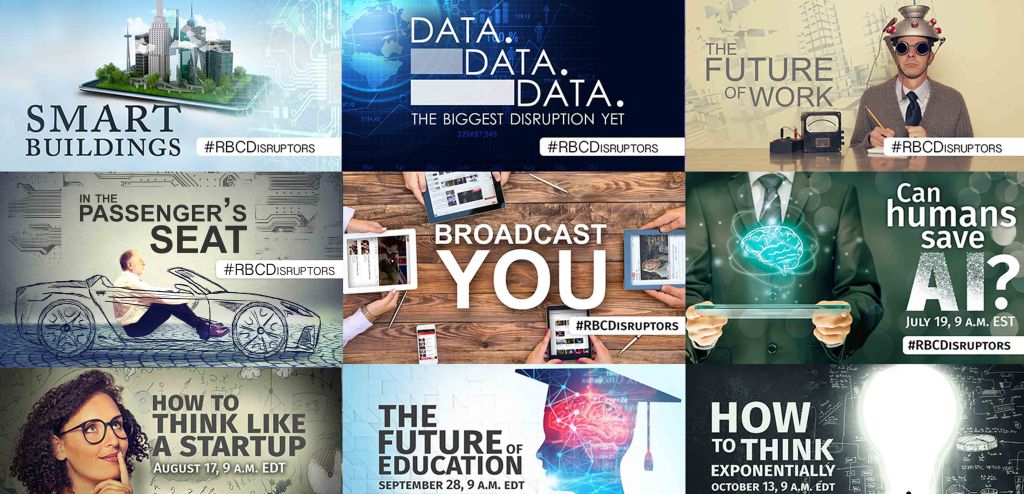
The show will bring new insights and conversations with your favourite guests from the Disruptors stage.

Our first guest is Dave Hopkinson, COO of Maple Leaf Sports & Entertainment, owners of the Toronto Raptors, Toronto Maple Leafs and Toronto FC.

I sat down with Dave back in Dec. 2017 after our eSports panel discussion, to chat about all things eSports and to hear how MLSE is helping to professionalize the industry, with the creation of the, “Raptors Uprising” 2K League, one of 17 new NBA eSports teams.

Listen to hear what Dave’s “aha moment” was with eSports, and how MLSE is hoping to capitalize on this highly-disruptive, $1-billion market.

Listen on Apple Podcasts, Spotify or Simplecast


Be sure to subscribe to RBCDisruptors on Apple podcasts and Soundcloud.

Happy listening!

We certainly covered a lot of ground – diving into everything from weather and data, the implications of AI, to rounding out the year talking about the disruptive world of eSports, at a key time in its lifecycle. In 2017, we brought Disruptors to the masses via Facebook Live, on the road to Regina’s Agribition show and it was the year we witnessed a few panelist selfies. Here are just a few highlights from the year:

Electric Cars & the Future of Driving

In May, we featured Steve Carlisle, President of GM Canada at the beautiful Roy Thomson Hall. Carlisle was joined onstage by an electric vehicle, which was a feat in itself to make happen! The conversation veered away from talking about the actual cars that GM sells, and focused instead on the future of mobility and travel. We learned that GM is not just selling vehicles anymore, they’re selling gigabytes. Carlisle sees a future in which fewer cars are sold, but are used more through shared ownership, or ride-hailing of autonomous-driving vehicles. Singularity University co-founder and CEO, Rob Nail, who spoke at our October session, predicted that his two young children will never know what it’s like to drive a vehicle, because they won’t have to. He also thinks that in five years, all truck driving jobs will be gone due to automation.

The Future of Work and Humans’ Relationship With AI

The impact of AI was a recurring theme at several sessions through the year. Our August event featured four NextAI entrepreneurs: Shea Balish, founder of fitness-focused REP.ai; Noel Webb, co-founder and CEO of Karen.ai; and Nima Shahbazi and Krista Caldwell, co-founders of food logistics startup Deepnify. All four noted the benefits and drawbacks of AI. For consumers, it offers the possibility of an entirely new range of personalized services — think automated personal assistants. For businesses, AI offers the potential to improve operational efficiencies, predict consumer preferences and reduce human error. Webb said AI can actually help humans by augmenting their skills, but we need to start preparing for the consequences of machine learning now. This relates the future of work and the data economy, which we discussed in April with two notable Canadian entrepreneurs: Wattpad co-founder and CEO Allan Lau, and Clearbanc co-founder and Dragon’s Den star, Michele Romanow. They too spoke about AI and the importance of data. For Lau, machine learning allows him to manage the sheer volume of data coming in via the Wattpad platform, and that he must rely on the machine to do most of the work. Romanow noted that it comes down to, “learning from your own data faster than other people can, and ultimately that data will be your trove of information going forward.”

Thinking Big With Singularity University

Exponential thinking. What is it and how did we manage to fill an entire hour talking about it? Singularity University co-founder and CEO, Rob Nail, told us that exponential thinking means looking to the future of your industry 10, 20, 30 years down the road. It’s about growing 10X, not 10%. Nail left us all feeling inspired to dream, and to think bigger about how we work and how we innovate from within our own respective areas. He also spoke about embracing crazy ideas. “If those crazy ideas just so happen to be the future of this business ten years from now, you need to set up a structure, a team or a process that will allow those to come in, or at least experiment with them in some way,” said Nail. “If you look at the horizon, all the systems set up 100 years ago are being tested – we are going to see fundamental change.” Singularity University was set up a place to understand this change and figure out what to do with it.

Side Hustles and All Things E-Commerce With Shopify

In November, we welcomed Shopify COO Harley Finkelstein to an in-house audience of over 600, including 100 RBC retail clients eager to learn more about e-commerce. Finkelstein gave some excellent advice on what retailers need to do to keep customers coming back: create a unique in-store experience for the customers they’re targeting. He also spoke about “side hustles” – naming several celebrities that have entered the ecommerce business, and feel very passionate about what they sell online. Reality TV star Kylie Jenner is selling more cosmetics than L’Oréal and MAC – combined. Thanks for being a part of the conversation this past year. We can’t wait to see what insights and memorable moments 2018 brings for RBCDisruptors. See you in the New Year!
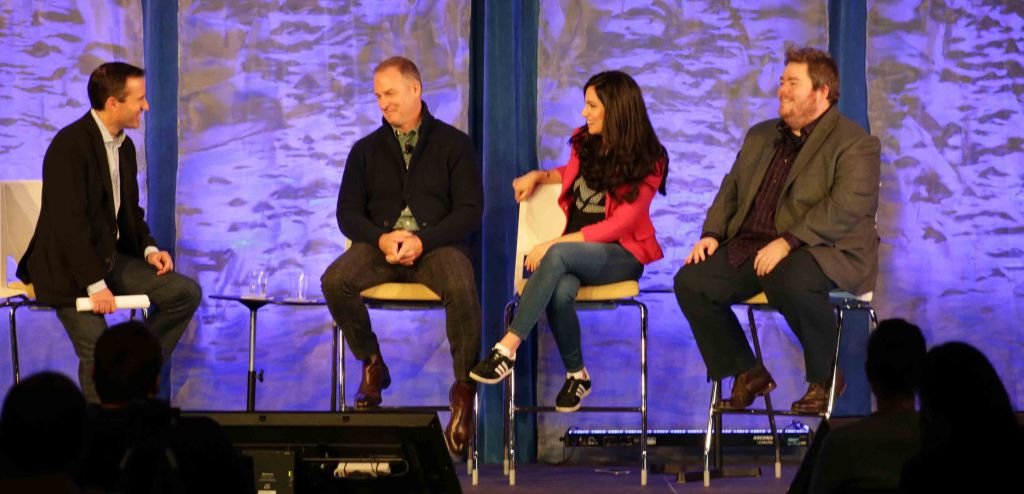
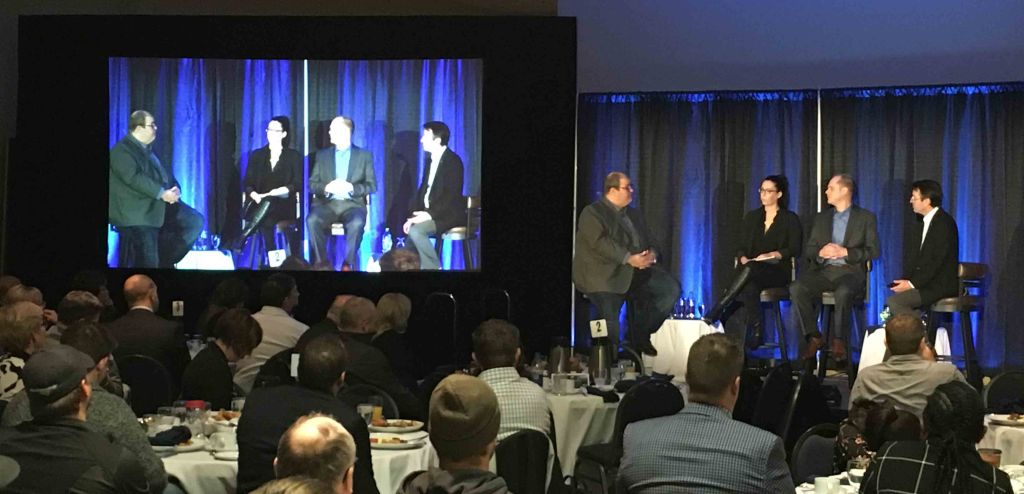
The numbers simply don’t lie. It’s a billion-dollar industry with 258 million fans around the globe, but is still considered “fringe”. Now, thanks to professional sports, it’s ready for prime time. This was the topic of discussion this week at the latest #RBCDisruptors, our monthly forum on technology and how it’s changing the world around us. We were joined by three individuals all helping grow and shape Canada’s eSports industry into ‘the next big thing.’ Not familiar with it? Esports melds at-home gaming, live events, big-money sponsorship and TV-style coverage into one disruptive package. “Esports is competitive multiplayer online gaming, handled by professionals, in front of, or for, spectators,” explained one of our panelists, Charlie Watson, CEO & Founder of SetToDestroyX. So be prepared — eSports is about to invade the physical and virtual spaces around your city.

How It Works

Professional eSports works basically the same as any other competitive league: players compete one-on-one or in teams, advancing through tournament brackets to take on progressively tougher competition. Some games are head-to-head competitions, while others are collaborative and team-based. The demands of professional eSports on the players aren’t all that different from any other professional sport. They practice, try to stay healthy, and optimize the best strategies for whomever their next opponent may be. “In our view, yes they’re athletes,” said David Hopkinson, Chief Operating Officer of Maple Leaf Sports & Entertainment (MLSE). “An inexperienced gamer makes about twelve moves per minute, as a gamer I’m personally at about eighty, and some of these eSports gamers are making 300 moves per minute. They’re able to do something with their minds and motor skills,” said Hopkinson. Yet the top eSports players seem more obsessive than those in more traditional athletic pursuits: many of them train seven days a week, up to 20 hours per day, and the community and culture of gaming fills every other waking hour. That, and the otherworldly hand-eye coordinating demanded of the sport, is why you’re unlikely to come across many eSports pros over the age of 25. “Having a healthy lifestyle is so important and then being able to surround yourself with good people is key in our industry,” said Watson.

Hitting the Big Leagues — Literally

In 2016, MLSE sold out the 20,000-seater Air Canada Centre in 34 seconds for the two-day North American championship of League of Legends (LoL), faster than some of the hottest acts in music. For Hopkinson, this was his “aha moment”. “I’ve never seen a higher curiosity factor from the marketplace in what we’re planning with eSports — it’s higher than we’ve ever seen,” said Hopkinson. MLSE will soon be announcing the Raptors 2K League, one of 17 new NBA eSports teams. Introducing new players, comes with a risk — the entertainment factor. “These players need to have personalities as we’re watching them play — they need an active fan base, or else, who’s going to watch?” commented Marissa Roberto, eSports Host and Brand Manager of Northern Arena, and an avid eSports fan.

Place Matters

Despite eSports taking place mostly online, in-person events still play a large role. “We’re not selling the opportunity to see the game, we’re selling the experience to see this game with like-minded people who want to meet others with shared values,” said Hopkinson. This trend isn’t going anywhere soon. “This started with Local Area Network (LAN) parties — gamers got together because they wanted to get together as a community,” said Roberto.

Making the Rules

As eSports blends into professional sports, one big question remains — who will moderate the “renegade” gamers used to the freedom (and toxicity) of the Internet? According to Watson, it’s all about the vetting process — doing proper due diligence when bringing on new professional players. “We ask the difficult questions and go through a lengthy process to ensure we’re not going to have someone that will compromise the representation of our brand and sponsors,” said Watson. “They understand that they have to sacrifice some freedom of speech in order to become a professional,” he explained. And for MLSE, it’s a zero tolerance policy to unprofessional behavior. “We’re going to have to put some rules and guidelines in place and find ways to police and enforce them just like any other community,” explained Hopkinson.

Is Traditional Sports a Dying Breed?

Hopkinson couldn’t say for sure, but pointed out that Ted Leonsis (AOL founder and CEO of Monumental Sports) thinks eSports will dwarf both the NBA and the NFL. One thing is for certain — all three share the same goal of bringing eSports mainstream. “I don’t see MSLE as competition, I see them bringing the sport in, and it only builds the community more,” said Roberto. “It’s like anything else — it will evolve and progress as time goes on,” noted Watson. “The future is really, really bright,” said Hopkinson.
The annual event, the biggest agriculture show in Canada, now draws 130,000 farmers and agriculture specialists, and is becoming a showcase of innovation. It was also the stage this week for the latest #RBCDisruptors, our monthly forum on technology and how it’s changing the world around us. “If we don’t embrace technology, we can’t compete,” said one of our panelists, Murad Al-Katib, the president and CEO of Regina-based AGT Food Ingredients, now the world’s largest distributor of lentils, peas and chickpeas. Agtech is among the hottest areas in innovation right now, spanning everything from automated fishing and artificial beef to grains and protein, an area Saskatchewan wants to transform. Al-Katib’s vision: to build a “Protein Highway” that would connect the Prairies, through the port of Churchill, to billions of emerging middle-class consumers in Asia. Call it the Silicon Valley of soil. Working with the University of Regina, other large companies and investors, Al-Katib’s group is one of nine finalists in a national competition for federal money to build so-called “superclusters” in research areas where Canada can be a world leader. The science is there. So are the challenges:

Scale

The new scale game isn’t about land; it’s about data. With sensors now attached to everything that moves, from livestock to plant stalks, competition is fierce for the biggest, and best managed, data sets. They’re needed to help machines learn the optimal way to run a farm. “Farmers need to understand how the data is used,” said Kim Keller, Co-Founder of Farm at Hand, a Vancouver-based company that runs a free, cloud-based app to help farmers run their operations through mobile devices. Right now, “they have no idea if the data will benefit them or not.”

Markets

The threat to NAFTA is not the only market access challenge for Canadian producers and processors. “We need to think and look at the rest of the world, at markets such as South America and Asia,” said Ian Meier, the CEO and co-founder of Saskatoon-based Bitstrada Systems Inc. Meier was recently in Germany, where the intensity of farming impressed him. And Canada now has preferred access to Europe, through the Comprehensive Economic and Trade Agreement (CETA). But in a world that will add another 2-3 billion people in the next few decades, most eyes are on Asia. With its booming middle class – and more demand for protein – Asia will be the top market as food demand globally increases by a projected 70% by 2050. Other countries like Australia and New Zealand are moving fast to secure better access to those markets. Canada needs to, too.

Techno-quality

Business strategists often fret about their products being commoditized. Tell that to a commodity producer. Al-Katib is trying to build a global enterprise based on quality. Not easy when you’re shipping your produce in giant bins and competing on the ground with Indian lentils. But he thinks technology has an answer. Using blockchain to enable every device in the world to know instantly what every other device is recording, he sees a new world of food distribution. Blockchain could allow a lentils dealer in Mumbai, for instance, to know where, when and how a batch was produced. Consumers, scanning food in a store, would know the same. “When we embed in technology, we embed in traceability,” he said. If Canada ups our quality game, distributed technology would be our game-changer.

Entrepreneurs

The tech world has evolved into a winner-takes-all economy, in which global giants are devouring all the companies in their way. Yet innovative economic clusters thrive on entrepreneurs. In fact, that’s all they thrive on. “We tend to focus on large companies, when small ones are driving innovation,” Keller noted. “We need to focus on building an ecosystem: start, flourish and have the companies stay in Saskatchewan.”

Farmers

It may seem obvious that agtech’s success depends on farmers – a bit like health tech and nurses – but they’re often the forgotten link in the chain. Too often, agtech is developed with everything but the farmer in mind. “Technology isn’t used by farmers because it’s not easy enough,” Meier said. Keller designed her Farm at Hand app with the mantra, “big fingers, bad eyes,” to ensure big buttons that are adequately spaced out. Even then, she said her app’s biggest competition is pen and paper. A greater tech challenge for many farmers lies beyond an app developer’s control. Most machinery, and therefore data, is designed and managed by the global equipment giants – and often their systems don’t integrate very well. The profile of farmers is changing, too. No more American Gothic. Tomorrow’s farmer will need to be part techie, part globalist, part futurist. One input that will be in greater demand: Diversity. More women, more new Canadians, more people who maybe didn’t grow up on the land. As Keller noted, “agtech takes the gender out of farming.” “We have a long way to go,” Meier said, “but we’re in the right direction.”