

 EN
EN 

➔ Breaking the silos in the Maritimes
➔ Canada steps up nature protection efforts amid climate onslaught
➔ Is energy transition an illusion? An IMF working paper explores
Signals
-
The Maritimes are breaking down provincial grid silos. Premiers of New Brunswick, Nova Scotia and Prince Edward Island signed an MoU in July to develop a more integrated electricity system. Aligning regulations, investments and utilities of three of the smaller regions in Canada by spring of 2027 would be a test case closely watched by larger provinces that are also eyeing interties to share power generation and capacity. Meanwhile, Newfoundland and Labrador and Quebec signed a $70-billion clean power deal—said to be North America’s largest clean energy investment, if completed. The pact would double Newfoundland’s total power capacity, and potentially boosts Quebec’s electricity exports. Quebec will pay 6.2 cents per kilowatt-hour in the new pact, a significant jump over the decades-old deal of 0.2 cents, that had triggered a long-running dispute between the two provinces.
-
Indigenous equity in Canadian projects grew 290% in eight years. Between 2017 and 2025, the number of Indigenous-owned projects starting operations grew from 10 to 39, while at least 47 Indigenous-owned projects will come online across Canada this year, according to the Indigenous Equity Monitor. Nearly 87% of the 546 Indigenous-owned projects are power and utilities and carbon capture, highlighting First Nations’ role in clean energy. The experience in project development arms communities with experience, funding and skills to participate in several energy developments on the horizon.
-
Canadian Crawford Nickel mine just got the greenlight from the Major Projects Office. The Timmins mine (featured in the 2025 Climate Action Report) is expected to be the biggest mine in the world when completed in 2029. It’s a flagship development in a Western nation for a material critical for EV batteries. Nickel production is currently dominated by Indonesia, which carefully regulates quota and exports, and Chinese processing companies. Demand for nickel is set to grow 65% this decade alone.
When AI comes to town
Nimbyism is coming for AI data centres.Oakville, Mississauga, and New York state are among North American jurisdictions looking to protect their power infrastructure from AI.
The transformative (and disruptive) technology is an energy—and capital—sponge. The communities are also seeking greater transparency on water, heat and air pollution associated with data centres, in addition to how these power-hungry projects impact Canadians provinces’ efforts to decarbonize their grids.
Here’s the scale of capital and energy AI needs:
US$715 billion: Capital expenditure of hyperscalers in 2026 globally—that’s more than the US$600-billion invested in the entire U.S. energy sector in 2024, according to the International Energy Agency.
US$200 billion: The amount AI companies tapped in debt markets to fund expansion. They are set to become the largest issuers of corporate debt going forward.
Five to 10 years. Wait times for grid connection in many jurisdictions globally. In Canada it averages six years.
10% of total electricity demand growth globally: AI power consumption will more than double to 950 TWh by 2030 from current levels. In the U.S, data centre electricity consumption would account for 45% of all growth.
Data centres will likely lean more on fossil fuels by 2030. Around 252 TWh will be powered by low-carbon energy sources, including nuclear. However, that will be eclipsed by fossil-fuel powerhouses coal and natural gas, accounting for around 270 TWh by 2030, with implications for emissions, the IEA forecasts.
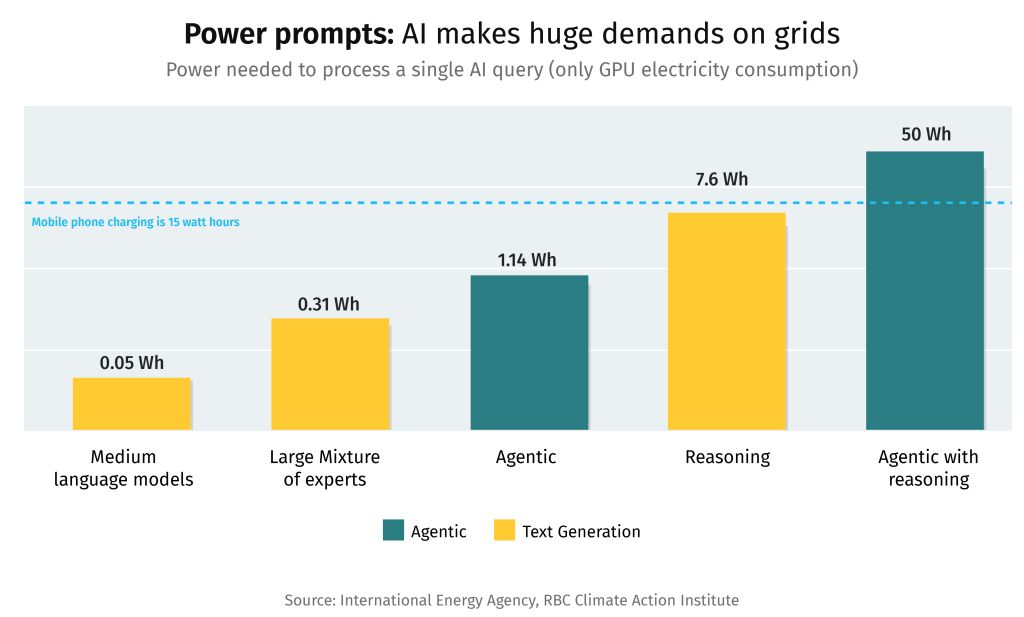
Agentic AI is a power sponge. A single, context-rich query eats up 50 watt-hours (similar to charging a smartphone 2-3 times),compared to 0.05Wh for a text query (medium language model).
The AI frenzy could raise emissions. AI models raised net annual CO₂ emissions by 0.47–1.8 gigatonnes (1.2–4.8% of 2024 global energy-related CO₂ emissions), according to a study in Nature. Renewable gains must exceed fossil gains by 4–5X for net emissions to reach breakeven levels.
Big Tech has gone dark on its emissions footprint. Multi-billion-dollar AI start-ups have no obligation to report their carbon footprint, while several listed Big Tech firms and investors have also cooled on their environmental disclosures as they power through the AI frenzy.
Clash between sovereignty and power. The Ontario province unveiled a playbook last week that aims to maintain Canadian data sovereignty but also ensure that deep-pocketed hyperscalers are paying higher prices and get no financial support.
The (task)force of nature
Ottawa’s new Expert Taskforce on Natural Capital Accounting and Nature Financing is among the first critical steps to attract more investment in protecting nature amid an onslaught from extreme weather. It follows the launch of a federal strategy to protect nature in the spring, aimed at increasing conservation areas, aligning economic growth with nature stewardship, and mobilizing private capital.
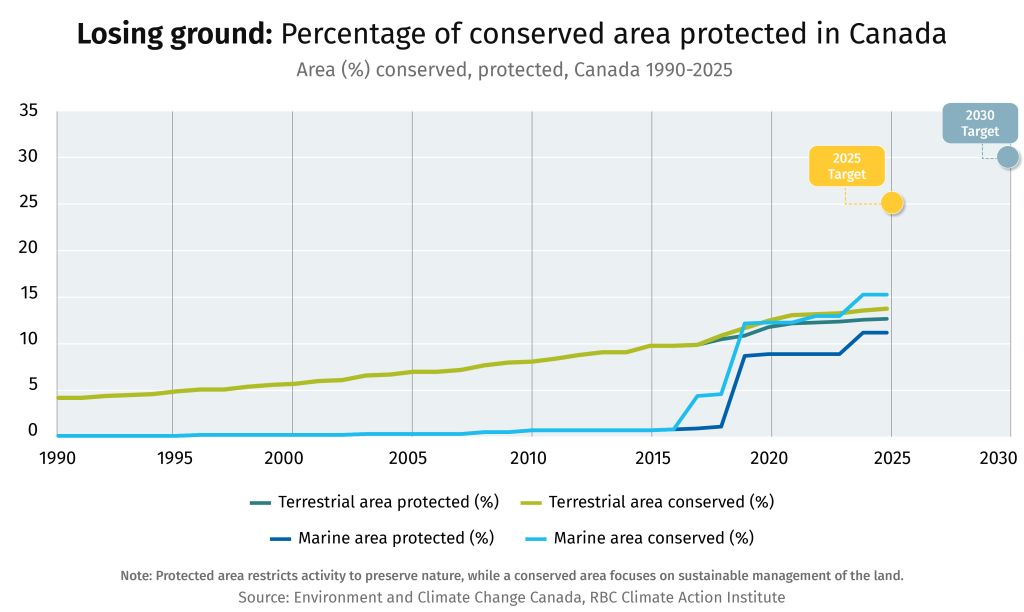
These efforts come after Canada missed, by a long shot, its 2025 target to protect and conserve 25% of terrestrial land and inland water and leaves a very narrow path for its 30% of land conservation by 2030 goal. The failure was highlighted in the 2025 Report of the Commissioner of the Environment and Sustainable Development on behalf of the Auditor General of Canada.
There are more reasons to be optimistic about the approach to 30×30 than previous conservation efforts, says Wilson Fink, Director of Agriculture.
-
Pillar 1-protecting nature. Acknowledging the need for an all-of-Canada approach. Protecting 30% of land is difficult when only 6% of Canada’s land is federally owned1. The rest is controlled by provinces, Indigenous governments, and private landowners. Collaboration would be key.
-
Pillar 2—building Canada well. The commitment to be data driven and “enable integrated conservation, carbon accounting, and project planning,” to facilitate funding for nature.
-
Pillar 3—mobilizing capital. It’s the least developed of the three, but perhaps the most consequential. There is global momentum to build nature frameworks that can accommodate more substantial investments, but they need harmonization and less risk to scale successfully. This is where the taskforce will spend most of its time.
Conversations
-
“We want to see carbon markets take their rightful place in the climate finance architecture,” said Mura Kurum, Turkey’s environment minister and president of COP31, hosted by his country in November.
-
Climate wonks are abuzz with a new International Monetary Fund working paper by Jean-Baptiste Fressoz, et al, on how new energy sources are additive not substituting old energy sources, effectively calling energy transition an illusion. Some say that’s not entirely true, pointing to the demise of whale oil.
-
Canadair’s water bombers “are the backbone of most European firefighting operations,” according to Neil Sweeney, De Havilland Canada’s vice-president of operations. As wildfires across North America and Europe destroy picture-perfect forests and foliage, the once-dormant Canadair line is being revived.
-
“Ottawa’s update on its National Adaptation Strategy documents a good deal of activity—but little sign that any of it is actually reducing the escalating climate and extreme weather risks that Canadians face,” said Ryan Ness, Director of Adaptation at the Canadian Climate Institute, in response to Canada’s 2026 National Adaptation Strategy Progress Report.
Curated by Yadullah Hussain, Managing Editor, RBC Climate Action Institute.
Climate Crunch would not be possible without John Stackhouse, Jordan Brennan, John Intini, Farhad Panahov, Lisa Ashton, Shaz Merwat, Vivan Sorab, Caprice Biasoni, Lavanya Kaleeswaran, Joelle Schonberg and Alicja Siekierska.
Have a comment, commendation, or umm, criticism? Write to me here (yadullahhussain@rbc.com)
Climate Crunch Newsletter
This article is intended as general information only and is not to be relied upon as constituting legal, financial or other professional advice. The reader is solely liable for any use of the information contained in this document and Royal Bank of Canada (“RBC”) nor any of its affiliates nor any of their respective directors, officers, employees or agents shall be held responsible for any direct or indirect damages arising from the use of this document by the reader. A professional advisor should be consulted regarding your specific situation. Information presented is believed to be factual and up-to-date but we do not guarantee its accuracy and it should not be regarded as a complete analysis of the subjects discussed. All expressions of opinion reflect the judgment of the authors as of the date of publication and are subject to change. No endorsement of any third parties or their advice, opinions, information, products or services is expressly given or implied by Royal Bank of Canada or any of its affiliates. This document may contain forward-looking statements within the meaning of certain securities laws, which are subject to RBC’s caution regarding forward-looking statements. ESG (including climate) metrics, data and other information contained on this website are or may be based on assumptions, estimates and judgements. For cautionary statements relating to the information on this website, refer to the “Caution regarding forward-looking statements” and the “Important notice regarding this document” sections in our latest climate report or sustainability report, available at: https://www.rbc.com/our-impact/sustainability-reporting/index.html. Except as required by law, none of RBC nor any of its affiliates undertake to update any information in this document.