

 EN
EN 


The Bottom Line:
Statistics Canada has revised Canada’s population numbers upward, pushing annual growth to 0.5% as of Q2 and erasing what had looked like negative year-over-year growth since early 2026.
The adjustment comes mainly from updated accounting methodology for non-permanent residents, which are up 240k (+9.4%) from the previous Q2 estimate. The post-pandemic temporary resident surge created a large cohort of work and study permits now expiring, straining the extension processing system as more people remain in the country beyond their permit expiry. Adjustments to the non-permanent resident estimate account for 80% of the total 301k (+0.7%) population revision.
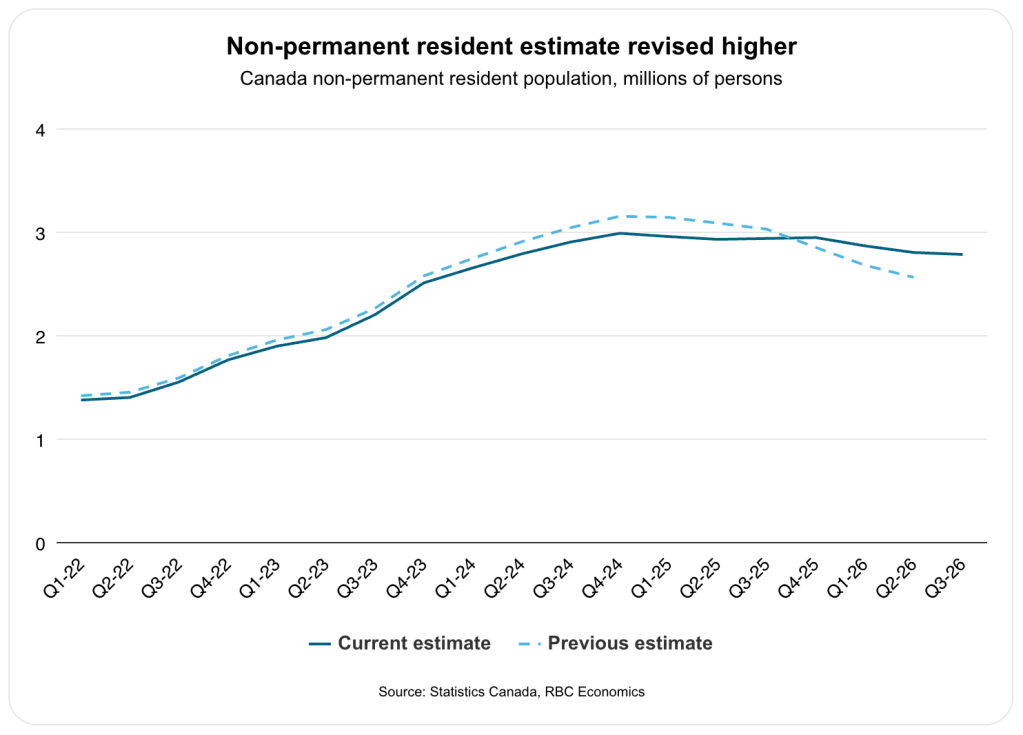
The changes significantly impact how some economic data looks in hindsight—for example, per-capita GDP growth looks less firm over the last year with the upward population revisions.
The revisions could impact the outlook for measures like total GDP growth, and employment growth too. More modest population declines in recent quarters could mean more aggressive slowdowns in future—impacting GDP growth and employment as both are functions of population growth.
Still, the broader economic narrative doesn’t materially change. Canadian structural demographic growth headwinds are still significant—Canada’s population no longer looks on track to decline outright for the first time on record in 2026, but the pace of growth is still tracking the smallest increase on record.
Demographic estimates have been expected to be more revision-prone than usual, and that’s shifted focus to economic indicators that are less impacted by changes in population growth trends as more reliable gauges of the health of the economy. Those measures—like the unemployment rate—are not impacted significantly by population revisions, and have still been showing signs of improvement to-date in 2026.
The details:
GDP growth: backward looking per-capita estimates not as strong and more demographic headwinds ahead
Stronger backward looking population growth takes some of the shine off recent GDP growth estimates when measured on a per-capita basis – per-capita GDP was up 0.7% year-over-year in the second quarter based on data released today compared to 1.7% based on previous estimates.
It is worth noting that GDP data is also revised regularly, including annual benchmark revisions expected in November.
And if the government remains committed to its 5% target for non-permanent residents as a share of the total population in next month’s immigration levels plan, annual population growth should still turn negative in the coming quarters, with B.C. and Ontario to feeling the demographic adjustment most acutely given their heavier concentration of non-permanent residents.
Housing markets: potentially less demand growth in the outlook
The revisions also reset the timeline for housing market pressures. We now expect the period of most significant population deceleration to unfold ahead of us rather than behind us, which could extend downward pressure on housing markets—particularly on the rental side where demand is most sensitive to immigrant and non-permanent resident population movements.
Higher rate of breakeven employment growth
The rate of breakeven employment growth (the number of new jobs needed each month to prevent the unemployment rate from rising) looks closer to zero than the -10k we were previously estimating based on prior population estimates.
But more reliable (and agnostic to population changes) measures of the economy’s health are less impacted
Critically, on the labour market side, a larger number of non-permanent residents staying in the country impacts the labour force and employment numbers simultaneously, which shouldn’t significantly change unemployment rate estimates or forecasts – labour markets have still been improving on a per-worker basis.
From the Bank of Canada’s perspective as policymakers consider interest rate hikes, higher backward looking population growth estimates imply the economy’s production potential was stronger than previously thought (all else qual, such as productivity estimates). But other real-time indicators of slack in the economy like business survey responses on excess capacity, the unemployment rate, and core inflation trends are all unimpacted by changes in population estimates.
The BoC will be closely monitoring these indicators ahead of their next policy decision in October. On the surface, mechanical upward adjustments to potential GDP via revised population estimates, would reduce urgency to hike rates, but with the BoC increasingly focused on “risks” from energy prices it makes the October meeting a difficult decision.
About the author:
Rachel Battaglia is an Economist at RBC, providing forecasts for the Canadian provincial economies and analyzing key trends in housing and consumer spending.
This article is intended as general information only and is not to be relied upon as constituting legal, financial or other professional advice. The reader is solely liable for any use of the information contained in this document and Royal Bank of Canada (“RBC”) nor any of its affiliates nor any of their respective directors, officers, employees or agents shall be held responsible for any direct or indirect damages arising from the use of this document by the reader. A professional advisor should be consulted regarding your specific situation. Information presented is believed to be factual and up-to-date but we do not guarantee its accuracy and it should not be regarded as a complete analysis of the subjects discussed. All expressions of opinion reflect the judgment of the authors as of the date of publication and are subject to change. No endorsement of any third parties or their advice, opinions, information, products or services is expressly given or implied by Royal Bank of Canada or any of its affiliates.
This document may contain forward-looking statements within the meaning of certain securities laws, which are subject to RBC’s caution regarding forward-looking statements. ESG (including climate) metrics, data and other information contained on this website are or may be based on assumptions, estimates and judgements. For cautionary statements relating to the information on this website, refer to the “Caution regarding forward-looking statements” and the “Important notice regarding this document” sections in our latest climate report or sustainability report, available at: https://www.rbc.com/community-social-impact/reporting-performance/index.html. Except as required by law, none of RBC nor any of its affiliates undertake to update any information in this document.

