We spent months talking to experts about why creativity is a competitive advantage. Throughout this report, you’ll hear from them directly.


The new “it” skill

Welcome to the Soaring ‘20s, where creativity is the new “it” skill.

As Canada emerges from the COVID-19 crisis and enters a “two-dose summer,” we’re coming back together in workplaces, coffee shops and restaurant patios. There’s a palpable excitement in the air, and an opportunity: to harness this energy to rethink and rebuild in a new era of creativity.

The pandemic transformed the economy and disrupted every aspect of our lives. It also unleashed a remarkable wave of creativity.

If you peeked into the windows of Winnipeg’s Chaeban Ice Cream during the lockdown, you might have spotted owner Joseph Chaeban finally pursuing his childhood dream of making cheese. He’s now selling his artisanal creations to local restaurants, bakeries and grocery stores.

When sports stadiums went quiet, teenage entrepreneur Elias Andersen launched a new generation of audio technology from Thornbury, Ontario. Hear Me Cheer takes microphones in fans’ mobile devices and creates a real-time crowd atmosphere that’s been used in college football games and Major League Soccer.

Creativity is rising to the top, and not just in the usual places, like the arts or science and technology. We’re already seeing that between the first quarter of 2020 and the first quarter of 2021, employers began asking for more creative competencies in job postings, like critical thinking (up 37%) and flexibility (up 20%). The spike is particularly notable in healthcare, education, and sales and service—fields that were deeply impacted, and likely forever changed, by the pandemic.


“There is no commerce without creativity.”

—Daniel Lamarre, CEO of Cirque du Soleil


Every corner of our economy, from construction to retail, should be seen as a place for creativity to grow. If you think some sectors are too traditional to change—reconsider. Just look at how the agriculture sector has responded to the uncertainties of climate change, global trade spats and labour shortages: with vertical farming, where food grows in warehouses near city centres.

Now that people are once again gathering and mingling—the jet-fuel of creativity—this next decade is a prime time for creativity to flourish. The pandemic has shifted power to individuals, who can take advantage of an increasingly decentralized economy to work, shop, watch and learn from anywhere. Large cities, secondary centres and online platforms are suddenly on equal footing. There’s never been a better time to take a new idea and run with it.

Read more from our conversation with Richard Florida.

The world was already on the cusp of a new creative era when the pandemic erupted. The key elements of the Fourth Industrial Revolution—automation and digitization—sparked an unprecedented opportunity to create. Individuals were free to take more risks, and businesses were more open to diverse ways of thinking and doing. Virtual reality, self-driving cars and remote surgery—all once the domain of science-fiction—were shepherded into reality.


LinkedIn data from more than 600 million professionals and 20 million jobs revealed creativity was the skill most in demand in 2019 and 2020.


Through our research, we are increasingly convinced that creativity is going to be a critical skill through the 2020s, as we re-emerge, re-build and re-invent, delivering ideas at a rate never seen before right across Canada.

The pandemic showed us that business doesn’t always proceed as usual. At the organizational level, firms are experiencing significant turnover. People are returning to different workplaces: either new ones, or ones that have radically changed since March 2020. It’s a unique moment in time, and it could slip away.

In this report, we talk with some of the most creative thinkers in Canada—business leaders, entrepreneurs, educators and artists—about Canada’s creative potential. We explore the growing demand for creative skills in key sectors of Canada’s economy, how different creative types deliver value—often in unexpected ways—and what actions should be taken to translate our country’s creativity into economic growth over the next decade.

There’s no time to waste, as we seek to solve some of the greatest challenges of our time: rebuilding downtowns, reimagining the delivery of healthcare and education, and tackling the climate crisis.

In Humans Wanted, a landmark 2018 report by RBC Thought Leadership and Economics, we examined how technology was disrupting the Canadian workforce, and identified the skills required for the jobs of the future.

The rise of artificial intelligence and automation mean routine and repetitive work is the most at-risk of disappearing, and even work in unexpected fields will be transformed. Our research showed the most highly valued skills are those not easily replicated by a machine—higher-function, cognitive activities from active listening to critical thinking and complex problem solving. Demand for these human, creative skills will only grow stronger.


Crisis drives creativity

This won’t be the first time crisis drives creativity. It’s a pattern that emerges when we look at the arc of human history.

Some of the greatest leaps in human achievement immediately followed periods of devastating crisis, after mass disruption opened the door to new leaders and new ideas. One example: the Renaissance after the Black Death. Another: the Roaring ’20s, after the First World War and the Spanish flu pandemic. Amid the crisis, people gained a better understanding of the most pressing issues that needed addressing. In the aftermath, those who had adapted to the changed circumstances had the opportunity to introduce new ways of doing things to an audience willing to listen.

Crisis drives creativity

Throughout history, pandemics have thrown society into crisis, disrupting the old way of doing things. Rather than returning to the status quo, the post-pandemic age is characterized by a radical rethink and a shift in power and resources.


Creativity = novelty + value

We’ve shown how creativity can thrive after crisis, and why the conditions are right for it to kick-start Canada’s COVID recovery. The next challenge is to better understand what creativity is, and how to nurture it in young people and across our country’s workforce.

Creativity, in our framework, delivers both novelty and value.

Creativity is an amalgam of skills and abilities that allows us to conceive novel and useful ideas. We’ve seen that through the pandemic, whether it’s healthcare workers or teachers or creative artists, all connecting with people in difficult circumstances, in different and ultimately creative ways.

When learning moved online, Ontario grade three French teacher Steve Massa decided to get creative to keep his students engaged from their kitchen tables. He launched a YouTube channel under the name Monsieur Steve, and took students on virtual field trips around Toronto and as far away as Thunder Bay, incorporating costumes and puppets and his pet cat all in the name of making French grammar fun.


“We have a great need for imagination and creativity to solve the grand challenges—whether these are social problems or healthcare or new technologies. We need creative minds and creative actors to make the world a better place.”

—Dr. Sara Diamond, President Emerita of OCAD University


While we often associate creativity with individuals, organizations, cities and even countries can be creative too. In action, it can mean taking a process from one industry and adapting it to another, like when the U.S. Army studied the logistical and planning methods of the Barnum & Bailey Circus. It can also take the form of coming up with new and practical uses for existing products, like when Nike co-founder Bill Bowerman used a waffle iron to mold a new urethane sole for running shoes.

Increasingly, creativity is acknowledged as a critical economic variable: a competency that can make an individual stand out in his or her field, or that enables a company to dominate, or even create, an industry. If exercised on a larger scale, it can give a society or economy outsized impact on the broader world.

Creativity is bolstered by certain mindsets, and an openness to new perspectives is one of the most important. There is a clear opportunity here for Canada, a country of immigrants, to step up to the plate and get creative.

If we can harness that kind of ambition as a country, Canada—the energy power—could become a creative energy power with ideas that fuel the world.

Most Canadian youth feel confident in their creative skills, but not as much as they do for other 21st century skills.

A survey of 15,000 RBC Future Launch participants found two-thirds (65%) of 15- to 29-year-olds have a high degree of confidence in their creative skills for the workplace. The groundwork for even more creativity is there: they are more comfortable thinking critically (74%), collaborating (73%) and problem solving (70%) than being creative.

Notably, young women have a high degree of confidence to “brainstorm in groups” (74%) compared to young men (64%). Youth not in education or employment (40%) have the lowest comfort in “thinking outside the box.”

This show us that injecting creativity into education specifically would have an outsized impact on the rest of Canada’s key sectors.

Read more from our conversation with Josie Fung.


A creative boom in Canada’s labour market

Nothing looks quite the same after COVID-19, and that includes the job market. According to our analysis, 21% of Canadians work in roles that require high creative-thinking skills. But that’s now ticking upward, as our appetite for creativity grows.


We’re seeing a greater demand for skills and tools that feed creativity across the labour market. Between the first quarter of 2020 and the first quarter of 2021, employers asked for more creative competencies in job postings, including:

  • Critical thinking, up 37%
  • Flexibility, up 20%
  • Teamwork, up 18%
  • Ability to learn, up 15%
  • Continuous improvement, up 12%
  • Problem solving, up 9%
  • Strategic thinking, up 8%

Three Canadian sectors in particular are demanding more creativity among new hires: healthcare, education, and sales and service. These sectors have been among the most affected by COVID and are undergoing large-scale transformations that will need creative workers at their core.

  • Healthcare: Job postings among health occupations are up 36% since February 2020, as demand has spiked for frontline workers and those who can help coordinate Canada’s public health response. Job postings that list creative skills are up 125%, as roles such as healthcare managers (up 79% in Q1 2021) and health diagnostics (up 67% in Q3 2020) need more problem solving, critical thinking and strategic planning to counter the spread of COVID-19.

  • Education: Job postings in the education field are up 39% since February 2020. Those requiring creative skills spiked by 50% in September 2020 and again by 30% in January 2021, reflecting educators’ need for fresh ideas as new restrictions took hold and online learning expanded. Demand for school administrators has jumped (up 167% in Q1 2021), while education policy and program development roles have grown (up 11% in Q3 2020), with needs for adaptability and continuous improvement driving demand for creative candidates.

  • Sales and service: Retail job postings overall tumbled during lockdown periods. However, postings explicitly seeking creativity in sales and service increased during these periods, by 14% in April 2020 and 20% in January 2021. Businesses appear to have sought out these skills to help develop new shopping and service models during disruption. Doing things differently was reflected in high growth jobs, including services supervisors (up 24% in Q3 2020) and retail and wholesale buyers (up 18% in Q1 2021), seeking more originality, analytical skills and those with the ability to learn.


In the short term, this means people with high creative skills will enjoy greater mobility and choice of roles. Over the longer term, more Canadians will develop creative skills as workplaces give higher priority to original ideas and critical thought.

Creativity will increasingly be a competitive advantage for individuals, for firms, and even for the country as a whole.


Tomorrow’s creative leaders

There’s only one Elon Musk—and that’s quite all right.

When we think of creative individuals, we often conjure up historic visionaries and inventors, but creativity lives in all of us. It just takes on different forms: in the studio, the laboratory, the classroom and the boardroom.

Through our research, we’ve identified four broad creative archetypes that play different but crucial roles in our society.

...

The Visionary

This is the Elon Musk category. The Visionary imagines new markets and is willing to take huge risks to bring about change in the world. They build loyal followings, even beyond their own industry, influencing consumer tastes and preferences. The way electric cars have sped from obscurity, to cool, to the dominant trend in the auto industry? That’s the Visionary touch.


...

The Instigator

This is the sector-specific superhero. The Instigator is able to identify gaps, combine ideas and see opportunities others do not. They can create wholly new products or service offerings, disrupting the sector where they operate. One such example: Canadian tech titan Michele Romanow, whose startup Clearco disrupted the lending market and is now the world’s biggest ecommerce investor.


...

The Thinker

Drill down a little deeper, and within every workplace, you’ll find the Thinker. This is someone who stands out for their critical thinking, and their adeptness at identifying challenges and coming up with novel ways to address them. In the 1990s, University of Pennsylvania biochemist Katalin Karikó devoted herself to an obscure field: mRNA research. Decades later, her discoveries led to the groundbreaking Moderna and Pfizer vaccines, and turned the tide on COVID.


...

The Hustler

Need someone to see a new idea through to execution? Call a Hustler. They’re critical to analyzing what is possible, and strategically tweaking the lofty ideas and strategies of the Visionaries and the Instigators. Without the action-oriented Hustler, many ideas might never see the light of day. Apple co-founder Steve Jobs is the Visionary behind the iPhone, but the awe-inspiring camera functions in every new model? Those are thanks to Apple’s 600 camera-hardware technology experts.


“Creativity rests on encouraging yourself to think freely outside of the box, and then working diligently to distill, iterate and ultimately prototype, depending on what the process is.”

—Janet Morrison, President of Sheridan College


How to cultivate creativity

Creativity has always been important, but it matters now, maybe more than ever, as Canada looks beyond the pandemic and into some exciting and scary decades ahead, that will test us as a nation.

Over the last few months, we talked to some of Canada’s most creative people about how they cultivate creativity and what others can learn about maximizing creative potential in individuals and organizations.

Here are four key takeaways:

1. Creativity can be nurtured

Creativity comes naturally to some. It can also be nurtured and developed.

Gil Moore, drummer of the rock band Triumph and founder of Metalworks Institute, differentiated between virtuosos—those who have “explosive growth in their talent and a natural repository of creative juice that just flows”—and the rest of us who have to actually work at it through repetition and gaining skills.

Read more from our conversation with Gil Moore.

Creativity is known to thrive in the world-famous animation program at Oakville, Ontario’s Sheridan College, but its president, Janet Morrison, is quick to point out the value of teaching creativity across all disciplines. In the college’s business program, students learn creative problem solving: how to clarify the situation, generate ideas, develop and iterate solutions, and implement plans.

Josie Fung, who is tasked with building “future-ready problem solvers” as the executive director of I-THINK at the Rotman School of Management in Toronto, suggested giving students real-world problems to solve, and then the space to do so.

When Parks Canada asked high schoolers at Toronto’s John Polanyi Collegiate Institute to help solve a problem—how to get more people to come to Rouge National Park—the students skipped over ideas like a poster or ad campaign. Instead, they reframed the question, to think about the role of the park in society. This opened up so many more possibilities. They thought: what if the park could be a place for a drug rehabilitation centre? What if it could be a place for mental health therapy? Four years later, Rouge Park struck up a partnership with Blue Door, a nonprofit that provides emergency housing for those experiencing homelessness and crisis, to provide affordable housing using Parks Canada land.

2. Create a culture that embraces the freedom to fail

Shopify—Canada’s most valuable company—embraces failure. You read that right.

“We have built an environment that allows for risk taking, that allows for curiosity and resourcefulness, that allows for reactions,” said Brittany Forsyth, former Chief Talent Officer.

That kind of environment is key, Forsyth said, because creativity isn’t about a lightbulb moment. It’s about coming up with lots of ideas, challenging assumptions and connecting dots, until it unlocks something new: the killer idea that separates you from the competition.


“We give permission to do these key things such as experiment, fail, grow. It’s OK to say you were wrong yesterday and you’re right today, to change your mind.”

—Brittany Forsyth, Shopify’s former Chief Talent Officer

Read more from our conversation with Brittany Forsyth.

If you look at Cirque du Soleil, ideas can come from every corner of the organization. You need to give employees the space and encouragement to share them.

“We have 5,000 pairs of eyes and ears and we encourage our people to always feed us with something they discovered,” said Daniel Lamarre, the Quebec-based company’s CEO. “Sometimes it might be by reading a book, seeing a new movie and hearing a new piece of music or just seeing something on YouTube or on social media that could be attractive to us.”

Pro tip: Companies can encourage employees to try new things by shaking up the work day, or incorporating such expectations into employee performance goals. Shopify uses “hack days,” where everyone stops what they’re doing and spends three days on a project of their choice, usually coming up with programs or solutions around a specific theme. Over at Google, Gmail was famously created as part of the company’s 20% rule, which allows employees to spend 20% of their time exploring projects that may not deliver immediate dividends but could become big opportunities in the future.

3. Creativity thrives on strategic constraints

It might sound counterintuitive, but limits can actually spur creativity.

“We thought that if we gave students open rein on creating ideas, that would be the way forward,” said Fung, speaking of her work with I-THINK. “And actually, what we heard is that by giving a little more structure, by giving a few more constraints, it actually helped channel their creativity.”

Creative people are comfortable with ambiguity but are also compelled to make sense of it and add their own structure, according to Tom Waller, Chief Science Officer at Vancouver-based Lululemon.

“We very much look for people that are able to sit in ambiguity and go, ‘Hmm, I’m on a blank sheet of paper here, but I’m just going to start doodling if nothing else. And, oh! This doodle turned into something,’” Waller said.

Read more from our conversation with Tom Waller.

Pro tip: There’s actually a simple three-step way to set up those constraints to drive creativity, according to Ajay Agrawal, head of the University of Toronto’s Creative Destruction Lab. Step one is to establish well-defined goals: what is the problem you’re trying to solve? Step two is ensuring that people have the resources they need, such as time and money, to explore potential solutions. And step three is to recognize and measure success along the way.

4. Creativity is a team sport

The creative engines of the past relied on solo inventors. Leonardo da Vinci, for instance, and other Renaissance thinkers who were polymaths with expertise across multiple areas.

That’s no longer the case, Agrawal said.

“As fields become more and more complex, in order to really understand the frontier of the field, you need to collaborate across multiple people who are experts in different areas.”


“I find that everybody has the potential to play a role in the creative process. It might be a different role, but there is a role for everybody in the creative process.”

—Ajay Agrawal, head of the University of Toronto’s Creative Destruction Lab

Read more from our conversation with Ajay Agrawal.

This brings us back to our point about creative archetypes: you may have a Visionary or Instigator championing the idea, but you’ll also need a Hustler. The key is to identify what roles are required to produce the best outcomes, and how leaders can help develop the right people and skills for those roles. It may mean casting a wide net to find people from diverse backgrounds and ways of life who are able to contribute their experiences and knowledge. Or thinking about what partnerships can be developed with firms in other sectors, and what opportunities can be generated by reaching out to community organizations.


An age of ideas

As we charge forward into the 2020s, Canada faces some epic challenges. The pandemic highlighted all that is not well within our borders: the broken structure of our long-term care homes, the disproportionate childcare burden on women, racial health and economic disparities, and the challenges of coordinating a country-wide response to an emergency. We cannot look away now. Instead, with fresh eyes, we must embrace the new possibilities that have opened up on a mass scale, including telehealth, remote education, and flexible work arrangements—and the new talent that we could draw in. We are in the early stages of a creative transformation of our economy and society. The COVID crisis, like those that have come before it, shattered our assumptions about how the world works and forced society to embrace experiments and reorganize in a new way. By promoting creativity as a key skill within our schools and workplaces in the post-pandemic world, we can shift into an exciting Age of Ideas that tackles Canada’s most pressing problems.

The Creativity Economy

For more insights on how Canada can weave creativity into its culture, listen to our special two-part series of the Disruptors podcast.

Listen and subscribe to the Disruptors podcast:



About the Authors

Trinh Theresa Do (she goes by Theresa) is responsible for strategy development on the Thought Leadership & Economics team, with occasional forays into podcasting, research, and writing. Previously, she was a strategy advisor to senior management and executives at RBC’s Personal & Commercial Banking business. Prior to joining RBC, Theresa was a national political journalist at CBC News and co-founded a nonprofit that promoted civic engagement through technology innovation.

Sonya Bell joined RBC’s Thought Leadership and Economics team as a Senior Manager, Content Delivery in 2018, coming from Queen’s Park where she was a senior writer to the former Premier of Ontario. Previously, Sonya worked in journalism as a producer at CBC and as a federal political reporter for iPolitics. Between Parliament Hill and Queen’s Park, she spent two seasons as a comedy writer on This Hour Has 22 Minutes.

Andrew Schrumm is a former lead researcher on RBC’s Thought Leadership team, where he examined how Canada can enter the 2020s as a diverse, innovative, and sustainable nation. He managed RBC’s future skills research project on skills-based job mobility, life-long learning, and the potential of automation in our economy.

 

The discovery of unmarked graves of Indigenous children who died at Canada’s former residential schools is a painful reminder of our history and the need for continuing focus on Truth and Reconciliation. The effects of centuries of systemic oppression continue to impact the lives of Indigenous Peoples. This report looks to the decade ahead and some of the ways in which we can help the next generation of Indigenous youth to thrive in our rapidly changing economy.

Key findings:

    1. In the 25 years since the Royal Commission on Aboriginal Peoples called for a new partnership between Indigenous Peoples and other Canadians, the Indigenous population in Canada has grown by 750,000.
    1. Indigenous youth are the fastest-growing cohort of Canadian youth, with their numbers expanding four times quicker than the non-Indigenous population. They will represent 45% of the Indigenous population by 2030.
    1. While this cohort represents 7% of all Canadian youth, it’s approaching one-third in the Yukon, Manitoba and Saskatchewan, 60% in the Northwest Territories, and 95% in Nunavut.
    1. Indigenous high school graduation rates are improving, but only 45% of Indigenous Canadians aged 24-35 have a post-secondary education compared to 71% of non-Indigenous Canadians.
    1. Nearly two-thirds of jobs held by Indigenous workers are at risk of a skills overhaul, as data, robotics and advanced technologies drive transformational change in sectors that many Indigenous communities depend on, like the skilled trades.
    1. An RBC Future Launch survey found that even though Indigenous youth frequently use digital devices, they are less confident in their digital literacy skills than their non-Indigenous peers, with a 13-percentage-point gap emerging.
  1. Rapid expansion of high-speed broadband Internet and greater access to digital tools will be critical for Indigenous youth to take advantage of the decentralized post-pandemic economy and position them for new opportunities in online health and education services, e-commerce and digitally-enabled mining, forestry and agriculture.

Leaders of Tomorrow

Listen to Podcast

The High Stakes of a Faster Future

Over the next decade, 750,000 Indigenous youth will move through the education system and into early careers. What will they need to thrive in the Canadian economy of the 2020s? Advanced technologies are transforming every sector in the country. From mining and forestry to retail and entertainment, the demand for digital skills is accelerating—and disrupting old jobs and ways. Traditionally, financial capital was seen as the main driver of economic development. Now we know, there’s a need for capital, technology and skills to all work together. Drawing on our ongoing effort to understand the skills challenges facing all young Canadians, this report will focus on the human capital and skills needed for Indigenous youth to thrive in a technology-rich economy. Over the past 18 months, RBC Economics and Thought Leadership led a series of conversations with Indigenous youth, educators, employers and community leaders to assess the opportunities and challenges ahead. Will this new generation be ready to turn the Fourth Industrial Revolution to their advantage? Our conversations began in-person, but the COVID-19 pandemic shifted them online. The crisis also sharpened our focus. Indigenous youth in all parts of Canada told us about adapting to online learning, honing their technical skills, and figuring out how best to fit into the digital future that’s crystalizing all around them: a world of remote sensors, automated vehicles and artificial intelligence. They shared a vision of themselves as a bridge to bring digital skills, economic opportunity and prosperity to their families, peers and communities.

“I feel like it is essential to learn more about computers, software and artificial intelligence to get a good job because everything is going to digital now.”

-Shanialyn Suggashie 23, Pikangikum First Nation, Ontario

To fully realize what the future can offer, we must be mindful of the history that brought us here. Generations of Indigenous youth have faced unique barriers to access and opportunity and have often been pushed to the periphery of economic life. In many places, pressing needs like clean water, appropriate housing and equal education continue to go unmet. RBC is committed to the reconciliation journey, and for over 25 years has been working on specific initiatives with Indigenous Peoples and communities to generate genuine and meaningful change. That work is ongoing. For this report, we focus more narrowly on where we believe the broader economy is heading and what we feel needs to happen in order for Indigenous youth to access the opportunities of the 2020s. Their success will be key to Canada’s success—and to the ongoing process of reconciliation into the 2030s.
An Ongoing National Conversation Public calls for better access to education and training for Indigenous Peoples have been growing for more than 25 years. The Royal Commission on Aboriginal Peoples (1996) recommended better integration between study and work through programs adapted to community realities; the Kelowna Accord (2005) sought to put $1.8 billion toward raising high school graduation rates; and the Truth and Reconciliation Commission (2015) called for educational achievement gaps to be closed within one generation.

The State of Play

Advantage: youth

  • Canada’s Indigenous population grew by 42.5% between 2006 and 2016.
  • The median age of Indigenous Canadians is 29 versus 41 for Canadians as a whole.
  • The gap in high school completion rates between Indigenous and non-Indigenous Canadians is close to 15 percentage points.
  • 45% of Indigenous Peoples aged 24 to 35 have a post-secondary education versus 71% of those who are non-Indigenous.

Improving: economic participation

  • There are 25 self-government agreements across Canada involving 43 Indigenous communities, with more negotiations ongoing.
  • The gap between Indigenous median income and non-Indigenous median income narrowed to 25% from 33% between 2005 and 2016.
  • Indigenous Peoples are creating new businesses at nine times the Canadian average.
  • More than half of Indigenous Peoples in Canada lived in urban areas in 2016.
  • Canada’s Indigenous GDP is $33 billion, but could rise to $100 billion if it matched Canada’s overall per capital levels.

Needed: better connectivity

  • Only 24% of households in Indigenous communities have access to quality, high-speed Internet.
  • Ottawa aims to connect 98% of Canadians to high-speed Internet by 2026, and all Canadians by 2030.
  • Two-thirds of jobs held by Indigenous workers are expected to require a different mix of skills.
  • Demand for skills in emerging technologies including machine learning, robotics, augmented and virtual reality, blockchain, and the Internet of Things rose 36% in 2019.

The Great Skills Shift

Visit Meadow Lake in Saskatchewan these days, and you will see workers preparing the ground and installing piping and wiring for an Indigenous-led bioenergy project that will eventually supply clean power to the SaskPower grid. Or head to Yellowknife, where jewelry designer Tania Larsson is creating new pieces for her 17,300 Instagram followers. Look east to Nova Scotia’s Cape Breton Island, and you’ll find the Membertou First Nation busy 24/7 operating a world-class data centre that provides data storage and recovery for clients. The Fourth Industrial Revolution was already reshaping how we work and live—pushing more of what we do online, disrupting established companies and industries, and forcing a rethink of education and training. The pandemic only accelerated that shift. This isn’t to say all Canadian youth are going to become coders or machine learning specialists. Rather, it is a signal that the base understanding of employment now includes the skills needed to work with digital and other advanced technologies like drones, robotics and the Internet of Things—and these expectations are growing. These shifts are affecting all of us. But for Indigenous Canadians, they present unique challenges that could impact socioeconomic progress, opportunities and the chance at fuller participation in the Canadian economy in the years ahead. In our 2018 report, Humans Wanted, we identified the skills that will prepare Canada’s youth to thrive in the workplaces of the future. We concluded that success will depend on two things: the skills to work with people (which we called foundational skills) and the skills to work with technology (also known as digital skills). While foundational skills like critical thinking and communication have always been important, acquiring digital skills will enable youth to work with technology as it permeates the workplace, rather than compete against it.

In this latest part of our three-year Humans Wanted endeavor, we trained our skills lens on Indigenous youth. Relative to the non-Indigenous population, fewer Indigenous youth are in jobs that require future-focused skills such as critical thinking and reading comprehension. And nearly two-thirds of jobs held by Indigenous workers will need a different mix of skills in the future. Mining companies will need fewer truck drivers—and more people to remotely operate driverless trucks, as well as to program, maintain and repair them. Nurses in remote communities will have to use digital tools to communicate with and assist doctors hundreds of kilometers away. The digital shift is upending sectors where Indigenous Peoples have traditionally built careers, including the skilled trades; natural resources and agriculture; and the sales and service sector, which covers roles such as consultants and repair workers. It’s also enabling new opportunities where Indigenous employment is high, but career advancement has been slow, including health and education. In the years ahead, we expect more automation and more humanity, and a new creative age that bridges the two. Are Indigenous youth ready? First, the good news. When it comes to foundational skills, Indigenous youth are confident in their abilities, according to a survey by RBC Future Launch, which asked thousands of program participants about their skills development through online surveys between 2019 and 2021, including 2,000 Indigenous youth aged 15-29. (Respondents who rated their skills at 7 out of 10 or higher are considered “confident.”) From critical thinking to communication to collaboration, Indigenous youth rated their skillset near the same level as their non-Indigenous peers.

But the digital divide is real. The survey revealed a 13-percentage-point gulf in confidence between Indigenous and non-Indigenous youth when it comes to digital literacy. The gap was widest among those still in school and narrowed as young people gained work experience.
Confidence gap is widest on digital literacy: Indigenous youth feel less prepared across the core workplace technology skills % of respondents who rated their skills at 7+ out of 10
Source: RBC Future Launch survey

“I’m pretty confident in my digital skills. But I think the fact that I live in a rural-ish area may limit my career success, because people underestimate my skills.”

-Shelby Anderson, 22, Gift Lake Metis Settlement, Alberta

Addressing the gap starts with the basics. The reality is, high-speed Internet still hasn’t come to large parts of rural and northern Canada, limiting online activity for many Indigenous Peoples. In 2017, the CRTC found that about 24% of households in First Nations communities had high-speed internet, compared with 97% of urban and 37% of rural households. Among Indigenous Peoples 15 years old and up, 76.4% use the Internet daily; among all Canadians, daily usage is 91%.

“The access to high-speed Internet in my community is about 2/10….Many people use their phone data to connect to the Internet. But without high-speed Internet, it is hard and takes a lot of time to access websites and Zoom calls.”

-Jaden Harper, 17, Garden Hill First Nation, Manitoba

Narrowing the gap would enable Indigenous youth to become more proficient in the use of technology and increase long-term earning potential: levelling up on digital skills has been shown to increase wages for Indigenous workers by up to 36%. Meanwhile, the cost of inaction is steep: Indigenous workers are underrepresented in high-tech sectors and only 1.2% of the high-tech workforce identifies as Indigenous. In June 2020, senior members of Canada’s tech, innovation and advanced industry sectors launched the Coalition of Innovation Leaders Against Racism (CILAR). The coalition’s mandate is to connect Black, Indigenous and People of Colour to the innovation sector by focusing on five priorities: youth skills development, job opportunities, venture and founder support, investment and funding as well as community leadership. The risk is that Indigenous youth will be underrepresented everywhere as digital permeates every sector. In our roundtable discussions and interviews, many youth were aware that a basic level of knowledge, like email and word processing, would not be enough to get a good job, and they were frustrated by the lack of learning opportunities.

“I learned my digital skills by teaching myself.”

-Selynn Gibeault-Plain, 17, London, Ontario

Left to their own devices—literally—many are taking their digital training into their own hands, advancing their skillset through creative, non-traditional means. On TikTok, Inuk college student Shina Novalinga (@shinanova), shares short videos with her 2.3 million followers, showcasing her throat singing. Theland Kicknosway, an Indigenous teen advocate and hoop dancer, is harnessing his following on Instagram (@the_landk) to raise money for Missing and Murdered Indigenous Women, Girls and Two-Spirit people. This tells us Indigenous youth are going to play a key role in bridging their communities to the digital age. Imagine how much more they could do if given the right tools. In August 2020, amid the COVID-19 push toward online learning, De Beers Group donated 117 new laptops to schools in seven Indigenous communities in the Northwest Territories and 10 refurbished computers to the Yellowknife Public Library. As part of the Shaw acquisition, Rogers committed $1 billion to the Rogers Rural and Indigenous Connectivity Fund and said the company will consult with communities to create Indigenous-owned ISPs.

Optimism about the future was a key characteristic in the roundtables and the survey, where nearly 40% “strongly agreed” when asked if they were optimistic about achieving their goals. Many young people were setting their sights on new cities and post-secondary institutions to build their skillsets and set themselves up for promising careers.

“One of my toughest decisions I made was coming to live in the city and continue my education.”

-Logan Mason, 18, Winnipeg, Manitoba

As young people navigate this transition, the desire for mentors is strong. This is complicated by the fact that many youth do not see Indigenous Peoples in the roles they aspire to, given the rapidly changing economy—but where they exist, they can be key to personal and spiritual development and help the next generation achieve strong outcomes.

“Some supports that would best set me up for success as I complete my education and begin my career are better Internet access, a mentor or someone there for me.”

-Gwendolyn Grimoldby, 17, Ingersoll, Ontario

Early, positive career experience is emboldening young Indigenous Peoples: the Future Launch survey found that employed Indigenous youth are even more confident when it comes to communication, collaboration and critical thinking than their non-Indigenous peers. Most notably, employed Indigenous youth rate their persistence (or the ability to manage under stress) higher than non-Indigenous youth—at 76% compared to 69%.
Basic skills can’t be overlooked Literacy and numeracy skills—the great equalizers in terms of economic incomes—are lower in Indigenous communities. Our roundtable with Indigenous employers stressed the importance of work exposure for Indigenous youth, to build not only future skills but—perhaps more fundamentally—these basic skills. Leona Baptiste, HR Director at Osoyoos Indian Band Development Corporation, says poor reading skills are preventing many youth from getting their first jobs and moving up the skills ladder. Employers can play a key role in supporting basic education and life skills during the transition to the workforce. They can also challenge themselves to recognize all types of learning among this incoming generation of Indigenous youth—on the job and through online certificates and land-based knowledge—in order to close the achievement gap.
Time to leverage strength in skilled trades Trades and transport are fields in which Indigenous workers have improved their income and representation across age groups. This is influenced by a strong connection to Canada’s resource economy. Indigenous and non-Indigenous youth complete apprenticeships in the Red Seal trades at almost identical rates. However, on-reserve learners aren’t accessing apprenticeships at the same rate as off-reserve youth, and they often miss out on the in-class portions where emerging skills are introduced. The trades are increasingly influenced by digital developments, and staying on top of them is critical. Paper blueprints are out, and project schematics are mostly shared digitally on tablets. Road construction vehicles are GPS-guided. And smart glasses help train new electricians and welders with key visual prompts and instant measurements.

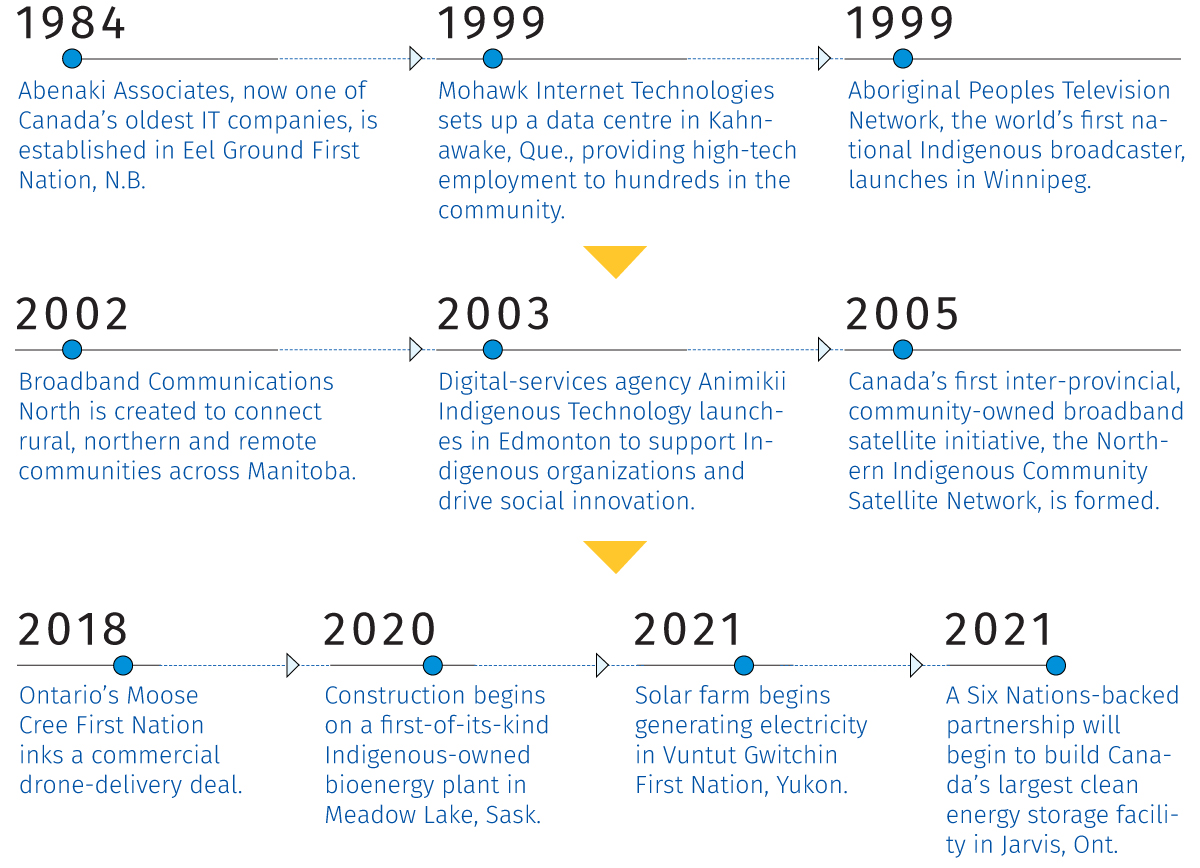
Indigenous technological innovation through the decades

Tomorrow’s Digital Leaders

We’ve outlined the challenges and opportunities Indigenous youth face as they carve out careers in a rapidly digitizing world, and noted the need for more role models. Here are four emerging categories of digital leaders that are demonstrating the way forward.

The Early Adopter

These familiar faces in the community—teachers, librarians, council members—are championing digital skills acquisition at the local level. When matched with accelerated training and resources, they become knowledge distributors within the community. They spark new forums for youth learning, like robotics teams and hackathons, and their skills will be in demand across education and local government.
...

Blaire Gould, 36

Eskasoni First Nation, Nova Scotia Executive Director: Mi’kmaw Kina’matnewey “I’m a tech-fanatic, really just truly interested in it. Once teachers become more comfortable with technology, it’s something that compliments or alleviates your work—and gives the best opportunity to the child.”
Blaire grew up during the tech boom of the 1990s, and never looked back. From typing classes in middle school, to her first cell phone, to attending the local high-tech high school, Blaire’s early life was shaped by the shift online. For a national high school competition about starting a business, her group’s business case included making a website—education and technology were two sides of the same coin. Blaire went on to study at Cape Breton University and St. Francis Xavier University, and embarked on a career focused on sharing her love of language with the next generation—with some help from technology, of course. Even one of her early projects, translating Robert Munsch books into Mi’kmaw, capitalized on tech advancements: the translated books included a CD to hear the Mi’kmaw readings. Fast-forward to today, and as the executive director of Mi’kmaw Kina’matnewey (MK), Blaire designs and develops resources that put a tech spin on the standard Nova Scotia curriculum in Mi’kmaq communities. (In 1998, an agreement with the federal and Nova Scotia governments turned over local control of education to 12 of 13 Mi’kmaq bands—one opted out.) She’s co-created 40 language apps, brought in green screens so students can make their own videos, and recently deployed 3D printers (plus training) to every school that MK oversees. These digital tools make learning fun, and (the results show) more effective. When Blaire started her own schooling in the early 1990s, just 20% of Mi’kmaw students graduated high school in Nova Scotia. Today, it’s about 90%.

Emerging jobs:

Education administrator Technology teacher Workplace trainer Library technician

Skills needed:

Managing resources Persuasion Problem solving Verbal communication

Leading the way:

Indigenous Teacher Education Program (BC) Prepares Indigenous students to become effective educators for public, band, and independent schools in B.C., with a focus on identity and cultural heritage. Indigenous Leadership Development Institute (MB) Builds leadership capacity in Indigenous people with specific training, including an online learning package. Centre for Indigenous Innovation and Technology (ON) Provides technology training, increases Indigenous representation in the tech industry in Canada, and promotes problem-solving using technology with an Indigenous lens.

The Knowledge Translator

These are the experts and creators bringing Indigenous culture and ways of knowing into the knowledge-based economy. They are able to operate between traditional and digital spaces, elevating ideas and developing new markets. Knowledge translators are connected to land, language and their Elders and plugged into advanced technologies. They will find opportunity not only in tech through product design or animation, but also in the sciences, through applying traditional knowledge to contemporary challenges.
...

Mick Appaqaq, 29

Sanikiluaq, Nunavut Technician: SIKU mobile app “The future for the Arctic is uncertain, but we have all these tools now that we can utilize. You’re able to transfer knowledge from your community to neighbouring communities by posting on the app.”
Mick was five when he first started going out to hunt and fish on the islands that dot Hudson Bay. There were no cellphones, no apps—just his father, passing down traditional knowledge. Mick’s early exposure to technology was limited; it wasn’t until high school that he took a computer course and learned about software like Excel. He pursued higher education in Ottawa, completing a two-year program in Advanced Inuit Studies through Nunavut Sivuniksavut, where he continued to build up his computer skills in the library. When he returned home, Mick saw opportunities to combine his traditional knowledge with technology. Internet connectivity in the territory had improved. Mick took a job as a constituency assistant to a Nunavut territorial lawmaker, using email to reach communities across the vast northern territory. Mick now works as a technician for SIKU, an Inuit-led social network that’s developed an app to help hunters share real-time knowledge of ice conditions and animal behaviour. For Mick, who said he’s motivated to advance Inuit well-being, the app’s purpose is key: sharing information on sea-ice conditions helps ensure hunters’ safety in the short term and serves a longer-term effort to collect and store climate change-related data. Mick grew up monitoring sea ice with a harpoon. Today, monitoring it on an app is simply part of the long march of technological progress: the generation before him, as the Inuit advocate Piita Irniq put it, went from igloos to microwaves.

Emerging jobs:

Digital artist / animator Climate scientist Documentarian UX designer

Skills needed:

Mathematics Research skills Land-based knowledge Indigenous language

Leading the way:

Aabijijiwan New Media Lab (MB) Provides Indigenous students with access to interactive studios with sound, projection, VR, video, animation, and more for learning, skills training, and development. First Nations University (SK) Offers an Indigenous Knowledge and Science program where science and math learning is complemented by courses in Indigenous Environmental Science. Aboriginal Territories in Cyberspace (QC) Ensures Indigenous presence in the web pages, online environments, video games, and virtual worlds that comprise cyberspace.

The Digital Enabler

These are the skilled tradespersons, project managers and consultants building the physical infrastructure to support digital opportunities. Their efforts are paving the way for better connectivity, as well as developments in renewables and the green economy. With a mix of technology and trades, their skills will be valued by various employers, from telecoms to construction to energy-servicing operations.
...

Joe Wabegijig, 39

London, Ontario CEO: Phoenix Smart Infrastructure Inc. “My hope is to establish a stronger presence as an Indigenous business leader in this space. And see more communities adopt leading practices of smarter infrastructure to improve the well-being of communities across Canada.”
Joe was in his 20s when he first heard of a professional engineer. Growing up on the Wikwemikong First Nation on Manitoulin Island, he says there was little exposure to career options. But he’d inherited a mindset from his grandfather to identify where the future is going, and get there first. That’s how Joe explains his decision, after high school, to attend Ontario’s Fleming College for home and building automation—a fairly new industry at the time. The program was a steep learning curve for someone with no background in electronics, but Joe went in with strong math skills and graduated with the ability to install audio-visual and security systems. Working on large-scale projects in Ottawa, including at the House of Commons, he encountered civil engineers and it clicked: this was a way to help Indigenous communities with housing and water challenges. Joe went back to school for civil engineering and worked for several Indigenous communities before landing a role advising the Minister of Indigenous Services on infrastructure, including drinking water. Again, Joe saw how technology was changing the game and decided to launch his own consultancy, focused on the next generation of infrastructure. As CEO of Phoenix Smart Infrastructure, Joe explores what advanced technologies can do for Indigenous communities: he sees blockchain and the Internet of Things as a way to close the data gap and develop smarter, more sustainable infrastructure to improve community well-being for the decades ahead.

Emerging jobs:

Electrician Network administrator Telecom installer IoT device specialist

Skills needed:

Reading Project management Design software Installing

Leading the way:

Building Environmental Aboriginal Human Resources (AB) Offers environmental workforce training programs for Indigenous communities to develop local environmental skills and foster green career opportunities. Diggin’ Digital Professional Development (SK) Provides on- and off-reserve teachers with the resources, materials, and professional development opportunities to incorporate STEM and ICT into lesson plans for Indigenous youth in culturally relevant and appropriate ways. Trade Winds for Success (AB) Prepares Indigenous youth for careers in the trades with reading and writing supports, and preparations for apprenticeship entrance exams.

The Service Connector

These are the e-commerce adopters, telehealth providers and online educators solving the twin problems of distance and integration with the broader economy. By breaking down stubborn barriers, they’re increasing access to critical services for Indigenous firms and communities, and showing both sides new opportunities in retail, education and health care. They will need steady access to the latest technology, training and resources to strengthen these new linkages within and beyond their communities.
...

Mallory Yawnghwe, 35

Saddle Lake Cree Nation, Alberta Founder: Indigenous Box “I would love to see my community thrive. If I can find new customers for Indigenous entrepreneurs and businesses, then I know I’ve done my job. We’re a tool to help them reach those new markets.”
Mallory would never have predicted she’d launch an online business. Growing up, she was strong in math and problem-solving, but digital skills weren’t taught at her high school. Her family didn’t get a home computer until she was 16—and even then, it only had dial-up Internet. After some time out of the education system, Mallory moved to Edmonton and found her way back to school, developing her digital skills in the library and eventually obtaining a business degree from MacEwan University. There, she learned about social enterprise and business with a purpose, which resonated with Mallory as someone who’s passionate about elevating Indigenous Peoples. When the pandemic hit and more commerce shifted online, Mallory began building simple websites for small businesses using interfaces like Squarespace. This experience gave her the idea for Indigenous Box, a subscription box service to showcase products from Indigenous entrepreneurs across the country. Mallory designed and built the Indigenous Box website on her own, and with a coding class now under her belt, she runs the rapidly growing startup from her basement—for the time being. Mallory’s goal is to run a sustainable, profitable business that uses modern tools to bridge the gap between the Western and traditional worlds she inhabits.

Emerging jobs:

Telehealth nurse Supply chain specialist E-commerce customer service provider Education navigator

Skills needed:

Collaboration Business writing Customer service Data management

Leading the way:

Shopify Indigenous(National) Offers Indigenous-led expert training on getting your business online. Keewaytinook Okimakanak (KO) eHealth Telemedicine (ON) Provides access to education sessions, training and support for health staff and community front line workers in remote communities in Northwestern Ontario. Connected North (National) Breaks down student learning barriers by connecting Indigenous partner schools across Canada with virtual field trips and remote mentorship.

Pathways Forward

We’ve looked at how Indigenous youth can thrive in a more inclusive digital future; but charting the way forward will take leadership and partnership. Here, we consider the various constraints faced by educators, employers, communities and government—and how they’re finding solutions.

Educators

You can’t teach digital skills if your community doesn’t have the Internet. That message was front and centre in our roundtable discussions with Indigenous educators, who face a number of challenges in preparing students for a world of advanced technologies. They liked the idea of a mandatory course in digital skills, but suggested certain foundations need to be in place first, including broadband connection, device access, and teacher training. In short, the digital literacy gap will persist as long as a funding gap does. Educators also raised concerns about how to connect students to careers in a rapidly changing economy. There is a lot of uncertainty about what skills will be in demand for tomorrow’s jobs—and educators from on- and off-reserve pointed out that the current youth employment crisis signals a disconnect between what students hear from school advisors, and the realities that await them. The first challenge for educators is trying to get kids to complete high school. The second is helping them transition to post-secondary education. Career role models, a better sense of where college could lead, and the funds to go, are all critical. At Six Nations Polytechnic STEAM Academy in Brantford, Ontario, students attend the first STEAM-focused (science, technology, engineering, arts and math) secondary school in Canada. This program wasn’t developed in isolation. With IBM as a partner, it is able to offer an Ontario Secondary School Diploma and a tuition-free two-year college diploma, with summer job opportunities along the way—plus a guaranteed job interview with IBM upon graduation. National programs can also reach students who might otherwise have limited options. Indspire helps Indigenous students across Canada complete their post-secondary education by providing bursaries and scholarships. About 90% of its Building Brighter Futures recipients graduate and find jobs—and the organization’s strong relationships with Indigenous employers mean 70% of them work in fields that support the Indigenous community.

Employers

Employers value tech-savvy job candidates—but a basic skill set is of primary importance. In our roundtable discussions, we heard that too many Indigenous youth aren’t prepared for the workforce. More job placements are crucial to bridging the gap between school curriculums and working life. This will also give Indigenous youth more exposure to different types of jobs, so they can see the opportunities that exist with their own eyes. Something else they need to see with their own eyes: diversity. Indigenous youth need to see themselves broadly reflected in the workplace. For the companies that are hiring them then, the job doesn’t stop with successful recruitment: coaching, mentoring and supervising supports are also critical. Employers that provide “wrap around” or secondary supports are more successful in retaining and motivating young workers, recognizing that a new hire is a person they’re investing in. Bruno Manufacturing Ltd. in Alberta retained 90% of the staff they recruited for a two-year off-reserve construction project by providing family housing, mental health support and peer accountability. The Osoyoos Indian Band Development Corporation in B.C. has an impressive record of pursuing economic development opportunities across 13 different lines of business, including tourism, construction and wine—and equipping band members with the skills to take on new jobs. It tailors its manager training programs to each role, focusing on skill-building for a period of up to two-years. Unemployment on the reserve is less than 3% and 20% of band members are in senior positions. To widen their own impact, national companies need to replicate these ideas and develop potential from the ground up. A good start: Suncor launched an Indigenous Mentorship Program that has grown by 50% since 2018.

Community

Longstanding gaps in funding and resources have left Indigenous communities and youth to count on programs and services from other actors, including not-for-profits, artists and athletes. These supplementary players provide access to skill-building and extracurricular activities that aren’t otherwise available. From dance classes to robotics clubs, youth learn valuable life skills, and build resiliency and self-confidence. What’s still missing is a way to recognize students for the skills they’ve attained through extracurricular activities, such as micro-credentials, so they can more easily demonstrate their abilities to future employers. As more community groups specialize in digital skills, we are approaching a tipping point in knowledge acquisition. In Nova Scotia, Digital Mi’kmaq focuses on introducing Indigenous students and educators to the core fundamentals of the knowledge economy, including coding, robotics, big data and web development. Its enriched educational programs, workshops and events across Atlantic Canada have reached 14,000 students and educators. Looking west, IndigeSTEAM has started a robotics club on four reserves in Alberta. In 2019, it sent an Indigenous-majority team to an international robotics competition in Dubai. The First Nations Technology Council in B.C. has partnered with more than 150 Indigenous communities across the province to provide advice, insights and technology-related training. Corporate actors are important in this space too, funding youth organizations like Actua Canada and Right to Play.

Government

Power dynamics are shifting—and that’s opening up new opportunities. Indigenous self-governance gained momentum in Canada in the 1990s, and calls for meaningful consultation and sustainable economic opportunities have grown louder in the wake of the Truth and Reconciliation Commission’s 2015 report. The effects of economic distortion are still felt today, but land settlements and investment have led to the broad expansion of Indigenous ownership, and greater capacity in private partnerships. Although more private sector partnerships are being reached, some bands are still learning what they should ask for. Both sides should strive to reach deals that are mutually beneficial, and provide young people with the chance to learn and advance new skills. Leadership can make or break the push for progress and partnerships. In northern Manitoba, economic reforms under Onekanew (Chief) Christian Sinclair successfully turned the Opaskwayak Cree Nation’s business wing profitable, with investments in the cannabis sector, aerospace and infrastructure renewal. Internet access fosters this growth. Indeed, the completion of a fibre-optic network through a Bell MTS partnership was the first of its kind in Manitoba. In B.C., more than 80% of the Haisla Nation’s band revenue comes from non-government sources. A nearby liquefied natural gas project provides key economic leverage, with land and construction agreements generating long-term revenue—which is then reinvested in the next generation. The newly-built Haisla Community School has smart boards in each classroom, blending culture, science and technology. Properly directing resources is key, and the First Nations Education Council of Quebec offers a lesson in how to do so. It collaborates with 24 schools across 24 First Nations, a cooperation that culminated in the 2011 establishment of Kiuna College—the only First Nations post-secondary institution in Quebec—to produce workplace skills for local employers, within an Indigenous-focused education. On a national level, the Truth and Reconciliation Commission has challenged the federal government to provide sufficient funding to close the education gap between Indigenous and non-Indigenous students within a generation.
Access to Capital For Indigenous youth to access the opportunities of the Fourth Industrial Revolution, new businesses, partnerships and services need to be cultivated within Indigenous communities. Significant investment will be needed to bring about these opportunities. The Indigenomics Institute points to the potential of a $100 billion Indigenous economy through strengthened economic capacity. Yet, for many Indigenous-owned businesses and communities, access to capital remains a central obstacle to fully participating in the broader economy. In 2017, Waterstone Strategies estimated that First Nations and Inuit owned businesses used only 0.2% of total available credit in Canada, and were able to access about 9-11x less market-based capital than most Canadian firms. Indigenous Peoples continue to face structural and systemic barriers to financial security, from restrictions under the Indian Act on asset ownership to racial bias of lenders. What’s needed now are new capital channels and business advisory services to connect entrepreneurs with capital. Organizations like the National Aboriginal Capital Corporations Association (NACCA) need to be supported in their work. It’s a network of 59 Aboriginal Financial Institutions (AFIs) stimulating economic growth by providing 50,000 loans totaling $3 billion to Indigenous-owned businesses.

Recommendations

Equipping the next generation of Indigenous Canadians with future-focused education, skills and opportunities is a shared responsibility. Governments, employers, educators and communities each play key roles. Some measures that may help:
    1. Fulfill the federal commitment to provide high-speed Internet, including broadband and related infrastructure to every Canadian by 2030, prioritizing underserviced Indigenous communities.
    1. Increase access to venture capital, with special focus on the new Indigenous Growth Fund, a $150 million commitment from the Government of Canada, Business Development Bank of Canada and other government agencies, which can be a signal for future investments.
    1. Allocate additional funding for digital devices and technology courses in primary and secondary schools, both on- and off-reserve, under the transfer formulas used by Indigenous Services Canada and the provincial and territorial education ministries.
    1. Close the gaps in access to work-integrated learning for Indigenous youth, by entrenching the subsidy for Indigenous students under the federal Student Work Placement program, expanding remote WIL options and through matching tools between employers and candidates.
    1. Expand academic bridging programs at universities, colleges and apprenticeship programs that boost fundamental and digital skills for Indigenous learners and improve outcomes in higher learning.
    1. Address the significant gaps in Canada’s Indigenous labour market data by increasing funding for data collection and coordination under the federal Indigenous Skills and Development Training program.
    1. Leverage recent investments in online education by school boards and post-secondary institutions to expand STEM course offerings for Indigenous students through high-quality remote and hybrid learning in their schools.
  1. Expand representation of Indigenous culture, languages and content in online spaces by making digital-first approaches a priority for arts councils, and increasing the reach of Indigenous social media influencers who are promoting their culture online.
This RBC report was developed within our Humans Wanted research program. It is informed by a series of roundtables and interviews with Indigenous youth, leaders, employers and other stakeholders over the course of the last 18 months. It leverages findings from RBC Future Launch participant surveys, including 2,000 Indigenous youth, as well as employment data analyses from the Census and other Statistics Canada products. Future Launch is RBC’s decade-long commitment to helping Canadian youth prepare for the skills economy of the 2020s and beyond.

Download the Report

Download

About the AuthorsAndrew Schrumm is a former lead researcher on RBC’s thought leadership team, where he examined how Canada can enter the 2020s as a diverse, innovative, and sustainable nation. He managed RBC’s future skills research project on skills-based job mobility, life-long learning, and the potential of automation in our economy. Sonya Bell joined RBC’s Thought Leadership and Economics team as a Senior Manager, Content Delivery in 2018, coming from Queen’s Park where she was a senior writer to the former Premier of Ontario. Previously, Sonya worked in journalism as a producer at CBC and as a federal political reporter for iPolitics. Between Parliament Hill and Queen’s Park, she spent two seasons as a comedy writer on This Hour Has 22 Minutes. Tracee Smith is the Founder and CEO of Outside Looking In, the largest national charitable organization empowering Indigenous youth to explore their full potential. A member of Missanabie Cree in northern Ontario, she specializes in corporate strategy, finance and Indigenous affairs and has held positions with TD Bank, TD Securities, TE Wealth and has advised clients such as Nestle Waters, Enbridge and Imperial Oil. She holds an MBA specializing in Community Economic Development and a Masters in Finance from Queens University. She also holds a BA in Dance from York University and was the first professional dancer to perform for the Governor General of Canada. She currently sits on the Board of the National Arts Centre, Smilezone Foundation and The Shoebox Project.