Artificial Intelligence is poised to reshape how value is created across Canada’s economy. To understand that shift, RBC Thought Leadership interviewed more than two dozen firms that are on the frontlines of building or deploying AI for Bridging the Imagination Gap: How Canadian Companies Can Become Global Leaders in AI Adoption. The report distilled the patterns that emerged from those conversations.

Building on that report, our series of case studies goes a level deeper. Here we follow how Manulife, a global insurer and asset manager, used generative AI as a catalyst to rethink how the organization learns, shares, and scales new ideas. The company’s experience shows that successful AI adoption is not a technology challenge alone—it’s a challenge of capability-building, governance, and empowering people to work differently.

Manulife, a global asset manager headquartered in Canada, saw AI as a chance to move beyond incremental efficiency gains and reimagine products and operations. Leadership judged the sector “too comfortable,” set a clear ambition to become a digital-customer leader, and treated OpenAI’s Large Language Model in 2022 as a tipping point. A hands-on executive session turned AI from a niche experiment into a CEO-level agenda item, signalling that real impact would require structure, governance, and integration—not one-off pilots.

Build absorptive capacity (infrastructure). Manulife created a multi-tier learning stack and embedded ~200 data science and machine learning experts, and used leadership rituals to grow the “stock of prior knowledge,” so new AI advances could be absorbed and embedded faster.

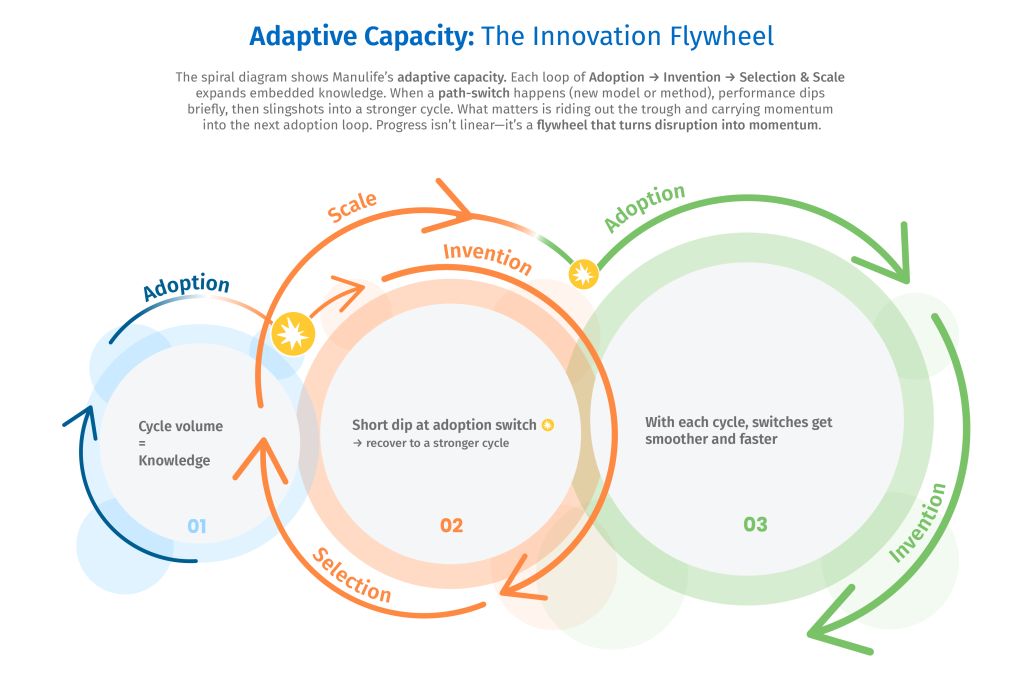
Institutionalize adaptive capacity (the engine). Leaders normalized copying—if one team built something useful, others reused it. This turned isolated wins into shared playbooks and spread improvements quickly. By embedding that habit, Manulife accelerated the cycle of adopt, invent, select, scale, building adaptive and innovative capacity together.

Balance speed and safety (governance by outcomes). Responsible AI principles, expanded model-risk frameworks, cross-functional review, and real-time telemetry treated fast iteration and strong oversight as complements, not one-off pilots

It was mid 2020. Jodie Wallis, then Manulife’s Global Chief Analytics Officer, had summoned the company’s top executives into a Toronto boardroom. She knew the meeting would mark a turning point: OpenAI’s breakthrough latest large language model (LLM), GPT1– 2 had just been released, and, at nearly 100 times stronger than its previous models, GPT-2’s implications stretched far beyond the technology itself. For Manulife, a 137-year-old insurer built on actuarial precision and risk discipline, the question was whether this new capability would be treated as a passing novelty, or as the spark for deeper change.

For years, AI at Manulife meant prediction and automation—underwriting models, fraud detection, lead scoring. Even as the frontier advanced with machine-learning models that could conjure hyper-realistic images, these applications still felt contained within the realm of “computer things.” They were useful and very impressive but safely bounded by expectation.

To Wallis, large language models like GPT shattered those boundaries. Designed for an iterative exchange, they created value not through a single output but through an unfolding dialogue—shifting the dynamic from command-and-response to something closer to collaboration. LLMs could now reason with a human-like cadence, inviting conversation rather than instruction. The breakthrough was not a more polished “answer,” but the model’s ability to so fluidly augment inquiry itself—generating new directions of thought and discovery.

That shift—from bounded tasks to open-ended discovery—was as unsettling as it was exhilarating. Wallis framed the moment with unusual candor: “Our industry has been too comfortable. This technology isn’t just another tool—it’s a fork in the road. We either harness it, or risk being reshaped by it.”

Around the table, reactions varied: curiosity, excitement, apprehension. The challenge was immediate. Should Manulife treat generative AI as an experiment at the margins, or as the new trajectory of the business itself? Wallis herself was convinced of the answer, but she also knew the technology was still raw—too raw, perhaps, for the boardroom to fully accept. The choice would force hard calls about strategy, governance, culture, and investment, all at the breakneck pace at which the frontier was advancing.

In such moments of technological upheaval, corporate boards look to figures like Wallis to distinguish passing trends from transformative forces. Unlike the technologist-soothsayers popular at the time, her task was consequential: to foresee how generative AI might reshape an institution built on actuarial discipline, and to ensure Manulife seized the opportunity rather than being undone by it. Frame the moment correctly, and new value could be unlocked; misjudge it, and the consequences could be existential.

But foresight alone would not suffice. Wallis knew no memo or slide deck could capture the implications of generative AI; words on a page risked being dismissed as abstractions. The only way forward was direct confrontation. To overcome that gap, one had to experience it themselves. Fortunately, the technology itself offered an answer—the opportunity to turn the crystal ball around and let skeptical peers glimpse inside for themselves.

So, she placed a tablet in front of each leader, preloaded with the latest OpenAI model, and invited them to test it—to ask it the questions they might otherwise have asked her. The room fell silent as screens lit up with blinking prompts. One by one, Manulife’s senior leaders began conversing with GPT-2, watching as it generated fluent answers in real time. The exercise was disarmingly simple, yet it shifted the atmosphere. Within minutes, the conversation had moved from “is this real?” to “what does this mean for us?”—the kind of pivot that months of memos and meetings could never have achieved.

It was Wallis’s decision—to make her colleagues experience the frontier for themselves—that created conviction at the top. But she knew conviction alone would not be enough. To matter, it had to be built into infrastructure, and then into the agility to adapt. With that boardroom experiment, Wallis set the flywheel in motion—conviction, infrastructure, adaptation—that would carry Manulife through one of the most profound technological shifts in its history. In doing so, Manulife joined a small group of financial giants positioning Canada at the forefront of AI transformation.

To understand how this journey unfolded, RBC Thought Leadership sat down with Jason MacDonald, Chief of Staff in the Office of the CEO, and Jodie Wallis—now the company’s Global Chief AI Officer—to explore how they and their colleagues steered a $72-billion insurer through one of the most profound technological shifts in its history.
Strong buy-in from senior executives is critical at the beginning of any transformative initiative. Wallis understood that leaders had to experience AI directly for themselves. In doing so, she was putting into practice what Everett Rogers’ diffusion theory had long shown: new ideas spread faster when they are trialable—safe to experiment with in low-risk conditions—and observable—when peers can see results firsthand. Together, these conditions turn abstract technology into something tangible enough to believe in.

That is exactly what unfolded in the boardroom. Once a few respected voices found the tool useful—asking follow-ups, reading fluent outputs aloud—trialability was satisfied: executives could experiment in a low-stakes, hands-on way. And because these experiments happened in public, observability took hold: colleagues could watch, compare reactions, and see the system working in real time. What could have been a solitary experiment quickly became a shared moment of discovery. Peer-to-peer reinforcement allowed skepticism to fall away and curiosity to spread, because the technology no longer seemed risky or abstract.

But conviction alone is not enough. To matter, it had to be translated into infrastructure that would let Manulife absorb and scale what leaders had seen. That is where absorptive capacity comes in.

A single demo, however persuasive at the individual level, fades unless an organization as a whole can metabolize what it saw into repeatable capability. That is the job of absorptive capacity—a firm’s ability to recognize the value of new information, assimilate it, and apply it to commercial ends—the infrastructure that makes later adaptation possible. Research on absorptive capacity, first developed by professors Wesley Cohen and Daniel Levinthal in the 1990s, highlights two foundations of that infrastructure:

Knowledge is cumulative and path-dependent—it builds fastest on what people already know, meaning prior knowledge is like scaffolding for future learning.

Breadth of knowledge expands absorptive reach—organizations with a wide base of prior knowledge can take in and apply new external ideas more effectively.

Absorptive capacity is about learning—building the knowledge base and routines to embed new tools. Adaptive capacity (discussed in Insight Three) is about changing—reconfiguring those routines when the frontier shifts and old paths no longer fit. Manulife needed both, but it started by deliberately building the absorptive infrastructure needed to allow the organization to learn. In doing so, Wallis’s team treated culture and skills as equal pillars to technology and designed a multi-tier learning stack:

AI 101 for anyone with an interest

advanced prompt-engineering and data-science for power users, and

tailored executive modules delivered with university partners.

They then wove AI into leadership rituals. At Manulife’s Global Leadership Conference, for example, executives showcased employee-built solutions to their peers, creating a common language of use cases and governance. The goal wasn’t just awareness; it was to give every layer of the company—front line to boardroom—enough context to recognize where AI was relevant and embed it in daily work.

In Cohen and Levinthal’s terms, Manulife was steadily increasing its stock of prior knowledge, so each new wave of technology could be absorbed and recombined faster. Wallis’s actions directly aligned with the two conditions they described: training and rituals made learning cumulative by building on what employees already knew, and broad participation across the workforce expanded the base of knowledge available to draw on. In an industry often criticized as “too comfortable,” this gave Manulife a distinctive edge: the ability to build on new tools and embed them into its routines in ways that accumulated advantage over time.

But infrastructure alone is not enough. Once that foundation was in place, the challenge became keeping momentum when the frontier shifted and old paths no longer fit. That required a different capability: adaptive capacity—the engine that keeps the flywheel turning.

When then-CEO Roy Gori warned that the industry had grown “too comfortable,” Wallis knew this complacency was dangerous in a domain where new AI models and applications were appearing at a breakneck pace, driven by massive new capital flows. Absorptive capacity had already given Manulife the infrastructure to learn and embed AI tools across the enterprise. The next challenge was agility: ensuring the company’s response to advancing technology was equally swift and dynamic. Adoption couldn’t be a one-off event; it had to become iterative. That insight set the stage for adaptive capacity—the engine that converts adoption into continuous reinvention.

Research underscores why this engine is critical. Prior adoption experience is the single strongest predictor of inventive capacity: organizations learn to invent by first copying. Yet when firms switch paths—moving to new models or methods —performance often dips before it recovers, as old mental models stop fitting the new approach. Adaptive capacity is therefore the discipline of riding out that trough and recovering faster, turning temporary disruption into cumulative learning. Manulife operationalized this discipline through a set of deliberate routines.

Adoption→ taking in new tools, practices, or patterns developed elsewhere, and embedding them into the organization’s routines.

Selection and Scale → filtering what works, embedding it into routines, and scaling proven solutions across the enterprise.

Invention→ creating original solutions internally, without relying on external patterns.

Manulife built this discipline deliberately. With a strong foundation of AI literacy embedded across the company, leadership worked to smooth adoption pathways by normalizing copying as a precursor to invention. Wallis instituted prompt-a-thons and leadership conferences where employee-built tools were showcased, creating a common language of value and risk. These rituals made it legitimate to borrow, refine, and scale what worked—ensuring adoption wasn’t confined to early enthusiasts but cascaded across the enterprise. In Cohen and Levinthal’s terms, this was about continuously increasing the firm’s stock of prior knowledge so that when a path switch came—whether a new model, platform, or application—the organization could absorb and apply it faster.

Secondly, Wallis deliberately designed for safe path-switching. A vendor-agnostic, cloud-ready stack allowed models to be swapped ‘even daily,’ making technology change a managed routine rather than a disruptive reset. Scaling decisions were tied to clear business outcomes—revenue lift, cost savings, risk reduction, or productivity—so that pivots created value rather than noise.

Finally, it embedded selection capacity—the discipline to prune weak ideas quickly and scale winners. Cross-functional forums and outcome-based funding kept the portfolio focused, so absorptive capacity compounded rather than leaked.

Together, these routines formed Manulife’s innovation flywheel: adoption experience generated invention; selection routines filtered the noise; flexible architecture enabled safe path-switching; and the loop restarted with each cycle stronger than the last.

From the outset, the company made responsible AI governance a design choice. In the absence of clear national rules, it created its own responsible AI principles and operating rules to ensure experimentation and deployment stayed aligned with ethical, privacy, and compliance obligations.

Manulife expanded its existing model risk frameworks to address GenAI’s unique challenges—vetting third-party vendors, monitoring outputs for bias or hallucinations, and requiring ongoing performance assessments for every model in production. A cross-functional governance committee reviewed use cases for ethical and privacy risks, aligning policies with evolving global guidelines. Governance was embedded as a living process, not a static policy.

Critically, Manulife treated fast iteration and strong oversight as complements, not trade-offs. Continuous model monitoring—tracking accuracy, drift, and usage—was used to tighten controls in real time. This outcome-based approach allowed models to stay in production as long as they met error and bias thresholds, and to be adjusted or pulled the moment they didn’t. Iteration was welcome, but never at the expense of trust.

This proactive stance enabled Manulife to scale GenAI quickly and responsibly, building confidence with compliance teams, customers, and policymakers, even in the absence of clear regulation. The broader lesson is that firms in sensitive sectors should not treat regulation as a brake. By self-imposing principles, operationalizing oversight, and demonstrating to regulators that innovation can be pursued responsibly, companies can get ahead of uncertainty. For policymakers, the takeaway is equally important: enabling real-time oversight and outcome-based guardrails may achieve safety faster than prescriptive, one-off compliance checks.

Within just a year of embracing generative AI, Manulife achieved broad-based adoption at a speed few incumbents match. Its proprietary assistant, ChatMFC, went from pilot to near ubiquity: within months, 40% of employees were using it monthly, and by early 2025, more than 75% of the global workforce was actively engaged with GenAI tools, training, or use cases. Adoption was not siloed to tech teams; it touched nearly every function, from sales and service to back-office operations.

The impact on productivity was equally striking. In call centers, AI tools shaved 30 – 40 seconds off average call times without lowering customer satisfaction. Across the enterprise, generative AI was no longer a side project—it had become embedded in the daily flow of work.

Customer-facing gains were even more visible. Newer advisors ramped up faster, using AI coaching to practice and refine interactions. Meanwhile, advisors reported that AI freed them to focus on client relationships, creating the unusual outcome of a technology initiative that delivered both efficiency and deeper human engagement.

At the strategic level, the flywheel was spinning. By mid-2025, Manulife had 35+ GenAI use cases in production and 70 more in queue. Early deployments alone contributed an estimated $4.7 million in benefits, while the broader digital transformation program (with AI at its core) yielded over $600 million in 2024 benefits—savings, new sales, and better risk outcomes. Looking ahead, the company projects a threefold return on AI investments over five years. These results affirm that Manulife’s design choices — hands-on executive engagement, outcome-gated scaling, perpetual-beta governance—transformed AI from novelty to institutional capability.

Numbers

$1.6T Assets under management
35MCustomers worldwide
$53BMarket Capitalization
$5.1BNet Income
38kNumber of employees
200Data scientists and engineers embedded across teams
$600mBenefits attributed to digital transformation (with AI as a core part) in 2024.
75+AI use cases deployed by the end of 2025
75%Share of Manulife’s global workforce engaged with GenAI

Download the Report

Artificial Intelligence is poised to reshape how value is created across Canada’s economy. To understand that shift, RBC Thought Leadership interviewed more than two dozen firms that are on the frontlines of building or deploying AI for Bridging the Imagination Gap: How Canadian Companies Can Become Global Leaders in AI Adoption. The report distilled the patterns that emerged from those conversations.

Building on that report, the series of case studies go a level deeper: following one company’s journey through specific problems, pivots and opportunities, helps illustrates the strategic choices and policy conditions that turn technical promise into economic and societal value.

Internal validation matters. Schneider Electric proved AI’s value both internally and in customer offers. Starting with supply chain projects that freed up millions to invest in predictive tools that reduced downtime. This internal credibility gave the company the confidence to embed AI directly into products and services.

Governance can be an advantage. By treating the EU AI Act as a design specification rather than red tape, Schneider built compliance into its MLOps machine-learning pipeline. This not only eased adoption internally but also created a “trust premium” with customers.

Centralization drives scale. A 350-person AI Hub concentrated scarce expertise, standardized tools, and linked directly to executive decision-making, turning AI into a repeatable capability rather than scattered experiments.

Future readiness requires sovereignty and edge leadership. Focusing on trust and compliance, Schneider is positioning itself to thrive in a world where data localization and sovereignty increasingly shape industrial competition.

When most people picture electronics manufacturing, they think of smart chips, GPUs, CPUs and capacitors. But it’s the hidden circuitry under the hoods that makes our world hum efficiently : a lattice of switches, sensors, drives, control panels, and interconnected IoT systems that silently, safely and reliably switch on lights, move elevators and keep servers cool.

Schneider Electric, the 189‑year‑old French manufacturing group, is the giant behind that invisible architecture. With €38.2 billion in annual revenue,1 177,000 employees, and operations in more than 100 countries, it manufactures the circuitry and control systems that power buildings, factories, grids and data‑centres.

2Schneider has maintained operations in Canada3for more than 100 years, with roughly 3,000 individuals across 10 provinces. Its products are featured in 40% of residences and 50% of commercial buildings in Canada.4

Schneider’s value to the global economy is twofold: it supplies5 the hardware and software that makes modern life possible and shepherds one of the world’s most distributed industrial supply chains6.

Yet even Schneider was not immune to the pandemic’s shock waves. By late 2020, COVID-19’s stop-start demand swings left warehouses bulging with unsold stock while plants struggled for parts. Across a network of 162 factories7, roughly 300,000 stock-keeping units (SKUs)8 and around revenues fell 6.4% organically9 in the first quarter of 2020, year-on-year, putting billions at risk.

Faced with this disruption, Schneider had to decide whether to keep tweaking legacy systems or take a chance on machine learning. They chose the latter.  Starting small, at one its North‑American switch‑gear plants, Scheider’s AI team trained a gradient‑boost model on three years of order history, macro indicators and pandemic mobility data. Six weeks later, there were double‑digit gains in forecast accuracy, safety‑stock days fell by a third, and the pilot resulted in considerable savings. The result became the catalyst for further exploring AI capabilities, that delivered great results in the energy management space. The strategic move to scaling AI initiatives globally resulted in creating Schneider’s centralized AI Hub.  

How did Schneider Electric transform multiple AI pilots into a global capability, and lead in enterprise AI deployment? To find out, RBC Thought Leadership sat down with Cédric Bureau, Senior Principal Product Manager for Artificial Intelligence at Schneider Electric, to unpack four key strategies the company implemented while scaling its AI capabilities, and the insights they offer today.

It clicked when we saw an internal AI pilot’s results. We weren’t just solving problems—we were building something that offered new opportunities for us and our customers — Cédric Bureau

Internally, under Schneider’s AI-at-scale program, the company rolled out machine-learning models across supply-chain planning and the factory floor; computer-vision and vibration analytics began feeding AI information and predicting failures, lifting throughput and uptime, and enhancing energy efficiency. In parallel, Schneider put AI into everyday enterprise support tools—HR and engineering chatbots and copilots, and enhanced energy-efficiency software—so teams had working tools, not just pilots.

The step-change came when those capabilities moved into customer offers. An anomaly-detection model first used to monitor building thermal performance and detect abnormal energy use now powers Schneider’s bespoke EcoStruxure Building Advisor10, which flags abnormal consumption and tunes HVAC automatically. By shifting from manual, Excel-based reporting to AI-powered building energy modelling, customers have achieved measurable benefits—including considerable operating cost savings across 50 sites and 2–5% reductions in energy consumption.

The two tracks now reinforce each other. Schneider’s AI-at-scale strategy sets the playbook—how pilots move to shop floor, enterprise tools and into products—and a centralized AI Hub runs it, rotating experts across projects, standardizing tooling and governance, and building enterprise-wide AI know-how. That pairing makes the hand-off between AI development and the factory floor routine: models that prove themselves are industrialized, documented and shipped into offers, while product telemetry feeds fresh data back for the next round. Internal efficiencies realized fuel further R&D, with every factory win becoming a candidate feature in a future product.

Takeaway: Use the enterprise as a live test bed and consistently build both technology and human capabilities to innovate with AI. When an AI solution delivers value inside the business, it provides credibility and de-risks similar use cases. Being able to claim “we run this at scale ourselves”improves sales prospects with cautious customers.


“AI is now past the hype cycle inside the company—it’s part of daily work habits”—Cédric Bureau

Scattered pilots could never keep pace with a network of 162 factories across five continents. So, in late 2021, Schneider launched a global AI Hub11—across three locations: Boston, Paris and Bangalore. Within 12 months the hub grew to around 350 data scientists, machine learning operations (ML Ops) engineers, product managers and an in‑house compliance squad. To ensure the hub can move at pace with technology development trends, it’s headed by a Chief AI Officer who reports to the executive committee, ensuring strategic bets on AI are scrutinized at the C‑suite level.

By elevating AI initiatives into a standalone enterprise function, Schneider pulled them out of isolated IT corners and gave them the strategic visibility needed to reach production. This centralized, AI-first organizational design enabled four key advantages:

1. Hub-and-spoke coordination: The centralized AI Hub supplies the technical backbone—algorithms, data infrastructure, compliance tools and features a team of AI product managers, each dedicated to a set of business units to work with marketing managers with clear understanding of local and/or industry specific challenges. This split of roles prevents duplication, ensures solutions are tailored to operational needs, and speeds up the rollout of AI projects across the enterprise.

2. Paved-road development: All AI projects share the same basic set of tools and processes—like standard methods to gather data, store and organize models, and perform quality checks. Think of it like using a standard recipe: following it takes some extra work at the start, but once you’ve done that, making adjustments or improvements becomes simpler and faster. Because as these processes are consistent across Schneider, teams don’t have to constantly reinvent the wheel. Netflix and Spotify use a similar concept, calling it a ‘paved road’, meaning a clear, straightforward path that makes developing technology quicker, safer, and easier.

3. Talent attraction and retention: The AI Hub offers a compelling career path and collaborative environment. Schneider can recruit top AI talent from Big Tech companies and retain skilled experts significantly longer than comparable industrial organizations.

4. Built-in compliance capability: Schneider’s compliance experts are integrated within the AI Hub. Every AI project undergoes a standardized risk assessment and bias testing before deployment, ensuring adherence to regulations such as the EU AI Act and laying the groundwork for the ‘compliance-by-design’ approach detailed further in the case.

Schneider is not alone in this architecture. Bosch’s Center for AI and the Siemens AI Lab follow a similar hub‑and‑platform pattern

Takeaway: Success comes from treating AI as a core enterprise function—appointing clear leadership, concentrating expertise, and serving business units as internal clients.


While talent solved capacity; trust solved adoption. When Brussels drafted the world’s first horizontal AI law, Schneider decided regulation would be a design spec, not a hand‑brake.” —Cédric Bureau

When the draft EU AI Act first circulated, many industrial peers froze projects, waiting to see how onerous the rules would become. In contrast, Schneider’s AI Hub embedded a ‘compliance squad’—lawyers, data‑privacy officers, risk engineers—directly into ideation and sprint teams. Every new use‑case begins with a 10‑question risk‑rating questionnaire that maps potential AI applications to the Act’s taxonomy (minimal, limited or high‑risk). Proposals assessed as high risk trigger up‑front data‑anonymization, mandatory human‑oversight12 plans and bias‑test requirements before development begins.

Schneider’s AI deployment pipeline itself enforces the law. Schneider’s AI policy requires that all use cases undergo a two-stage compliance review. First, use cases are scanned for risks across ethics, design, IP, data security, and governance. Then, those risks are mapped into a treatment plan—identifying owners, setting mitigation actions, and tracking accountability—so that compliance is not just a checklist but a living process. This AI Policy ensures alignment with EU AI Act Articles 1013 (data & bias), 11 (technical documentation) and 14 (human oversight). Once a model is live, the platform’s monitoring dashboard logs performance drift and automatically opens an incident ticket if thresholds are breached, satisfying Articles 72‑73 of the act on post‑market surveillance.

By having compliance experts on the team, Schneider’s engineers treat concerns like bias mitigation, data anonymization, and cybersecurity—as design inputs, not obstacles. This is an organizational cultural shift—developers are guided to think about ethical/legal constraints from the start rather than scramble to retrofit fixes later.

These extra steps yielded  three commercial dividends:

1. Faster sales cycles :Clients in heavily regulated industries often demand proof of AI governance; handing them an ‘AI‑Act‑ready’ dossier trims procurement reviews.

2. Trust premium: Positioning Schneider’s solutions as ‘regulation‑ready’ differentiates them against rivals who still treat compliance as paperwork to be done later. 

3. Build once, comply everywhere: Treating EU standards as the floor cuts duplication across markets and future‑proofs the portfolio against new laws—Canada’s Bill C‑27 included. As it stands, Schneider maintains compliance with standards across the world, including the Institute of Electrical and Electronics Engineers (IEEE14), International Electrotechnical Commission (IEC15) and the Organisation for Economic Co-operation and Development (OECD16).

Take‑away: By baking the rulebook into the codebase and deployment processes, Schneider converts the cost of compliance into a strategic advantage.


“We knew we’d succeeded when operators started asking us for AI models, not because management pushed them, but because workers saw firsthand how they improved their jobs.” — Cédric Bureau

With Schneider’s talent (AI Hub) and compliance guardrails (compliance by design) in place, it established the four-gate funnel to manage ideas. Every AI use case, from factory forecasting to customer-facing microgrid control, flows through the same four stages. At each gate, a go/no-go decision is made based on business case and feasibility. Pet projects without ROI, or projects deemed too high-risk are stopped early. Winners move quickly, because approval chains, tooling, and documentation are built in from the start.

Gate 1: Data owners co-develop a one-page problem brief with the AI Hub—qualifying return on investment (ROI), carbon impact, and passing a 10-question risk scan. Key technical challenges are identified, and sandbox phase on masked data with built-in bias and robustness testing is done to evaluate feasibility and to assess the best technology to overcome such challenges.

Gate 2: A Minimum Viable Product development and real-life deployment. Plant operators co-design dashboards and evaluate the solution in as-close to real-life-conditions as possible. Critically, the funnel separates trying from scaling—preventing the common trap of endless proof-of-concepts.

Gate 3: Solutions are hardened for production: user interfaces, documentation, and business integration. Models are migrated onto the Hub’s MLOps platform, and the compliance team completes the EU AI Act technical dossier.

Gate 4: Live dashboards track ROI, drift, and incident logs. Red flags auto-escalate to both the site lead and AI product team. Some models retrain automatically based on performance thresholds.

Takeaway: Human-centric design extends through the development, implementation, and operational phases of AI applications—Schneider doesn’t treat business stakeholders as merely AI end-users. They’re co-owners of AI solutions.

This cultural strategy scales, too. As small tools proved helpful, trust grew. Engineers adopted AI as naturally as any other tool. Plant managers began expecting data-driven insights in meetings. Executives used AI dashboards to spot margin opportunities. The result wasn’t just tech fluency—it wasa mindset shift. People no longer see AI as opaque or threatening—they understood where it fits, and how it can help them do better work.

Internally, Schneider backed this shift with a firm-wide initiative to elevate the AI knowledge of all employees through awareness/training programs, regular data & AI webinars, and the publicly available AI at Scale podcast.

Schneider Electric has thrived under Europe’s regulation-first approach, aligning early with the EU AI Act and embedding compliance into its operating model. This strategy has given it a competitive edge: customers see its solutions as “regulation-ready,” and regulators view the company as a trusted partner.

But the future of regulation may expose the company to competing paradigms, in which the EU resides in the middle. In the United States, a market-led approach prioritizes rapid innovation, with looser rules and fewer documentation burdens. China, meanwhile, pursues a state-steered model, demanding tight government oversight and strict localization of data. Each system pulls global players in different directions, and supply chains are increasingly split along regulatory lines.

Numbers

€38.2 b 2024 revenue
€4.3 bNet 2024 income
177 000 Number of employees
162Number of manufacturing sites, globally
1836Year of founding, in Le Creusot, France
100+Number of countries Schneider Electric maintains operations in     
5%Portion of revenue invested in R&D
20,000Number of active, global patents
1stRanking in Corporate Knights Global 100 most sustainable corporations

Download the Report

Artificial Intelligence is poised to reshape how value is created across Canada’s economy. To understand that shift, RBC Thought Leadership interviewed more than two dozen firms that are on the frontlines of building or deploying AI for Bridging the Imagination Gap: How Canadian Companies Can Become Global Leaders in AI Adoption. The report distilled the patterns that emerged from those conversations.

Building on that report, the series of case studies go a level deeper: following one company’s journey through specific problems, pivots and opportunities, helps illustrates the strategic choices and policy conditions that turn technical promise into economic and societal value.

In mining, the most important board-level decisions still hinge on results from distant lab tests—where core samples are cut and analyzed to measure mineral content. These tests are often slow, costly, and logistically risky, taking 6–10 weeks at precisely the stage when capital is most at risk.

GeologicAI moves the lab to the drill pad. Its AI-enabled sensors compress the sense–think–act loop to under 48 hours, turning scans into grade and NPV metrics that drive next-shift drilling decisions and reduce idle capital.

Adoption depends on trusted translators—domain experts fluent in both geology and AI—who can champion the shift and explain results in terms colleagues believe. Scaling that expertise along continued integration of new tools will be critical to scaling the technology within the industry.

For Canada, the lesson is clear: world-class AI research only becomes industrial leadership if policy incentives also target deployment and scale, not just R&D—funding field-ready teams, adoption support, and speed-to-scale in critical minerals.

Picture this. It’s nearly 40°C as a pair of geologists carefully extract two deep core samples from the 40,000-pound drill rig towering above them—the highest point for miles in Australia’s scorching Pilbara desert. Sent from Sydney, the team’s task was straightforward: retrieve the cores and escort them safely to geological assay lab 1,400 kilometres away in Perth. The tests would reveal whether the deposit has the potential to become a mine.

Battling oppressive heat and the clock, the window to act is short. The next phase requires loading the cores onto a Land Cruiser before navigating 200 kilometres of treacherous desert roads to a remote airfield and a waiting plane. These cores represented the final testing round for a proposed lithium mine, a pivotal step standing between their junior mining company and nearly AUD $500 million in funding should the core sample yield positive results.

The pair of geologists, along with a handful of others staking their careers on the two-year-old mining venture, understand the thinning patience of their financiers. Each day spent waiting on core results equates to well over AUD $110,000 in foregone returns—capital that an established mine could easily generate. The financiers know the stakes, but patience wanes with prolonged uncertainty. This was their eighth round-trip in five months, each journey a tense race against fading trust and tightening budgets. A dropped core, a missed flight, or another lengthy lab delay could shatter the fragile confidence holding this venture together.

GeologicAI flips the script by bringing its AI-powered core scanning technology to the deposit—eliminating many of the trips between assay lab and drill site and speeding up assessment processes.

Exploration is a relentless triangle of geology, capital, and time—often played out in the planet’s remotest corners. For Grant Sanden, Calgary-based founder and CEO of GeologicAI, it’s more than a logistical headache—it’s the central problem of mining: how to turn rock into reliable knowledge fast enough to guide investment. That’s the problem GeologicAI set out to solve.

A veteran of Canada’s resource sector, Sanden had watched scores of projects like the scene outlined above stall on the same bottleneck: the time it took to turn rock into knowledge. He knew the issue was not about pulling more samples—at 300 metres down you can drill forever and still miss the truth. The real cost lay in the slow, fragmented data loop that leaves geologists guessing, financiers fretting, and drill rigs burning cash in limbo. What if, he asked, the industry stopped treating assays as an after-the-fact report card and started treating them as a the key to a real-time decision engine?

Numbers

6 -10 daysTypical number of days delay for lab results to arrive from core samples, which determine how much metal is in the rock. Until then, multi-million-dollar drilling and investment decisions are on hold.
24 – 48 hoursHow long it takes GeologicAI to deliver the same results using its on-site, AI-enabled sensors.
$US 13bAnnual globalnon-ferrous exploration budgets (2023).
$US 60mGeologic AI’s July 2025 raise to scale globally amid the data‑centre/energy‑transition mineral crunch; headcount ~220, ~80% in Canada.
5Number of continents GeologicAI is active in.
16Median years from discovery to first production globally.        
6Per cent of firms in the mining sector that currently use AI.

Sanden’s hypothesis was straightforward: if core samples could be scanned where they’re drilled, mining exploration and development decisions would no longer hinge on assay lab results that could take several weeks. In practice, this involved a truck-towed trailer fitted with hyperspectral, X-Ray Fluorescence (XRF) and visual sensors, connected to machine-learning models that classify rock type, estimate grade and assign a preliminary dollar value. The trailer could also be lifted by helicopter to a mining project.

After building the prototype and conducting some initial field tests, Sanden and his team proved the AI-powered system could return a usable dataset in roughly 48 hours—compressing what had been an eight-to-twelve-week cycle and giving geologists enough confidence to refine drill plans before the next shift.

In mining exploration, GeologicAI shows that the real power of industrial AI is not only in accurate prediction, but also in compressing the sense–think–act cycle so it keeps pace with daily operations. By placing a multi-sensor lab at the drill pad, GeologicAI cuts the turnaround time for critical data from weeks to hours. Routing those scans through AI models that output economic metrics—grade, tonnage, NPV deltas—GeologicAI can turn enhanced data into better decisions before the next two-week shift even begins.

AI models that generate economic metrics—grade, tonnage, net present value (NPV) deltas—allow its mobile labs to deliver the analysis needed for better decisions before the next site shift begins.

  • Sense – Hyperspectral, XRF and visual sensors capture gigabytes of rock data on site.

  • Think Cloud models classify lithology, estimate grade and recalculate NPV in near real-time.

  • Act – Before the next shift, geologists see a refreshed analysis that answers the pivotal financial questions: Where do we drill next? How deep? When do we stop?

GeologicAI’s “High Resolution Decision Engineering” made decision-making faster and more dynamic. What had once been a linear sequence of costly bets became an agile sprint cycle—each hole informed by the last, each dollar tied to a fresh decision metric. In short, data stopped being a retrospective audit trail and became the steering wheel of the program.

Pitching GeologicAI’s solution also carried the challenge all first-movers face: no competitive heat. Early adopters could not point to rival mines already reaping the benefits. In a business where margins hinge on proven processes, being first could feel like volunteering for a metallurgical science experiment. Without “follow-or-fall-behind” pressure to fuel later-stage diffusion, GeologicAI had to sell both the vision and the urgency of change—one champion at a time.

Fortunately, within months of the first 24-hour data loop, GeologicAI secured its first set of pilot programs—including a high-profile engagement with Agnico Eagle Mines, one of Canada’s largest mining companies. According to Executive Vice President of Exploration Guy Gosselin, “this core scanning revolution places Agnico Eagle on the frontline of innovation and improves our critical decision-making capacity.”

For Agnico, the attraction was threefold:

  • GeologicAI’s system was faster and more accurate than traditional assays—compressing weeks of data-crunching into hours.

  • The richer datasets complemented, rather than replaced, existing geological information, giving decision-makers a complete and more reliable picture of deposits.

  • Adopting cutting-edge AI technology bolstered Agnico’s reputation as an employer of choice in a sector competing fiercely for talent.

That willingness to innovate created the opening for an internal champion. At Agnico Eagle, Gosselin, with purview over exploration, recognized the opportunity, translated the value for colleagues, and bridged skepticism with proof.

Sanden recognized the power of an internal champion early on. At Agnico Eagle, a forward-looking geoscience lead could see the opportunity and translate it for colleagues.

The business development lesson crystallized quickly: decision-makers who grasp both geology and data science are rare—but indispensable. Rather than cold-calling every mine CFO, Sanden focused on searching deliberately for strong leaders—cultivating their interest with pilot data and shared credit. Once an internal champion within a target client firm validated the technology, resistance melted away and adoption rippled across additional sites.

With persistence—and a few early wins—GeologicAI found its stride abroad. GeologicAI’s core value proposition is characteristically Canadian: a fusion of Calgary’s world-class natural resources expertise with national leadership in AI. Export Development Canada and the Bill Gates-backed Breakthrough Energy Ventures recognized that potential, backing an initial US$30 million Series A to turn the concept into field-ready hardware. Still, as Sanden would later reflect, building the technology was only half the battle; getting it deployed at home proved harder.

Today, there are more than two dozen trailer labs around the globe, from the Yukon to Pilbara and Chile’s Atacama Desert. The company’s Canadian pedigree quickly became a stamp of legitimacy in foreign jurisdictions.

GeologicAI’s workforce has grown to more than 200 across five continents, giving the company a front-row seat to how AI talent meets real industrial problems. One contrast is striking: Canada is a recognized AI research powerhouse—home to pioneers like Richard Sutton, Geoffrey Hinton, and Yoshua Bengio—yet the pool of production-grade, domain-savvy engineers is thin. The missing piece is not brainpower, but the applied expertise to turn world-class research into field-ready solutions. That gap—between invention and application—set the stage for GeologicAI’s third lesson: the need to cultivate “translators” who are articulate in both technology and geology.

GeologicAI’s answer has been twofold: hire translators—midcareer specialists who already know ML Ops, sensor fusion and drilling economics—wherever they live, and run an internal upskilling program that pairs Canadian researchers with field-seasoned geologists until both languages—rock and code—are fluent with each other.

In effect, the company’s journey has come full circle. What began as a Calgary startup solving a logistics headache now sits at the first link of North America’s electrification supply chain—mapping orebodies that will feed battery factories in Ontario and EV assembly lines across the continent. At the same time, its building out its CO₂-reduction analytics capabilities—helping miners blend ore and run smelters more efficiently, turning sustainability from a compliance cost into a competitive lever. GeologicAI is both innovator and enabler: a showcase of Canadian AI deployed at scale and a tool for unlocking the critical minerals Canada needs to cement its place in the next wave of advanced manufacturing.

Research and Experimental Development (SR&ED), a tax credit which reimburses firms after they invest in development and can take months in reviews and approval processes. While SR&ED is useful for prototypes, it’s not equipped to underwrite the riskier leap to first deployment. GeologicAI learned this firsthand: its Canadian pilot languished in grant limbo while the same scanner, shipped to a U.S. customer under a performance-linked voucher, reached fleet rollout in just six months.

If SR&ED looks backward, international programs look forward. Australia’s METS Ignited and the U.S. Department of Energy’s US$6.3 billion Industrial Demonstrations Program tie funding to milestones or proven outcomes—effectively paying for results, not receipts. That structure de-risks adoption for buyers and accelerates diffusion. GeologicAI’s own progress highlights both sides of the equation: despite slower support at home, the company has continued to expand, proving what Canadian innovation can achieve when paired with the right conditions.

For Canada, the lesson is clear. Redirecting even a portion of SR&ED spending toward outcome-based deployment incentives—field vouchers, first-deployment guarantees, and measurable performance targets—would shorten the path from lab to loader. Done right, Canada could position itself not just as the birthplace of AI breakthroughs, but as the place where heavy-industry AI actually runs. That’s how Canada can turn its AI breakthroughs into lasting industrial advantage.

From Rock to ROI: How GeologicAI Turns Cores into Capital - download report

Download the Report

As artificial intelligence comes of age, Canada finds itself at a crossroads. While we possess world-class research and a robust talent pool, the country is falling behind as global competitors race ahead in AI adoption. The core challenge is not a lack of technology or talent, but a pervasive “imagination gap”—a widespread inability among Canadian businesses, especially small and medium-sized enterprises (SMEs), to see AI as relevant or beneficial to their operations. Only 12% of Canadian firms have integrated AI into their production or services, placing Canada among the lowest in AI adoption in the OECD. Data from the OECD also shows that Canadian firms tend to explore a more limited set of use cases for AI than other nations.

And yet, the upside is clear. A recent Business Development Bank of Canada survey revealed that 97% of AI-adopting SMEs reported ‘tangible’ benefits. And Statistics Canada data showed that AI’s impact on task reduction is particularly pronounced in companies with fewer than 100 employees—underscoring significant potential for SMEs. The issue was also high on the agenda at the G7 in Kananaskis, Alberta, where leaders committed to “double down” on AI adoption efforts to improve prosperity.

To better understand why Canadian businesses have been so slow to adopt AI, RBC Thought Leadership partnered with the University of Toronto’s Munk School of Global Affairs & Public Policy and conducted more than two dozen in-depth interviews with senior business, public service and technology leaders in Canada. Here’s what we learned about the barriers that companies, both big and small, are facing. And some lessons from organizations that have taken the challenge of AI adoption head-on.  

Some companies that have been slow to adopt AI are locked in inertia. The costs associated with AI adoption are immediate and tangible, while the benefits seem distant and notional. For chief technology officers, AI initiatives carry fixed, up-front financial costs, as well as reputational costs if the project fails. But, as some of the leaders we spoke with recognized, late adoption carries the risk of lagging behind quick-moving competitors. It’s a double‑edged sword: move early and risk losing scarce capital and personnel resources; move late and risk competitive disadvantage.

Several technology leaders noted that these uncertainties frequently stall approvals by six to 12 months. Adding to that, they expressed frustration that Canadian industry leaders often failed to clearly perceive the benefits competitors were already achieving through AI. Technology developers even cited achieving greater success pitching their AI solutions to U.S. based divisions of Canadian companies than their domestic counterparts.

To navigate these obstacles successful AI transformation leaders recommended clearly quantifying AI investments by contrasting the costs of immediate action versus the cost of inaction. Tools such as ‘cost of delay’ dashboards help clarify the opportunity costs of not acting sooner.

Bell Canada: Overcoming Inertia Bias

When GPT‑4 burst onto the scene in early 2023, Bell’s directors wanted to know immediately what waiting to implement might cost them. Within weeks, the AI Group President convened two board‑level tutorials and unveiled ‘cost‑of‑delay’ analysis that contrasted lost productivity with the modest price of pilot projects. The numbers were decisive: capital to fund AI applications was released the same quarter. Real‑time speech analytics now mine 100% of the firm’s 50,000 daily customer calls, surfacing friction points that were previously buried in anecdotal samples. This has enabled AI voice and chat agents to handle inquiries with greater accuracy.

Cultivating a ‘culture of entrepreneurship and experimentation’ has also allowed Bell to grow innovative AI use cases from the bottom up, developing novel AI applications that vastly improve communication processes, workflows and customer satisfaction. 

2. AI Literacy: Moving from Apprehension to Opportunity

Whether it’s a fear that AI is coming to take their jobs or just a lack of understanding of its benefits, Canadians are skeptical of AI. One recent KPMG study found that 79% of Canadians are concerned about negative AI outcomes. And it’s estimated that less than one-in-four Canadian employees have received AI training. Simply put, most Canadians haven’t engaged sufficiently with AI to demystify it.

While having an AI champion in the corner office or a single business unit dedicated to experimentation and implementation helps, if AI expertise remains confined to a narrow ‘priesthood,’ widespread adoption stalls. Our research indicates that companies that invest in AI literacy for their staff see faster scale-up of AI projects, stronger employee engagement, and growing organizational confidence. Knowledge is a powerful catalyst for continuous innovation and competitive differentiation.

Hopper: Workforce Reskilling for Enhanced Efficiency

Rather than using AI to displace its customer support staff, Hopper, a Montreal-based travel platform, trained employees to take on roles focused on AI content, training, and testing. Up-skilling its staff to embed AI into its customer support function not only addressed employee hesitation, it allowed Hopper to handle customer inquiries 75% faster—reducing average resolution time from 15–20 minutes to 3–5 minutes. It did this without compromising customer satisfaction and led to cost savings of ~90% compared to human-driven interactions.

Canada’s most successful adopters match grassroots experimentation (“super‑agency” employees who already prompt, patch and prototype with GenAI) with an executive‑mandated transformation agenda. When only the bottom layer is active, shadow‑IT proliferates and pilots stall for lack of budget or risk authority. When only the top pushes, initiatives feel imposed, and staff revert to old workflows.

Lumberhub: Bottom‑Up “Super‑Agency” in Traditional Industry

When a chronic pricing lag between sawmills and home‑builders kept eating into margins, George McKeown, a PhD chemist turned lumber trader, asked a simple question: Why do we accept this inefficiency?

Lacking a deep coding background, he turned to GenAI pair‑programmers to develop over 40k lines of code and in less than three months built a conventional react/typescript web app running on Amazon Web Services that ingest real‑time futures data, spits out dynamic quotes for every stock keeping unit (SKU), and auto‑generates purchase orders for suppliers.

  • AI as an enabler, not the end‑product: The final platform runs on conventional SQL + Python; the code itself was written multiple times faster thanks to Copilot‑style tools.

  • Immediate pay‑off: The quote‑to‑order cycle time dropped from days to minutes, metigating inefficient and volatile price swings.

  • Leadership unlock: Once the CEO saw a live demo, the lumber mill fenced budget to refine the prototype and plugged it into the ERP stack inside.

3. Paralysis of Plenty: Too Many Use‑Cases

AI has opened the floodgates. To a technologist’s eye, every process, product, and customer touch‑point looks like it can be automated. But abundance can lead to inaction—‘choice paralysis.’ The bottleneck is often choosing the first use case. To accelerate the decision process, some firms tapped the expertise of their staff, including hosting a ‘use‑case tournament’ to evaluate options.

But even if a pilot program is selected and initiated, mid-size Canadian firms frequently encounter significant barriers to scaling projects. Our interviews highlighted three primary factors impeding AI initiatives:

  • Budget cliff: Public incentives frequently support only initial pilot phases, covering equipment or personnel but rarely address subsequent integration, training, and retrofitting costs. Many initiatives stall after pilot phases because ongoing costs typically fall into operating budgets instead of capital expenditure.

  • Champion churn: Key sponsors, such as plant managers or IT leads, often rotate or are promoted after pilots begin, leaving successors to inherit risks without corresponding enthusiasm or clarity around the initiative’s original vision.

  • ROI lost in translation: Tangible benefits essential for scaling rarely make it into capital allocation discussions. Technical improvements proposed by engineers must translate into clear cash-flow projections. Consequently, potential operational expenditures must be explicitly justified by cash-flow benefits rather than abstract metrics like ‘defects-per-million.

4. Data: Fragmented and Low-Quality

Many of the leaders interviewed cited the enormous lengths they had to go through to get to a place where AI usage was even possible, underscoring how foundational data architecture is to successful AI adoption. Some leaders flagged the shortage of high-quality, production-level data in manufacturing. That, in combination with the difficulties around unifying diverse datasets, creates a data integration burden that ends up thwarting or delaying AI implementation. Significant upfront investments are often required to improve data quality, reliability, and governance before AI can even be contemplated, which acts as a deterrent to adoption.

Strengthening Canada’s data foundations by building robust, AI-ready data ecosystems is essential. Many SMEs, nearly half of which are more than 20 years old, face significant hurdles adapting legacy systems and fragmented datasets. Legacy management information systems capture data in incompatible formats, riddled with gaps and duplicative records. The time spent cleaning and stitching these sources drains enthusiasm and budgets long before benefits materialize.

St. Michael’s Hospital: What Canada forfeits when data stays in silos

GEMINI, Canada’s largest hospital-data platform for research, was established to facilitate the creation of large health data sets to improve healthcare.

Despite successfully integrating more than 60% of Ontario’s hospital medical care within its platform and supporting more than 1,000 clinicians and researchers through $140 million in combined grant funding, challenges persist. A disparate web of hospital systems with incompatible data formats slow governance processes, and infrequent data refresh cycles block progress. These barriers highlight what Canada will miss out on if data integration efforts are not improved.

Platforms like GEMINI can automate patient matching into trials and efficiently capture health outcomes, reducing the cost of trials by up to 80% and enhancing Canada’s attractiveness as a clinical trial hub. Large-scale, richly detailed datasets are critical for health AI. GEMINI and its partners in Alberta and Quebec have started taking steps to overcome barriers, aspiring to build a 100-hospital near real-time data sharing network called ‘VITAL.’ Large and detailed datasets like GEMINI are critical for health AI and accelerating their development will be key to Canada‘s ability to be a leader in this field.

5.  Blind Spots: Overlooking the Unknown

It is common to invest in AI to automate the known knowns (repetitive tasks) or to analyse the known unknowns (questions we can articulate but cannot answer). Yet, some of the biggest wins came from the unknown unknowns—insights managers didn’t realize they were missing until they were unearthed by the model.

AI models can ingest years of sensor data, call logs, or shipment records, which can lead to the surfacing of correlations and anomalies that may have otherwise escaped human analysis. For example, excess energy use on a single production line, chronic micro‑stoppages in a distribution network, or an unexpected cross‑sell pathway in e‑commerce. Budgets, KPIs and risk reviews are designed for defined problems, the ability of an AI to augment ‘discovery value’ widens a firm’s operational possibilities.

Linamar: Turning ‘Unknown Unknowns’ into Competitive Advantage

Uncovering hidden inefficiencies and unexpected solutions in complex manufacturing environments is transforming Linamar’s approach to overlooked data, revealing tangible competitive advantages.

When Linamar piped 10 years of shop‑floor data into Acerta’s LinePulse Industrial AI and Analytics platform, the first surprise was a set of micro‑fluctuations in pump pressure that engineers had never tracked. By fixing it, the company was able to eliminate what had been a silent cost in its manufacturing process in parts for EV gearboxes. The software’s machine learning root-cause analysis tool then flagged the single upstream variable most responsible for ‘noise, vibration, and harshness’ from one of more than 100 parameters that no human could have correlated in real time. On another manufacturing line, the model showed that a non‑bottleneck station within the assembly line was slowing throughput.

By adopting an industrial AI platform that can solve problems in virtually any discrete manufacturing environment, Linamar has re‑positioned AI as a continuous diagnostic instrument rather than as a one‑off cost‑saver. Each unexpected insight frees capacity, trims launch challenges and even wins business.

6. Digital Infrastructure: Canada’s Compute‑Capacity Deficit

Much like how railways or electricity grids fuelled economic growth in the past, robust AI compute capacity—supercomputers and GPU clusters—underpin innovation. Currently, Canada’s compute capacity significantly lags the growing demand for training and deploying cutting-edge AI models. Canada trails every other G7 nation in AI computing infrastructure, possessing only one-eighth to one-tenth of the available compute performance per capita compared to countries like the U.S. Without sufficient domestic compute capacity, Canadian innovators may be held back in comparison to other countries that are providing subsidized and extensive compute capacity to their leading AI firms and researchers. And Canadian institutions may rely on foreign cloud providers which, in the context of sensitive data or government-facing AI applications, could heighten risks to sovereignty, security and economic resilience.


AI leaders shared that waiting in domestic compute queues can extend training cycles from hours to days—killing iteration speed. Procurement rules and cautious public‑sector buying also slow the build‑out of sovereign clusters that could attract anchor tenants. Without targeted ‘compute credits’ or pooled infrastructure, even world‑class research talent cannot fully commercialise models at home.

Provincially, initiatives like Alberta’s Artificial Intelligence Data Centres Strategy help to align more localized strengths, such as skills or energy, with the economic opportunities offered by AI compute infrastructure. Such initiatives are valuable complements to federal strategies which broadly incentivize compute infrastructure development.

And recent federal initiatives, notably the $2 billion Canadian Sovereign AI Compute Strategy, represent important steps toward addressing this gap. The program’s first project—a domestic supercomputing partnership between Cohere and CoreWeave—will provide Canadian AI firms access to essential computing resources on Canadian soil. Accelerating and expanding such strategic investments can significantly enhance Canada’s domestic AI infrastructure, enabling solutions to be securely and swiftly developed without reliance on external providers.

7.  Regulation and Policy: Duplicative and Uncertain

Regulatory responsibility is currently divided among several bodies—including Innovation, Science and Economic Development (ISED), Office of the Privacy Commissioner (OPC), Competition Bureau—as well as sector-specific regulators (e.g. Health Canada, and Transport Canada). Plus, provinces are increasingly drafting their own distinct guidance (e.g., Québec’s Bill 25 privacy amendments), creating what some describe as a ‘mini-EU’ landscape of 13 distinct regimes.

A major regulatory obstacle cited in most of the interviews was the absence of federal leadership. Recent attempts, notably the Artificial Intelligence and Data Act (AIDA), ultimately failed amid political challenges. AIDA drew criticism not only for its overly cautious, burdensome compliance demand, but also for procedural shortcomings and inadequate stakeholder engagement. Canada could benefit from a clear regulatory framework that facilitates innovation, involves meaningful public participation, and enables practical AI implementation.

This absence of clear federal guidance disproportionately affects SMEs—Canada’s economic backbone. Smaller businesses typically have limited resources to independently navigate regulatory ambiguities, leading to hesitation around investing in AI. Many technology leaders interviewed by RBC lamented how repeated announcements without substantive guidelines have created persistent uncertainty, pushing companies toward overly cautious approaches. As a result, organizations often limit their AI implementations to conservative use cases, wary of significant future compliance costs if regulations become stricter. Clarity would help.

Conclusion: Five Lessons for Leaders

Despite the obstacles, there are many examples of Canadian firms successfully embedding AI in their operations and reaping the competitive benefits. Successful firms:

  • Quantify the costs associated with both action and inaction to ensure decisions about capital allocation are informed by both the risks and the rewards of AI adoption.

  • Educate employees about the benefits of AI and teach them how to utilize the technology, both to advance their careers and to improve operational effectiveness.

  • Address the problem of ‘too many ideas, too little focus’ by pulling employees into the evaluation process, empowering them to drive solutions.

  • Invest in data governance, ensuring data is standardized, consolidated, and AI-compatible.

  • Formalize an ‘exploration budget’—a portion of annual AI spend reserved for open-ended data mining to ensure that hard-to-find opportunities are discovered. Embedding that mindset among employees turns every new dataset into a hunting ground for hidden efficiencies and growth opportunities.

Download the Report