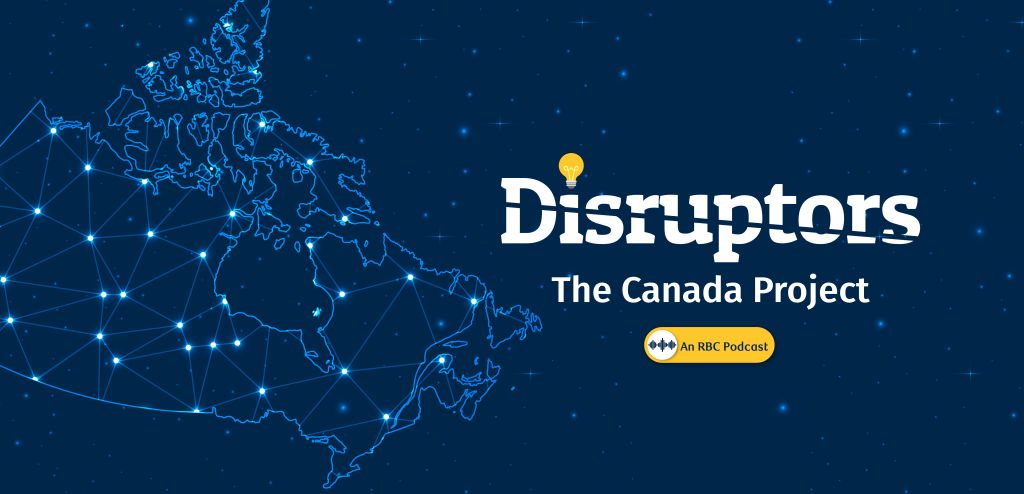
Across Nunavut’s Kivalliq region, communities and mine sites still rely on imported diesel for electricity and satellite links for basic connectivity. It’s expensive, carbon-intensive, and leaves a strategically vital part of Canada dependent on infrastructure we don’t fully control.

In this episode of Disruptors: The Canada Project with John Stackhouse, we travel to Nunavut to explore the Kivalliq Hydro-Fibre Link (KHFL) — a 1,200-kilometre, Inuit-led project that would connect Manitoba’s renewable grid and Canada-based broadband backbone to five Kivalliq communities and future mining projects. Led by Nukik Corporation under 100% Inuit ownership, KHFL is designed to deliver clean power, high-speed terrestrial connectivity, and Nunavut’s first physical infrastructure link to southern Canada.

Joining us are former premier P.J. Akeeagok and Anne-Raphaëlle Audouin, who unpack how this corridor could cut diesel use, reduce dependence on satellite networks, strengthen Arctic sovereignty, and create a new model for community-driven infrastructure in the North.

Listen on Apple Podcasts, Spotify or Simplecast

P.J. Akeeagok: When Canadians think about growth, we don’t always think about the Arctic, but we should. Nunavut has a place in this world and certainty is right here. Opportunity is right here. Nation building in Canada has never been completed. We built highways from the east coast all the way to the west coast, but now is our time to do the same in the Arctic.

P.J. Akeeagok: The Arctic is where sovereignty is tested and where the next gains in critical minerals could be unlocked. Nunavut is ready and Nunavut is ripe. A productive, a resilient Arctic is a national project. It means dependable energy, connectivity, and transportation delivered in ways that truly reflect Inuit rights, knowledges, as well as priorities.

John Stackhouse: That’s P.J. Akeeagok, the sixth premier of Nunavut, or as he’s known to pretty much everyone in the north PJ.

P.J. Akeeagok: With the announcement of the Iqaluit Hydro Project, we see the first of four nation-building pillars, taking shape: clean, reliable energy for our capital, anchoring sovereignty, resilience, and opportunity.

P.J. Akeeagok: Canada is starting to recognize the Arctic is essential to sovereignty and to our prosperity. Alongside the Kivalliq Hydro Fibre Link, Northern Transportation Corridors and Arctic Digital Backbone. These projects complete Canada’s unfinished work of nation-building. Our peers across the Arctic have invested steadily and acted with clear timelines.

P.J. Akeeagok: Canada could do the same. We need Canada to join us to treat the Arctic, not as a pilot, but truly as a pillar. Plan with indigenous leadership, financed with certainty and built to last. This is our moment to complete nation-building together. I’m John Stackhouse. Welcome to

John Stackhouse: Disruptors the Canada Project. This season we’re crisscrossing the country to meet the builders who are using technology to tackle our toughest problems. Along the way, sketch a blueprint for a stronger, more competitive nation. Today’s destination, Nunavut’s Kivalliq region.

John Stackhouse: The Arctic isn’t a postcard, it’s a pillar of Canada. For generations, our sovereignty has rested on a real presence in the north.

People living there, working there, raising families there. And beneath that land lies some of the world’s most important reserves of critical minerals, the inputs for batteries, grids, and the cleaner economy we keep talking about. Here’s something you might not know. Canada’s Arctic still runs on imported diesel and connects to the world through satellite networks that we don’t control.

John Stackhouse: That means high volatile power costs for families and businesses, and an internet that freezes when the bandwidth does. Meanwhile, across the Nordic Arctic in Norway, Sweden, Finland, Iceland, and Denmark, remote communities are tied into national grids and fiber backbones. In other words, they’ve wired their north and we haven’t, at least not yet and that matters.

John Stackhouse: When we don’t control the energy and connectivity that keep communities running, we create national vulnerabilities, economic, social, and strategic. That is no longer acceptable for a G7 country. An Inuit owned project aims to change that equation. The Kivalliq Hydro-Fiber Link, a 1200 kilometer corridor delivering clean electricity and true high-speed internet from Manitoba to none of it.

John Stackhouse: It can cut diesel, use and emissions and give families, schools, and businesses a line they can trust no matter the weather. And it does something bigger. It powers Canada’s next economy in the north critical minerals projects that need steady low carbon energy and real connectivity to hire locally, automate and compete globally.

John Stackhouse: Built for permafrost and 40 below. A nation building test we can actually pass. Our guest today is Anne-Raphaëlle Audouin CEO of the Nukik Corporation, the Inuit owned developer leading the Kivalliq energy and fiber build. With more than 15 years in major projects and indigenous partnerships, Anne Raphael focused on a simple goal, reliable power, and real connectivity that work in 40 below and that work for people who live there.

John Stackhouse: We started by asking Anne-Raphaëlle, what’s the pitch for this project?

Anne Raphaele: The project is called the Kivalliq Hydro-Fibre Link. It’s an ambitious Arctic project that intends to connect the Canadian Arctic to Southern electrical grid and fiber-optic network by connecting around the Churchill area, crossing the border into Nunavut, taking five communities off of diesel, plus active operating mines, and bringing full broadband connectivity into the territory.

Anne Raphaele: It’s important to know that Nunavut is very much relying on antiquated systems because a hundred percent of all the energy needs in the territory have to be met by burning diesel. So everyday life, everyday business, everyday government operations, everything functions by burning diesel. And most of the diesel we burn in the Arctic comes from foreign countries most years.

Anne Raphaele: It’s actually a hundred percent that all the diesel that is imported into the territory that comes from foreign countries, mostly the United States. And then on the connectivity piece, to give you the full picture. We rely mostly now on Starlink, which is amazing technology, but it’s not domestic technology..

Anne Raphaele: It’s number one driven by the people who have to really live under third world conditions in the north, which is unacceptable. And B, it’s really about national security because the Canadian Arctic in Nunavut is a real Achilles heel at this time. We’re heading into a wall with no energy or connectivity optionality whatsoever.

Anne Raphaele: When you look at the map of Sweden, Finland, Russia, Norway, they’ve built roads, they’ve built networks, they’ve built high voltage transmission lines, and they did that decades ago. Name me, one nation around the world that is powering a modern society solely on diesel. It just doesn’t exist.

John Stackhouse: Before we dive into the engineering behind this new project, let’s get our bearings. The Fibre-Link Corridor runs up the west coast of Hudson Bay from northern Manitoba. Near Churchill then follows the Kivalliq communities north before turning inland to Baker Lake or Qamani’tuaq, as it’s known in Inuktitut. The goal is simple. Connect household schools and clinics first, while giving local employers the reliability they need to plan and grow.

John Stackhouse: We asked Anne-Raphaëlle to walk us along the path from Churchill through places like Arviat, Whale Cove, Rankin Inlet, Chesterfield Inlet, and on to Baker Lake, and explain who gets connected first.

Anne Raphaele: The line would connect around Churchill, and so we would take that line, take it 1000 kilometers north, and address all the different hamlets along the way, which are five of them.

Anne Raphaele: Then take it inland West towards Baker Lake, which is the only inland community in the Kivalliq region and power existing mining operations, mostly Agnico Eagle mines mining operation, which is 20 kilometers off of Rankin Inlet.

John Stackhouse: Let’s ground this in everyday life so it’s easier to picture. Imagine the changes for a family, a school, and a clinic. Once the community can count on steady power and real broadband, rather than diesel and a satellite link.

Anne Raphaele: Day in and day out, you’re burning a diesel that is damaging your health. Those diesel plants weren’t built 50 kilometers out of the hamlets, they are right downtown, near schools, near hospitals, near homes. The diesel you burn in the Arctic is called Arctic grade diesel, and it is much more polluting, much more health affecting than regular diesel that you put in your car in maybe Toronto or Ottawa. Just because it has to resist some pretty harsh climatic conditions in terms of everyday life.

Anne Raphaele: It’s transformative. That’s the beauty of being connected to the grid as well, is now you’re not only connected to the next city, but you’re connected to the North American grid. The real benefit of North America is really a connected web, and the grid unfortunately is more connected north south, as in Canada US than it is north, south, as in, you know, Canadian to Canadian provinces and territories.

Anne Raphaele: We’ve been better neighbors to the US than we have to our own fellow Canadians. When I started working for Nukik Corporation four years ago, I could have never had even just a teams call without the camera on because the connectivity was so spotty. It has gotten much better with Starlink, but again, how resilient are we and how much can we say that we have a sovereign arctic if we rely on non-domestic assets and foreign owned technologies?  It’s just a slogan at that point to talk about arctic sovereignty in Canada.

John Stackhouse: Once Nunavut gets connected to the grid, a number of overdue systemic improvements suddenly become possible.

Anne Raphaele: The fibre it’s gonna power and allow telehealth to happen. Reduce medical evacuation. Now you have the ability to have a doctor online powered and supported by terrestrial fibre, as reliable as we experience anywhere else in the country, and then it’s transformational for education. People won’t have to leave the territory to have access to long-term education.

John Stackhouse: One corridor doing two jobs is part of the efficiency here. The same right of way that carries electricity, can carry the fibre that keeps clinics, classrooms, and local businesses online, while also supporting industrial operations.

Anne Raphaele: You have to run fibre optic anyways in a transmission line of this length. And in modern assets, high voltage, you typically nowadays run fiber optic for the maintenance and operation of your line. We are just going to bring more so that we can serve the communities, serve the businesses, serve the mines, and different, you know, broadband off-takers that, uh, maybe interested in, in the fibre optic.

John Stackhouse: It’s an ambitious and necessary idea, but the challenge lies in how you build efficiently across permafrost and 40 below.

Anne Raphaele: The project will be a technical feat, just, uh, just by its sheer realization because we’re talking of hundreds and hundreds of towers built into the tundra, into Nunavut, and into sections of it, into permafrost.

Anne Raphaele: The way to do it is to anchor it as much as possible and as deep as possible to use a certain type of transmission tower that resists to high winds, and that is designed to withstand those climatic conditions that tend to be quite extreme in the Arctic. It’s really gonna be groundbreaking, and we’ve never done it here in Canada.

Anne Raphaele: Other nations have done it in the seventies, in the eighties, they’ve made it happen. They were innovators of their days. But also it’s a technology that has so much proof of concept, right? The first transmission line commission in North America was commissioned, I think in 1889. There’s an ability to be innovators and to build the next chapter of your country with vision by leveraging the known expertise that is in your country.

Anne Raphaele: And we are builders in Canada. In the 1800’s, we built the Canadian railway, and at the time there were maybe 3 million people in Canada. We didn’t build it for 40 million Canadians, but the founders of Canada knew that the country was gonna grow, knew that this was the vision. And so, the innovation sometimes is not necessarily in the technology itself.

Anne Raphaele: I would say it’s in the leadership, in the vision, in believing in its people and saying, okay, we’re gonna embrace technology that is available now, purpose it to the needs of the terrain of the people, of the purpose, and make it happen over maybe sometimes very ambitious targets and distances. And just go for it.

John Stackhouse: Just go for it, it’s a clear imperative if ever there was one. Ultimately, this is a corridor story. Northern Manitoba and the Port of Churchill are part of the same ecosystem as the Kivalliq. If we do this right, we’ll have people, goods, data, and opportunity moving more reliably in both directions. So the big question then becomes how do Churchill and the Kivalliq rise together, and what does that pairing unlock for the region?

Anne Raphaele: You won’t see a port of Churchill that thrives without a Kivalliq region that thrives. You won’t see a port of Churchill that really taps into the full breadth of the value proposition of new inflow and outflow from the port without a Kivalliq region that becomes developed with, you know, new mines. There’s a modular home factory in Arviat.

Anne Raphaele: Those materials are gonna be barged in from Churchill. You cannot have and realize the full potential of the region without interlocking the two priorities in April of 2025. I was lucky enough to, I think, witness history in the making when Premier Kinew and Premier Akeeagok, together to sign a joint announcement on the creation of a strategic energy and economic corridor between their two jurisdiction.

John Stackhouse: We managed to dig out the CPAC recording of that historic signing. If you’re curious,

P.J. Akeeagok: uh, first off, it’s, uh, an honor to be here. Uh, always, uh, great to, to be able to work with you, uh, really as, as Canadians. Uh, it is. What a historic moment that we’re in. Uh, I just really wanna recognize the incredible leadership. Uh, that has brought us here. Uh, this has been the vision of many Inuit leaders that wanted to connect, uh, Southern Canada to the north and this is nation building, and so we’re very excited to be able to work with such a incredible partner. We already share many of our, uh, common interest from healthcare to education among others, but now to be able to look at what we could do together, uh, really excites me. So I’m very honored to be here and to be welcomed to your beautiful province.

Wab Kinew:
So welcome to Manitoba and lets put pen to paper.

Anne Raphaele: And that was done in the context of Premier Kinew repatriating, 500 megawatts of expiring hydro exports to the US and saying we’re gonna do a carve out and we are gonna do that, carve out for the Kivalliq Hydro-Fibre link and we’re gonna allocate 50 megawatt of that 500 to Nunavut.

Anne Raphaele: Nothing had ever been done like this before. We have some expiring contracts. We’d rather be good neighbors to our Inuit brothers and sisters rather than, you know, selling it to the US who are turning their back on us at this time during the trade dispute. So there were a lot of things happening, but I think it was really moving to be in that room when the two premiers signed the announcement and took the lead on saying, we are Indigenous leaders and we are gonna stand hand in hand and make history here.

John Stackhouse: I love this idea of close collaboration and sharing of priorities, and for a big infrastructure project like this, when it comes to cost versus value, what should Canadians know about jobs GDP and payback?

Anne Raphaele: Yes, the project capital cost is high, $3 billion, but you know, the benefits are proportionally as high $3.2 billion GDP contribution during construction alone, more than 15,000 person years of employment. Millions and millions of revenues in terms of taxes, payrolls, royalties.

The one thing to understand, at the end of the day, this is not a diesel displacement project. It’s not even a fiber project. It’s a critical and strategic infrastructure project, and it’s, it’s a critical differentiation because it transforms how you’re gonna approach the investment.

Anne Raphaele: It’s not that insurmountable to build infrastructure in the Arctic, and it is important to understand the mining potential, specifically in the Kivalliq region of Nunavut is world class. In that area, we’re sitting on all sorts of critical mineral in one of the largest greenstone belts that exists in North America that is still completely untapped.

Anne Raphaele: The uranium deposit is akin to what we’re seeing in the Athabasca deposits in Saskatchewan and potentially what could redefine what could be the economic engine of Canada.

John Stackhouse: So we need to call it what it is, strategic infrastructure that powers a new economic engine. Our Arctic peers in other northern countries made these bets decades ago. We can still catch up and on our terms. Inuit owned, cleaner, smarter commissioning is targeted for 2032. So we asked Ann Raphael to paint us the 10 year picture.

Anne Raphaele: 2032, we are planning on energizing the line, so a 10 year outlook. After commissioning, you’ll see more connected people bring more connected mindsets, more connected businesses. Businesses that start and stay and remain in the Arctic because now they’re connected to the fabric. They have a place to reliably power their operations. Not just mining. I think this will be a critical enabler of a lot of things, and that again, is the defining value of the project is that by investing in a project like the Kivalliq Hydro Fibre-Link, you send a clear message to the people who live there, that it’s not just about planting a Canadian flag and then claiming that we are Arctic sovereign, but it’s about telling those people that they matter.

Anne Raphaele: That they deeply matter, that their future matters. That yes, there are Canadians. They’re not just Canadians when we wanna assert our sovereignty, but that we believe in their future. We believe in their contribution, workwise and in other ways, and that we’re gonna give a future to their children.

John Stackhouse: We’ll give P.J. the last word.

P.J. Akeeagok: You know, it’s incredible to see the unity from coast to coast to coast in terms of our opportunity that we see as a country. The Arctic truly has what the world needs. We’ve made in true partnership with, in identifying four projects that really mean the criteria of what we could do to build a strong, resilient country.

P.J. Akeeagok: It means training and jobs that stay in the north and public service that works 40 below that open up markets, whether it’s the deep sea port in that can unlock incredible fisheries where we could supply the world. With our resources, whether it’s the Arctic security corridor or the Grays Bay Rode and Port Project that can allow us to become a super power in terms of supplying the world of critical minerals among many, or whether it’s the Kivalliq Hydro-Fibre Link that would connect Southern Canada to the Arctic for the first time and complete true nation building as we move forward.

John Stackhouse: For generations, the North has tested Canada’s resolve and defined our sovereignty. Families from Arviat to Baker Lake have built communities in 40 below, relying on foreign diesel and bandwidth we don’t control. The Kivalliq Hydro-Fibre Link corridor isn’t just about cleaner power and faster internet. It’s about ending that dependency so schools don’t suffer, clinics don’t close, and local businesses can plan for growth. This is strategic infrastructure. It unlocks world-class critical minerals under the Kivalliq.  Metals for batteries, grids, and industry on terms that keep more value in Canada and in the north. It strengthens a northern corridor anchored by Churchill, tying people goods and data to a future we build, not one we rent, and it moves us towards parity with other Arctic nations that wired their North years ago. The question isn’t whether Canada needs Arctic capability. It’s whether we’ll choose to build it at home with Inuit leadership and the certainty that turns plans into projects from the west shore of Hudson Bay to the rest of the country.

John Stackhouse: You can see how much opportunity there is for Canada if we wire it. You’ve been listening to Disruptors: The Canada Project. Thanks for joining us on this incredible journey across Canada. There’s much more ahead. If you’ve enjoyed this episode, please subscribe and leave us a review and five star rating.

John Stackhouse: It helps others discover the show and you can learn much more about this project and other RBC thought leadership initiatives at rbc.com/thought leadership. Join us next time. As we continue our journey across the country, in search of the innovators and leaders who are helping Canada meet this moment boldly with their eyes on the future.

John Stackhouse: I’m John Stackhouse, thanks for listening.

Saskatchewan, long known for feeding the world, is now leading a revolution in ag-tech. With automation, machine learning, and AI-powered quality control, the province is redefining how food moves from field to port.  Agriculture is more than Canada’s heritage – it’s our future advantage. 

In this episode of Disruptors: The Canada ProjectJohn Stackhouse speaks with Kyle Folk, founder and CEO of Ground Truth Ag, whose technology automates grain grading — a process that once took hours, now done in minutes. He’s joined by Murad Al-Katib, CEO of AGT Food and Ingredients.  

It’s a story about turning information into prosperity, and about how Saskatchewan’s innovators are helping Canada feed a growing world while building a more resilient, sovereign economy. 

Listen on Apple Podcasts, Spotify or Simplecast

Feeding the Future: How Saskatchewan is Seeding Canada’s Ag-Tech Revolution 

John Stackhouse: Hi, it’s John here. If you’ve ever stood on the prairies, you know there’s a quiet ambition on those endless horizons. Generations of farmers and land keepers have looked at these horizons and also seen endless possibilities. They’ve learned to read the soil and spot opportunity in the earth itself. Now in the data flowing from it.

Murad Al-Katib: The future of agriculture will be those sensors and that data collection put to use to generate billions of dollars of economic output. And you know, there’s a ready market for our product, the emerging markets of the world. Population growth to 10 billion by 2050, and middle incomes rising in Asia to $33 trillion by 2030. Those are the drivers of the Canadian agricultural commercialization opportunity, and I believe it’s a generational opportunity, one that we must seize for the benefit of all Canadians.  So, we’ll feed food security of the world, and we’ll create economic wealth and benefits.

John Stackhouse: That’s Murad Al-Katib President and CEO of a AGT Food and Ingredients. It’s a homegrown Canadian success story and one of the world’s largest suppliers of pulses. If you’ve ever made lentil stew or split pea soup, you’ve probably tasted his work.

John Stackhouse: Murad keeps close tabs on the overall health of Canada’s agribusiness. Today we’re going to show you why we all should do.

Murad Al-Katib: I want Canadians to recognize that food systems are not something to take for granted, and that we have a responsibility to the world to provide quality food. So, we can alleviate 735 million people who are undernourished every day, and at the same time, we create wealth in our communities.

John Stackhouse: The opportunity here is enormous. As global agriculture shifts and new markets open, Canada is competing alongside major players like Brazil, Argentina, and Kazakhstan. The danger isn’t that we can’t meet this moment, it’s that we won’t, if we stop innovating, we’re not just falling behind on feeding the world, we’re leaving money on the table.

John Stackhouse: I’m John Stackhouse. Welcome to Disruptors the Canada Project. This season we’re taking you on a journey across the country to meet some of the visionaries who are using technology to tackle our most urgent challenges, and in the process, create a blueprint for a stronger, more competitive Canada.

John Stackhouse: Today’s destination, Saskatchewan. Whether it’s automated elevators or GPS guided tractors or climate-controlled storage facilities, or those incredible three kilometer long trains that you see on the Saskatchewan landscape, this sort of ag tech is what we’re going to need a lot more of in the years ahead. If Canada is going to produce more food for a growing and increasingly divided world. For all the technology that is helping farmers and AgriFood companies do so much more in this age. Here’s something that might shock you. We’re still grading grain the way our great-grandfathers did by hand, sample by sample.

John Stackhouse: As every Saskatchewan farmer knows, the global marketplace for their crops is getting well more rough and tumble. Whether it’s the United States or China or India, our trading partners are becoming more demanding and in some ways less reliable, which means we’re going to have to be more sophisticated and competitive than ever, like in so many other sectors.

John Stackhouse: Canada’s competitive edge in agriculture is going to require even more automation. In this episode, we meet Kyle Folk. He’s the CEO of ground truth Ag. To discover how our province that has helped feed the world for a century or more is building AI powered computer vision that can grade grain in minutes instead of hours.

John Stackhouse: Giving Canada the automated edge, we need to stay competitive in global food markets. I can’t think of anyone better to kick off this conversation than Murad. He’s based in Regina, where over the past two decades, he’s built a AGT from a startup to a global exporter to more than 120 countries. He served on multiple boards as well as the UN World Food Program’s Innovation Advisory Council.

John Stackhouse: Morad is a passionate advocate for AgriFood innovation, value added processing, and sustainability. He grew up in Saskatchewan, so I started by asking him what it’s been like to watch the Saskatchewan farmers of his youth change and innovate.

Murad Al-Katib: The transition and the transformation of agriculture. It’s been a, a very fascinating thing to watch over a lifetime.  Growing up in Davidson, Saskatchewan, a small, uh, rural community of 1200 people, every farmer would grow wheat. If I go back to my childhood in the late seventies and eighties, you know, we were predominantly known as the breadbasket of the world.

John Stackhouse: Of course, that breadbasket looks very different today, more diversity of crops for starters. Also, a lot more automation and technologies, helping farmers maximize yield and get their cross to market more efficiently. I asked Marad if there was a turning point, a moment when farmers began to think about data technology as central to how they work.

Murad Al-Katib: Farmers have been early adopters of technology. You know, I look at the stacking of technologies and that’s where we get to the kind of the precision farming innovation that we’re now implementing. It started with technologies on soil conservation, moisture conservation that really date back 40 and 50 years. I mean, remember, we’re growing these crops in soil conditions that are receiving less than 400 millimeters of annual rainfall and precipitation.

Murad Al-Katib: This is what in the world they would call desert agriculture. The technologies that have been developed over the last 20 and 30 years, leading up to things like precision farming, the use of sensors, data collection, decision support systems, all of that led to a dramatic improvement of the cropping systems and the yield while providing a carbon footprint that’s lower than any broad acre cropping system in the world.

John Stackhouse: Murad is talking about decades of evolution, but the next generation of farmers are taking that data-driven approach even further. I want you to meet Kyle Folk. He’s the CEO of Ground Truth Ag, and he’s here to talk about how Saskatchewan is transforming brain handling, giving Canada the automated edge. We need to stay competitive in global food markets.

John Stackhouse: Kyle, you and I were together a number of years ago, uh, I think before the pandemic in Regina, and I was always fascinated at your transition from, uh, farm kid to Ag Tech. Tell us what got you first interested in digital technology.

Kyle Folk: I left the farm after high school, became an electrician, and then in about 2009 or 10, John, I was back at the farm one weekend visiting and dad needed a hand, he wanted to get help setting up for a truck that was coming to haul, some canola way.  So we went to throw the auger in the bin and this wasn’t, uh, hopper bottom, it was the old flat bottom type and went to slide the auger in and it wouldn’t go in ’cause the grain had spoiled. And so that. Got me down this path of my first venture into Ag Tech and it was, uh, building a system that would be able to show farmers what their temperature moisture was in their bins so they could detect grain spoilage ahead of time.

Kyle Folk: And so that was pre-ground truth days, but that was my first foray into, into Ag Tech.

John Stackhouse: Tell us a bit about ground truth and what the ambition is.

Kyle Folk: Ground truth is really focused on automating the grain grading process. Growing up around the farm, the way that we were sampling grain and having it sent away to be graded was the same way that it is today and the same way it was 115 years ago. It’s a manual process. Grain graders take up to eight years to be fully trained, John. That’s because weather patterns or weather cycles just don’t even show up for up to eight years.

John Stackhouse: Grain grading is something that’s done, uh, around the world. What’s the advantage that you’re developing in Saskatchewan?

Kyle Folk: Grain grading. Yes, you’re right. It is done around the world since the early ninteen hundreds. The only thing that’s really changed when it comes to grain grading is the ability to do some non-visual assessments like protein, moisture, test weight, those kinds of things. There’s machines that can do that, but the large part of grain grading is visual.

Kyle Folk: And so it’s a human that has to make a judgment call on subjective elements. And so, you know, hard Red Spring wheat is one of the hardest, if not the hardest grains to grade in the world. Humans are expected to be able to determine that in a very short time period because as you know, the scale of farming is changing drastically, and the window for being able to make these assessments keeps closing, getting shorter and shorter.

John Stackhouse: Kyle’s story captures what’s happening across the prairies, a quiet revolution where people who grew up on farms are now using sophisticated data systems to solve problems, they’ve seen firsthand. They’re taking gaps in the system like spoiled grain or inconsistent grading and fusing them with capabilities like AI and computer vision. The result, agricultural tradition meets digital precision, and the opportunity isn’t just local, it’s national, and Saskatchewan innovators are already proving they’re up to the challenge.

Murad Al-Katib: When I chaired the national strategy table for agriculture and food for the government of Canada in 2019, we filed our recommendation saying that we believe that the ag sector in Canada can go from 45 billions of exports to 85 billion in exports.

Murad Al-Katib: We met that in the third year of the target. How many sectors of our economy can deliver $65 billion of tangible economic growth in a three year period while agriculture did that?

John Stackhouse: When you look at how quickly those targets were reached, you gotta wonder what’s changed. Was it innovation on the farm, new global demand, or something cultural in how we think about AgriFood as a high tech sector.

Murad Al-Katib: We’re doing more with less, which is ultimately the aim of technology and innovation commercialization. We, you know, are taking the same land base, the same seeded acres, and we’re dramatically increasing the production efficiency of that land. Your increasing competitiveness and productivity. We’ve been always viewed as a sleepy sector, one that is more traditional. Yet when I look at it, it’s leading in tech innovation. Agriculture is no longer the family farm. It is a technology innovation centric industry that is not only steady and reliable, but it’s growing and dynamic. Data and analytics will make us able to make better decisions. What we need to do is ensure that technology and innovation and the applications of those are gonna allow us to meet that consumer demand for clean, safe, reliable, trustworthy food.  So it’s an opportunity for a career. It’s an opportunity that is very, very exciting. And could it be more bullish on the agriculture sector in this country? It’s gonna be exciting over the next couple of decades.

John Stackhouse: Murad is talking about transformation at a national scale. Billions in growth as technology reshapes the entire sector. But that transformation starts with innovations like Kyle’s. Let’s see how ground truth works. Kyle, maybe paint a picture for us of what your technology looks like and how it operates.

Kyle Folk: Yeah, so grain samples we’ve talked about, you can pour ’em into Our bench top unit runs through, we utilize machine vision, so computer vision, and we utilize near infrared spectroscopy.  Combined with machine learning models, deep learning models, to be able to then assess that sample visually and non-visually, to be able to identify 50 plus visual characteristics in a matter of like sub five minutes for a human trained, just to identify what is the worst characteristic in that sample.

Kyle Folk: It takes about eight minutes on average. If you’re going to assess a sample for all the characteristics, it’s going to take you days, if not a week, to do that.

John Stackhouse: You’ve been at this for a while now. What have been the biggest breakthroughs and also what are you most up against right now?

Kyle Folk: Coming from the farm aspect, we always felt that we were subjected to all the risk and nobody else took on any risk in the process.

Kyle Folk: And you know, our grain buyers, although we had good relationships with them, they were doing what was best for them. And really, we’d wear all that risk. The biggest shocker for me was understanding and realization that the grain buyers are just doing the best that they can with all of the shortcomings that are in place.

Kyle Folk: As soon as I started talking to them and exploring this idea of ground truth and automating the grain grading process, it was very exciting to me and how interested they were in having something like this for themselves. Once we started building these models to grade the grain in a comprehensive way, John, not just a handful of characteristics, but all of them, it was a big, exciting milestone for us to hit to see this starting to work.

John Stackhouse: Kyle, maybe we can step back and better understand what this can mean for Canada.

Kyle Folk: The reason we can grow more today, John, is because we understand it. You can’t manage what you can’t measure. So with quality aspects, this has been relatively unmeasurable, inconsistent, at the field level, but once this technology becomes mainstream, John and farmers are able to understand in great detail what their quality is.

Kyle Folk: Then they can start to manage it better. The quality of grain that’s going to come out of Canada. Is only going to increase and be better. And so that will only position us better on a world stage. And to be honest, yes, I would say our supply chain is a little fragile from this perspective right now, but we still are one of the best in the world, if not the best.

John Stackhouse: How does that change the economics for, for the farmer?

Kyle Folk: When you harvest, you send one kg samples to two kg samples to your prospective buyers and they grade it. And this is a human making a judgment call. You send three samples to three different prospective buyers and you get three different results.

Kyle Folk: So what do you do with that as a farmer, if you had our unit at your yard and you could grade it immediately, you’d know what you could sell that for. You’d know what contract you could pick up. You’d know what premiums would be available to you. That’s a different mindset.

John Stackhouse: You’ve developed all of this in Saskatchewan, which is frankly one of the world’s leaders in so many aspects of ag tech, but you’re also up against a world that is getting better and better at this. What does Saskatchewan have as an ag tech leader, and what does it need to maintain or improve that position going into the 2030s?

Kyle Folk: You go to Silicon Valley, you go out for a coffee or a tea at a local coffee shop, you’ll see or hear people having conversations about tech startups. That same thing applies to Saskatchewan.

Kyle Folk: I can’t go to a rink without overhearing two farmers talking about the weather or talking about how their crop looks, or talking about pricing, talking about a contract. You are immersed when you’re in Saskatchewan. You’re completely exposed to agriculture, whether you like it or not. We definitely have an advantage when it comes to Ag Tech.

Kyle Folk: You know, five to 10 years down the line that we will be the powerhouse in technology for agriculture as much as we are just for agriculture as a whole. Because there’s no question I could see us being at the top.

John Stackhouse: What a great ambition, Kyle, thanks for being on disruptors.

Kyle Folk: Thanks for having me, John.

John Stackhouse: For these innovations to truly scale, they need to be part of something bigger. A resilient food system that feeds both ourselves and the world. I asked Murad what it’s going to take to keep Canadian Ag Tech at the front of the pack.

Murad Al-Katib: We still have hangovers from what I would call the old Canadian Wheat Board bulk grain handling economy that we had for so many years. We have to be planning for what the trade infrastructure looks like in 2050 and 2060, not in 2026.

Murad Al-Katib: If I was Prime Minister for a day, I would spend a hundred billion on trade infrastructure. It will pay for generations to come. Supply chains are all about connectivity. Each link must be efficient. Data and technology will also make that more efficient. So let’s seize that opportunity.

John Stackhouse: That’s the long game infrastructure that lasts half a century, not half a season. But Murad also sees shifts in global demand that are forcing us to think differently about what we produce. How we add value to it.

Murad Al-Katib: We have an opportunity to have a consumer base that’s completely different than the consumer base we have today. We continue to ship commodities around the world.

Murad Al-Katib: We’re not doing as good of a job on value added. We need to ensure the regulatory system allows, allows and encourages the development of food and food products. We have to remind people you don’t get more prosperity from redistributing the current wealth that you have. You get more prosperity in a nation by creating new wealth.

Murad Al-Katib: And new wealth is largely created by a customer abroad who is willing to purchase our product for a price and economics that make us able to not only compete, but to make a profit.

John Stackhouse: To meet the demands of global markets and complete agriculture’s transformation, we’re going to need more people like Kyle, who are looking at our systems with a critical eye and finding ways to make them more competitive. But as Murad Al-Katib reminds us, this isn’t just about gadgets and growth. It’s about building the infrastructure and intelligence that will feed the world and fuel Canada’s prosperity. We simply can’t keep planning our trade strategy one crop year at a time. We need to think like builders, not just producers, because the next frontier of agriculture isn’t just in the soil, it’s in the systems that connect us with a fast changing and increasingly fragmented world. The question now isn’t whether the technology works. The question is whether we can scale up fast enough to stay ahead. Canada has a unique advantage. A prairie culture that fuses innovation with practical farming experience. That’s what helps global ambition grow straight outta the soil. I’m John Stackhouse and you’ve been listening to Disruptors, the Canada Project, an RBC podcast. If you wanna hear the whole series, please subscribe wherever you get your podcasts, and better yet, give us a five star rating that will help others hear these stories and share them. And if you wanna learn more about The Canada Project. Go to rbc.com/thoughtleadership. Join us next time as we continue our journey across the country in search of the innovators and leaders who are helping Canada meet this moment boldly with their eyes fixed on the future.

At the edge of Hudson Bay, the Port of Churchill is being revitalized — reconnecting the Prairies to global markets and strengthening Canada’s northern gateway to the world.

In this episode of Disruptors: The Canada Project, John Stackhouse speaks with Premier Wab Kinew, Chris Avery of Arctic Gateway Group, and Grant Barkman of Decision Works about how Indigenous ownership, modern rail infrastructure, and drone-powered innovation are reconnecting the Prairies to global markets.

As global trade routes shift and Arctic access expands, Manitoba is positioning itself as a northern link between the Prairies and the world — redefining how Canada moves goods, builds partnerships, and prepares for the future.

Listen on Apple Podcasts, Spotify or Simplecast

Premier Wab Kinew: Little old Manitoba is having a big moment, a wealth of critical minerals, a clean energy grid, access to tide water, a direct trade road to Europe, and hardworking people. I think we’re about to surprise a lot of people across Canada.

John Stackhouse: That’s Premier Wab Kinew, and he’s right. Manitoba is having a moment.

John Stackhouse: The world is changing. Supply chains are shifting, and Canada is realizing that sovereignty isn’t just about borders. It’s how we get what we produce to the rest of the world.

Premier Wab Kinew: Canada’s at a critical moment for our economy and for our shared future. In a time of tariffs and nation building projects, Manitoba is leading the way. We might just have a national unity project as well. In this moment, we’re going to be a game changer. When we build Manitoba, we not only make our province stronger, but we also make all of Canada stronger

John Stackhouse: As the world redraws its trade maps. Manitoba is positioning itself as Canada’s third coast connecting the prairies to global markets through the north. It’s a story of resilience, reconciliation, and reorientation for the country’s economy.

Premier Wab Kinew: Here at the heart of the continent. We’re building the critical infrastructure that connects our country and brings our goods to the world, but we can’t do it alone. Together with indigenous nations, with businesses, and with all levels of government, we can deliver more good jobs and a stronger economy for all of us.  Little old Manitoba making big things happen.

John Stackhouse: I’m John Stackhouse. Welcome to Disruptors the Canada Project. This season we’re crisscrossing the country to meet the leaders and innovators, making bold moves at a pivotal moment for all of Canada. In the process, creating a blueprint for a stronger, more competitive nation.

Today’s destination is Manitoba, the heart of the continent, where a new trade corridor is taking shape on the edge of the Arctic. The Port of Churchill has long been imagined as Canada’s northern gateway. Now it’s being rebuilt by indigenous and northern communities to give our exporters something they’ve never had before, A third coast to serve as a gateway to the world.

We’ll meet Chris Avery of the Arctic Gateway Group and Grant Barkman of Decision works to explore how in drone powered innovation have restored a critical Northern Rail link unlocking the Port of Churchill and giving Canada flexibility, independence, and a northern trade route to the world. This northern route depends on the Arctic Gateway Group, led by Chris Avery, who’s working with indigenous and northern communities to reconnect Canada to the world through the north.

John Stackhouse: Let me start with the Arctic Gateway Group. Tell us a bit about it and the ambition.

Chris Avery: Arctic Gateway Group owns and operates the Hudson Bay Railway, the Port of Churchill, and the Churchill Marine Tank Farm. We in turn are, um, owned by One North, which is a consortium of 29 First Nations and 12 Northern Manitoba communities. So largely indigenous owned. The Port of Churchill is the gateway for the vast resources of Western Canada to global markets in Europe, middle East, Africa, south America, even Latin America.

John Stackhouse: Churchill has been a dream of many visionaries for generations as a gateway. What’s different now that will allow you to do what others before you have not been able to achieve

Chris Avery: In an era where President Trump is applying tariffs to Canadian goods and talking about Canada as a 51st state, and Canada needing to look to diversify its trade, become a global energy superpower, and really assert our sovereignty in the North. Churchill now, once again, has become a strategic asset for Canada.

John Stackhouse: Take us deeper, Chris, into the tech transformation in infrastructure. You’ve got three legs of the challenge here, the rail across some pretty rugged terrain to get all the goods to the coast and the port itself. And then of course, the water between Churchill and those markets you referenced go, pretty far north. So multiple challenges on each of those fronts. How is technology helping you?

Chris Avery: About 50% of Canada’s geography has permafrost present, and as a result, much of our linear infrastructure, whether it’s roads or railways or pipelines, go through permafrost, and we are very adept at dealing with this.

Chris Avery: So more specifically for the Hudson Bay Railway, we utilize great technology to help us understand what’s happening in the ground. So for example. We have, uh, ground penetrating radars that are mounted onto our locomotives. And as the locomotives are traveling over our tracks, it’s gathering data on what’s happening in the ground underneath the tracks. You know, how frozen is it? How stable is the ground underneath. We also use drone technology that wasn’t available before to us. To fly over the tracks and really measure the geometries of the track and look at how level the track is and look and identify where there may be problems. So, whether you have overflowing rivers or ponds or beaver dams that are causing, uh, trouble away from the railway tracks, the drones are able to fly over and identify where there might be issues as well.

John Stackhouse: Keeping that railway open through permafrost and floods isn’t easy, but it’s vital. And now technology is giving Northern operators the tools to predict and prevent problems before they happen. One of the innovators helping Arctic Gateway do just that, is a Manitoba based company that’s taken drone inspection to a whole new level.  Meet Grant Barkman. He’s the president and director of flight operations for decision works.

Grant Barkman: We started decision works almost 20 years ago with the primary idea in mind that if people spend too much time making decisions, it slows the process of innovation down. It slows the process of project completion down. Effective decision making, meaning having all the right information at hand drives positive change faster, and ultimately leads to greater efficiency in the work processes that decisions are driving.

John Stackhouse: To reach Churchill, there’s really only one way in by rail. The Hudson Bay railway runs almost a thousand kilometers north from the Pas Transporting goods by rail in the north isn’t easy. Muskeg and permafrost mean that the ground under the rail line is literally shifting. Grant and his team at Decision Works were brought in to help the railway tackle a challenge unique to this remote line grant. And the team came up with a solution called Track Sense. It’s a unique rail infrastructure monitoring platform.

Grant Barkman: They’ve built a rail line essentially on top of a shifting foundation. It’s a constantly shifting foundation. So, the rail line itself does need to move. It needs to move laterally. It needs to move vertically.  They came to us and said, our biggest issue is that we work in the remotest environments in Northern Manitoba, and we must continually monitor our rail from a safety perspective, is there anything you can do to address that issue? Track sense provides them with a toolkit that allows ’em to do the same level of inspections, in some cases, even better quality inspections than they do today.  And do it very, very efficiently without disrupting any of the rail traffic that’s generating revenue. When a railway operator, like Hudson Bay Railway puts their crews out on the track to do manual inspection, they can’t be running revenue, earning stock at the same time. So capturing that same inspection data with a drone flying over the track, it provides them with not only the quality of inspections, but it also facilitates them earning revenue at the same time by running stock underneath us.

John Stackhouse: Monitoring the line in such a remote location is challenging. Grant says Track Sense uses the drones and predictive analytics to interpret images and complex data spotting problems before they become disasters.

Grant Barkman: Early indications, for example, of overland flooding, understanding water flow patterns and water basin data and so on, were able to predict well ahead of impacts affecting the railway infrastructure.  We’re able to predict the likelihood of a flooding event that could cause a major disruption to the infrastructure and therefore derailments are worse. So that’s an area that we are very dedicated to working on predictive capabilities wherever possible water, overland flooding is probably the most significant predictive issue that we are looking to resolve and looking to solve for all infrastructure owners, whether it be railways, highways, or whatever.  The other area is forest fire risk. So we can identify the relative risk of forest fire based on the forest fire fuel conditions that exist within any particular area. This is also a very significant predictor of future events. So, if we can see a high-risk area of forest fuel. We can also monitor that area more continuously identifying early identification of fires that can be responded quickly before they become out of control.

Grant Barkman: So that’s another very significant area. So hydrology and forest fire are the two biggest areas. The other one is just around trending and trend analysis on track itself. There are what we call areas of interest that are perennial problem spots that move regularly based on seasonality, based on temperature, based on water flow patterns, et cetera. So being able to more continuously monitor those areas, seeing trends developing and then responding. To those trends before they become significant issues, before they cause actual events like derailments and so on. Predictively and proactively, and these are some of our ongoing goals at Track Sense and working with partners to go even beyond that to say at a more macro level, let’s look at the combination of all these events and drive out a risk model, if you will.  For the entire network and say, where’s our highest risk of potential issue? Let’s proactively direct our limited crew resource, our limited human resource to those highest risk areas. I think looking at it holistically is probably the next major step that we’re going to take as we start to pull all these different incidents into track sense. Analyze them for relative risk and start presenting those back to the railway owners to say, here’s how you can proactively invest your maintenance budget, your maintenance dollars, your maintenance resources to drive the highest value in reducing risk within your railway network. In general, I think that’s where we’re going, and ai, generative ai and predictive AI is a very significant part of that.

John Stackhouse: As you heard, these high-tech drones are now mapping, measuring and predicting risks, turning large amounts of raw data into real-time decisions in the most remote areas, more data, more analysis, faster turnaround time, and that shift just isn’t about safety, it’s about keeping Canada’s Northern lifelines open year round, and the array of high-tech drones, grant and his team use are pretty impressive.

Grant Barkman: Vertical takeoff and landing fixed wing drones, which is a specialized area of drone tech. Wingra is the orange drone that you see. It’s what they call a tail sitter drone. It takes off and lands vertically, but transitions to horizontal flight. Very much like SpaceX. The SpaceX maneuvers, it’s a very cool drone to fly and it’s, uh, orange because orange is the color we can see the furthest as humans. It’s a very advanced survey and mapping drone. We also fly drones from a company called Quantum. Quantum has vertical takeoff and landing drones, but they take off and land in a horizontal orientation with tilt rotors or tilt propellers, so they take off vertically and then tilt the rotors forward to transition to horizontal flight

John Stackhouse: Five to 10 years out you have to wonder what will have in how we operate Northern Rail from a control room. Here’s grant’s prediction

Grant Barkman: Long range. Beyond visual line of sight operations and you know, we’ve been actively involved in that for a few years now. The regulation has changed or is just about to change such so that we can fly much longer-range flights from a central point. We don’t necessarily have to even have pilots on the ground in all these locations where drones are being utilized. We can fly them from a central point anywhere that we’re network connected effectively, we can operate drones remotely. So that’s a very significant change. Now, you combine that with some of the other technologies coming along, like Drone in a Box Solutions where you can put a drone in a location that itself recharges itself. It downloads its data or uploads its data, depending on what you’re doing, whether your flight planning or collecting the data from a flight. So, it has an independence, and you can launch that drone again remotely. So, we’re gonna see drone swarming becoming much more part of the strategy here. Drone swarming, meaning multiple drones, doing multiple jobs at the same time, but control from a single point.

Grant Barkman: So, it’s gonna become a much more efficient technology over the next five years. And then coupled a course with the advancements in ai, the advancements in real time object detection and ai. Along with onboard compute capability on the drone itself.

John Stackhouse: Visionaries like Grant and his team at Decision Works have taken a legacy piece of infrastructure and reinvigorated it through a combination of predictive analytics and drone technology. It’s a novel combination, but is Canada ready to scale this up?

Grant Barkman: Canada is leading in so many areas within the drone industry globally. We have some innovation in this country that is way beyond what people are seeing today, and a lot of that, again, is back to regulations, holding them back. Canada is already leading in several very key areas and can maintain that leadership position through smart investments, through leveraged investments, through collaboration and government, and regulators can play a very significant role in, uh, facilitating those kinds of collaborations. The wheels of government just move so slowly when it comes to approving new technology and innovation.

John Stackhouse: Manitoba is proving how technology can make some of the toughest infrastructure in the world smarter, safer, and more connected. If Canada can learn from this, if we can embrace new technologies with open arms and apply them across the north in a way that works closely with indigenous communities, imagine what that could unlock for Canada’s economy idea of the North 3.0. Here’s Chris Avery again from Arctic Gateway Group.

Chris Avery: What Churchill allows us to do is to diversify our trade beyond any one partner. So certainly, when President Trump came into power and tariffs were levied against Canadian goods and there were talks of 51st State, you know, it really amplified the need for us as a nation to diversify our trade and give ourselves optionality’s, another port option, aside from the ports and the borders that we have today. So, I think that’s a really important thing is the Port of Churchill and the Hudson Bay railway allows us to diversify our trade. Right now, it’s a us but if it’s not the US today, it could be something in Asia tomorrow or in another part of the world another time. So having that diversity of options for Canadian trade just makes a ton of sense.

Chris Avery: Credit to Premier Canoe in Manitoba and Prime Minister Carney for having visions of Manitoba truly being a maritime province. And I think if you look ahead 10 years from now. You’ll see the growth of Churchill and Northern Manitoba, truly as a gateway to other markets, including Europe, middle East, Africa, south America, and a gateway for the vast resources we have in Western Canada and Alberta and Saskatchewan and in Manitoba, and really leverage those resources for the good of the country

John Stackhouse: With better data and stronger rail Churchill isn’t just a port, it’s a proving ground for a new kind of Canadian infrastructure. And of course, none of it would be happening without participation and ownership by Northern First Nations. You mentioned the role of government and also there’s a foundational role for First Nations and indigenous communities.Walk us through the capital structure and the ownership model that you’ve been developing and what that may signal for other communities and provinces across the country that are looking to bring in all sorts of new capital to finance these sorts of projects.

Chris Avery: Maybe to answer that question, I might take a step back. This set of infrastructure with the port, the railway, the airport, you know, it’s a great set of infrastructure to facilitate our trade and also help us assert our sovereignty in the north. And more recently, given the geopolitical situation with the US, it has become even more important. And this set of assets was, you know, back in 96, was sold to American interests and the American interest owned the asset, but really didn’t invest properly into the asset, and it was neglected for decades. And that accumulated into the railway washing out in 2017 and it was washed out for 18 months, essentially cutting off the northern communities in Northern Manitoba, in central Nono it, which depended on Churchill for a lot of its supplies. So it was at that time that Canada bought the infrastructure in partnership with the Arctic Gateway Group, which is the indigenous owned organization, to take the ownership back from the Americans. So right now, Arctic Gateway Group, as I said, is owned by One North, which is a consortium of 29 First Nations and 12 Northern Manitoba communities, and it’s a unique form of indigenous economic reconciliation. Now you really don’t see anywhere else in Canada. In fact, we were, uh, recently at the First Nations Major Project Coalition in Toronto. Large organizations were talking about how they were looking for indigenous participation in their projects. And you know, when we got up, we sort of talked about how we’re already indigenous owned. We’re not a joint venture. We’re not partly or percentage owned by First Nations. We’re largely indigenous owned.

John Stackhouse: Churchill’s revival is about more than infrastructure. It’s economic reconciliation in action led by indigenous communities, unlocking new opportunities for all of Canada. What lets you move quickly now?

Chris Avery: We’re an operating port and operating railway in a set of infrastructure that already exists, whether you’re talking about the town site that can handle a large population to an airport, to the port and the railway itself. We’ve shipped 10,000 tons of critical minerals recently. We have a number of vessels coming in to supply the Nunavut region and the central, uh, Keal region in Nunavut. And we expect to have agricultural products moving through the port this year. So, this is very much a set of assets that already exist today, and now we can move at speed to really, fully leverage it for the benefits of today and to address the issues of our times today.

John Stackhouse: As the ship’s return to Hudson Bay, Churchill is once again showing how northern infrastructure can move at the speed of opportunity. When you think about the year or years ahead, what will be the biggest challenges?

Chris Avery: Some conversations that people have that says in three and a half more years, when President Trump is no longer in office, we don’t have to worry about this. So. Maybe some of the fears that I have is not seizing the moment and making sure that we’re prepared for the future and believing that things will come back to the way they were after three and a half years and so on.

Chris Avery: We will always be very strong trading partners with the us, but fundamentally, as the Prime Minister has said, and the Premier has said, the relationship has changed. And then as I said, you know, we have a trade deal with the US that may last or that may not last. We don’t know. And then if it’s not the US it could be something in Asia or other parts of the world. So having this optionality and having diversity of trade is really important for Canada.

John Stackhouse: Chris, you’ve just nailed the very purpose of our podcast series that’s looking at this phenomenal moment of economic transition and the whole excitement around Build, baby Build, which really should be labeled Innovate Baby Innovate, because that’s exactly what we must do. Nowhere more than in the north and the far north, as you’ve just explained we can do that with Rail. How is technology then transforming the port side of the operations and what you’ll be developing in Churchill?

Chris Avery: The port itself is almost over 80 years old, and it was a port of strategic importance for Canada back in the day when agriculture products were our primary exports. And of course that’s changed. Agricultural products is still a big part of our export. Other things have overtaken it, and maybe in the meantime, the port has been underutilized. The set of infrastructure that we have in Canada, the port, the railway that connects to the port to the rest of North America, an airport with a 9,200 foot runway in a town infrastructure that’s capable of supporting a lot more than its supports today. This whole set of infrastructure is now underutilized, but it’s now a strategic asset for our day and time today.

John Stackhouse: The Port of Churchill and the Hudson Bay Railway isn’t just about reopening a port; it’s about reopening possibilities from drones to data to indigenous partnerships. The Port of Churchill is redefining what it means to build a resilient nation, one that trades on its own terms and connects every coast. Churchill isn’t just Manitoba’s story, it’s part of Canada’s next chapter in sovereignty and trade. The rail line to Hudson Bay has weathered, floods, frost foreign ownership, and decades of neglect. But today, it stands as a reminder of what we can achieve when we bet on ourselves and each other as the world rethinks trade energy and sovereignty.  Canada’s third coast. Right here in Manitoba signals how Canada can adapt by thinking bigger, reaching farther, and looking north. This has been another episode of Disruptors: The Canada Project, an RBC podcast. If you want to hear our complete series on Canadian innovators who are helping Canada chart a new course, subscribe to Disruptors wherever you get your podcasts, and better yet, give us a five star rating. Visit rbc.com/thoughtleadership I’m John Stackhouse.  Thanks for listening.

Canada’s prosperity depends on how efficiently it can move goods to market — yet its largest ports have fallen behind the world’s best. With global trade accelerating and supply chains under pressure, Roberts Bank Terminal 2 represents a generational investment in Canada’s competitiveness.

In this episode, Peter Xotta, CEO of the Vancouver Fraser Port Authority, Devan Fitch, the project’s Program Director, and Tamara Vrooman, CEO of the Vancouver Airport Authority, join John Stackhouse to discuss how this long-planned expansion will bring new automation, capacity, and environmental innovation to Canada’s Pacific Gateway. Together, they explore how smart infrastructure and strong partnerships can secure Canada’s trade future — sustainably and sovereignty.

Listen on Apple Podcasts, Spotify or Simplecast

Port to Prosperity: How Roberts Bank Terminal 2 Is Rebuilding Canada’s Pacific Gateway

Tamara Vrooman: Canada is a country with a large geography, but a small population and so we literally need connectivity and transportation infrastructure to make our country work, and we certainly need that infrastructure to connect our country to the world. Global trade will need reliability. The supply chain disruptions that we have seen as a result of global conflict, pandemic, economic disruption, climate occurrences, that resilience is the name of the game. And so being able to confidently ensure that goods can move through a variety of circumstances is going to be the thing that allows, uh, different jurisdictions to win.

John Stackhouse: Hi, it’s John here, and that’s Tamara Vrooman. CEO of YVR or Vancouver International Airport. It’s one of the world’s top ranked airports giving us her bird’s eye view on Canada’s global trade position.

Tamara Vrooman: So we start with a position of advantage in terms of Asia Pacific trade and traffic. We have the country’s largest port, the country’s second largest international airport, and our proximity to the US border

John Stackhouse: Aounds pretty good so far, but how do we ensure that? As Tamara puts it, we win.

Tamara Vrooman: We need to ensure that we have multimodal access so that if one mode is constrained, another mode can be activated. Our goal is to move faster and more resiliently to more diversified markets. In order to do that, we have the component parts. They’re just not integrated in the way that they could be to allow for that speed and resilience that the international trade market is going to demand.

John Stackhouse: I’m John Stackhouse. Welcome to Disruptors the Canada Project. This season we’re crisscrossing the country to meet the leaders and innovators, making bold moves at a pivotal moment for the country when the shifting tides of trade are forcing us to look both inward and outward to prepare for what’s ahead. Speaking of Tides, today’s destination is British Columbia. It’s the Pacific Gateway. Home to our largest Tidewater shipping ports and for generations, a vital link to our trading partners across the globe. Every day, thousands of ships move across the world’s oceans, and they’re getting bigger. The newest container vessels are more than 400 meters.  That’s four football fields from bow to stern, making them among the largest moving structures ever built. And Canada’s largest port is simply not equipped to receive them. These ships are changing the math of global trade, and if we can’t fit them into our ports, they’re going to go south for Canada.

John Stackhouse: The simple question is, can we keep up? The Vancouver Fraser Port Authority is poised to break ground on a massive new project years in the making. It’s called the Roberts Bank Terminal two or T two. Before we get to how this project is going to happen. Let’s start with the why. We’re walking along Barard Inlet in downtown Vancouver. This area is so rich with natural resources, mountains, forests, oceans. It’s also an incredible hive of human and commercial activity.

John Stackhouse: Devan, we’re staring at a mountain of shipping containers, many of them destined for inland Canada. This port seems like it’s at capacity. Is that correct?

Devan Fitch: Yeah, we’re the size of the next five largest Canadian ports combined in terms of the amount of commodities that we move, uh, through the port of Vancouver.  You know, on the container sector, we are fast running outta capacity and we are forecasting to be short by the year 2030. And if we look at the container ship that’s right in front of us, that’s about a nine and a half thousand TEU ships. So those 20-foot equivalent units, those are those containers on board. We need to accommodate ships that are much, much bigger than that. We’re talking about 24,000 TEU so over double the size of that container ship. The terminals that we’re looking at right here, they were also built many decades ago, and they just don’t simply have the birth depth that’s required. You couldn’t pull up next to the container terminal because it’s just gonna bottom out on the, on the birth face there.

John Stackhouse: So best to keep those large ships away from the downtown core and bring the containers in it by rail. But even then. We’re gonna have a lot of ship traffic out, uh, in the waters with very big ships. Yes. How many more ships can we accommodate?

Devan Fitch: Well, that’s the funny thing about the trade through the Port of Vancouver, we’ve had a significant increase in container trade over the last two decades. So about 4% increase per year. 11% increase, uh, 2024 relative to 2023. And we’ve achieved that not by having more ships. But by having bigger ships with a higher percentage of the cans on board being pulled off or put on at Vancouver. And so that’s a trend that we see continuing into the future. So it’s not about more ships, it’s about much bigger ships coming.

Devan Fitch: And if we want to attract those shipping lines and be able to move Canada’s products and avoid having Canadian trade moving through US ports, we need to build big and we need to build now to accommodate that and attract that.

John Stackhouse: So the port in Burrard Inlet, its Vancouver’s inner Harbor, is already at its limits. Fortunately, Canada’s next chapter of trade is being expanded about 35 kilometers southwest at the mouth of the Fraser River Delta lies Roberts bank. It’s where the Vancouver Fraser Port Authority plans to build T2. Devan Fitch has spent years advancing the project. So after our walk, I sat down to pick his brain about what it takes to get something of this scale off the ground. Tell us first how you got into infrastructure and ports more specifically.

Devan Fitch: I started off as an engineer designing bridges and decided that I didn’t want to focus all my time working with computers, figuring out how much steel to put in a concrete column, and then moved over to, uh, project delivery. So that was a role with the local municipality here, figuring out where do we place bridges, not just how much steel do we put in a bridge, but where should it be? How do we marry the interest of community, the economic considerations? And through that was exposed to transportation more generally. And uh, the Vancouver Fraser Port Authority seemed like an excellent marriage of commercial competitiveness, operating uh, in competition with other ports and serving the public good as well with public infrastructure.

John Stackhouse: Most Canadians probably take the Port of Vancouver for granted, even though wherever you are in the country, if you look around at least some of the stuff in your life, pass through this port.  Give us a sense, Devan, of the magnitude of the Port of Vancouver and what it means to the Canadian economy.

Devan Fitch: I think the, the simplest way to wrap your mind around that is that if you take out of the equation all of the trade that we do with the US and you think about the trade that we do with the rest of the world, $1 in every $3 of trade passes through the port of Vancouver that’s supporting businesses right across Canada, consumers, right across Canada. We happen to be located in Vancouver, but we are very much Canada’s port.

John Stackhouse: As I understand it, the Port of Vancouver is the size nearly of the next five biggest ports in the country. So, it is by far the biggest, and Roberts Bank will enable it to grow by another 30%, is that correct?

Devan Fitch: Yeah, it’s somewhere between 20 and 30% depending on the, on the basis that you take.

John Stackhouse: So just what does 30% bigger actually mean in terms of new infrastructure? I asked Devin to give us some idea of the size of the place.

Devan Fitch: It’s a proposed new 2.4 million TEU, so 20 uh, foot equivalent unit container capacity terminal that in one fell swoop will increase capacity on the west coast of Canada by approximately one third.  It’ll allowed 135 hectares of, uh, new waterfront trade, enabling industrial land in one of the most industrial land constrained regions of North America. To give you a sense of scale of T two, I can’t help myself. Uh, 12 million cubic meters of sand and 4 million cubic meters of manufactured rock. And to put that in perspective, uh, on the sand side, that’s about, uh, 2,500 Olympic sized swimming pools.

John Stackhouse: Sounds enormous, but how does it compare to the world’s mega ports?

Devan Fitch: It’s big for Canada. It is modest in size and scale as you compare to some of the, the, the largest ports around the world in Asia and, and, and Europe. But certainly, a step function increase for for Canada. And, and, and our hope is that it’s the first step of, of us having more ambition to get big projects built, uh, where we both protect the environment and support the economy.

Devan Fitch: It will provide capacity to move a hundred billion dollar’s worth of trade goods every single year and support over 17,000 supply chain jobs across the nation.

John Stackhouse: Give us a sense of how the port business is transforming and what opportunities there may be for Canada to move up in the competition leagues.

Devan Fitch: Right now the world’s biggest container ships are about 24,000 foot equivalent units. They’re applying their trade from Asia to Europe, and we see shipping lines cascading those large ships onto the North American, uh, roots as they age. And so we’re expecting as we move forward to see a significant increase in the size of ships, calling it the Port of Vancouver.Right now the average size is around 10,000 TEU and we’re building Roberts bank terminal two to futureproof it to be able to accommodate ships as large as 24,000 TEU.

John Stackhouse: So those giant ships that we probably see on YouTube, uh, that seem mind-boggling yes. Uh, are largely for Asia to Europe, and now they’re gonna be deployed more to Asia, to North America.

Devan Fitch: Yeah. Over time, because the volumes of trade are highest on that Asia to Europe, uh, route because of the, the population centers and density. Then as ships age, they move them off that route over to the North American route. But as demand grows and shipping lines look to achieve economies of scale, those bigger and larger ships are gonna start coming to the west coast of North America, and we need to enable that.

John Stackhouse: Devan sees building the infrastructure to receive these new mega ships as nothing short of a critical nation building project.

Devan Fitch: We are literally building more Canada and we need to build it at a size and scale that is competitive and attractive on a global stage. Canadian consumers benefit because we’ve got an efficient supply chain bringing those goods in a cost effective way, and our exporters that are looking to get Canadian products on those ships heading back to Asia, have access to those containers. If we don’t build that infrastructure, those shipping lines are gonna look to go to other ports potentially in the us and I don’t think it takes much imagination to picture the consequences of having Canadian trade dependent on US ports given today’s climate.

John Stackhouse: Fair point. So now that Devon’s explained the why, I wanted to get the answers to questions like, how are we going to get this built and where exactly are we going to fit this giant terminal Roberts bank?

Devan Fitch: The proposed site for T2 sits just outside Vancouver in a sensitive coastal estuary. If you zoomed out on the west coast of Canada and you had to decide where would be the most appropriate place to put a container terminal, it’s right down in this Roberts bank area. It’s very close to deep sea shipping lanes. It has excellent, uh, railway service, highway roadway service. It’s got a population center that can provide labor, but that it isn’t so close that it’s located in this dense urban core. There are no bridges that ships need to pass under. It just so happens that that area is also one of Canada’s most diverse and rich ecological systems across the nation.  And so for us, when we look at trying to build a really big project that quite frankly, again, Canada hasn’t had the appetite to build a marine infrastructure project of this nature for several decades. We need to marry. How do you get a big project like that built in a cost effective way? While maintaining compliance and protection of the environment and considering the needs and interests of local First Nations.

Devan Fitch: So bringing that all together to deliver a project on time within budget that’s cost competitive to attract the terminal infrastructure investment that’s top of mind for us.

John Stackhouse: No easy feat, especially when you, uh, suggest it has to be done on time and on budget. What are some of the ambitions for the terminal that Canadians may want to appreciate?

Devan Fitch: Well, this terminal, once complete, will have the deepest berths of any container terminal on the west coast of Canada. It’s also gonna have significant on dock railway service. A, a big component of Canada’s competitive advantage is those class one railways that provide access from the water’s edge all the way through Canada to those deep population centers.

John Stackhouse: You’ll have to do some dredging to make, uh, more space for the ships. What’s required in this day and age to dredge, especially in an ecologically sensitive area like this?

Devan Fitch: Yeah. So just to give a sense of scale, um, the existing kind of births at the Port of Vancouver are up 15 meters deep out at Roberts Bank. We need to be over 18 meters deep for the birth face. But we need to also dredge, um, uh, 10 meters below that roughly to put in a layer of mattress rock to sit underneath these giant concrete caissons. These caissons are huge. They’re about the size of an eight-story apartment building, and there’s 32 of them that we’ve gotta float over and sink to create this, uh, this birth face.  And so for us, you know, considering the size and scale, uh, but also the environmental sensitivities, uh, we are working with Canadian scientists and, uh, engineering consultancies to come up with novel technologies to monitor in real time the presence of, um, species such as Echelon, uh, also known as Candlefish.  Very high significance and importance to local first Nations.

John Stackhouse: Incidentally, they’re called candlefish for a reason. They’re so oily. A dried one can literally burn like a candle. When they return to spawn, they bring a powerful pulse of nutrients to the rivers, feeding all kinds of other creatures like seals, eagles, and bears.

John Stackhouse: The Port of Vancouver has had to get creative to protect this keystone species. They’re actively networking with local tech companies to develop and deploy new underwater technology to keep tabs on them. So yes, they’re tiny fish, but they matter.

Devan Fitch: As we’re dredging, we can monitor in real time for the presence of Echelon and slow down or stop when they come in close proximity. Now, it’s critically important that we get that technology right because I’m sure you can imagine the cost and schedule impacts of false positives. Slowing down production on a big project like this. So trying to deploy new novel technology. Um, it might sound simple. It sounds like a fish finder that you get on a recreational fishing boat, but it’s a fish finder on steroids and it’s a new technology that hasn’t been deployed for real time monitoring before.  So that’s a first for us and a, and a first for the industry.

John Stackhouse: And a great opportunity for Canada to develop these sorts of technologies that we can then export to other ports, but other use cases around the world.

Devan Fitch: Yeah, we’re, we’re certainly prioritizing made in Canada products, um, Canadian businesses to trial and deploy these technologies, uh, on T two and it’s certainly, we will certainly do moving forward as well.

John Stackhouse: So besides developing new technology for fish monitoring, what else is support doing to ensure First nations and environmental issues are considered?

Devan Fitch: We’ve worked in close collaboration with First Nations for well over a decade. Unfortunately, it’s taken Canada over a decade to, to give regulatory federal environmental approval of the project.  We started around 2013 and, got that approval in 2023. One of the most robust environmental approval processes ever undertaken in Canada. As part of that process, we consulted with over 51st Nations and, uh, secured the consent of 27 First Nations through, uh, mutual benefit agreements. And so through the planning, uh, for the design of the terminal and then also the approach to construction, we’ve incorporated indigenous knowledge to work together with what we call western science to come up with, um, a approaches to construction, approaches to monitoring of key species.  That, uh, recognizes the importance of this environment to First Nations and to mitigate and, um, uh, manage the construction of a very large infrastructure project in a very, I’d say, sensitive and important, uh, diverse ecosystem.

John Stackhouse: Another key issue for the port is turnaround time. The longer it takes to load or unload, the less profitable the product.

John Stackhouse: Devan sees the T2 facility as a chance to streamline operations. He says Canada needs to boost port efficiency and capacity, and we need to do it fast.

Devan Fitch: If we look at the time horizon, you know, we’ll start construction in 2028. That terminal won’t be operational to 2035. That’s five years late relative to Canada’s need. Canada is projected to run out of container capacity in 2030. So the question isn’t, will we run outta capacity? It’s how long will we be short of capacity, and how problematic will that be for the supply chain?

John Stackhouse: It’s concerning that we’re going to have at least a five year gap between when we hit capacity and when more capacity comes on.  What might the consequences of that be? What do we need to think through in the interim?

Devan Fitch: Yeah, I, I, I would say that, you know, the supply chain crisis that we had, the pandemic, I should say, that we had a few years ago is unfortunately a bit of a, I would say, a data point of what we can expect. So Canadian businesses are gonna, need to start to look at ordering ahead of time, looking at resiliency in their supply chains. And so for us as a port authority, our focus is on what can we do to accelerate T2? Is there a way that we can get it getting constructed faster, get it in our operational faster? And what are some things that we might be able to do to get more juice outta the lemon, if you will, for some of our existing terminals to kind of bridge that gap?

John Stackhouse: Despite the extensive consultations, as you’ve heard, it still took a decade for federal approval. That’s exactly the kind of holdup Canada simply can’t afford under today’s pressurized trade conditions. To learn more about why we’re in this situation and about where things stand now, I spoke to Peter Xotta, he’s Devan’s Boss and CEO of the Vancouver Fraser Port Authority.

John Stackhouse: Peter, where are we at in terms of T two and how can we move more expeditiously?

Peter Xotta: You know, we’ve talked a lot about major projects in this country and how difficult it has been over the course of the last decade or two to get major projects done. Roberts Bank, terminal two is in a unique state of readiness for this point in time in Canada’s trade history. We have federal approvals, we have provincial approvals. We have the support of many First Nations for the project, and we’re now poised to make a final investment decision to move the project forward. So. Projects like this don’t happen overnight. It will be sometime five years of construction to make it happen.

Peter Xotta: But it’s important both to make sure that as our economy continues to grow and when economies grow, they require the things that are shipped into and out of the country via container. It’s important for us to move forward with that project to make sure we have the capacity, but also at this unique point in time to signal to the world that Canada is prepared to make tough choices, to get things done, to make sure that we can continue to play that important role in the Canadian economy.

John Stackhouse: When you say signal to the world, who’s watching and what are they wondering?

Peter Xotta: Well, it comes to the role that Canada has been playing with respect to, uh, providing agriculture, forestry and minerals, uh, critical minerals to the world as we continue to grow our capacity to produce those things. The question fundamentally is. Can you get your stuff to us? And, uh, investments in the supply chain are what’s important. Frankly, we’ve had a couple of years of challenges, uh, with respect to supply chain stability, some of that driven by geopolitics, some of it by, uh, virtue of, uh, labor discord, uh, that has happened over the last couple of years.  Now’s the time for us to settle that down, particularly in the context of our discussions between Canada and the United States. Our national imperative has been to pivot, to make sure that we reduce our dependence. Thankfully, we have trade relations with many countries around the world. It’s about us supporting the companies that do that business and growing that business.

John Stackhouse: Ports, of course, don’t exist in isolation. They’re connected to other infrastructure, rail and road, especially in this country. How would you evaluate the state of rail and road, particularly to expand with the port expansion here?

Peter Xotta: Yeah, I’d say, look, there is a, uh, an infrastructure deficit across North America because a lot of the capacity that was created 40, 50, or 60 years ago has now been consumed or is coming to the end of its useful life.  That said, in the time that I’ve been working at the Port Authority, we’ve just about doubled our volume of international trade through this gateway, so I’m optimistic. That we can and will find ways to do that, but it takes a determined kind of corporate and national strategy around trade, supporting the industries that need to make those investments.

John Stackhouse: When you look at other world-class ports, Rotterdam and Singapore, as examples, what should we be aspiring to do?

Peter Xotta: We should be aspiring to do what works for Canada. And so when you look around the world, what happens in Singapore, what happens in Shanghai, or frankly, what happens in Rotterdam isn’t necessarily the formula for what will work in Canada.  I say when you’ve seen one port, you’ve seen one port because there’s a unique alchemy in every port given the types of cargoes that it handles. For example, in some ports like Singapore, it’s largely containers. The west coast of Canada is. Predominantly bulk commodities, the coal, sulfur, potash, and other commodities that are exported, and particularly agriculture products.  Containers is an important part and a growing part of our business that we need to manage. And along with investments in RBT two come the opportunity to bring new technologies, new methods of handling. To make sure that we are competitive, uh, globally, and that we’re productive as a supply chain. So that’s what I’m excited about, is defining what that place will look like, that we’re trying to, to get to, and then getting on with moving down the path.

John Stackhouse: And of course, despite two mountain ranges, Canada’s west coast is connected to the rest of the country by rail and highway. And according to Tamara Vrooman, we need to start thinking more about greater connectivity for greater profit and for the common good.

Tamara Vrooman: We have some of the best trade and transportation providers in the world. You know, the airport that I’m privileged to to lead regularly gets ranked as the best in North America and one of the best on the planet. The same is true for other parts of our transportation and trade system. The problem is, is that they’re each independently strong but not adequately connected, and a lot of that has to do with. Data sharing with systems, with allowing this to be a truly integrated platform that moves goods and as I said, is agnostic as to the mode that requires a change and a shift in terms of how we share data, in terms of how we make decisions, in terms of making sure that we’re mobilizing the invested capital and the strength that we have in service of.Ultimately the same goal, which is moving goods versus moving goods via our own platform.

John Stackhouse: Figuring out where we’re headed as a country isn’t so simple, and it’s easy to get tangled in the details as we imagine the future of trade. But watch those containers, the cans as they’re called, moving in and out of Vancouver’s harbor for a while, and you’ll start to see it.

John Stackhouse: Clearly. There’s a huge opportunity here, not just for Vancouver, but for all of Canada. Here’s Devan Fitch again.

Devan Fitch: At its most simple level, there’s a trade balance there where a can comes here with something for import and if we don’t have something to put in that can, going back, it’s empty, it’s going back empty, it’s, we’re basically exporting air and that’s a lost opportunity for Canada.  It’s a lost opportunity for the shipping line because they can make a fee if it’s a loaded container. If it’s not loaded, they’re just taking it back to try and recycle it quickly. So really there’s a great opportunity for us to, to put more Canadian products in those containers and send them to markets overseas.  The world increasingly is looking to trade with Canada as a stable trading partner, and we have a very excellent opportunity there. There’s no shortage of things that we can put in there. We just need to explore it and take advantage of it. The demand is there. Shipping lines want a call at the port of Vancouver.  We just don’t have the births to accommodate additional ships. T2’s gonna provide three new births that are, can accommodate the biggest, largest, most cost effective ships. We will build it and they will come and Canada will prosper.

John Stackhouse: Pretty simple. Get our act together is the, uh, the message from the world and T2.  Not just a great movie, but uh, an opportunity for infrastructure for the country. Devin, thank you for being on disruptors. Thank you for having me. Looking out over Vancouver’s Bur Inlet with container ships loading and unloading goods from across Canada. And the world is clear that T two at Roberts Bank can be a game changer.  It’s a chance to enhance Canada’s trade story with the Indo-Pacific at a moment when it matters most. But only if we act together, investing with a sense of shared purpose. After all, this is a country built on ambitious infrastructure projects, including that mighty railway that connects this port with the rest of the country.

Tamara Vrooman: Who gets infrastructure built and who doesn’t is one of the most powerful determinants of the future that we wanna create. And so making those investments today. Like were made generations ago with the St. Lawrence Seaway and with other pieces of major rail, marine road and air infrastructure that were thought to be audacious and bold at the time really helped to build economic health of this country. And we can do so. Again, we just need to do it in an integrative way,

John Stackhouse: Build infrastructure in an integrated way. Those are words to live by. Whether that means integrating indigenous knowledge into how we build or sharing data across systems to increase efficiency. A port is not just a port, it’s part of an economy and a big part of a country.

John Stackhouse: And when it comes to deciding what to do next, Canadians need to listen to what global markets are telling us. And right now, at least part of what they’re saying is look to the west so we can ship to the east. This has been another episode of Disruptors, The Canada Project, an RBC podcast. Check out the rest of our series and subscribe to meet a nation of innovators who are riding the next wave of trade and technology.

John Stackhouse: I’m John Stackhouse. Thanks for listening.

For over two centuries, Atlantic Canada has been the launch point for Canada’s ventures into the unknown — from the Grand Banks to global trade routes. Today, that pioneering spirit is looking skyward.

In this episode, Stephen Matier of Maritime Launch Services and Rahul Goel of NordSpace explore how Canada is closing that gap. Together with Chris Hadfield, they unpack what sovereign access to space means for national security, climate resilience, and technological leadership — and how Nova Scotia and Newfoundland’s emerging space sectors are helping bring Canada into the new space age.

Because if Canada can’t launch its own satellites, it can’t lead its own future.

Listen on Apple Podcasts, Spotify or Simplecast

Launching Sovereignty: How The Maritimes are Powering Canada’s Place in Space

John Stackhouse: Hi, it’s John here. I’d like to start with a voice. A lot of Canadians will recognize.

Chris Hadfield: Canada is a huge country, second biggest in the world, and so to imagine it as one thing, but to be able to fly onboard a spaceship and see the entire country from coast to coast to coast in 10 minutes, suddenly the reality of Canada becomes much clearer and the potential of our country is laid right out there in front of you,

John Stackhouse: In case you didn’t guess that’s retired astronaut engineer, fighter pilot, and pretty decent guitar player, Chris Hadfield. And when I think of Canadians who can help us see what the future of our country might look like, Chris Hadfield’s view is pretty hard to beat.

Chris Hadfield: Canada’s next growth engine is waiting above us if we want a bigger. More resilient economy. We need to move from trusted partner to a full stack space nation. Our critical systems that we take for granted every day, from communication to navigation, gosh, to timing, to money, transfer to weather everything, and sovereignty itself as a nation depends on space and the assets that we put up there.  We need to be able to put payloads into orbit from our own soil when our access and timeline depend on others, so do our jobs and our intellectual property. And of course, our ability to scale the universe isn’t going away. The necessity to take advantage of the high ground of space, that’s not going to diminish with time.

John Stackhouse: Chris has flown two space shuttle missions and was the commander of the International Space Station. Since returning to Earth, he’s been a tireless advocate for Canada’s role in the global space economy. Pushing for investments in satellites, robotics, and training the next generation of space leaders.

Chris Hadfield: So the real question for Canada is how do we continue to build the opportunity for young Canadians so that they won’t just be tempted to stay in Canada? They’ll be excited to stay in Canada. They’ll recognize, wow, this is cool. We got the landmass, we got the intellectual property, we got the education.  We got the raw materials, we got the history. We can do it here and sell it to the world. We just need to get at it and support the early nascent launch companies that are working on it right now.

John Stackhouse: The stakes for Canada’s space independence couldn’t be higher. Arctic surveillance, disaster response, communication, sovereignty, they all depend on satellite access, right now we don’t control. And while our competitors are iterating rapidly, launching new capabilities, testing innovations, adapting to threats, Canadian space, technology has to sit in line for foreign launches. Subject to other nation’s priorities and schedules.  I’m John Stackhouse. Welcome to Disruptors the Canada Project. This season we’re taking you on a journey across the country to meet some of the visionaries who are using technology to tackle our most urgent challenges, and in the process, create a blueprint for a stronger, more competitive Canada. Our destination today is Atlantic Canada.  In a minute we’ll hear from Rahul Goel. He’s the CEO of Nord space who’s building a Canadian rocket plus a launchpad in a small community in Newfoundland, but first to Nova Scotia, where we’ll meet Stephen Matier of Maritime Launch Services. Right now, they’re focused on building a launchpad for a near Earth satellite, so stick with us to discover how a region built on ocean exploration is now pioneering space exploration giving Canada some of the independents will need in a very new space age. This could be the perfect location to break Canada’s foreign launch dependency, turning a strategic vulnerability into a competitive advantage.

John Stackhouse: A lot of us grew up watching amazing Canadian innovations, the Canada arm probably being the most celebrated. Launched into space on the vehicles of other nations, and I’d say for the most part we were pretty proud of that, that we got to team up with NASA later, a SpaceX. Now there’s a bit of worry that, uh, we don’t have more sovereignty over our launch.  Why does launch matter, Steve, in terms of which nation controls it?

Stephen Matier: Well, it’s about sovereignty and autonomy and the ability to do the things we wanna do without intervention. Most everything we’re doing today, whether it’s using your cell phone or an ATM or your medical records or banking. All those kinds of things are all tied to satellites these days, and not having the ability to do those on our own can be problematic. And then when you look at our own sovereignty and the safety and security of our country, then it becomes even more important to have that autonomy.

John Stackhouse: So that’s an argument I’m guessing most Canadians would quickly agree with. Help us understand what we’re up against because we are in some respects, decades behind in terms of building large capacity. Is there a leapfrog opportunity here or do we just have to giddy up and try to catch up faster than decades might take?

Stephen Matier: There is certainly a leapfrog. The idea behind Maritime Launch Services and Spaceport Nova Scotia is exactly that, and whether it’s geopolitical as we’re seeing and worrying about on a daily basis or whether it’s that launch Cadence has picked up so much that there isn’t enough space ports in the right locations to put all these satellites into orbit. That’s the real issue for us to be able to have that capability to meet our own launch needs. Then the way to do that is. To collaborate with our allied partners that have some capabilities that can use our launch facility for deploying our own satellites from Canadian soil while we’re working to develop our own launch vehicle capabilities in Canada because that you’re right. That is years behind. So having a spaceport up and running gives us that window of opportunity while our own launch vehicles mature to be placing our own material into orbit.

John Stackhouse: A lot of people may be wondering, while this is going on in Nova Scotia, may have images of launch pads being better situated towards the equator. Which many of us probably learned in high school, why would there be an advantage in building more launchpads in Nova Scotia or on other parts of Canada’s coastlines?

Stephen Matier: When you look at any coastal area in the United States, it’s got a lot of stuff, a lot of people. And at the end of the day, overlying large numbers of, of people with rockets, uh, will never reach that level of safety. So being near the ocean is really key. Being on the right side of the pond is really key. So our European partners, they have places in saxophone and, and in the uk. And Norway and Sweden that can launch due North. But what we have in Nova Scotia and off the tip of this peninsula is a range of orbits that go all the way north south, all the way down to South America, over to the coast of Africa and over Europe. So 45 to 98 degree inclinations is, is a huge range. You can get to Sun synchronous Polar orbit from the West coast by launching due South from Vandenberg, and you can get to some of these other orbits on the East coast at Kennedy Space Center. But you can’t get to both from one place where we, because we hang out over the top of the North Atlantic, are perfect to achieve both. We’ve signed an agreement with reaction dynamics. They’re developing their own launch capability in Montreal. They want to try to start orbital launches in 2028. So we’re on a way right now of, of just executing on our plan to deliver for launch as early as next year.

John Stackhouse: What does Canada need to do to, uh, get fully behind, not just you, but all your peers who are trying to get Canada back into the top tier of Space Nations?

Stephen Matier: We’re a member of Space Canada, and that organization has really been an important piece of communicating to the government about some of their priorities. We already build a whole. A lot of satellites in Canada, whether it’s, you know, Kepler, MDA, TELESAT, to even here in Nova Scotia with Galaxy Mission Systems, GHG Sat, there’s a lot of satellites already made here and just having the ability to launch them ourselves is gonna be really monumental I think. So that’s a change that’s coming. We’ve signed an agreement with Reaction Dynamics. They’re developing their own launch capability in Montreal. They want to try to start orbital launches in 2028. That’s something we’ll be able to deliver. I think the current government really gets it. There is a real keen interest in dual use infrastructure that is gonna provide economic development in rural parts of Nova Scotia. We’re checking all those boxes and I think there’s a lot of support and a lot of interest from our government, uh, because of the geopolitics is part of it, but also because of the launch cadence and the requirements to serve our own needs in putting material into orbit.

John Stackhouse: That’s a great rallying cry. Steve, thanks for being on Disruptors.

Stephen Matier: Oh gosh, very much. My pleasure. Thank you.

John Stackhouse: Now of course, others have heard that rallying cry too. While Stephen Metier is building Canada a runway in Nova Scotia across the Gulf in Newfoundland. Rahul Goel of North Space is trying to build the pad and rocket an end-to-end bet.

John Stackhouse: On Canadian launch, different path, same goal, sovereign access to orbit. But what does it actually take to pour concrete on the Atlantic Coast? Wire a range and stand up a launch system in one of the windiest foggiest corners of the country. Rahul Goel joins us now. Maybe we can start by talking about how and maybe why you first got involved in the Canadian Space Race.

Rahul Goel: Well, you know, I’ve been involved in this for basically my whole life. I started off as a kid, just like any other, who wanted to be an astronaut, wanted to be a fighter pilot, but I never grew up. I’ve always wanted to do that. And as the years went by, I was not only fond of the amazing accomplishments that Canada’s had in space, especially our astronaut program and robotics, but also started realizing that we are falling behind and I decided that it’s incredibly important to help our country catch up. We have a massive exodus of talent, of capital, of sovereignty, of national pride. So all of those factors led to the founding of North Space and kind of trumped just this cool factor about building in space.

John Stackhouse: So now you’re building this uniquely Canadian rocket to launch from the small Newfoundland community of St. Lawrence. What are some of the key factors you must consider right outta the gate?

Rahul Goel: Choosing the architecture for rocket is incredibly important at this stage, and the reason is scalability. So we chose a liquid rocket architecture. We use kerosene and liquid oxygen, you know, very standard propellants.  A challenge with liquid oxygen is it’s a cryogenic propellant, so it’s a major challenge to sort it, keep it cool, and keep it in the exact right conditions. Forcing these propellants at exactly the right moment, at exactly the right temperatures and exactly the right pressures with almost no margin is the in incredible challenge.  We’re using a lot of innovative technologies from our software simulations all the way to additive manufacturing. To the logistics and operations, we’re starting with a small launch vehicle that’ll be capable of taking about 500 kilograms to lower earth orbit so that vehicle’s called tundra, and then we’ll scale up the exact same architecture because these types of rockets like to be big to a five ton, 5,000 kilogram metric, tons to lower earth orbit vehicle called Titan, and that’ll be able to really supply the necessary capability for the most valuable and most important missions.

John Stackhouse: From where you’re sitting, how would you describe the current state of space transportation and where do you think it’s headed?

Rahul Goel: There’s been kind of this growth in the small satellite sector over the last 10, 15 years, led largely by Rocket Labs Electron, SpaceX’s, ride share, transporter emissions. That kind of market will still exist. It’ll be a niche market, but we’re seeing satellite buses get larger. We’re seeing the most valuable missions go to larger payloads. We’re seeing our d and d and others looking for multi ton capabilities to orbit, and we’re looking at all rockets being reusable. And the only way to have a reusable rocket architecture like the one that you see, you know, Falcon nine, SpaceX launching and then landing back at the launch site is if you have enough propellant and a large enough vehicle. So, all that kind of is laddering up to our, uh, Titan vehicle in the early 2030s.

John Stackhouse: As Rahul points out, Canada’s department of defense or d and d is showing more interest in launch technology and orbital security, but national security alone won’t sustain a space economy. The tundra and his bigger sibling, the Titan will also have to make economic sense.  So, we asked Rahul beyond defense, what’s the real commercial opportunity here?

Rahul Goel: So on the satellite side, it’s a good question. Like, why are we building satellites? Again, the historical precedent, if you look at something like SpaceX, 70% of their launches nearly are starlink satellites. If you look at Rocket Lab, a great New Zealand company that’s now American, that’s scaled up, second most successful launch company in the world.  Their top line and bottom line are space systems satellites. Despite being a launch company, a launch is very important ’cause it gives you the flexibility and it builds this moat around your company. But without a robust demand pipeline, it becomes very difficult to scale a launch business. Our goal is to internalize 50% of our launch supply with, with our own demand, uh, by building our own satellites and constellations.  And this is very important for us to be a commercial success, not just a technological success.

John Stackhouse: As Raul’s team works towards that future, we asked him what his neighbors in St. Lawrence, Newfoundland can expect to see taking shape on the North Space site over the next few years?

Rahul Goel: What you can expect over the next couple years is fairly simple.You know, we’re building two launch pads for small to medium lift vehicles, so really a fraction still of what the SpaceX vehicles are like. We’ll have our own propellant generation stations. We’ll have a humble mission control to fit maybe 20 to 30 people. We’ll have a bunch of roads. It’ll span about 50 acres in total, and, uh, it’ll look a lot more like, you know, a regional airport than like Pearson Airport, for example. Then we scale up from there. But that should be very sufficient for us to get off the ground and do what we need to do. A lot of this is also enabled by the fact that modern technology means that we can remotely manage a lot of operations. So our, our main mission control very likely will be in St. John’s and not St. Lawrence, three and a half hours away. So it’s going to look futuristic, it’s going to look cool, but it, it doesn’t need to and won’t look necessarily like a massive Cape Canaveral like Complex.

John Stackhouse: The idea of a Canadian spaceport launching a Canadian rocket to carry a Canadian built satellite serving Canadian needs is pretty exciting.  But we’ve still got a ways to go as every astronaut knows how far and how fast we get there. Well depend on the goals we set.

Rahul Goel: Now, you know, it, it really depends on a company’s goal. So, you know, a lot of companies will come out of the gate launch companies or companies that are developing launch as part of their services and say, we’re gonna launch 50 or a hundred times a year. You look at an Isar, for example, they’ve raised north of 600 million euros. That’s a Isar Aerospace, by the way, a German launch company currently developing the Spectrum Rocket. So, they are going to require, uh, extremely successful and extremely frequent launch cadence in order to just break even on their r and d and development costs. By contrast, we’re estimating our program budget for our first orbital launch vehicle Tundra, to be south of a hundred million cad. There’s precedent for this. Falcon One by SpaceX was $95 million USD.  Rocket Labs, uh, electron was under a hundred million. USD survivability is extremely challenging in this business, so that’s why we have our space system side and building our own infrastructure to minimize the marginal cost.

John Stackhouse: When you think about what North Space is developing, what would success look like?

Rahul Goel: So for us, success for launch will mean if we’re launching once a month, roughly, we’re gonna be in a really good position as a company. Our whole business plan is built that way. We’re definitely gonna gun for launching way more and doing way more, but it’s not an existential threat to us if we don’t launch at, you know, at SpaceX levels because it is very hard to do this activity and especially to scale it up, but they’ll pay off in the, in the long term.

John Stackhouse: I like Raul’s distinctly Canadian take on success. Cautious, grounded, but optimistic. He talks about survivability and the long view, and that’s exactly what Canada’s new space companies are trying to do. Build systems that have room to grow, can withstand setbacks and then learn from them. Because in this business, progress often means a few failed launches along the way.

Rahul Goel: Failure is always hard. We try to launch our rocket for the first time, and we failed at that.

John Stackhouse: He’s talking about the launch attempts back in September. When Nord space’s tiger Rocket, which incidentally is powered by the Hadfield engine, fail to launch.

Rahul Goel: Of course we would love to not fail, but it doesn’t work like that in rockets. This is really tricky stuff. We are preconditioned to that and we have a better sense of understanding which failures are actual, like serious systems, programmatic failures, and which are just the right type of failure, the type of failure that you can learn from rapidly, and you don’t have to go back to the drawing road because you realize your business case is wrong or your fundamental technology choices are wrong in rocketry. I think it’s really important to fail to a certain extent. ’cause if you’re not, you don’t know if you’re really pushing all the way to the edge. And because the margins are so slim, you wanna know that you’re not wasting any capacity. So you, you know, you’ll see engines fail, uh, from Nord space for sure. In fact, we’ll, we’re gonna push them to fail. You’ll see some rockets fail, but that’s part of the process, uh, to get their, you know, SpaceX does it exceptionally well. Not every company has a billionaire backing it to allow for so many failures. But it’s just part of the process and par for the course for us.

John Stackhouse: I can’t help thinking about Chris Hadfield watching those early launch attempts. His name literally stamped on the rocket engine.

Chris Hadfield: It’s funny when people ask me about, uh, being an astronaut, all, all they really focus on, even though I was an astronaut for 21 years, is the six months I was in space. There’s almost no awareness and, and very little recognition of the fact that I spent 20 and a half years doing things so that I could succeed in my six months in space. And what you do in preparation essentially is you get stuff wrong, you get into simulators and you. You know, some days everybody dies, and it’s only when you get into a place where you can test it safely so that failures aren’t deadly, that then you could actually improve things and, and have a chance to succeed when it matters the most. You can’t make every event sacred. You have to recognize that failure is a part of success. How did you learn to ride a bicycle? Did you ever fall down? Was there a time in your life when you didn’t know how to ride a bicycle? But hopefully someone helped you enough that you didn’t do permanent damage to yourself while you were learning? As you develop the skill, we need to provide that same environment as we develop rocket technology.

John Stackhouse: You can’t make every event sacred. Failure is part of success. I love hearing people like Chris Hadfield and Rahul Goel reflect on the role of risk and how embracing it is essential for our future success. And one more thing that will secure that future as a Spacefaring nation building and keeping a skilled workforce.

Rahul Goel: We already do such a great job as Canadians. I think training our workforce. In fact, we train our workforce and it enables other countries to build their space programs and everything else. Our best and brightest leave our country. We train them here. A lot of it is publicly funded and they leave. I think we’re doing an exceptionally good job in Canada training talent and, and creating opportunities. But at the end of the day, the, the retention is really the problem. The amazing thing about building capabilities in space is that it spans the entire spectrum. Highly multidisciplinary, especially in rockets. We need people, you know, in business development, we need people in, you know, we need welders, and we need plumbers and we need people on the ground who are building roads and, and we need civil engineers. And yes, we need the rocket scientists, and we need electrical engineers and software engineers, propulsion engineers, all kinds of highly specialized, but also just key roles that, you know, Canadians are really, really good at.

John Stackhouse: We’ve got the skills and we’ve got the talent. Canadians have been talking about going to space for a long time. Building up to this moment when Canadian school kids get to count down the launch attempt of a Canadian rocket.

Rahul Goel: I like to say that we’re working really hard to give Canada its own Apollo moment, what the Apollo program did for the United States, and demonstrated that they can go to the moon if they decide to, if they choose to. Within a decade completely changed the country to a point. You know, I’m, I have a NASA hat still, like, why do I have that? It’s because it’s, it’s the most inspiring brand in the world still.

John Stackhouse: Here’s Chris Hadfield again on what this moment means for Canada.

Chris Hadfield: Our kids are kind of counting on us as the current crop of adults to do inspiring things. If they aren’t inspired by what’s happening in Canada, then why wouldn’t they leave? When I was a 9-year-old kid, I had a head full of ideas and no way to turn them into reality until I saw the very first astronauts going to, and then eventually walking on the moon. Neil and Buzz, just imagine instead of planting an American flag on the moon, if they had been planting a Canadian flag and if that rocket had been a Canadian rocket. Not only would I have felt great pride, but the path for me would’ve been so much more clear. During the Apollo program, every single one of them was an American. No one has ever left earth orbit in all of human history, except those 24 Americans. But in February, in fact, the plan date is February 5th. This enormous rocket is gonna launch out of Florida and onboard. It will be three Americans going to the moon, but the fourth crew member is a Canadian. It is a hugely historic moment that of all the countries in the world, the first non-American to ever go to the moon is gonna be Colonel Jeremy Hansen from Ailsa Craig Ontario. An amazing moment of Canadian capability, individual perseverance. And of great Canadian pride

John Stackhouse: From the shores of Canso Nova Scotia or Newfoundland’s Bureau Peninsula, you can see clearly what generations before us saw the edge of the known world and an open invitation to go beyond it. For more than two centuries, the Maritimes have been Canada’s launching point into the unknown. From fishing on the grand banks to merchant runs to the Caribbean, to naval convoys crossing the Atlantic, Stephen Mattie and Rahul Goel aren’t just building space technology. They’re confronting Canada’s longstanding dependency on others to get us where we need to go. Instead of waiting months for foreign launch slots or settling for whatever satellite capacity others provide, they’re creating the infrastructure that Canada needs to compete in the space economy. The stakes couldn’t be higher. Climate change is opening Arctic shipping routes that need monitoring our coastlines stretch across three oceans requiring surveillance. Our digital economy depends on satellite communications that we don’t control with 254 launches happening globally in 2024. And Canada dependent on foreign rockets for every single mission. Every day we delay is another day we may fall further behind. The question isn’t whether Canada needs more space sovereignty. It’s whether we can build that capability at home, and maybe that’s the maritime advantage. A region that’s been launching things into the unknown for centuries and now applying that expertise where there are no limits from rocky shores to the edge of space, you can see how much opportunity there is for Canada. You just need to look up. You’ve been listening to Disruptors, the Canada Project, an RBC Podcast. I’m John Stackhouse. Thanks for joining us on this incredible innovation journey across Canada and stay tuned for lots more ahead.

Canada’s future security doesn’t just lie in the skies or across its borders—it lies beneath the waves. Newfoundland and Labrador, long defined by its connection to the North Atlantic, is emerging as the front line in Canada’s underwater defence and surveillance revolution.

In this episode, Kraken Robotics’ David Shea reveals how cutting-edge sonar and subsea intelligence are giving Canada new eyes and ears in the ocean depths—technology once reserved for superpowers, now developed and deployed from St. John’s. And General Rick Hillier, former Chief of the Defence Staff, joins host John Stackhouse to explore why control of our underwater domain is critical to national sovereignty, Arctic readiness, and alliance security in an age of rising global tension.

Listen on Apple Podcasts, Spotify or Simplecast

Defending the Deep: How Newfoundland Is Securing Canada’s Underwater Sovereignty

John Stackhouse: Hi, it’s John here. It seems like lately when it comes to our national priorities, Canada has been doing some pretty serious soul searching. Who are we? What do we stand for, and what do we need to do to move forward as a nation today, we’ve got some pretty special stuff to start off with because when you really wanna get the big picture.

John Stackhouse: Sometimes you gotta go right to the top.

Rick Hillier: Ladies and gentlemen, I’m General Rick Hillier. I spent my entire life as a soldier and retired after 35 years, three months, two days, and 14 hours. I was never so proud as when I put my uniform on with that beautiful Canadian flag on my left shoulder.

John Stackhouse: General Hillier, of course, was the chief of the defense staff of the Canadian Armed Forces from 2005 to 2008. He also helped organize Ontario’s vaccine rollout during COVID, and he spent years pushing for reforms to make the Canadian forces more effective and respected at home and abroad.

Rick Hillier: Security is the guiding principle, the pillar on which every single one of our friends and allies now operate on three sides of our great nation. We have the longest coastlines in the world. It’s a vast ocean. It’s deep. That landscape is now changing. It’s faster, it’s murkier, and we’re seeing much more traffic. And the threats that come in are more connected than in any times in our lives. We have to invest in defense and security. I think in a more serious way than we have ever done in the history of our nation.

John Stackhouse: Now, I know there are a lot of urgent issues that need our attention as Canadians, climate change, healthcare, tariffs. You might be wondering, is a stronger military really that important, at least on the scale of things we need to tackle?

Rick Hillier: This is not about becoming a military power. It’s about meeting our responsibilities as a sovereign nation, as a G seven country, as a founding member of NATO, as a founding member of the United Nations, and as a nation in the UN who brought forth the resolution to protect and say we would not stand highly by when peoples around the world were being persecuted.  The next decade will judge us by what we build, so we have to get to work.

John Stackhouse: General Hillier’s passion for this country comes through loud and clear. And when he says, get to work, you know, he means it. We’ve got a lot to do. So let’s get to it.

John Stackhouse: I’m John Stackhouse. Welcome to Disruptors the Canada Project. This season we’re taking you on a journey across the country to meet some of the visionaries who are using technology to tackle our most urgent challenges. And in the process, create a blueprint for a stronger, more competitive, more resilient Canada.  Today’s destination, Newfoundland the Rock, a granite gateway to this part of North America. Those of you who know your Canadian history know that during World War II, when Newfoundland was still a British territory. The waters around the rock were frequented by German U-boats, and in the many decades since they’ve been trespassed upon by others who use the ocean as a gateway into Canadian territory.  Today that matters more than ever. Because our national defense and our sense of sovereignty is again at a new height. Canadians are about to make the largest peacetime investment in defense in our history. Hundreds of billions of dollars will be spent over the next decade, and we have a generational choice of how to spend that money.  The threats that you might see from Signal Hill in Newfoundland today are not U-boats or even submarines. They’re cyber attacks, digital incursions, and something. Most of us never think about the cutting of underwater cables that carry the bulk of internet traffic and the digital economy. If Canadians want to stay connected to the world around us, we’re going to need to protect those waters more than ever.  In today’s episode, we’ll meet Dave Shea, the CTO of Kraken Robotics. And we’ll discover how a provinces where generations have read ocean conditions for survival is now creating the technology that lets navies see underwater threats and may just give Canada the maritime defense edge we’re going to need.

John Stackhouse: Dave, welcome to Disruptors. Oh, thanks for having me. First of all, great name for a company, especially for certain Seattle Hockey fans. Tell us a bit of the origin story of Kraken Robotics.

David Shea: When we were founding the company, our, our founder, Carl Kinney, was looking for a name. There was a lot of tech companies out in the industry, you know, digital sonar this, and electronic, underwater that.  And we were looking, really looking for something to differentiate us and to stand apart. One of his favorite novels at the time was 20,000 Leagues Under the Sea. So of course the infamous Kraken coming from that. So trying to, uh, really differentiate ourselves. We started out with the name Kraken Sonar, and then over time.

David Shea: As we kind of expanded our product portfolio, really we wanted to redefine what we were doing and be more holistic. Uh, we adopted the Kraken robotic Systems.

John Stackhouse: Dave Krakens culture is famously relentless. That’s one thing in Canada, but how does that translate into your ambition on the global stage?

David Shea: The ambition is really to be the world leader in undersea, uh, subsea and seabed intelligence. We are a highly technical focused company. One of our mantras internally is innovate or die. We truly try and drive forward technological innovation in everything that we do from in our headquarters in St. John’s, Newfoundland, and, uh, working across the world now. Built in Newfoundland, competing everywhere.

John Stackhouse: I love it. Krakens reputation really took off with a single breakthrough. It’s called synthetic aperture. Sonar. Can you walk us through that?

David Shea: So Kraken started out, our first innovative product was our synthetic aperture sonar. That’s probably what we’re best known for. That’s been our bread and butter for many years. So that’s a very high resolution seabed imaging sonar system. So much like synthetic aperture radar. It allows you to stitch together multiple pings from a sonar system and make a a one meter long sonar array look like it’s a 25 meter long sonar array. So we can image from a small underwater robot. So that allows us to generate some fantastic images of the sea floor to identify almost with optical quality, small objects. Most of our business is in mine countermeasures, mine warfare. So being able to identify these objects and really give operators Navy sailors the ability to say, yes, that’s a mine. We need to dispose of it. Or no, that’s just a piece of. Something natural that we don’t have to do anything about.

John Stackhouse: Of course, as all of us know, from taking pictures with our phones, incredible images require a steady hand, and in this case, depend on a rock steady platform. You built a custom one. To deliver that sonar, it’s called Katfish.

David Shea: The Katfish is the Kraken active tow fish, so it’s an actively stabilized towed underwater vehicle. It’s essentially an an AUV, an autonomous underwater vehicle, but without a propeller, so it’s towed from either a crude or un crewed surface vessel. It’s designed to be the optimal sonar delivery platform, so it’s a highly specialized capability built around our synthetic aperture sonar.

David Shea: So it is meant to be the most stable platform for delivering our sonar out into the field that allows us to operate the catfish, the Toad system in very high sea states. So if you’re in very rough waters, you know the ship’s bouncing around, the cable’s being pulled as the vessel’s towing it. The catfish can compensate for all of those motions. It has its own control system on board, so it’s looking ahead to see is there a bottom, is there a rock, is there a shipwreck coming up? It can also choose where it wants to be in the water column so it can optimize itself for the mission that it’s driving there and look and tell you, and it can feed back up to the surface vessel and say, Hey, I need you to give me a little more cable out. Or, Hey, I need you to pull more cable in.

John Stackhouse: What’s the competitive advantage right now, especially on the East Coast in centers like St. John’s and Halifax versus, say, a Boston or other great maritime knowledge centers that are presumably working on similar technology opportunities.

David Shea: I think one of the great advantages that they have in Newfoundland and that we’ve had starting our company there and growing our company there is the Newfoundland people.  And the Newfoundland culture. It is one, it’s a very hardy group of people. It is a challenging environment. Anyone who’s ever been there, the weather is hard. It’s hard to get into and out of, and you go out on the ocean. It is not long before you are in the middle of the North Atlantic. So it is one of the harshest climates in the world, and when we talk about hardening technology, building technology, proving that it can work, and we’ve said for many years, if we prove it can work off the coast of Newfoundland, then it can work anywhere.  And that’s a significant advantage for Newfoundland technology companies. I think one of the other core advantages we have is where in the US uh, a lot of companies and entities can rely on the defense industrial complex. They can rely on a lot of government support, a lot of government funding. You know, they have advantages there.  In Canada and in Newfoundland in particular, we don’t have the same support from the government. We don’t have the same budgets that are being poured into that, so we’re forced to. Focus on exports. So we take our technologies around the world, we take our people, our capabilities, our innovative solutions around the world, and that’s allowed us to foster relationships and really prove these technologies, prove these capabilities in other environments with other nations, with our NATO allies.

David Shea: We say many, many times when we talk about the quality of the technology that we use, if it doesn’t work, it gets left on the pier, right? When you’re out there, when you’re a war fighter, when you’re a sailor, you’re in an operational environment. You need to know that the kit that you have is gonna do the job that you need to do, because their lives very much depend on those capabilities. So that really drives us to harden these capabilities because they have to work. They have to be proven out there in the world. And we have to, you know, provide support for our customers in that way,

John Stackhouse: Technology, this advanced doesn’t happen by accident. It takes a disruptor’s mindset. Questioning assumptions that industries have lived with for decades and the stakes are real. Here’s General Rick Hillier again.

Rick Hillier: The threats are now measured and change in hours, not months or years. And the Arctic sovereignty now is not a slogan in Canada. It’s logistics and domain awareness. Which are crucial for actually securing our North and exercising our sovereignty in the Arctic. The imperative in all of our defense platform, air, land, sea, special Forces and more is simple. Build that home, build it fast, and build it with our allies. We’ve gotta invest in engineers and technology. Operators and operators on the ground because the workforce. Those men and women who will make this happen for us are the most crucial part.

John Stackhouse: For General Hillier. It’s not only a matter of sovereignty and national defense, it’s about strengthening our participation in the global economy and our ongoing ties with our allies.

Rick Hillier: You cannot join the European Club and increase our trade with them unless we have an investment in security in defense, which is much greater than what we have now. We cannot have any kind of a relationship going forward with the United States of America unless we increase our investment in defense in security. One of the great challenges, of course, is finding the companies which could produce all the things that we need for our armed forces, for our security, and for support to our allies around the rest of the world as we seek to help stabilize that international community. And therein allow us to thrive. So what do we need to do right now?  Set along a rise in demand, single, multi-year commitments that let firms invest with confidence. And that’s one of the things that’s been missing over this past decade or so. Streamline procurement. So we can test, we can fail, we can learn, and we can feel in months, not years or decades.

John Stackhouse: One thing’s clear. Canada needs capability fast, and we need to think about getting a lot more bang for our military buck. For innovators, the challenge is twofold. We need to question the premise and respect the constraints. Don’t just build the best, build what Canada and our allies can actually buy, deploy, and maintain at scale and beyond one customer.  That’s the hard leap. Turning a breakthrough into something usable and affordable across many markets.

David Shea: One of the principles behind Krakens technology development was commercialization of high-end, high quality military technologies, but at a price point, at a cost point where they are commercially relevant.  We wanted to build things that are accessible, that are available, not these bespoke, highly specialized unicorn solutions that are being built traditionally in the defense space. Develop technologies that can be used by the military, but they’re built for a commercial application that allows us an export opportunity. So when you have dual use in the context of export control, it means we can sell things more easily. It means I can sell a device, not just holding my breath, waiting for a Navy to buy one of these things, but in the meantime, I can sell 4, 5, 6, 10 of them too. Commercial survey companies, offshore energy companies, I can sell them to commercial habitat mapping or Ocean Geographic research.

John Stackhouse: General Hillier would concur with this approach. By the way, we asked him how he thought military spending should break down. And here’s what he said.

Rick Hillier: The vast majority of the investment can be used in dual use technologies. A drone is equally good for sussing out force fires or wildfires, and how we can prevent, and how we can fight, and how we can recover from them as it is for flying in hostile territory.

John Stackhouse: Dual use technology can of course, widen the market and speed adoption. You’re not relying on one order, one purchaser or one application. But it can also get complicated in a hurry with multiple demands on a single technology. What are some of the smarter ways to invest so that we’re both learning and moving at the speed that the market demands?

David Shea: The challenge that we have is really one of risk tolerance. We are focused so much on compliance because we’re so afraid to take risk, and in this time, you must go fast. You must take risks. You must be willing to allow some of those things to fail, and we learn from failure. We learn more from failure sometimes in engineering and in science and r and d than we do from success.

David Shea: If you build something and it fails, it breaks, it implodes. As an engineer, you don’t get to ignore it, then you have to explain what happened. You spend time analyzing it, understanding it, really digging into the core principles there, and that helps inform the next version, the next phase. From the procurement side, we need to be willing to spend money on things that might not work. We need to be willing to, to take some of those risks on the financial side and on the technological side,

John Stackhouse: And according to both Dave and to General Hillier. As a country, we’ve gotta get faster and bolder in the development of new defense technologies.

Rick Hillier: The clock is ticking in Ukraine right now. Every three months, a new generation of drones is introduced into the conflict.  We’ve got to be able to match those timelines. If we are gonna be serious about our defense insecurity with our allies.

David Shea: The best time to invest in that defense industry would’ve been, you know, 20 years ago, 30 years ago. The second-best time to invest into it is today. So if we want to have these capabilities going forward into the future, if we want to be able to secure our own national security, protect our own borders, and know what’s going on in our waters, in our coastline, in our airspace, we really have to be fostering that development in that capability.

John Stackhouse: If we get this  right five years from now, what does Newfoundland look like as a defense tech center?

David Shea: I think that Newfoundland is uniquely positioned both geographically and economically and technologically to be a potential hub for this type of defense technology development. We are positioned out in the North Atlantic. We have access to amazing testing grounds, very challenging testing grounds, which is exactly what we need to harden these technologies. We have an enormous number of highly motivated, very intelligent, very capable people. We have great academic institutions for training the next generation of, of engineers, technologists, scientists, and we have a, a motivation. The Newfoundland people have, have gone through a number of challenges historically from the cod moratorium to the collapse in oil prices. And the Newfoundland people are, are highly resilient and they are motivated to develop new capabilities and export them onto the world stage. So well said.

John Stackhouse: Dave.Thanks for being on Disruptors.

David Shea: Oh, well, thank you very much for having me

John Stackhouse: Standing on Signal Hill, you realize something profound about this place. For over a century, this has been where new technologies often first touched North America. Take for example, Marconis Wireless Signal in 1901. Or radar systems during the Second World War and now some of the world’s most advanced underwater detection systems.

John Stackhouse: In a world where underwater cables carry our digital economy and Arctic shipping lanes are opening as ice melts. The ability to see what’s happening beneath our waters isn’t just about defense, it’s about sovereignty, and it’s about economic opportunity. What Dave Shea and the team at Kraken have proven is that world-class maritime defense technology can be designed, built, and exported from Canada’s Eastern most province.

John Stackhouse: We can create so much here, especially using that maritime DNA, that comes from generations of Newfoundlanders who learn to read the ocean because getting that wrong was a matter of life and death. This is how a province that was built on reading the ocean is now teaching the world to see beneath it.

John Stackhouse: You’ve been listening to disruptors. I’m John Stackhouse. Thanks to Dave Shea of Kraken Robotics and General Rick Hillier for sharing their thoughts on national security and the future of defense technology. And thank you for joining us on this part of our journey across Canada. And stay with us for lots more ahead.

Canada stands at a crossroads. Become a leader or continue to ride shotgun. The choice is obvious. But global political and economic uncertainty demands we act decisively. We need to close the productivity gap with our peer nations and build bigger, better and bolder. Visionary leaders across the country are seizing this moment, harnessing technology to take on Canada’s most-urgent challenges.

For this season of Disruptors, hosted by John Stackhouse, we’re crisscrossing the country to showcase their groundbreaking work. From robotics that safeguard Arctic sovereignty and AI that rewrites how we grow food to critical minerals powering the clean transition and housing innovations reshaping our cities. In every sector we explore, technical ingenuity meets national purpose. These are not just stories of invention-they provide a blueprint for a stronger, more competitive Canada.

Listen on Apple Podcasts, Spotify or Simplecast

Are we ready for the AI era or are we stuck in an imagination gap? In this special 200th episode, recorded live at Creative Destruction Lab’s Super Session, John Stackhouse and Sonia Sennik sit down with Evan Solomon, Canada’s first-ever Minister of Artificial Intelligence and Digital Innovation. From national sovereignty and productivity to global competition and culture, Solomon outlines a bold vision for Canada’s AI future – what he calls a “Gutenberg moment” in human progress.

Drawing on findings from the new RBC Thought Leadership report The AI Imagination Gap, this episode explores why Canadian enterprises are hesitating on AI adoption and how the right mix of policy, ambition, and imagination can close the gap. Minister Solomon speaks candidly about the four key pillars of Canada’s AI strategy: scaling champions, adoption, trust, and sovereignty, and offers tangible insights into how SMEs, researchers, and public institutions can all benefit from AI’s abundance, if the right supports are in place.

This wide-ranging conversation dives into Canada’s AI spine, the importance of protecting national culture through digital sovereignty, and how government, startups, and citizens alike must embrace this pivotal moment with urgency, collaboration, and creativity.

Listen on Apple Podcasts, Spotify or Simplecast

From Arctic sovereignty to wildfire response, Canada’s challenges are increasingly being solved by the low earth orbital satellites less than 1000km from the earth’s surface.  In this episode, co-hosts John Stackhouse and Sonia Sennik dive into the pivotal role that satellite communications have in Canada’s future. Prompted by Prime Minister Mark Carney’s call for enhanced Canadian defense, the conversation explores how innovation in low earth orbit will shape global competitiveness and security.

Mike Greenley, CEO of MDA Space, offers a compelling look at how Canada’s satellite and robotics capabilities are fueling both surveillance and strategic infrastructure in space, including the next generation of the Canadarm. Dan Goldberg, CEO of Telesat, discusses their $6B Lightspeed constellation and how low Earth orbit networks will revolutionize broadband access across Canada and beyond. Finally, planetary scientist Dr. Margarita Marinova outlines a bold vision of an emerging space economy – from fire detection to lunar research, and what it means for Canadian innovation.

Listen on Apple Podcasts, Spotify or Simplecast

What does it take to transform a startup into Canada’s second-largest company in just a decade? Sonia Sennik and John Stackhouse discuss his conversation with Harley Finkelstein, President of Shopify, live from C2 Montreal.

Harley discusses how Shopify embraced anti-fragility, continually reinvented itself beyond e-commerce, and leveraged AI to reshape retail and empower creators globally. He highlights the essential entrepreneurial mindset needed to foster innovation in Canada, urging ambitious entrepreneurs to think bigger, build stronger networks, and seize the opportunities emerging at the forefront of technology and commerce. Tune in to explore how crises become catalysts, why relentless ambition matters, and how Shopify’s success story could inspire Canada’s next wave of global companies.

Listen on Apple Podcasts, Spotify or Simplecast

John Stackhouse: [00:00:00] Hi, it’s John here

Sonia Sennik: And I’m Sonia Sennik, CEO at Creative Destruction Lab.

John Stackhouse: This is Disruptors x CDL: The Innovation Era.

Sonia, it’s conference season in Tech Land. They seem to be everywhere, every day, all at once, all over North America, from the Google and Microsoft Jam Fest to the upcoming Toronto Tech Week. I just got back from one of them C2 in Montreal, which is all about the creative class meets technology, and I got to interview on stage, our old friend and one of the first disruptors guests.

Harley Finkelstein, the president of Shopify, and a force of nature in the Canadian tech conversation.

Sonia Sennik: The trajectory that Shopify has been on for the last 15 years has been tremendous. You actually interviewed Harley on the anniversary of their IPO. Can you think back 10 years ago to what Shopify was like before they [00:01:00] became the public powerhouse that they are in Canada?

John Stackhouse: $3.50 is what springs to mind. I think that was the IPO price and yeah, it’s now in the $150 range or. Maybe it’s higher today, I don’t know, but it has been one of the great Canadian rocket ships. So let’s have a listen. Here’s our conversation recorded live at C2 in Montreal. Good morning.

I’m John Stackhouse with, uh, RBC here with my good friend Harley Finkelstein from Shopify. We’re gonna have a great conversation about Shopify, a bit about Harley, but mostly about entrepreneurship. And what we need to come to grips with at this amazing moment of time. We are recording Live for Disruptors, an RBC podcast.

So hello to people far and wide who are listening to this as well. Harley is a repeat guest on Disruptors. So Great to, I was one of your first guests, I think actually. Uh, you, you were an OG. Yeah. In fact, this is an auspicious day. For a [00:02:00] few reasons. May 21st, 2015, 10 years ago, today, Shopify went public.

That’s true. So congratulations Harley, and to the team at Shopify.

Harley Finkelstein: Yeah. 10 years ago, almost to the minute we rang the bell in New York Stock Exchange. And for all of you in the crowd that are entrepreneurs, you know that there’s no feeling in the world, uh, like ringing that bell where people like Henry Ford once stood and it’s been an amazing ride.

John Stackhouse: And just to give you a sense of the ride, a billion dollar valuation, then 10 years later about $150 billion,

Harley Finkelstein: Something like that. Yeah. Give or

John Stackhouse: take. Give or take. Looking back 10 years,

Harley Finkelstein: what’s been most surprising for you? Well, I mean today the largest company in Canada is RBC. The second largest company in Canada is Shopify.

Just saying it out loud, we’re the second largest company in the country is is unbelievable. So that I think, obviously sticks with me. The other thing that sticks with me is just the impact we’ve been able to have. Shopify now powers somewhere in the neighborhood of 12% of all US e-commerce. We cross a trillion dollars in sales on the platform like trillion with a T, [00:03:00] and pretty much other than Amazon, we are the largest checkout on the internet.

So from a business perspective, obviously that’s been remarkable. But the other thing has been the amount of people at Shopify that are still around. We’re now about 8,000 or 8,500 people at the company, and there is a lot of OGs that are still doing their life’s work at Shopify 10 years later. It’s been an amazing ride.

So many critical points along the way. If you had to pick, uh, one, what would it be? I think the pandemic was one of those moments that I think in any entrepreneur’s life, similar to IPO, that you can forget overnight. This is something that most people don’t know, but I. Everyone thinks e-commerce is obviously a huge part of the economy, which it is, but e-commerce as a percentage of total retail is still in Canada, like 16%.

So part of what happened with the pandemic was overnight, the entire physical retail world shut down and all of a sudden everyone kind of woke up and realized that the future retail is not just offline, it’s, it’s online, it’s offline, it’s on social, it’s everywhere. We’re operating now is not just as an e-commerce company for small business, but rather as the [00:04:00] world’s commerce company.

If you look at the top five companies by market cap in Canada, um, RBC was created in 17, 1800, something like that. It was 1800. 1800, 1800. We’re not, we’re not that old. I know. Sorry. Excuse me. 1800, 150 years old, 150 years old. So other than. Shopify. The youngest company in the top five market cap companies in Canada was created in the fifties, which was TD Bank 1950s.

So for us at least there, there is a real sense of responsibility that not only do we want Shopify to continue to become a leader in Canada, but also how do we inspire the next vintage of incredible entrepreneurs, many of you who are in the room right now, to actually build these global dominating companies from here in Canada.

John Stackhouse: Uh, I just take, take a detour here on this point about age, because we’re only as old as, uh, we let ourselves be because our RBC is 155 years old. We consider ourselves the youngest bank in Canada, and that is very important. There’s a corporate biography. The title is Fast to the Frontier, and that is a mindset if there is a frontier.

We get there [00:05:00] before the others do. So let’s pivot to this idea of the entrepreneurial mindset, not just for individuals, for entrepreneurs, but also for a country. And how can Canada be more entrepreneurial and be more of a builder nation, which is what entrepreneurs are. So give us a glimpse of Shopify and how you maintain that builder and entrepreneurial mindset.

Harley Finkelstein: I mean, part of it is the love of ambition, but the other part is, I dunno if you folks know this book, but there’s this great book by Naim Telleb called Anti-Fragile. You and I talk about this book all the time. So this idea of anti-fragility is a fascinating model because most people assume that there’s sort of two types of systems.

There’s fragile and there’s durable. So you take a glass. You drop it and it breaks and it’s fragile. Take a glass and you drop it and it doesn’t break and it’s durable. But there’s sort of this other system called anti fragility, which is effectively you drop the glass and the glass actually reshapes stronger than it was in the first place.

We’ve taken that approach to Shopify in many ways. We’ve tried to, you know, name your podcast. We’ve tried to disrupt ourselves. So one of the things that I think historically we were [00:06:00] known for is e-commerce. We actually do not think we are an e-commerce company. We think we are a commerce company. We think the future of retail will be retail everywhere.

And the big change between retail 30 years ago in retail today is not that you have new channels, whether it’s. Social commerce, or we just announced a partnership with Roblox. So now if you’re on Shopify, you can literally sell products in Roblox, which is a big deal because there’s a hundred million people living in Roblox digitally every single day.

What we realized was that what is happening now is consumers are dictating to the retailers how they wanna buy the retailers and the brands that are gonna be most successful will sell wherever it’s most convenient for those consumers. So we started to go into things like physical retail. We started to go into things like social commerce.

We constantly thought about what is the next version of Shopify? Not like next year’s version, but in 10 years from now, what it’s gonna look like. That’s the first thing. The second thing is probably one of the best venture capital firms in the planet is Sequoia. Sequoia passed on Shopify in 2010, and when you ask Sequoia why they passed, they will say, [00:07:00] ultimately, we had an issue with your TAM, your total addressable market.

At the time, in 2010, there were about 16 million retail SMBs in the world. So they basically said, well, Shopify has 2000 of them or 5,000 of them. We think that’s, that’s good growth, but that doesn’t necessarily mean they’re ever gonna be a billion dollar company. The way we saw it though was that rather than simply just growing our slice of the pie, we were trying to grow the pie itself, and I think what would due respect to Sequoia, what they missed was that.

We were actually creating new entrepreneurs, not just taking the larger market share from the existing base of entrepreneurs. That’s kind of the way we’ve always thought about things. How do we actually disrupt ourselves? So e-commerce is cool. What’s next? Where’s retail going? And maybe the, the last one I would say is that.

We don’t lick wounds very often. We have a lot of different areas of our business. We have a payments business as a standalone company. Shopify Payments would be one of the largest companies on the planet. We have a capital business. We have a shipping label business. We had a shipping and fulfillment business for a while.

It didn’t work. We shut it down. We moved on. We [00:08:00] believe failure is the successful discovery of things that did not work. And I think when you apply that lens to decision making, you end up making much better decisions and you end up growing faster. How do you assess failure as an organization or as a team?

It’s one of two things. Either it’s product market fit or it’s simply we don’t have the right team in place. And so in the case of fulfillment, for example, if you were to pretend that Shopify was a single retailer, you aggregated all of our stores into one single large store, we would be the second largest online retailer in America.

Amazon will be the first shop, be the second. We decided, uh, years ago that what if we actually acted like that as if we were the second largest retailer and then went ahead and tried to get economies of scale across every single pain point that a retailer might have. And so fulfillment was a pain point.

We thought if we build our own warehouses and we build our own fulfillment companies, three PL capabilities, maybe we can make that easier. At some point we realized that bits and bytes and atoms are very, very different. We’re really good at building software. We are not very good at building physical infrastructure.

And so we looked around and figured out [00:09:00] is there someone out there that is doing fulfillment in a way that we would love to emulate? In the case of fulfillment, there was a company called Flexport. And so we decided to, rather than do it ourselves, sell it all to Flexport. And now the thing that was a side quest for us is a main quest for them.

That’s kind of how we look at these things that don’t necessarily always work is, is there someone out there that can do this better than us, but we can still participate in the upside.

John Stackhouse: I wanna go back to the anti fragility point and link that to recruitment, because recruitment is a huge part of Shopify. As part of your culture, how do you recruit for anti fragility?

Harley Finkelstein: We have a little bit of a hack that all of you are welcome to steal from us, which is that. Ultimately, if you look across the company, most people that work at Shopify, again, Shopify is an entrepreneurship company.

The software we build, the products we care about, it’s all about entrepreneurship. Often what we end up doing is we end up hiring entrepreneurs. We look for founders. So [00:10:00] if you’ve met people that work at Shopify, the first question you can ask them as a test is, have you built your own company? And almost everyone at Shopify would say, yeah, I have.

Sometimes they’ve been very successful and we’ve acquired them. In other cases they said, yeah, I tried. It didn’t work. Looking for people that are actually founders, we have found to be the best type of DNA for people that to come work at Shopify. They seem to have the, uh, more of an anti fragility mindset about building, but more importantly.

They have been affected by entrepreneurship to the extent that falling in love with the mission of Shopify, which is about increasing the surface air of entrepreneurship is a lot easier. And so we recruit for that. We’ve now opened up our offices on Sundays. I told you we called it Builder Sundays. So every Sunday in Montreal, here and in Toronto, the Shopify office is open.

Any entrepreneur can come hang out, and for those of you that have been you, you know that I come hang out, I spend a couple hours every Sunday there. I’ll answer emails or I’ll work on a talk or something like that. That’s the best way for us to actually find incredible people that may wanna come work at Shopify, or in the worst case scenario, people [00:11:00] that wanna build apps for Shopify or build teams for shop, or be part of our ecosystem.

That ability to actually recruit founders to build software for other founders, that’s been the best thing for us on the recruiting side.

John Stackhouse: You mentioned total addressable market, TAM and how a lot of people don’t get that. They don’t get that. In a lot of companies, a lot of entrepreneurs are not good at explaining.

Yeah. Uh, explaining their TAM. How do you see TAM today for Shopify?

Harley Finkelstein: The clever answer that I’d like to say is it should be the same TAM as Oxygen, which is anyone, but ultimately it is someone that wants to sell a product to somebody else. Historically, the stores on Shopify, the businesses that we worked with were these startups, these small companies that started at their mom’s kitchen table that grew really large.

And if you look at companies like Aloe Yoga or RI or Gym Shark, that was their story. But now we’re seeing companies like Yellow and Mattel and Birkenstocks and on running also come to Shopify as well. Ultimately. What we’re trying to do is make it so that if you have something of value that you wanna share with someone anywhere in the world, on any single surface area, and that might be e-commerce, that may be [00:12:00] ai.

I mean, I think what’s one of the things that’s gonna happen in the next couple years is you’re gonna see the shift from searches, stop starting on search engines to search starting on. Chat GBT perplexity code. And that’s a huge opportunity. And so our responsibility is if you’re on Shopify, wherever someone is looking for your products, we make sure you show up.

So our TAM is is not a particular segment or a particular type of channel. It’s anyone that wants to sell something to anybody else. And so one is to helping existing entrepreneurs, but also helping aspiring entrepreneurs convert that idea in the shower into a real business. So if you think about the history of of commerce, the history of retail, the way it always started was first you build a product and the new found audience go back 150 years.

You’re the baker, you make bread, you then do some marketing. You get people to come into your bakery, you sell the bread. That’s how it always worked for the first time in the history of the world. What’s happening now is someone like Hailey Bieber. Who has a huge audience is able to create Rhode Beauty.

R-H-O-D-E. She created a cell phone case for your [00:13:00] iPhone that allows you to put your lipstick in it. So she has an audience. She understands her audience. She decides I’m gonna create a product specifically for this audience, and she creates a hundred million dollars company in a matter of months. This idea of shifting the sequence of events from product first, audience second to being audience first, product second.

That is some of the coolest thing ever that that’s ever happened in entrepreneurship.

John Stackhouse: Take us deeper into the AI aspect of this. How is AI going to change that, or how is it already changing that dynamic of creator and market?

Harley Finkelstein: There’s some obvious ones which around leverage you. You know this, and some of you in the crowd know this, but when I’m not a leading Shopify, my Sunday project is I have this podcast called Big Shot where I’m creating an archive of the greatest Jewish entrepreneurs.

One of my last episodes was a guy named Mickey Drexler. He’s about as close to retail royalty as it comes. He created Old Navy. He basically created J Crew. He ran the Gap for 20 years. He was on the board. Steve Jobs and him were very close friends. He was on the board of Apple. Mickey Drexler talks about that.

In the heyday at the Gap, there were literally hundreds of [00:14:00] people working in the product photography Department of the Gap. I. Doing product descriptions, product photography, merchandising. Today, it’s not a pitch for Shopify. Shopify is $39 a month. You get better tooling and a better quote, unquote helper or co-founder with a free product that we give you as part of Shopify than Mickey had at the gap with 300 people.

So that’s the obvious stuff that like technology is gonna make product descriptions and product photography much easier. But the much larger picture is that right now, if you go to Google and you type in sneakers. The first search result you’re going to see is Footlocker. It’s because Footlocker pays for that.

I believe in a few years from now, when you go to chatGPT or Perplexity or any of these amazing AI tools and you type in sneakers, they’re gonna look at all of your history of every search you’ve ever done on that particular platform, and they’re gonna say, you know what? That guy really likes running or hiking.

I’m gonna show him. Adams, Allbirds. I’m gonna show him ON running. I’m [00:15:00] gonna show Birkenstocks. All of a sudden now, consumers are getting products that actually they care about based on their particular search history, not who has the most amount of money. I. And for any of you in the room right now who sell product, particularly online, that is the biggest fundamental change like paradigm shift in 20 years of e-commerce, because now it’s not who has the most amount of money, it’s actually who can get in front of the most amount of customers.

And I think that is incredibly disruptive, but also incredibly democratizing.

John Stackhouse: So let’s shift to what Canada needs to do to seize this moment. ’cause it is a moment. I’m not sure there’s ever been a better time to be a creator. Yeah. In the world. There’s all sorts of challenges, but. Classic frictions are being removed hour by hour, minute by minute, and we just talked about what AI can do to reduce friction.

Yep. Interestingly, here in Montreal, there’s one of the greatest concentrations of creators in the [00:16:00] world. I think YouTube has more creators, producers in Montreal per capita than anywhere else. More gamers and game creators here in Montreal. The same can be said across Canada, and yet clearly we’re not creating enough value from that. What are we missing?

Harley Finkelstein: Well, first let me just say this, I’ve spoken at C2, I dunno, four or five times in my life. This is actually the first time I met C2 living in Montreal. I moved to Montreal 18 months ago because I think Montreal is by far one of the most entrepreneurial cities, not in Canada, on the freaking planet.

This is a place that praise of the altars of entrepreneurship. There is no place like this city, especially as someone that is an entrepreneur. I love this place.

The Canada thing. Part of what I think is missing here, and just look at the last 48 hours, there’s been two op-eds published, one in the globe and one in the financial posts. One says, is Canada a legitimate trading partner? The other one says, is Canada a real economy? So. I [00:17:00] think generally most people in the crowd are probably tired of hearing what the problems of Canada.

We get it. There are issues with the country, we can get better. We have a new government. We have a much more ambitious leader, I think here, and I think there’s a lot of momentum right now in Canada. So I don’t wanna talk about the problems of Canada. I think we talk about the opportunity. I think the opportunity is that ultimately if you’re a creator or you’re an entrepreneur.

There’s no reason that you cannot live in any of these amazing cities in Canada. There’s no reason that your audience, that your addressable market needs to be here too. In the same way that if you are a tech entrepreneur and you have to raise venture capital, you can look at great Canadian VCs. You can also look at great American VCs or European VCs or Asian VCs or Latin American VCs.

Businesses now geographically agnostic. When you look up something on Perplexity or chat GBT, and you’re looking for a pair of shoes and the shoes that come back up, you don’t ask yourself, where is the founder based? You ask [00:18:00] yourself, is this a product I wanna purchase? Yes or no? If it’s yes, click to buy, hopefully on shop pay.

If not, you move on. So I think one of the things that we need to just remember is that. This may be a smaller market than our neighbors to the South, but Shopify, most of our merchants are in the US. Most of our partners are in the US. The original venture capitalists from Shopify were American VCs.

Canadian VCs are also involved, but ultimately we were agnostic. I was born in Canada. I grew up in the States, Tobi’s born in Germany. We never looked at Shopify as being a company that needs to be focused on Canada. We were a company based in Canada, and although those sound similar, those are very, very different things.

RBC capital markets and your investment banking arm on Wall Street. You guys don’t wanna be the best Canadian investment bank on Wall Street. You wanna be the best investment bank. Full stop. And I think the companies that are most interesting, like Fullscript in Ottawa, or plus grade here, or I think about Cohere or League, uh, or Clio in Vancouver, all these guys running those companies, [00:19:00] they are not building.

Companies focus on Canada. They just happen to be building from Canada and they wanna be the best in the world, and they’re leveraging this incredible place. I think that’s not a major aha moment, it’s just a different way to think about ambition.

John Stackhouse: I can feel the energy from you here on stage. What do we need across the country? To force multiply this.

Harley Finkelstein: I think more role models are really, really important. I mean, I mentioned that builders Sunday, as at Shopify, brings in founders to come work in our office who want to. No strings attached, but selfishly, I also wanna meet these people.

I wanna hear what they’re doing. I wanna see what they’re excited about. I feel a responsibility to show up on Sundays, just to remind them that this office, they’re in Shopify, was not built overnight, nor was it built by having small ambition. The second is, you know, you started this, our session today by talking about the 10 year anniversary of [00:20:00] Shopify.

Anyone that has messaged me to say we are close. In IPO, I’ve pretty much stopped everything that I’m doing day to day and said I’m going to like come up to Montreal or come, I’ll meet you somewhere. I will give you the exact roadmap of what you need to be IPO, ready, company, team, bankers, lawyers, governance, whatever you need, I will deliver you in a silver platter.

I will not hold back. I will tell you the cheat sheet of how to do it because I actually think. Like success gets more success. We need more op-eds about what can we do given the current situation we’re in right now. And I think talking about anti fragility, talking about admission, celebrating our successes here.

You know, on the IPO roadshow, which was a 10 years ago, we were on the IPO roadshow. We did 93 meetings, probably 40 of those 93 meetings. Someone mentioned to us, oh, you’re Canadian. We haven’t seen a company from Canada since North Teller Rim. That wasn’t a compliment. They were sort of insinuating that companies in Canada, you know, don’t last.

We’re gonna be here in another 10 years and 20 years and 30 years, Shopify’s not going [00:21:00] anywhere. So again, like change that narrative that American investors think that just think of RIM or think of Nortel instead of thinking about Shopify. I think of us thinking about RBC instead of thinking about cohere.

I think that will help a great deal too.

John Stackhouse: By the way, just an observation for the crowd and those listening. Uh, Harley and I did our first fireside a little more than 10 years ago. It was before the IPO and Shopify was known then. You were known a little bit then, but early, early days. I was impressed then and more and more impressed over the decade about how you are.

Just irrepressible number one, but you, you power your network. You will reach out to, I’m guessing almost anyone, anytime for pretty much anything legit that is helpful to you, but also has a bigger purpose. I’ve seen you do this and not enough people will pick up the phone, even metaphorically, and just reach out to someone and say, can you help me?

And. What are the odds of someone saying yes?

Harley Finkelstein: Yeah. Uh, to that they’re not zero because we don’t have the quantity of population in Canada like they do in other places, in other countries. What we [00:22:00] do have is relationship. We actually have people here. There are, I’m looking around the crowd. There are a dozen people in this crowd right now who have helped me in my career.

Mitch Joel’s in the back when I was setting up smoofer, which was store number 137 on Shopify. Before I got to Shopify, I was one of the first merchants. Mitch Joel was running twisty mod at the time, sat down with me and said, here’s everything you need to know about digital marketing. He didn’t know me, he didn’t have to help me.

He did it because he gave a shit. And if all of us give a shit and we do this at scale over and over again, we’re gonna win. It’s kinda like a total addressable

John Stackhouse: market, but it’s not the market, it’s the supporters. That’s right. Like your, your team is almost infinite if you let it, uh, if you let it be.

Harley Finkelstein: That’s right.

That ecosystem reciprocity. That’s where this stuff gets really good. I get this call. We wanna build more Shopifys. Everyone in this room could build another Shopify. Tobi and I are not smarter than anyone in this room. We work really, really hard. We are incredibly disciplined. We’re very, very ambitious.

We just really. We give a shit, we really give a shit about Shopify being an incredible business product and company. I wanna share that with everyone that needs that from me.

John Stackhouse: So we’ve got just, uh, two minutes [00:23:00] left. Uh, how do we create that flywheel in Canada? And I think an important reference point is the value that Shopify has created gone from 1 billion to $150 billion.

That’s not a gold bar sitting. In a vault somewhere that is spread across thousands of people, largely here in Canada, I’m guessing, who are reinvesting, who are building other assets with that, as well as building Shopify. So we need more of that flywheel wealth creation. It’s not a bad thing, it’s a great thing.

Harley Finkelstein: And celebrating success like that is a great thing too. What we need to, so, you know, spin the flywheel. What John’s referencing is before we came on, I showed him a slack message on my phone from someone who now lives in TMR here in Montreal. And. This woman joined Shopify 12 years ago. I posted a photo of the IPO and she wrote me a note and said, my life has forever been changed by that particular day at the IPO.

That her life, her children’s life, her family’s trajectory for the next three generations has been changed by it. If anyone knows me and my background, my [00:24:00] family’s background, our story of, of immigrating to Canada, you know, like that hits hard for me. I love that stuff, but I think that is like sharing in the upside every single person that Shopify has equity.

Everybody, not a single person design of equity. So not only helping Shopify become a bigger company, but also I think we’ve created, I don’t know, 700 800 millionaires, people at Shopify that are now millionaires because of the IPO. That means that if they stay at Shopify, great. If they don’t, they may leave and they may be angel investors.

They may start another company. That stuff really matters. And so for those of you that are sort of the early stages, considering how to think about equity and your option pool, be really generous. Help that flywheel exist because getting a note like that from someone saying their family’s trajectory has been changed because of a single pushing of a bell in New York City 10 years ago.

That is what is exothermic energy gets distributed and then they get to distribute to other people as well.

John Stackhouse: That’s the magic of human capital and financial capital totally combining, which is the Shopify story. Um, last question. If we are fortunate enough to be here in 10 years time. What do you hope to be able to [00:25:00] say?

Harley Finkelstein: Well, there’s never been a trillion dollar market cap company ever been created in Canada ever before. I think obviously RBC is the largest, uh, I’d like you to say the largest. If there, there’s a bit of a curse, as you probably know, of companies that eclipse RBC from a market cap perspective, but there’s never been a trillion dollar company created in Canada ever.

Uh, there’s eight in the US or someone like that. I think I would like in 10 years from now for there to be a trillion dollar company in Canada. I’d love it to be Shopify, but I’d also be very proud if it’s one of you in the room who ends up doing that.

John Stackhouse: Let’s do it. Yeah. Harley, thank you so much. Thank you.

That was my conversation with Harley Finkelstein at the C2 Conference in Montreal, Sonia. It’s hard to be with Harley and not feel like you just drank a case of Red Bull. The guy has more energy than almost anyone I know he likes to call himself a power extrovert, but behind that extroversion is a lot of thinking about technology, about companies, about [00:26:00] startups, and about entrepreneurship. We sure need a lot more of that in Canada.

Sonia Sennik: John, one of the things I loved that Harley said at the end was about the importance of exothermic energy and creating relationships and networks that start to build upon themselves and create that flywheel effect. You could just sense his energy and his enthusiasm for entrepreneurship spending time on Sundays just with an open door at the Shopify.

Headquarters meeting entrepreneurs. That type of excitement for entrepreneurship is something that is rare and even more rare to see it 15 years into his journey as president at Shopify.

John Stackhouse: Yeah, I love that innovation of opening your doors. I’ve often called it mingling, and many of the best leaders I’ve known through the years have been mingler.

They mingle with their clients and potential clients. I used to know A CEO who would spend an hour a week. As a customer care person just to take complaint calls from his customers because he wanted to have an honest conversation. They [00:27:00] had no idea they were talking with the CEO, but for him it was this superpower of learning and business history is full of great leaders, innovators, and builders who perfect that art of mingling.

Sonia Sennik: A quote from your conversation with Harley that really stuck with me was fast to the frontier. And how important are networks and relationships when you’re looking to be fast to the frontier in any new emerging technology?

John Stackhouse: Yeah, you’re not gonna get there on your own. So find the force multipliers in your network or add them to your network.

That was something I’ve also learned from Harley in this conversation and in knowing him over the years, is he’s a power networker and not ashamed about it. And maybe a last point to refer to is the importance of crises in building a company. We don’t wish crises on anyone, but they come. And great companies.

Shopify is one of them. The global financial [00:28:00] crisis as a catalytic moment for Shopify before it IPO’d, and then of course the pandemic, which was another inflection point for it. But it became an inflection point because they made it an inflection point to many of us run to our basements, lock the door, and wait for a friendly knock rather than see it as.

What I’ve heard described is a blue water opportunity, and that means creating more blue water between you and your competitors.

Sonia Sennik: It’s so clear in listening to Harley’s story that Tobi and Harley were so incredibly focused. He talks about their work ethic, their discipline, and very humbly says, we’re not any smarter than anyone in this room.

We just knew what we wanted to build, and we’ve been relentless about building it. Tying that back to his conversation about the importance of networking in this world of hyper productivity where all of our calendars are stacked from morning to night. In the innovators that you’ve met with the CEOs that you talked to, how best for people to carve out that time and ensure they’re investing in relationships?

What have you [00:29:00] learned in all the conversations you’ve had, John?

John Stackhouse: Well look for those gifts that knock on the proverbial door, seeing someone in a room or in a hallway, or in an airport, and taking the opportunity to introduce yourself, seize that moment, and then keep the word relentless in mind, partly shows, and Shopify as a company, shows that you need to be focused, as you say, and just relentless in your pursuit of growth.

Not for growth’s sake, but for constant improvement. I love the reference from Tobi from way back when, where I think he says if you’re not growing 40% a year in whatever it is you’re doing, you’re stagnating. Wow. That’s a, uh, that’s a high bar. But uh, these are folks who keep raising that high bar higher and manage to keep clearing it.

And that is what has made them the most successful, dare I say, technology company in Canadian history. And part of that we should stress is Harley’s point that they don’t see themselves as Canadian. They happen to come from [00:30:00] Canada, but they’re global and we all need that mindset a little bit, maybe a lot more.

Sonia Sennik: And how you talk about yourself matters. I loved when he said that before they were even considering being on the list with the likes of Amazon, they were designing their company as if they were already the second biggest marketplace in the world and started building for scale well before they were there.

And I think if we can get more of that conversation in. The ecosystem of reciprocity of that network of entrepreneurs in our country think we’ll be in really great shape.

John Stackhouse: The mic drop moment, of course, was his reference to Canada needing a trillion dollar company. And why not Shopify? What a great ambition.

We’ll see if they get there. Let’s hope they, and many others do get there, but you’re not gonna get there if you don’t have that. Ambition. So thanks again to Harley for spreading the ambition and coming back to Disruptors. This [00:31:00] is Disruptors, an RBC podcast. I’m John Stackhouse.

Sonia Sennik: And I’m Sonia Sennik.

John Stackhouse: Talk to you soon.