

 EN
EN 


The Bottom Line:
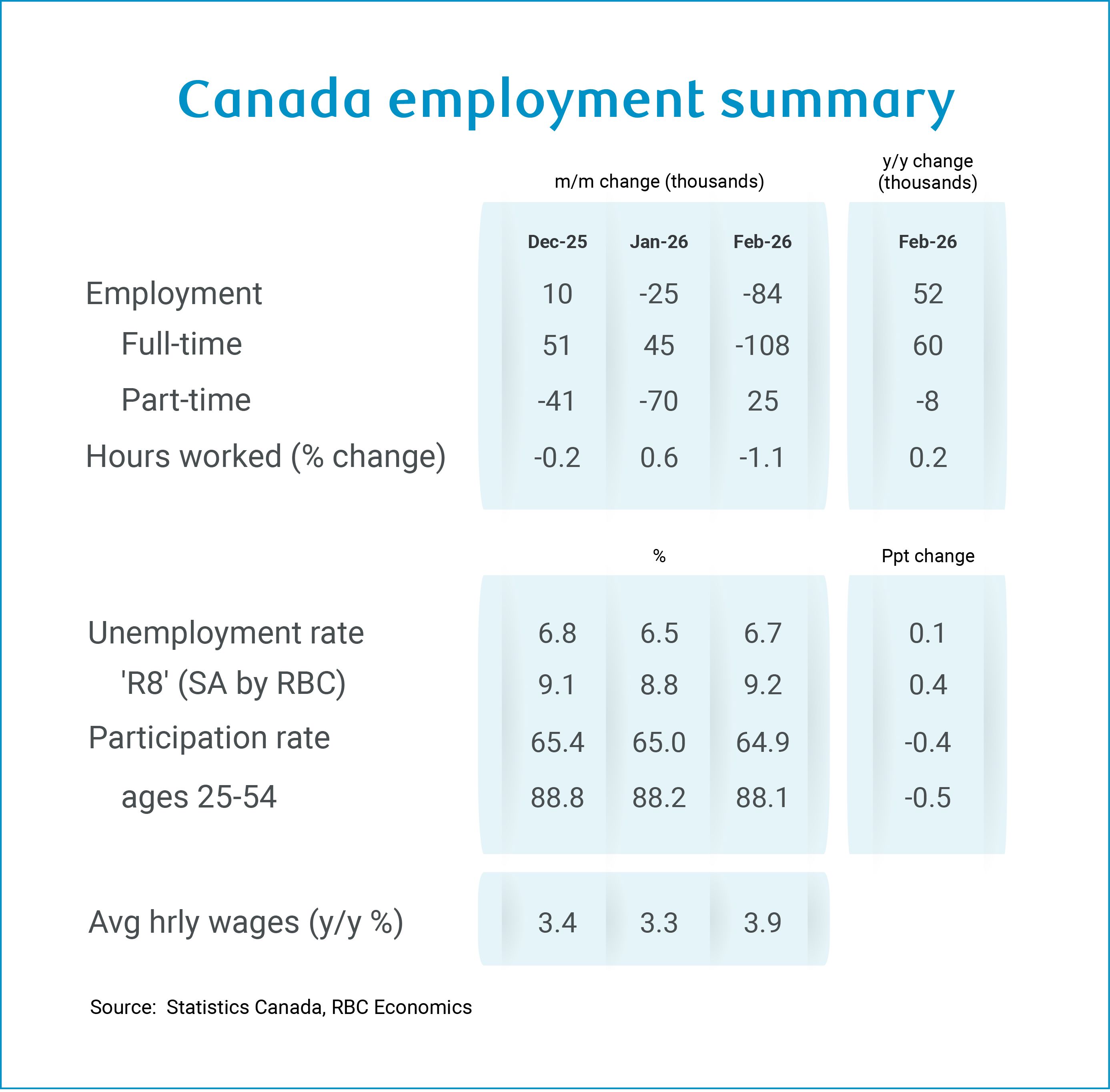
February’s Canadian labour market report was soft. Employment fell 84,000, adding to the 25,000 losses in January. The unemployment rate rose to 6.7% after dropping to 6.5% in January, and the labour force participation rate declined again, to its lowest level outside the pandemic since 1997.
Monthly employment prints are volatile, and headline job growth remains partly distorted by sharply slower population and labour force growth, driven by retirements and government curbs on the share of non-permanent residents. In January and February combined, Canada’s population grew just 12,500—well below the 103,000 increase in 2025 over the same months.
In the past, we have warned how soft employment growth could persist and mask improvements in underlying hiring demand better reflected in the unemployment rate. In February, the unemployment rate ticked higher to 6.7% but remains below the Q4 2025 average of 6.8%. Total hours worked fell 1.1% in February, leaving Q1 on average flat versus the prior quarter.
Looking ahead, the macro environment—particularly a stabilizing trade backdrop thanks to preserved CUSMA exemptions, healthy domestic consumer spending trends, and continuous monetary and fiscal support—should all support a recovery in hiring demand. We look through near-term volatility, and continue to expect gradual improvements to drive the unemployment rate lower through the remainder of the year.
The details:
-
Employment declined 84,000 (-0.4%) in February, with full-time (mostly private) employment bearing the brunt, falling 108,000 (-0.6%), while part-time work held steady.
-
Weakness was relatively broad-based across industries. Employment in wholesale and retail trade dropped 18,000 (-0.6%), with a cumulative 52,000 decline (-1.7%) since October. Other services (repair and maintenance services, personal care and laundry services, as well as religious and advocacy activities) fell 14,000 (-1.8%). Manufacturing and construction each edged down 9,200 (-0.5%) and 12,000 (-0.7%) respectively.
-
Year-over-year, manufacturing employment was down 52,000 (-2.8%), reflecting the ongoing impact of U.S. tariffs on the sector given tightly integrated Canada-U.S. production chains.
-
The unemployment rate rose 0.2 percentage points to 6.7% in February, but climbed notably higher among youth, up 1.3 percentage points to 14.1%. The participation rate fell 0.1 percentage points to 64.9%, down 0.4 percentage points year-over-year.
-
As a result of slowing population growth and falling participation rate, Canada’s labour force shrank 146,000 (-0.6%) in January and February combined. Importantly, there are little signs of an increase in discouraged workers dropping out of the labour force – the supplementary unemployment rate that add back discouraged workers is still moving in tandem with the official unemployment rate.
-
Looking at the provinces, Quebec led the decline with a 57,000 drop (-1.2%), the first significant monthly decrease since January 2022. Employment in British Columbia fell 20,000 (-0.7%), while Saskatchewan and Manitoba posted smaller declines. Ontario employment held steady but saw unemployment rise 0.3 percentage points to 7.6% as job search increased. Newfoundland and Labrador was the sole province with gains (+2,100; +0.8%).
-
Finally, wage growth in February edged up to 3.9% year-over-year. Statistics Canada highlighted progress in narrowing the gender wage gap over time, though in February women aged 25 to 54 still earned $0.88 on the dollar versus men and were more than twice as likely to work part-time, largely due to childcare responsibilities.
About the author:
Claire Fan is a Senior Economist at RBC. She focuses on macroeconomic analysis and is responsible for projecting key indicators including GDP, employment and inflation for Canada and the US.
This article is intended as general information only and is not to be relied upon as constituting legal, financial or other professional advice. The reader is solely liable for any use of the information contained in this document and Royal Bank of Canada (“RBC”) nor any of its affiliates nor any of their respective directors, officers, employees or agents shall be held responsible for any direct or indirect damages arising from the use of this document by the reader. A professional advisor should be consulted regarding your specific situation. Information presented is believed to be factual and up-to-date but we do not guarantee its accuracy and it should not be regarded as a complete analysis of the subjects discussed. All expressions of opinion reflect the judgment of the authors as of the date of publication and are subject to change. No endorsement of any third parties or their advice, opinions, information, products or services is expressly given or implied by Royal Bank of Canada or any of its affiliates.
This document may contain forward-looking statements within the meaning of certain securities laws, which are subject to RBC’s caution regarding forward-looking statements. ESG (including climate) metrics, data and other information contained on this website are or may be based on assumptions, estimates and judgements. For cautionary statements relating to the information on this website, refer to the “Caution regarding forward-looking statements” and the “Important notice regarding this document” sections in our latest climate report or sustainability report, available at: https://www.rbc.com/community-social-impact/reporting-performance/index.html. Except as required by law, none of RBC nor any of its affiliates undertake to update any information in this document.

