

 EN
EN 



Canada’s economic outlook so far in 2026 has evolved broadly in line with our cautiously optimistic view a quarter ago. The economy is not yet strong, but has remained more resilient than feared when U.S. tariff threats began escalating a year ago.
A spike in energy prices from the conflict in the Middle East will boost revenues for Canada’s oil producing regions, but threatens to add to household affordability concerns—particularly at the lower end of the income distribution.
Tariff uncertainty also remains a key risk to the outlook with potentially contentious negotiations to extend CUSMA this summer.
Add in the impact of sharp slowing in population growth to gross domestic product, plus, a more uncertain economic backdrop that keeps businesses cautious about making large new investments.
Yet, on a per-person basis, GDP growth rose for the first time in three years in 2025. And, per-worker labour market conditions have begun to improve with the unemployment rate starting to drift lower in recent months.
We remain optimistic that per-capita GDP growth will rise again in 2026. Most Canadian exports remain duty-free via the CUSMA exemption to the new Section 122 tariffs that replace the broad tariffs from 2025 struck down by the U.S. Supreme Court.
Earlier Bank of Canada interest rate cuts also continue to ease concerns about household balance sheet, and planned government spending is beginning to ramp up.
Escalating geopolitical risks could impact distribution of growth
The surge in oil prices from conflict in the Middle East will increase revenues in the Canadian and U.S. energy sectors, but raise costs (particularly gasoline prices) for most consumers.
Since both economies are net energy exporters, the net GDP impact is likely modest. However, distributional effects still pose challenges.
Higher gasoline costs will disproportionately impact lower-income households with energy prices consuming a larger share of disposable incomes—adding to already rising grocery bills. Income inequality has not widened in Canada to the extent seen in the U.S., but affordability pressures are, particularly, acute at the lower end of the income distribution.
Labour markets sending positive signals
Ultimately, the best cure for affordability challenges is stronger job markets. Canada’s has shown further signs of improvement in recent months after broadly deteriorating (on a per-worker basis) for much of the prior three years.
The interpretation of labour market statistics is being complicated by the unprecedented slowdown in Canada’s population growth. Employment growth is still expected to be historically slow in the year ahead, but largely due to a shrinking labour force sharply reducing the rate of job growth needed to keep the unemployment rate on a downward trajectory.
Importantly, the unemployment rate is less impacted by shifting population growth, and therefore, continues to provide a “cleaner” read on per-worker labour market conditions.
The main sources of labour force contraction in the year ahead are expected to be a net outflow of temporary residents and retiring workers. Both of these reduce employment and the labour force at the same time, but leave the unemployment rate essentially unchanged.
Unless the unemployment rate declines from discouraged workers leaving the labour force—this is trackable in the data and has not yet been the case—a lower unemployment rate means hiring demand is strong enough, relative to the size of the labour force, that a larger share of the population that wants a job is able to find one. That’s good news for the Canadian workforce.
Stabilizing trade helps support improvement in per-worker economy
Overall, GDP contracted in the last quarter of 2025, but underlying details showed the decline largely came from a drawdown in inventories by businesses.
Canadian businesses, consumers, and governments all spent more in Q4, and exports rose for a second straight quarter after a post U.S. tariff plunge in Q2 2025.
That improvement is not uniform across the economy though. Sectors targeted directly with U.S. tariffs over the last year have underperformed—steel product and forestry exports fell by 24% and 8%, respectively, in 2025 from a year earlier.
But, critically, most U.S. imports from Canada remain duty-free with an exemption for CUSMA compliant trade included in the new 10% Section 122 tariffs imposed by the U.S. administration to replace broad IEEPA tariffs.
A long list of broader product-specific tariff exemptions for imports from all other countries means the average effective U.S. tariff rate likely edged lower under the new tariffs, even if the rate is increased to 15% as promised by the U.S. administration.
Policy support remains in place
The BoC still has room to boost to the economy through lower interest rates if the backdrop were to weaken, or inflation to slow more than we expect. But, our cautious optimism that the economy will continue to improve means we don’t think further reductions will be needed.
That’s in part because fiscal policy support is beginning to ramp up. Government spending jumped an annualized 6% in Q4, led by a surge in spending on defence.
We continue to view government spending as a better policy lever to address the current fragmented economic backdrop than blanket interest rate cuts.
Provincial overview
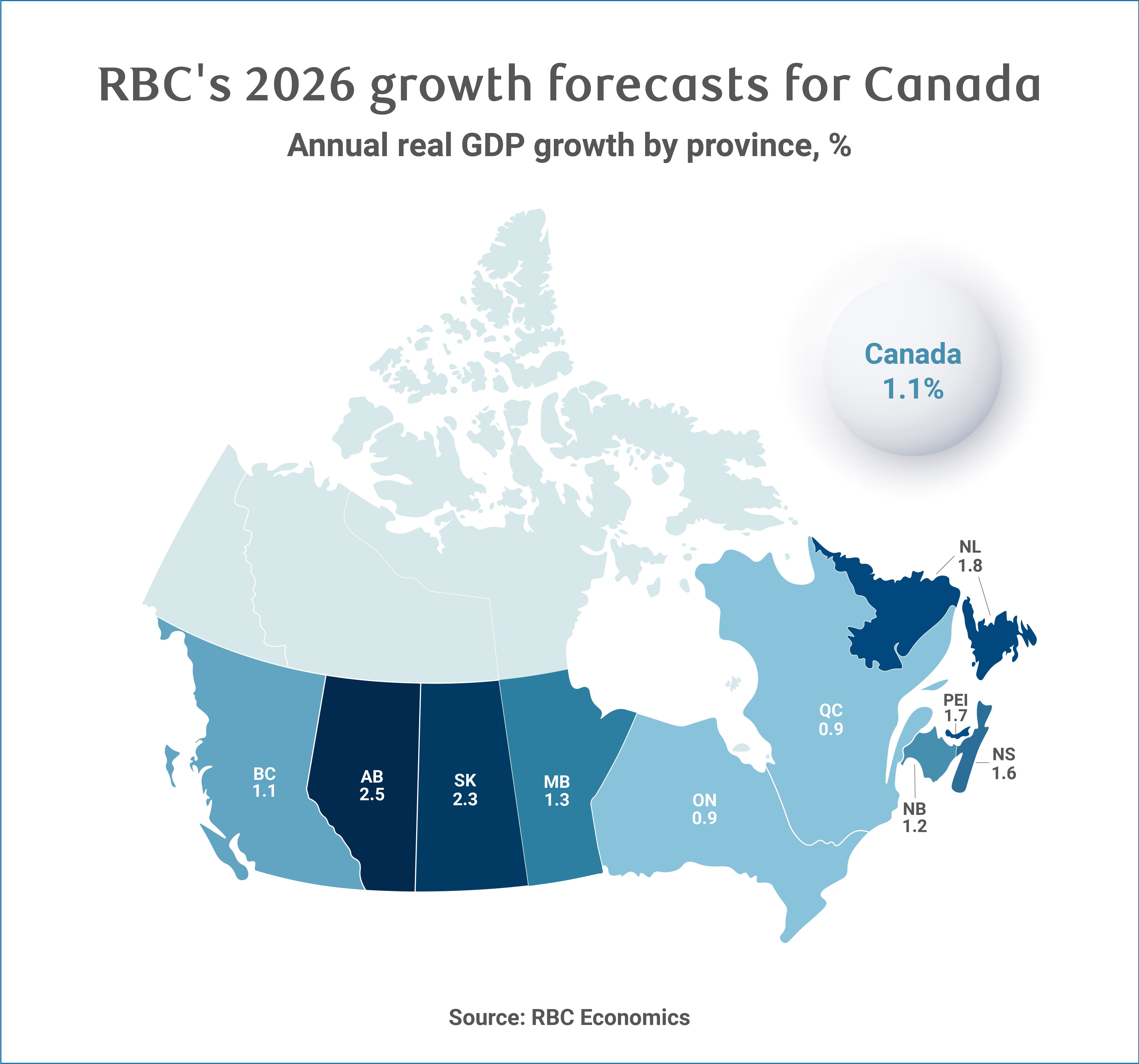
Growth headwinds persist in Quebec, Ontario and B.C. amid upsides for sectors
We continue to see all provincial economies expanding this year despite the challenging global environment. Oil producing provinces are poised to outperform, while U.S. tariffs weigh more heavily on Ontario and Quebec’s manufacturing sectors.
Canada’s immigration policy shifts pose additional risks to Ontario and British Columbia, where non-permanent residents represent a larger share of the population.
That said, three developments have prompted adjustments to our provincial growth forecast:
-
Immigration cuts have been swifter and more significant than we expected in some provinces, leading to outright annual population declines in Ontario and B.C. by the end of 2025.
-
Global oil price spikes present upside to oil-producing provinces.
-
The partial truce Canada reached with China materially reduced tariffs on canola seeds and seafood, offering relief to affected sectors.
Accordingly, we have slightly lowered our 2026 growth forecast for Ontario, Quebec—which remain at the back of our provincial growth ranking alongside B.C.
In contrast, Alberta and Saskatchewan continue to lead the rankings with both upgraded further as elevated commodity prices bolster their outlooks. Newfoundland and Labrador has also been upgraded under the same commodity tailwinds while other Atlantic provinces occupy the middle tier, gaining some relief from improved trade relations with China.
U.S. exposure weighs on outlooks for Quebec and Ontario
Soft manufacturing production is driving downward revisions to our 2026 growth forecasts for Ontario and Quebec. We now expect real GDP in both provinces to expand by 0.9%—down from 1.1%.
Both anchor Canada’s manufacturing base and are most exposed to U.S. tariffs on steel, aluminum, copper, and lumber. Negative impact has been especially visible in Quebec, where manufacturing output has been on a downtrend for almost all of 2025. This weakness has prompted us to revise Quebec’s 2025 growth forecast down to 0.8% from 1.2%.
The outlook remains challenged. Highly integrated North American supply chains mean manufacturing in both provinces will remain under pressure as trade friction persists.
Population declines in Ontario and B.C.
Population growth contracted faster than anticipated in some provinces.
We previously acknowledged the possibility of negative population growth in Ontario and B.C., but the latest figures from Statistics Canada have materially raised the likelihood of this being the case in 2026. Year-over-year population growth has already fallen negative in these provinces as of Q4 2025.
Demographic headwinds are compounding weakness in Ontario’s manufacturing sector, contributing to our 2026 real GDP downgrade to 0.9%. B.C.’s demographic drag similarly warrants a downward revision to 1.1% from 1.2%.
Oil price shock adds upside to oil producing provinces
Traffic disruptions in the Strait of Hormuz have prompted a near 30% increase to our oil price forecast for 2026 compared to our December assumptions, adding material upside to oil producing provinces of Alberta, Saskatchewan and Newfoundland and Labrador.
Alberta stands to see the largest net impact given the scale of its oil and gas production. Producers were already guiding 2026 output higher before the shock, and the province has surplus pipeline capacity on Trans Mountain and Enbridge’s systems to move incremental barrels. As such, we’ve upgraded our 2026 real GDP projection for Alberta to 2.5% from 2.3%.
We see Saskatchewan and Newfoundland and Labrador also benefiting from the commodity upside. We’ve upgraded their 2026 real GDP projections to 2.3% and 1.8% respectively, from prior forecasts of 2.1% and 1.7%.
Chinese tariff relief offers upside to Nova Scotia, Prairies
Canada’s partial trade truce with China offers some relief to heavily impacted regions.
For Nova Scotia, the agreement provides the most direct near-term benefit. Exports of farm, fishing, and intermediate food products to China fell roughly 30% in 2025, accounting for the majority of the region’s $90 million decline in these categories year-over-year.
With tariffs now suspended on critical lobster and crab products, we expect a partial recovery of those lost export volumes over the remainder of 2026. This improvement has prompted us to upgrade Nova Scotia’s 2026 real GDP projection to 1.6% from 1.5%.
Though China is an even more significant trading partner for some Prairie provinces—representing roughly 10% of total exports for Saskatchewan and 8% for Manitoba—the remaining levy on canola seed may still encourage Chinese buyers to substitute to tariff-free competitors. We see this limiting the growth benefit to the region.
Moreover, we previously assumed Canadian canola would find alternative markets given the global nature of the commodity. We maintain this expectation and are already beginning to see evidence of it as the European Union and other markets capture an increasing share of Prairie agricultural exports. Accordingly, we have made no change to growth forecasts for the Prairies, though there’s upside risk to this policy shift.
Detailed forecast tables:
Download the report
About the Authors:
Frances Donald is the Chief Economist at RBC and oversees a team of leading professionals, who deliver economic analyses and insights to inform RBC clients around the globe. Frances is a key expert on economic issues and is highly sought after by clients, government leaders, policy makers, and media in the U.S. and Canada.
Robert Hogue is an Assistant Chief Economist, responsible for providing analysis and forecasts on the Canadian housing market and provincial economies.
Nathan Janzen is an Assistant Chief Economist, leading the macroeconomic analysis group. His focus is on analysis and forecasting macroeconomic developments in Canada and the United States.
Rachel Battaglia is an Economist at RBC, providing forecasts for the Canadian provincial economies and analysing key trends in housing and consumer spending.
This article is intended as general information only and is not to be relied upon as constituting legal, financial or other professional advice. The reader is solely liable for any use of the information contained in this document and Royal Bank of Canada (“RBC”) nor any of its affiliates nor any of their respective directors, officers, employees or agents shall be held responsible for any direct or indirect damages arising from the use of this document by the reader. A professional advisor should be consulted regarding your specific situation. Information presented is believed to be factual and up-to-date but we do not guarantee its accuracy and it should not be regarded as a complete analysis of the subjects discussed. All expressions of opinion reflect the judgment of the authors as of the date of publication and are subject to change. No endorsement of any third parties or their advice, opinions, information, products or services is expressly given or implied by Royal Bank of Canada or any of its affiliates.
This document may contain forward-looking statements within the meaning of certain securities laws, which are subject to RBC’s caution regarding forward-looking statements. ESG (including climate) metrics, data and other information contained on this website are or may be based on assumptions, estimates and judgements. For cautionary statements relating to the information on this website, refer to the “Caution regarding forward-looking statements” and the “Important notice regarding this document” sections in our latest climate report or sustainability report, available at: https://www.rbc.com/community-social-impact/reporting-performance/index.html. Except as required by law, none of RBC nor any of its affiliates undertake to update any information in this document.
Get the latest forecasts and analysis from RBC Economics.
Subscribe Now
- Escalating geopolitical risks could impact distribution of growth
- Labour markets sending positive signals
- Stabilizing trade helps support improvement in per-worker economy
- Policy support remains in place
- Growth headwinds persist in Quebec, Ontario and B.C. amid upsides for sectors
- U.S. exposure weighs on outlooks for Quebec and Ontario
- Population declines in Ontario and B.C.
- Oil price shock adds upside to oil producing provinces
- Chinese tariff relief offers upside to Nova Scotia, Prairies
- Detailed forecast tables
