

 EN
EN 


The cost of food is on everyone’s minds. Mounting grocery bills weigh on household budgets, and are pushing many Canadians to make difficult decisions about how and where to spend.
This also isn’t a new problem. We’ve seen higher food prices for more than five years, and there are few signs of relief in the near term, especially as the conflict in the Middle East continues and trade policies evolve.
While high food costs aren’t a uniquely Canadian phenomenon, they live at the heart of the economic experience in Canada.
Here are the top questions we’ve have been asked about this challenging environment, and how we respond to them.
1. What’s pushing up food prices?
Food inflation has been a persistent issue for Canadians in recent years, but the drivers have varied over time.
The biggest recent spike occurred between 2021-2023 when grocery inflation soared to a new high since the early 1980s, and prices grew 11% year-over-year in late 2022.
Pandemic-related disruptions and the Russia-Ukraine war raised costs for transportation, materials, labour, and key inputs like energy and fertilizers across the food supply chain.
Businesses passed some higher costs to consumers, who were supported by stronger income growth and savings from the pandemic.
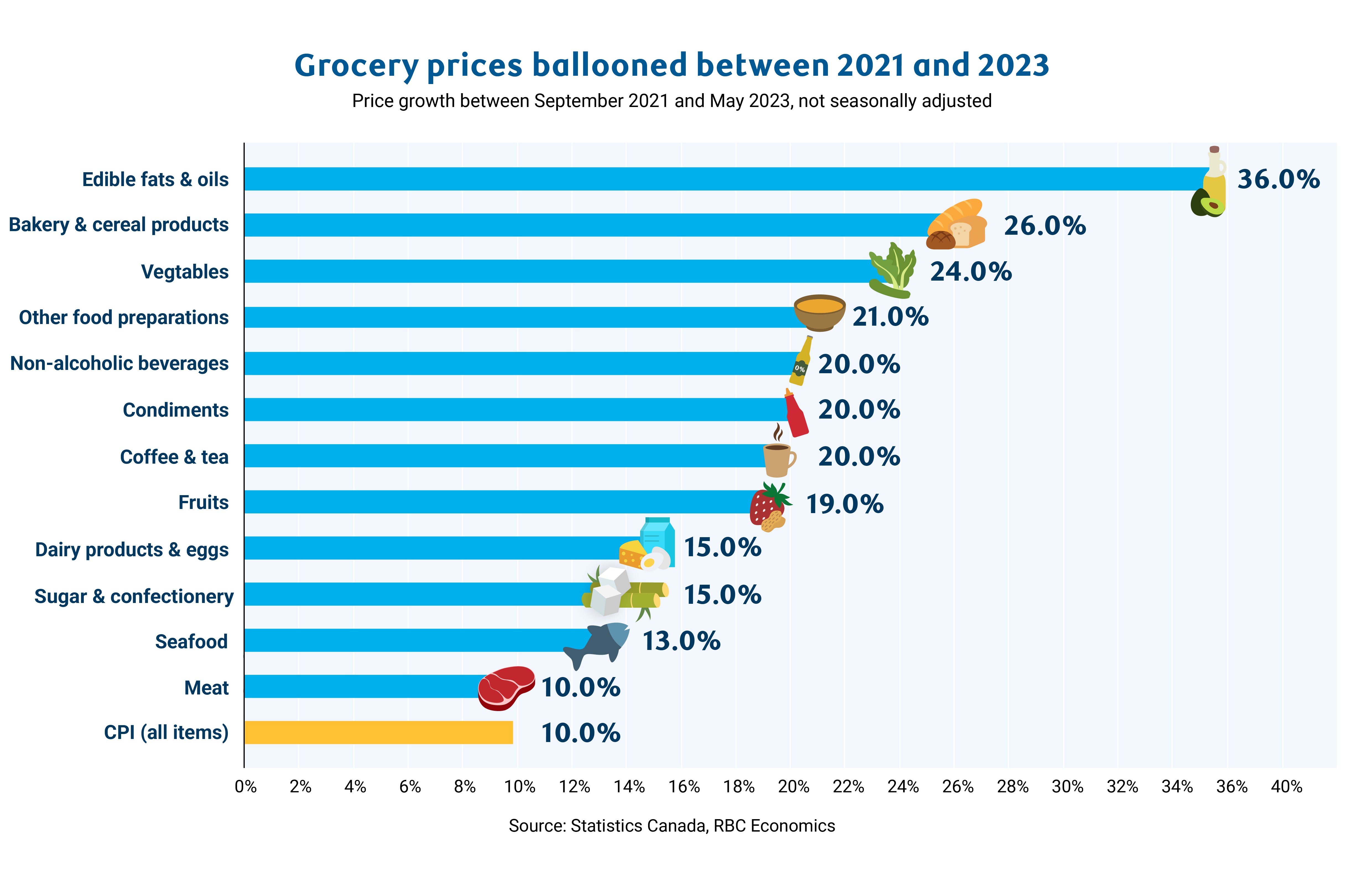
Prices of virtually all food items ballooned with the bill for a typical grocery basket rising 18% from fall 2021 to spring 2023. Growth in prices didn’t moderate to about 2% until early 2024 once supply chains stabilized.
Food prices soared above general inflation partly because grocery items are more vulnerable than many other consumption items. They are affected at nearly every production stage from raw commodity flows through processing, packaging, and distribution, along with food’s perishable nature making it more susceptible to transportation delays.
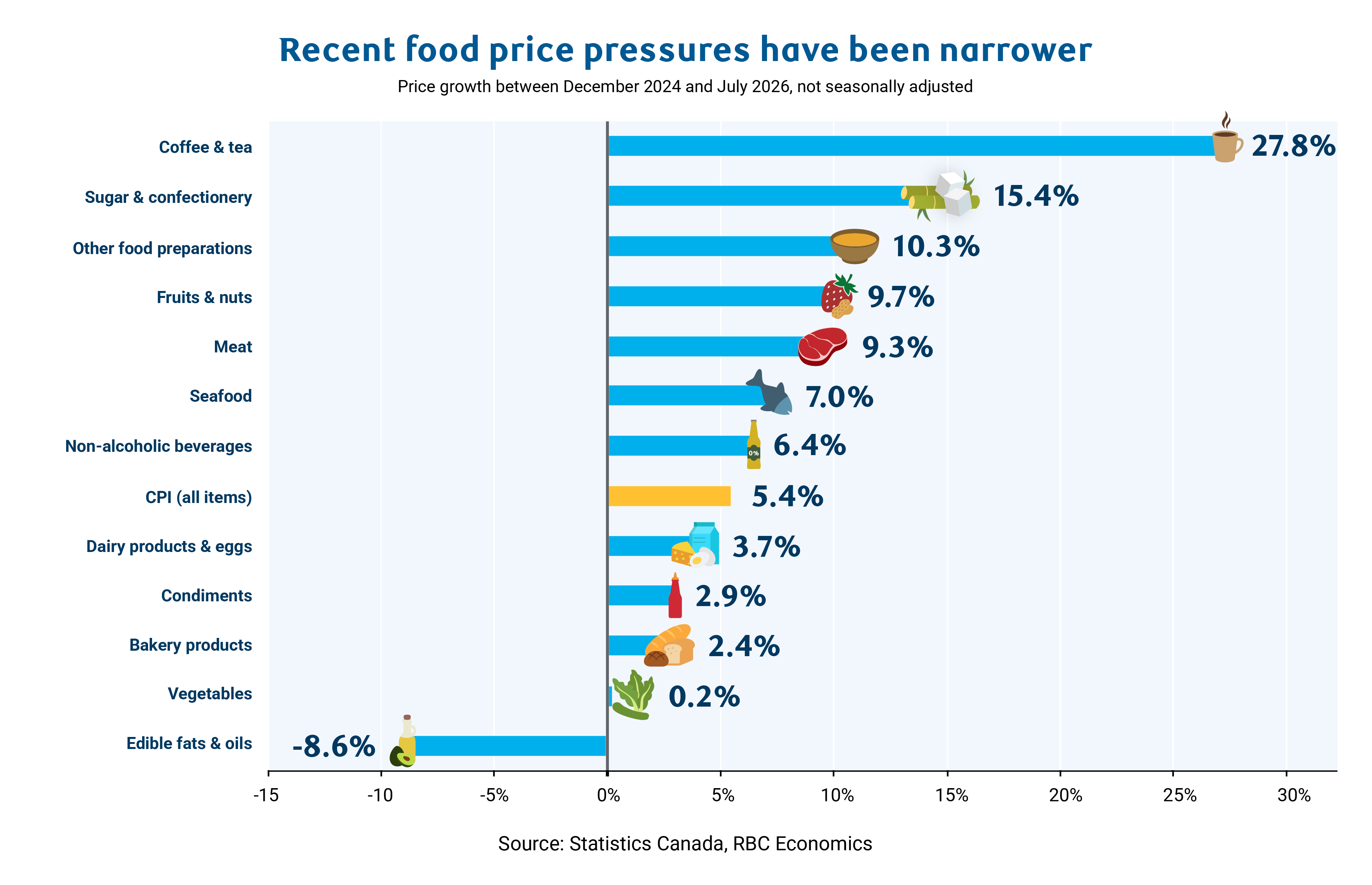
A second wave of food price pressures emerged in late 2024, driven by a narrower set of factors. Three stand out in particular:
-
Higher meat prices. Prices have risen 9% since the end of 2024, and more than 40% from December 2019 as of July 2026. Droughts and higher feed costs contributed to lower animal herd counts in recent years, constraining supply and pushing prices higher. Meat accounts for roughly 11% of the food basket, so price increases have an outsized impact on grocery inflation.
-
More expensive imported foods. Higher imported food costs, particularly processed foods, have also been a primary factor for food price growth through 2025, according to the Bank of Canada. This reflects a mix of depreciation in the Canadian dollar and higher prices for imported products like coffee due to weather-related challenges, and U.S. tariffs impacting supply.
-
Retaliatory tariffs. Canada’s retaliatory tariffs on certain U.S. food imports between March and September 2025 temporarily boosted food prices, but those pressures eased with a relatively rapid run-down of price increases after measures were removed.
2. How does Canadian food inflation compare to other countries?
Canadians haven’t been alone in experiencing heavy food inflation since the pandemic—it’s happened around the world due to the global nature of supply chain shocks.
The United Nations nominal Food Price Index rose more than 30% since the end of 2019.
Similarly, among peer countries, food costs have risen 33% on average across the G7 over the same period, with Germany and the United Kingdom recording the largest increases (+38%). Canada ranks roughly in the middle of the pack.
3. Is grocery inflation more severe in different parts of Canada?
Not really. Higher grocery costs have been a challenge of similar magnitude across all provinces.
That’s because one: Local grocery prices are shaped by many of the same global and national factors. And, two: Large national suppliers and distributors as well as big retailers operate across multiple regions, meaning changes in their costs and prices can be reflected in grocery prices across broad regions in much the same way.
Some price variation exists due to local transportation costs, provincial regulations or other regional factors, but the structure of Canada’s food supply chain tends to keep grocery inflation similar coast to coast.
4. How does the Middle East conflict impact Canadian food prices?
Closures in the Strait of Hormuz have raised concerns that higher energy and fertilizer prices could trigger another spike in food inflation.
So far, the direct impact in Canada appears limited. Higher fuel prices increased production and transport costs, but grocery inflation has trended lower since the conflict erupted in late February.
Still, a prolonged escalation in fuel and fertilizer prices could eventually feed through to consumer prices. These shocks typically flow through the food supply chain with a lag, taking between six to nine months to be fully reflected in grocery prices, according to the BoC.
Food prices are shaped by supply and demand. Whether higher productions costs are passed on to consumers depends on factors such as competitive conditions, consumer demand, and firms’ pricing power.
Many producers are global price takers and have limited pricing power, making it difficult to fully pass higher costs to distributors, retailers or consumers. Competition at each link of the supply chain exerts pressure on sellers to absorb some or all cost increases, compressing profit margins or pushing for savings on other costs in the process.
Consumer pushback can take various forms including cutting back purchases and switching to alternative products, brands and stores. When households resist price increases, producers and retailers face greater constraints on pricing.
So, while costs across the food supply chain may rise, the final impact on household grocery bills may not be a one-for-one passthrough.
5. Where are grocery prices headed?
We expect Canadian grocery prices will continue rising at a rate likely exceeding overall inflation as existing pressures work through the supply chain over the near term.
Pressure on meat prices is likely to persist. Cattle herds showed early recovery signs in 2026, but rebuilding supply takes several years, continuing to constrain availability. A weaker Canadian dollar also makes imports more expensive.
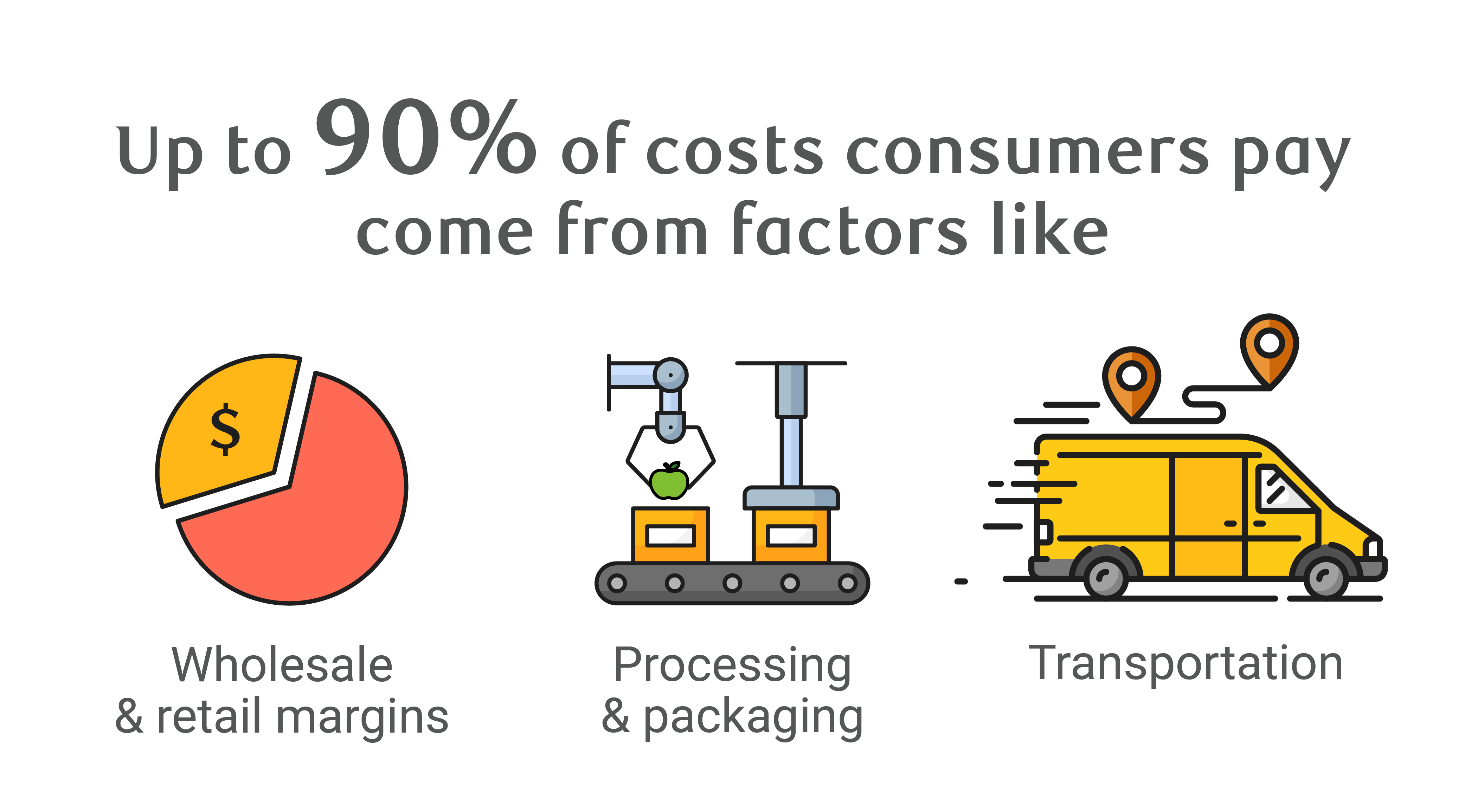
Some food commodity prices could ease depending on crop conditions or other factors. But, we expect little let up in pressure on other components of the food supply chain like processing, labour, packaging, wholesale and retail margins, and transportation. These costs make up to 90% of consumers’ food costs and are often stickier.
Our outlook has grocery inflation moderating closer to headline inflation next year, but this hinges on assumptions that key input prices like oil trend lower, there are no major trade-related supply chain disruptions, and existing industry-specific supply challenges continue to ease.
Longer term, several key risks could keep food costs running hot:
-
Climate-related disruptions: Droughts, wildfires, floods, and other extreme weather events are becoming an increasingly persistent source of pressure on the global food supply chain, contributing to rising costs and lower yields.
-
Protectionism: Canada could be drawn into imposing barriers (tariffs or quotas) on imported food products that may lead to more pressure on prices. Importantly, even protectionist trade measures outside Canada—in the U.S., for example—could impact domestic food costs through inflationary effects along global or continental supply chains. For example:
-
Canada’s retaliatory measures in response to U.S. section 338 tariffs will mechanically impact the import cost of some foods (particularly seafood products) – although Canadian importers will almost certainly look for alternative markets to avoid import costs.
-
U.S. tariffs on imported tomatoes raised tomato prices in Canada. Statistics Canada reported that tomato prices rose 45% year-over-year in May, partly due to reduced planted acreage in Mexico after U.S. tariffs were implemented.
-
-
Unintended policy impacts: Policies designed to address environmental, labour, and health objectives such as packaging and recycling standards, and carbon pricing among others could unintentionally increase food production and distribution costs.
6. Who’s impacted the most from high food prices?
Rising grocery bills are a source of frustration for all Canadian households, though the impact varies significantly by income.
For the average household, disposable income growth has generally outpaced the increase in food spending. Average annual spending on food and non-alcoholic beverages rose from just under $7,400 in 2019 to around $9,600 in 2025—roughly $180 more per month. Over the same period, average household disposable income increased roughly $23,000, or roughly $1,900 a month.
However, food costs are a much greater burden for lowest-income Canadian households with food and non-alcoholic beverage spending accounting for nearly one-quarter of their disposable income1. Average disposable income growth for households in the lowest income quintile has also been lower, up $7,300 between 2019 and 2025.
With shelter and transportation costs also rising roughly 30% on average since 20192, lower-income households have less room to absorb rising food costs.
Higher food costs have forced many households to make difficult adjustments, including altering their diets, trading down to lower-cost options, and buying from discount retailers like warehouse clubs, supercenters, and dollar stores to stretch budgets.
But for a growing number of Canadians, these adjustments aren’t sufficient. Food bank visits have risen more than 99% between 2019 and 2025, partly reflecting the growing strain higher food costs have placed on vulnerable households.
Salim Zanzana is an economist at RBC. He focuses on emerging macroeconomic issues, ranging from trends in the labour market to shifts in the longer-term structural growth of Canada and other global economies.
This article is intended as general information only and is not to be relied upon as constituting legal, financial or other professional advice. The reader is solely liable for any use of the information contained in this document and Royal Bank of Canada (“RBC”) nor any of its affiliates nor any of their respective directors, officers, employees or agents shall be held responsible for any direct or indirect damages arising from the use of this document by the reader. A professional advisor should be consulted regarding your specific situation. Information presented is believed to be factual and up-to-date but we do not guarantee its accuracy and it should not be regarded as a complete analysis of the subjects discussed. All expressions of opinion reflect the judgment of the authors as of the date of publication and are subject to change. No endorsement of any third parties or their advice, opinions, information, products or services is expressly given or implied by Royal Bank of Canada or any of its affiliates.
This document may contain forward-looking statements within the meaning of certain securities laws, which are subject to RBC’s caution regarding forward-looking statements. ESG (including climate) metrics, data and other information contained on this website are or may be based on assumptions, estimates and judgements. For cautionary statements relating to the information on this website, refer to the “Caution regarding forward-looking statements” and the “Important notice regarding this document” sections in our latest climate report or sustainability report, available at: https://www.rbc.com/community-social-impact/reporting-performance/index.html. Except as required by law, none of RBC nor any of its affiliates undertake to update any information in this document.
Get the latest forecasts and analysis from RBC Economics.
Subscribe Now
- 1. What’s pushing up food prices?
- 2. How does Canadian food inflation compare to other countries?
- 3. Is grocery inflation more severe in different parts of Canada?
- 4. How does the Middle East conflict impact Canadian food prices?
- 5. Where are grocery prices headed?
- 6. Who’s impacted the most from high food prices?
