

 EN
EN 

➔ Stick to net zero by 2050 or abandon it?
➔ Some land sectors have a new emissions standard
➔ Canada makes a big nuclear push in Europe
The signals
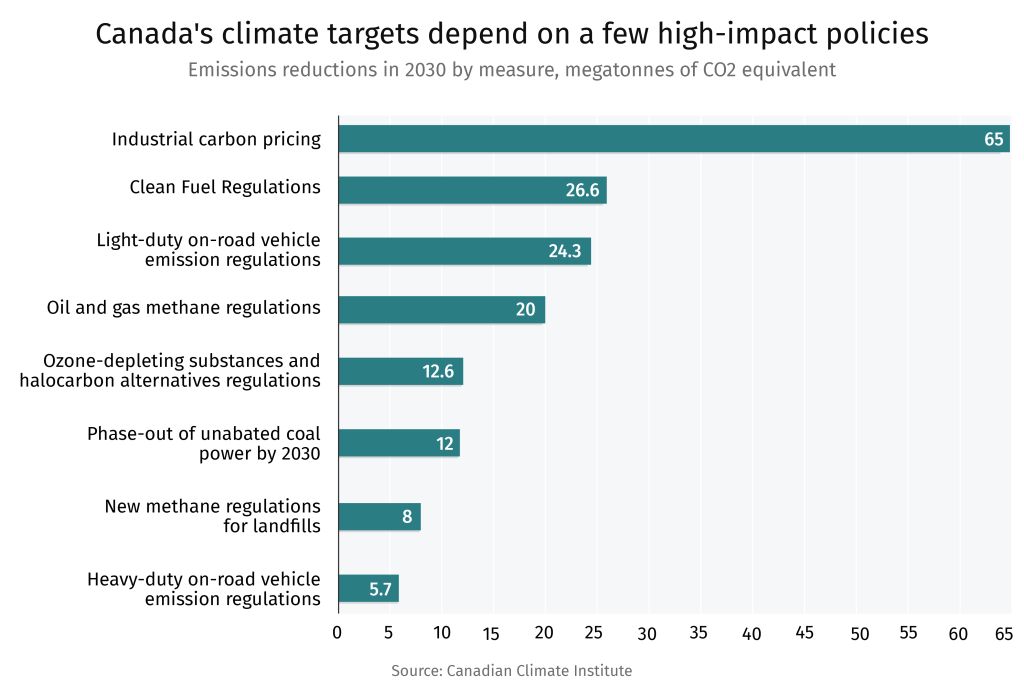
Could April 1 reset Canada’s off-course climate trajectory? The Canadian Climate Institute’s latest report (which notes that Canada’s climate targets are “off course”), suggests that strengthening measures such as industrial carbon pricing and oil and gas methane rules is critical to coming close to the targets. Both measures are part of the MoU that Ottawa and Alberta agreed to hammer out by April 1. Together, these two policies could deliver an emissions-busting punch (see chart).
Should the world give up on net zero by 2050? U.S. Energy Secretary Chris Wright thinks so. He recently chastised the International Energy Agency (IEA) for its “destructive illusion” of the 2050 goal. Amid this friction, energy ministers at an IEA summit in Paris last week failed to agree on climate objectives. It’s true that the world’s struggling to hit its net-zero targets, the UN projects, as nations from Canada to Germany retreat from some of their more ambitious climate policies. But few are looking to cast aside net zero just yet. France and other European nations pushed back during the summit, noting that electrification remains a cornerstone of the bloc’s economic policy. Meanwhile, Canada is expected to unveil its Climate Competitiveness Strategy, and China has already emerged as the world’s first “electro-state.”
China has galloped ahead of competitors with a new electric work horse of the ocean. Fittingly, in the new Year of the Horse, China debuted ocean-going Ning Yuan Dian Kun, featuring a battery capacity equivalent to 380 Tesla Model 3s. The test launch comes as the international Maritime Organization dithers on solving ocean pollution—technology, as it so often does, is leading policy here. Crucially, the batteriescan be shore-charged and swapped like cargo container to ensure its 740 twenty-foot equivalent (TEU) load can sail further. It’s a critical breakthrough: half the world’s container fleet is under 3,000 TEUs (twenty-foot equivalents) and these vessels are considered the ocean’s true work horses. An emissions dent in that space could make a real splash.
From lab to land: Can the new emissions standard deliver?
– By Lisa Ashton, Interim Head, Climate Action Action Institute
The first international standard for accounting for land-based sectors’ greenhouse gas (GHG) emissions is a true test of taking science from the lab to the field—and of patience.Land-based sectors, including agriculture and forestry, finally have an international standard for accounting, reporting and tracking GHG emissions.
The GHG Protocol’s Land Sector and Removals Guidance (LSRG) is intended to standardize GHG inventory accounting across companies with land-based GHG emissions allowing for consistent disclosures, which is necessary to boost their credibility with investors and regulators around claims like farmers increasing soil carbon sequestration and tree planting that are at risk of miscalculating their real impacts given the complexity of tracking GHG sources and sinks in natural systems.
It was a long time coming, taking more than five years of debates, revisions—and even a period of derailment—to land the GHG Protocol.
Why did it take so long? Simply put, it was due to tensions between climate accounting purists and industry trying to agree on a practical standard.
The sticking points:
-
Not knowing who your farmer is: Agri-food supply chains are geographically dispersed and cover large swaths of land to feed a growing population, challenging companies pursuing perfection in tracking changes in GHG emissions and soil carbon removals happening on the farms from which the companies are sourcing from.
-
Counting GHG emissions when land use changed: Repurposing land from, say grassland to cropland, has GHG emissions and soil carbon change implications that could alter a company’s GHG emissions inventory. Determining which measurement technologies, like remote sensing, are acceptable for tracking these changes and how to report net impacts has been a source of confusion.
-
Accounting, measuring and tracking soil carbon: GHG changes in natural ecosystems like agricultural soils is deeply complex and datasets take years to establish. The right approach that allows companies to track soil carbon changes without becoming an exhaustive, expensive academic exercise is still up for debate as measurement approaches are still being refined and many factors influence soil carbon changes.
Should Canadian businesses align with the GHG Protocol’s Land Sector and Removals Guidance?
Companies that source agriculture and forestry products are now faced with this challenging question as the decision influences their business far beyond their climate goals–from supply chain logistics and relationships to their sourcing regions and ingredient choices. The decision is even more complicated because the standard took longer than expected to be developed and missed a window when influential companies were creating their GHG accounting frameworks and developing incentive programs for farmers and foresters to deliver on-the-ground climate action in the early 2020s.
A thousand cuts
– By Stephanie Shewchuk, Housing Policy Lead
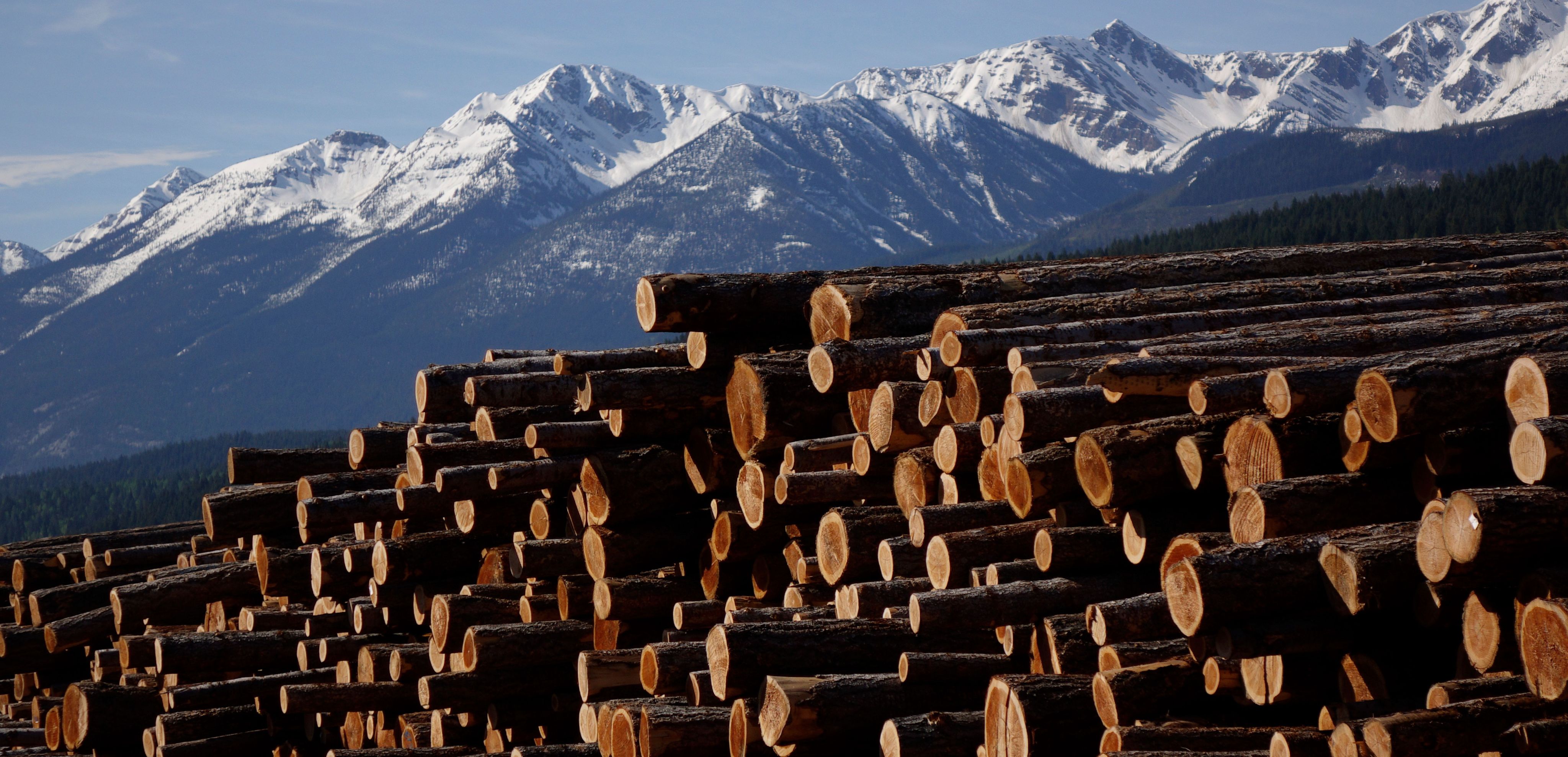
Canada’s stumbling forestry sector could hurt the country’s ability to develop homegrown sustainable solutions for packaging, building and retail sectors. The Forest Products Association of Canada called 2025 “one of the most challenging years in recent memory.” In addition, wildfires—paradoxically exacerbated by climate change—laid to waste 886,300 hectares in 2025 alone, which is well above the province’s 10-year average.
Ottawa and the B.C. governments have both acknowledged the depth of the province’s forestry crisis through targeted budget measures, but there may be room for more: new investment tax credits to encourage biomass use, improved procurement guidelines to support greater uptake of Canadian wood in government projects, and for the newly launched Build Canada Homes agency to prioritize Canadian lumber in federal construction products. It could prove to be a significant climate move as buildings currently make up 18% of Canada’s greenhouse gas emissions.
These approaches will support an industry in crisis today but its future will hinge on three key factors: market recovery, positioning sustainable wood products as a strategic asset in the transition to a low-carbon economy, and how effectively it can adapt to climate-driven wildfire risk.
Climate conversations
-
Canada’s Energy Minister Tim Hodgson was in Warsaw recently pushing the CANDU nuclear technology for Poland’s next suite of nuclear reactors. “We have what Poland wants,” Hodgson said as he drums up more interest for the baseload power source. Canada is also reportedly eyeing a uranium deal with India during Prime Minister Mark Carney’s visit to New Delhi this week.
-
Canada’s new auto strategy promises a new path for the sector, but Climate Action Institute Economist Farhad Panahov says the road ahead will be driven by three key themes.
-
Geothermal—the heat beneath our feet—could be a transformative baseload power source. CAI’s Clean Energy Lead Vivan Sorab digs into the opportunity.
-
Who came up with the 1.5 Celsius global target anyway? Climate scientist Katharine Hayhoe explains how science and politics converged on a number that defines global ambition.
-
Any credible scenario for Canada’s electricity future must consider wind and solar supplying majority of new demand growth. “The question is not whether these sources will expand, but whether Canada will begin to treat solar power as a core strategic asset or continue to regard it as marginal,” writes Peter Nicholson, Chair, Canadian Climate Institute, in an essay.
-
“Energy is not an end in itself; what people want is hot showers and cold beers.” Micheal Liebreich and others believe policymakers will have better success if they count energy from the consumer’s perspective.
-
Pollution poses a bigger threat to India’s economy than trade tariffs, IMF chief economist Gita Gopinath warned recently. Here’s why one of the world’s largest economies is being choked.
Curated by Yadullah Hussain, Managing Editor, RBC Climate Action Institute.
Climate Crunch would not be possible without John Stackhouse, Jordan Brennan, John Intini, Farhad Panahov, Lisa Ashton, Shaz Merwat, Vivan Sorab, Caprice Biasoni, Lavanya Kaleeswaran and Joelle Schonberg .
Have a comment, commendation, or umm, criticism? Write to me here (yadullahhussain@rbc.com)
Climate Crunch Newsletter
This article is intended as general information only and is not to be relied upon as constituting legal, financial or other professional advice. The reader is solely liable for any use of the information contained in this document and Royal Bank of Canada (“RBC”) nor any of its affiliates nor any of their respective directors, officers, employees or agents shall be held responsible for any direct or indirect damages arising from the use of this document by the reader. A professional advisor should be consulted regarding your specific situation. Information presented is believed to be factual and up-to-date but we do not guarantee its accuracy and it should not be regarded as a complete analysis of the subjects discussed. All expressions of opinion reflect the judgment of the authors as of the date of publication and are subject to change. No endorsement of any third parties or their advice, opinions, information, products or services is expressly given or implied by Royal Bank of Canada or any of its affiliates.
This document may contain forward-looking statements within the meaning of certain securities laws, which are subject to RBC’s caution regarding forward-looking statements. ESG (including climate) metrics, data and other information contained on this website are or may be based on assumptions, estimates and judgements. For cautionary statements relating to the information on this website, refer to the “Caution regarding forward-looking statements” and the “Important notice regarding this document” sections in our latest climate report or sustainability report, available at: https://www.rbc.com/our-impact/sustainability-reporting/index.html. Except as required by law, none of RBC nor any of its affiliates undertake to update any information in this document.