

 EN
EN 

➔ Winter Olympics: running out of slope?
➔ Chinese EVs: low emissions, high drama
➔ Notes from Davos: The looming fight for grid power
Hot takes
➔ Only four locations would be able to host Winter Olympics by 2050 if current climate trajectory persists. The 2026 Winter Olympicorganizers are powering venues in Milan and Cortina d’Ampezzo with certified renewable electricity and sustainable sourcing, even as the February event is expected to emit around 930,000 tons of CO2. More crucially, snow management remain an issue as the Alpine region has seen a 25% drop in snowfall since 1980. It’s a problem that’s unlikely to go away: a new University of Waterloo study shows that of the 92 potential Winter Olympic host locations, only 52 would remain-climate reliable for the winter edition and 22 for the Paralympics in the future, if current climate policies persist. Without snowmaking technology—only four will reliably be able to host the event by 2050.
➔ China-made EVs could lower Canadian transport emissions—but at a political cost. The decision to allow Chinese EVs in return for Canadian agri-food access comes as Canadian federal and provincial governments have rolled back subsidies. EVs have done the heavy work of lowering Canda’s emissions over the past six years, with transport emissions down 6% compared to 2019, according to Climate Action 2026 report. Cheaper EVs could help maintain the momentum. But rumblings from Washington suggest the deal could complicate CUSMA negotiations.
➔ Canada’s agri-food processors are not waiting for policy perfection. In Atlantic Canada, processors are investing to extract more output from less energy and water, while farmers see emission cuts as a way to boost productivity, observed our Interim Head Lisa Ashton, during her trip to Prince Edward Island to share Climate Action 2026 report’s findings. PEI farmers are leading the way with their 2040 Pathways plan to reduce GHG emissions, accelerate on-farm climate adaptation actions, and boost economic outputs and trade by 2040. It’s an example of how farmers can organize and design a pragmatic plan to drive environmental and economic outcomes for their businesses.
Warming up to the north
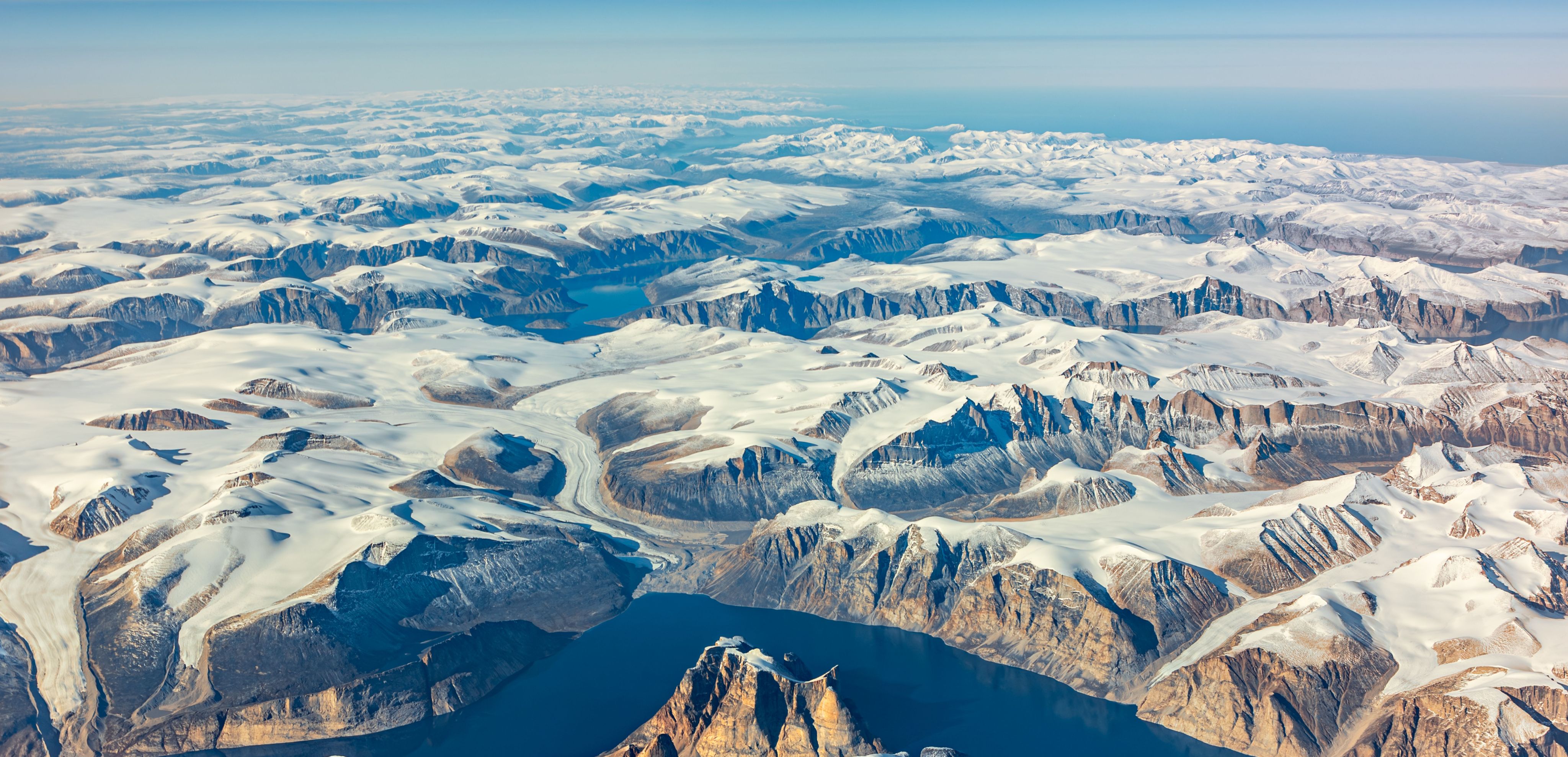
Nowhere has climate change, resources and geopolitics collided more quickly. U.S. interest in the Arctic island of Greenland and Russian ships patrolling the region should compel Canada to cover—and bolster—its northern bases.
Climate change is the trigger for interest in the Arctic: Washington’s sudden interest in the “piece of ice” is sparked by a climate-change induced thaw that’s opening up the region to activity— benign or otherwise. The Arctic has just ended a year of record heat and shrunken sea ice as northern latitudes become rainier and less ice-bound due to the climate crisis, scientists say. That’s also accelerated a race for control by the U.S., Russia and “near-Arctic state” China. Canada needs to catch up.
While the Arctic’s location is strategic—so are its resources. The northern region contains significant fossil fuel reserves—an estimated 13% (90 billion barrels) of the world’s undiscovered conventional oil resources and 30% of its undiscovered conventional natural gas resources. In addition it also contains rare earths, nickel, cobalt, graphite and other elements that are vital for energy transition. While it’s unclear whether the region can meaningfully meet rising global energy demand at cost and at scale any time soon, the faster the region warms, the more attractive and accessible its resources would become.
Sovereignty and strategic competition: Canada’s Arctic sovereignty is shaped by competing interpretations under the United Nations Convention on the Law of the Sea, with Canada ratifying the treaty and defining extended continental shelf claims, while the United States has signed but not ratified it.
The North American Aerospace Defense Command (NORAD) detected and tracked Russian military aircraft operating in international airspace near Alaska in 2025, while China and Russia launched a joint patrol in 2024.
Canada’s calculus: Canada makes up 28% of the Arctic land area, second only to Russia’s 67% Arctic landmass. However, the Canadian Arctic accounts for just under 2% of the Arctic region’s economy, and negligible population.
The Major Project Office’s focus on developing Churchill Port at the mouth of Hudson Bay, the Red Chris Mine Expansion and the North Coast Transmissions Line and Ksi Lisim LNG, along with a separate $1-billion investment to strengthen the North’s trade and transportation infrastructure, suggests Canada is joining the Arctic race. Getting these proposals to completion would be the ultimate test. The projects—and more defence spending—will be vital to allay U.S. concerns about the vulnerability of the Canadian Arctic. But they also need to be respectful of climate and Indigenous issues.
Notes from Davos: The looming fight for grid power
By John Stackhouse, Senior Vice President, Office of the CEO, RBC
John was at Davos last week to make sense of the new world order and a global economy that’s resembling more a bartering and babbling souk than a tightly wired marketplace. Among his observations, two directly impact energy and climate: the competing priorities for grid power, and the continued rise of renewable energy—against all odds. Read the excerpts:
A/C or AI: It’s gridlock
The next energy crisis won’t be fuelled by oil or gas; it will be strained by the world’s faltering electricity grids. Electricity demand globally is rising three times faster than total energy demand, driven by air conditioning and electric vehicles, as well as data centres.
While 90% of Americans have access to air conditioning, the number is 20% in India, 18% in Indonesia and 5% in Nigeria—each with some of the world’s fastest-growing cities. Add to that the growing demand for EVs, which now account for a quarter of global car sales, up from 5% in just five years.
Fatih Birol, head of the International Energy Agency, said the world will need 10,000 terra-watts of new electricity in the next decade, which is the equivalent of adding another U.S., Canada, Europe and Japan. Without any innovation breakthroughs, that would require 70% more copper, and a vast expansion of steel and critical minerals processing.
A renewable lease on energy: There were two vastly telling moments in Davos’s main Congress Hall, one speaking to scarcity, the other to abundance. Donald Trump went off script to lambaste renewable energy, especially wind which he said was for “losers.”
A day later, Elon Musk used the same stage to profess a glorious future for renewables, especially solar which he said could power all of America if he had his way. Just give him a parcel of land, 160×160 kilometres, and tariff-free solar panels! Away from North America, renewables are still the driver of energy growth and have shifted from a “transition” source to a default for new supply in many markets. Europe reached roughly 50% renewable generation in 2024.
In other fast-growing markets, renewables are increasingly seen as energy additions, not just replacements for fossil fuels. Falling battery costs (solar is down roughly 80% in India) and longer lifetimes (30–35 years) have helped shift economics from a simple cost per unit to a cost per lifecycle.
Read John’s full Davos commentary here.
The Institute in Action
-
Interim Head Lisa Ashton recently hosted a roundtable in Edmonton with industry leaders and investors on growth capital in Canada’s agri-food sector to dive into the investment challenges that were highlighted in The Next Generation of Growth.
-
Energy Lead Shaz Merwat moderated a panel at the BC Natural Resources Forum at Prince George, focused on Canada’s future gas and LNG competitiveness with senior executives from industry, Indigenous organizations.
Curated by Yadullah Hussain, Managing Editor, RBC Climate Action Institute.
Climate Crunch would not be possible without John Stackhouse, Jordan Brennan, John Intini, Farhad Panahov, Lisa Ashton, Shaz Merwat, Vivan Sorab, Caprice Biasoni, Lavanya Kaleeswaran and Joelle Schonberg .
Have a comment, commendation, or umm, criticism? Write to me here (yadullahhussain@rbc.com)
Climate Crunch Newsletter
This article is intended as general information only and is not to be relied upon as constituting legal, financial or other professional advice. The reader is solely liable for any use of the information contained in this document and Royal Bank of Canada (“RBC”) nor any of its affiliates nor any of their respective directors, officers, employees or agents shall be held responsible for any direct or indirect damages arising from the use of this document by the reader. A professional advisor should be consulted regarding your specific situation. Information presented is believed to be factual and up-to-date but we do not guarantee its accuracy and it should not be regarded as a complete analysis of the subjects discussed. All expressions of opinion reflect the judgment of the authors as of the date of publication and are subject to change. No endorsement of any third parties or their advice, opinions, information, products or services is expressly given or implied by Royal Bank of Canada or any of its affiliates.
This document may contain forward-looking statements within the meaning of certain securities laws, which are subject to RBC’s caution regarding forward-looking statements. ESG (including climate) metrics, data and other information contained on this website are or may be based on assumptions, estimates and judgements. For cautionary statements relating to the information on this website, refer to the “Caution regarding forward-looking statements” and the “Important notice regarding this document” sections in our latest climate report or sustainability report, available at: https://www.rbc.com/our-impact/sustainability-reporting/index.html. Except as required by law, none of RBC nor any of its affiliates undertake to update any information in this document.