Enabling Transformation: Bold ideas for change
The path forward will take an urgent and coordinated effort from governments, postsecondary institutions and industry. The world is not standing still. Competitor nations are racing ahead in space exploration and AI adoption, while also investing in skills and infrastructure. Canada has the tools to compete—and lead—but only if we align our systems to meet this moment with urgency and ambition. Summit participants surfaced the following recommendations for governments, postsecondary and industry to take immediate action on.
Federal Government
Leverage the AI strategy for skills: Canada’s new AI strategy should have guidance for postsecondary that supports their modernization, e.g., explicit advice that helps institutions efficiently and effectively develop necessary AI skills (including an understanding of risks and when not to leverage AI) among staff and students, across disciplines.
Build Defence and Energy Workforce Alliances: Canada plans to launch up to five Workforce Alliances “to tackle urgent labour market challenges, drive growth and advance industrial strategies.”12 These should include alliances in defence and energy.
Capitalize on global strength in wildfire management: Use a portion of new defence spending to grow earth observation capabilities, AI-enabled disaster response and drone technologies for wildfire management.
Empower the Defence Investment Agency: This newly announced agency should have the mandate to streamline goals and operational requirements across the Department of National Defence, the Department of Public Works, Public Services and Procurement Canada and other departments, as applicable.
Modernize research and innovation funding: Funding criteria should focus more on outcomes and less on process.
-
Consider a new research and innovation agency, like the Defence Investment Agency, to review and coordinate “tri-agency” funding and other relevant programs–ensuring a balance of funding directed to strategic priorities, and between inquiry–and mission-driven research. Such an agency could lead or support additional changes like:
-
Embracing a model like DARPA with BOREALIS: fund high-risk, high-reward projects, free from political constraints and academic processes.
-
Reforming the Scientific Research & Experimental Development (SR&ED) tax credit (building on reforms made in 2024) to incentivize commercialization.
-
Revamping and expanding national sandboxes,13 creating more opportunities for collaborations between industry, military, universities and colleges, focused on rapid prototyping and testing new defence and space capabilities.
-
Ensuring any new funding commitments are leveraged strategically. For example, at the summit, the federal government shared plans to fund additional research chairs to attract top American academics to Canada. Funding should be tied to strategic priorities and focus on attracting talent with experience driving mission-driven research projects. New chairs should be expected to help build capacity and act as champions for change in Canadian universities.
Backstop training for major projects: Coordinate with industry and relevant provincial governments to provide immediate financial support for training required to advance major energy projects.
Incentivize talent recruitment and retention: Offer tax credits for global talent needed to fill urgent skill shortages (i.e. energy project managers), and to retain exceptional Canadian graduates (i.e. in technology fields).
Stabilize annual international student caps: Outline realistic, stable international student targets that enable appropriate population inflows and longer-term institutional planning.
Prioritize Canadian technology: Commit to using Canadian technology, including AI and space-based technologies, unless no domestic supplier offers an appropriate product or service. Prioritize Canadian technology in all future procurements and seek to be an anchor customer for promising Canadian start-ups.
Provincial Governments
Protect postsecondary systems: Increase domestic per-student funding (potentially tied to performance criteria or outcomes) in line with inflation. And/or offer more flexibility for institutions to set tuition, ensuring access is protected with robust government student assistance systems and institutional set-aside programs (that reserve a portion of tuition revenue for financial aid).
Offer strategic direction: Outline modernized expectations for transferable skill development.14 Institutions should develop AI literacy skills and collaboration skills, for example, across disciplines.
Backstop training for major projects: Coordinate with industry and the federal government to provide immediate financial support for training required to advance major energy projects.
Facilitate work-integrated learning partnerships: Consider replicating the U.K.’s Knowledge Transfer Partnerships, a granting program co-funded by industry partners that pairs recent grads with business or community organizations to solve innovation challenges.
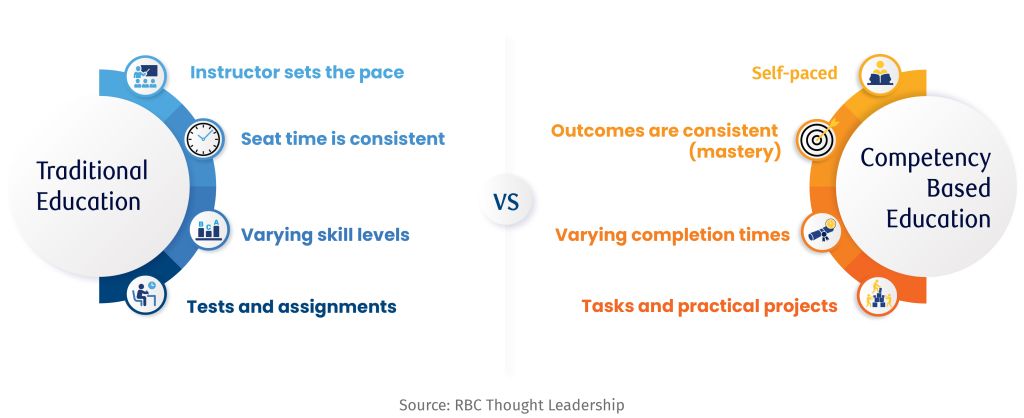
Fund innovative pilot projects: Help institutions break the mold and develop competency-based education programs divorced from seat-time, for example, and ensure policy and qualifications frameworks are set up to scale successes.
Prioritize Canadian technology: Commit to using Canadian technology, including AI, unless no domestic supplier offers an appropriate product or service. And prioritize Canadian technology in all future procurements.
Postsecondary Institutions
Meaningfully engage employers: Explore new models for industry involvement. Build on successes engaging industry, for example, through university continuing education departments and colleges’ program advisory committees (which involve industry and community partners in curricula development).
Ensure all students graduate with transferable skills: Develop work-ready skills like AI literacy, adaptability, entrepreneurship, communication and collaboration in courses, assignments and work-integrated learning experiences.
Expand access to work-integrated learning: Including but not limited to internships and co-ops; practical programs with applied learning opportunities or immersive field trips, like visiting mining sites with industry partners are also great examples of work-integrated learning.
Facilitate greater career mobility: Enable workers to navigate a dynamic economy. Consider:
-
Multi-disciplinary programs like the University of Calgary’s new energy science program, which covers a range of in-demand energy fields.
-
Incremental credentialling, for students in programs with low completion rates, like apprenticeships, so they receive recognition for skills gained.
-
Competency-based education programs that allow adults with relevant skills and experience to earn credentials quickly, learning at their own pace.
-
Skills-based transcripts that position graduates to articulate their competencies and succeed as employers shift toward skills-based hiring.
Develop community-based programming: Work closely with Indigenous communities and industry to develop tailored training programs. Consider using mobile training units, and remote or hybrid learning formats (where internet connectivity allows).
Offer upskilling and reskilling programs: This should include programs aligned with opportunities in defence and energy sectors, and to support an AI-literate workforce. Programs must meet the needs of learners with competing responsibilities, embracing formats like remote/hybrid, intensive learning, and competency-based education.
Prioritize Canadian technology: All colleges and universities should commit to using Canadian technology, including AI, unless no domestic supplier offers an appropriate product or service.
Industry
Send executives to participate in federal Workforce Alliances: They should come prepared with long-term project plans and skills projections.
Allocate staff resources to inform program development: Industry representatives with insight into day-to-day and forecasted long-term skill needs should be involved in designing postsecondary programs and work-integrated learning experiences. They should commit to hiring students who complete those programs.
Allocate more corporate resources for staff training: Canada’s top 100 companies, by market cap, should commit to a minimum annual training budget of $500 per employee – roughly double the current estimated industry average.
Innovate with postsecondary partners: Contract researchers at Canadian universities and colleges to overcome issues or improve productivity with new processes and tools. Consider a “relay race” partnership approach, e.g., university ideation, college or polytechnic application, industry deployment.
Reach students in high-schools, colleges and universities: Shareinformation about rewarding careers in sectors in need of talent, like energy. Host secondary and postsecondary student field trips that provide sightlines into specific industries.
Leverage AI for productivity gains: Integrate AI into core operations, not simply pilot projects and provide access to AI upskilling that develops internal capacity for productivity and growth.
Build mutually beneficial Indigenous partnerships: Engage communities surrounding major project sites to lay the foundation for meaningful employment and community benefits, including working with postsecondary to design and offer tailored training programs.
Hire for skills: move from hiring candidates who have held the same or similar job title previously, toward hiring candidates with skills and experience that align with expectations (or skill families), supporting a more mobile workforce and sending clear signals to training providers about which skills are needed.
Prioritize Canadian technology: Canada’s top 100 companies, by market cap, should commit to using Canadian technology including AI and space-based technologies, unless no domestic supplier offers an appropriate product or service.


 EN
EN