

 EN
EN 

Troubled waters
It does not take sustained disruption to ships sailing through the Strait of Hormuz for it to stop operating as a reliable artery of global trade. The costs are starting to add up: container shipping rates have risen 12% in the two weeks ended last Thursday, according to the Drewry World Container Index.
-
When maritime war risks emerge, a relatively concentrated group of insurers designate high-risk areas, standard coverage falls away and shipowners must secure additional war risk insurance on a voyage basis, priced as a percentage of the vessel’s value.
-
In recent weeks, those premiums have surged from fractions of a percentage point to now 5% of a ship’s value. For a large tanker, that translates into millions of dollars for a single passage. That could soon lead to shortages and likely higher prices for everyday items from toys to clothes to chips.
-
When Iranian drones, mines, or small-boat attacks present a persistent and credible threat to the strait, this also becomes a human judgment call for the captains and crew. Not to mention the shipowners who don’t want to see one of their expensive tankers go down or be rendered useless.
-
There are rising international efforts, including from Canada, to safely reactivate a key maritime channel in the Gulf, where an estimated 1,000 ships—largely energy tankers—are currently stalled.
-
According to Lloyd’s List Intelligence, the conflict has already seen 23 vessels targeted, with some incidents leading to crew casualties.
-
While Covid hit volumes sharply and dramatically increased freight rates, Hormuz is testing the precision of the global shipping system: flows are being rerouted, voyages are lengthening, and tonnage is being repositioned across basins. Cargo that would typically transit Hormuz is increasingly moving west via alternative corridors, with Red Sea ports emerging as key nodes in what is now a rapidly shifting map for cargo transiting through the Middle East.
What’s the impact?
-
Longer voyages absorb capacity, tighten vessel availability in some regions, and create imbalances elsewhere. For containerized trade, the impact is consequential. E-commerce delivery delays have already hit Middle East retail, as air cargo is also taking a hit.
-
Global supply chains depend on timing. Goods move in sequence and within defined windows. That predictability is now eroding. An increase in freight rates can be absorbed. A shipment that arrives weeks late, and without certainty, cannot.
–Thomas Ashcroft
LNG in Dire Straits
Oil and gas trade has virtually halted in the countries surrounding the Strait of Hormuz in the Persian Gulf. And as Qatar’s natural export facilities suffered a hit, it has sent energy forecasters back to the drawing board.
The global LNG market was on track to move into meaningful surplus in 2026, with two million tonnes on supply of 475 million tonnes (MT) in 2026 and 30 MT on supply of 585 MT in 2029.
How badly are Qatar’s LNG exports hit?
-
A disruption to Qatari supply — the world’s second largest LNG exporter — would wipe that surplus out entirely for roughly three years to a 30 MT shortage in 2026, and only 8 MT excess in 2029. Of course, this assumes no demand destruction, which remains to be seen.
-
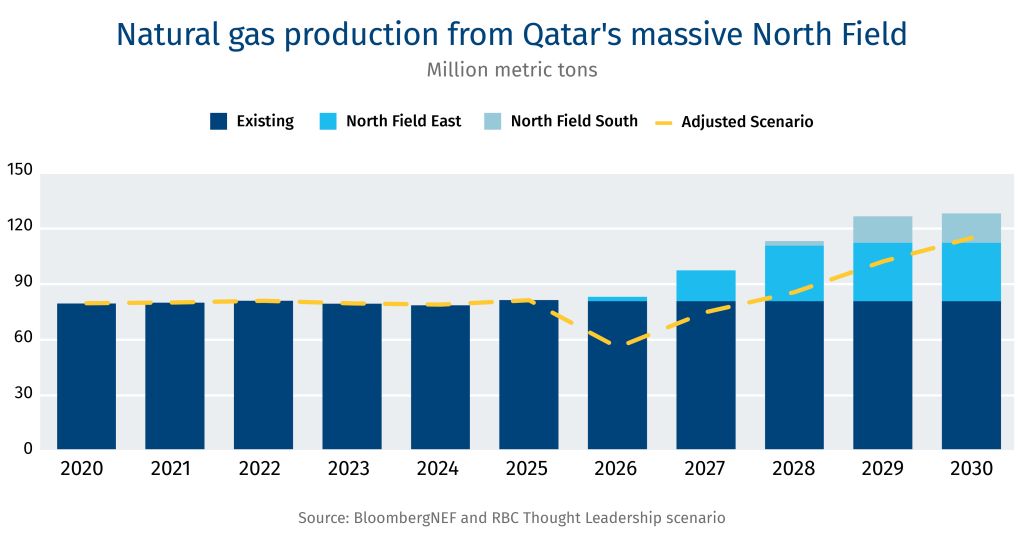
Based on conversations, Qatar’s adjusted supply scenario of LNG this year is likely 50-55 MT, a ~30 mtpa disruption from last year’s ~83 mtpa of production. That’s not a rounding error—it is a decline just under two times greater than Canada’s current entire LNG export capacity.
-
Qatar’s North Field expansion, which underpins the global supply growth story through 2030, could get pushed back with a slower ramp. The market was pricing in those volumes but is now repricing a near to mid-term shortage.
This is a two-stage shock
-
The Strait of Hormuz dimensions compound the picture. With tanker traffic effectively frozen, the disruption isn’t just a production story – even unaffected volumes are shut-out of the Strait.
-
LNG Canada is revving up. Eight vessels departing B.C. in the first 17 days of March versus four in all of December signals that Pacific Basin buyers are already rerouting toward non-Gulf supply.
-
Reports suggest U.S. LNG cargoes are also headed to Asia via the Panama Canal.
-
Bottom line: The anticipated LNG glut — widely expected to lower prices and improve affordability — is likely off the table through at least 2028.
For more, read: Energy Shock: 8 charts that explain the global oil and gas fallout – RBC
–Shaz Merwat
Moving tariff targets
Negotiating trade with President Donald Trump is like playing whack-a-mole. Irritants pop up relentlessly and belligerently. Except if you swing late, the mole pops up and whacks you back harder. The U.S. Trade Representative’s launch of a Section 301 investigation into Canada is just the latest belligerent act.
The investigations, targeted a total of about 60 trading partners, fall under two probes:
-
First, to determine if countries have failed to effectively ban or enforce prohibitions on goods produced with forced labour entering America (which is the focus of the Canadian investigation).
-
Second, whether foreign government subsidies result in overcapacity that floods markets and hurts U.S. manufacturing in key sectors.
The U.S.’s motive is to force allies to share the load in hardening against forced labour goods from regions like Xinjiang region—where minorities are forced to produce goods—, apart from overcapacity, and broader Chinese supply risks. It’s not just bilateral finger-pointing but, for Canada, it does initiate a deliberately targeted process:
-
Washington charges that Ottawa’s forced-labour enforcement regime unfairly burdens U.S. commerce by letting tainted goods flow into North America.
-
That triggers mandatory consultations, public hearings, and evidence-gathering before tariffs can then be applied.
What’s the realistic threat?
If Canada falls foul of these investigations, duties could target manufacturing inputs (steel, aluminum, minerals), high-tech goods (semiconductors, solar, electric vehicles), seafood, toys, electrical equipment, and consumer essentials like textiles and leather.
Canadian Border Services Agency (CBSA) data reveals modest gains after 2024 Forced Labour and Child Labour in Supply Chains Act took effect in Canada. Seizures of suspected forced-labour shipments—apparel, toys, and electronics often traced indirectly to the Xinjiang autonomous region in China—edged up, with around 50 detentions in 2024 versus almost none in the prior three years. However, only one shipment was confirmed as violating the prohibition in Canada, a fraction of U.S. Customs and Border Protection’s US$1 billion in seizures over suspected ties to forced labour. The Canadian government committed $25.1 million over two years starting 2025 to Global Affairs Canada and CBSA for investigations and enforcement, to accelerate this, but Washington questions the bite, arguing the enforcement lacks the teeth would help achieve its strategic goals with China.
What happens now?
-
Section 301 is a process, not a trigger. Unlike Section 232, it requires consultations, evidence-building, and public hearings before any tariffs can be imposed.
-
Canada has a narrow window to shape the record: April 15 submissions and hearings beginning April 28 will be critical to demonstrate enforcement progress and anchor arguments in CUSMA labour commitments (Chapter 23).
How it impacts CUSMA negotiations
-
The timing is deliberate. Section 301 process is running in parallel with the CUSMA review, giving the U.S. Trade Representative office USTR an early signal of whether consultations are producing results.
-
United States Trade Representative’s Jamieson Greer said this week that Canada lags Mexico in the CUSMA review process. The Canadian pacing is strategic, reflecting a conscious allocation of risk and leverage in Ottawa. Mark Carney assembled his team and split roles accordingly: Ambassador Mark Wiseman courts Congress against wild cards like CUSMA withdrawal (which can be done through executive order, although Congress does maintain ultimate control over repealing the legislation).
-
Meanwhile, chief negotiator Janice Charette coordinates the relevant government departments and red lines for the PM.
-
Pre-U.S. midterms, Canada must collaborate on forced labour without offering high-value concessions like critical minerals access. Demonstrating enforcement progress and willingness, while holding strategic cards close and letting the midterms test Trump’s leverage to preserve Ottawa’s negotiating room.
–Thomas Ashcroft
A nuclear reboot for Taiwan
China’s recent opportunistic “offer” to Taiwan to unite with the mainland in exchange for energy security illustrates how energy security, trade, and geopolitics are converging, as the Middle East conflict violently shakes up global energy systems.
Why does Taiwan need energy security?
-
The East Asian Island is the world’s leading producer of semiconductors, with natural gas and oil—mostly imported—accounting for 61% of energy supply, according to data from the Statistical Review of World Energy. Coal (33%), nuclear (3%), and renewables (3%) make up the rest.
-
In 2016, Taiwan initiated policies to phase out nuclear power and completed the shutdown of its final reactor in May 2025, bringing nearly 5GW of power—or 42% of Canada’s nuclear capacity—offline, and growing its liquefied natural gas imports.
-
Around 42% of Taiwan’s imported LNG came from Qatar, which suffered a severe missile attack from Iran this week.
-
Taiwan is revisiting its nuclear strategy, with feasibility studies to examine restarting two nuclear power plants. State-owned utility Taipower is also expected to submit reactor restart plans this month.
Lessons in a new energy era
-
Our report Atomic Advantage: Canada’s generational opportunity in a new Nuclear Age, underscored how energy security is driving a resurgence in nuclear power worldwide.
-
Many European and Asian nations are diversifying their energy suppliers but also power sources to navigate the geopolitical instability disrupting global energy markets.
-
As nations seek to diversify both energy supplies and power sources, Canada is well positioned to help. Canada’s Candu reactor technology, which includes sub-gigawatt scale reactors suited to smaller grids, and growing SMR expertise make it a natural partner for countries looking to reduce fossil fuel dependence without relying on Chinese or Russian technology.
–Vivan Sorab
This article is intended as general information only and is not to be relied upon as constituting legal, financial or other professional advice. The reader is solely liable for any use of the information contained in this document and Royal Bank of Canada (“RBC”) nor any of its affiliates nor any of their respective directors, officers, employees or agents shall be held responsible for any direct or indirect damages arising from the use of this document by the reader. A professional advisor should be consulted regarding your specific situation. Information presented is believed to be factual and up-to-date but we do not guarantee its accuracy and it should not be regarded as a complete analysis of the subjects discussed. All expressions of opinion reflect the judgment of the authors as of the date of publication and are subject to change. No endorsement of any third parties or their advice, opinions, information, products or services is expressly given or implied by Royal Bank of Canada or any of its affiliates.
This document may contain forward-looking statements within the meaning of certain securities laws, which are subject to RBC’s caution regarding forward-looking statements. ESG (including climate) metrics, data and other information contained on this website are or may be based on assumptions, estimates and judgements. For cautionary statements relating to the information on this website, refer to the “Caution regarding forward-looking statements” and the “Important notice regarding this document” sections in our latest climate report or sustainability report, available at: https://www.rbc.com/our-impact/sustainability-reporting/index.html. Except as required by law, none of RBC nor any of its affiliates undertake to update any information in this document.