

 EN
EN 

That was the case at last week’s Fortune’s Most Powerful Women event in Montreal. The conference, which was sponsored by RBC, touched upon the big business issues of our day: the opportunities and concerns posed by artificial intelligence, the challenge of lifelong reskilling, and how to navigate a more uncertain economic and political environment.
The room was filled with executives, company founders and senior policy makers, including veteran Canadian CFO Cynthia Devine, now financial chief at Maple Leaf Sports and Entertainment, RBC Chair Katie Taylor, and Fortune’s Most Powerful Woman of 2018, Lockheed Martin CEO Marillyn Hewson, who gave the audience a hint of what it’s like to negotiate with U.S. President Donald Trump.
Here are six things that stood out:
DQ is the New EQ
Digital transformation is factoring into the decisions of every business, from auto-parts makers to retailers and marketing firms. Barbara Humpton, CEO of the U.S. arm of industrial conglomerate Siemens, said leaders need to be evaluated not just on IQ and EQ, but on their Digital Quotient, or ability to envision a company’s digital future and help employees transition in a disrupted environment. Humpton should know: she was tapped to help accelerate the use of digital technologies at Siemens USA, which has 50,000 employees and more than 60 manufacturing plants.
Ranit Aharonov heads an IBM research team in Israel that’s developing an AI system that can debate real people on complex topics. Aharonov’s work highlights the tensions surrounding AI: while it holds great promise, business leaders are keenly aware of the impact AI adoption can have on the workforce. Siemens’ Humpton stressed that it is increasingly part of a business leader’s responsibility – and critical to the success of any company – to ensure workers aren’t left behind in digital transformation.
Embrace Disruption, Ramp Up Reskilling
For executives, embracing technological disruption means shifting focus to reskilling – providing employees with training to meet the needs of evolving businesses, or working with universities to ensure students are prepared for a changing workplace.
Many of the women at the conference had successfully pivoted at key moments in their own lives, embodying the best of what reskilling can offer. (Take Manjit Minhas, an engineering grad who built an international beer and spirits company, Minhas Breweries & Distillery, or Canadian Foreign Minister Chrystia Freeland, who has both journalist and Member of Parliament on her resume.)
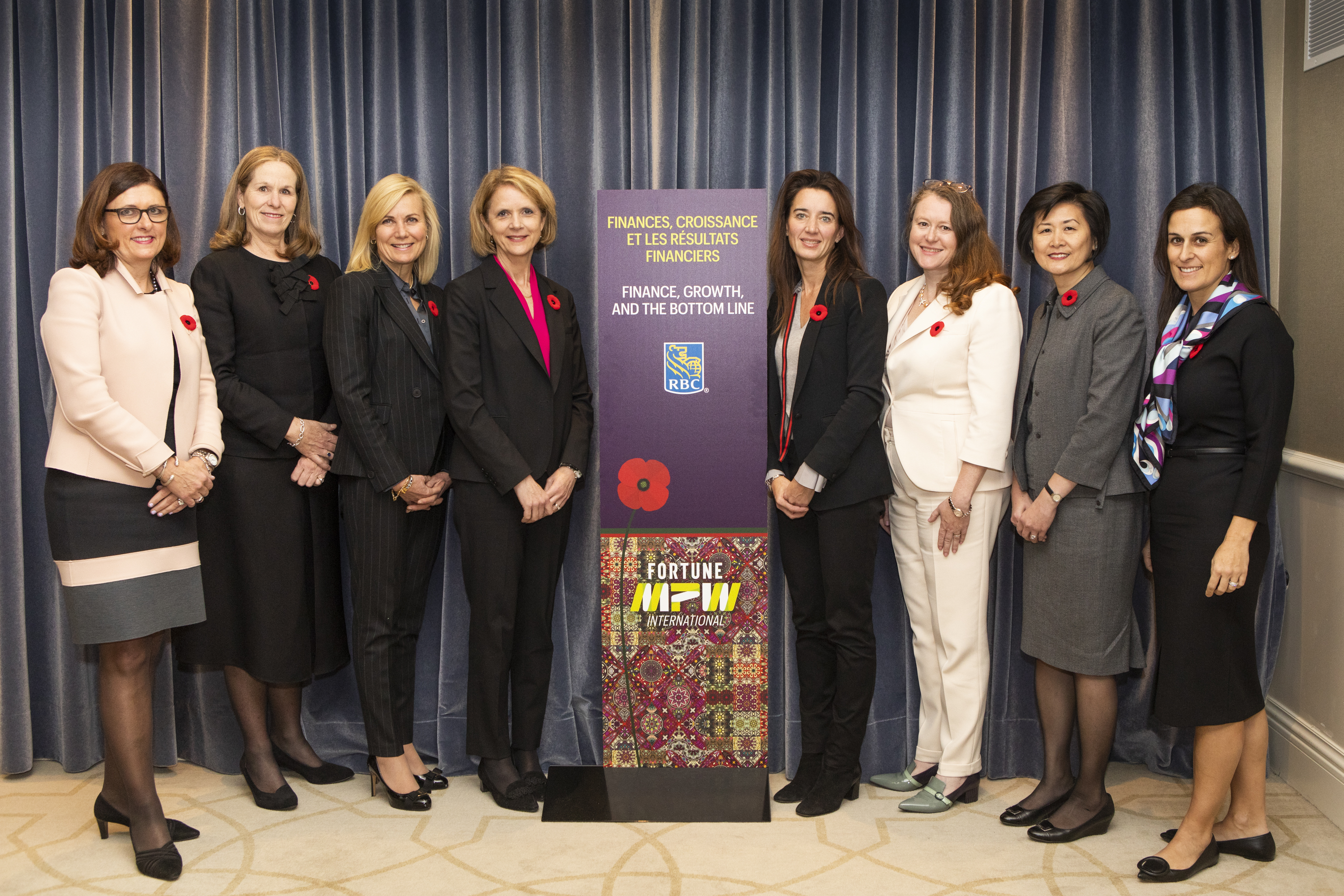
From left to right: Patti Shugart – MD & Head, Corporate Banking and Global Credit; Jennifer Tory – Chief Administrative Officer; Kim Mason – Senior Vice-President, Personal & Commercial Banking; Helena Gottschling – Chief Human Resources Officer; Carrie Cook – Managing Director, RBC Capital Markets; Leanne Kaufman – Head, Estate & Trust Services; Bernadine Leung – Managing Director, Enterprise Strategic Client Group; Claire Sturgess – Managing Director, RBC Capital Markets
Raising Capital is Still a Gender Game
Intrigued by the lack of innovation in family planning over the last 60 years, Danish entrepreneur Ida Tin created an app called Clue as a way to harness data to help women better understand their bodies. She started her Berlin-based company with €70,000 in funding; it recently raised US$30 million.
Tin has achieved success in the startup world but she didn’t sugar-coat the challenges. Calling raising money “a man’s game,” she said she found it helpful to have a male ally as she was working to attract fundraising. Tin coined the term “femtech” as a way to entice investors to see women-focused technologies as a whole new category.
Know Your Red Line
Businesses are keeping a wary eye on the geopolitical backdrop. Growing trade tensions and political uncertainty were concerns for CEOs like Linda Hasenfratz, who heads auto-parts maker Linamar. Free trade is critical to a business like hers, in which a typical car part crosses a North American border seven times before ending up on the car lot.
Freeland, fresh from stickhandling Canada’s trade talks with the U.S. and Mexico, voiced optimism about international cooperation, highlighting her recent efforts to convene women foreign ministers from around the globe. But she revealed the steely side that served her well in renegotiating what is now the USMCA: Know your red lines, and make sure you stick to them.
Men Can Help Move the Dial
There was almost no talk of #MeToo at the conference, but the topic came up briefly on one panel, when the interviewer asked if the movement makes it harder for men to mentor women. RBC’s Katie Taylor brushed that off, saying men can play a positive role in “moving the dial” on getting more women into senior leadership and board roles.
With women occupying less than 30 per cent of senior management roles in Canada (and not even one-tenth of the C-Suite jobs at the country’s biggest public companies), Taylor’s point was clear: while women should support other women aspiring to senior roles, they can use male allies too.
The F Word Came Up
Family, that is. The challenge of raising children while managing a demanding career remains a largely female concern. Foreign Minister Chrystia Freeland got the last word on that score. She closed the conference by telling the younger attendees not to listen to those who tell them it can’t be done. With three kids and a new North American trade pact to boast about, she proves it can.
This article is intended as general information only and is not to be relied upon as constituting legal, financial or other professional advice. The reader is solely liable for any use of the information contained in this document and Royal Bank of Canada (“RBC”) nor any of its affiliates nor any of their respective directors, officers, employees or agents shall be held responsible for any direct or indirect damages arising from the use of this document by the reader. A professional advisor should be consulted regarding your specific situation. Information presented is believed to be factual and up-to-date but we do not guarantee its accuracy and it should not be regarded as a complete analysis of the subjects discussed. All expressions of opinion reflect the judgment of the authors as of the date of publication and are subject to change. No endorsement of any third parties or their advice, opinions, information, products or services is expressly given or implied by Royal Bank of Canada or any of its affiliates. This document may contain forward-looking statements within the meaning of certain securities laws, which are subject to RBC’s caution regarding forward-looking statements. ESG (including climate) metrics, data and other information contained on this website are or may be based on assumptions, estimates and judgements. For cautionary statements relating to the information on this website, refer to the “Caution regarding forward-looking statements” and the “Important notice regarding this document” sections in our latest climate report or sustainability report, available at: https://www.rbc.com/our-impact/sustainability-reporting/index.html. Except as required by law, none of RBC nor any of its affiliates undertake to update any information in this document.