

 EN
EN 



A smarter way for adult learners to hone new skills
What is competency-based education?
Competency-based education (CBE) is a personalized style of post-secondary learning that allows participants to earn credentials by mastering skills and knowledge at their own pace.
There are more than 1,000 CBE programs offered at U.S. institutions, many at the degree or associate degree level.
In Canada, while several postsecondary institutions are experimenting with CBE at micro-credential and certificate levels, no public Canadian institution offers the chance to earn competency-based degrees or diplomas (Bow Valley College in Calgary plans to offer hybrid diplomas in information technology and cybersecurity beginning in September).
Why did CBE take off in the U.S.?
In 2013, the Obama administration called for individually paced programs that “award credits based on learning, not seat time” as a way of promoting innovation, and creating affordable, accelerated degree pathways for adults. Within a decade, the number of providers grew from about a dozen to more than 600.
What’s different about CBE?
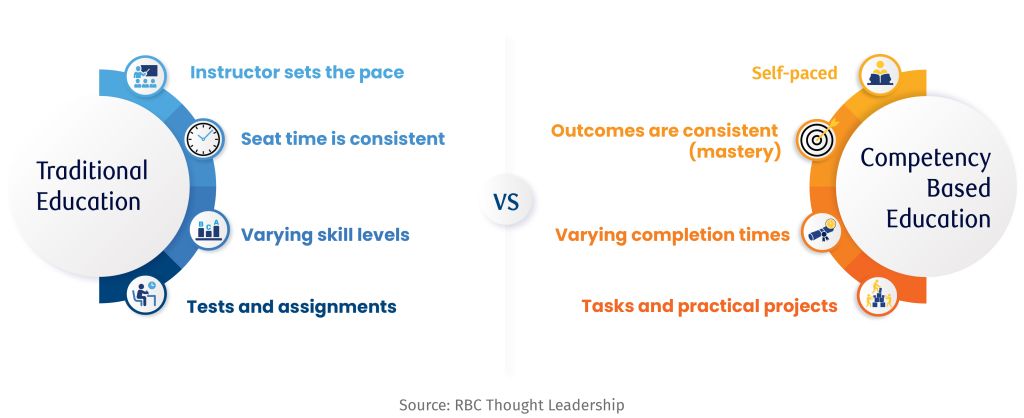
Traditional degree and diploma programs are generally designed to serve students studying full-time and moving directly from high school to college or university. These students often seek and benefit from a cohort experience—students start and progress together, with a pace set by an instructor. Their final grades vary.
CBE degree and diploma programs are designed for adults who already have a level of skill and experience. Programs tend to start monthly or even weekly. Learners move at their own pace with individualized support from coaches or advisors. CBE assessments are usually performance-based tasks or projects that reflect real-life scenarios—a business student might analyze a company’s financial statements and identify inefficiencies, for example, while a nursing student might conduct a thorough patient assessment.
Everyone is required to meet the same high bar. Students pass by demonstrating mastery and are supported to address learning gaps until they do (e.g., they may get rounds of feedback from a faculty coach, persisting until they can perfect a specific task before moving on to the next). This approach allows participants to progress more quickly through content they’re familiar with and devote the necessary time to new skills and concepts.
Who do CBE programs benefit?
In today’s rapidly changing economy, CBE can help adults whose jobs are disrupted, providing them an opportunity to upskill in evolving sectors or reskill to shift into an entirely new area of work. CBE programs could also provide foreign-trained workers the opportunity to earn Canadian credentials aligned with their skills and expertise.
Employers benefit, too. CBE programs can help match skills with jobs quickly. And the focus on mastery ensures that graduates achieve a high level of skill.
How does CBE work in practice?
Western Governors University–The pioneer of CBE
Salt Lake City, Utah + regional hubs in nine states
On offer: Online undergraduate and graduate degrees in business, education, information technology, health & nursing.
How it works: Most program intakes are monthly. Leaners pay US$4,000 in tuition per six-month term, working at their own pace to earn competency units by demonstrating skills on various tests or projects. On average, a bachelor’s degree takes 2.5 years to complete.
University of Maine at Presque Isle–Nearly doubled CBE enrolment last year
Presque Isle, Maine
On offer: Online undergraduate and graduate degrees in areas such as accounting, education, public policy and management.
How it works: Learners progress through courses in eight-week sessions– US$1,800 per session for undergraduates, US$2,450 for graduate students. An advisor helps ensure students maximize their time each session; programs can be completed in a year.
Capella University –A founding member of the Competency-Based Education Network
Minneapolis, Minnesota
On offer: Undergraduate and graduate degrees in business, education, health care administration, information technology, nursing and psychology.
How it works: Programs operate on an ‘all-you-can-learn’ 12-week subscription basis. Students can start any month. An evaluation of the first five years of program delivery found the median completion time was 60% faster in CBE bachelor’s degrees compared to credit-hour versions Capella offered; and median tuition costs were 60% lower.

Download the report
Jackie Pichette is Skills Policy Lead at RBC Thought Leadership
This article is intended as general information only and is not to be relied upon as constituting legal, financial or other professional advice. The reader is solely liable for any use of the information contained in this document and Royal Bank of Canada (“RBC”) nor any of its affiliates nor any of their respective directors, officers, employees or agents shall be held responsible for any direct or indirect damages arising from the use of this document by the reader. A professional advisor should be consulted regarding your specific situation. Information presented is believed to be factual and up-to-date but we do not guarantee its accuracy and it should not be regarded as a complete analysis of the subjects discussed. All expressions of opinion reflect the judgment of the authors as of the date of publication and are subject to change. No endorsement of any third parties or their advice, opinions, information, products or services is expressly given or implied by Royal Bank of Canada or any of its affiliates.
This document may contain forward-looking statements within the meaning of certain securities laws, which are subject to RBC’s caution regarding forward-looking statements. ESG (including climate) metrics, data and other information contained on this website are or may be based on assumptions, estimates and judgements. For cautionary statements relating to the information on this website, refer to the “Caution regarding forward-looking statements” and the “Important notice regarding this document” sections in our latest climate report or sustainability report, available at: https://www.rbc.com/our-impact/sustainability-reporting/index.html. Except as required by law, none of RBC nor any of its affiliates undertake to update any information in this document.