

 EN
EN 

Key Findings
-
Canada is one of only six countries with a domestically designed and exportable nuclear technology portfolio. That strategic leverage positions Canada to shape global energy security and forge long-term alliances.
-
Canada can take advantage of rising global interest in nuclear power. The United States has ambitions to quadruple its nuclear capacity, and more than 30 other nations have pledged to triple nuclear capacity by 2050.Canada can offer proven value across the nuclear supply chain to help scale the growing global market.
-
Uranium is the U.S.’s structural vulnerability—and Canada’s advantage. U.S. nuclear reactors require 25,355 tonnes of uranium annually, but sources only 8% of that requirement domestically. Canada, which has the world’s third-largest uranium resources and is ramping up production, is establishing its anchoring role in North America’s nuclear fuel supply chains with its high-quality deposits, reliable production, and geopolitical stability.
-
Canada’s nuclear supply chain is primed for expansion but sits at a strategic inflection point. Ontario’s successful nuclear refurbishment projects have preserved high-value nuclear manufacturing and engineering capabilities and have demonstrated that large-scale nuclear projects can be delivered ahead of schedule and under budget. But future competitiveness depends on sufficient policy clarity, project pipelines, and new nuclear build success to justify sustained investment and expansion.
-
Canada faces three credible, and not mutually exclusive, nuclear futures. Canada can anchor its strategy around: (1) uranium and fuel security; (2) lead in technology through pressurized heavy water reactors (PHWRs) and light water small modular reactors (SMRs); or (3) integrate more deeply into a North American nuclear build-out.
-
Canada needs to move fast to execute its nuclear ambition. Civil nuclear competitors are pairing technology with financing, diplomacy, and long-term partnerships as global interest in nuclear power surges. The window is narrowing for Canada to translate intentions into lasting influence. It could prove to be a multi-billion-dollar exporting opportunity as nuclear investments need to nearly double to US$120 billion annually by 2030 to double nuclear capacity, according to one International Energy Agency scenario.
Following a period of stagnation in the Western world, nuclear power is making a comeback—a global resurgence driven by the rising power demand of artificial intelligence, the energy security concerns, and shifting industrial policy.
The technology sector, facing imminent increases in power demand thanks to AI data centres, is a key driver of nuclear’s resurgence, with companies like Google, Microsoft, Meta, and Amazon signing agreements with conventional nuclear power producers and advanced nuclear technology companies. Google signed a 25-year power purchase agreement with NextEra Energy to restart the Duane Arnold Energy Centre in Iowa, a 610MW plant offline since 2020,1 provided early-stage capital to Elementl Power to develop three advanced nuclear sites in the U.S.2 and partnered with Small Modular Reactor (SMR) company Kairos Power and the Tennessee Valley Authority on a reactor demonstration project.3 Amazon has invested over US$1 billion in nuclear projects and technologies,4 including a stake in the advanced SMR company X-Energy.5 And Meta, looking to secure reliable, long-term electricity supplies to power its AI ambitions, inked 20-year agreements to buy energy from three U.S. nuclear plants (Meta also committed to developing small modular reactors with two companies). These deals will provide the company with 6.6 gigawatts of power by 2035, according to Meta.6
Beyond the growing power needs of artificial intelligence, energy security concerns, particularly in Europe, are driving the reversal of nuclear phaseout plans and the development of new nuclear strategies. Italy has recently begun exploring the reintroduction of nuclear power into the country’s energy mix, almost four decades after its last plant was shut down.7 Denmark is actively considering nuclear power,8 and Norway has begun impact assessment studies for a potential SMR.9 The European Commission is also developing a strategy targeting SMR deployment by the 2030s.10
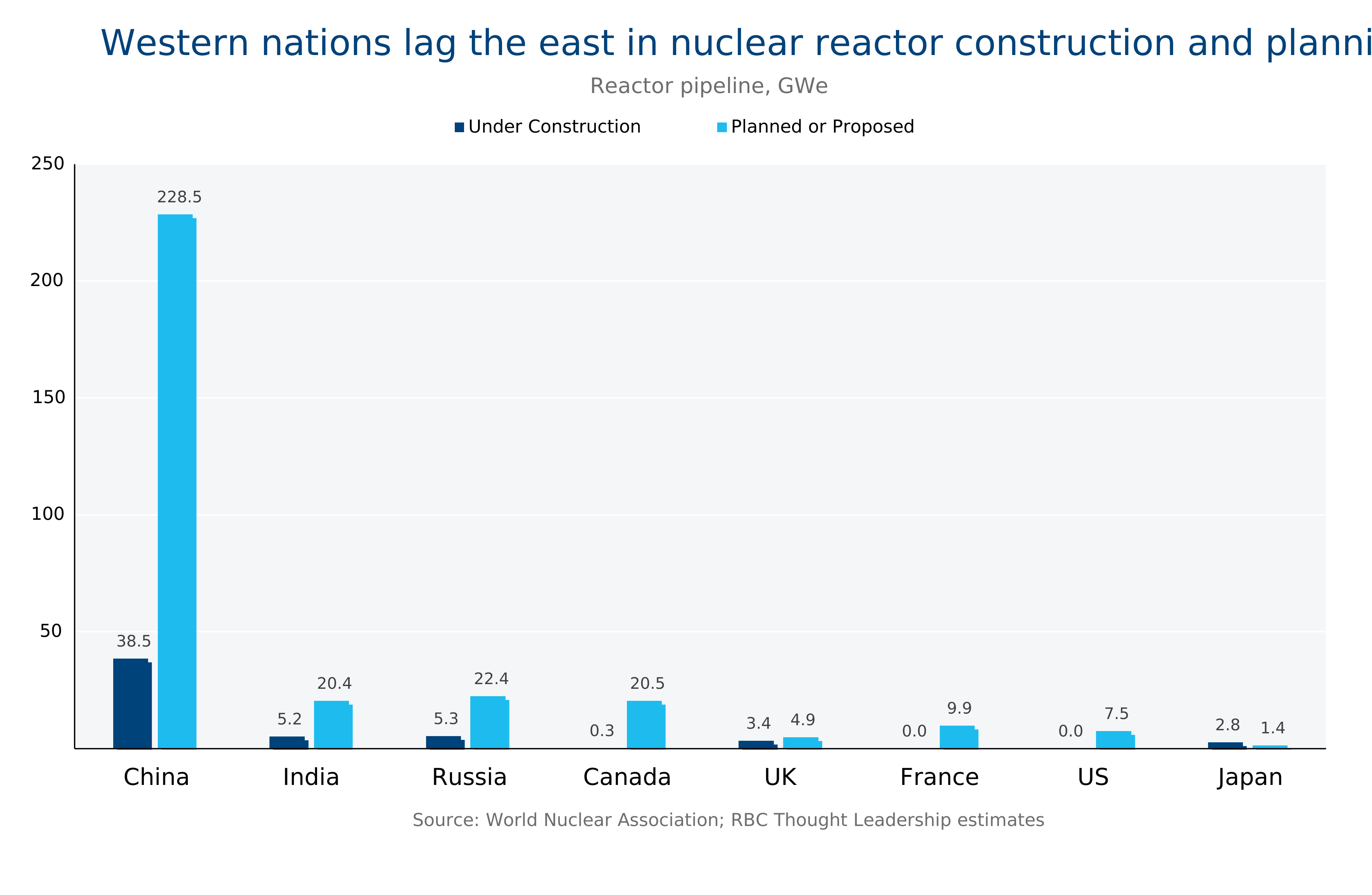
Yet nuclear’s resurgence in the West faces significant challenges. Most notably, reactor construction projects across several Western nations have been marked by cost and schedule overruns that have raised execution risk and hampered financing. The Vogtle 3 and 4 projects in Georgia, the first new reactor projects in the U.S. in decades, were built at an estimated cost of US$36.8 billion as of 2014, relative to an original estimated cost of US$14 billion.11 The Flamanville 3 project in France connected to the grid in December 2024, twelve years behind schedule, at a cost of €13.2 billion, quadruple the initial cost estimate.12 The U.K.’s Hinckley Point C project remains under construction, and is now projected to cost £49 billion, nearly triple the £18 billion estimate when it commenced construction in 2017, with Unit 1 not expected online before 2030.13 And in the U.S., the V.C. Summer nuclear project in South Carolina was abandoned in 2017 following project delays and cost overruns.14
But with interest in nuclear resurgent, worldwide capacity could grow 75% to roughly 730GW by 2050 under current policies, according to the International Energy Agency.15
For its part, the U.S. is aiming to quadruple what is already the world’s largest nuclear reactor fleet by 2050 (up from its previous goal to triple capacity), strengthen its supply chain, and modernize nuclear fuel supplies. The U.S. is advancing rapidly on next-generation nuclear technology, committing about US$5 billion in federal funding to small modular and advanced reactor research, demonstration, and early deployment through U.S. Department of Energy programs.
China, meanwhile, is building an additional 38.5GW of capacity16, while Russia is leveraging nuclear energy for its Arctic, industrial and foreign policy goals, extending its state-backed reactor export model.
With significant uranium reserves and deep nuclear technology expertise, Canada is one of only six countries with domestic and exportable nuclear technology portfolios. And it is embarking on a new nuclear construction program that could become one of the largest in the West if the full suite of projects proceeds as planned. Construction of the G7’s first Small Modular Reactor (SMR) has started at the Darlington nuclear site in Clarington, Ontario, and several of Canada’s nuclear reactors have been successfully refurbished ahead of schedule and under budget, bucking the cost overrun trend of nuclear projects in other Western countries.
Simply put, Canada has an opportunity to play a key role in nuclear’s resurgence—from anchoring global uranium and fuel supply to leading in nuclear technology and service exports to its allies, scaling North American nuclear supply chains, and enhancing global nuclear exports.
Here are some of the goals and requirements for each pathway.
1. Uranium Powerhouse
The Goal
As global reactors restart, stable uranium mining and nuclear fuel services (conversion, enrichment, fabrication) become increasingly critical to energy and security. Canada’s world-class uranium deposits and uranium conversion expertise anchor allied nuclear fuel security in North America and abroad, guarding against energy insecurity and resource nationalization risks.
Leveraging Canada’s Advantage
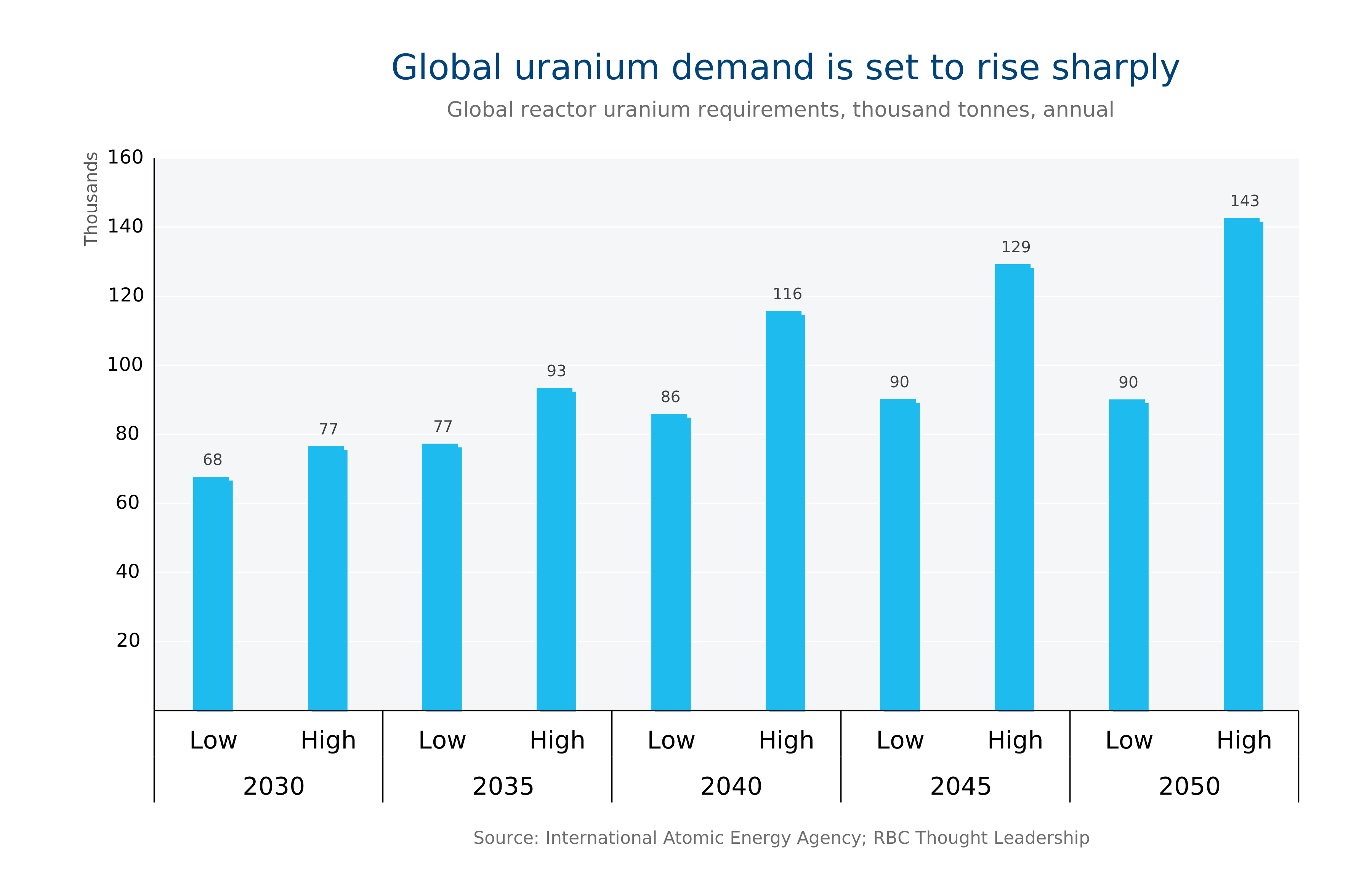
Planned and under-construction reactors will increase global uranium requirements as they come online, necessitating new mines as existing resource quality drops and supplies of secondary uranium become more constrained.
Canada is home to the world’s third largest uranium resources after Australia and Kazakhstan,17 and already plays a key role in anchoring nuclear fuel supply chains thanks to its high-quality deposits, reliable production, geopolitical stability, and fuel manufacturing expertise.
Ongoing expansion of existing projects and new mines in Saskatchewan will enhance Canada’s position as a key energy security pillar for allies in North America and globally. By building on its strengths in uranium conversion (Canada holds 18% of global uranium conversion capacity),18 Canada can strengthen fuel services stability for an expanding nuclear fleet in North America and abroad.
Pathways to Success
The U.S.’s nuclear reactor fleet already has key energy security vulnerabilities, with 20% of its enriched uranium sourced from Russia in 2024.19 U.S. policy efforts have sought to reduce the dependence with proposed investments in spent fuel reprocessing, and the previous administration’s ban on Russian enriched uranium imports (Russia controls 40% of global enrichment capacity)20. However, even with potential expansion of enrichment infrastructure, the U.S. will remain dependent on uranium imports, with domestic production currently a fraction of annual reactor requirements. U.S. nuclear reactor operators purchased 25,355 tonnes of uranium in 2024, with only 8% sourced domestically, with Canada providing the greatest source of U.S. purchases at 36% of the total.21 Continued U.S.–Canada partnership on uranium will be critical for the security of the U.S.’s nuclear fuel supply. While Canada is currently self-sufficient in uranium and fuel manufacturing thanks to reactors that run on natural uranium, future nuclear reactors, such as SMRs and potentially large light water reactors, will necessitate enriched uranium for fuel, potentially strengthening the case for Canada to seek domestic enrichment capabilities.
2. Nuclear Tech Pioneer
The Goal
Leveraging its existing technology expertise and expanding its domestic large-scale nuclear program alongside growing expertise in SMR deployment would strengthen Canada’s energy and economic security domestically. It would also provide a differentiated portfolio of reactor technologies, engineering and operational services, and regulatory support for new and existing nuclear jurisdictions.
Leveraging Canada’s Advantage
Canada’s experience in the Candu pressurized heavy water reactor (PHWR) design, construction, and operation, underpins a 17-reactor strong fleet across Ontario and New Brunswick and 12 units exported internationally since the 1970s.22 Fuelled by natural uranium, Canadian reactors do not rely on enriched uranium fuels, enabling independence from a concentrated set of enrichment suppliers, an increasingly valuable attribute as energy independence gains traction globally. Modern, gigawatt-scale designs and upgraded versions of existing reactors could expand Canada’s reactor portfolio if they are licensed and proven commercially at home. Simultaneously, successful construction and operation of grid-scale light water SMRs in Ontario would cement Canada’s position as a first mover and operator in this technology, allowing Canadian nuclear suppliers and operators to market their construction, operational and regulatory expertise to new markets.
Combined, these capabilities could position Canada among a handful of countries with credible expertise and export capability across a portfolio of technologies ranging from large nuclear reactors to small modular reactors.
Such a nuclear energy strategy could also provide a boost for the more than 200 domestic nuclear component manufacturers supporting Canada’s program. PHWR and SMR deployments abroad could enable value capture for Canada across the full reactor lifecycle, from uranium and fuel services supply, regulatory support, reactor construction and operation, through refurbishments, and decommissioning—even with some supply chain localization in partner countries.
Pathways to Success
Experience from early SMR projects will enable the Canadian nuclear sector, and partners across the supply chain, construction, and engineering services, to anchor global deployment. Poland,23 Hungary,24 and Bulgaria25 alone could represent a potential pipeline of up to 40 SMRs, providing a critical early market for Canada starting in the 2030s, as domestic deployment of large reactors sets the stage for international exports later into the decade. To succeed, Canada’s local deployments will need to be delivered and operated successfully, backed by the expansion of its supply chain and nuclear manufacturing base beyond its current refurbishment-ready capabilities. Key manufacturing gaps, such as reactor vessels and heavy water production for new reactors, will need to be closed. Canada will also need to expand its nuclear talent pool to prepare for reactor construction, as well as preserve existing expertise, as global deployments create competition for talent.
3. Continental Energy Partner
The Goal
Integrating more deeply into the U.S. supply chain (including reactor component manufacturing, construction, and deployment) would give Canada access to an established export pipeline for large light water nuclear reactors. Favourable commercial negotiations and cross-border intellectual property transfer could enable Canada to partially localize supply chains for U.S.-origin large reactor components, allowing Canada to support domestic construction programs and support foreign reactor construction.
Leveraging Canada’s Advantage
U.S.–Canada civil nuclear cooperation is rooted in decades of technology collaboration and expertise exchange. Although Canada and the U.S. operate different nuclear reactor technologies today and have distinct nuclear regulatory procedures, the two nations have formally collaborated on several advanced nuclear technologies such as next-generation SMR fuels and light water SMRs through joint technical work between each nation’s regulators.26
A traditionally single-technology nuclear nation, Canada could expand its large nuclear reactor fleet to include U.S.-origin designs such as the AP-1000, which benefits from more than a decade of operating experience in the U.S. and China. This could lower construction risk for gigawatt-scale reactors in Canada by leveraging lessons learned from prior construction projects in the U.S. and China, and enable Canada’s nuclear supply chain to expand, and selectively access a global export pipeline. Currently, 20 AP-1000 reactors have been contracted in markets such as Poland, Bulgaria, Ukraine, and India,27 and Canadian manufacturers have signed memorandums of understanding for the potential supply of components such as valves and flow control equipment,28 as well as steam generators, pressure vessels, and heat exchangers.29
Canadian manufacturers have already provided components such as valves30 and fabrication services for reactor modules31 to U.S. nuclear projects such as Georgia’s Vogtle 3 and 4 reactors. U.S. nuclear supply chains, which lay largely dormant until the Vogtle projects lack the capacity to scale reactor construction to the levels envisaged under the U.S. government’s ambitions,32 could create opportunities for Canadian manufacturers if projects proceed to construction. The Canadian nuclear supply chain already hosts more than two dozen companies with nuclear certifications from the American Society of Mechanical Engineers, covering core nuclear components, safety systems, and relief systems,33 evidence of an established, licensable industrial base capable of supporting large-scale reactor deployment.
Pathways to Success
For deeper North American supply chain integration to succeed, Canada will need to secure and increase domestic manufacturing and export opportunities as the U.S. builds out its nuclear industrial base. Washington has increasingly framed nuclear energy as a strategic economic sector, with industrial policy playing a growing role alongside commercial considerations. Recent agreements between the U.S. federal government and nuclear sector partners reflect this orientation, positioning reactor deployment as a vehicle for U.S. industrial renewal. The trajectory of existing U.S.–Canada trade dynamics, such as tariffs on Canadian-manufactured components, alongside commercial negotiations, will determine the extent to which Canada is able to localize manufacturing and scale current exports to the U.S.
The path forward
As Canada expands its nuclear power industry, it needs to enhance and refine several areas across the supply chain.
-
Establish a comprehensive nuclear strategy. Centred on energy and economic security and a fleet-based approach for deployment, a pan-Canadian comprehensive strategy—in coordination with Ontario and other provinces, industry and universities—can improve certainty needed for supply chain investment, workforce development, inter-provincial cooperation, and international partnerships. It could integrate deployment targets, construction timelines for major projects, and technology pathway clarity with the goal of ensuring future energy and economic security.
-
Develop a competitive nuclear export financing and diplomatic infrastructure. A dedicated nuclear export financing facility, supporting a multi-technology reactor portfolio including SMRs, could improve Canada’s competitiveness as an exporter of nuclear reactors, components, and expertise. It could be paired with enhanced diplomatic infrastructure, with dedicated nuclear trade commissioners and the integration of civil nuclear cooperation into Canada’s foreign policy strategy.
-
Build and maintain a nuclear-skilled workforce. Skills development planning, including expansion of apprenticeship programs, visa fast-tracks for nuclear specialists, university partnerships, and training facilities tied to deployment timelines could smooth the way for large-scale nuclear deployment.
-
Close critical supply-chain gaps and support expansion. Canada’s nuclear supply chain will need to scale heavy water production and close gaps in calandria manufacturing and zirconium supply for fuel cladding, while supporting local suppliers to remain competitive against manufacturers in other civil nuclear jurisdictions like China. The nuclear supply chain can provide an avenue for manufacturers from other sectors (e.g., the automotive industry) to diversify into, but can benefit from targeted support for high-cost and time-intensive nuclear component manufacturing certifications from professional bodies such as the Canadian Standards Association and the American Society of Mechanical Engineers.
-
Protect uranium value chain and strengthen fuel security. Growing mining capacity, expanding conversion infrastructure to capture more value-added services along the nuclear fuel cycle, and assessing advanced fuel requirements and potential expansion of Canada’s fuel capabilities into areas such as fuel fabrication for light water nuclear reactors and enrichment will prepare Canada and its allies for an energy secure future regardless of technology.
Download the Report
Vivan Sorab is RBC Thought Leadership’s Clean Tech Lead
RBC Thought Leadership is grateful to the following individuals and organizations for sharing their expertise.
Atkins Realis
Atomic Energy of Canada Limited
BWXT Canada
Cameco Corporation
Canadian Nuclear Safety Commission
Conexus Nuclear Inc.
David Paterson
Laurentis Energy Partners
Michelle Leslie
Milt Caplan, MZ Consulting
Norm Sawyer, ION Nuclear Consulting
Ontario Power Generation
RBC Capital Markets
SMR Forum
The Breakthrough Institute
The Canadian Association of Small Modular Reactors
The Canadian Nuclear Association
The Organization of Canadian Nuclear Industries
The World Nuclear Association
Westinghouse Canada
World Nuclear News, Duane Arnold restart underpins NextEra Energy and Google collaboration, 2025
World Nuclear News, Google to fund development of three nuclear power sites, 2025
World Nuclear News, Google, Kairos Power, TVA announce collaboration, 2025
World Nuclear News, Amazon, Google, Meta and Dow back goal to triple nuclear capacity, 2025
X-Energy, Amazon Invests in X-energy to Support Advanced Small Modular Nuclear Reactors and Expand Carbon-Free Power, 2024
World Nuclear News, Meta announces ‘landmark’ agreements for new nuclear, 2026
World Nuclear News, Italian government introduces draft bill on nuclear energy, 2025
World Nuclear News, Denmark begins study on potential use of nuclear energy, 2026
World Nuclear News, Assessment of proposed Norwegian SMR plant to begin, 2026
European Commission: Commission presents measures to increase EU’s energy independence and affordability, 2026
U.S. Energy Information Administration, Plant Vogtle Unit 4 begins commercial operation
Power Magazine: Flamanville 3: Europe’s Hard-Won Nuclear Milestone, 2025
Wall Street Journal: How to Build the World’s Most Expensive Nuclear Power Plant (2026)
World Nuclear Industry Status Report: Utilities Abandon V. C. Summer AP1000 Reactor Construction Following Westinghouse Bankruptcy, 2017
International Energy Agency, World Energy Outlook 2025.
World Nuclear Association, World Nuclear Outlook Report, 2026
World Nuclear Association, Supply of Uranium, 2025
Cameco Fuel Services
U.S. Energy Information Administration Uranium Marketing Report, 2024.
Thunder Said Energy, Uranium enrichment: by country, by company, by facility?
U.S. Energy Information Administration Uranium Marketing Report, 2024.
World Nuclear Association, Nuclear Power in Canada, 2025
Ontario Power Generation: OPG and OSGE strengthen collaboration on small modular reactors in Poland, 2025
World Nuclear News: Hungary looking at deployment of BWRX-300s, 2025
World Nuclear News: BWRX-300 to be considered for deployment in Bulgaria, 2026
U.S. Nuclear Regulatory Commission, Joint Reports of the Canadian Nuclear Safety Commission (CNSC) and the NRC, 2026
U.S. Department of Energy Systems Analysis & Integration Campaign: Potential Cost Reduction in New Nuclear Deployments Based on Recent AP1000 Experience, 2025
Westinghouse Electric Company: Westinghouse Expands Canadian Supply Chain with Key MoUs (2024)
Westinghouse Electric Company: Westinghouse and BWXT Canada Sign MoU for AP1000® and AP300™ Projects
U.S. Department of Energy, Nuclear Energy Supply Chain Deep Dive Assessment, 2022
Aecon, Aecon and Westinghouse sign collaboration agreements for development and deployment of advanced nuclear new-build projects, 2024
U.S. Department of Energy: Pathways to Commercial Liftoff: Advanced Nuclear, 2023
RBC Thought Leadership estimates based on data from the American Society of Mechanical Engineers Certificate Holder database
Canadian Nuclear Association: History of Nuclear in Canada
World Nuclear Association: Nuclear Power in Canada, 2025
Natural Resources Canada, Industry profile: Nuclear energy
This article is intended as general information only and is not to be relied upon as constituting legal, financial or other professional advice. The reader is solely liable for any use of the information contained in this document and Royal Bank of Canada (“RBC”) nor any of its affiliates nor any of their respective directors, officers, employees or agents shall be held responsible for any direct or indirect damages arising from the use of this document by the reader. A professional advisor should be consulted regarding your specific situation. Information presented is believed to be factual and up-to-date but we do not guarantee its accuracy and it should not be regarded as a complete analysis of the subjects discussed. All expressions of opinion reflect the judgment of the authors as of the date of publication and are subject to change. No endorsement of any third parties or their advice, opinions, information, products or services is expressly given or implied by Royal Bank of Canada or any of its affiliates.
This document may contain forward-looking statements within the meaning of certain securities laws, which are subject to RBC’s caution regarding forward-looking statements. ESG (including climate) metrics, data and other information contained on this website are or may be based on assumptions, estimates and judgements. For cautionary statements relating to the information on this website, refer to the “Caution regarding forward-looking statements” and the “Important notice regarding this document” sections in our latest climate report or sustainability report, available at: https://www.rbc.com/our-impact/sustainability-reporting/index.html. Except as required by law, none of RBC nor any of its affiliates undertake to update any information in this document.