

 EN
EN 


➔ Canada charts new scenarios for a new energy era
➔ The small switcheroo that revolutionized energy efficiency
➔ A handbook for climate hopefuls
Signals
What happens to coffee farms when pest-controlling bats disappear? The world is waking up to the fact that biodiversity impacts everything from your morning cup of Joe to corporate bottom lines. Recently, 152 member governments, including Canada, backed the IPBES Business & Biodiversity Assessment report. It’s groundbreaking research as more than half of the world’s economy, roughly US$78 trillion, depends on nature, from food to tourism to construction, according to RBC research. One of the IPBES report’s key takeaways: align fiscal policies and financial flows with biodiversity and sustainability goals. However, muted mainstream media coverage suggests the message of nature as an asset—and shield—has yet to resonate with a mass business audience. For more, read Unearthing Value: How nature can play a critical role in pro-growth agendas
It’s a light-bulb moment for energy efficiency. While the global built floor area grew 20% over the past decade, lighting electricity use remained stable—in no small part to the humble LEDs, which are nearly 12 times more efficient than halogen lamps. Without them, the world would have gobbled up 800 TWh more electricity—exceeding Africa’s annual electricity consumption, the International Energy Agency estimates. Significant potential remains: 30% of lamps in South America and parts of Asia-Pacific (excluding China and India) still need upgrades, while replacing aging first-generation LEDs would further conserve power watts.
Nuclear’s making a climate comeback. The low-carbon electricity technology underlies some of the world’s cleanest grids and could help decarbonize several industries, says Vivan Sorab, our Clean Tech Policy Lead. France’s electricity grid emits just 22 gCO2/kWh, one of the lowest in the world, as nuclear supplies 65% of the country’s power. Ontario’s grid saw emissions intensity rise to 74 gCO2/kWh in 2024 over the previous year as nuclear refurbishments and demand growth necessitated more natural gas in the system. Small modular reactors (SMRs) could extend nuclear’s climate logic beyond the grid. Carbon-intensive industries like heavy oil extraction and petrochemicals require high-temperature steam that renewables are struggling to deliver on their own. SMRs could eventually provide both electricity and industrial process heat, making them one of the few technologies that can help hard-to-decarbonize sectors. For more on nuclear, read Atomic Advantage: Canada’s generational opportunity in a new Nuclear Age.
Canada’s message from CERAWeek
By John Stackhouse, Senior Vice-President, Office of the CEO

The climate contingent at this week’s big CERAWeek energy conference in Houston could be forgiven for a bit of dizziness. It’s not just the bayou city’s humidity (early) or the marathon TSA lineups at Bush International (late); the tenor on climate action felt a bit 180.
Two years ago, Joe Biden’s energy secretary Jennifer Granholm was here to explain the administration’s LNG pause. On Monday, Donald Trump’s energy secretary Chris Wright stood on the same stage to explain plans to double LNG production this decade.
It’s not just the White House that has changed climate colours. Delegations from dozens of countries came to Houston to plead for more of everything—especially natural gas. The Japanese—home to Kyoto and a lot of climate innovation—were at the front of the queue, explaining they can no longer rely on Qatar and a few others for the gas that powers their island economy. (Remember the nuclear shut down, post-Fukushima.)
The U.S. is now working to supply Japan and other allies with as much gas and oil as it can muster. And it looks like a lot of that will come from Canada.
When it comes to oil, Canada covers two-thirds of the gap between U.S. production (12 million barrels a day) and consumption (20 million). We supply an even bigger share of Americans’ gas in a range of states.
Energy Minister Tim Hodgson came to Houston to tell the world that the federal government is committed to seeing oil production increase by 2.5 million barrels a day — a 50% jump — and doubling LNG exports from what’s now planned. Can that massive increase be done in line with climate commitments?
I posed the question to Hodgson and Alberta Premier Danielle Smith in a conversation I moderated at Canada House, as part of the conference. They expressed strong alignment (so much so that Smith called herself the environmental spokesperson for Carney’s energy policy). They then honed in on three words: methane, carbon pricing and Pathways.
Their governments later that day unveiled an agreement on methane emissions that will help keep Canada, and Alberta, on a path to net zero (“carbon neutrality” is Smith’s preferred measure). Industrial carbon pricing is thornier, although it may get solved by extending some timelines.
The big nut is Pathways, which Hodgson called “the biggest carbon capture project in the world” and would make all those new barrels much more carbon efficient. Cost is another matter. Ottawa thinks Pathways could cost as little as 50 cents a barrel, which it sees as a deal for the industry if it secures a 50% increase in production. Industry people here see the cost to be higher, although there’s some hope that possible investments from Canadian pension funds would reduce long-term capital costs.
We can expect more on all this next week, when the Ottawa-Alberta MOU on energy hits its key milestone date of April 1. The global crisis may cause some delays, and lead to further adjustments. But the message in Houston from Ottawa and Alberta was clear: more production and lower emissions is the new Canadian plan.
New scenarios for a new energy era
By Shaz Merwat, Energy Policy Lead
Electrification is going to be Canada’s key climate enabler. Electricity generation is expected to be up 50% by 2050, with renewables making up 91% of the grid (compared to 79% today), according to Canada Energy Regulator’s latest traditional scenario, which it labels as Current Measures.
While net-zero by 2050 remains a challenging aspiration, the economy is also forecast to advance towards lower-carbon sources. With carbon-intensive coal almost out of the equation, and crude oil production growth easing, fossil- fuel growth will be driven by the relatively lower emissions natural gas: By 2050, natural gas will account for 43% of total oil and gas production—compared to 36% today.
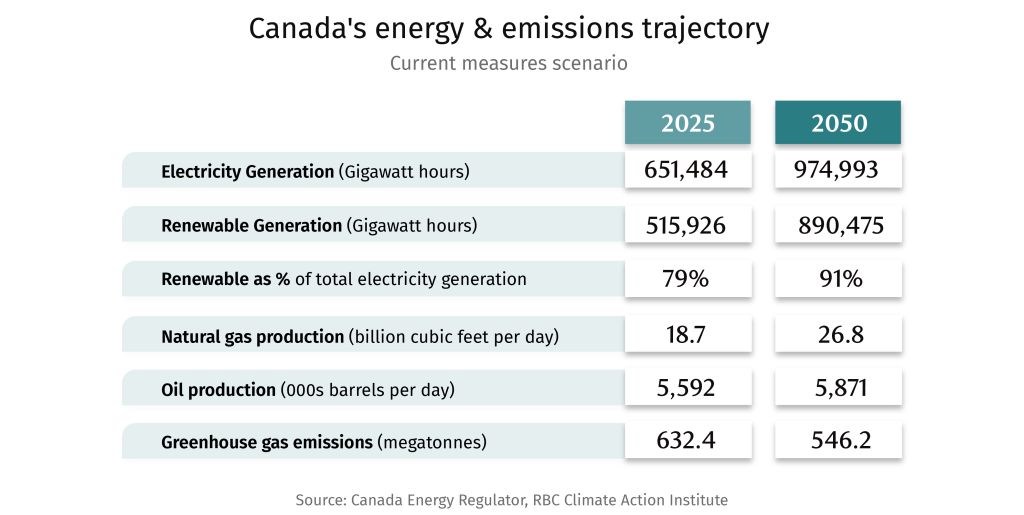
Published two weeks into the war on Iran—what could prove to be one of the most cataclysmic energy events of this century—the report offers multiple paths for Canadian energy and electricity growth and emissions contraction.
-
Canada is moving beyond net zero: This year’s edition retains the Current Measures and Canada Net-Zero Scenarios from Canada’s Energy Future 2023 (EF2023), but adds Higher and Lower Cases that bracket the baseline by varying economic growth, liquefied natural exports, data centre demand, and global energy prices—offering a more plausible ±20% range of outcomes rather than anchoring the analysis around net zero by 2050 as the only destination.
-
Emissions will decline around 14% by 2050. GHG emissions under Current Measures are lower in EF2026 at every point—but a net-zero Canadian economy is nowhere on the horizon. By 2050, EF2026 projects 546 megatonnes (Mt) versus 566 Mt in EF2023, reflecting better near-term decarbonization from policies already in place, particularly in the electricity sector.
-
Sun and wind power will power the grid. Electricity generation under Current Measures is broadly similar across both reports. By 2050, total generation reaches approximately 975 Terawatt-hour (TWh) in the Energy Futures 2026 report compared to 972 TWh (EF2023). The more notable divergence is in the renewables share: EF2026 projects a faster ramp-up, reaching 91% non-emitting generation by 2050 versus 86% in EF2023, with stronger growth from 2035 onward.
-
Canada’s kicking the peak oil can down the road. Oil production is consistent near-term but EF2026 is notably more conservative in the medium term. By 2035, EF2026 projects ~6.0 million barrels per day (bpd) versus 6.5 million bpd in EF2023—converging closer by 2050 at 5.9 versus 6.3 million bpd by 2050. Peak oil production has been pushed out seven years, to 2042 from 2035 prior. The High Scenario projects oil production soaring to 6.4 million bpd.
-
…and firing up natural gas. EF2026 projects substantially higher output in every time horizon, reaching 26.8 billion cubic feet per day (bcfd) by 2050 versus 21.5 bcfd in EF2023—a 25% increase—driven largely by new LNG export assumptions baked into the 2026 modelling.
-
Carbon capture, utilization and storage (CCUS) volumes will likely be marginal. While not specifically broken out in the forecast, about 4% of Canada’s total power generation will be from carbon-captured natural gas in the Current Measures scenario.Total oil and gas emissions are expected to be 176 MT in 2050, down 12% vs 199 MT as modelled in 2025, on the back of a 5% increase in oil and gas production (5.9 million bpd by 2050, compared to 5.6 million bpd in 2025).
-
Canada is trailing peers: Within a global context, under Current Measures, Canada’s emissions decline from 694 Mt in 2023 (latest available data) to 562 Mt by 2035 is a 23% reduction from its 2005 baseline of approximately 730 Mt. That puts Canada marginally behind the U.S., where Rhodium Group projects a 26–35% reduction below 2005 levels by 2035. Both trail the EU considerably—the EU is on track for roughly a 45–47% reduction by 2035 under current and planned measures. All three are falling short of net-zero without additional policy action.
A handbook for climate hopefuls
Fred Pearce, a UK-based science writer and public speaker, who has authored a few ominously titled books over the years: When the Rivers Run Dry, The Land Grabbers and With Speed and Violence, has a change of tone with Despite it All: A Handbook for Climate Hopefuls. In it, heaims to tell stories about “hope amid the gloom.”
Here’s an excerpt from a short email exchange:
What makes you hopeful?
We remain in deep peril. Every tonne of greenhouse gases added to the atmosphere sticks around for centuries. But my hope lies in the extraordinary progress we have made technically. China, and increasingly India and other fast-developing countries, are adopting solar power as their default source of energy, because it is so cheap. That was unimaginable even 20 years ago. The Chinese are now transforming the cost of batteries so we can store the sun’s energy, rather than just tapping it real-time. We are entering the solar age. It is economics now, not politics, that is making the difference. Whether it is happening fast enough remains as issue. But it is happening.
One of the reasons you give for your optimism are smaller families and an ageing population—but isn’t that going to impact economic growth and government’s ability to support citizens?
It’s a new kind of population bomb. The fear is of a growing number of aged economic “dependents”, and fewer people of working age to support them. Ageing could also slow economic activity by undermining innovation from young go-getters. We have to rethink the old: see them as a source of wisdom and knowledge, as carers as well as the cared for. I am 74 now and still working, so I would say that! But let’s also remember we have fewer children to care for, and today most women are economically active, not at home to bring up the kids.
What worries you the most?
Cliff-edges, points of no return. Melting ice sheets on Greenland and Antarctic and the resulting rising sea levels may soon be unstoppable—even if temperatures come back down. Deforestation in the Amazon may be near the point where lack of trees dries out the air so the remaining trees die off. And the ocean circulation system could be close to collapse, switching off the Gulf Stream. Then there is melting permafrost unleashing methane, a potent greenhouse gas that would supercharge warming. Again, unstoppable. Science cannot tell us yet where or when we may trigger such tipping points. So even as we make remarkable ground in ending our addiction to carbon-based fuels, my fear is it could be too late to avoid these great regime shifts. We may be lucky; we may not.
Conversations
-
Failure to value and account for natural assets are among the four barriersholding back climate adaptation initiatives in Canada,write C.D. Howe senior fellow James Stewart and Anabela Bonada, managing director at the Intact Centre on Climate Adaptation, University of Waterloo.
-
Gavin Mooney at the Energy Transition Advisor explores how rapid solar power deployment helped Pakistan cushion its crushing dependence on Middle East natural gas.
-
Canada is entering one of the largest electricity buildouts in its history. If it’s going to succeed, Indigenous Nations must be at the centre—not on the sidelines, write Kwatuuma Cole Sayers and Blake Shaffer in an op-ed.
-
As energy systems are struggling to transform in the face of climate change, Justice in Canada’s Energy Transition report asserts that justice and equity are central to making a low-carbon economy sustainable, writes Julie MacArthur, a co-editor of the report.
-
“Excessive heat warnings, red flag warnings for wildfire conditions, and monthly temperature records being shattered yet again… this is easily one of the most anomalous out-of-season heatwaves that I’ve observed,” says climate scientist Zachary Labe about the current season.
Curated by Yadullah Hussain, Managing Editor, RBC Climate Action Institute.
Climate Crunch would not be possible without John Stackhouse, Sarah Pendrith, Jordan Brennan, John Intini, Farhad Panahov, Lisa Ashton, Shaz Merwat, Vivan Sorab, Caprice Biasoni and Lavanya Kaleeswaran.
Have a comment, commendation, or umm, criticism? Write to me here (yadullahhussain@rbc.com)
Climate Crunch Newsletter
This article is intended as general information only and is not to be relied upon as constituting legal, financial or other professional advice. The reader is solely liable for any use of the information contained in this document and Royal Bank of Canada (“RBC”) nor any of its affiliates nor any of their respective directors, officers, employees or agents shall be held responsible for any direct or indirect damages arising from the use of this document by the reader. A professional advisor should be consulted regarding your specific situation. Information presented is believed to be factual and up-to-date but we do not guarantee its accuracy and it should not be regarded as a complete analysis of the subjects discussed. All expressions of opinion reflect the judgment of the authors as of the date of publication and are subject to change. No endorsement of any third parties or their advice, opinions, information, products or services is expressly given or implied by Royal Bank of Canada or any of its affiliates.
This document may contain forward-looking statements within the meaning of certain securities laws, which are subject to RBC’s caution regarding forward-looking statements. ESG (including climate) metrics, data and other information contained on this website are or may be based on assumptions, estimates and judgements. For cautionary statements relating to the information on this website, refer to the “Caution regarding forward-looking statements” and the “Important notice regarding this document” sections in our latest climate report or sustainability report, available at: https://www.rbc.com/our-impact/sustainability-reporting/index.html. Except as required by law, none of RBC nor any of its affiliates undertake to update any information in this document.