

 EN
EN 

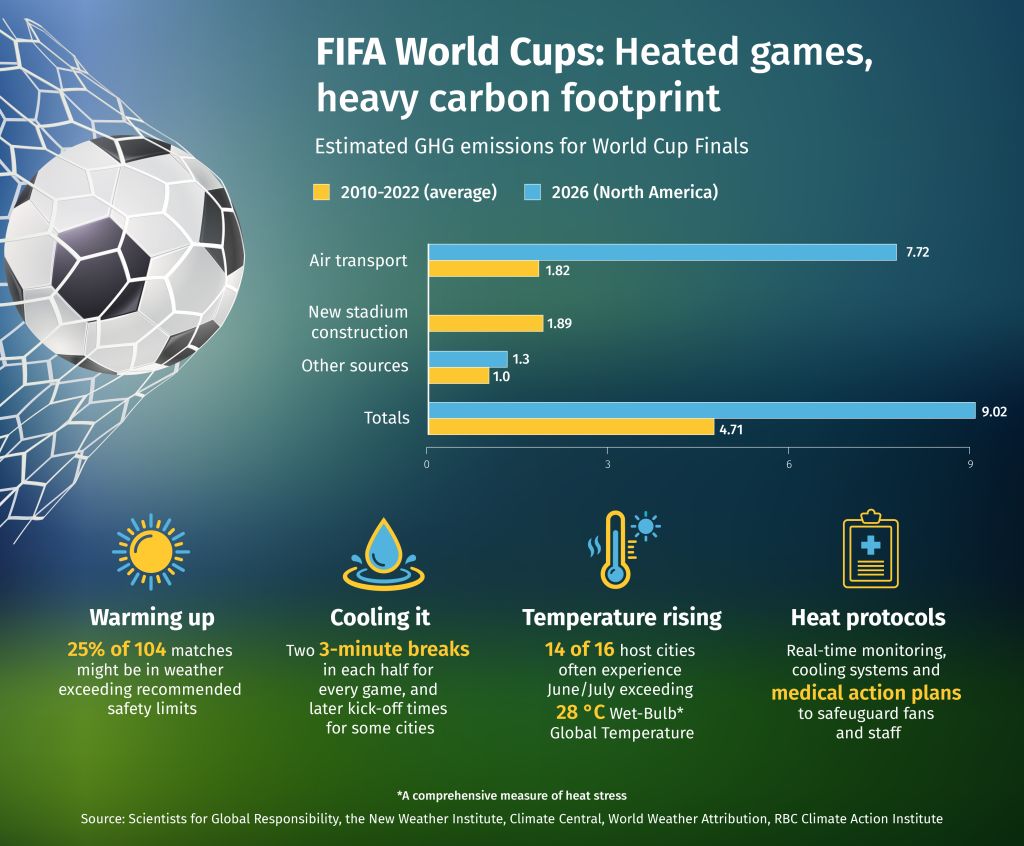
➔ The beautiful game’s rising carbon footprint
➔ How to acknowledge, encourage and scale conservation
➔ Notes from the U.S.-Canada Summit: Canada must play its critical minerals, and nuclear cards strategically
Signals
-
The Canadian Deep Geothermal Coalition will develop the country’s first national geothermal energy roadmap. Ottawa tasked the group— comprising industry and Indigenous leaders, researchers, policymakers—to tap a nascent clean industry that has caught the eye of 50 jurisdictions globally.
-
Quebec rolled back its target of 100% zero-emissions sales by 2035. It’s now 80%, a “balanced approach,” the government said, that accounts for supply chain challenges facing the global auto industry. In March, Ontario Premier Doug Ford urged Quebec and British Columbia to drop their EV sales targets to boost the country’s competitiveness.
-
It will be a sizzling summer of soccer. As 48 teams clash in the FIFA World Cup, they are also facing another formidable opponent: unusually hot weather, and El Nino, a natural warming cycle, that will “pour fuel on the fire of a warming world,” according to UN Secretary General António Guterres. The event, hosted by Canada, the U.S. and Mexico, also has a heavy carbon footprint.
Hidden in Plain Sight: Recognizing conservation on working lands
In a guest commentary, Catherine Grenier, President & CEO, Nature Conservancy of Canada, writes about assigning value to nature.
From agriculture and forestry to municipalities and mining, many sectors are actively managing their lands in ways that deliver real, measurable conservation outcomes. But these outcomes are not properly acknowledged or reflected on balance sheets. These outcomes do not formally advance conservation targets or inform conservation decision-making, and are not included in the frameworks that assign value to nature.
It is time to acknowledge these sectors more intentionally as contributors to the conservation community and conversation. Together, we can identify and advance practical approaches to using our lands that continue to support biodiversity outcomes.
OECMs: Acknowledge, encourage, scale
The first step in deepening this collaboration is formally acknowledging the work that is already being done. One approach is through Other Effective Area-Based Conservation Measures (OECM) recognition.
OECMs are sites, other than Protected Areas, that achieve effective, long-term conservation–even though they are managed primarily for other reasons. They offer a way to value and sustain strong land management practices, which allows biodiversity to persist over the long term.
Consider, for example, the choices cities make to protect drinking water through land-use restrictions and watershed management. Or how landowners and corporations exempt portions of forestland from active logging and industrial extractive use. Ranchers support conservation-compatible activities like grazing native grasslands. Green infrastructure sustains wildlife connectivity by limiting the land fragmentation caused by human development.
OECM recognition is one way to make these long-term commitments visible and credible, offering something real to show in markets that are increasingly asking about environmental contributions.
OECMs in action
Earlier this year, the city of Saint John, New Brunswick, formally recognized 4,800 hectares of city-owned land as having special conservation status. The land includes mature, intact forests, lake shorelines, and rich wetlands that are used to enhance and safeguard the city’s drinking water supply, with its benefits extending beyond the health and well-being of its citizens.
In 2022, J.D. Irving, Limited, became the first forestry company in Canada to have some of its land recognized as an OECM: nearly 10,000 hectares of Acadian forest and coastline. This land supports public commitments and recreational use, while also conserving some of the province’s most unique and species-rich areas.
The path forward
OECMs are not new, but the federal government’s recently released Strategy to Protect Nature has reinvigorated a policy environment that can accelerate their use. Collectively, we have an opportunity to define the path forward, embrace innovation, collaborate on new ways to engineer solutions for, and with, partners whose efforts are not currently being accounted for.
For conservation leaders, this means exploring ideas like: How and where are industry-led management decisions leading to durable conservation outcomes? How can these management practices be strengthened and supported for the long term? And where is there opportunity to develop tools that can respond to both industry and biodiversity needs?
OECM recognition has gained momentum on working ranches, within sustainably managed forests, in municipalities, and within research and recreation landscapes. The opportunity ahead lies in working alongside industry to dig deeper, get creative, and determine where else they might apply.
This approach also opens the door to greater recognition, more meaningful support, and stronger community engagement. It makes clear that when considered together, nature and economics can work harmoniously.
Conversations
-
In the new world order, Canada will need to play its many cards more assertively: low-carbon natural gas, critical minerals, food and fertilizer, nuclear fuel, and a stable rule-of-law environment that capital increasingly prizes, notes John Stackhouse, Senior Vice-President, Office of the CEO, RBC, in his analysis of the recently-concluded U.S.-Canada Summit hosted by RBC and the Eurasia Group.
-
At the Climate Smart Buildings Alliance 2026 Leadership Summit industry leaders explored ways building and construction sectors can drive Canada’s economic growth while meeting our climate commitments. Stephanie Shewchuk from RBC Thought Leadership engaged with the ideas and innovators driving this conversation forward. Read some of the highlights from the event here.
-
At London Climate Action Week next week, more than 75,000 attendees will discuss the state of energy transition, supply chains, energy security, sustainable cities, and carbon removal, among others. Are you attending? Send us your thoughts. #LCAW2026
-
The rise of batteries shoots down the argument that “the wind doesn’t always blow, and the sun doesn’t always shine,” notes Alison Reeves, program director at Grattan Institute. “Who cares any more if we can store electricity at scale?”
Curated by Yadullah Hussain, Managing Editor, RBC Climate Action Institute.
Climate Crunch would not be possible without John Stackhouse, Jordan Brennan, John Intini, Farhad Panahov, Lisa Ashton, Shaz Merwat, Vivan Sorab, Caprice Biasoni, Lavanya Kaleeswaran and Joelle Schonberg .
Have a comment, commendation, or umm, criticism? Write to me here (yadullahhussain@rbc.com)
Climate Crunch Newsletter
This article is intended as general information only and is not to be relied upon as constituting legal, financial or other professional advice. The reader is solely liable for any use of the information contained in this document and Royal Bank of Canada (“RBC”) nor any of its affiliates nor any of their respective directors, officers, employees or agents shall be held responsible for any direct or indirect damages arising from the use of this document by the reader. A professional advisor should be consulted regarding your specific situation. Information presented is believed to be factual and up-to-date but we do not guarantee its accuracy and it should not be regarded as a complete analysis of the subjects discussed. All expressions of opinion reflect the judgment of the authors as of the date of publication and are subject to change. No endorsement of any third parties or their advice, opinions, information, products or services is expressly given or implied by Royal Bank of Canada or any of its affiliates.
This document may contain forward-looking statements within the meaning of certain securities laws, which are subject to RBC’s caution regarding forward-looking statements. ESG (including climate) metrics, data and other information contained on this website are or may be based on assumptions, estimates and judgements. For cautionary statements relating to the information on this website, refer to the “Caution regarding forward-looking statements” and the “Important notice regarding this document” sections in our latest climate report or sustainability report, available at: https://www.rbc.com/our-impact/sustainability-reporting/index.html. Except as required by law, none of RBC nor any of its affiliates undertake to update any information in this document.