

 EN
EN 


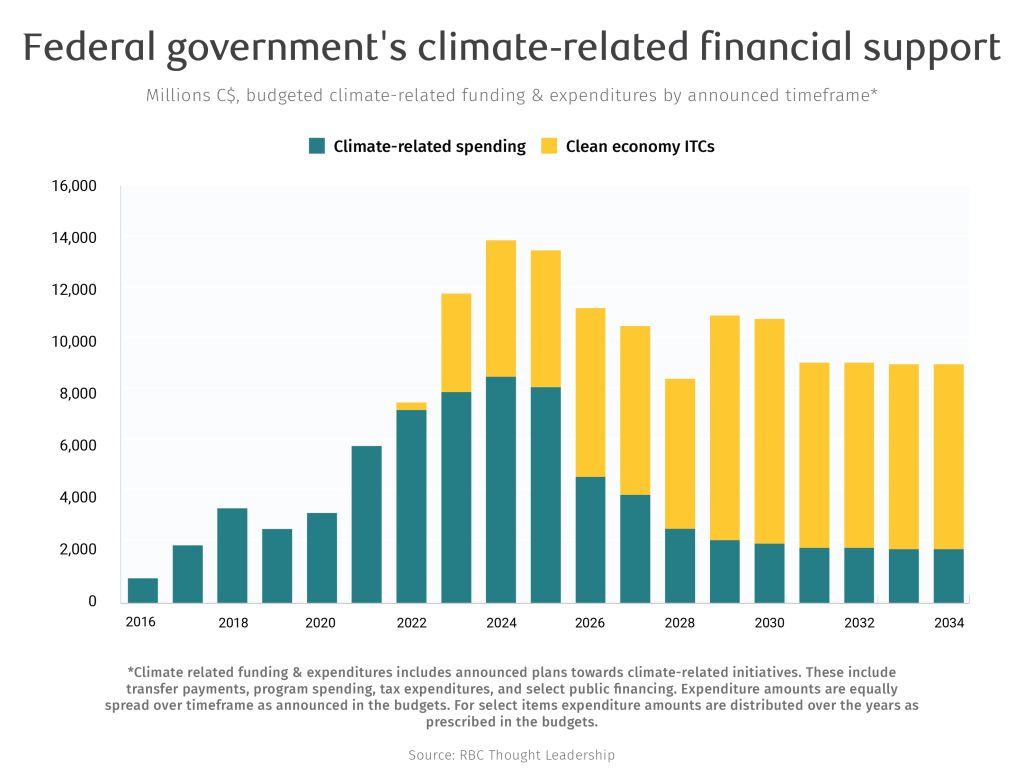
Consumer carbon pricing—scrapped. Electric vehicle mandate—delayed. Oil and gas emissions cap—all but gone. The headlines suggest Canada’s climate ambition is in retreat. However, much of the climate action-enabling capital has already been locked and loaded, with an estimated nearly $100 billion worth of incentives—by our count—ready to be deployed between now and 2035 for clean-tech and climate programs and initiatives.1
As part of the Climate Action Report 2026, which will be released on January 13, we analyzed the various federal government’s climate policy and commitments over the decades.
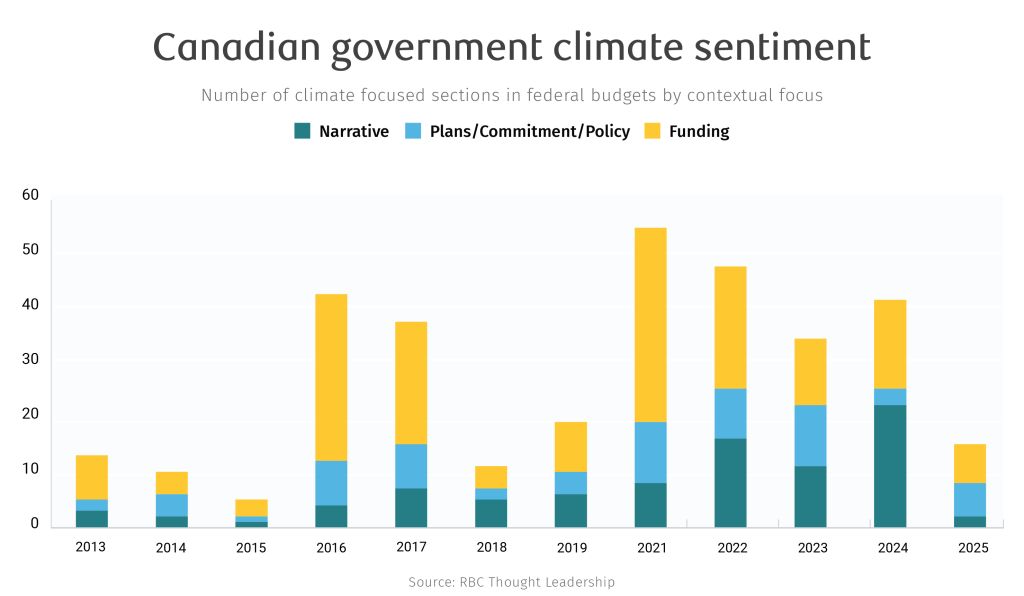
For the Canadian Government Climate Sentiment we used OpenAI’s advanced reasoning models to curate and analyze contextual framing of climate and related topics to assess government resolve around climate.
Federal Budgets: Evolving climate narrative
Our research applied the analysis to federal government budgets across three main categories: narrative (references to climate trends and past actions), policy, commitments and plans signalling government intentions, and new funding announcements.
-
The Trudeau years were packed with talk—and action. Climate talk hit its highest levels during the pandemic years. Justin Trudeau’s Liberal government started strong with a number of climate focused funding announcements in its first federal budget in 2016 to about $6 billion, according to our count.2
-
Climate funding has been frontloaded. Since 2016, cumulative budgeted climate-related spending has risen to $150 billion. Clean economy Investment Tax Credits of around $78 billion as initially announced are already in place and will support adoption of low-carbon technologies for another decade into the 2030s.3 Program spending, transfer payments and other tax expenditures accounted for another $70+ billion in financial support.4
We track climate related funding and expenditures announced in the budgets of the federal government and the four largest provincial governments (British Columbia, Alberta, Ontario and Quebec). This includes announced plans towards climate- and environment-related initiatives focused on decarbonization, innovation energy efficiency, fuel switching, clean and low-carbon technology manufacturing and deployment, skills, research and planning. It also includes transfer payments, program spending, tax expenditures, and select public financing. Total expenditure amounts are equally spread over timeframe announced in the budgets. For select items expenditure amounts are distributed over the years as prescribed in the budgets.
This number only refers to data calculated from the 2016 federal budget. It’s based on our tracking of budgeted climate-related spending from the federal government and the four largest provinces.
Based on original announcements across federal budgets. Budget 2024 updates the total value to $93 billion, and PBO’s Long-Term Fiscal Cost of Major Eco-nomic Investment Tax Credits estimates the cost at $103 billion.
This article is intended as general information only and is not to be relied upon as constituting legal, financial or other professional advice. The reader is solely liable for any use of the information contained in this document and Royal Bank of Canada (“RBC”) nor any of its affiliates nor any of their respective directors, officers, employees or agents shall be held responsible for any direct or indirect damages arising from the use of this document by the reader. A professional advisor should be consulted regarding your specific situation. Information presented is believed to be factual and up-to-date but we do not guarantee its accuracy and it should not be regarded as a complete analysis of the subjects discussed. All expressions of opinion reflect the judgment of the authors as of the date of publication and are subject to change. No endorsement of any third parties or their advice, opinions, information, products or services is expressly given or implied by Royal Bank of Canada or any of its affiliates.
This document may contain forward-looking statements within the meaning of certain securities laws, which are subject to RBC’s caution regarding forward-looking statements. ESG (including climate) metrics, data and other information contained on this website are or may be based on assumptions, estimates and judgements. For cautionary statements relating to the information on this website, refer to the “Caution regarding forward-looking statements” and the “Important notice regarding this document” sections in our latest climate report or sustainability report, available at: https://www.rbc.com/our-impact/sustainability-reporting/index.html. Except as required by law, none of RBC nor any of its affiliates undertake to update any information in this document.