

 EN
EN 

➔ Can the Canada-Alberta methane deal deliver both rising oil and gas production and falling emissions?
➔ Why Canada’s clean trade is in the red
➔ A British Columbia city leads on heat bylaws
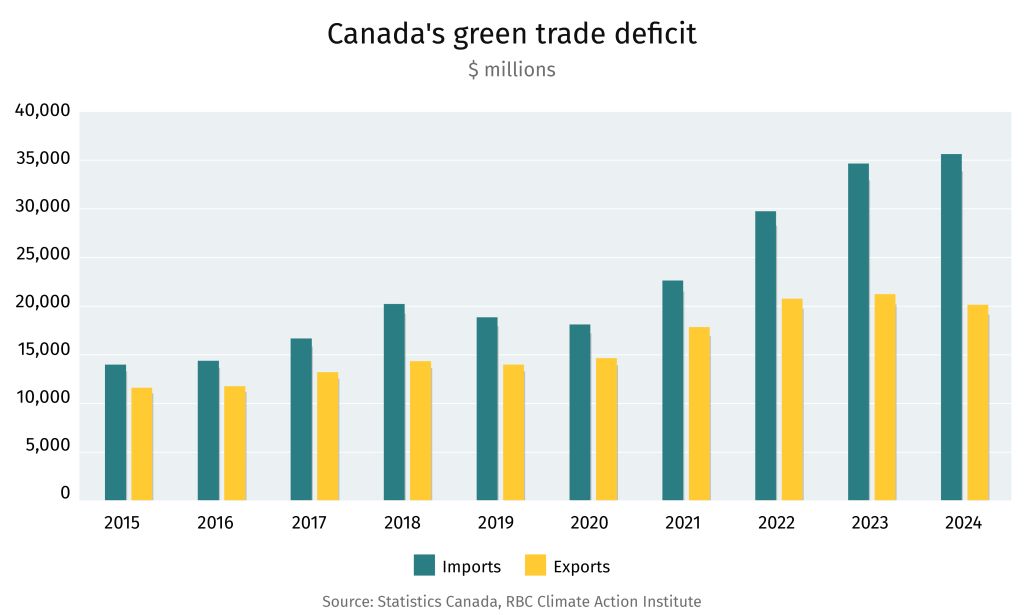
➔ Canada’s clean-tech trade deficit is growing. The country’s environmental and clean tech (ECT) trade deficit has steadily risen to $15.6-billion in 2024 compared to $2.4 billion a decade ago, Statistics Canada’s latest data shows. Imports of clean electricity—Canada’s prized climate ace—have surged in recent years, just as exports fell due to drought conditions and growing domestic electricity demand. Clean tech hardware, spanning wind turbines, electric vehicles, water treatment equipment, accounted for around 80% of the growth in imports, aligned with strong adoption and deployment trends in Canada over the same period, says Economist Farhad Panahov
➔ The EU created the bloc’s first voluntary scheme for carbon removal credits. The credits produced under the Carbon Removals and Carbon Farming (CRCF) Regulation are being designed for the voluntary carbon market, to boost scalability and help the EU meet its net-zero 2050 targets. It could be a model for Canada: the agriculture sector has a patchwork of pathways to enter compliance and voluntary market opportunities, but with limited availability of compliance protocols that recognize the role of farmers in building the country’s carbon sinks through sustainable practices, says Lisa Ashton , Interim Head of RBC’s Climate Action Institute. However, the Canada-Alberta energy MoU and carbon pricing benchmark review potentially open the door for Canada to streamline farmers’ ability to access carbon markets.
➔ Hydro Quebec wants households to generate their own energy. A new $1,000 per kW grant for solar kits aims to cover up to 40% of eligible project costs. Quebec is a laggard compared to other North American jurisdictions on solar as cheap hydroelectricity meant 25-30-year payback periods made solar uneconomical. That’s changing. As Hydro-Québec develops alternative power sources and redirects surplus hydro for exports and industry, distributed generation eases the strain on the grid. Indeed, households can even sell excess power back to the grid. The new incentives aim to drop investment costs from $36,000 to $24,000—a payback period of 10-12 years. While that’s a long time to recoup costs, it’s hard to compete with the lowest electricity prices on the continent. In contrast, in Pakistan, which is in the midst of a solar revolution, a similar set up would cost $6,500, estimates Energy Policy Lead Shaz Merwat. Also read our report on how smart homes can unlock grid efficiencies.
Gathering wind in the Atlantic
Newfoundland and Labrador could be among the major drivers of wind power in Canada. The Canada Energy Regulator’s latest projections (Canada’s Energy Future 2026 ) expects the Atlantic province to emerge as an offshore wind powerhouse, accounting for a sizeable chunk of new wind power capacity by 2050, along with Alberta.
Shaz Merwat examines the Atlantic province’s wind prospects:
-
Wind, primarily offshore, could make up 13.3 gigawatts of electricity capacity by 2050 in the province, from negligible numbers today, according to CER’s base case (which it calls its Current Measures Scenario).
-
The province’s total electricity capacity is set to triple, with 98% from renewables by 2050 (compared to around 87% today).
-
The CER is betting big on Newfoundland. The province has world-class wind conditions but virtually no wind industry at present, and given some major setbacks involving planned green hydrogen demand anchors recently, it likely presents more market risk.
-
Offshore wind development is also constrained by deep water and floating turbine costs. The transmission corridor needed to move power to the Quebec market remains a multi-billion-dollar proposal without a final investment decision, but will be needed if NL is to build upon its hydro exports to Quebec and Atlantic Canada scaled for wind.
-
Alberta could present another challenge to Canada’s effort to ramp up wind power. The province has the resource and the grid as Canada’s largest wind producer. But new wind investment has essentially frozen, the result of policy uncertainty that has yet to thaw.
-
Wind’s build up rides heavily on Alberta and Newfoundland that are expected to add about 16 GW and 13 GW, respectively, in the CER’s base scenario, accounting for much of the 72 GW of capacity additions by 2050 across Canada.
-
By 2050, wind is expected to account for 30% of Canada’s total generative capacity, compared to just 11% in 2025, according to the CER outlook.
Ottawa and Alberta’s big methane deal
By Vivan Sorab
Ottawa and Alberta’s recent agreement-in-principle on methane equivalency sets the stage for Alberta to regulate methane its own way.
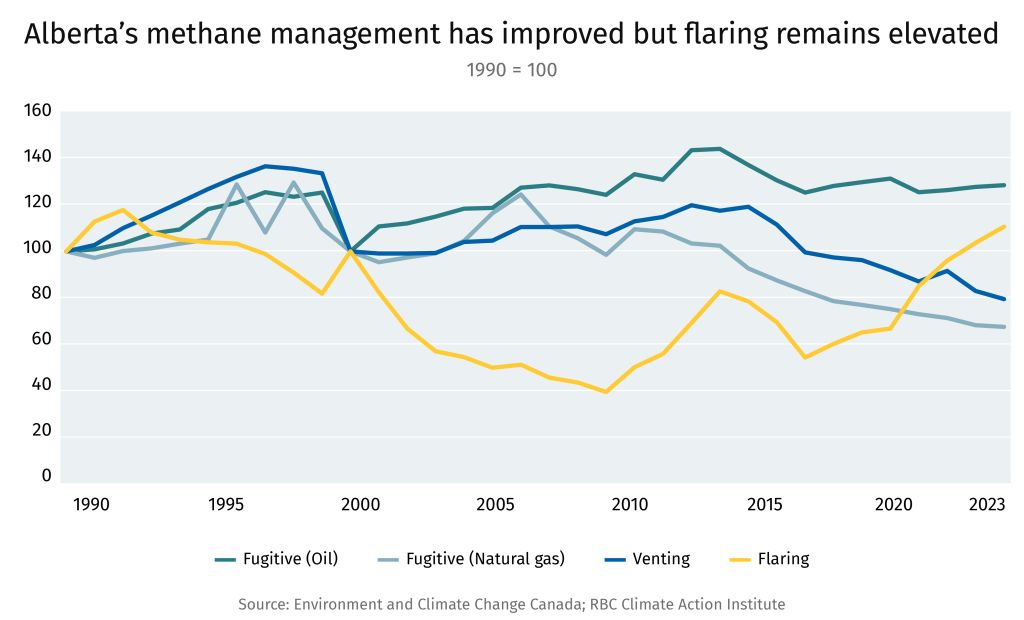
Cutting methane emission is considered one of the lowest-cost, highest-impact action levers available for near-term climate progress. Methane has roughly 80 times the warming impact of carbon dioxide over a 20-year period, and accounts for nearly a quarter of the Canadian oil and gas sector’s total greenhouse gas emissions.
The equivalency deal suspends Ottawa’s Enhanced Methane Regulations and allows Alberta to implement its own performance-based approach, comprising a mix of provincial regulations, offset credits, and targeted investments, with methane modelling, emissions reductions analysis, and reduction results overseen by a jointly appointed and cost-shared third party.
New provincial rules will take effect on January 1, 2027, and the agreement would run for a decade, replacing the current equivalency agreement, which is set to expire in October 2030. If reductions fall short, Alberta has committed to corrective action.
Here are some insights:
-
There’s real momentum behind this. Alberta has already cut methane emissions by more than 50% from 2014 levels, backed by roughly $172 million in reduction technology investments since 2019 and more than 58,000 low- or no-bleed devices installed through the province’s carbon-offset system.
-
Agreement to third-party emissions verification is an important step given previous discrepancies between industry-reported figures and independent studies.
-
The 2035 target extends Alberta’s timeline for compliance by five years relative to existing federal methane regulations, while raising the compliance threshold to 75% reductions versus 72% previously.
-
Canada’s methane mitigation sector has grown to more than 130 firms. Compliance actions under federal regulations could generate 34,000 jobs from 2027 to 2040, according to one estimate.
-
Companies looking to position ahead of the compliance date could leverage this rapidly evolving technology suite, including a specific focus on monitoring and measurement, such as through facility-level monitoring, and satellite- and aircraft-based detection technologies.
-
A draft equivalency agreement is expected later this year, followed by a 60-day public consultation, with both sides aiming to finalize it by year-end.
-
Two other Canada-Alberta MoU commitments, namely industrial carbon pricing equivalency and a trilateral agreement with Pathways Alliance partners, remain outstanding.
Ottawa and Alberta are betting that cooperative, outcome-based regulation can deliver both rising oil and gas production and falling emissions. Whether the details hold up to scrutiny will determine if this model becomes a blueprint.
Conversations
-
British Columbia dropped its EV sales target to 75% by 2035 (from 100%) to align with federal goals. The Pembina Institute’s Adam Thorn is “encouraged”, but Brian Kingston, CEO at Canadian Vehicle Manufacturers’ Association, is “disappointed” that B.C. is sticking to its provincial EV mandate.
-
New Westminster wants to avoid another “heat dome” episode: After the B.C. city had the highest fatality rate during the 2021 heat dome, it became the first Canadian city to pass a maximum heat bylaw, requiring landlords to keep at least one room in a rented apartment at or below 26 C. “While imperfect… this is a recognition that more heat waves are coming, and we all need to adapt,” says Colin Chan, Executive Director of B.C.’s Provincial Health Service Authority.
-
Solar hit a tipping point. “Overall, solar has already been cheaper than fossil power for a while, but upfront costs used to be higher,” says Nicolas Fulghum, senior energy and climate data analyst at Ember.
-
Fast follow: Jesse Jenkins, Associate Professor of Energy Policy at Princeton University, is the most influential digital voice in U.S. clean energy. Here’s a list of the other 99 influential U.S. climate heavyweights.
Curated by Yadullah Hussain, Managing Editor, RBC Climate Action Institute.
Climate Crunch would not be possible without John Stackhouse, Jordan Brennan, John Intini, Farhad Panahov, Lisa Ashton, Shaz Merwat, Vivan Sorab, Caprice Biasoni, Lavanya Kaleeswaran, Joelle Schonberg and Alicja Siekierska.
Have a comment, commendation, or umm, criticism? Write to me here (yadullahhussain@rbc.com)
Climate Crunch Newsletter
This article is intended as general information only and is not to be relied upon as constituting legal, financial or other professional advice. The reader is solely liable for any use of the information contained in this document and Royal Bank of Canada (“RBC”) nor any of its affiliates nor any of their respective directors, officers, employees or agents shall be held responsible for any direct or indirect damages arising from the use of this document by the reader. A professional advisor should be consulted regarding your specific situation. Information presented is believed to be factual and up-to-date but we do not guarantee its accuracy and it should not be regarded as a complete analysis of the subjects discussed. All expressions of opinion reflect the judgment of the authors as of the date of publication and are subject to change. No endorsement of any third parties or their advice, opinions, information, products or services is expressly given or implied by Royal Bank of Canada or any of its affiliates. This document may contain forward-looking statements within the meaning of certain securities laws, which are subject to RBC’s caution regarding forward-looking statements. ESG (including climate) metrics, data and other information contained on this website are or may be based on assumptions, estimates and judgements. For cautionary statements relating to the information on this website, refer to the “Caution regarding forward-looking statements” and the “Important notice regarding this document” sections in our latest climate report or sustainability report, available at: https://www.rbc.com/our-impact/sustainability-reporting/index.html. Except as required by law, none of RBC nor any of its affiliates undertake to update any information in this document.