

 EN
EN 

How dependent is the U.S. on Canadian electricity to power its homes and industries? Could electricity serve as a point of leverage in Ottawa’s trade negotiations with Washington?
These questions emerged after Ontario Premier Doug Ford imposed a 25% surcharge on its electricity exports to the U.S. border states of New York, Michigan and Minnesota—only to scrap it after Washington threatened to double tariffs on Canadian steel and aluminum. Electricity flowing between Canada and the U.S. are exempt from tariffs under USMCA, which explains why the Ontario government imposed a surcharge on electricity exports, a de facto export tax.
While Ontario’s threat has died down—for now—, the episode highlights the significance of Canadian electricity in cross-border trade dynamics. We shed some light on the continental power trade flow and whether electricity could be a card worth playing in Ottawa’s negotiations with Washington.
Powering the U.S.
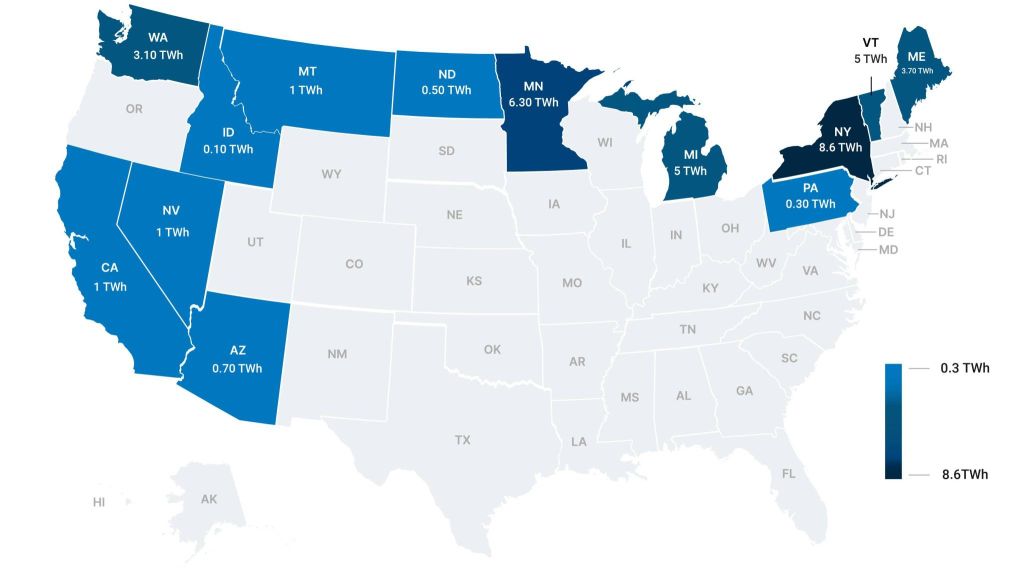
Canadian electricity exports to the U.S., by state (2024)
Source: Analysis of Statistics Canada data by RBC Thought Leadership
Four provinces dominate
Last year, Canada sent 35 terawatt-hours (TWh) of electricity to the U.S.–that’s less than 2% of total U.S. electricity generation—adding $3.4 billion to the Canadian economy. But some states are more dependent on Canadian power than others.
The movement of electricity within the continent follows a north-south axis, mirroring the broader trade pattern for physical goods. Four provinces dominate the Canada-U.S. electricity trade–Quebec, Ontario, British Columbia and Manitoba, accounting for 86% of exports.
Until 2022, Quebec had been the largest exporter, with one-third of Canada’s electricity exports originating from its border. While it has been surpassed by Ontario recently, that’s more a function of lower hydroelectric power output in Quebec due to droughts, and not a surge in the terawatt-hours (TWh) Ontario sends down to neighbouring states.
And it’s not entirely a one-way traffic. Occasionally, U.S. power surges back into Canada, with the above-mentioned four provinces also the biggest beneficiaries of these imports, accounting for 95% (21 TWh) of all U.S. electricity imports, especially in times of drought. British Columbia is the biggest buyer of American electricity, accounting for 57% of imports. Controlling for drought conditions and B.C.’s supply shortage—which will be resolved once the Site C hydroelectric dam runs at full capacity later this year—, Canada’s annual reliance on U.S. power would be 10 times smaller to around 2 TWh.
Canada Provides the U.S. with Enough Electricity to Power 3.4 Million Homes Annually
Provincial breakdown of electricity trade (2024)
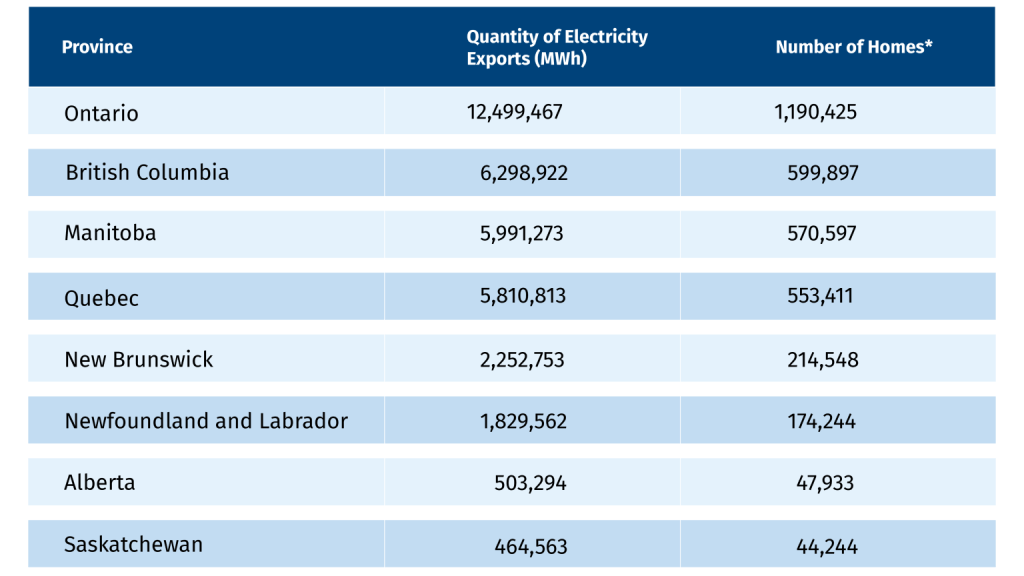
*Numbers based on the power consumed by the average American home annually.
Source: Analysis of Statistics Canada data by RBC Thought Leadership
Maine and Minnesota are most dependent on Canada
Electricity as a bargaining tool in trade negotiations depends on the province’s market share in various U.S. jurisdictions.
While New Brunswick only accounted for 11% of Canadian electricity exports in 2023, the 5.5 TWh of power accounted for 44% of Maine’s power needs. When imports from Quebec and Newfoundland are added to the mix, Maine’s dependence on Canadian electricity jumps to 64%.
Similarly, Manitoba provided 13% of Minnesota’s electricity needs in 2023, a figure that’s expected to grow this summer. The Midcontinent Independent System Operator (MISO), which oversees transmission in several Midwest states including Minnesota, is anticipating a supply shortfall due to a confluence of events: the retirement of coal-fired power plants, growing demand, and slower than anticipated new generation assets coming online1.
Sourcing additional power from neighbouring system operators, Southwest Power Pool and PJM Interconnection are limited, as the grids operated by these systems operators are also facing a similar challenges2. That could leave Minnesota more reliant on Manitoba’s grid.
A weak hand?
For Quebec and Ontario, electricity is a weak hand to play. While Ontario supplies 6% of Michigan’s electricity needs, much of it is pushed out to neighbouring states, mainly Ohio and Indiana. New York, meanwhile, is reliant on Quebec and Ontario for 6% of its power.
Could the U.S. states easily switch to alternatives if Canada slaps new surcharges? New York is part of the Northeast Power Coordinating Council (NPCC), (which also includes Quebec, Ontario) and six New England states that can emerge as viable alternative suppliers. However, by 2026 demand growth in the northeast region is anticipated to cause a supply shortfall.
A co-ordinated strategy is required for Ontario and Quebec, if electricity is to be an effective bargaining chip with the U.S. administration. That may be tough for Quebec, as Hydro Quebec has an offtake agreement with New York’s independent system operator that may limit additional service level changes and charges outside of the contract.
What to watch for as trade tensions simmer
The Ontario government says electricity surcharges remain on the table as a retaliatory measure against any future U.S. trade actions. With reciprocal U.S. tariffs expected on April 2, Ontario may once again proceed with its credible threat of imposed the surcharge—as it briefly did on March 10.
A hot summer could further strengthen Ontario’s case. Keeping the lights on and air-conditioning running without Canadian electricity could prove to be challenging this summer for strained U.S. state grids. And that may prove to be the ultimate power play for Ontario, and other provinces.
But rather than a blunt negotiating tool, electricity trade represents a strategic asset for Canada—one that can help build deeper energy co-operation with the U.S. while ensuring stability for both economies.
Myha Truong-Regan is Head of Climate Research, RBC Climate Action Institute.
1. NERC 2024 Long-Term Reliability Assessment
2. Ibid
This article is intended as general information only and is not to be relied upon as constituting legal, financial or other professional advice. A professional advisor should be consulted regarding your specific situation. Information presented is believed to be factual and up-to-date but we do not guarantee its accuracy and it should not be regarded as a complete analysis of the subjects discussed. All expressions of opinion reflect the judgment of the authors as of the date of publication and are subject to change. No endorsement of any third parties or their advice, opinions, information, products or services is expressly given or implied by Royal Bank of Canada or any of its affiliates.
This article is intended as general information only and is not to be relied upon as constituting legal, financial or other professional advice. The reader is solely liable for any use of the information contained in this document and Royal Bank of Canada (“RBC”) nor any of its affiliates nor any of their respective directors, officers, employees or agents shall be held responsible for any direct or indirect damages arising from the use of this document by the reader. A professional advisor should be consulted regarding your specific situation. Information presented is believed to be factual and up-to-date but we do not guarantee its accuracy and it should not be regarded as a complete analysis of the subjects discussed. All expressions of opinion reflect the judgment of the authors as of the date of publication and are subject to change. No endorsement of any third parties or their advice, opinions, information, products or services is expressly given or implied by Royal Bank of Canada or any of its affiliates. This document may contain forward-looking statements within the meaning of certain securities laws, which are subject to RBC’s caution regarding forward-looking statements. ESG (including climate) metrics, data and other information contained on this website are or may be based on assumptions, estimates and judgements. For cautionary statements relating to the information on this website, refer to the “Caution regarding forward-looking statements” and the “Important notice regarding this document” sections in our latest climate report or sustainability report, available at: https://www.rbc.com/our-impact/sustainability-reporting/index.html. Except as required by law, none of RBC nor any of its affiliates undertake to update any information in this document.