

 EN
EN 


Eelgrass and Salt Marshes
- Eelgrass is a breed of seagrass found off Canada’s Atlantic, Pacific, Arctic coasts.
- Eelgrass promotes biodiversity and is a habitat for marine life like eels, lobsters, crabs, and cod. Unlike kelp or seaweed, eelgrass develops roots and flowers.
- Salt marshes are found across Canada’s coastline. They act as a transitional zone between terrestrial and marine environments and are a buffer against coastal erosion.
- Salt marshes provide a critical habitat for a variety of plant and animal species.
The great Canadian coastal mapping challenge
Realizing this economic potential could bring significant cross-sectoral benefits: helping fisheries become more resilient, rewarding conservation, and improving national defense through the mapping of seabeds and coastlines. But to make it happen, we’ll need to grapple with many of the same obstacles facing soil sequestration efforts, including scientific challenges that begin with how to measure and verify the carbon sequestered in coastal ecosystems.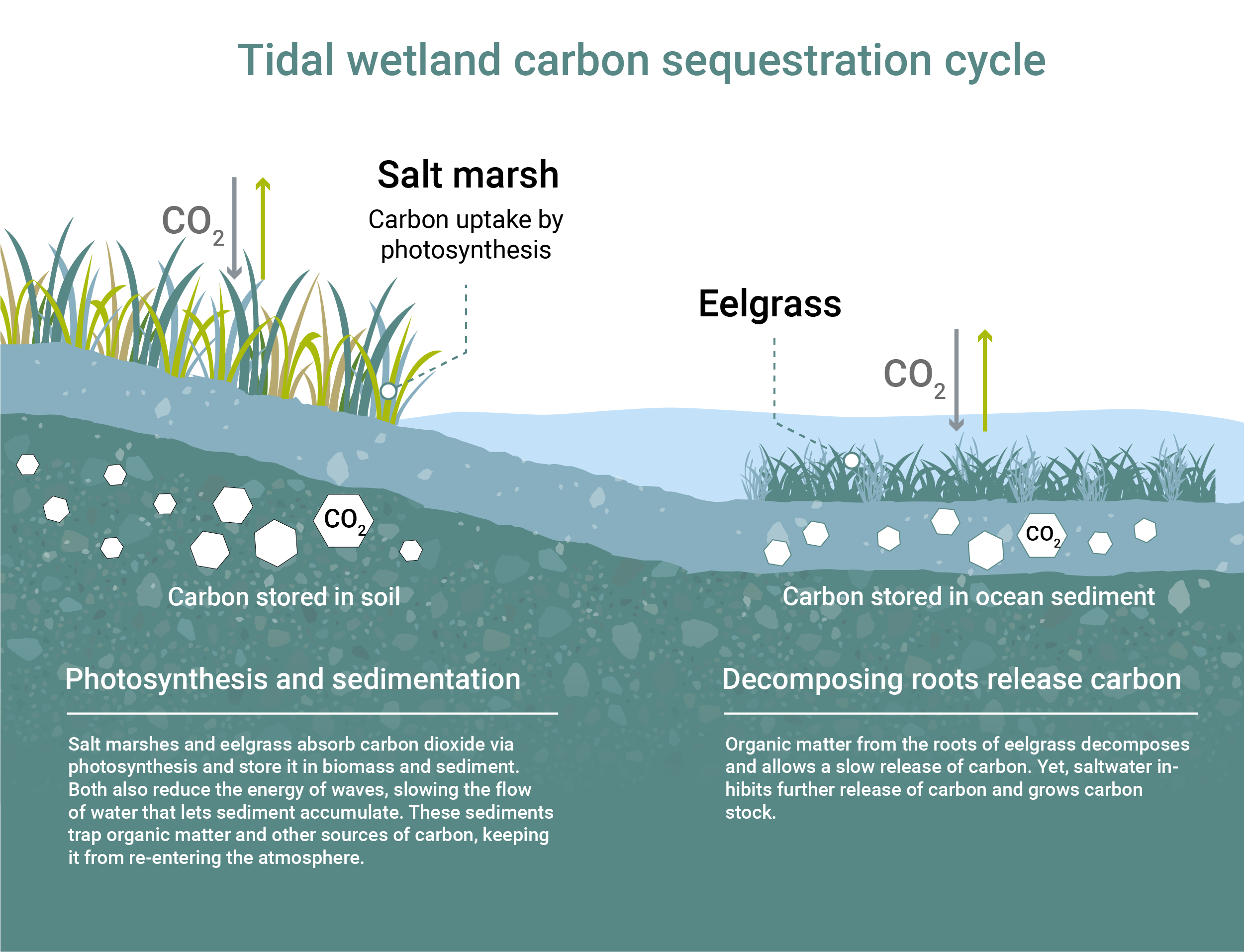
Our most precious blue carbon assets
While other marine organisms, like macroalgae, can sequester and store carbon, eelgrass and salt marshes are the most promising blue carbon assets we have. This is both because of their sizeable current carbon stock and the immediate benefits their ecosystems provide. Through chemistry and the process of photosynthesis in marine organisms, carbon dioxide dissolves in water to create carbonic acid—a form of carbon that doesn’t easily escape the ocean. Eelgrass (a marine plant with ribbon-like leaves) can store twice as much carbon as terrestrial forests while salt marshes can sequester carbon 11 times more efficiently than grasslands and around 125 times more than forests. Roughly 90% of eelgrass meadows in Atlantic Canada have been decimated since the 1930s. And salt marshes in many coastal regions have been converted into agricultural lands or have been flooded to make way for hydroelectric dams. Current figures suggest the global blue carbon market is worth over US$190 billion (81 million metric tons of carbon) with countries like Australia, Indonesia, The Bahamas, and many more involved.ii Despite Canada’s potential to become the largest player in this market, our presence will remain minimal without a national blue carbon strategy. Action is needed now. Here are three key steps for building a made-in-Canada blue carbon strategy:
-
Step 1: Indigenous communities must take the lead

-
Step 2: Start with mapping and research

-
Step 3: Start conserving and restoring eelgrass and salt marshes now
| Type of carbon offset market | Compliance | Voluntary |
|---|---|---|
| Regulated by national, regional, or international reduction regimes |  |
 |
| Open market for trading and generating credits | |
|
| Rely on independent standard bodies | |
|
| Legally mandated reduction of emissions | |
|
| Optional reduction of emissions | |
|
Conclusion: Perfection is the enemy of execution
Canada cannot wait for perfection. We must start executing a blue carbon strategy immediately. To succeed, the federal government should consider adopting a two-pronged approach. First, eelgrass and salt marsh ecosystems that currently store carbon ought to be protected. Policies should be developed with communities that depend on fisheries for their livelihoods to ensure their buy-in and participation in future blue carbon markets. A clear separation of departmental jurisdiction between Environment and Climate Change Canada (ECCC) and Department of Fisheries and Oceans Canada (DFO) can ensure program rollouts aren’t trapped in bureaucratic overlaps. For instance, ECCC has dominion over salt marshes till the high tide line, while DFO manages the ocean at large. Major funding for climate change research is mainly diverted to ECCC, oftentimes leaving DFO’s expertise and research on climate change aside. For this strategy to be effective, both departments ought to be involved and have their roles clearly defined. Through an intergovernmental top-down approach, the federal government can also motivate and guide provinces to collect data on existing blue carbon assets. Second, studies into the carbon stock of eelgrass meadows and salt marshes need further funding. Government should collaborate further with researchers to develop a national blue carbon stock account and understand that promising results will emerge within years, not months. This research will contribute to the policy development of any voluntary market that issues credits based on blue carbon. It will ensure measurements fit within the proper magnitude of carbon sequestration measurement. Blue carbon can be Canada’s defining initiative against climate change. We just need to rise to the challenge.Contributors:
Lead author: Mohamad Yaghi, Agriculture and Climate Policy Lead, RBC
RBC Naomi Powell, Managing Editor, Economics and Thought Leadership Farhad Panahov, Economist Darren Chow, Senior Manager, Digital Media Acknowledgements: Kristina Boerder, Research Scientist Future Of Marine Ecosystems Lab, Dept. of Biology, Dalhousie University Mary O’Connor, Professor, Department of Zoology, Director, Biodiversity Research Centre, The University of British Columbia Melisa Wong, Ph.D., Research Scientist, Fisheries and Oceans Canada- Nicolas Gruber et al.,The oceanic sink for anthropogenic CO2 from 1994 to 2007.Science 363,1193-1199(2019).DOI:10.1126/science.aau5153
- Friess DA, Howard J, Huxham M, Macreadie PI, Ross F (2022) Capitalizing on the global financial interest in blue carbon. PLOS Clim 1(8): e0000061. https://doi.org/10.1371/journal.pclm.0000061
- Gallagher, A.J., Brownscombe, J.W., Alsudairy, N.A. et al. Tiger sharks support the characterization of the world’s largest seagrass ecosystem. Nat Commun 13, 6328 (2022). https://doi.org/10.1038/s41467-022-33926-1
- C. Ronnie Drever et al., Natural climate solutions for Canada.Sci. Adv.7, eabd6034(2021). DOI : 10.1126/sciadv.abd6034
- Christensen, M.S. (2023). Estimating blue carbon storage capacity of Canada’s eelgrass beds. University of British Columbia.
- Additionality will be a challenge in some circumstances where eelgrass meadows or salt marshes may be located near tributaries of forests that have issued credits.
This article is intended as general information only and is not to be relied upon as constituting legal, financial or other professional advice. The reader is solely liable for any use of the information contained in this document and Royal Bank of Canada (“RBC”) nor any of its affiliates nor any of their respective directors, officers, employees or agents shall be held responsible for any direct or indirect damages arising from the use of this document by the reader. A professional advisor should be consulted regarding your specific situation. Information presented is believed to be factual and up-to-date but we do not guarantee its accuracy and it should not be regarded as a complete analysis of the subjects discussed. All expressions of opinion reflect the judgment of the authors as of the date of publication and are subject to change. No endorsement of any third parties or their advice, opinions, information, products or services is expressly given or implied by Royal Bank of Canada or any of its affiliates. This document may contain forward-looking statements within the meaning of certain securities laws, which are subject to RBC’s caution regarding forward-looking statements. ESG (including climate) metrics, data and other information contained on this website are or may be based on assumptions, estimates and judgements. For cautionary statements relating to the information on this website, refer to the “Caution regarding forward-looking statements” and the “Important notice regarding this document” sections in our latest climate report or sustainability report, available at: https://www.rbc.com/our-impact/sustainability-reporting/index.html. Except as required by law, none of RBC nor any of its affiliates undertake to update any information in this document.