

 EN
EN 


-
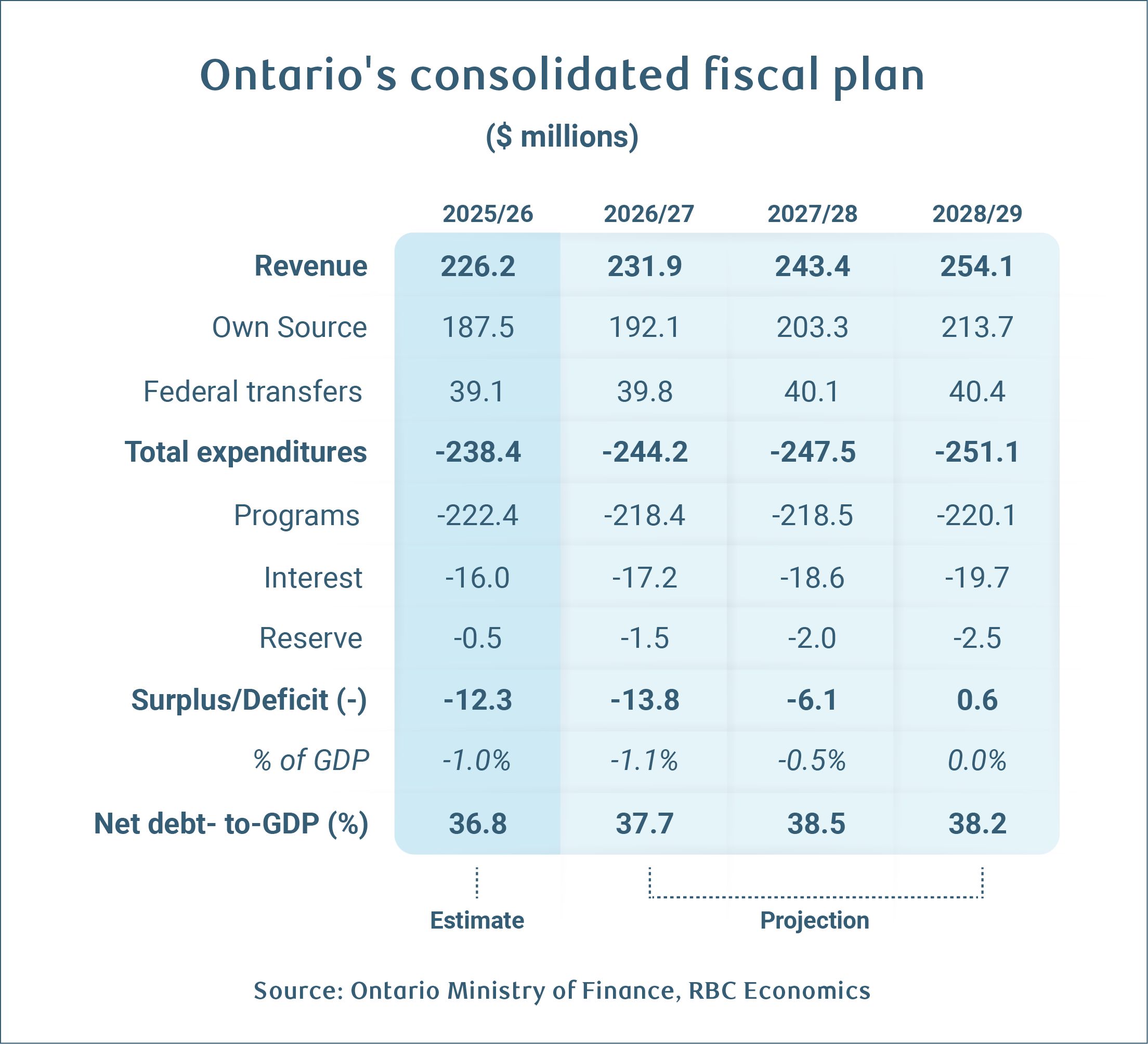
Budget 2026 expects a marginally lower deficit for the 2025-26 year that is about to end versus the fall update and prior budget – $12.3 billion (1.0% of GDP).
-
However, deficits for the next two years have been marked up to $13.8 billion in 2026-27 (1.1% of GDP) and $6.1 billion in 2027-28 (0.5% of GDP), while the path to balance has been delayed by 1 year to 2028-29.
-
Included contingencies reflect the uncertain economic environment, but low outer-year expenses growth could come under pressure.
-
Some significant new measures build on actions already taken.
-
The debt-to-GDP ratio stabilizes at the end of the projection period in 2028-29, but not before trending upward for 3 consecutive years, the first tilt upwards since the pandemic.
-
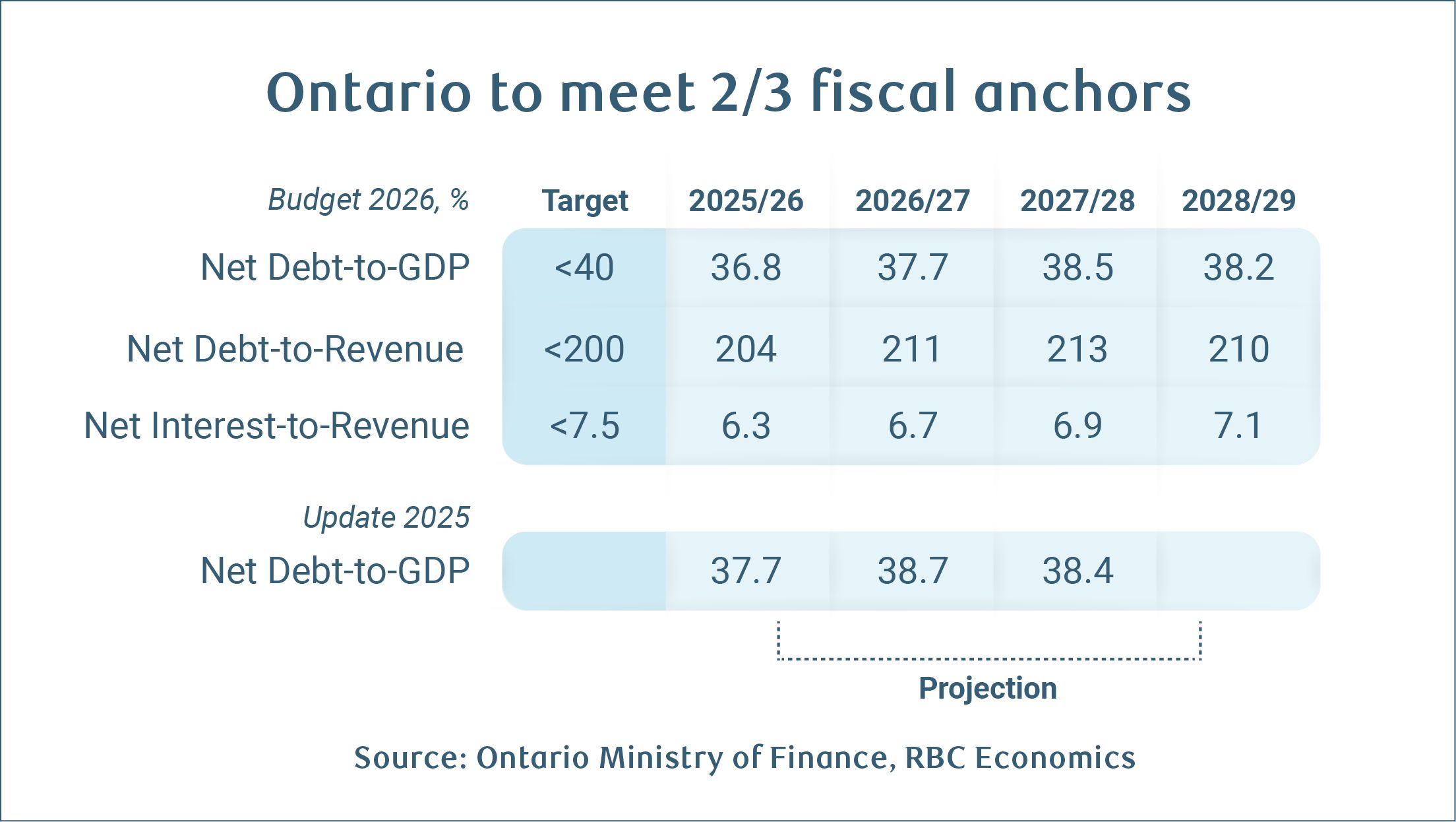
The province expects to continue to operate within 2 of 3 fiscal anchors throughout the forecast period.
In our own economic outlook, Ontario’s real GDP growth is bottom of the provincial table this year given its acute exposure to both the trade and population growth shocks. While the population shock is temporary and manufacturing show signs of stabilization under current tariffs, ongoing trade recalibrations leave its economy more vulnerable than many others.
Thus, there is particular urgency to advance the themes important for all provinces – address health/affordability pressures while making fiscal room to support growth-oriented spending, tap into federal spending priorities, and leverage non-budgetary policy for growth.
Improved financial metrics in recent years has freed up more fiscal space in Canada’s largest province, which Budget 2026 puts to some use. But with a relatively high debt load and abundant pressures, Ontario will need to plan carefully.
Revenue growth to be weak in 2026-27
Revenue levels are somewhat higher than in the fall, boosted by slightly better-than-expected nominal GDP growth. But year-over-year growth is expected to continue to be weak in 2026-27 – a reflection of economic challenges and marked down further by the cost of new tax expenditures (see measures below). In 2027-28, revenues growth recovers, growing above nominal GDP.
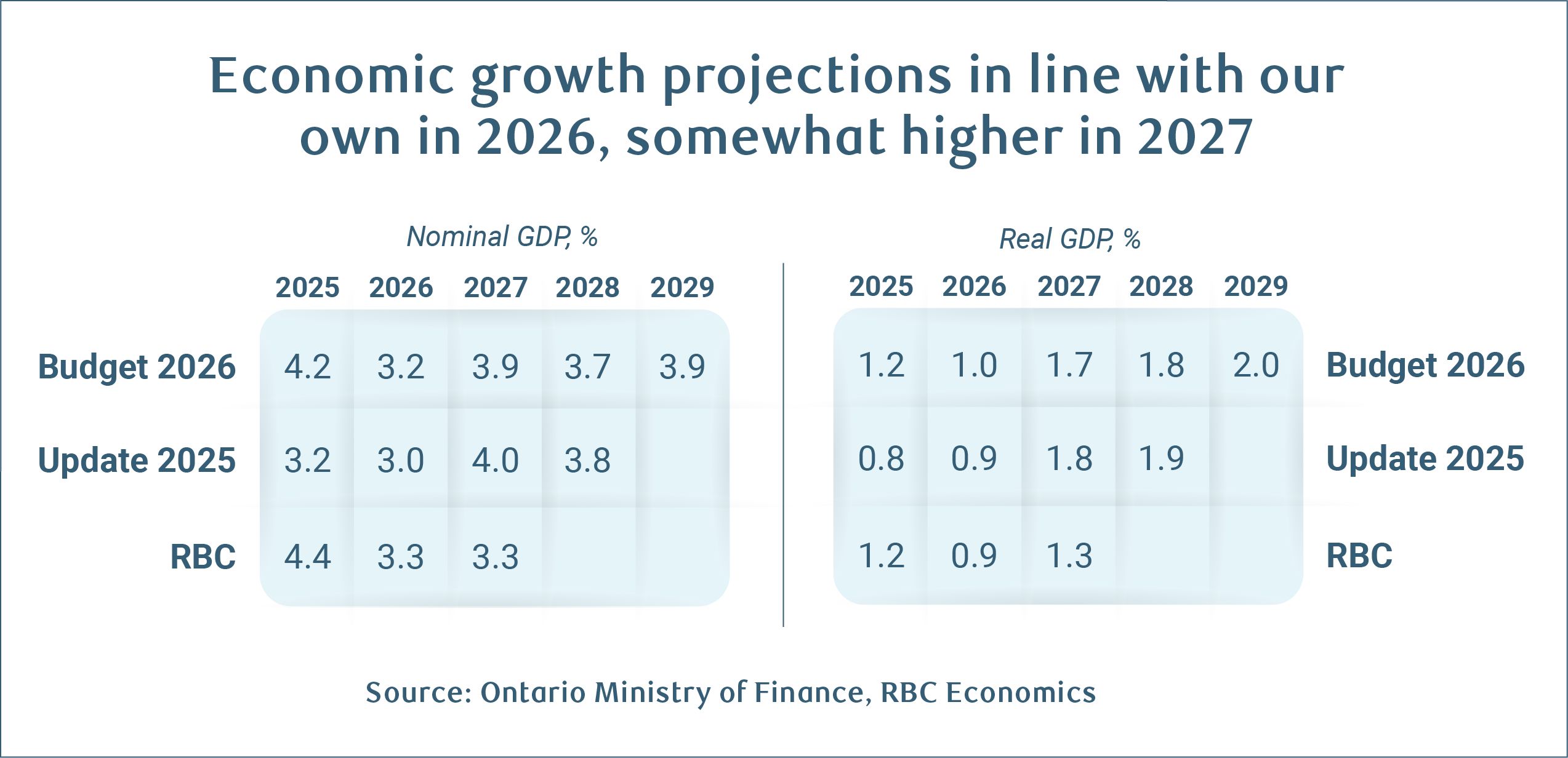
Overall, the economic growth assumptions in Budget 2026 are in line with our own in 2026 but are somewhat more optimistic in 2027.
Spending growth forecast is low
Expense levels have also shifted up since the fall, given 5% annual growth expected for 2025-26 (the year currently ending). This is above the 3.3% projection in the fall, due to higher spending in health, social services and justice, partially offset by the contingency fund.
Projected spending growth is low for the remaining years at only 2.4% in 2026-27 and under 1.5% in the subsequent two years. Even adding the budgeted contingency would only lift growth to 3% and under 2.5%, respectively. The expected small decline in the population in Ontario this year will help keep near-term spending in bounds, but the outer years may need to be revisited over time.
New measures build on actions already taken
Budget 2026 includes a handful of new measures (significant ones below).
These build on previous actions. Importantly, investment-oriented funds announced in recent years (e.g., Building Ontario Fund), non-budgetary policy from last year (e.g., single project review process, measures to advance free trade and labour mobility within Canada), and a significant energy and public infrastructure plan need time to be fully developed and bear fruit.
Aside from support for Toronto to host the headquarters of the (under development) Defence, Security and Resilience Bank, there are no explicit measures to plug into federal defence priorities, although these are still coming into view.
Affordability
-
$1.4 B for expanding HST relief on new build homes up to $1.5M for one year.
-
$1.2 billion over 3 years for cutting the small business corporate tax rate.
Social services
-
$6.4 billion over 4 years for the postsecondary sector (announced last month).
-
$1.1 billion new funding for hospitals.
Investment-focused spending
-
$4 billion in new Protect Ontario Account Investment Fund to support ‘economy-enabling investment opportunities’ in high growth industries.
Stabilization in debt ratio at end of projection period
Along with a path to balance by 2028-29, Budget 2026 foresees a stabilizing net debt-to-GDP ratio by this timeline after trending upward for 3 consecutive years, the first tilt upwards since the pandemic.
Despite the higher deficit path, the peak ratio is at a similar level as in the fall update, with upward revisions to the level of nominal GDP paving the way. Budget 2026 has the province continuing to meet 2 out of 3 of its fiscal anchors throughout the forecast period.
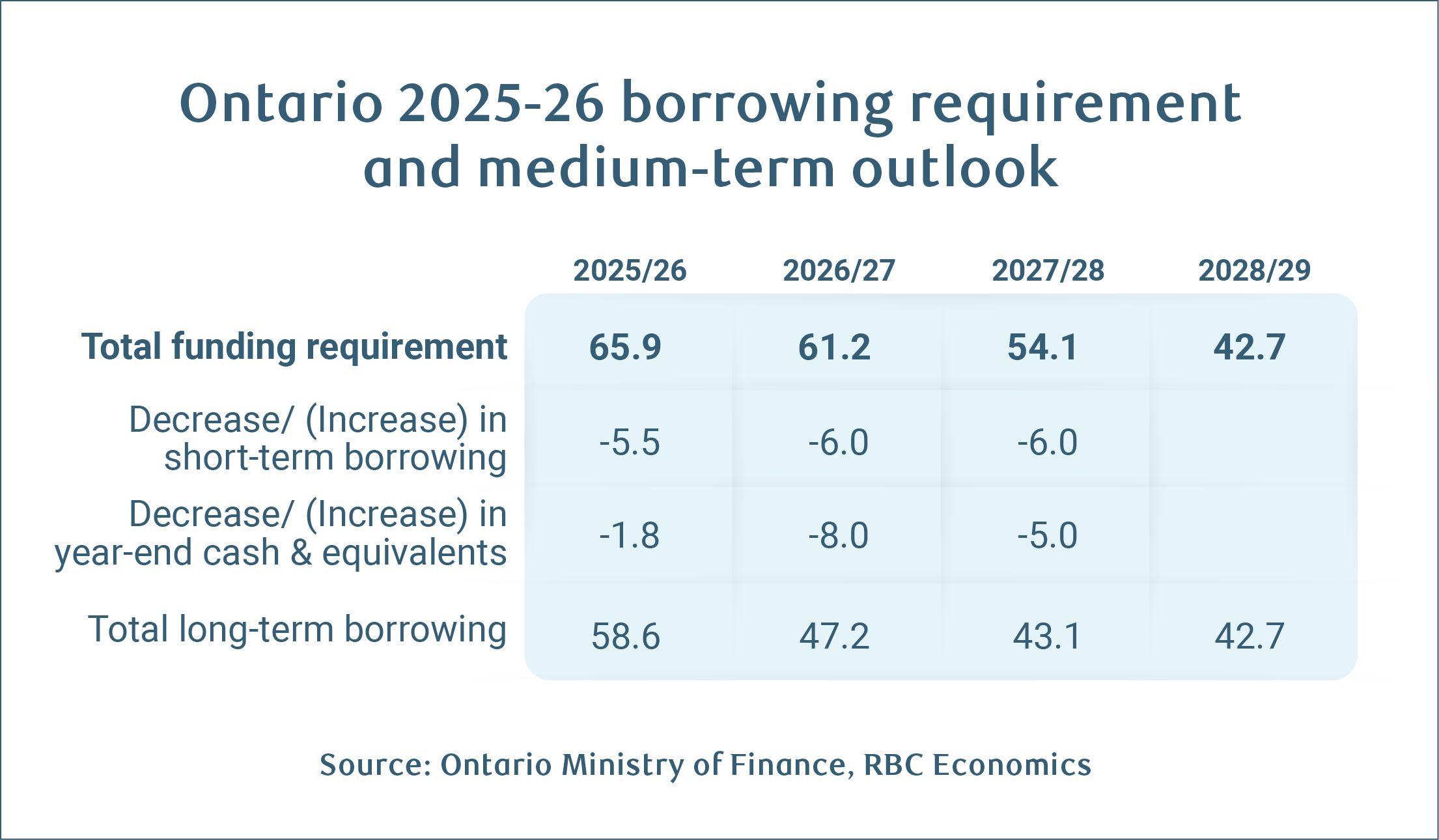
The budget does not explicitly mention additions to capital spending plans, but the $210 billion 10-year Capital Plan is $10 billion higher than in last fall’s update. This may result from funding reprofiles, instead, but leads to an additional $14 billion in capital expenditures targeted for 2026-27 and 2027-28 versus the fall. Capital investments flow fully into net debt and borrowing requirements when outlays occur, but only the annual amortized portion of capital spending shows up in the budgetary balance.
About the author:
Cynthia Leach is Assistant Chief Economist at RBC covering the team’s medium-term economic analysis, including primary research areas of federal and provincial fiscal analysis, structural government policy, and demographics.
This article is intended as general information only and is not to be relied upon as constituting legal, financial or other professional advice. The reader is solely liable for any use of the information contained in this document and Royal Bank of Canada (“RBC”) nor any of its affiliates nor any of their respective directors, officers, employees or agents shall be held responsible for any direct or indirect damages arising from the use of this document by the reader. A professional advisor should be consulted regarding your specific situation. Information presented is believed to be factual and up-to-date but we do not guarantee its accuracy and it should not be regarded as a complete analysis of the subjects discussed. All expressions of opinion reflect the judgment of the authors as of the date of publication and are subject to change. No endorsement of any third parties or their advice, opinions, information, products or services is expressly given or implied by Royal Bank of Canada or any of its affiliates.
This document may contain forward-looking statements within the meaning of certain securities laws, which are subject to RBC’s caution regarding forward-looking statements. ESG (including climate) metrics, data and other information contained on this website are or may be based on assumptions, estimates and judgements. For cautionary statements relating to the information on this website, refer to the “Caution regarding forward-looking statements” and the “Important notice regarding this document” sections in our latest climate report or sustainability report, available at: https://www.rbc.com/community-social-impact/reporting-performance/index.html. Except as required by law, none of RBC nor any of its affiliates undertake to update any information in this document.
