

 EN
EN 


-
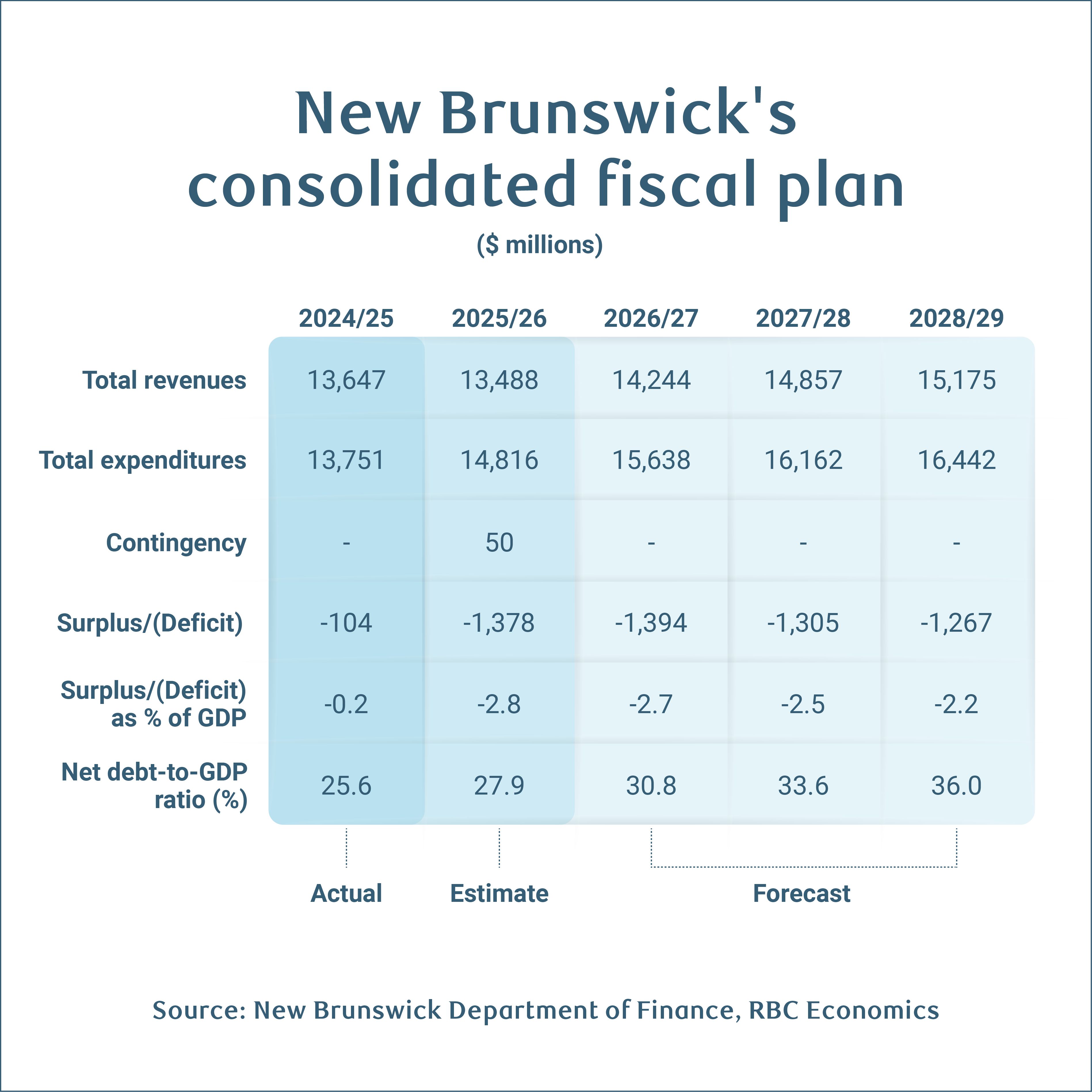
Provincial government projects record-high deficit of $1.39 billion in 2026-27, virtually unchanged from $1.38 billion in 2025-26.
-
(Deep) red ink to prevail through the remainder of the fiscal plan with shortfalls shrinking only slightly to -$1.31 billion in 2027-28 and -$1.27 billion in 2028-29.
-
A $1.1 billion (7.7%) expenditure surge and $159 million (1.2%) revenue drop in 2025-26 have thrown the government off the course of moderate deficits set a year ago.
-
Another hefty rise in expenditures (including mounting debt service charge and increased healthcare spending) will further deepen the shortfall in 2026-27.
-
Provincial indebtedness will get heavier fast though will continue to compare favourably against most other provinces.
The situation took an ugly turn in 2025-26
The tone was set in February when New Brunswick Finance and Treasury Board Minister René Legacy presented last year’s third quarter budget update. In it, he revealed a notable deterioration in the province’s fiscal affairs with revenue coming weaker than expected and expenditures widely surpassing Budget 2025 projections.
A deficit originally forecasted at just under $600 million (1.2% of GDP) in 2025-26 ballooned to $1.38 billion (2.8% of GDP, including a $50 million contingency). This turn of event prompted a thorough review of expenditures and a warning that “tough decisions” were coming in the upcoming budget.
Some spending cuts but few of them
Budget 2026 did announce measures to rein in public spending, with General Government reduced by $161 million (or 11%) and other smaller cuts to being made to Natural Resources and Regional Development Corporation in 2026-27.
Total spending still rising rapidly
However, much larger increases to Health (up $278 million or 6.1%), Education and Early Childhood Development (up $158 million or 7.6%), Social Development (up $143 million or 7.6%) and other departments significantly boosted program spending.
And, a sharp $120 million (16%) increase in the cost of servicing the province’s rapidly growing debt further added to total in expenditures, which are projected to rise by $822 million to $15.6 billion in 2026-27.
This will exceed projected total revenue growth of $756 million (5.6%) to $14.2 billion, further deepening the budget deficit to a record high (in nominal terms) of $1.39 billion (2.7% of GDP).
Heavy deficits through 2028-29
Budget 2026 projects slightly stronger growth in revenues than expenditures through the remainder of the three-year fiscal plan. This results in the deficit shrinking just a touch to $1.31 billion (2.5% of GDP) in 2027-28 and to $1.27 billion (2.2% of GDP) in 2028-29.
New Brunswick’s updated deficit profile represents a substantial deterioration to the province’s bottom line from Budget 2025 (which projected the gap shrinking from $447 million to $144 million over the same period).
Provincial debt is soaring but still compares well
Funding deeper shortfalls will cause the province to take on debt at an accelerated pace. The government projects its net debt to surge 42% in the next three years. As a share of GDP net debt will rise from 27.9% at the end of 2025-26 to 36% by the end of 2028-29.
This would constitute the province’s heaviest debt load since 2020-21.
That said, New Brunswick entered this period of elevated economic uncertainty on a relatively strong financial footing with a lighter debt load than many other provinces—affording it some room to maneuver to address pressing issues.
A calculated choice
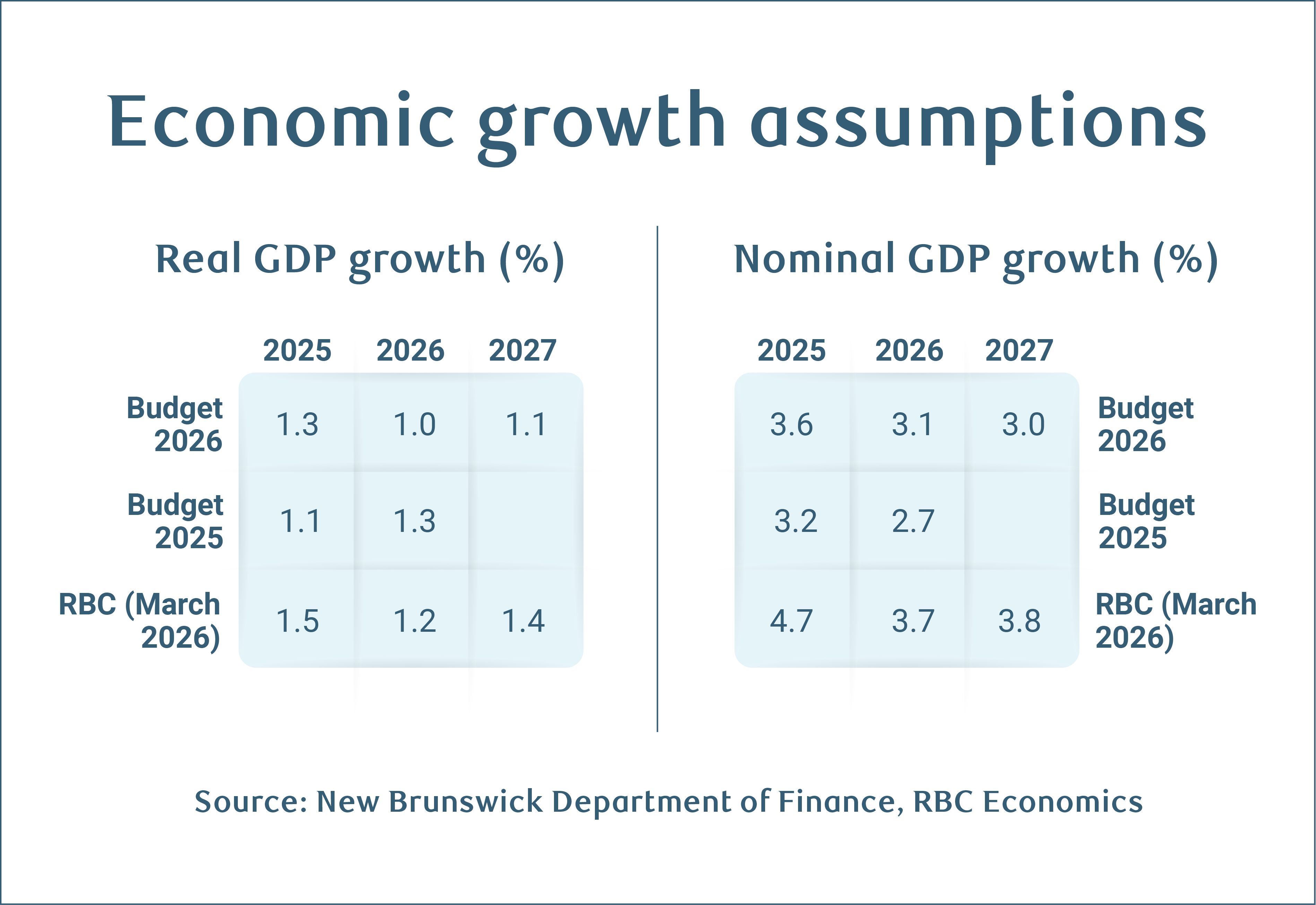
The government is making a calculated choice to use some of that room while the provincial economy is expected to continue growing (albeit slowly). We note nominal economic growth assumptions have even slightly improved since Budget 2025.
While that choice could be justified if measures ultimately boost New Brunswick economic potential, it’s disappointing the government hasn’t provided a plan—possibly going beyond 2028-29—to balance its books. As it stands, the current fiscal plan isn’t sustainable and tough decisions seem to be for another day.
In the meantime, though, rapidly rising debt will cause debt service costs to soar. The 16% ($120 million) projected rise in those costs in 2026-27 will almost certainly be followed by further sizable increases. This will increasingly compete against the government’s spending priorities (e.g. healthcare and education).
About the author:
Robert Hogue is the Assistant Chief Economist responsible for providing analysis and forecasts on the Canadian housing market and provincial economies.
This article is intended as general information only and is not to be relied upon as constituting legal, financial or other professional advice. The reader is solely liable for any use of the information contained in this document and Royal Bank of Canada (“RBC”) nor any of its affiliates nor any of their respective directors, officers, employees or agents shall be held responsible for any direct or indirect damages arising from the use of this document by the reader. A professional advisor should be consulted regarding your specific situation. Information presented is believed to be factual and up-to-date but we do not guarantee its accuracy and it should not be regarded as a complete analysis of the subjects discussed. All expressions of opinion reflect the judgment of the authors as of the date of publication and are subject to change. No endorsement of any third parties or their advice, opinions, information, products or services is expressly given or implied by Royal Bank of Canada or any of its affiliates.
This document may contain forward-looking statements within the meaning of certain securities laws, which are subject to RBC’s caution regarding forward-looking statements. ESG (including climate) metrics, data and other information contained on this website are or may be based on assumptions, estimates and judgements. For cautionary statements relating to the information on this website, refer to the “Caution regarding forward-looking statements” and the “Important notice regarding this document” sections in our latest climate report or sustainability report, available at: https://www.rbc.com/community-social-impact/reporting-performance/index.html. Except as required by law, none of RBC nor any of its affiliates undertake to update any information in this document.
