

 EN
EN 


-
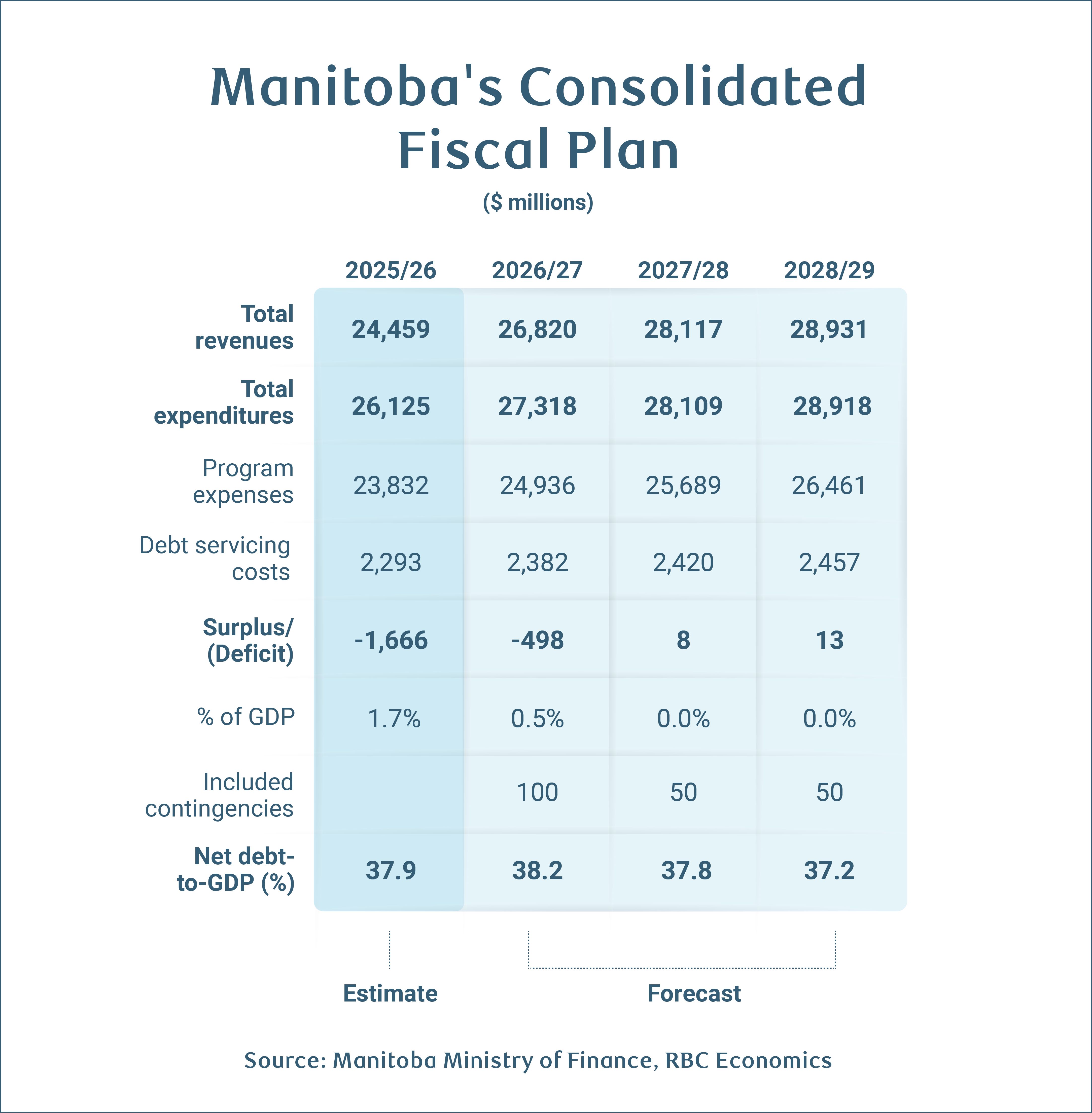
Budget 2026 included a higher deficit projection for the 2025-26 year that is about to end – $1.7 billion (1.7% of GDP) versus $0.8 billion expected in last year’s budget – as wildfires and lower Manitoba Hydro net income took a bite out of the bottom line.
-
Moving forward, the 2026-27 deficit is higher than the prior budget by a much lower margin at $0.5 billion (0.5% of GDP), while a balanced budget continues to be expected from 2027-28.
-
A smattering of new measures focus on health care, education and affordability.
-
The debt-to-GDP ratio rises to 2026-27 and then stabilizes despite significant new additions to the province’s Capital Plan.
Manitoba is the seventh province to table its 2026 budget, and the new numbers look not as challenged as several others. Despite the negative surprise in 2025/26, Manitoba claims the smallest 2026/27 deficit-to-GDP ratio and is one of few provinces charting a path to balance. Spending pressures and the uncertain economic environment could erode planned fiscal balances, and the province will need to continue to make fiscal room to support growth-oriented spending. These are similar to the fiscal challenges faced by other provinces, but Manitoba will need to keep an eye on a debt ratio that is on the high end of the provincial average.
Revenues to recover in 2026-27
For 2026-27, revenue is expected to grow 10% year-over-year due to normalization in Manitoba Hydro net income, as well as higher federal transfers and income taxes. Following this it settles down to 5% in 2027/28 and 3% in 2028/29.
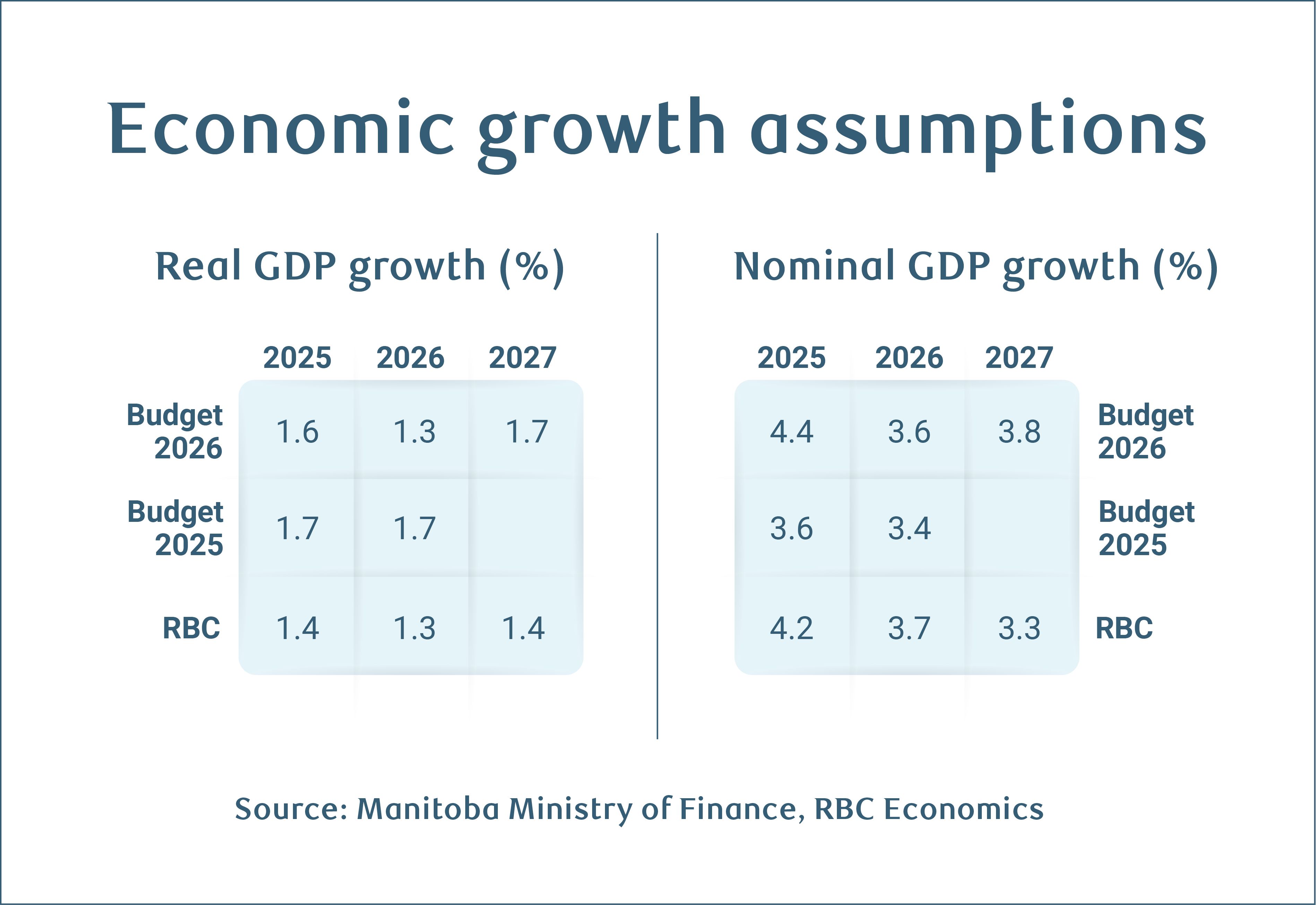
Overall, the economic growth assumptions in Budget 2026 are somewhat more optimistic than our own, particularly for 2027. Combined with the uncertain economic environment, it lends risk to meeting the balanced budget target in 2027-28.
Higher expenses growth profile and new measures
Expenses are projected to grow by 4.6% year-over-year in 2026-27, with the majority allotted to health care and early childhood learning. In the outer years, it grows by 3% annually. These rates are higher than the 2% in last year’s budget that we flagged as low. With the 10-year average growth rate in the 5% zone and ongoing health/affordability pressures, current growth rates are also at risk of needing to be revisited.
The budget presentation does not allow for a clean read of total new measures or their costs, but significant new announcements appear to include:
Health Care
-
$223 million for more doctors
-
A new CancerCare headquarters, emergency room at Victoria hospital, restoring a cardiac centre of excellence at St. Boniface hospital, and expanding electronic medical records
Affordability measures
-
Removal of PST on all food at grocery store
-
Increases in the Homeowners and Renters Affordability tax credits
Investment-focused spending
-
Funding for development of the Port of Churchill and Hudson Bay rail line that was referred to the federal Major Projects Office in fall 2025, adding to federal funds
-
$144 million for business risk management programs for farmers and producers
Manitoba expects stabilization in debt ratio
Along with a path to balance by 2027-28, Budget 2026 foresees a net debt-to-GDP ratio that peaks in 2026-27 and then trends down slightly over the next 2 years of the projection period.
The debt ratio profile is somewhat higher than last year’s budget, both because of the higher-than-expected deficit for 2025-26 and additions to the provinces Capital Plan. Over 2026-27 to 2029-30, Budget 2026 adds over $4 billion to the $13 billion that was previously planned. Capital investments flow fully into net debt and borrowing requirements when outlays occur, but only the annual amortized portion of capital spending shows up in the budgetary balance.
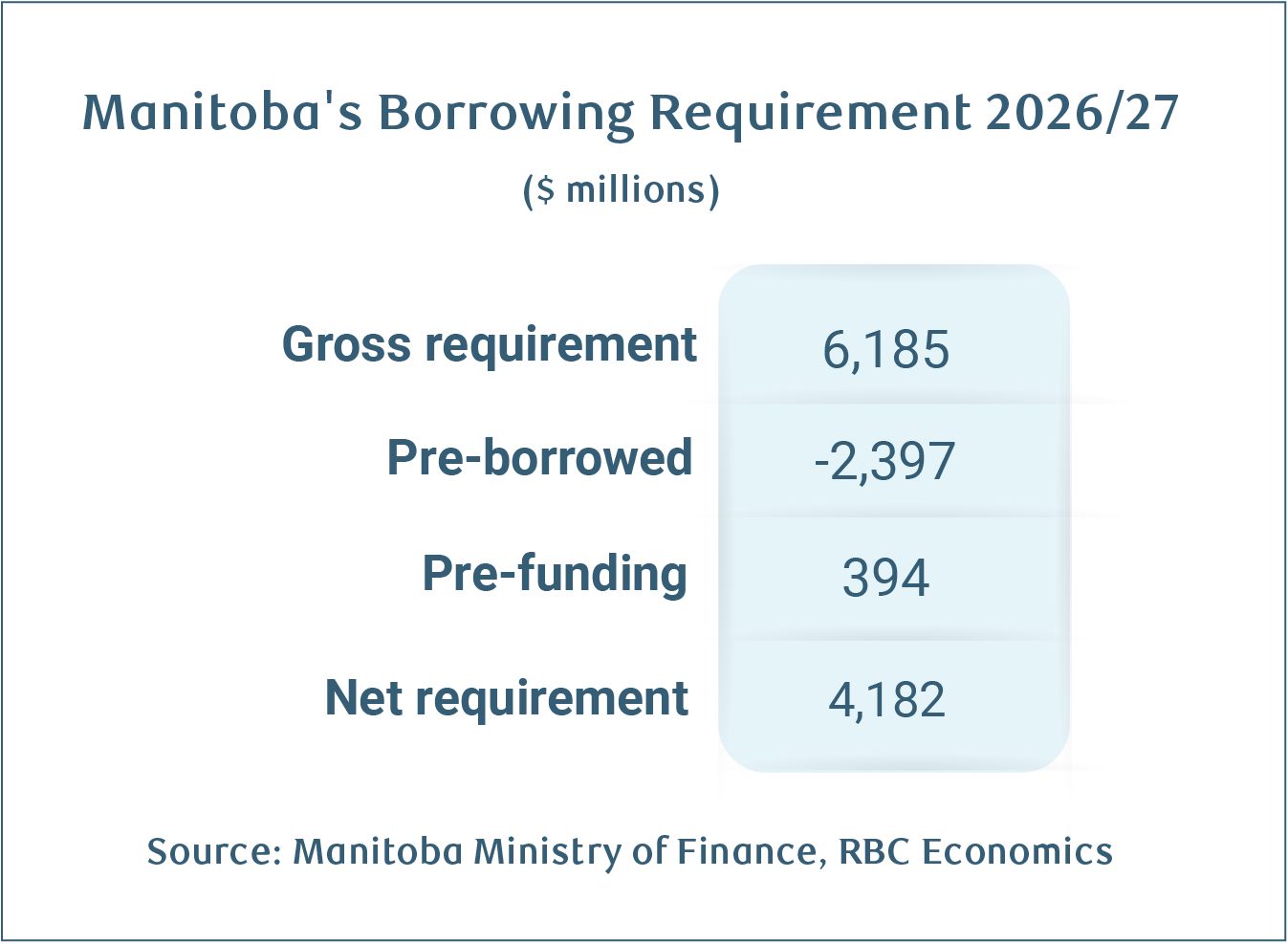
In terms of borrowing requirement, Manitoba expects a net 2026-27 requirement of $4.2 billion, lower than the gross $6.2 billion requirement given high pre-borrowing that will be much lower in the current year.
About the author:
Cynthia Leach is Assistant Chief Economist at RBC covering the team’s medium-term economic analysis, including primary research areas of federal and provincial fiscal analysis, structural government policy, and demographics.
This article is intended as general information only and is not to be relied upon as constituting legal, financial or other professional advice. The reader is solely liable for any use of the information contained in this document and Royal Bank of Canada (“RBC”) nor any of its affiliates nor any of their respective directors, officers, employees or agents shall be held responsible for any direct or indirect damages arising from the use of this document by the reader. A professional advisor should be consulted regarding your specific situation. Information presented is believed to be factual and up-to-date but we do not guarantee its accuracy and it should not be regarded as a complete analysis of the subjects discussed. All expressions of opinion reflect the judgment of the authors as of the date of publication and are subject to change. No endorsement of any third parties or their advice, opinions, information, products or services is expressly given or implied by Royal Bank of Canada or any of its affiliates.
This document may contain forward-looking statements within the meaning of certain securities laws, which are subject to RBC’s caution regarding forward-looking statements. ESG (including climate) metrics, data and other information contained on this website are or may be based on assumptions, estimates and judgements. For cautionary statements relating to the information on this website, refer to the “Caution regarding forward-looking statements” and the “Important notice regarding this document” sections in our latest climate report or sustainability report, available at: https://www.rbc.com/community-social-impact/reporting-performance/index.html. Except as required by law, none of RBC nor any of its affiliates undertake to update any information in this document.
