

 EN
EN 


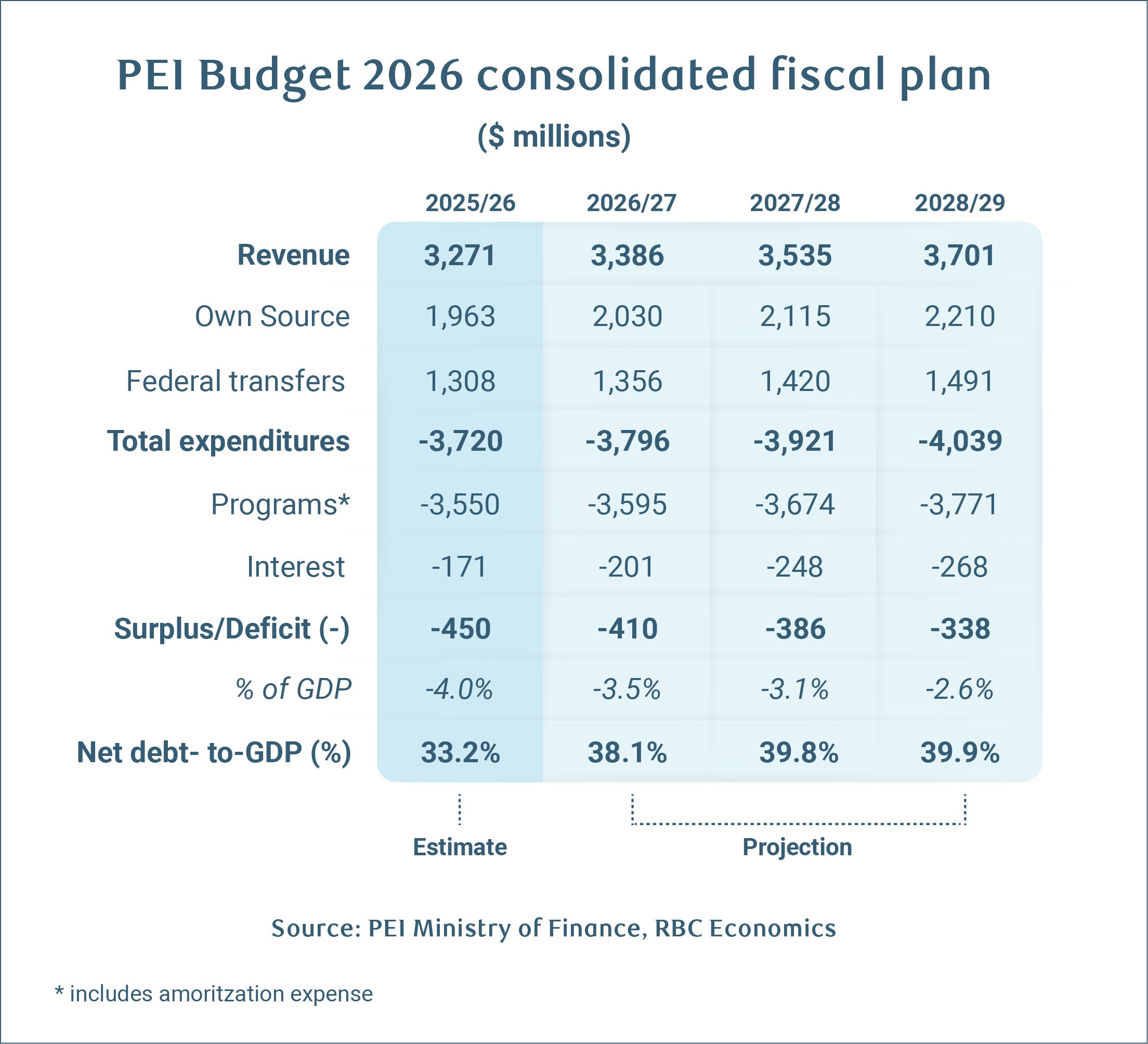
Last year, PEI’s budget delivered the largest projected nominal deficit in the province’s history – $184 million (1.6% of GDP) for 2025-26. Even then, Budget 2026 has that number coming in much higher at $450 million (4.0% of GDP), by far the largest provincial deficit as a share of the economy.
Deficits improve from 2026-27 on but remain elevated at 2.6% of GDP by the end of the projection period. This is despite optimistic 2026-27 spending assumptions and savings in the outer years from an expenditure review that is just getting started.
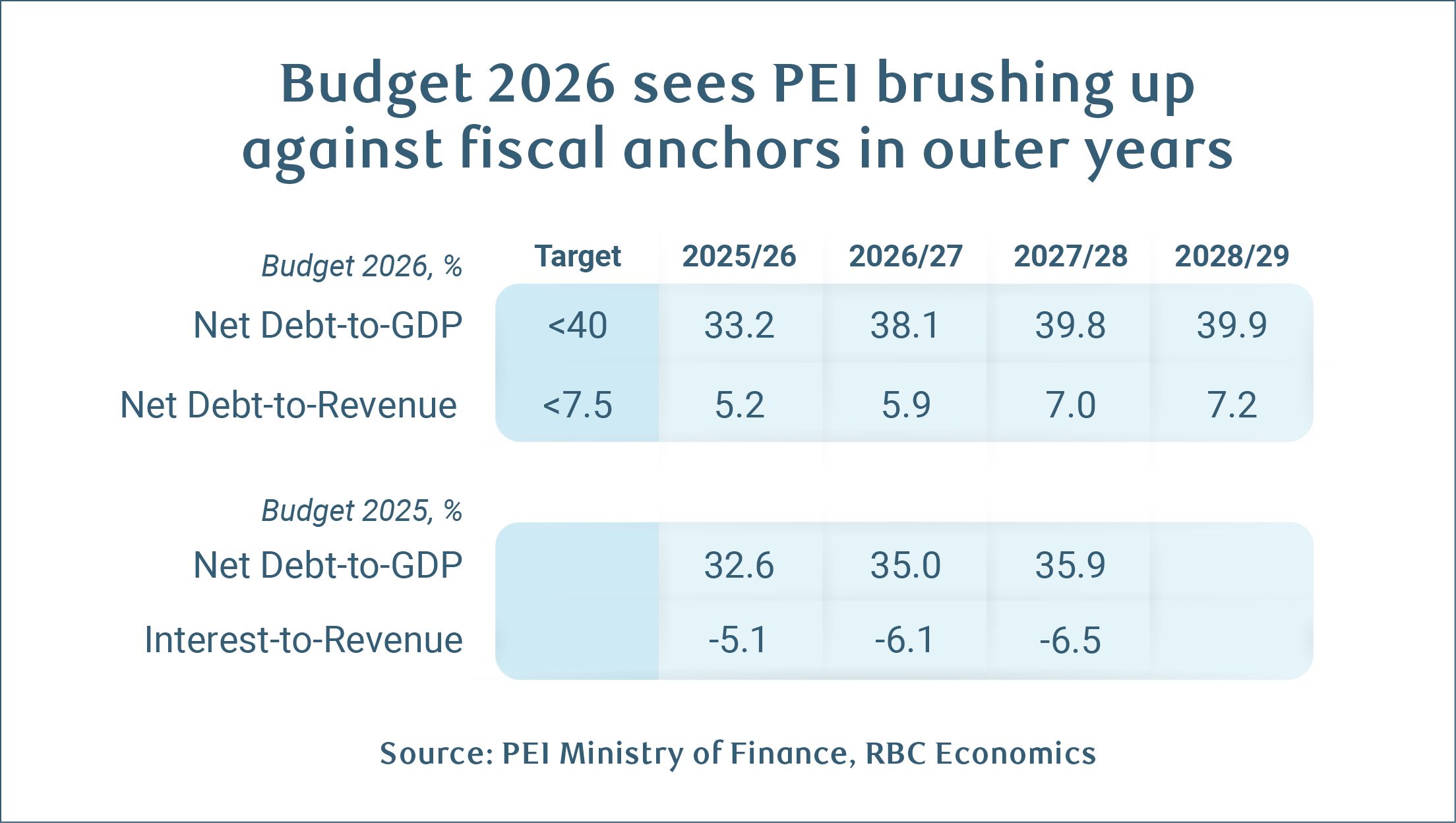
Unsurprisingly, the province expects a big jump in its debt burden, surpassing its prior peak in 2013-14 and brushing right up against its fiscal anchor.
Deficit
-
Budget 2026 sees significant red ink across the forecast period with no path to balance. Deficits peak at 4% of GDP in 2025-26 – the fiscal year just ended – falling to 2.6% by 2028-29.
-
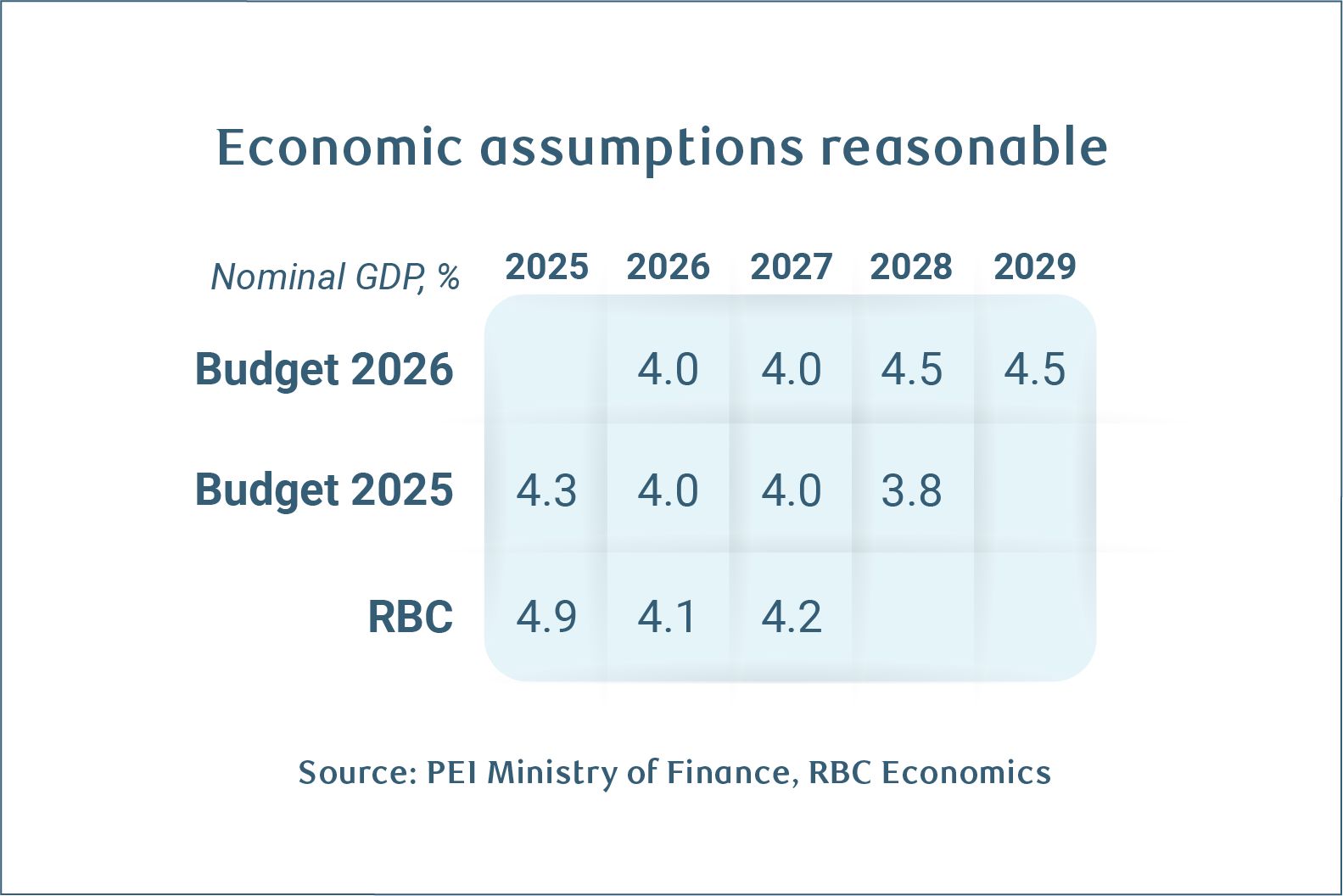
Reasonable economic assumptions see revenue growth outpace expenses growth from 2026-27 onwards. While this supports declining deficits, it is not enough to undo the deficit tract given significant deficit jumps in earlier years.
-
Among provinces, PEI has the largest deficit as a share of the economy throughout the projection period, sometimes by a significant margin. Yet, its growth outlook is above average, per our projections.
Spending
-
The 2025-26 deficit jumped on the back of 13% year-over-year expenses growth versus the 7% expected in budget 2025. The biggest surprises came in health spending and what appears to be a one time expense in the Agricultural Insurance Corporation.
-
Going forward, the expenses profile is optimistic. While total expenditures grow 2.0% year-over-year in 2026-27, it’s only 0.7% for program spending. This coincides with projected population growth, implying an expectation for falling real spending.
-
For 2027-28 and 2028-29, projected spending grows ~3% (~2% for program spending). These years include expected savings from a newly announced Comprehensive Expenditure Review that seeks to cut 5% of total spending. The allocation of the cuts is yet to be determined.
-
Absent these savings, total spending in 2027-28 and 2028-29 would grow at 8% annually – similar to the high rates in 2024-25 and 2025-26, which makes 2026-27’s projected 2% growth anomalously low.
Debt and fiscal anchors
-
Higher expected deficits will significantly increase the debt burden, more than unwinding the prior improvement seen since the last peak in 2013-14. By 2028-29, the debt burden will surpass this peak, totaling 39.9%, and brushing right up against the government’s 40% target as part of its fiscal anchor.
-
The government’s other anchor – interest to revenue – will also get close to its 7.5% target by the end of the projection period.
Additional Tables
About the author:
Cynthia Leach is Assistant Chief Economist at RBC covering the team’s medium-term economic analysis, including primary research areas of federal and provincial fiscal analysis, structural government policy, and demographics.
This article is intended as general information only and is not to be relied upon as constituting legal, financial or other professional advice. The reader is solely liable for any use of the information contained in this document and Royal Bank of Canada (“RBC”) nor any of its affiliates nor any of their respective directors, officers, employees or agents shall be held responsible for any direct or indirect damages arising from the use of this document by the reader. A professional advisor should be consulted regarding your specific situation. Information presented is believed to be factual and up-to-date but we do not guarantee its accuracy and it should not be regarded as a complete analysis of the subjects discussed. All expressions of opinion reflect the judgment of the authors as of the date of publication and are subject to change. No endorsement of any third parties or their advice, opinions, information, products or services is expressly given or implied by Royal Bank of Canada or any of its affiliates.
This document may contain forward-looking statements within the meaning of certain securities laws, which are subject to RBC’s caution regarding forward-looking statements. ESG (including climate) metrics, data and other information contained on this website are or may be based on assumptions, estimates and judgements. For cautionary statements relating to the information on this website, refer to the “Caution regarding forward-looking statements” and the “Important notice regarding this document” sections in our latest climate report or sustainability report, available at: https://www.rbc.com/community-social-impact/reporting-performance/index.html. Except as required by law, none of RBC nor any of its affiliates undertake to update any information in this document.
