

 EN
EN 


The Bottom Line:
The first increase in employment of the year in Canada in March (+14k) retraced little of the cumulative 109k drop over January and February.
But per-worker labour market conditions showed further signs of stabilization with the unemployment rate holding at 6.7%—still above the 6.5% rate in January but below the 6.8% level in December and the recent peak 7.1% rate in September 2025.
The (gradual and choppy) drift lower in the unemployment rate since September has been, mechanically, tied as much to softer labour force growth as to stronger hiring—Canada’s labour force has declined by 39k workers over the last 6 months compared to an 42k increase in employment.
But that labour market decline has more to do with stalled population growth and an aging population rather than a ‘distortion’ like discouraged workers giving up their job searches.
What really matters for per-worker labour market conditions (the unemployment rate) is whether labour demand is strong enough to absorb available labour supply—and we argued here that job growth could be slightly negative for the year in 2026 and the unemployment rate could still fall. ~25k workers retired per-month over the last year, and reduced immigration has meant fewer new labour market entrants to replace those workers.
Looking ahead, the economic growth backdrop still faces headwinds. Trade uncertainty remains ahead of negotiations to extend CUSMA this summer, and higher energy prices are cutting into household purchasing power. But we remain cautiously optimistic that per-person economic growth and labour market conditions will continue to gradually improve this year, with the unemployment rate edging broadly lower.
The details:
-
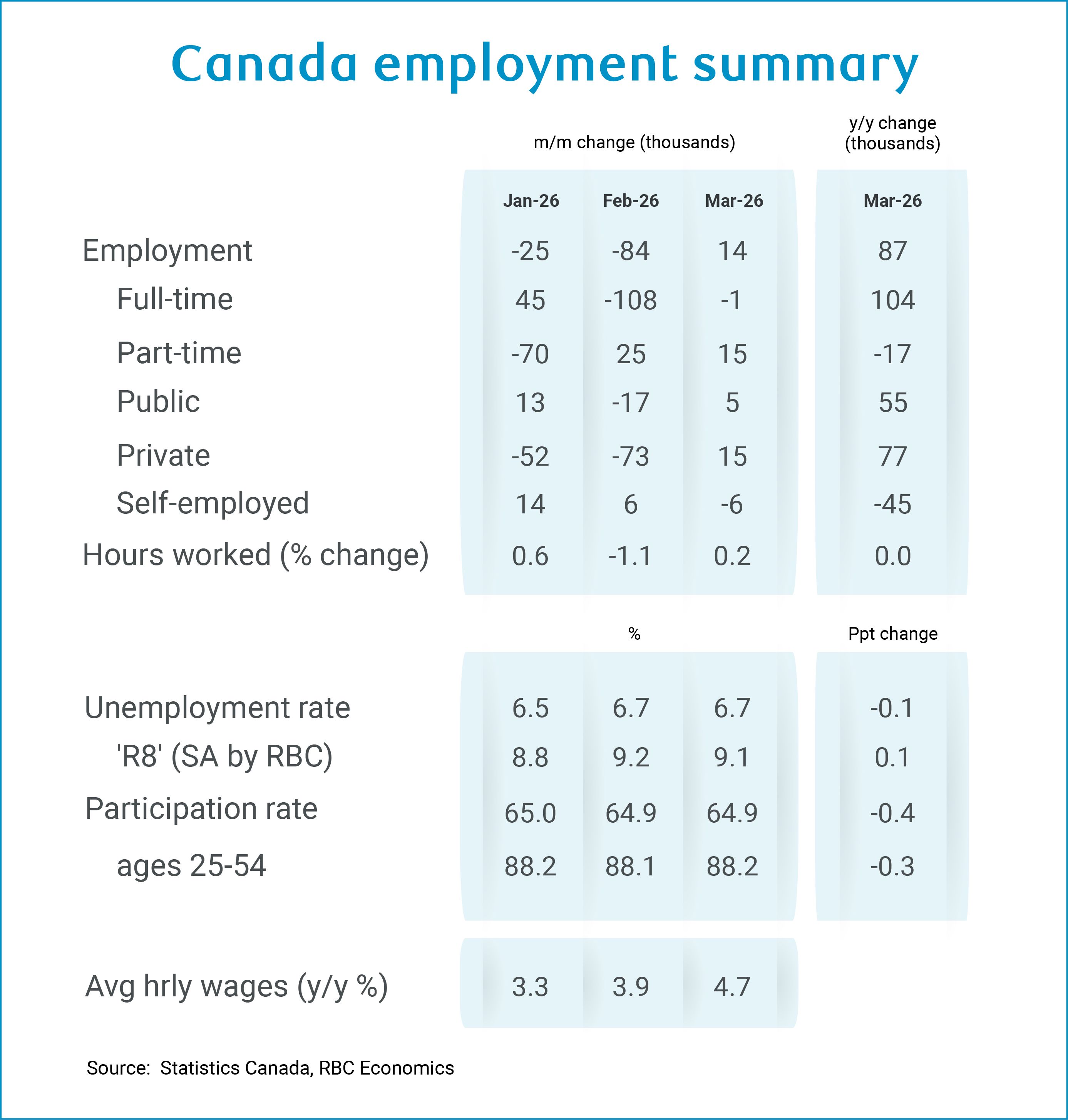
Employment edged up 14k in March, to post the first gain of 2026 but retracing little of the 109k cumulative drop over January and February.
-
Part-time employment rose 15k and full time edged down 1k. Self employment was down 6k, with paid employment up 20k, split between private (+15k) and public (+5k) jobs.
-
Industry details were mixed—manufacturing employment was little changed (+2.5k) following sizable declines over the prior two months.
-
The unemployment rate held steady at 6.7%—still 0.2 ppts above the 6.5% rate in January, but below the 6.8% rate in December and recent peak 7.1% rate in September 2025, and down 0.1 percentage points from a year earlier.
-
Details underlying the unemployment rate for March were relatively constructive—layoffs remained low while future starts (unemployed currently but with an expected future start date) and those on temporary layoff were up from a year ago.
-
The labour force participation rate was unchanged at 64.9%, but edged slightly higher among the core 25-54 year old age groups (to 88.2% from 88.1%)
-
The Canadian working age (aged 15+) population edged up 11k—close to the average 12k per month over the last 6 months (11k in March), but and still well-below the record 100k+ per month increases in the first half of 2024. The monthly rate of population growth will highly likely turn negative in coming months as ongoing immigration caps restrict arrivals of younger population from abroad.
-
Hours worked edged up 0.2% and wage growth accelerated to 4.7% on a year-over-year basis from 3.9% in February (rising to 5.1% from 4.2% for permanent employees)
-
Regionally, British Columbia led the regional decline with a 19,000 drop in employment (-0.7%), contributing to the unemployment rate rising 0.6 percentage points to 6.7% – the highest level since February 2016 (outside the pandemic period). Employment in Manitoba (+11,000) and Saskatchewan (+5,800) rebounded in March, with the unemployment rate in Saskatchewan reaching the lowest level across all provinces at 5%. Ontario’s employment remained stable with an unchanged unemployment rate, while Quebec’s unemployment rate declined by 0.5 percentage points to 5.4% in March, reflecting fewer people searching for work.
-
London (9.1%), Kitchener-Cambridge-Waterloo (8.6%), Windsor (8.5%), Barrie (8.5%), and Toronto (8.1%) posted the highest unemployment rates among Canada’s 20 largest census metropolitan areas, while Quebec City recorded the lowest at 2.6% (three-month moving averages).
About the author:
Nathan Janzen is an Assistant Chief Economist, leading the macroeconomic analysis group. His focus is on analysis and forecasting macroeconomic developments in Canada and the United States.
This article is intended as general information only and is not to be relied upon as constituting legal, financial or other professional advice. The reader is solely liable for any use of the information contained in this document and Royal Bank of Canada (“RBC”) nor any of its affiliates nor any of their respective directors, officers, employees or agents shall be held responsible for any direct or indirect damages arising from the use of this document by the reader. A professional advisor should be consulted regarding your specific situation. Information presented is believed to be factual and up-to-date but we do not guarantee its accuracy and it should not be regarded as a complete analysis of the subjects discussed. All expressions of opinion reflect the judgment of the authors as of the date of publication and are subject to change. No endorsement of any third parties or their advice, opinions, information, products or services is expressly given or implied by Royal Bank of Canada or any of its affiliates.
This document may contain forward-looking statements within the meaning of certain securities laws, which are subject to RBC’s caution regarding forward-looking statements. ESG (including climate) metrics, data and other information contained on this website are or may be based on assumptions, estimates and judgements. For cautionary statements relating to the information on this website, refer to the “Caution regarding forward-looking statements” and the “Important notice regarding this document” sections in our latest climate report or sustainability report, available at: https://www.rbc.com/community-social-impact/reporting-performance/index.html. Except as required by law, none of RBC nor any of its affiliates undertake to update any information in this document.
