

 EN
EN 


Rents in Canada have been cooling for more than a year now, and we think this trend has longer to run.
Slowing population growth, improved ownership conditions and elevated inventory could push the rental vacancy rate over 3% this year—the threshold we believe marks a balanced market.
This would be the third consecutive year of rising vacancy rates across Canada and the first time in a decade that the rate would exceed 3% for a two-bedroom apartment.
These conditions point to additional softening in rents. Asking rents dropped outright in 2025 and are projected to decline further in 2026. Other market dynamics, however, are likely to keep average rents paid by tenants from falling.
Asking rent and average rent measure different aspects of the market.
Asking rent reflects prices at the margin—rents landlords advertise for available units that may or may not be leased at that price. This makes asking rents more volatile and responsive to supply and demand dynamics than other metrics.
Average rent, by contrast, measures rent paid on all units in the purpose-built apartment universe—consisting mainly of units where tenants remain in place from year-to-year. It is less volatile, because government rent increase guidelines (anchored to CPI) and rent control (where applicable) tend to set steadier standards for renewing leases. Landlords’ efforts to retain tenants can also contribute to taming fluctuations in a rapidly rising rent environment.
Average rent change for turnover units (those where new tenants have moved in) highlights another important market dynamic. It measures how rent paid by the new tenants varies from the old tenants’ rent. The rate can differ significantly from average rent for in-place tenants as landlords are normally able to reset rent at market rate once a tenant leaves. In areas under rent control, it can lead to large increases even when asking rent is declining.
Asking rents fall, but relief for in-place tenants remains limited
Asking rents fell 3.2% nationally between 2024 and 2025, according to Rentals.ca, and declined in half of Canada’s CMAs, according to Statistics Canada—partially reversing the surge recorded in 2022 and 2023.
Yet, this hasn’t translated to much relief for most tenants.
Average rent for a two-bedroom apartment still grew 5.1% in 20251 despite moderating from 8% in 2023 and 5.4% in 2024.
Landlords have continued raising rents on existing tenants—contributing 3.1 percentage-points to the overall increase. And for the 12.8% of rental units that turned over, rent went up 8.7% between the old and new tenants—contributing the remaining 2 percentage points to the overall rise.
This explains why rent is still among the fastest growing component of the CPI basket, even as advertised rents for available units have declined.
Still, the drop in asking rents gives bargaining power to in-place tenants at lease renewal. In an environment where vacancies are harder to fill, it’s in the best interest of landlords to be more accommodating by containing rent increases or offering various incentives.
This dynamic is already playing out. The gap between rent increases for in-place tenants and newly leased units is narrowing, with turnover units posting average rent growth of less than 10% in 2025—down from nearly 24% in the prior two years—contributing to the moderation in average rent increases.
Moving forward, we expect average rent increases to slow further, to 3.6% in 2026 across Canada, as weaker temporary resident inflows, and improved ownership affordability further restrain rental demand. An influx of new units hitting the market is poised to strengthen tenants’ bargaining power as well.
That said, the sticky nature of average rent means an outright decline remains unlikely unless vacancy rates are sustained significantly above 3%.
Not all types of units see softness
Larger housing units haven’t experienced the same degree of softness as smaller ones. Individuals and families are renting for longer, often competing for a small pool of larger units.
Indeed, missing middle housing is not just a problem in the ownership market. Townhouses and mid-rise rental buildings have seen limited construction for decades across most markets as well.
Limited supply will likely keep market conditions tighter for larger-sized units, preventing vacancy rates from rising as quickly as for studio and one-bedroom apartments.
Below-market units and those at the bottom end of the rent distribution face a similar constraint, keeping conditions tight for landlords and lease hunters.
In-migration slowdown weakens rental demand
Immigration policy has had a strong impact on Canada’s rental market.
Temporary resident inflows fell sharply in 2025, pulling population growth down to 0.9%. We expect the number of net new non-permanent residents will drop further in 2026, stalling population growth entirely.
Temporary residents, such as international students, are far more likely to rent than purchase, making them a critical source of rental demand. Reduced inflows of this group will weigh particularly heavily on Ontario and British Columbia, which have historically absorbed the majority of temporary resident arrivals.
Population contraction risks threaten rental demand in Toronto and Vancouver
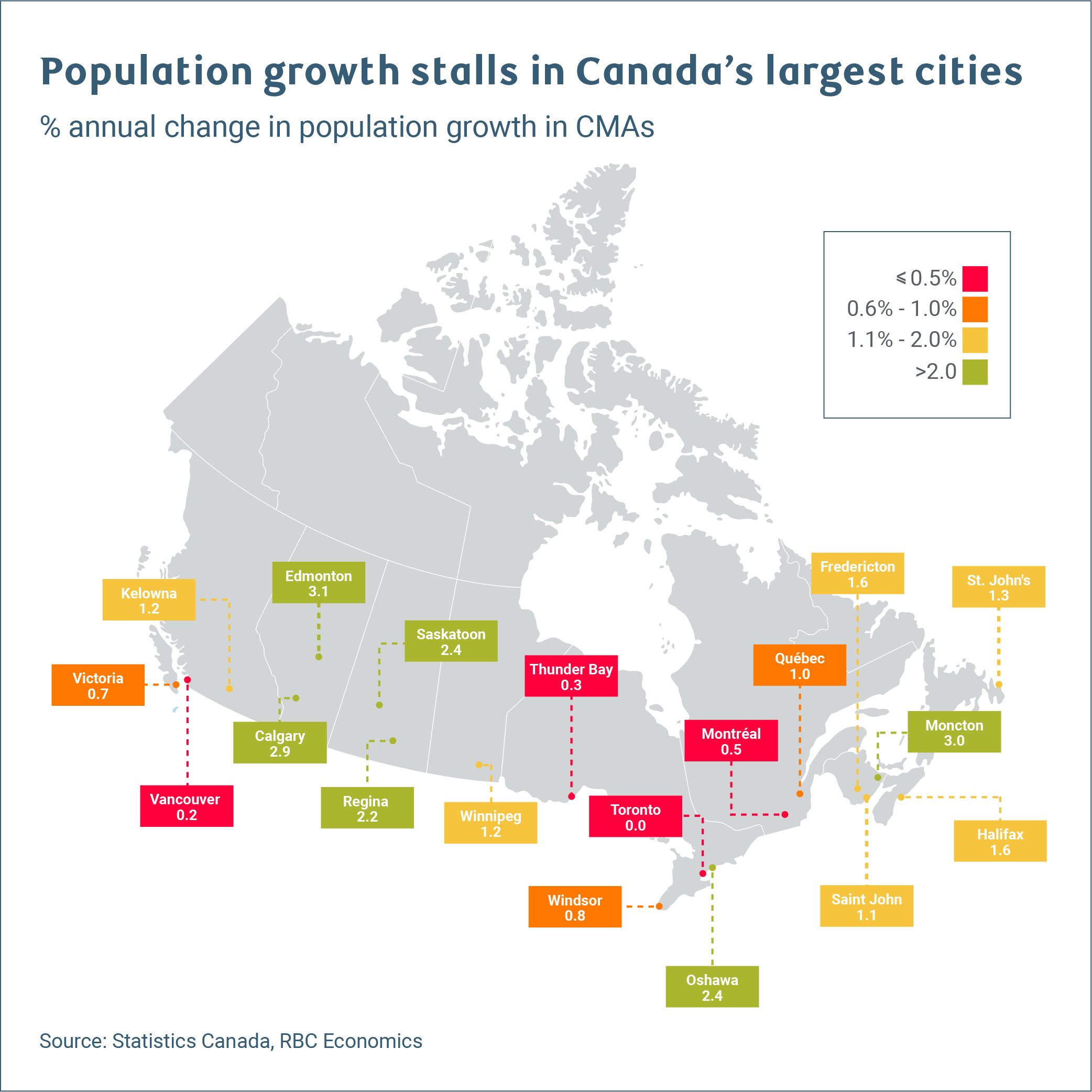
Canada’s population growth slowdown is not uniformly distributed. The deceleration is most acute in markets that anchor immigration inflows, creating fragmentation across regions.
As primary destinations for newcomers, Toronto and Vancouver are now among the slowest growing cities. Toronto posted no population growth in 2025, while Vancouver grew by just 0.2%—the slowest rates among CMAs aside from Kamloops, where the population shrunk.
This stagnation also reflects outflows of residents from those cities to other jurisdictions. Toronto saw a net departure of nearly 80,000 residents in 2025 to smaller Canadian cities, while Vancouver lost nearly 21,000. Poor affordability of both owned and rental housing in these markets likely plays a central role in these outflows. Toronto and Vancouver are two of Canada’s most expensive rental markets, with average two-bedroom rents of $2,046 and $2,363 respectively—$500 and $800 above the national average.
We expect these outflows to persist in the near-term, likely shrinking the population of Toronto and Vancouver in 2026. This would further pressure rents in these historically hot markets.
Markets in the surrounding Greater Toronto and Greater Vancouver Area will experience some offset as residents decamp from large urban centres for smaller and more affordable cities nearby. But many of these markets also face net outflows to other provinces, limiting the upside to rental demand in the broader regions.
Montreal also recorded a significant loss (nearly 29,000 on net interprovincially and within Quebec). Still, population growth is slowing less sharply than in Toronto and Vancouver, limiting the impact on rental vacancies, alongside a stronger labour market.
In contrast, Prairie markets—especially Edmonton, and Calgary—continue to benefit from strong levels of interprovincial migration along with Maritime city Moncton. We see this sustaining stronger rental demand, though conditions are expected to loosen further here as well.
Rental construction pipeline holding up better than ownership
Supply dynamics are playing an equally important role in shaping Canada’s rental market.
Rental construction boomed in recent years, fuelled by quickly rising rents and government incentives, that encouraged development across the country. This is particularly true for Toronto and surrounding areas such as Hamilton, St. Catharines, and further out to Thunder Bay and Ottawa.
For now, the rental construction pipeline remains strong—particularly compared to the ownership market, where depressed pre-construction sales in Toronto, Vancouver, and other markets will lower housing starts in the period ahead.
That said, sustaining this pace of construction beyond 2026—and perhaps 2027—may prove difficult in some markets.
For one, developers need rent to stay above minimum levels to justify new projects. If rents moderate too sharply, it may dampen their appetite for additional rental projects without added incentives—like reduced development charges, preferential tax treatment, relaxed design requirements or faster project approvals.
And second, there will eventually be more competition for resources from new low-rise and condo projects once demand for owned homes picks up, raising the bar for launching purpose-built rental projects.
Recent policy announcements to stimulate pre-construction sales of owned homes could potentially accelerate the timing of this shift in Ontario and other parts of the country.
A full view of rental conditions requires looking at the entire rental stock. This includes both primary and secondary markets.
Primary rental market refers to purpose-built rental housing. That is, residential structures designed and constructed specifically for rental occupancy. These are owned and operated by professional landlords or rental companies.
Secondary rental market includes investor-owned residential units. These were not built with rental as the primary intent but are leased out to generate income. In markets like Toronto and Vancouver, investor-owned condos have historically supplied a significant portion of the rental stock. Vacancy rates suggest supply-demand conditions are much tighter in this segment than the primary rental market, with just 1.3% of units sitting vacant in 2025—well below the 2.9% vacancy rate reported on the primary market.
A rent correction is underway, but is unlikely to last long-term
Canada’s rental market is experiencing a period of adjustment after years of unsustainable rent growth.
The rental stock experienced a much-needed expansion in recent years, but not to the point of excess. Rental vacancy rates remain tight in several markets despite the increase in new units—with few markets seeing vacancies significantly higher than 3%.
Though current headwinds will continue pulling vacancies higher in most markets near-term, we don’t see the rental correction extending far out into the future.
Importantly, population growth should reaccelerate by 2028 once Canada’s immigration policy has recalibrated, bolstering demand for rental housing. We see this contributing to stabilizing rents across most markets.
About the author:
Rachel Battaglia is an Economist at RBC, providing forecasts for the Canadian provincial economies and analyzing key trends in housing and consumer spending.
- Based on CMHC data for average rent paid by tenants in privately initiated apartment structures of three units and over across Canada’s urban centres with populations over 10,000. ↩︎
This article is intended as general information only and is not to be relied upon as constituting legal, financial or other professional advice. The reader is solely liable for any use of the information contained in this document and Royal Bank of Canada (“RBC”) nor any of its affiliates nor any of their respective directors, officers, employees or agents shall be held responsible for any direct or indirect damages arising from the use of this document by the reader. A professional advisor should be consulted regarding your specific situation. Information presented is believed to be factual and up-to-date but we do not guarantee its accuracy and it should not be regarded as a complete analysis of the subjects discussed. All expressions of opinion reflect the judgment of the authors as of the date of publication and are subject to change. No endorsement of any third parties or their advice, opinions, information, products or services is expressly given or implied by Royal Bank of Canada or any of its affiliates.
This document may contain forward-looking statements within the meaning of certain securities laws, which are subject to RBC’s caution regarding forward-looking statements. ESG (including climate) metrics, data and other information contained on this website are or may be based on assumptions, estimates and judgements. For cautionary statements relating to the information on this website, refer to the “Caution regarding forward-looking statements” and the “Important notice regarding this document” sections in our latest climate report or sustainability report, available at: https://www.rbc.com/community-social-impact/reporting-performance/index.html. Except as required by law, none of RBC nor any of its affiliates undertake to update any information in this document.

