

 EN
EN 


-
Government plans to keep a lid on program spending growth this year and in the next four.
-
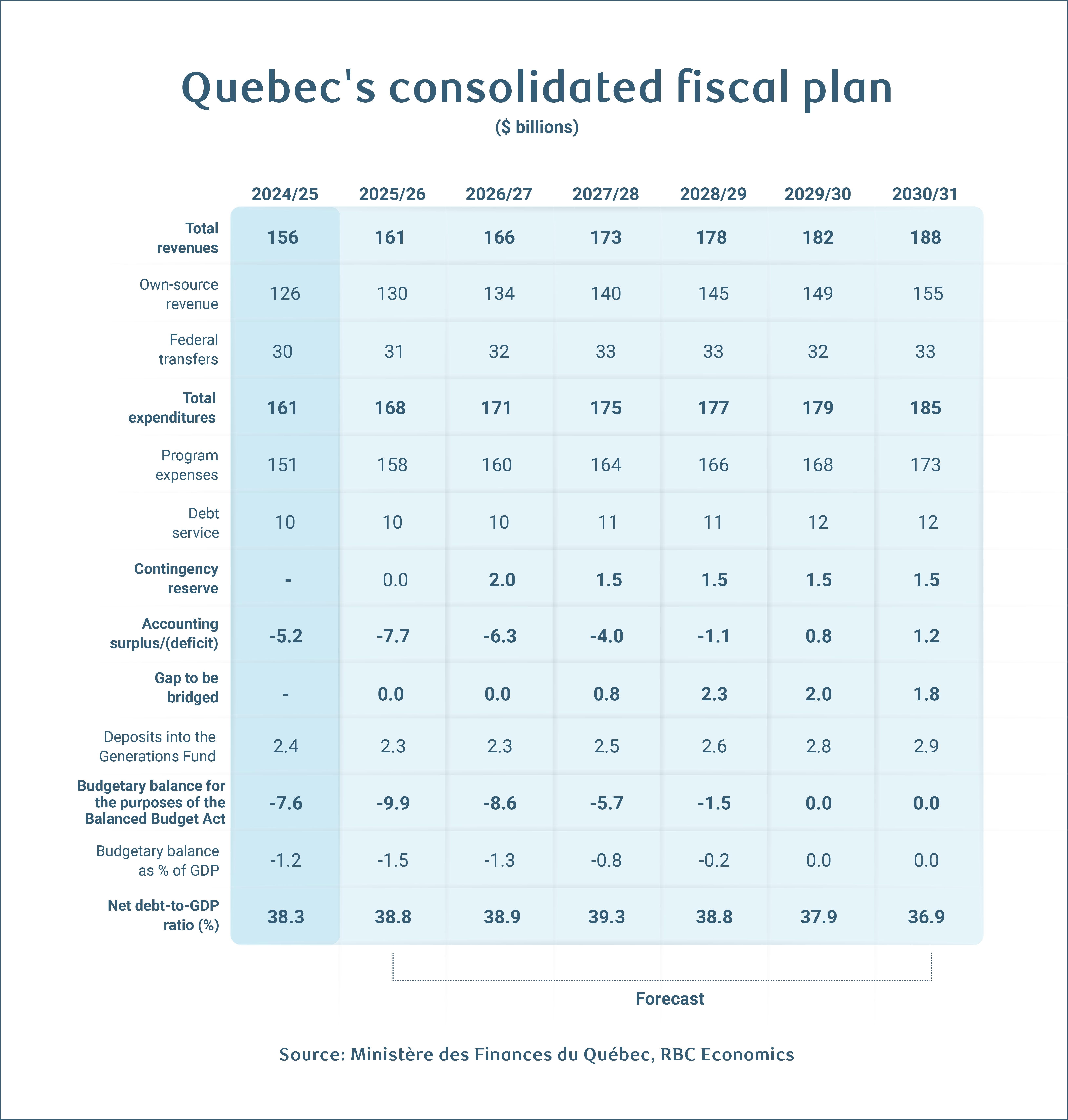
This will help reduce deficit projections slightly from $9.9 billion (1.5% of GDP) in 2025-26 to $8.6 billion (1.3% of GDP) in 2026-27 after deposits to the Generations Fund.
-
Budget balance is still expected by 2029-30 (as legally required) though $5 billion in new revenue or savings still need to be found.
-
The province’s debt load is now projected to largely stabilize in the next three years before easing gradually thereafter.
-
Overall, this is a budget that stresses restraint and commitment to fiscal sustainability.
Not your ordinary election budget
Budget 2026 comes at an interesting time. It’s being released just six months before a general provincial election and less than a month before a new Coalition Avenir Québec leader (and premier) takes over from Premier François Legault who will resign in April. It’s also coming out just weeks after a new external economic shock (soaring oil prices) threatens a fragile provincial economy.
Yet, Quebec Finance Minister Éric Girard resisted handing out pre-election goodies—recall his government earlier sent $500 cheques to 6.4 million Quebecers as part of Budget 2022 just before the last provincial election.
This time he focused on further course-correcting the provincial fiscal plan which had previously slipped amid soaring program costs and tax cuts designed to cushion higher cost of living.
A lighter touch on new measures
Budget 2026 does include several new measures, though at a total of $9.6 billion over six years these are relatively light from a cost perspective. Budget 2025, by comparison, added $12 billion to expenditures over five years.
The new measures fall under three umbrellas:
-
Speeding up Quebec’s economic transformation ($1.7 billion over five years)
-
Adding support to the government’s primary missions ($4.3 billion)
-
Helping Quebecers and communities ($3.6 billion)
To help businesses adapt to a more challenging economic environment, the government will inject $410 million over five years to support investment in promising sectors and $283 million to promote innovation and improve competitiveness. It will also support small and medium size businesses—including those in the forestry sector—to the tune of $581 million.
Healthcare and social services ($2 billion over five years) will receive the lion’s share of new spending on the government’s primary missions. Education is getting an additional $639 million, and justice and public safety $1.1 billion.
Finally, Budget 2026 offers a series of measures to help Quebecers deal with higher cost of living (including daycare), fight homelessness, improve access housing and help the most vulnerable that total $2.4 billion over five years. There’s also an additional $1 billion toward supporting communities. This includes funding to maintain local infrastructures and support climate-resilience investment.
These measures are generally targeted and front-loaded—impacting primarily the first two years of the fiscal plan.
Slow expenditure growth…
Overall, the government’s five-year expenditures profile shows restraint, growing at an average rate of 2.0% (or roughly zero on inflation-adjusted terms). That’s despite debt service costs increasing at close to 4% per year over that period.
For 2026-27, program expenditures are even forecast to grow just 1.6%, which would be the slowest rate since 2015-16 when the province was in the midst of difficult budget austerity.
…and comparatively faster-tracking revenues…
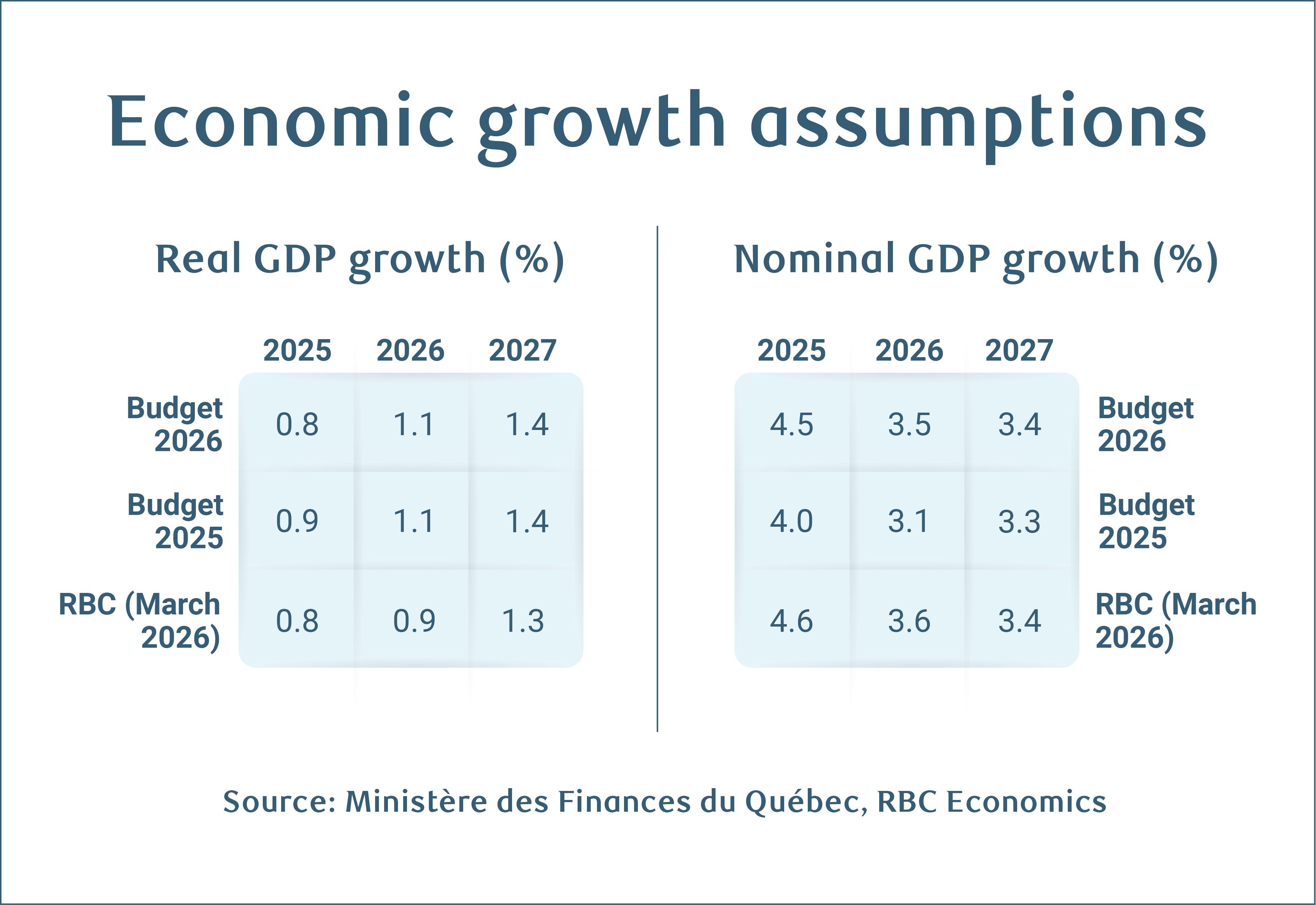
Meanwhile, the government is counting on sustained—albeit slowing—nominal economic growth and increased federal transfers to drive up total revenues by 3.7% in 2026-27, and an average of 3.2% over the next five years.
…will shrink the deficit
These revenue and expenditure trajectories will result in the government deficit shrinking from a downwardly revised $9.9 billion in 2025-26 (from $12.4 billion in the fall update) to $8.6 billion in 2026-27 and $5.7 billion in 2027-28 after deposits to the Generations Fund.
The government remains on track to balancing its books by 2029-30, as required by law.
Debt load to stabilize at improved levels
A slightly lower deficit profile in the next two years and upwardly revised nominal economic growth assumptions will help stabilize the province’s debt load.
Budget 2026 projects Quebec’s net debt-to-GDP ratio to remain little changed in the next three years, edging marginally higher from 38.8% at the end of 2025-26 to 38.9% in 2026-27 and 39.3% in 2027-28 before easing through the remainder of the fiscal plan to a terminal value of 36.9%.
This profile is an improvement from the previous profile which peaked at a higher 41.3% in 2027-28 before ending at a 39.3% terminal value.
Budget 2026 therefore places Quebec closer to its fiscal anchors of 35.5% by 2032-33 and 32.5% by 2037-38 for its net debt-to-GDP ratio.
Executing the plan will take resolve
Having an almost complete plan to return to balance and stabilize its indebtedness to a more sustainable level puts Quebec ahead of many other provinces that are still figuring out their course of action. Part of it is because Quebec has been confronted with fiscal issues—including a heavy debt load—for a long time.
But having a plan and executing it are two very different things. Carrying out significant spending restraint year after year is especially hard and will take resolve.
And, with elections around the corner, it’s uncertain whether Minister Girard and his government will in fact be the ones holding the purse strings come next budget.
About the author:
Robert Hogue is the Assistant Chief Economist responsible for providing analysis and forecasts on the Canadian housing market and provincial economies.
This article is intended as general information only and is not to be relied upon as constituting legal, financial or other professional advice. The reader is solely liable for any use of the information contained in this document and Royal Bank of Canada (“RBC”) nor any of its affiliates nor any of their respective directors, officers, employees or agents shall be held responsible for any direct or indirect damages arising from the use of this document by the reader. A professional advisor should be consulted regarding your specific situation. Information presented is believed to be factual and up-to-date but we do not guarantee its accuracy and it should not be regarded as a complete analysis of the subjects discussed. All expressions of opinion reflect the judgment of the authors as of the date of publication and are subject to change. No endorsement of any third parties or their advice, opinions, information, products or services is expressly given or implied by Royal Bank of Canada or any of its affiliates.
This document may contain forward-looking statements within the meaning of certain securities laws, which are subject to RBC’s caution regarding forward-looking statements. ESG (including climate) metrics, data and other information contained on this website are or may be based on assumptions, estimates and judgements. For cautionary statements relating to the information on this website, refer to the “Caution regarding forward-looking statements” and the “Important notice regarding this document” sections in our latest climate report or sustainability report, available at: https://www.rbc.com/community-social-impact/reporting-performance/index.html. Except as required by law, none of RBC nor any of its affiliates undertake to update any information in this document.

