

 EN
EN 


-
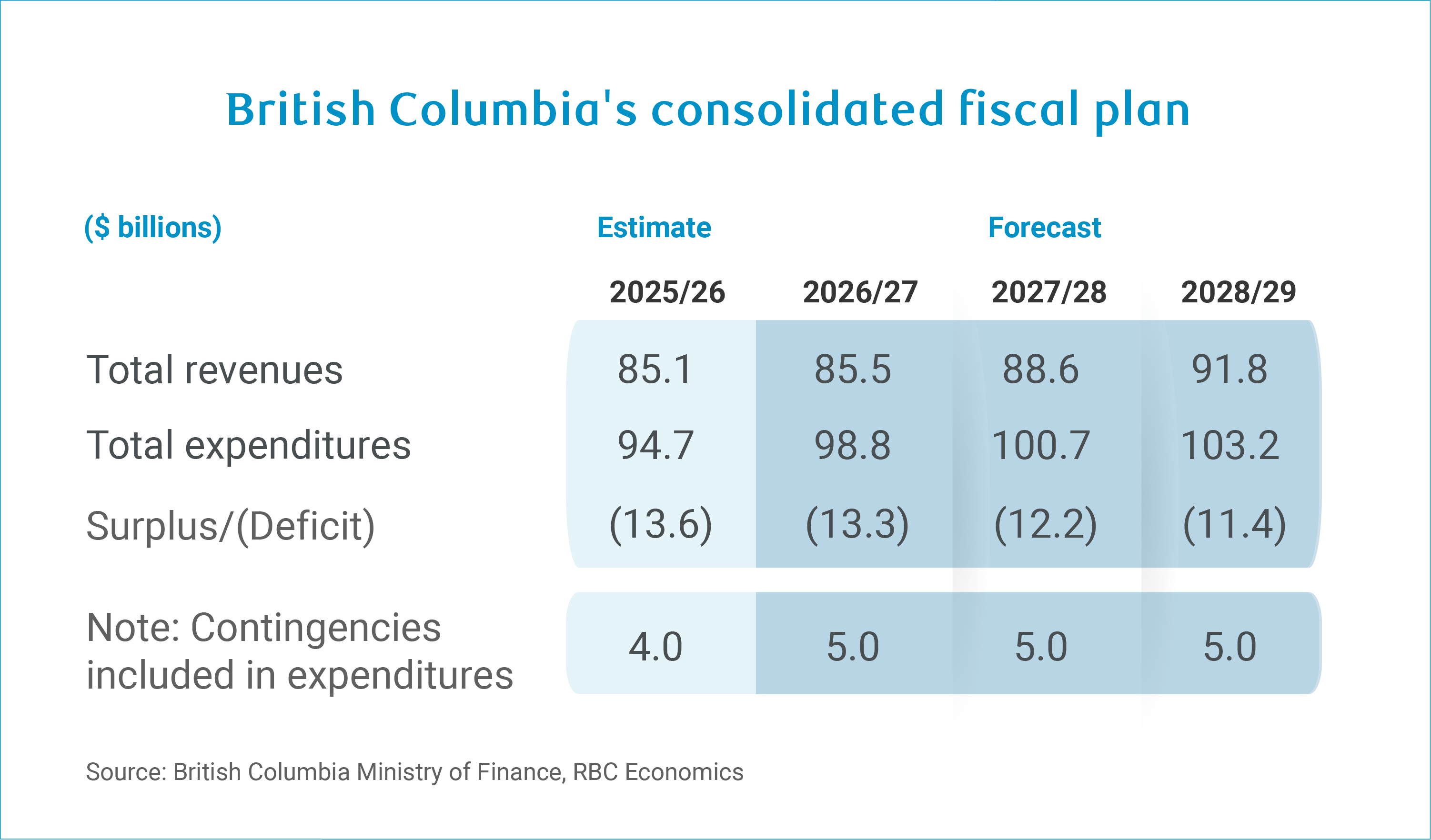
The B.C. government slightly lowered its 2025-26 deficit projection – to $9.6 billion from $10.9 billion in last year’s budget and $11.2 billion in its most recent fiscal update – but charted a higher deficit track for 2026-27 and outer years of the fiscal plan.
-
While the deficit will trend down after 2026-27, there is no path to balance.
-
The debt-to-GDP ratio rises across the forecast, which puts it on track to change B.C’s debt advantage relative to other provinces.
-
New spending continues to skew heavily toward health and other social services, adding to already strong growth from recent years. Additional savings from the expenditure review and public service staffing cuts offset some of these costs.
-
The deficit track would be higher if not for personal income tax increases and other tax measures, while the debt track would be higher were not for pushing out some previously-planned capital spending
B.C.’s budget 2026 faced a tough task: to rein in deficits which have shot up in recent years amid high social spending and constrained revenue growth. The importance was underscored by credit rating downgrades from two major rating agencies following last year’s budget. Yet, the province does not face a benign economic environment. Budget 2026 achieves only minimal headway, with structural pressures remaining that will leave stabilizing B.C’s fiscal situation a task to another day.
B.C. faces fiscal tall order amid economic headwinds
Amid the challenging external environment, a key task for all Canadian governments is to try to shift spending to more investment-focused activities that promote long-term growth and export diversification, despite potentially needing to support tariff-affected sectors today. This is particularly challenging for provinces, where health care represents 40%+ of provincial spending and the stall in population growth is setting the country abruptly back on an ageing trend.
As the first province out of the gate in the 2026 budget round, B.C shows the difficulty of this task, not least because of its already high deficits and some acute economic headwinds. While ongoing trade turmoil with the U.S. is less severe than some other provinces, tariff headwinds in lumber and aluminum will slow growth. Meanwhile, the prospect of negative population growth in 2026 from drastically reduced federal immigration targets and very slow activity in the B.C housing sector will also be growth drags.
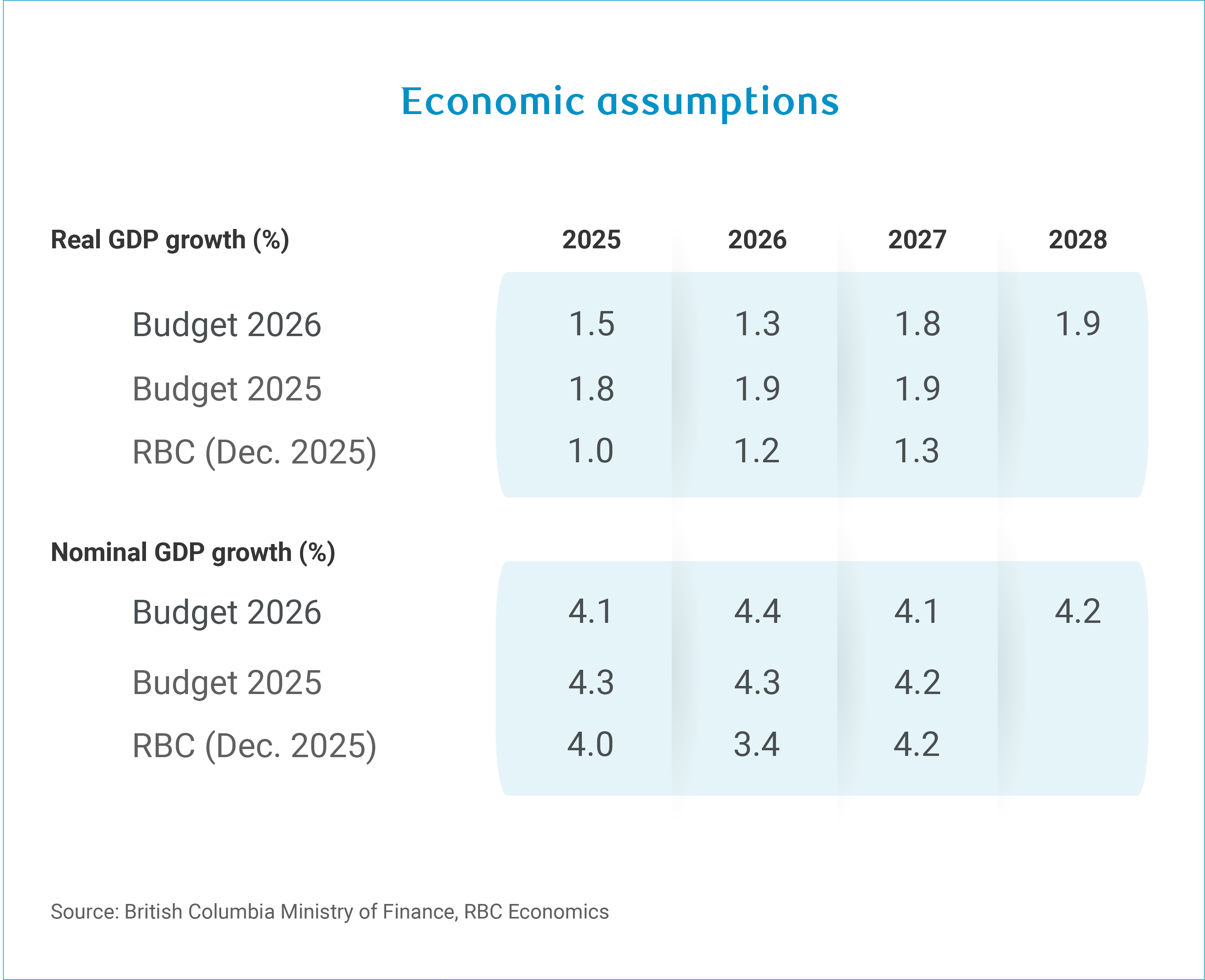
While the Budget did not include significant changes in the forecast for nominal GDP growth, these headwinds will limit potential growth in the tax base.
New spending skews toward social services
Health and other social spending continue to grow in budget 2026 after sizeable increases in recent years, while spending review and public servant staffing cuts help to partially offset the fiscal impact. New spending measures include:
Social Spending
-
$2.8 billion for a wide range of health-care services
-
$634 million for K-12 education, with funding for additional teachers, classroom supports, and teacher psychologists and counsellors
-
$330 million to reduce childcare fees
-
$475 million for social services supporting children and youth
-
$139 million for community safety supports
Investment-focused spending
-
$283 million to achieve a target to attract $200 billion in new private sector investments over the next decade, 85% of which is dedicated to trades training. The balance strengthens permitting capacity across the resources and tourism sectors.
-
$400 million B.C. Strategic Investments Special Account to co-invest with the federal government in projects “to secure Canada’s sovereignty”
-
Temporary manufacturing and processing investment tax credit, and aligning BC research tax credit with recent federal changes
Contingencies of $4 billion in 2025-26 and $5 billion in 2026-27 and outer years have been included to address potential spending pressures, including for wage increases for BC’s public employees given the new round of collective bargaining that began in 2025-26.
Finally, some of this new spending is offset by government operations savings. Last year’s budget launched a government efficiency review and efforts to reduce the size of the public service, which had grown briskly in recent years. Additional savings from the expenditure review and a new commitment to reduce public service positions by 15,000 over 3 years look to deliver around $5 billion in incremental savings over 3 years versus budget 2025.
New revenue measures raise taxes on individuals
Budget 2026’s deficit path would be higher if not for revenue-raising measures. While the personal tax measures appear calibrated to avoid being regressive and they are not significant increases, they add to already high Canadian taxation rates at time of heightened competition for international investment and talent. Overall, revenues grow 8% over the forecast period, but are outpaced by expenditures growing at 9%.
Key revenue raising measures over 2026-27 to 2028-29 include:
-
The bottom tax bracket is raised from 5.06% to 5.60%. It will raise $1.1 billion when combined with an increase in the B.C. tax reduction credit which will lead to 40% of taxpayers seeing net savings.
-
Pausing of tax bracket indexation from 2027 to 2030 will raise $1.0 billion.
-
Expanding B.C.’s PST tax base will raise $1.5 billion
-
Increasing School Tax rates for property values above $3 million will raise $787 million.
No path to balance and no stabilization in debt-to-GDP ratio
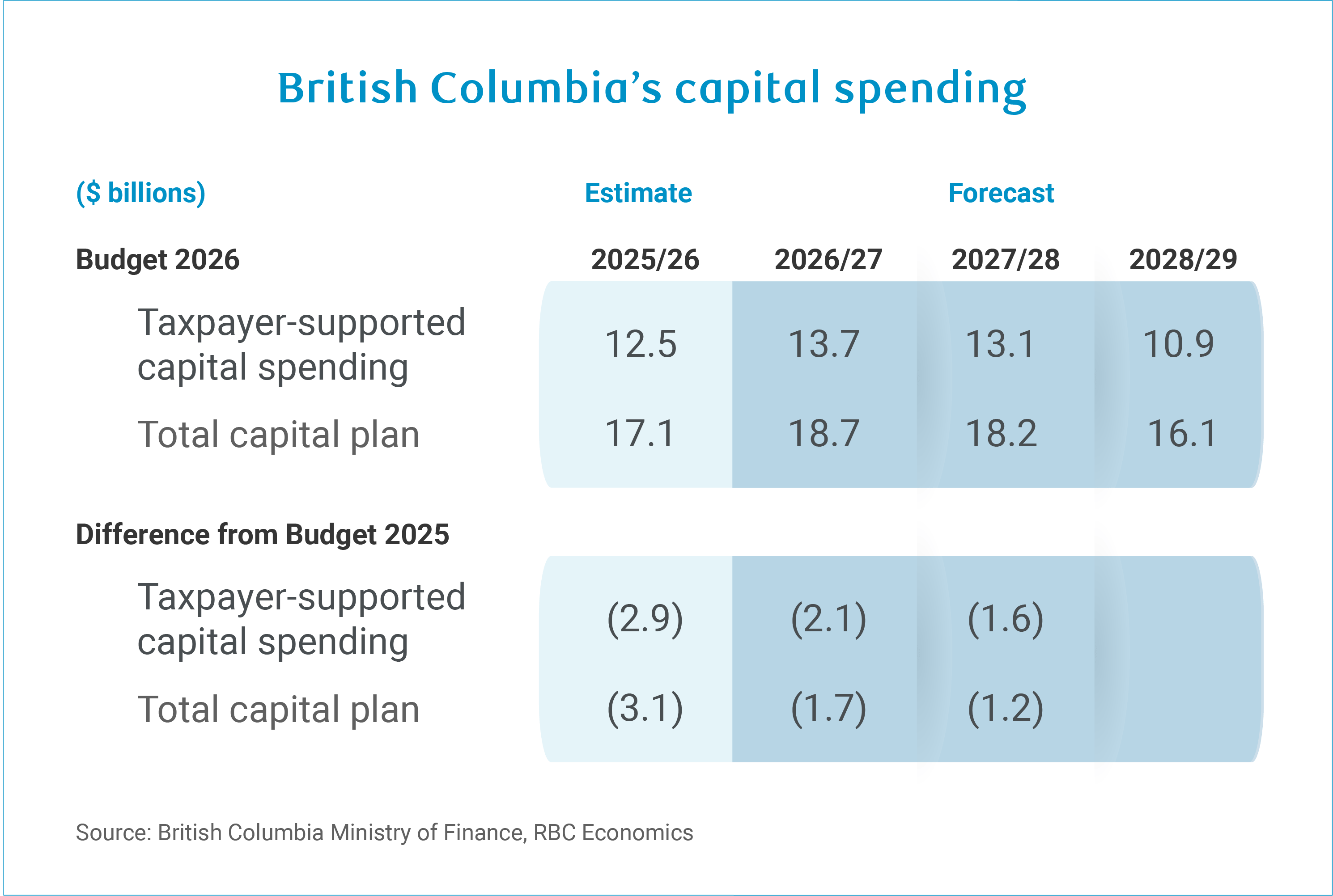
Budget 2026 plots declining deficits after 2026-27, but these deficits remain elevated and there is no path to balance proposed. B.C’s debt-to-GDP ratio will also continue to trend upwards over the entire forecast period. While the changes are not significant relative to last year’s budget, they do nothing to stall the projected dramatic increase in taxpayer-supported debt, given a string of sizeable deficits and ambitious capital spending plans.
B.C. debt burden has typically been better than some other big provinces. For example, in 2024-25, B.C.s debt-to-GDP sat at 23.2% versus 36.2% for Ontario and 38.3% for Quebec. While these provinces are expected to see increases in their debt-to-GDP ratios over the next few years, B.C.’s budget 2026 shows it will nearly catchup, with its debt-to-GDP in 2028-29 expected to be 37.4%.
Budget 2026’s projected debt-to-GDP ratio would have been higher, except the government opted to reprofile some capital spending. This was also done to mitigate construction cost escalation. Based on the budget backgrounders, it appears to affect the timing of the delivery of long-term care projects and housing.
About the Author
Cynthia Leach is the Assistant Chief Economist at RBC covering the team’s structural economic and policy analysis. She joined in 2020.
This article is intended as general information only and is not to be relied upon as constituting legal, financial or other professional advice. The reader is solely liable for any use of the information contained in this document and Royal Bank of Canada (“RBC”) nor any of its affiliates nor any of their respective directors, officers, employees or agents shall be held responsible for any direct or indirect damages arising from the use of this document by the reader. A professional advisor should be consulted regarding your specific situation. Information presented is believed to be factual and up-to-date but we do not guarantee its accuracy and it should not be regarded as a complete analysis of the subjects discussed. All expressions of opinion reflect the judgment of the authors as of the date of publication and are subject to change. No endorsement of any third parties or their advice, opinions, information, products or services is expressly given or implied by Royal Bank of Canada or any of its affiliates.
This document may contain forward-looking statements within the meaning of certain securities laws, which are subject to RBC’s caution regarding forward-looking statements. ESG (including climate) metrics, data and other information contained on this website are or may be based on assumptions, estimates and judgements. For cautionary statements relating to the information on this website, refer to the “Caution regarding forward-looking statements” and the “Important notice regarding this document” sections in our latest climate report or sustainability report, available at: https://www.rbc.com/community-social-impact/reporting-performance/index.html. Except as required by law, none of RBC nor any of its affiliates undertake to update any information in this document.

