

 EN
EN 

Also in this edition: CUSMA’s non-negotiables and a back-and-forth on provincial booze bans
Taking things to the next level
The future of Canada-EU economic ties lies in industrial policy
-
As Canada diversifies its trading relationships beyond the U.S., the European Union has emerged as a priority partner.
-
Increased diplomatic engagement has some even floating the idea of Canada joining the bloc.
-
While that’s unlikely for several reasons, what is relevant and actionable is the growing alignment between Canada and Europe on industrial policy, particularly in sectors where governments are directing capital, shaping supply chains, and setting the terms of competition.
From market access to industrial access
For the past decade, the Canada-EU relationship has been defined by the Comprehensive Economic and Trade Agreement (CETA) signed in 2016. Trade has grown materially in that time, but the agreement has not been frictionless in practice:
-
Ratification remains incomplete and the agreement is yet to come into full effect, with several EU member states still yet to approve its investment chapter.
-
Regulatory barriers persist, particularly in agriculture, where Canadian exporters face constraints tied to EU sanitary rules, pesticide thresholds, and product standards.
-
However, its provisional application has seen bilateral merchandise trade increase by over 77% from 2016 to $134 billion in 2025.
-
Now, across clean energy, advanced manufacturing, and defence, both Canada and the EU are directing public financing and procurement towards building domestic capacity and securing supply chains. That shift is changing how bilateral market access will be determined.
How access is being redefined
-
The European Green Deal is directing capital into batteries, hydrogen, and industrial decarbonization, to concentrate production within the EU.
-
The proposed “Made in Europe” Industrial Accelerator Act would tie access to subsidies and public procurement in strategic sectors to EU-based production or partner-country based reciprocity.
-
This week, Industry Minister Mélanie Joly said Canada will pursue negotiations with Brussels to gain access to the “Made in Europe” program with a reciprocal approach that aligned on industrial policy.
Defence is leading Canada-EU industrial collaboration
-
Canada’s participation in the EU’s Security Action for Europe (SAFE) program provides the clearest example yet of how this shift is taking shape.
-
SAFE will provide up to $244 billion in loans to EU member states to support defence projects and in December, Canada became the only non-member state to gain preferential access to the program.
In practice, that means:
-
Canadian firms can bid into EU-funded defence contracts on the same footing as European suppliers, competing directly for contracts rather than relying on subcontracting or local intermediaries.
-
Up to 80% of Canadian content is permitted in contracts, versus the 35% for other third countries, materially increasing the ability for Canadian manufacturing, engineering, and supply chains to anchor work domestically while still qualifying for EU procurement contracts.
-
Canada will provide an upfront €10 million contribution, and a 15% participation fee will apply to the value of Canadian content in contracts where European content makes up less than 65% of the value.
What to watch
-
Whether Canada secures entry into “Made in Europe”: the government has opened the door, but EU openness to participation will require significant negotiation. The key question is whether Canada can convert political alignment into formal access across multiple sectors, not just defence, to participate in subsidy-backed projects.
-
How SAFE translates from access to contracts: preferential terms are in place, but the signal to watch will be contract awards. Whether Canadian firms can secure meaningful roles in SAFE-funded projects and scale their exports across the continent, will define the scale and longevity of this partnership.
-
The evolution of CETA: key sticking points remain for exporters, the agreement is only provisionally applied, regulatory alignment will be difficult to achieve, and negotiations are underway to reach an agreement on digital trade.
Taken together, these will determine whether Canada moves from being a preferred partner to a structural participant in Europe’s buildout and capitalize in trade on the hundreds of billions the EU is deploying through its industrial policies.
–Thomas Ashcroft, Global Policy Issues Lead
Look what’s trending
-
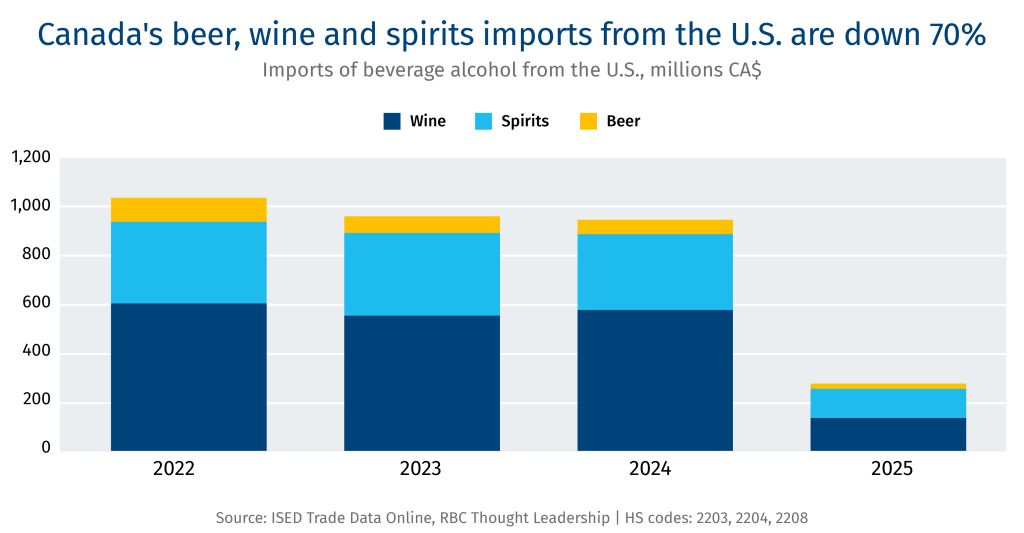
Provincial bans on U.S. liquor could be resolved “quickly” said Mark Carney. That is, the Prime Minister said, if the U.S. takes steps on the tariffs imposed on Canadian steel, aluminum and autos—as well as Canadian forest products: “Those are more than irritants,” said Carney. “Those are violations of our trade deal.” The comments came a day after U.S. Trade Representative Jamieson Greer threatened “enforcement action” in response to Canadian provinces, including Ontario, B.C. and Quebec, keeping U.S liquor off store shelves.
-
Ottawa said it won’t back down on dairy supply management in trade talks. Dominic LeBlanc,the Minister responsible for Canada-U.S. Trade, also said Canada won’t give in to U.S. demands on French-language labelling rules when CUSMA negotiations begin later this year. Both of those issues, as well as Canada’s Online Streaming Act and its Buy Canadian policies, have been criticized by the Trump Administration. On whether tariffs of some kind will remain in place even if a deal is struck, LeBlanc said “we should be realistic–they have not taken anybody to zero.”
-
Trump administration to begin refunding US$166 billion of tariffs—plus interest. Two months after the Supreme Court struck down the “Liberation Day” tariffs, the U.S. government began accepting requests for refunds this week. The government had to build a new processing system for the 330,000 importers who paid International Emergency Economic Powers Act (IEEPA) duties.
This article is intended as general information only and is not to be relied upon as constituting legal, financial or other professional advice. The reader is solely liable for any use of the information contained in this document and Royal Bank of Canada (“RBC”) nor any of its affiliates nor any of their respective directors, officers, employees or agents shall be held responsible for any direct or indirect damages arising from the use of this document by the reader. A professional advisor should be consulted regarding your specific situation. Information presented is believed to be factual and up-to-date but we do not guarantee its accuracy and it should not be regarded as a complete analysis of the subjects discussed. All expressions of opinion reflect the judgment of the authors as of the date of publication and are subject to change. No endorsement of any third parties or their advice, opinions, information, products or services is expressly given or implied by Royal Bank of Canada or any of its affiliates.
This document may contain forward-looking statements within the meaning of certain securities laws, which are subject to RBC’s caution regarding forward-looking statements. ESG (including climate) metrics, data and other information contained on this website are or may be based on assumptions, estimates and judgements. For cautionary statements relating to the information on this website, refer to the “Caution regarding forward-looking statements” and the “Important notice regarding this document” sections in our latest climate report or sustainability report, available at: https://www.rbc.com/our-impact/sustainability-reporting/index.html. Except as required by law, none of RBC nor any of its affiliates undertake to update any information in this document.