

 EN
EN 

➔ How’s Canada doing on fighting climate change? It’s complicated
➔ Is the world falling out of love with Teslas?
➔ Canada’s methane rules get pragmatic
Hot takes
➔ Can the IPCC survive its breakup with Washington? The UN-backed Intergovernmental Panel for Climate Change is in a “keep calm-and carry-on” mode after the U.S. decided to pull out, noting that it continues to work on its next cycle of reports, starting in 2027. The IPCC reports are extremely influential, and many countries benchmark themselves to its authoritative data. It’s critical for IPCC to persist, but one of the criticisms of the body is its focus on the science and the tech, that underplays the economics and politics of energy transition. While the White House labelled the IPCC (and the 65 other UN organizations the U.S. exited) as a “waste” of American taxpayer money, others argue that the IPCC has been instrumental in focusing global policymakers on one of the world’s most critical challenges. Science, they hope, will prevail.
➔ New methane rules mark a pragmatic evolution in Canadian climate policy. The new rules—covering onshore oil and gas operations and large landfills with requirements beginning in 2028—pair high ambition with greater regulatory flexibility. The most consequential change is optionality, says Vivan Sorab, our Clean Tech Lead. Government estimates suggest that the new rules could deliver cumulative reductions of 304 Mt CO2e from 2028 to 2040. Operators can follow a regulator-prescribed inspection pathway, subject to regulatory verification and enforcement, or demonstrate compliance through their own processes, backed by monitoring and verification. The removal of the five-year expiry on federal-provincial equivalency agreements further strengthens the framework by improving long-term certainty for provinces and the industry. The rules are reinforced by a $16-million federal investment in methane monitoring and verification tech. Given ongoing uncertainty on methane emission volumes, the focus on measurement could prove to be crucial.
➔ Is the world moving past Elon Musk’s Tesla? It’s hard to say whether the billionaire’s politics put off many, but it could certainly be a factor. Globally, EV cars sales hit a record 21.7 million last year, Bloomberg New Energy Finance estimates, even as Tesla sales contracted 9% to 1.64 million. BNEF forecast 24.3 million EV car sales in 2026—a slower pace of growth than previous years—as falling government incentives are offset by falling battery prices, a bump in commercial vehicle sales and the slow ramp up of robotaxis.
What it takes to write a climate action report
Behind the scenes, the Climate Action Institute team spent the past six months on what’s emerging as a benchmark of Canadian climate action: our Climate Action report, now in its third year.
While there’s been some retreat on climate policies, there’s plenty of action too, on climate. Our report title, Retreat, reset or renew?, suggests it’s all of the above.
The report is based on calculations, aggregations and estimates using a variety of measures from across the economy and society. We selected those metrics to help paint a picture of where we’re at, how far we’ve come and some of the distance ahead. The report, and its measurement tools, are not designed to be a precise diagnostic of any one sector, policy or technology—it’s more like a mirror in which we can see Canada’s successes and shortcomings.
The report was also informed by our team attending over 100 events, and visiting farms, facilities and offices, cross-country, where we listened, spoke and compared notes with peers, experts and skeptics. Over 2,000 Canadian consumers and 150 business executives participated in our two annual surveys. Peer groups dove into the methodologies and several external experts stress-tested our analysis. For our case studies, several companies agreed to heart-to-hearts on the challenges of putting their boardroom promises into action on their factory or office floor. The result is a snapshot of Canada’s climate journey: some milestones achieved, a few dead-ends, and strapping up for the next curve round the bend.
Read the full report here, but here’s a peek at a handful of findings:
-
Emissions progress is mixed: National emissions are down 7% since 2019, with reductions in electricity (-27%), buildings (-19%), and oil/gas (-19%) sectors. However, new projects like the TMX pipeline expansion and LNG Canada Phase 1 are projected to increase oil/gas emissions.
-
There’s a strong pipeline of climate funding. Climate capital flows of around $20 billion annually continue to support the low-carbon sector.
-
…And there’s more on the way. Nearly $100 billion worth of incentives for clean-tech and climate programs and initiatives budgeted for deployment between now and 2035—although funding remains uncertain given policy shifts.
-
Climate Action Barometer declined: the Institute’s flagship index fell for the first time in six years amid policy uncertainty.
-
Canadians still care about climate: Cost of living issues, healthcare access and strengthening the economy were front and centre, but 33% still consider climate change as a top-three priority for policymakers.
Five insights from the frontlines of climate policy
Don’t fixate on 2030 Canada’s emissions targets. That’s the message from Environment and Climate Change Canada (ECCC) in its latest progress report on the country’s 2030 emissions reduction plan, released days before the Christmas break. Focusing on 2030 targets “at all costs” risks undermining the long-haul climate fight, the report notes. “Focusing narrowly on short‑term reductions could also divert attention from the deeper, systemic transformations needed to reach net‑zero by 2050.”
Pushing heavy industry and oil and gas—two sectors that are deeply tied to competitiveness, investment flows, and trade— could “trigger capital flight, carbon leakage, and a loss of international competitiveness, especially if compliance costs outpace those faced by peer economies.”
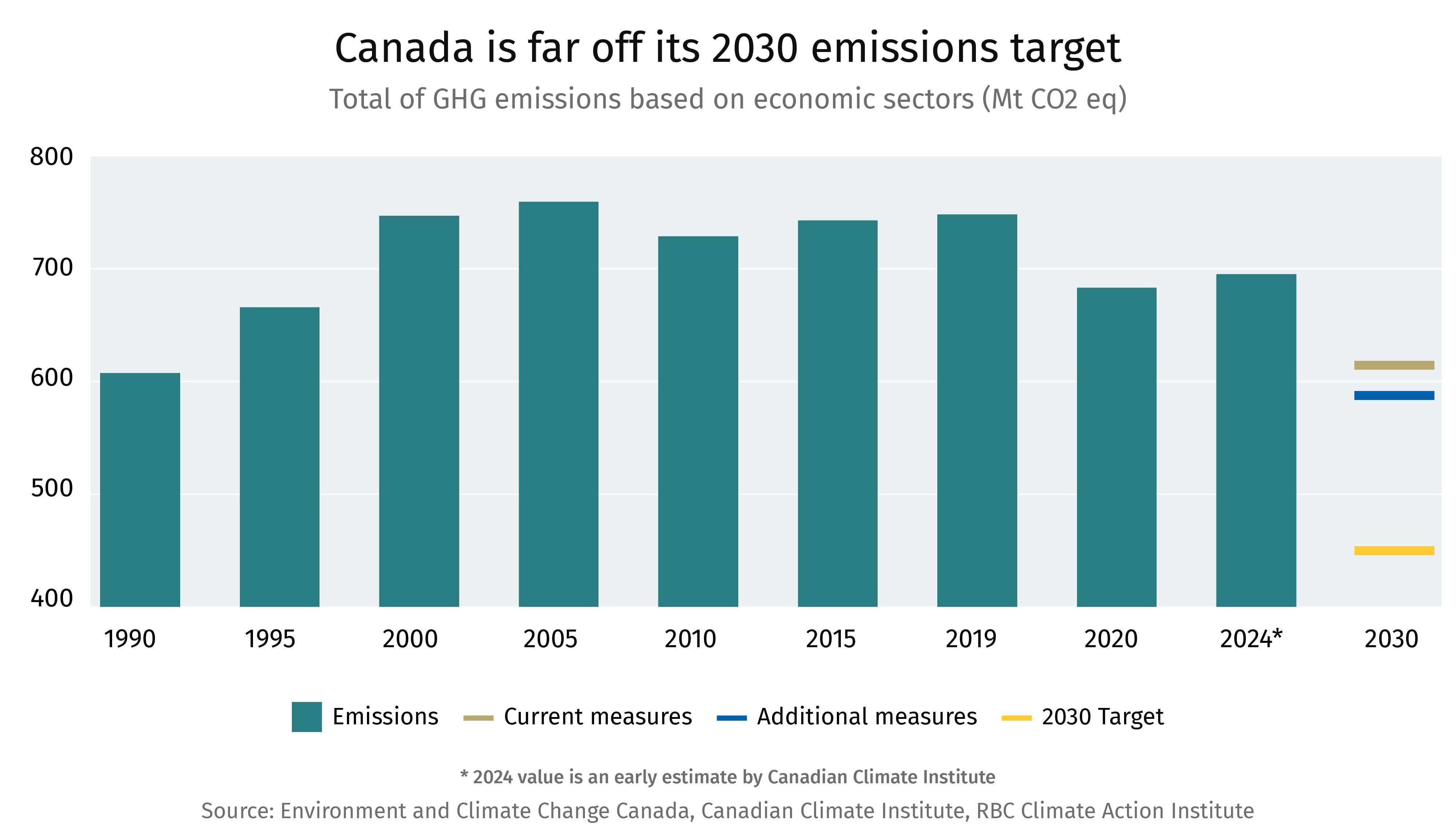
Economist Farhad Panahov pored through the data trove to glean 5 valuable insights:
-
Emission declines are impressive, given population growth. By 2023, Canada’s emissions declined 8.5% from 2005 levels. More impressively, emissions intensity was down 35% based on the economic size and 29% based on population (which has been growing at a fast clip over the past two decades).
-
We need four times the pandemic era emissions declines. Canada’s emissions would need to drop fourfold compared to the 2020-COVID-era magnitude to reach its 2030 targets.
-
Most sectors are pulling their weight. Electricity, transportation, heavy industry and buildings sectors are projected to deliver a combined 68 MtCO2e emissions reductions by 2030, through several measures including electric vehicle and heat pump adoption, fuel switching and electrification in heavy industry, and renewable technology deployment.
-
Fossil fuels are the outliers. Oil and gas sector, however, has a diverging projection, ranging from either flat to 33 MtCO2e emissions with enhanced methane regulations, hydrogen substitution, and deployment of solvent-based extraction technologies.
-
What’s going to move the needle? The controversial, and now shelved, Oil and Gas Emissions Cap (excluded from the projections) would have only added 3MtCO2e in emissions reduction. Meanwhile, agriculture practices along with nitrogen management could contribute up to 12 MtCO2e in emissions reduction.
The Institute in Action
-
John Stackhouse will be on the ground in Davos next week. Watch out for his analysis on what he saw, shared and heard at the world’s most influential forum for discussion and debate on the global economy.
-
Lisa Ashton, the Institute’s Interim Head, was the keynote speaker on how agri-food can lead a new era of economic development at the Saskatchewan Crops Forum this week.
-
Lisa also hosted a roundtable in Saskatoon with industry leaders and investors on growth capital in Canada’s agri-food sector to dive into the investment challenges that were highlighted in the Next Generation of Growth.
-
Shaz Merwat, Director of Energy Policy, is moderating a panel on Canada and B.C.’s Competitive Edge as a Global Gas and LNG Producer on Jan. 21 at the B.C. Natural Resources Forum.
On our binge list
-
The Elements of Power: A Story of War, Technology and the Dirtiest Supply Chain on Earth by Nicolas Niarchos, on what it takes to usher in the battery era.
-
TV series Landman, starring Billy Bob Thornton, that shows wildcat drilling is alive and well in Texas—often powered by wind turbines.
-
Disruptors podcast: Alberta’s Next Energy Mix. John Stackhouse speaks with Premier Danielle Smith about the future of power in Alberta.
-
Things Are Never So Bad That They Can’t Get Worse (2022), by William Neuman, on the steady collapse of Venezuela over the years.
Curated by Yadullah Hussain, Managing Editor, RBC Climate Action Institute.
Climate Crunch would not be possible without John Stackhouse, Jordan Brennan, John Intini, Farhad Panahov, Lisa Ashton, Shaz Merwat, Vivan Sorab, Caprice Biasoni, Lavanya Kaleeswaran and Joelle Schonberg .
Have a comment, commendation, or umm, criticism? Write to me here (yadullahhussain@rbc.com)
Climate Crunch Newsletter
This article is intended as general information only and is not to be relied upon as constituting legal, financial or other professional advice. The reader is solely liable for any use of the information contained in this document and Royal Bank of Canada (“RBC”) nor any of its affiliates nor any of their respective directors, officers, employees or agents shall be held responsible for any direct or indirect damages arising from the use of this document by the reader. A professional advisor should be consulted regarding your specific situation. Information presented is believed to be factual and up-to-date but we do not guarantee its accuracy and it should not be regarded as a complete analysis of the subjects discussed. All expressions of opinion reflect the judgment of the authors as of the date of publication and are subject to change. No endorsement of any third parties or their advice, opinions, information, products or services is expressly given or implied by Royal Bank of Canada or any of its affiliates.
This document may contain forward-looking statements within the meaning of certain securities laws, which are subject to RBC’s caution regarding forward-looking statements. ESG (including climate) metrics, data and other information contained on this website are or may be based on assumptions, estimates and judgements. For cautionary statements relating to the information on this website, refer to the “Caution regarding forward-looking statements” and the “Important notice regarding this document” sections in our latest climate report or sustainability report, available at: https://www.rbc.com/our-impact/sustainability-reporting/index.html. Except as required by law, none of RBC nor any of its affiliates undertake to update any information in this document.